Exhibition | William Blake in Sussex: Visions of Albion
From the National Trust:
William Blake in Sussex: Visions of Albion
Petworth, Sussex, 13 January — 25 March 2018
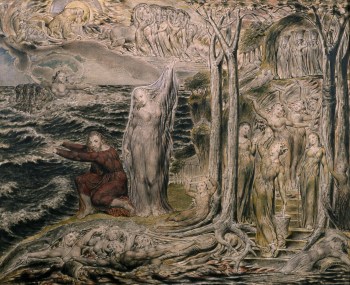
William Blake, The Sea of Time and Space, 1821 (Arlington Court, National Trust).
William Blake in Sussex: Visions of Albion offers a rare opportunity to see original works by Blake inspired by the Sussex coast and countryside re-united for the first time. The exhibition takes place in the Servants’ Quarters Gallery and the mansion. Due to limited space in the Servants’ Quarters Gallery, timed tickets are required for this part of the exhibition.
Celebrating Blake’s three years living in Sussex between 1800 and 1803, the exhibition features over 50 loans from such prestigious collections as the British Museum, V&A, and Tate. These are complimented by works from the Petworth collection acquired by George Wyndham, the 3rd Earl of Egremont and his estranged Countess, Elizabeth Ilive.
Sussex remains the only area outside of London where Blake ever lived, settling with his wife in a cottage in Felpham, which he described as “the sweetest spot on Earth.” It is here that Blake saw ‘Visions of Albion’, surrounded by the Sussex coast and countryside that would continue to inspire his work. This exhibition is the first to re-unite these works and nowhere could be more fitting than Petworth, the only great English country house to hold major paintings by the artist.
Among the highlights of the exhibition, on loan from the British Museum, are hand-coloured relief etchings from Blake’s illustrated epic poem Milton, of which only four are in existence. Written and illustrated between 1804 and 1811, the preface contains the words ‘And did those feet in ancient time’ that was adopted for the anthem Jerusalem.
As part of the William Blake in Sussex exhibition, step inside an immersive experience featuring the original drawings by the author and President of the Blake Society, Philip Pullman, created for his best-selling His Dark Materials trilogy. Using projections, sound, and text, Pullman’s Miltonian works are brought to life and offer parallels with Blake’s art which also draws inspiration from the 17th-century English poet John Milton.
A very limited amount of tickets are available on the day sold on a first come, first serve basis. We recommend arriving early and checking with our team for any last minute availabilities, but to avoid disappointment we advise booking at least 24 hours in advance.
Exhibition | San Antonio 1718: Art from Viceregal Mexico

José de Páez, Mexican Castes (Castas mexicanas), (15 total), ‘1. De Español, e India, produce mestizo’, oil on canvas, 1780
(Private Collection)
◊ ◊ ◊ ◊ ◊
From the San Antonio Museum of Art:
San Antonio 1718: Art from Viceregal Mexico, A Tricentennial Exhibition
San Antonio Museum of Art, 17 February 2018 — 13 May 2018
Three hundred years ago the city of San Antonio was founded as a strategic outpost of presidios defending the colonial interests of northern New Spain and missions advancing Christian conversion. The city’s missions bear architectural witness to the time of their founding, but few have walked these sites without wondering who once lived there, what they saw, valued, and thought. San Antonio 1718: Art from Viceregal Mexico tells the story of the city’s first century through more than one hundred landscapes, portraits, narrative paintings, sculptures, and devotional and decorative objects, many of them never before exhibited in the United States. The exhibition is organized in three sections: People and Places, The Cycle of Life, and The Church.
San Antonio 1718 includes portraits of political and economic power, Spanish viceroys and military leaders who helped shape the destiny of the city. It explores the intrepid Franciscan missionaries who spearheaded the evangelization of the region, including Fray Antonio Margil de Jésus, known as the ‘Patron Saint of Texas’, and the religious figures who anchored their teachings such as the Virgin of the Immaculate Conception and her American manifestation, the Virgin of Guadalupe. Many works are more personal: portraits of poised young women whose marriages will solidify status, aspirational paintings of young families at home, nuns depicted at the threshold of their vows or at their death, intimate miniatures of lovers and soldiers, post-mortem portraits of infants. Throughout, the works invoke the lineage and authority of mainland Spain, while revealing the lives and times of San Antonio’s earliest inhabitants.
Celebrating the city’s deep Hispanic roots and cultural ties with Mexico, San Antonio 1718 features works by New Spain’s most talented eighteenth-century artists, including Cristόbal de Villalpando (1649–1714), Miguel Cabrera (1695–1768), and José de Páez (1720–1790), as well as pieces by talented unknown vernacular artists.
Marion Oettinger, ed., with essays by Jaime Cuadriello, Cristina Cruz González, Ray Hernández-Durán, Katherine Luber, and Gerald Poyo, San Antonio 1718: Art from Mexico (San Antonio: Trinity University Press, 2018), 288 pages, ISBN: 9781595348340, $33.
◊ ◊ ◊ ◊ ◊
Note (added 19 February 2018) — The original posting did not include the catalogue details.
Exhibition | ‘He First Brought it to Perfection’: John Smith and Mezzotint
From the Agnes Etherington Art Centre
‘He First Brought it to Perfection’: John Smith and the Mezzotint in Early Modern England
Agnes Etherington Art Centre, Queen’s Unversity, Kingston, Ontario, 6 January — 8 April 2018
Curated by Andrea Morgan under the supervision of Jacquelyn Coutré

John Smith (after Godfrey Kneller), Portrait of John Smith, mezzotint on paper, 1716 (Gift of Mary C. Stewart in memory of J. Douglas Stewart, 2013, 56.014.04)
The new printmaking technique of mezzotint found a modest audience in continental Europe, but, around 1700, it achieved incredible popularity in England. This exhibition focuses on the printmaker-publisher John Smith (1652–1743), who captured the market with his sophisticated mezzotint prints after Renaissance and contemporary masters. It frames his achievements within the context of the printmaking tradition in England and evinces his savviness on the art market.
Artists represented in this show include Isaac Beckette, Anthony van Dyck, John Faber, Jr., John Smith, Wallerant Vaillant, and William Vincent.
The show is curated by Andrea Morgan under the supervision of Dr Jacquelyn N. Coutré as part of the practicum course in the graduate program of the Department of Art History and Art Conservation at Queen’s University.
Exhibition | Travesty in the 18th Century: William Hogarth
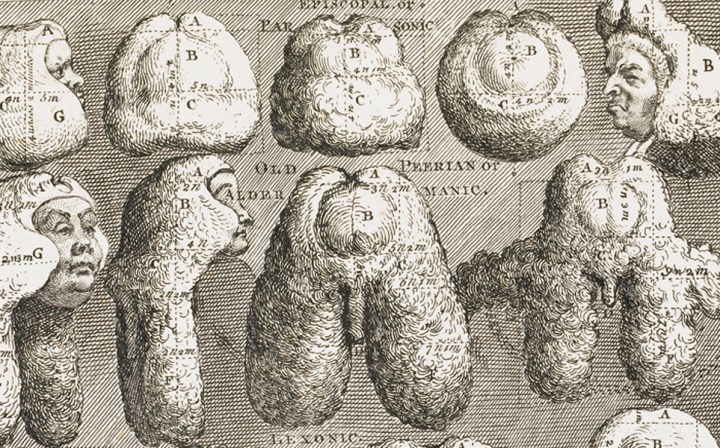
William Hogarth, The Fiver Orders of Periwigs, detail, 1761
(Honolulu Museum of Art, Gift of Andrew Adams Collection)
◊ ◊ ◊ ◊ ◊
Now on view at the Honolulu Museum of Art
Travesty in the 18th Century: William Hogarth’s Modern Moral Subjects
Honolulu Museum of Art, Honolulu, 14 September 2017 — 11 March 2018
The Honolulu Museum of Art’s Works on Paper Gallery comes alive with the work of the hilarious William Hogarth (1697–1764). One of the eighteenth century’s most influential artists, Hogarth is best known for his complex, satirical, and uncannily prescient images, through which he exposed humanity’s foibles by lampooning the conventions, lifestyles, and scandals of contemporary England. Inspired by the popular and plot-driven literary forms of the day—the comic opera, the bourgeois tragedy, and the serialized novel—Hogarth approached his subjects in the spirit (as he put it) of a “dramatic writer,” inventing a new genre called the “modern moral subject,” in which humor and tragedy merged with the purpose of teaching a lesson.
The exhibition focuses on a selection of prints from the museum’s collection, including The Rake’s Progress, a serialized group of eight images that mock the pitfalls of decadence by tracing the fortunes of the fictitious gambler Tom Rakewell; Beer Street and Gin Lane, which warn against the consequences of alcoholism by mordantly blaming gin for the ruin of a working-class neighborhood; and The Five Orders of Periwigs, which chart the elaborate and often absurd semiotics of modish men’s hairstyles.
Exhibition | From Life

Thomas Rowlandson, Drawing from Life at the Royal Academy, (Somerset House), hand-coloured aquatint by A. C. Pugin and Thomas Rowlandson published in Ackermann’s The Microcosm of London, 1 January 1808. 20 × 26 cm (London: Royal Academy of Arts).
◊ ◊ ◊ ◊ ◊
Press release from the RA for the exhibition:
From Life
Royal Academy of Arts, London, 11 December 2017 — 11 March 2018
Curated by Adrian Locke
The Royal Academy of Arts presents From Life, a special exhibition project taking place across two distinct spaces: the Sackler Wing of Galleries and the Tennant Gallery. From Life examines what making art from life has meant to artists throughout history and how the practice is evolving as technology opens up new ways of creating and visualising artwork.
Drawing from casts of Classical and Renaissance sculpture and life models was long considered essential training for any aspiring artist, and was once a staple of the RA Schools, Britain’s longest established fine art school. Beginning with a display of historic paintings and works on paper drawn from the RA Collection, From Life explores the practice of life drawing, from the origins of the Royal Academy in the 18th century to the present day, whilst also looking to the future. Historic paintings by artists such as Johann Zoffany are followed by works in a diverse range of media by contemporary artists, including Jeremy Deller’s Iggy Pop Life Class (2016), Cai Guo-Qiang’s film One Thousand Youngsters Drawing David (2010), and Jenny Saville’s Entry (2004). From Life also presents work by Royal Academicians who continue to interrogate the practice of working from life, among them Antony Gormley, Chantal Joffe, Michael Landy, and Gillian Wearing.
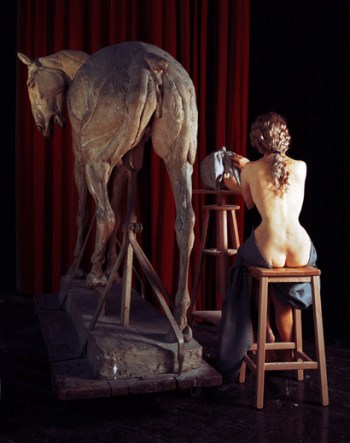
Liane Lang, Casts Series (Royal Academy), Ars Equina, 2006–07, c-type photographic print.
For the first time the Royal Academy is working with artists exploring emerging technologies, which presents them with new ways to both observe and represent themselves and the world around them. Farshid Moussavi RA, Humphrey Ocean RA, Yinka Shonibare RA, and Jonathan Yeo have experimented with virtual reality technologies, creating new artwork for the exhibition using virtual reality platform HTC Vive, Tilt Brush by Google, and artistic software programmes, including MakeVR Pro. Farshid Moussavi’s VR experience transports visitors into masterpieces of ecclesiastical architecture, which they can adapt and transform themselves, while creative technology and content studio Happy Finish have worked with Yinka Shonibare to develop a three-dimensional rendering of a neo-classical painting, featuring a cast of Venus dressed in Shonibare’s trademark batik fabric. Meanwhile, Humphrey Ocean invites audiences to create their own three-dimensional sketches within a playful virtual environment centred on the artist’s fascination with chairs.
From Life reveals the creative process in making these new artworks, as well as opening up the exciting potential of future artistic applications of virtual reality. HTC Vive has supported the development of these works, which will also be available for audiences to experience at home on Viveport, HTC’s global VR app store. Artist Jonathan Yeo has collaborated with Google Arts & Culture to create the first physical free-standing sculpture in metal made by using Tilt Brush, his creative process is captured in a VR film to be published on Google Arts & Culture Youtube channel. The visitors’ experience of the virtual reality element within the exhibition will depend on availability. As each virtual reality artwork can only be experienced individually, access cannot be guaranteed.
Tim Marlow, Artistic Director of the Royal Academy of Arts said: “This is an experimental project that explores everything from artistic process to technological evolution and creative collaboration. In a sense, From Life embodies what an artist-run academy was, is and might become.”
Sky Arts have commissioned immersive content studio Factory 42 to produce a documentary entitled Virtual Reality: Mystery of Creativity, which explores creating art in a virtual environment and how artists use these cutting-edge technologies to explore the limits of traditional artistic methods. There are also a series of short films across the Royal Academy’s online platforms, as well as available via the Sky VR and Google Arts & Culture apps.
To coincide with From Life and as part of the 250th anniversary celebrations in 2018, the Royal Academy is offering free life drawing classes for 250 people of all abilities in the historic Life Room in the RA Schools [dating to the 1860s]. Each class is for a particular group that has a special relationship with either the RA, drawing, or the human body, from members of the Royal Academy’s outreach programmes to nurses and architects. The guest tutors will not be revealed until the life drawing class begins. The project will be documented by online features and videos. The RA is also inviting the public and Friends of the RA to participate through an open ballot to win 50 places at the following free classes, led by guest tutors who will be revealed on the day. Enter the ballot here.
13 December 2017 (10.30am–1.30pm), exclusive to Friends of the RA
24 January 2018 (10.30am–1.30pm), open to all
Sam Phillips, ed., Artists Working From Life (London: Royal Academy, 2017), 160 pages, ISBN: 978 19103 50904, £22.
 From Michelangelo’s marbles to photographer’s self-portraits, artists have always been fascinated by their creative encounters with the human body. Often a key part of their early training, drawing and sculpting from life go on to inform their later work in unexpected and inspiring ways. This illuminating publication brings together interviews with over 19 artists from all disciplines, including painters, sculptors and conceptual artists, working in a variety of different media. Through in-depth conversations with them, the authors explore the many ways artists work ‘from life’: from Jeremy Deller’s open life class with Iggy Pop as model, to Jonathan Yeo’s innovative use of 3D scanners and virtual reality. The interviews are written by contributors including Caroline Bugler, Martin Gayford, Laura Gascoigne, Angela Kingston, Adrian Locke, Ben Luke, Sam Phillips, and Michael Prodger. The book is introduced by an essay on the history of life drawing by Annette Wickham, the Royal Academy’s Curator of Works on Paper.
Sam Phillips is editor of the Royal Academy of Arts Magazine.
Exhibition | Modernity vs. Tradition: Art at the Parisian Salon
 From the Redwood Library and Athenaeum:
Modernity vs. Tradition: Art at the Parisian Salon, 1750–1900
The Redwood Library and Athenæum, Newport, 1 December 2017 – 8 April 2018
Curated by Benedict Leca
Named after the Salon carré at the Louvre, where it was held between 1725 and 1848, the Salon’s rise as the world’s preeminent regular exhibition of contemporary art was intertwined with the rise of a modern viewing public. Early presentations—first at the Palais Royal and then in the Grande Galerie of the Louvre by the 1690s (above)—were of comparatively restricted attendance. Yet already contained in them was the tension between the rule-bound tradition of academic pedagogy and the more progressive tendencies of venturesome artists pandering to popular taste.
What had begun in the 1670s as the French Académie Royale de Peinture et Sculpture’s desire to foster artistic competition and thus progress, and as an invitation to a nascent public to scrutinize and judge the products of its Academicians, had evolved by the mid-eighteenth century into one of the most charged public forums for the exchange of aesthetic and political ideas. A catalyst was the emergence of the new literary genre of art criticism in the 1740s, which from the outset contained a strongly partisan wing highly critical of official art and of the Crown’s management of national art production. Aesthetic judgements were in this way often of a piece with political critiques, thus compounding the meanings and public impact of artworks and their interpretation.
As an arm of the French Crown, the Académie suffered a similar fate during the Revolution, being abolished in 1793 only to re-emerge as the Institut national and, later, as the École des Beaux Arts. These successive institutions managed the Salon fitfully. It endured in close alliance with official arts policy during the Empire and benefited from the more permissive era of the Bourbon Restoration. Later, having fully entered the popular imaginary through the explosion of modern press coverage after mid-century, it became the defining context that gave rise to modern art. Indeed, if the number of exhibitions and visitors doubled during Napoleon’s reign, by the last quarter of the century the Salon had reached an altogether different level of impact. Now featuring thousands of works viewed by tens of thousands of visitors, the Salon as an international cultural phenomenon can be seen as the precursor of today’s many biennales.
Exhibition | The Business of Prints
Press release (via Art Daily) for the exhibition:
The Business of Prints, 1400–1850
The British Museum, London, 21 September 2017 — 28 January 2018
Curated by Antony Griffiths
 The British Museum has one of the greatest collections of prints in the world and holds the UK’s national collection. The majority of this collection, which totals more than two million prints, was made in the years before the invention of photography. Due to the sheer volume of the collection it can become difficult to grasp its contents, and many of the prints are today very unfamiliar and puzzling. For the past century, prints have usually been discussed either as finished works of art or as illustrations of a particular subject. This exhibition reverses the perspective in a way that has not been attempted before, and endeavours to show prints as an object of trade.
The exhibition The Business of Prints is in part based on the book The Print before Photography: An Introduction to European Printmaking, 1550–1820 by Antony Griffiths, published last year by British Museum Press. This won the Apollo Prize for the best art book of the year 2016. It is the first work ever to attempt to explain how the print world worked.
The exhibition focuses on four major topics: the production of prints, the lettering on prints, the usage of prints, and the collecting of prints and the concern for quality. In addition, books and series are being shown in table cases, and framed prints on the wall. Famous works by artists such as Dürer, Rembrandt, and Goya are being shown alongside far less familiar subjects by artists of the print trade who have almost been forgotten. Among them is a rabbit used as target practice, a prompt for an early form of karaoke, and prints from plates that had been so heavily used that they had almost worn out. The display offers a more complete understanding of the lettering on prints, the information it gives us, and some of the complicated ways in which images were linked with text.
We are now so used to the deluge of photographically-derived imagery of the modern world that it is difficult to imagine a period which lasted for nearly 450 years, from around 1400 to 1850, when every pictorial image had to be designed by someone and then cut by a craftsman onto a copper plate or wooden block—there were no mechanical aids. These were then printed by another expert, and distributed by printsellers to buyers around the whole of Europe. Behind them stood the publishers and entrepreneurs, who financed the production, and frequently came up with ideas for new subjects. It was a huge business, which gave work to thousands of people. The exhibition sheds light on this forgotten trade of mass production which required numerous collaborations in order to produce a single print, whilst revealing some of the complexities of the craftsmanship and the process, the varied nature of the prints themselves, and the ways in which buyers used or collected them.
Johannes Gutenberg invented moveable type in Mainz in the late 1440s. However, type is designed to deal with words, and as soon as the need to communicate goes beyond the verbal, the support of another variety of printing must be called on—one that is specifically suited for images. Two such technologies were used alongside type, one based around cutting designs into wooden blocks (the relief process of woodcut), the other in which the design was incised as lines into a copper plate (the intaglio processes such as engraving and etching).
The uses to which these technologies were put were enormously varied. The printing of maps and music, wallpaper, diagrams, decorative paper, bank notes, playing cards and fans, as well as many types of decoration of textiles and ceramics, depended on woodcut or engraving. Many of these applications spun off to become separate businesses. In museums the field is conventionally narrowed to one area of this vast expanse, that of pictorial images on sheets of paper. This is still very wide, covering a wide range of functions, such as portraits, devotional images, current events, landscape and topography, caricature, fantasy and designs for the decorative arts. Many of these classes of print did not need the support of typography, and most intaglio prints carried their text engraved on the plate itself alongside the image. One example that demonstrates the volume and diversity of the European print trade is the mass production of the recognisable image of a devotional saint which would have been sold by pedlars and worn as amulets by peasants. These were often printed on vellum, a more durable material than paper, to withstand daily wear and tear.
When speaking of the display, curator Antony Griffiths highlights that “this is the first exhibition ever to demonstrate what prints can tell us about the vast business of trading prints. The exhibition aims to open the visitor’s eyes to the business of printing. Prints were multiples made in the hope that people would buy lots of them. The range of subjects, sizes and purposes was huge—far larger than people realise today.”
Exhibition | Napoleon: The Imperial Household
On this day, 2 December, in 1804, Napoleon became emperor of the French. This exhibition exploring the imperial household opens in February in Montreal:
Napoleon: The Imperial Household / Napoléon: La maison de l’empereur
Montreal Museum of Fine Arts, 3 February — 6 May 2018
Virginia Museum of Fine Arts, Richmond, 9 June — 3 September 2018
Nelson-Atkins Museum of Art, Kansas City, 4 October 2018 — 13 January 2019
Musée National du Château de Fontainebleau, 13 April — 15 July 2019
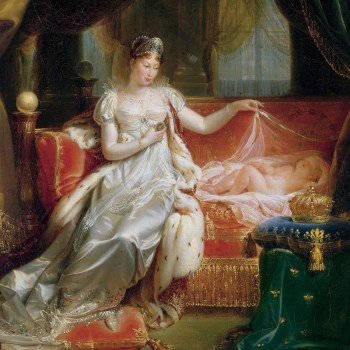
Joseph Franque, Empress Marie-Louise Watching over the Sleeping King of Rome, 1811 (Châteaux de Versailles et de Trianon).
The Imperial Household was a key institution during the reign of Napoléon Bonaparte (1769–1821). It was responsible for the daily lives of the Imperial family and the day-to-day existence of former general Bonaparte, who became Emperor Napoleon in 1804. Napoleon: The Imperial Household aims to re-create the ambience and capture the spirit that prevailed in the French court during the Empire. A selection of works and objets d’art, most of which have never before been exhibited in North America, will reveal the Imperial Household’s role in fashioning a monarchic identity for the new emperor who ruled France following the Revolution, as well as his family and loyal entourage.
The Imperial Household consisted of six departments, each headed by a grand officer, a high-ranking dignitary of the Empire: the grand chaplain, grand master of ceremonies, grand marshal of the Palace, grand master of the hunt, grand chamberlain and grand equerry were each involved in orchestrating every minute of the pageantry in the Court. This is another aspect of the Napoleonic saga that will be presented here, with more than 250 works in which the fine arts and decorative arts were used for purposes of ideology and official propaganda.
Sylvain Cordier, Napoleon: The Imperial Household (New Haven: Yale University Press, 2018), 350 pages, ISBN: 978 030023 3469, $50 / £40.
◊ ◊ ◊ ◊ ◊
Note (added 17 August 2018) — The posting was updated to include dates for venues other than Montreal. It’s also worth noting that the exhibition title varies according to location; in Richmond and Kansas City it’s called Napoleon: Power and Splendor.
The Burlington Magazine, November 2017
The eighteenth century in The Burlington:
The Burlington Magazine 159 (November 2017)
 A R T I C L E S
• Oronzo Brunetti, “A Nymphaeum for the Villa Salviati at Ponte alla Badia in Florence,” pp. 893–99.
R E V I E W S
• Jeremy Warren, Review of Mark Gregory d’Apuzzo, La collezione dei bronzi del Museo Civico Medievale di Bologna (Libro Co. Italia, 2017), pp. 912–13.
• François Marandet, Review of Hannah Williams, Académie Royale: A History in Portraits (Ashgate, 2015), pp. 918–19.
• Peter Murray, Review of Jane Fenlon, Ruth Kenny, Caroline Pegum, and Brendan Rooney, eds., Irish Fine Art in the Early Modern Period: New Perspectives on Artistic Practice, 1620–1820 (Irish Academic Press, 2016), p. 923.
• David Cowan, Review of the exhibition Bonnie Prince Charlie and the Jacobites (National Museum of Scotland, Edinburgh, 2017), pp. 930–31.
• Xavier F. Salomon, Review of the exhibition Caroline Murat, Sister of Napoleon, Queen of the Arts / Caroline, Soeur de Napoléon, Reine des Arts (Palais Fesch, Musée des Beaux-Arts, Ajaccio, Corsica, 2017), pp. 940–41.
Exhibition | The Sweat of Their Face: Portraying American Workers

Lewis Wickes Hine, Child Labor, ca. 1908; gelatin silver print
(Bank of America Collection)
◊ ◊ ◊ ◊ ◊
Press release (17 October 2017) for the exhibition:
The Sweat of Their Face: Portraying American Workers
National Portrait Gallery, Smithsonian, Washington, D.C., 3 November 2017 — 3 September 2018
Curated by Dorothy Moss and David Ward
The National Portrait Gallery’s exhibition The Sweat of Their Face: Portraying American Workers presents nearly 100 portrayals of laborers by some of the nation’s most influential artists. The multifaceted exhibition includes paintings, sculptures, drawings, prints, media art and photographs that reveal how American workers have shaped and defined the United States over the course of its history—from the Colonial era to the present day. The exhibition examines the intersections between work, art, and social history. The fully bilingual (English and Spanish) display is on view from November 3 until September 3, 2018.

John Rose, Miss Breme Jones, 1785–87, watercolor and ink on paper (Williamsburg: Abby Aldrich Rockefeller Folk Art Museum, museum purchase, the Friends of Colonial Williamsburg Collections Fund).
The Sweat of Their Face includes portraits by Winslow Homer, Dorothea Lange, Elizabeth Catlett, Lewis Hine, Jacob Lawrence, and other renowned American artists. Power House Mechanic, a photograph by Lewis Hine, and The Riveter, by Ben Shahn, are significant works in their own right, but they also highlight the artist’s ability to recognize the vast population of anonymous workers and the contributions that their subjects have made. Furthermore, those depicted in The Sweat of Their Face—many of whom now appear as anonymous workers—draw attention to the relationships that exist between viewers, artists, and subjects.
“In The Sweat of Their Face, we explore who works, why, and how their surrounding conditions have changed and evolved over time,” said Kim Sajet, Director of the National Portrait Gallery. “In the early years of the 21st century, crucial questions persist over issues of jobs and workers’ rights, as well as larger issues of economic equality and social mobility. As we grapple with these questions, we might reflect on the labor of the workers from past epochs who have been brought out of anonymity and given the fullness of their humanity by some of America’s great fine artists.”
Spanning centuries and encompassing various genres, each of the artists in The Sweat of Their Face depicts an individual at a specific moment amidst America’s changing landscape, but as the exhibition reveals, some laborers remain the same. For example, migrant workers have always been a part of American labor’s story, and portraits such as Jean Charlot’s Tortilla Maker and photographs from the California fields are reminders that with immigration, the United States has benefited from cultural exchange, innovation, and economic growth.
This exhibition displays loans from such notable institutions as the Smithsonian American Art Museum, the Metropolitan Museum of Art, the J. Paul Getty Museum, the Phillips Collection, and the Pennsylvania Academy of the Fine Arts, among others. The Sweat of Their Face is organized by curator of painting and sculpture, Dorothy Moss and historian emeritus, David C. Ward. An accompanying catalog presents essays by Moss, Ward, and British art historian John Fagg.
David Ward and Dorothy Moss, with an essay by John Fagg, The Sweat of Their Face: Portraying American Workers Hardcover (Smithsonian Books, 2017), 224 pages, ISBN: 978 158834 6056, $40.
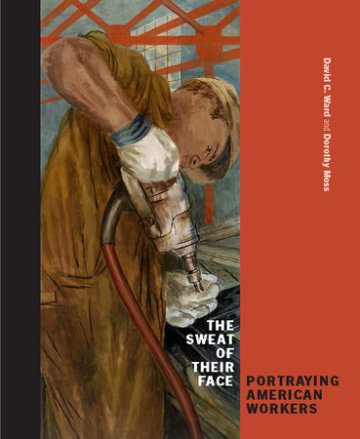 Work always has been a central construct in the United States, influencing how Americans measure their lives and assess their contribution to the wider society. Work also has been valued as the key element in the philosophy of self-improvement and social mobility that undergird the American value system. Yet work can also be something imposed upon people: it can be exploitative, painful, and hard. This duality is etched into the faces of the people depicted in the portraits showcased in The Sweat of Their Face: Portraying American Workers. This companion volume to an exhibition at the Smithsonian National Portrait Gallery examines working-class subjects as they appear in artworks by artists including Winslow Homer, Elizabeth Catlett, Danny Lyon, and Shauna Frischkorn. This richly illustrated book charts the rise and fall of labor from the empowered artisan of the eighteenth century through industrialization and the current American business climate, in which industrial jobs have all but disappeared. It also traces the history of work itself through its impact on the men and women whose laboring bodies are depicted. The Sweat of Their Face is a powerful visual exploration of the inextricable ties between American labor and society.
David C. Ward is the National Portrait Gallery’s senior historian. He has curated exhibitions on Walt Whitman, Abraham Lincoln, American poetry, and the award-winning Hide/Seek: Difference and Desire in American Portraiture. He has also authored several books, including Charles Willson Peale: Art and Selfhood in the Early Republic. Dorothy Moss is director of the Outwin Boochever Portrait Competition and curator of painting and sculpture at the National Portrait Gallery. She has contributed to numerous exhibition catalogues, and her articles and essays have been published in The Burlington Magazine, Gastronomica, and American Art.










 Enfilade
leave a comment