Exhibition | From Life

Thomas Rowlandson, Drawing from Life at the Royal Academy, (Somerset House), hand-coloured aquatint by A. C. Pugin and Thomas Rowlandson published in Ackermann’s The Microcosm of London, 1 January 1808. 20 × 26 cm (London: Royal Academy of Arts).
◊ ◊ ◊ ◊ ◊
Press release from the RA for the exhibition:
From Life
Royal Academy of Arts, London, 11 December 2017 — 11 March 2018
Curated by Adrian Locke
The Royal Academy of Arts presents From Life, a special exhibition project taking place across two distinct spaces: the Sackler Wing of Galleries and the Tennant Gallery. From Life examines what making art from life has meant to artists throughout history and how the practice is evolving as technology opens up new ways of creating and visualising artwork.
Drawing from casts of Classical and Renaissance sculpture and life models was long considered essential training for any aspiring artist, and was once a staple of the RA Schools, Britain’s longest established fine art school. Beginning with a display of historic paintings and works on paper drawn from the RA Collection, From Life explores the practice of life drawing, from the origins of the Royal Academy in the 18th century to the present day, whilst also looking to the future. Historic paintings by artists such as Johann Zoffany are followed by works in a diverse range of media by contemporary artists, including Jeremy Deller’s Iggy Pop Life Class (2016), Cai Guo-Qiang’s film One Thousand Youngsters Drawing David (2010), and Jenny Saville’s Entry (2004). From Life also presents work by Royal Academicians who continue to interrogate the practice of working from life, among them Antony Gormley, Chantal Joffe, Michael Landy, and Gillian Wearing.
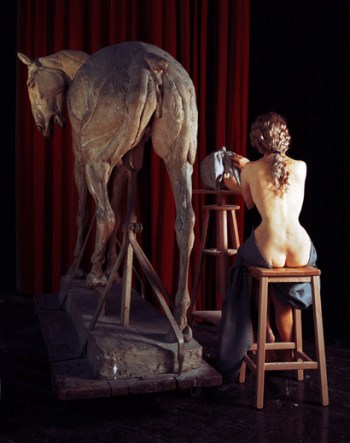
Liane Lang, Casts Series (Royal Academy), Ars Equina, 2006–07, c-type photographic print.
For the first time the Royal Academy is working with artists exploring emerging technologies, which presents them with new ways to both observe and represent themselves and the world around them. Farshid Moussavi RA, Humphrey Ocean RA, Yinka Shonibare RA, and Jonathan Yeo have experimented with virtual reality technologies, creating new artwork for the exhibition using virtual reality platform HTC Vive, Tilt Brush by Google, and artistic software programmes, including MakeVR Pro. Farshid Moussavi’s VR experience transports visitors into masterpieces of ecclesiastical architecture, which they can adapt and transform themselves, while creative technology and content studio Happy Finish have worked with Yinka Shonibare to develop a three-dimensional rendering of a neo-classical painting, featuring a cast of Venus dressed in Shonibare’s trademark batik fabric. Meanwhile, Humphrey Ocean invites audiences to create their own three-dimensional sketches within a playful virtual environment centred on the artist’s fascination with chairs.
From Life reveals the creative process in making these new artworks, as well as opening up the exciting potential of future artistic applications of virtual reality. HTC Vive has supported the development of these works, which will also be available for audiences to experience at home on Viveport, HTC’s global VR app store. Artist Jonathan Yeo has collaborated with Google Arts & Culture to create the first physical free-standing sculpture in metal made by using Tilt Brush, his creative process is captured in a VR film to be published on Google Arts & Culture Youtube channel. The visitors’ experience of the virtual reality element within the exhibition will depend on availability. As each virtual reality artwork can only be experienced individually, access cannot be guaranteed.
Tim Marlow, Artistic Director of the Royal Academy of Arts said: “This is an experimental project that explores everything from artistic process to technological evolution and creative collaboration. In a sense, From Life embodies what an artist-run academy was, is and might become.”
Sky Arts have commissioned immersive content studio Factory 42 to produce a documentary entitled Virtual Reality: Mystery of Creativity, which explores creating art in a virtual environment and how artists use these cutting-edge technologies to explore the limits of traditional artistic methods. There are also a series of short films across the Royal Academy’s online platforms, as well as available via the Sky VR and Google Arts & Culture apps.
To coincide with From Life and as part of the 250th anniversary celebrations in 2018, the Royal Academy is offering free life drawing classes for 250 people of all abilities in the historic Life Room in the RA Schools [dating to the 1860s]. Each class is for a particular group that has a special relationship with either the RA, drawing, or the human body, from members of the Royal Academy’s outreach programmes to nurses and architects. The guest tutors will not be revealed until the life drawing class begins. The project will be documented by online features and videos. The RA is also inviting the public and Friends of the RA to participate through an open ballot to win 50 places at the following free classes, led by guest tutors who will be revealed on the day. Enter the ballot here.
13 December 2017 (10.30am–1.30pm), exclusive to Friends of the RA
24 January 2018 (10.30am–1.30pm), open to all
Sam Phillips, ed., Artists Working From Life (London: Royal Academy, 2017), 160 pages, ISBN: 978 19103 50904, £22.
 From Michelangelo’s marbles to photographer’s self-portraits, artists have always been fascinated by their creative encounters with the human body. Often a key part of their early training, drawing and sculpting from life go on to inform their later work in unexpected and inspiring ways. This illuminating publication brings together interviews with over 19 artists from all disciplines, including painters, sculptors and conceptual artists, working in a variety of different media. Through in-depth conversations with them, the authors explore the many ways artists work ‘from life’: from Jeremy Deller’s open life class with Iggy Pop as model, to Jonathan Yeo’s innovative use of 3D scanners and virtual reality. The interviews are written by contributors including Caroline Bugler, Martin Gayford, Laura Gascoigne, Angela Kingston, Adrian Locke, Ben Luke, Sam Phillips, and Michael Prodger. The book is introduced by an essay on the history of life drawing by Annette Wickham, the Royal Academy’s Curator of Works on Paper.
Sam Phillips is editor of the Royal Academy of Arts Magazine.
Exhibition | Modernity vs. Tradition: Art at the Parisian Salon
 From the Redwood Library and Athenaeum:
Modernity vs. Tradition: Art at the Parisian Salon, 1750–1900
The Redwood Library and Athenæum, Newport, 1 December 2017 – 8 April 2018
Curated by Benedict Leca
Named after the Salon carré at the Louvre, where it was held between 1725 and 1848, the Salon’s rise as the world’s preeminent regular exhibition of contemporary art was intertwined with the rise of a modern viewing public. Early presentations—first at the Palais Royal and then in the Grande Galerie of the Louvre by the 1690s (above)—were of comparatively restricted attendance. Yet already contained in them was the tension between the rule-bound tradition of academic pedagogy and the more progressive tendencies of venturesome artists pandering to popular taste.
What had begun in the 1670s as the French Académie Royale de Peinture et Sculpture’s desire to foster artistic competition and thus progress, and as an invitation to a nascent public to scrutinize and judge the products of its Academicians, had evolved by the mid-eighteenth century into one of the most charged public forums for the exchange of aesthetic and political ideas. A catalyst was the emergence of the new literary genre of art criticism in the 1740s, which from the outset contained a strongly partisan wing highly critical of official art and of the Crown’s management of national art production. Aesthetic judgements were in this way often of a piece with political critiques, thus compounding the meanings and public impact of artworks and their interpretation.
As an arm of the French Crown, the Académie suffered a similar fate during the Revolution, being abolished in 1793 only to re-emerge as the Institut national and, later, as the École des Beaux Arts. These successive institutions managed the Salon fitfully. It endured in close alliance with official arts policy during the Empire and benefited from the more permissive era of the Bourbon Restoration. Later, having fully entered the popular imaginary through the explosion of modern press coverage after mid-century, it became the defining context that gave rise to modern art. Indeed, if the number of exhibitions and visitors doubled during Napoleon’s reign, by the last quarter of the century the Salon had reached an altogether different level of impact. Now featuring thousands of works viewed by tens of thousands of visitors, the Salon as an international cultural phenomenon can be seen as the precursor of today’s many biennales.
Exhibition | The Business of Prints
Press release (via Art Daily) for the exhibition:
The Business of Prints, 1400–1850
The British Museum, London, 21 September 2017 — 28 January 2018
Curated by Antony Griffiths
 The British Museum has one of the greatest collections of prints in the world and holds the UK’s national collection. The majority of this collection, which totals more than two million prints, was made in the years before the invention of photography. Due to the sheer volume of the collection it can become difficult to grasp its contents, and many of the prints are today very unfamiliar and puzzling. For the past century, prints have usually been discussed either as finished works of art or as illustrations of a particular subject. This exhibition reverses the perspective in a way that has not been attempted before, and endeavours to show prints as an object of trade.
The exhibition The Business of Prints is in part based on the book The Print before Photography: An Introduction to European Printmaking, 1550–1820 by Antony Griffiths, published last year by British Museum Press. This won the Apollo Prize for the best art book of the year 2016. It is the first work ever to attempt to explain how the print world worked.
The exhibition focuses on four major topics: the production of prints, the lettering on prints, the usage of prints, and the collecting of prints and the concern for quality. In addition, books and series are being shown in table cases, and framed prints on the wall. Famous works by artists such as Dürer, Rembrandt, and Goya are being shown alongside far less familiar subjects by artists of the print trade who have almost been forgotten. Among them is a rabbit used as target practice, a prompt for an early form of karaoke, and prints from plates that had been so heavily used that they had almost worn out. The display offers a more complete understanding of the lettering on prints, the information it gives us, and some of the complicated ways in which images were linked with text.
We are now so used to the deluge of photographically-derived imagery of the modern world that it is difficult to imagine a period which lasted for nearly 450 years, from around 1400 to 1850, when every pictorial image had to be designed by someone and then cut by a craftsman onto a copper plate or wooden block—there were no mechanical aids. These were then printed by another expert, and distributed by printsellers to buyers around the whole of Europe. Behind them stood the publishers and entrepreneurs, who financed the production, and frequently came up with ideas for new subjects. It was a huge business, which gave work to thousands of people. The exhibition sheds light on this forgotten trade of mass production which required numerous collaborations in order to produce a single print, whilst revealing some of the complexities of the craftsmanship and the process, the varied nature of the prints themselves, and the ways in which buyers used or collected them.
Johannes Gutenberg invented moveable type in Mainz in the late 1440s. However, type is designed to deal with words, and as soon as the need to communicate goes beyond the verbal, the support of another variety of printing must be called on—one that is specifically suited for images. Two such technologies were used alongside type, one based around cutting designs into wooden blocks (the relief process of woodcut), the other in which the design was incised as lines into a copper plate (the intaglio processes such as engraving and etching).
The uses to which these technologies were put were enormously varied. The printing of maps and music, wallpaper, diagrams, decorative paper, bank notes, playing cards and fans, as well as many types of decoration of textiles and ceramics, depended on woodcut or engraving. Many of these applications spun off to become separate businesses. In museums the field is conventionally narrowed to one area of this vast expanse, that of pictorial images on sheets of paper. This is still very wide, covering a wide range of functions, such as portraits, devotional images, current events, landscape and topography, caricature, fantasy and designs for the decorative arts. Many of these classes of print did not need the support of typography, and most intaglio prints carried their text engraved on the plate itself alongside the image. One example that demonstrates the volume and diversity of the European print trade is the mass production of the recognisable image of a devotional saint which would have been sold by pedlars and worn as amulets by peasants. These were often printed on vellum, a more durable material than paper, to withstand daily wear and tear.
When speaking of the display, curator Antony Griffiths highlights that “this is the first exhibition ever to demonstrate what prints can tell us about the vast business of trading prints. The exhibition aims to open the visitor’s eyes to the business of printing. Prints were multiples made in the hope that people would buy lots of them. The range of subjects, sizes and purposes was huge—far larger than people realise today.”
Exhibition | Napoleon: The Imperial Household
On this day, 2 December, in 1804, Napoleon became emperor of the French. This exhibition exploring the imperial household opens in February in Montreal:
Napoleon: The Imperial Household / Napoléon: La maison de l’empereur
Montreal Museum of Fine Arts, 3 February — 6 May 2018
Virginia Museum of Fine Arts, Richmond, 9 June — 3 September 2018
Nelson-Atkins Museum of Art, Kansas City, 4 October 2018 — 13 January 2019
Musée National du Château de Fontainebleau, 13 April — 15 July 2019
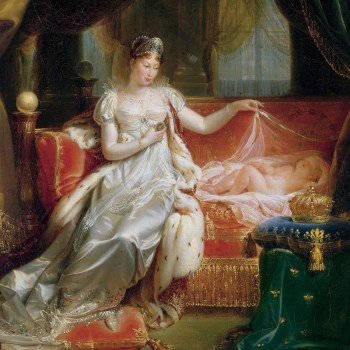
Joseph Franque, Empress Marie-Louise Watching over the Sleeping King of Rome, 1811 (Châteaux de Versailles et de Trianon).
The Imperial Household was a key institution during the reign of Napoléon Bonaparte (1769–1821). It was responsible for the daily lives of the Imperial family and the day-to-day existence of former general Bonaparte, who became Emperor Napoleon in 1804. Napoleon: The Imperial Household aims to re-create the ambience and capture the spirit that prevailed in the French court during the Empire. A selection of works and objets d’art, most of which have never before been exhibited in North America, will reveal the Imperial Household’s role in fashioning a monarchic identity for the new emperor who ruled France following the Revolution, as well as his family and loyal entourage.
The Imperial Household consisted of six departments, each headed by a grand officer, a high-ranking dignitary of the Empire: the grand chaplain, grand master of ceremonies, grand marshal of the Palace, grand master of the hunt, grand chamberlain and grand equerry were each involved in orchestrating every minute of the pageantry in the Court. This is another aspect of the Napoleonic saga that will be presented here, with more than 250 works in which the fine arts and decorative arts were used for purposes of ideology and official propaganda.
Sylvain Cordier, Napoleon: The Imperial Household (New Haven: Yale University Press, 2018), 350 pages, ISBN: 978 030023 3469, $50 / £40.
◊ ◊ ◊ ◊ ◊
Note (added 17 August 2018) — The posting was updated to include dates for venues other than Montreal. It’s also worth noting that the exhibition title varies according to location; in Richmond and Kansas City it’s called Napoleon: Power and Splendor.
The Burlington Magazine, November 2017
The eighteenth century in The Burlington:
The Burlington Magazine 159 (November 2017)
 A R T I C L E S
• Oronzo Brunetti, “A Nymphaeum for the Villa Salviati at Ponte alla Badia in Florence,” pp. 893–99.
R E V I E W S
• Jeremy Warren, Review of Mark Gregory d’Apuzzo, La collezione dei bronzi del Museo Civico Medievale di Bologna (Libro Co. Italia, 2017), pp. 912–13.
• François Marandet, Review of Hannah Williams, Académie Royale: A History in Portraits (Ashgate, 2015), pp. 918–19.
• Peter Murray, Review of Jane Fenlon, Ruth Kenny, Caroline Pegum, and Brendan Rooney, eds., Irish Fine Art in the Early Modern Period: New Perspectives on Artistic Practice, 1620–1820 (Irish Academic Press, 2016), p. 923.
• David Cowan, Review of the exhibition Bonnie Prince Charlie and the Jacobites (National Museum of Scotland, Edinburgh, 2017), pp. 930–31.
• Xavier F. Salomon, Review of the exhibition Caroline Murat, Sister of Napoleon, Queen of the Arts / Caroline, Soeur de Napoléon, Reine des Arts (Palais Fesch, Musée des Beaux-Arts, Ajaccio, Corsica, 2017), pp. 940–41.
Exhibition | The Sweat of Their Face: Portraying American Workers

Lewis Wickes Hine, Child Labor, ca. 1908; gelatin silver print
(Bank of America Collection)
◊ ◊ ◊ ◊ ◊
Press release (17 October 2017) for the exhibition:
The Sweat of Their Face: Portraying American Workers
National Portrait Gallery, Smithsonian, Washington, D.C., 3 November 2017 — 3 September 2018
Curated by Dorothy Moss and David Ward
The National Portrait Gallery’s exhibition The Sweat of Their Face: Portraying American Workers presents nearly 100 portrayals of laborers by some of the nation’s most influential artists. The multifaceted exhibition includes paintings, sculptures, drawings, prints, media art and photographs that reveal how American workers have shaped and defined the United States over the course of its history—from the Colonial era to the present day. The exhibition examines the intersections between work, art, and social history. The fully bilingual (English and Spanish) display is on view from November 3 until September 3, 2018.

John Rose, Miss Breme Jones, 1785–87, watercolor and ink on paper (Williamsburg: Abby Aldrich Rockefeller Folk Art Museum, museum purchase, the Friends of Colonial Williamsburg Collections Fund).
The Sweat of Their Face includes portraits by Winslow Homer, Dorothea Lange, Elizabeth Catlett, Lewis Hine, Jacob Lawrence, and other renowned American artists. Power House Mechanic, a photograph by Lewis Hine, and The Riveter, by Ben Shahn, are significant works in their own right, but they also highlight the artist’s ability to recognize the vast population of anonymous workers and the contributions that their subjects have made. Furthermore, those depicted in The Sweat of Their Face—many of whom now appear as anonymous workers—draw attention to the relationships that exist between viewers, artists, and subjects.
“In The Sweat of Their Face, we explore who works, why, and how their surrounding conditions have changed and evolved over time,” said Kim Sajet, Director of the National Portrait Gallery. “In the early years of the 21st century, crucial questions persist over issues of jobs and workers’ rights, as well as larger issues of economic equality and social mobility. As we grapple with these questions, we might reflect on the labor of the workers from past epochs who have been brought out of anonymity and given the fullness of their humanity by some of America’s great fine artists.”
Spanning centuries and encompassing various genres, each of the artists in The Sweat of Their Face depicts an individual at a specific moment amidst America’s changing landscape, but as the exhibition reveals, some laborers remain the same. For example, migrant workers have always been a part of American labor’s story, and portraits such as Jean Charlot’s Tortilla Maker and photographs from the California fields are reminders that with immigration, the United States has benefited from cultural exchange, innovation, and economic growth.
This exhibition displays loans from such notable institutions as the Smithsonian American Art Museum, the Metropolitan Museum of Art, the J. Paul Getty Museum, the Phillips Collection, and the Pennsylvania Academy of the Fine Arts, among others. The Sweat of Their Face is organized by curator of painting and sculpture, Dorothy Moss and historian emeritus, David C. Ward. An accompanying catalog presents essays by Moss, Ward, and British art historian John Fagg.
David Ward and Dorothy Moss, with an essay by John Fagg, The Sweat of Their Face: Portraying American Workers Hardcover (Smithsonian Books, 2017), 224 pages, ISBN: 978 158834 6056, $40.
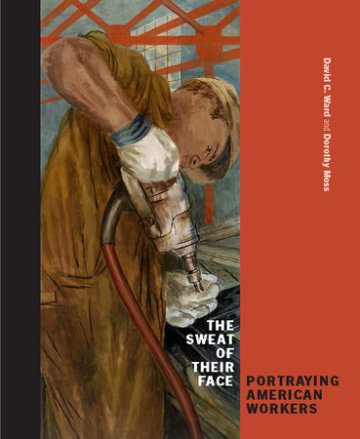 Work always has been a central construct in the United States, influencing how Americans measure their lives and assess their contribution to the wider society. Work also has been valued as the key element in the philosophy of self-improvement and social mobility that undergird the American value system. Yet work can also be something imposed upon people: it can be exploitative, painful, and hard. This duality is etched into the faces of the people depicted in the portraits showcased in The Sweat of Their Face: Portraying American Workers. This companion volume to an exhibition at the Smithsonian National Portrait Gallery examines working-class subjects as they appear in artworks by artists including Winslow Homer, Elizabeth Catlett, Danny Lyon, and Shauna Frischkorn. This richly illustrated book charts the rise and fall of labor from the empowered artisan of the eighteenth century through industrialization and the current American business climate, in which industrial jobs have all but disappeared. It also traces the history of work itself through its impact on the men and women whose laboring bodies are depicted. The Sweat of Their Face is a powerful visual exploration of the inextricable ties between American labor and society.
David C. Ward is the National Portrait Gallery’s senior historian. He has curated exhibitions on Walt Whitman, Abraham Lincoln, American poetry, and the award-winning Hide/Seek: Difference and Desire in American Portraiture. He has also authored several books, including Charles Willson Peale: Art and Selfhood in the Early Republic. Dorothy Moss is director of the Outwin Boochever Portrait Competition and curator of painting and sculpture at the National Portrait Gallery. She has contributed to numerous exhibition catalogues, and her articles and essays have been published in The Burlington Magazine, Gastronomica, and American Art.
Exhibition | Animals: Respect, Harmony, Subjugation
Press release for the exhibition:
Animals: Respect, Harmony, Subjugation
Museum für Kunst und Gewerbe Hamburg, 3 November 2017 — 4 March 2018
 Animals are a frequent subject of debate these days. Do they have a soul? How much do they suffer? Are we under any obligation to protect their individuality by granting them rights? Are human beings morally authorized to do as they want with animals, to consume them, rob them of their freedom and train them for the purposes of entertainment? Scientific discussion takes the relationship between animal and human being very seriously. In the everyday life of our consumption-oriented society, on the other hand, that relationship oscillates between unreflecting exploitation and sentimental anthropomorphization. Against the background of these contrasts, the exhibition Animals at the Museum für Kunst und Gewerbe Hamburg has been geared primarily towards informing visitors and sensitizing them to ways and means of respectful co-existence. With a view to the visual and applied arts but also to science, the show undertakes to re-evaluate the common history of man and animal from the perspective of a wide range of epochs, cultures and media. Loans from museums as well as natural history and ethnology-oriented institutions of Germany and the world will enhance the objects from the MKG’s own abundant and diverse collection. The chief focus is on works of the visual arts in which the interaction between animal and man gives rise to something altogether new. So-called thematic islands unite creations of high culture with those from popular contexts, while also integrating examples from indigenous cultures and natural history. The exhibition features some 200 objects dating from antiquity to the present, including paintings, sculptures, prints, photographs, video art, large-scale installations and films. In addition to the 1,200 square metres exhibition there are 14 satellite locations throughout the entire museum that focus on animals. The exhibition is accompanied by a catalogue published by Hirmer Verlag.
This exhibition explores the relationship of animals and mankind with a view on the arts and focusses on ethical, spiritual and emotional questions. The centre for Natural History (CeNak) at the University of Hamburg, as a cooperation institution of the MKG, completes the perspective with a scientific view of mankind in the animal world. Beside the joint projects with the Zoological Museum, CeNak presents a special exhibition Vanishing Legacys: The world as a Forest (10 November 2017 – 29 March 2018) addressing the current research results regarding species extinction, deforestation and climate change.
Origins and Inspiration
The oldest known depictions of animals date to over 30,000 years ago—carved out of bones or painted on the walls of caves. Ever since humans started making artworks, animals have been one of the main sources of inspiration. The earliest object in the exhibition, the engaging amber sculpture of a moose from Weitsche, dates back to the Ice Age. Just like a falcon sculpture found in Egypt, a jade deer from China, a bull from the ancient Orient, and a golden boar from Greece, it bears witness to the encounter between human and animal. All of these works tell us something about how humans viewed the animals around them, how the particular society saw itself and about its religious and moral constitution, its attitude to creation and to nature. The exhibition examines how artists across the ages envisioned animals and the aesthetic developments that influenced their interpretations.
Longing and Distance
Paradise! A return to Arcadia is not possible, but the arts can play a vital role on the way to a better future. The selection of works on view is not based on chronology or specific species; instead, two renderings of elephants form thematic bookends for a wide range of animal depictions ranging from early civilizations to the present. The cave was the birthplace of both magic and enlightenment, as our ancestors began to develop a first impression of themselves and the world. Humans did not yet dominate their world; on a painting in the Mutoko Cave in Zimbabwe, fleet stick figures seek their place in the vast animal kingdom. Two majestic elephant silhouettes stand watch over the scene teeming with flora and fauna. They are the rulers of the visible world and the mediators between it and transcendental spheres. The life-size copies made by art students in 1929 on an expedition to Zimbabwe with the ethnologist Leo Frobenius spread word of the prehistoric rock and cave paintings. The seven-meter-wide drawing of the Big Elephants and further sheets convey in the exhibition a connection between human and animal in prehistoric times, in a society whose organization we still know very little about. But they stand above all for modern man’s longing for a harmonious consensus with nature, a primordial state that we presume prevailed in many early civilizations.
It is for this reason that Franz Marc’s Dog Lying in the Snow (1911) and The Goldfish (1925) by Paul Klee are juxtaposed with the cave paintings in the show. Both artists tried in their work to picture an authentic world that had in the meantime been lost. Klee’s Goldfish visualizes the beginnings of life emerging from the primordial soup of the waters. Marc’s metaphysical view of a resting animal at peace with itself and the world imagines an early state of innocence, which must then yield to the exigencies of civilization. Joseph Beuys, too, evoked melancholy at the loss of an edenic unity of man and animal. He sought closer contact with the animal spirit in ceremonial acts. Just as the ‘animalization’ of the world represented for Marc a vision of the future, for Beuys, recovering the communication between human and animal was an integral part of a new, environmentally motivated social movement.
A contemporary response to the elephants from the cave is provided in a video installation by Douglas Gordon from 2003: the elephant cow Minnie was brought from the circus to New York’s Gagosian Gallery. We see her there laying down—or falling—and awkwardly getting up again in a clinical white room. In Play Dead; Real Time, Gordon doesn’t summon thoughts of a common origin but instead reflects on the changed balance of power in the course of thousands of years of co-evolution of humans and elephants. Forced to assume unusual poses for the camera, Minnie looks both powerful and vulnerable at the same time. In her clumsy movements, she lends a face to all the anonymous trapping, training, and exploitation of elephants perpetrated by so many humans. The impressive work combines admiration for the beauty and dignity of the animal with empathy for a subjugated and drilled creature, and finally grief over the dying out of an endangered species.
Insight and Appropriation
We can never really know what it feels like to be an animal, nor can we say with any certainty how an animal feels about us. The desire to understand animals is an ancient one. Insights have been sought using all conceivable means. Scientific developments in this field and innovations in technical media have also influenced artistic practice. Over the centuries, paintings and graphic art techniques have shaped our basic concepts about the animal world. In the Renaissance, animals were made the sole subjects of depictions. Durer’s Young Hare is still today an iconic animal image. A contemporary copy by Hans Hoffmann is on view in the exhibition. Dürer’s Rhinoceros, on the other hand, originally printed as a leaflet, brought an animal worldwide fame that normally lies outside our horizon of experience. The combination of the fantastical, factual, and direct observation is characteristic of bestiaries and zoological encyclopedias that map the myriad species of the animal kingdom; exotic and mythical beasts are rendered here just as realistically as domestic animals. The deceptively true-to-life images are not an end in themselves, however, but are above all testimonies to the skills of the artists who made them. In the mid-18th century, George Stubbs’s gaze penetrated right under the animal’s skin. In five layers, he dissected the body of a horse down to the bare skeleton. This knowledge-oriented deconstruction reveals not only the anatomical facts but also a fundamental realization: The horse, like the human, is a creature of flesh and blood, vulnerable and capable of feeling pain. In the 19th century, the new media of photography and film brought previously hidden phenomena to light, and X-rays laid bare the internal structure of animals. Etienne-Jules Marey’s chrono-photographic experiments captured motion sequences in slow motion, in order to find new answers to the ageold question: Why does a cat always fall on its paws?
Animals can do many things humans can’t: they can rise into the air and maneuver safely through the dark night, like the bat. Bats sleep upside down while we are awake, and then unfurl their wings at dusk. A watercolor from the Dürer school depicts the bat’s flight apparatus in detail, the animal’s wingspan spreading beyond the margins of the sheet. Detailed anatomical studies were meant to make the ‘fantastic’ world of animals understandable. Ernst Haeckel, for example, ventured in his 1904 Art Forms in Nature thirteen taxonomic descriptions of various bat faces. In the exhibition, a contemporary study of the bat’s abilities is contributed by Bat Bot from 2017. An American research team succeeded in mimicking the fascinating bat aeronautics, complete with complex movement sequences and a whisper-thin flight membrane.
Subjugation and Fascination
Do animals have a soul? Are we really entitled to eat them, imprison them, and drill them to do our bidding? In an image cosmos made up of 177 individual photographs made between 2006 and 2010 in various European food production locations, Michael Schmidt shows matter-of-factly, without sentiment or any moral appeal, the reality of the processing of animals for food. The very objectivity of this presentation of an everyday practice prompts us to critically reflect on the mass exploitation of animals. A rejoinder to the tableau Food is posed by an 18th-century Boar’s Head Tureen from the collection of MKG. In that era, hunting wild animals was still a dangerous feat, and their consumption not yet commonplace and hence associated with special ceremonies. While in the Middle Ages the bloody animal corpse would be placed directly on the table, the etiquette of the European courts banished the evisceration and cutting up of the animal to the kitchen. The deceptively realistic porcelain boar’s head contains not an identifiable animal but rather a steaming pot of game meat ragout.

Tethart Philipp Christian Haag, Orangutan Eating Strawberries, 1776, oil on canvas, 109 × 89 cm (Braunschweig, Herzog Anton Ullrich-Museum, Kunstmuseum des Landes Niedersachsen).
The young female orangutan that was brought to The Hague from the Dutch East Indies in 1776 caused a sensation. Speculations about the nature and appearance of the great apes and the boundaries between human and animal could finally be tested on a living specimen. The orangutan was clever, could break free of her chains, open a bottle of wine, take a swig, and then put it back. She was always in a good mood and didn’t like sleeping alone. On the first oil painting of a great ape, this orangutan eats strawberries from a porcelain plate with a silver fork. Despite these civilized traits, however, her abode is still a barren pen lined with straw. Human superiority is substantiated. Two generations later, Charles Darwin would characterize the ape as man’s closest relative, arguing for its ability to feel and empathize with others. Since then, humans have been forced to acknowledge that they are not the crowning achievement of all creation but merely one animal among others. Only recently there have been discussions in the USA and Turkey about banning Darwin’s theory of evolution from school curricula—demonstrating how disturbing this realization can still be even today.
No animal has preoccupied man as much as the ape. This is evident from a variety of exhibits: For the Egyptians, the baboon was the incarnation of Thot, the god of wisdom. The medieval world view banished the apes to the kingdom of the devil. On the stage of the Baroque courts, the ape wore a wig and inspired laughter with his vain attempts as an artist. In the wake of Darwin’s theorizing about evolution, Gabriel von Max showed a rhesus monkey confronting the skeleton of a fellow ape in a painting from around 1900—does the ape realize upon this sight its own mortality? As late as the 1920s, apes in the zoo were still being presented dressed in human clothing. The constellation of ape and woman became a hot topic in the 1930s with the movie hero King Kong, a subject of lasting fascination. The chilling realism of the monstrous giant ape and the breathtaking chase scenes and views of the beast scrambling up New York’s Empire State Building contrasted the savage beast with the contemporary ideal of the progress of civilization. In the bloody end, however, pity for the unrequited lover triumphs over the fear of untamed nature.
Myth and Desire
Ancient mythology provided some disturbing answers to the question of where human nature ends and animality begins. From the constellation of god—human—animal, it developed hybrid creatures that challenge boundaries and taxonomies. How close or how far apart are human and animal? These composite creatures are unsettling because they make us sense that the boundaries are fluid … Out of the countless anthropomorphic creatures that lie outside the accepted systems, the exhibition has chosen to focus on feathered changelings. The femme fatale decked out in feathers is dangerous! The Sphinx with her riddles about the world is featured on Sigmund Freud’s ex libris for good reason … Medusa’s gaze can kill, no man alive can resist the song of the sirens, and vampires subsist on the blood of humans. As erotic temptresses, they make men their victims, arousing desire even today. Amidst ancient sculptures and paintings by Fernand Khnopff, Franz von Stuck, and Max Beckmann, the exhibition circuit also presents a modern-day siren: a bolero covered in parrot feathers from Jean Paul Gaultier’s first haute couture collection, in 1997, animated by a multimedia projection created at the Hochschule für Musik und Theater Hamburg that lends the seductive feathered object a voice.

Johann Heinrich Füssli, The Nightmare, oil on canvas (Freies Deutsches Hochstift / Frankfurt Goethe Museum, photo: David Hall).
Humans do not appear physically in this exhibition; they are presented instead by way of their desires and fears as mirrored in the depiction of animals. After their physical bearings have been lost and their faculty of reason switched off, however, we do encounter humans in two memorable images: Francisco Goya’s The Sleep of Reason Produces Monsters from 1799 shows a man in an ‘exceptional state’, beset by owls and bats. The most famous scene of animals taking command is Johann Heinrich Füssli’s Nightmare, whose animal protagonists give rise to a wide range of interpretations: incest fantasy, the processing of unfulfilled passions, a moral panorama of the revolutionary age, or an encoded expression of violence. Because it lends itself to so many possible readings, the painting with its trio of white horse, apelike incubus, and woman’s body lasciviously draped upside-down across the bed has become an iconic image of the unfathomable relationship between human and animal. In the age of Enlightenment, animals insist in this picture on having a life of their own, which humans try to suppress and dominate without being able to fully comprehend it. When the dreamer awakes, her nighttime companions have vanished. This is why the physical weight of these chimeras so disturbs the subconscious mind. They point to the connection between animals and sexuality, an association already anchored in ancient mythology, which was taken up by Sigmund Freud and then appears in various forms in the erotic fantasies of the 20th century. Max Ernst painted the motif of the Bride of the Wind in 1927 as something he had seen in a dream, under the influence of psychoanalysis. Two amorphous horse bodies writhe in love play, under the sway of a magical star. The concept of the ‘uncanny’ that Freud formulated in 1919, which acknowledges a feeling of strangeness, repulsion, and fear as part of what we find aesthetic, applies exceptionally well to the animals people encounter in their dreams.
Reconciliation and Respect
The exhibition ends on a conciliatory note with the video installation Raptor’s Rapture by Allora & Calzadilla. A musician and an Old World vulture sit opposite one another, and aggressive tones fill the room. The music is played on a prehistoric flute, a replica of the oldest surviving musical instrument, which came to light in 2008 in the Hohle Fels Cave. It was carved 35,000 years ago from the wing bone of a griffon vulture, an ancestor of our protagonist. Through the music, the bird and woman symbolically come into contact with their ancestors. They communicate in this way, the vulture responding to the sound of the flute with guttural calls and spanning its powerful wings. ‘Kak, kak’, calls the flute just like the vulture, sounds from a distant world. If the ability to express oneself artistically is part of being human, then it was apparently the animal that triggered this creativity in the first place. The vulture contributed the material for the flute not only with its wing bone, also sending the impulse to create sound and conveying to humans a sense of musicality. Raptor’s Rapture shows human and animal wrapped up in a dialogue and thus awakens the longing for harmonious co-existence—a desire that is presumed to have prevailed in primitive society but which has now been lost and must be regained in order to confidently face a common future.
Sabine Schulze and Dennis Conrad, eds., Tiere: Respekt, Harmonie, Unterwerfung (Munich: Hirmer Verlag, 2017), 288 pages, ISBN: 978 37774 29571, 40€.
Exhibition | Beranger’s Ireland

Cromlech on the South Side of Kilternan Hill, 2 miles from Killgobbin (MS 3 C 30/45).
◊ ◊ ◊ ◊ ◊
Now on view at the Royal Irish Academy
Beranger’s Ireland: Eighteenth-Century Watercolours by Gabriel Beranger
Royal Irish Academy, Dublin, 14 August 2017 — 21 December 2017
Marking the bicentenary of the death of Gabriel Beranger on 18 February 1817, this exhibition features a selection of original watercolours from the collection of the Royal Irish Academy.
Gabriel Beranger (c.1729–1817) was a Dutch artist who came to Ireland in 1750, remaining there until his death. He ran a print shop and artist’s warehouse in Dublin and spent much of his time sketching the antiquities of Ireland. From 1779 to 1783 he was one of the main artists employed by the Hibernian Antiquarian Society—a predecessor of the Royal Irish Academy—to draw the ancient monuments of Ireland. He embarked on an extensive sketching tour of Connacht in 1779 with the Italian architect Bigari, which became the most important archaeological survey of Ireland until the Ordnance Survey began in 1824.
The Academy has one of Ireland’s finest collections of antiquarian drawings, and the Beranger collection is its largest collection of 18th-century watercolours. Many of the drawings are either copies by Beranger of his own originals or of originals by other artists such as General Charles Vallancey or the Earl of Portarlington. This exhibition showcases a selection of drawings of buildings and antiquities, many of which have since either fallen into ruin or entirely disappeared, such as St John’s Tower in Dublin or Ballybrittas Castle, Co Laois. Many of Beranger’s drawings are the only extant records of these monuments of Irish heritage.
Exhibition | Ages of Wonder: Scotland’s Art 1540 to Now

Thomas Hamilton (1784–1858) RSA, Design for National Gallery and Royal Scottish Academy.
◊ ◊ ◊ ◊ ◊
Press release from the National Galleries of Scotland:
Ages of Wonder: Scotland’s Art 1540 to Now
Royal Scottish Academy, Edinburgh, 4 November 2017 — 7 January 2018
The National Galleries of Scotland (NGS) and the Royal Scottish Academy (RSA) have collaborated to organise a major new exhibition, which opens in Edinburgh this autumn. Ages of Wonder: Scotland’s Art 1540 to Now will be the largest exhibition of the RSA’s hugely significant collection ever mounted and the first to occupy the entire RSA building.
The RSA is an independently funded institution founded in 1826, and is led by artists and architects to promote and support the creation, understanding and enjoyment of contemporary art. It was instrumental in the establishment of a Scottish national art collection in 1859, with the opening of the Scottish National Gallery (SNG). In 1910, the RSA transferred significant works to the SNG’s collection in exchange for exhibiting rights within what is now known as the RSA Building, which is part of the SNG complex in the heart of Edinburgh.
Ages of Wonder will, for the first time in over 100 years, reunite these paintings and sculptures with the RSA collection, bringing together a selection of over 450 works by more than 270 artists and architects that will highlight the significant part played by RSA in Scottish cultural over the past two centuries. Around 60 outstanding works from NGS will feature in the exhibition.
The artworks on show will cover a period of nearly five centuries, from 1540 until the present day—from the The Adoration of the Kings by Jacopo Bassano (c.1510–1592) right through to Callum Innes’s Exposed Painting Lamp Black, submitted as the artist’s Diploma Work in 2015 after his election as an Academician, and a number of new commissions. Among the exhibition’s highlights will be a spectacular recreation of a Victorian gallery hang, which in RSA Gallery 3 will see over 90 works hung as they would have in the 19th century, from dado rail to ceiling.
Ages of Wonder will also feature a range of special events, including a series of life drawing classes led by prominent contemporary artists such as John Byrne (b.1940), and live etching classes which will utilise a beautifully preserved 19th-century printing press which belonged to the distinguished etcher E. S. Lumsden (1883–1948).
One room will focus on Sir James Guthrie (1859–1930) and the 1910 transfer, featuring major works from both the RSA and NGS, by Guthrie and other artists such as William Dyce (1806–1864) and Joseph Noel Paton (1821–1901), and a specially commissioned sculpture of Guthrie by Kenny Hunter (b.1962). There will also be a room of outstanding portraits of RSA Presidents and artists, showcasing key works by David Allan (1744–1796), Elizabeth Blackadder (b.1934) and Alberto Morrocco (1917–1998).
John Leighton, Director-General of the National Galleries of Scotland, said: “The NGS and the RSA have a shared history and together we occupy a central place in the past, present and future of the arts in Scotland. We now work very closely together and we are delighted to have partnered with the Royal Scottish Academy (RSA) to help deliver what is set to be a historic show. Visitors to the exhibition can soon enjoy some exceptional works by artists both past and present, with items from the national collection complementing the rich and important holdings of the RSA.”
The exhibition will be accompanied by a fully illustrated publication edited by Tom Normand and a catalogue. The publication includes essays around the Academy from Duncan Macmillan HRSA, Joanna Soden HRSA, James Holloway, Helen Smailes, Arthur Watson PRSA, Alexander Moffat RSA, William Brotherston RSA, Iain Gale, Lyon and Turnbull, John Morrison, University of Aberdeen, John Lowrey, University of Edinburgh and Sandy Wood, RSA Collections Curator.
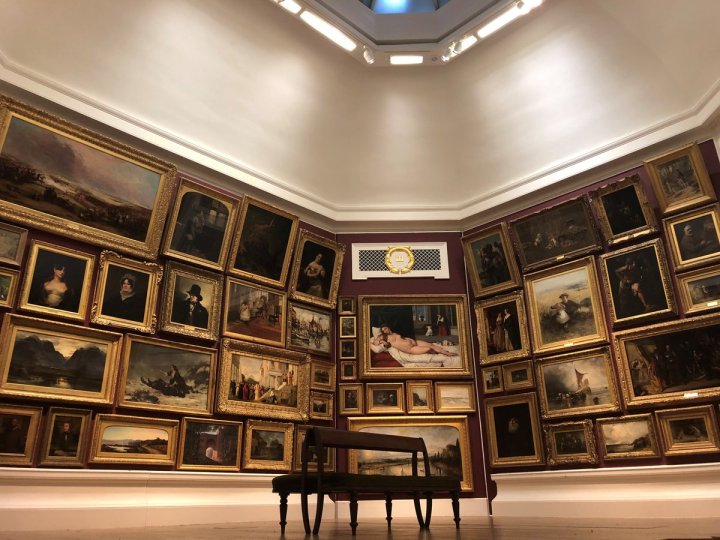
Salon hang with William Etty’s Venus of Urbino.
Exhibition | Painted in Mexico, 1700–1790: Pinxit Mexici
Press relese (5 July 2017) from LACMA:
Painted in Mexico / Pintado en México, 1700–1790: Pinxit Mexici
Fomento Cultural Banamex, Mexico City, 29 June — 15 October 2017
Los Angeles County Museum of Art, 19 November 2017 — 18 March 2018
The Metropolitan Museum of Art, New York, 24 April — 22 July 2018
Curated by Ilona Katzew with Jaime Cuadriello, Paula Mues Orts, and Luisa Elena Alcalá
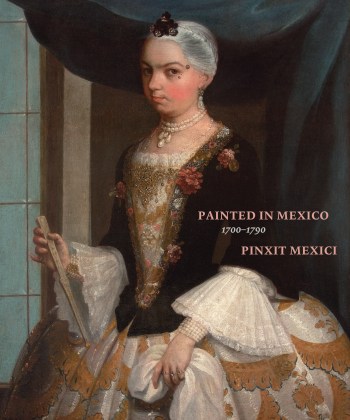
The Los Angeles County Museum of Art presents Painted in Mexico, 1700–1790: Pinxit Mexici, the first major exhibition to reposition the history of 18th-century Mexican painting, a vibrant period marked by major stylistic changes and the invention of compelling new iconographies. Co-organized by LACMA and Fomento Cultural Banamex, A.C. in Mexico City, this exhibition foregrounds the connections between Mexican painting and transatlantic artistic trends while emphasizing Mexican painting’s internal developments and remarkable pictorial output. More than 100 paintings are presented in the exhibition, many on view for the first time and restored for this exhibition.
Painted in Mexico, 1700–1790: Pinxit Mexici is curated by Ilona Katzew, curator and department head of Latin American art at LACMA, with guest co-curators Jaime Cuadriello, Universidad Nacional Autónoma de México, and Paula Mues Orts, Escuela Nacional de Conservación, Restauración y Museografía, both of Mexico City, and Luisa Elena Alcalá, Universidad Autónoma de Madrid of Spain. The exhibition is presented as part of the Getty’s Pacific Standard Time: LA/LA initiative and is one of a handful of historical exhibitions focusing on the legacy of Latin American art before the 20th century.
“This is truly a once-in-a-lifetime undertaking of an engrossing chapter in art history,” said Michael Govan, LACMA CEO and Wallis Annenberg Director. “Over the last six years, the co-curators have traveled all over Mexico to uncover new materials; many restored specially for the exhibition and photographed for the first time. This is a groundbreaking reassessment of the field, and we are proud to be at the forefront of this important undertaking and advancing new scholarship.”
Ilona Katzew, project director and a noted expert in the field, stated, “The 18th century is a particularly rich period in the history of Mexican art, which has not yet received its due attention. In organizing this exhibition, we hope to open up a vista on a sophisticated and innovative body of work, one that is contextually rich and highly rewarding to look at and study, and share our collective enthusiasm for this fascinating chapter of global art history.”
In the 16th century, European artists immigrated to Mexico to decorate newly established churches and complete artistic commissions. Some of these artists and their families formed workshops in Mexico that endured for several generations. By the 17th century, a new generation of artists born in the Americas began to develop their own pictorial styles that reflected the changing cultural climate as well as the desires of their patrons, both religious and secular. The 18th century ushered in a period of artistic splendor as local schools of painting were consolidated, new iconographies were invented, and artists began to group themselves into academies.
During the 18th century, painters were increasingly asked to create mural-size paintings to cover the walls of sacristies, choirs, and university halls, among other spaces. The same artists produced portraits, casta paintings (depictions of racially mixed families), painted folding screens, and finely rendered devotional imagery, attesting to their extraordinary versatility. The volume of work produced by the four generations of Mexican artists that spanned the 18th century is virtually unmatched elsewhere in the vast Hispanic world.
Painters also became more aware of their own contributions, largely owing to the sizable number of pictures that were exported to Europe, throughout Spanish America, and within the viceroyalty itself. This awareness led many educated painters not only to sign their works and emphasize their authorship but also to make explicit references to Mexico as their place of origin through the Latin phrase Pinxit Mexici (Painted in Mexico). This expression eloquently encapsulates the painters’ pride in their own tradition and their connection to larger, transatlantic trends.
The exhibition combines a chronological and thematic approach, and includes seven major sections:
Great Masters introduces the works of some of the leading painters of the day around which others congregated; the notion of a local tradition and intergenerational ties is emphasized. Since the 16th century, educated painters in Mexico City had organized themselves in guilds. By the 18th century, their most distinguished members (some of whom descended from long lines of illustrious painters) also established informal academies. The academy organized by the brothers Juan and Nicolás Rodríguez Juárez around 1722, for example, evidences the artists’ growing interest in revitalizing their art.
Master Story Tellers and the Art of Expression illustrates how works were designed to convey complex stories. Conceived as series, these works decorated the interiors of churches, convents, colleges, and other public spaces, where they became activated through their particular arrangement, including as part of altarpiece-ensembles. During the 18th century narrative painting underwent a resurgence, which is evident in its more organic and idealized (and at times idyllic) sensibility. The artist’s increasing interest in emphasizing domestic interiors and details of everyday life helped to establish a more intimate connection with the viewer.
Noble Pursuits and the Academy explores the efforts of artists throughout the 18th century to form art academies. The introduction of academic principles in Mexico is generally connected with the arrival of Jerónimo Antonio Gil from Spain and the establishment of Mexico’s Royal Academy of San Carlos in 1783. This perspective has overlooked the earlier trajectory of local artists, who long sought to have painting recognized as a noble, as opposed to a mechanical art. In the 18th century painters organized several independent academies (c. 1722, 1754, and 1768), where they actively engaged in discussions about the theory and practice of their art. They also attempted to elevate the status of painting by writing and referencing art treatises, by equating their task with that of the supreme creator, and refashioning their image through their self-portraits.
Paintings of the Land brings together a compelling group of works representing local subjects. The expression “paintings of the land” (pinturas de la tierra) recurs often in contemporary panegyric literature and artistic inventories to describe works unique to Mexico—either made there or representing aspects of life in Mexico. Many of the works included in this section, such as vedute (large-scale paintings of a cityscape or vista), casta paintings (depictions of racially mixed families), folding screens with fête gallant scenes (amorous figures in pastoral settings), and depictions of Indian weddings, are peppered with colorful local elements. The works brilliantly exemplify how Mexican painting could simultaneously fulfill artistic, political, and documentary purposes.
The Power of Portraiture illustrates the various modalities of the portrait genre. In the 18th century, Mexico saw an upsurge in portraiture associated with the economic growth of the viceroyalty, and different social groups, particularly within urban contexts, commissioned artists to paint their likenesses. In a hierarchical society such as New Spain, which placed a premium on nobility of birth, piety, wealth, titles, and merits, portraiture had the power to convey both corporate and personal messages. Through portraiture people could fashion and refashion their identities and project them onto society. Portraiture also fulfilled a genealogical role, designed to preserve the memory of families and institutions—religious and secular. Dress and other attributes became an essential part of the genre.
The Allegorical World looks at a highly inventive group of works that became prevalent in the 18th century. Often commissioned by ecclesiastical orders to instruct in issues of faith, allegorical images are fascinating manifestations of a culture that relied increasingly on its own visual metaphors. These images became particularly popular, in part, because of the versatility of allegorical language that could express many things simultaneously. Allegorical paintings can be broadly divided into four categories: guides to inner spirituality for nuns and monks within cloistered life, teaching or mnemonic tools to aid in the practice of piety, symbols that promoted local devotions, and commentaries to extol (or even criticize) figures of power. Some allegories were conceived as large- scale paintings that covered the walls of different institutions and religious spaces, while many smaller ones were designed to awaken piety within the context of cells and oratories.
Imagining the Sacred features a stunning selection of paintings that copied holy effigies, many considered miraculous. Copying holy images became part of a long tradition that engaged the best painters of the day. Although most subjects were universal, sacred painting saw significant developments in 18th-century Mexico. Painters updated age-old formulas: the resulting richness of themes, pictorial approaches, and devotional complexity is noteworthy. The most visible public images were large paintings representing specific sculptures that were known for performing miracles. Intimate devotional experience was more commonly channeled through smaller paintings, many on copper, in which painters demonstrated great precision and skill. These works reflect the extent to which art, belief, and society were inextricably connected.
Painters in the Exhibition
Juan Francisco de Aguilera (Spain [?], active Mexico, first quarter of the 18th century) Manuel de Arellano (Mexico, 1662–1722)
Ignacio María Barreda (Mexico, c. 1754–1800)
Ignacio Berben (Guadalajara, 1733–c. 1814)
Miguel Cabrera (Mexico, c. 1715–1768)
Francisco Clapera (Spain, 1746–1810, active Peru and Mexico)
Nicolás Correa (Mexico, 1657–c. 1708)
Nicolás Enríquez (Mexico, 1704–c.1790)
Rafael Joaquín Gutiérrez (Mexico, c. 1750–1792)
Fray Miguel de Herrera (San Cristóbal de la Laguna, Canary Islands, 1696–c. 1789, active Mexico)
José de Ibarra (Mexico, 1685–1756)
Andrés López (Mexico, 1727–1807)
Francisco Martínez (Mexico, 1687–1758)
Manuel Montes y Balcázar (Guadalajara, active, c. 1727–1760)
Juan Patricio Morlete Ruiz (Mexico, 1713–1772)
José de Páez (Mexico, 1721–c. 1790)
Rafael Ximeno y Planes (Spain, 1759–1825, active Mexico)
Pascual Pérez (Puebla, d. 1721)
Juan Rodríguez Juárez (Mexico, 1675–1728)
Nicolás Rodríguez Juárez (Mexico, 1677–1734)
Antonio de Torres (Mexico, 1667–1731)
Francisco Antonio Vallejo (Mexico, 1722–1785)
Miguel Jerónimo Zendejas (Puebla, 1720–1815)
José Joaquín de la Vega (Mexico, active second half of the 18th century)
International Scholar’s Day
February 2018
An international scholar’s day will be co-organized with the University of California, Los Angeles (UCLA), enabling established and junior scholars to present new research. Given the extensive restoration undertaken for the exhibition, part of the event will be dedicated to presentations by leading conservators from Mexico, the United States, and Europe, who will discuss the techniques, materials, and pictorial processes employed by Mexican painters, and their wider art historical implications.
Ilona Katzew, ed., with contributions from Ilona Katzew, Luisa Elena Alcalá, Jaime Cuadriello, Ronda Kasl, and Paula Mues Orts, Painted in Mexico, 1700–1790: Pinxit Mexici (New York: Prestel, 2017), 512 pages, ISBN: 978 379135 6778, $85.
Painted in Mexico, 1700–1790: Pinxit Mexici is accompanied by a groundbreaking catalogue that offers the first in-depth assessment of 18th-century Mexican painting, making accessible an extraordinary body of images, alongside compelling new scholarship. The volume is edited by Ilona Katzew with contributions by the exhibition co-curators Luisa Elena Alcalá, Jaime Cuadriello, Ilona Katzew, and Paula Mues Orts. Exquisitely illustrated with newly commissioned photography of never-before-published artworks, the book includes fascinating essays on a number of themes, such as the tradition and innovation of Mexican painting, the mobility of pictures within and outside the viceroyalty, the political role of images, and the emphasis on ornamentation. Rounding out this volume are over 130 catalogue entries that offer new and authoritative interpretations. The book is published by LACMA and Fomento Cultural Banamex, A.C., and DelMonico Books, Prestel. A Spanish edition is also available.
Catalogue cover image: Juan Patricio Morlete Ruiz, Mexico, 1713–1772, Portrait of Doña Tomasa Durán López de Cárdenas (Retrato de Doña Tomasa Durán López de Cárdenas), ca. 1762, Galería Coloniart. Collection of Felipe Siegel, Anna and Andrés Siegel, Mexico City.










leave a comment