Exhibition | Model Citizens
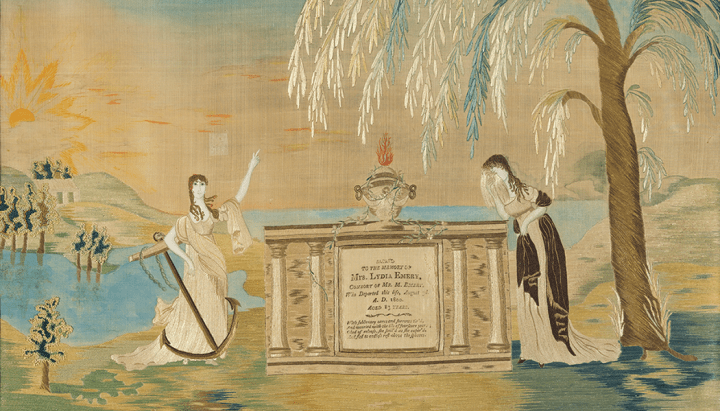 Susan Merrill, Memorial to Mrs. Lydia Emery (1717–1800), 1811; watercolor on silk
(Portland Museum of Art, 1968.4)
◊ ◊ ◊ ◊ ◊
From the Portland Museum of Art:
Model Citizens: Art and Identity in the United States, 1770–1830
Portland Museum of Art, 10 September 2017 — 28 January 2018
Model Citizens: Art and Identity in the United States, 1770–1830 presents works from the PMA’s permanent collection by the most celebrated artists of the early United States alongside portrait miniatures, samples, and silhouettes. This wide range of visual culture provides a glimpse into how late 18th- and early 19th-century Americans elected to represent themselves in private and public spheres as husbands, wives, children, and citizens.
Arranged in three sections, the exhibition uses the life cycle as an organizing principle to introduce viewers to the many modes of self-representation popular in the era, from finely painted portraits by Gilbert Stuart and Thomas Badger to modestly-scaled cut silhouettes and mourning embroideries. The first section showcases paintings of children alongside embroidered samplers produced by the young women of the Stone family at Portland’s Miss Martins’ School. This portion provides a glimpse of how families understood lineage as well as how painters helped visualize changing ideas about the nature of childhood. The samplers show how young, upper-class women expressed their creativity and accomplishment. The second section features works that portray grown men and women, often commemorating major life events such as marriage. In addition to paired portraits and individual works by renown painters such as Stuart and John Singleton Copley, this section will also feature silhouettes and minatures—small-scale, modestly priced works that allowed sitters to circulate likenesses among family and friends. The final section presents examples of men and women at the end of life such as the PMA’s newly acquired portrait of Judge Stephen Jones, who was in his eighties when he sat for Gilbert Stuart. This section will also include mourning emroideries to underscore how early Americans used painting and needle work to commemorate loved ones after death.
Generously supported by Shannon C. Gordon with additional support from Friends of the Collection.
Exhibition | Louis-Nicolas van Blarenberghe and the Battle of Yorktown

Louis-Nicolas Van Blarenberge, The Siege of Yorktown, 1786; gouache on panel, 24 × 37 inches
(Private Collection of Nicholas Taubman)
◊ ◊ ◊ ◊ ◊
Press release (24 August 2017) from the Museum of the American Revolution:
Louis-Nicolas van Blarenberghe and the Battle of Yorktown
Museum of the American Revolution, Philadelphia, until 24 September 2017
Only one month remains to see two 18th-century paintings depicting the last major land battle of the Revolutionary War on display at the Museum of the American Revolution. The paintings, The Siege of Yorktown and The Surrender of Yorktown, are incredibly detailed and populated with hundreds of tiny figures, like 18th-century ‘Where’s Waldo?’ scenes. The original versions of the paintings were created for King Louis XVI by French artist Louis-Nicolas van Blarenberghe, the court Painter of Battles to the King. Those paintings are on display at the Palace of Versailles. The paintings on view at the Museum of the American Revolution are secondary versions created by Van Blarenberghe in 1786 for French General the Comte de Rochambeau, the commander of the French forces at Yorktown. The paintings remained in the Rochambeau family until about 15 years ago and are in pristine condition.
“We are thrilled to be able to offer our visitors the extraordinary opportunity to view these incredible, richly detailed paintings,” said Museum President Michael Quinn. “The discovery of previously undetected differences between the two sets of paintings is a fascinating detective story, making the paintings all the more intriguing.”
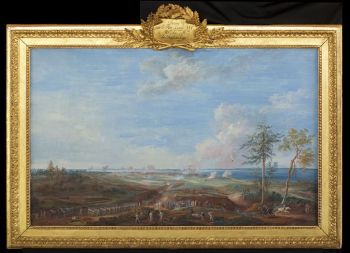
Louis-Nicolas Van Blarenberge, The Siege of Yorktown, 1786; gouache on panel, 24 × 37 inches.
Having researched the paintings, Christopher Bryant, a Massachusetts-based independent scholar and dealer of historical portraits and artifacts, believes that Rochambeau gave direction to Van Blarenberghe in the execution of the paintings on display at the Museum. Bryant argues that, given the interest taken by Rochambeau in the paintings as visual records of the crowning achievement of his career and the fact that he was an eyewitness to the events depicted, the differences between the paintings are likely corrections made from the originals, rendering Rochambeau’s copies even more historically accurate than those painted for King Louis XVI.
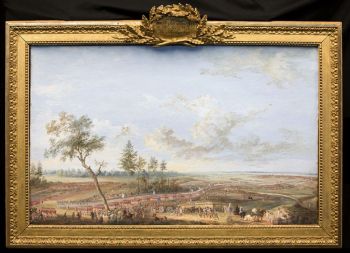
Louis-Nicolas Van Blarenberge, The Surrender of Yorktown, 1786; gouache on panel, 24 × 37 inches.
The most prominent alteration to the 1786 version of the Siege is the addition of a group of American officers near the figure of Rochambeau. While the original painting includes only one American officer holding a map, the replica depicts a group of ten officers gathered around that original figure, now identifiable as General George Washington. The map he holds can be identified as a plan drawn by Lafayette’s cartographer of the British fortifications at Yorktown. Interestingly, this same scene is reprised in Louis-Charles-Auguste Couder’s Siege of Yorktown (1836), a 19th-century copy of which is displayed on the Museum’s second floor.
“These paintings are remarkable in being superb works of art while also being extraordinarily accurate and detailed. It is very rare that you have that combination as those two circumstances are usually mutually exclusive,” said Bryant. “However, these paintings are both: they are wonderful paintings on an artistic basis, but there is also so much historical information within them that can be independently corroborated, that they can now be seen as important historical documents in their own right. The Surrender provides one of the most accurate accounts of this historic event known.”
Other changes to the paintings include alterations to the uniforms worn by Rochambeau and Washington, several topographical revisions, and the addition of a tree to obscure portions of a scene in Surrender. Van Blarenberghe also altered the location of the Metz Artillery, the senior French artillery present at the battle, within the Surrender painting. This change reveals the important role the Metz Artillery played in the surrender ceremony.
The paintings, on short-term loan from Ambassador and Mrs. Nicholas F. Taubman, are located in one of the Museum’s final galleries that explores the battles and skirmishes in 1781 that culminated with the Siege of—and ultimately, the Surrender of General Cornwallis’s 6,000-man British army at—Yorktown, Virginia. They will be replaced with two 18th-century prints from the Museum’s collection, one of British General Charles Cornwallis and one of British Lieutenant Colonel Banastre Tarleton.
Exhibition | Streams and Mountains

Ten Thousand Miles along the Yellow River, detail, 1690–1722; Chinese, Qing Dynasty (1644–1911); two handscrolls; ink, color, and gold on silk; image is 78 × 1285 cm (New York: The Metropolitan Museum of Art, 2006.272a, b). More information is available here»
◊ ◊ ◊ ◊ ◊
Press release (10 August) from The Met:
Streams and Mountains without End: Landscape Traditions of China
The Metropolitan Museum of Art, New York, 26 August 2017 — 6 January 2019 (with three rotations)
Curated by Joseph Scheier-Dolberg
From the standpoint of splendid scenery, painting cannot equal [real] landscape. But when it comes to the wonders of brush and ink, [real] landscape is no match for painting! —Dong Qichang (1555–1636)
About a thousand years ago, the legendary Chinese landscape painter Guo Xi posed the question, “In what does a gentleman’s love of landscape consist?” This question is at the heart of The Metropolitan Museum of Art’s Streams and Mountains without End: Landscape Traditions of China.
Showcasing more than 120 Chinese landscape paintings in three rotations, Streams and Mountains without End explores the many uses of landscape in the Chinese visual arts. The focus is on paintings, but textiles, ceramics, bamboo carvings, and objects in other materials are also included. Arranged in thematic groupings, the works in the exhibition have been selected to provide gateways into the tradition, drawing out distinctions between types of landscape that may not be obvious at first glance. What appears to be a simple mountain dwelling is revealed to be the villa of the painter’s friend, which encodes a wish for his happy retirement; what seems to be a simple study in dry brushwork turns out to be an homage to an old master, a sign of reverence for what had come before. The exhibition brings the tradition to life by showing the layers of meaning that lie behind these ubiquitous images of tree, stream, and mountain. A quotation from classical Chinese painting theory introduces each grouping, giving the tradition itself a voice in the exhibition. The works in the exhibition are drawn primarily from The Met collection, supplemented by a dozen works from private lenders. The exhibition is made possible by the Joseph Hotung Fund.
Among the show’s highlights are a Song dynasty (960–1279) handscroll, Two Landscapes Inspired by the Poetry of Du Fu, a rare example of early literati painting, attributed to Sima Huai (Chinese, active ca. 1131–62); a 15th-century handscroll, The Four Seasons, which takes the viewer through an extended journey; the 1571 handscroll Fantastic Scenery in the Human Realm, a dynamic landscape of bizarre and contorted forms, by Wen Boren; and two majestic landscapes from the Qing dynasty court: Ten Thousand Miles along the Yellow River, dated to 1690–1722, and the The Qianlong Emperor’s Southern Inspection Tour, scroll four, dated 1770, by Xu Yang (active ca. 1750–after 1776).
In conjunction with the exhibition, The Met’s Education Department is offering tours led by the exhibition organizer Joseph Scheier-Dolberg, Assistant Curator in the Museum’s Department of Asian Art, on September 27 and November 8; the one-hour tours start at 10:30am.
Exhibition | Leonardo to Matisse: Master Drawings
From The Met:
Leonardo to Matisse: Master Drawings from the Robert Lehman Collection
The Metropolitan Museum of Art, New York, 4 October 2017 — 7 January 2018
Curated by by Dita Amory and Alison Nogueira
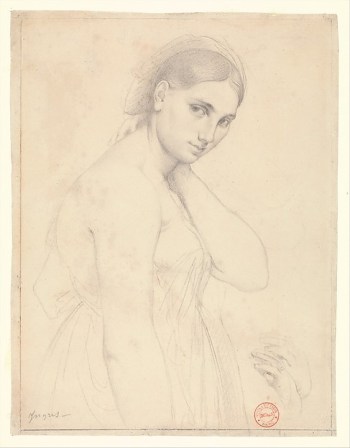
Jean Auguste Dominique Ingres, Study for ‘Raphael and the Fornarina'(?), ca. 1814; graphite on white wove paper, 25.4 × 19.7 cm (New York: The Metropolitan Museum of Art, Robert Lehman Collection, 1975.1.646).
This exhibition will trace the development of European drawing from the Renaissance to the early 20th century through works by celebrated masters such as Leonardo da Vinci, Dürer, Rembrandt, Tiepolo, Ingres, Seurat, and Matisse. Fifty-five drawings from the Museum’s acclaimed Robert Lehman Collection will present a dynamic array of styles, techniques, and genres—from panoramic landscapes and compositional studies for mythological and biblical narratives to arresting studies of the human form.
The selection will illustrate different facets of the artists’ creative processes—from Leonardo’s keen anatomical observation in his Study of a Bear, to Dürer’s awakening self-consciousness as an artist in his Self-Portrait study, to Rembrandt’s reinterpretation of Leonardo’s painted masterpiece, The Last Supper. The exhibition will also be the first to explore Robert Lehman’s significant activity as a 20th-century collector by highlighting the full range of his vast and distinguished drawings collection, which numbers more than 700 sheets.
The exhibition is organized by Dita Amory, Curator in Charge, and Alison Nogueira, Associate Curator, both of the Robert Lehman Collection at The Met.
New Book | Enchanted World of German Romantic Prints
The related exhibition was on display at the Philadelphia Museum of Art in the autumn of 2013. From Yale UP:
John Ittmann, ed., with essays by Warren Breckman, Mitchell B. Frank, Cordula Grewe, John Ittmann, Catriona MacLeod, and F. Carlo Schmid, Enchanted World of German Romantic Prints, 1770–1850 (New Haven: Yale University Press, 2017), 424 pages, ISBN: 978 03001 97624, $65.
 From the 1770s through the 1840s, German, Austrian, and Swiss artists used the medium of printmaking to create works that synthesized poetry, literature, music, and the visual arts in new and captivating ways. Finding an eager audience in the growing number of educated middle-class collectors, printmakers experimented with modern technologies, such as lithography, and drew on the contemporary interest in regional folklore and traditional fairy tales to produce innovative compositions that both contributed to and reflected the dramatic cultural and political upheavals of the Romantic era. Featuring the work of more than 120 artists, including Casper David Friedrich, Ludwig Emil Grimm, Joseph Anton Koch, Philipp Otto Runge, and Johann Gottfried Schadow, this authoritative book contains many unique and never-before-published examples of prints from the Philadelphia Museum of Art’s unrivaled collection.
John Ittmann is the Kathy and Ted Fernberger Curator of Prints at the Philadelphia Museum of Art.
Print Quarterly, September 2017
The eighteenth century in the current issue of Print Quarterly:
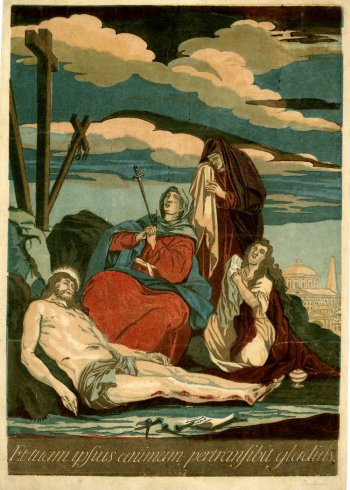
John Baptist Jackson, Lamentation over the Body of Christ, ca. 1740–44, woodcut with embossing (London: The British Museum).
Print Quarterly 34.3 (September 2017)
A R T I C L E S
• Evelyn Wöldicke, “John Baptist Jackson’s Woodcuts and the Question of Embossing,” pp. 298–310.
• Freyda Spira, “Micrographic Allegories by Johann Michael Püchler and Matthias Buchinger,” pp. 310–16.
R E V I E W S
• Adriano Aymonino, Review of the exhibition catalogue, Maria Rosaria Nappi, ed., Immagini per il Grand Tour: L’attività della Stamperia Reale Borbonica (Edizioni Scientifiche Italiane, 2015), pp. 328–31.
• Rolf Reichardt, Review of Philippe de Carbonnières, La Grande Aarmée de papier: Caricatures napoléoniennes (Presses Universitaires de Rouen et du Havre, 2015), pp. 331–33.
• Perrin Stein, Review of Kristel Smentek, Mariette and the Science of the Connoisseur in Eighteenth-Century Europe (Ashgate, 2014), pp. 340–44.
Exhibition | Witches: Metamorphosis of Goya
Press release (via Art Daily) for the exhibition:
Denise de la Rue, Witches: Metamorphosis of Goya / Brujas: Metamorfosis de Goya
Lázaro Galdiano Museum, Madrid, 21 June — 31 October 2017
Curated by Carmen Espinosa and Flavia Hohenlohe
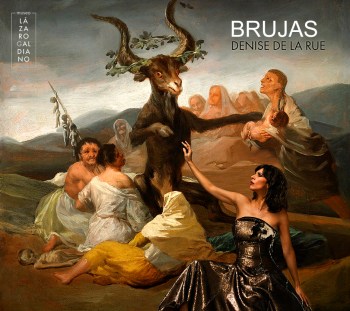
Denise de la Rue, ‘Maribel Verdú y Goya’, a partir de ‘El Aquelarre’ de Francisco de Goya (1798), 2017.
Witches, an exhibition by Mexican artist Denise de la Rue, curated by Carmen Espinosa and Flavia Hohenlohe at the Lázaro Galdiano Museum in Madrid, is the second component of her series Angels and Witches: Goya, Metamorphose, a study of Francisco de Goya’s paintings through a reinterpretation of the old master’s work. De la Rue has created a series of photographs juxtaposing iconic Spanish actresses with the painter’s work, analysing the dichotomies and similarities between these characters whilst engaging with historical and relevant sites such as the Museum. Taking elements of the actor profession that coincide with the characteristics of angels and witches such as mysticism, magic, life, death and the power of creation, transformation and destruction, De la Rue has created a dialogue between the actresses and Goya’s paintings. The essence of this series is the interest of the artist in researching the capability of women to transform and empower themselves, which historically has been seen as threatening to the conservative preconception of patriarchal societies.

Denise de la Rue, a partir de ‘Vuelo de Brujas’ de Francisco de Goya (Prado, 1798), 2017.
As a starting point to create Witches, a new body or work, De la Rue has taken Goya’s Vuelo de Brujas (Witches’ Flight), Prado Museum; El Aquelarre (Witches’ Sabbath) and Las Brujas (The Witches), both at the Lázaro Galdiano Museum; Hechizado a la Fuerza (The Forcibly Bewitched), National Gallery London; La Cocina de las Brujas (The Witches’ Kitchen), untraced; and Don Juan y el Comendador (Don Juan and the Commander), untraced. The series was commissioned by the Dukes of Osuna between 1797 and 1798 for the Alameda Palace in Madrid, best known as El Capricho.
Two of these pieces, Las Brujas and El Aquelarre, are part of the Museum’s permanent collection and will be displayed alongside De la Rue’s work, creating a conversation between the old master and the contemporary artist. The extravagance of these two pieces also draws special attention. Here the unreal becomes visible, riding between the terrifying and the ironic. Both paintings appear to be inspired by eighteenth-century texts as well as popular tradition, a key focus in De la Rue’s research. The exhibition of Witches is a unique opportunity not only to see two of Goya’s original paintings of witches together but to appreciate the full series through De la Rue’s work.
Two of the original paintings have been lost, and De la Rue has recaptured them by retrieving historic files that include details of the works. Using photography technology, the artist has reconstructed the works and reunited them in the same space for the first time since the pieces left the Dukes of Osuna’s hands.
In addition to the photographs, the Museum will present De la Rue’s video dedicated to the painting Las Brujas in which the actress Bárbara Lennie dances to the poem “Pequeño vals Vienés” (“Little Venice Waltz”) by Federico Garcia Lorca interpreted by flamenco singer Enrique Morente.
The first component of the exhibition Angels and Witches Goya, Metamorphose was the chapter of Angels at the Royal Chapel of San Antonio de la Florida in Madrid where Goya remains rest, as well as where some of his most recognised frescos are. The exhibition opened in February and was a highlight of the Madrid cultural calendar. Having the two exhibitions of Angels and Witches in dialogue with Goya’s work in these unique venues is a rare opportunity to see and understand Goya’s interest in witchcraft and the holy, revised by photography and a contemporary perspective.
Video from the previous installation Ángelas:
Symposium | Art of Power: The 3rd Earl of Bute, Politics, and Collecting
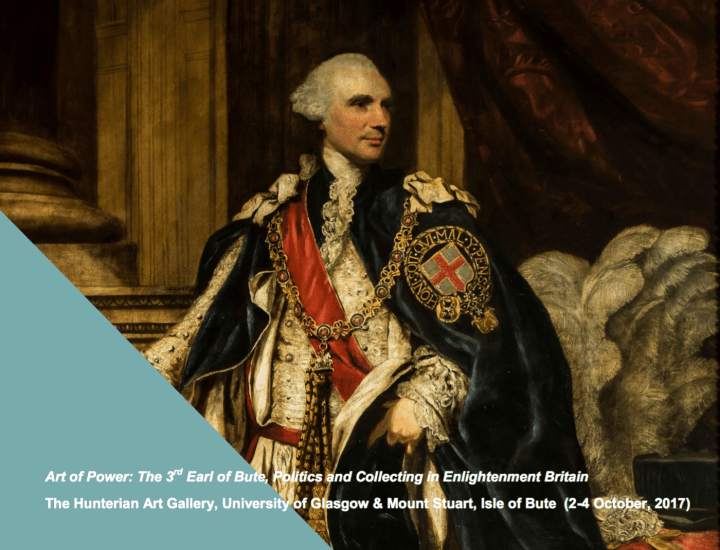
From the symposium flyer:
Art of Power: The 3rd Earl of Bute, Politics, and Collecting in Enlightenment Britain
The Hunterian Art Gallery, University of Glasgow and Mount Stuart, Isle of Bute, 2–4 October 2017
In 2017, the Mount Stuart Trust and The Hunterian Art Gallery, University of Glasgow, are hosting a major exhibition merging art, biography, politics, and cultural history. Art of Power: Masterpieces from the Bute Collection uncovers the fascinating Enlightenment figure, John Stuart, 3rd Earl of Bute (1713–1792), and his collection of rarely-seen masterpieces. A three-day interdisciplinary symposium inspired by themes of the exhibition will explore the dynamic interplay between art, politics, and collecting so evident in the life of the 3rd Earl of Bute. In sessions open to the public, papers will be delivered on day one in Glasgow. Days two and three will take place at Mount Stuart (with only a very limited number of spaces) and will include tours of the house, archives, and collection highlights.
Confirmed Speakers
Desmond Shawe-Taylor (Royal Collection), Rosie Razzall (Royal Collection), Anne T. Woollett (J. Paul Getty Museum), Anthony Lewis (Glasgow Museums), Wayne E. Franits (Syracuse University), Graham Rowe (University of Derby), Heiner Krellig (independent), Janet Stiles Tyson (Birkbeck), Oliver Cox (Oxford), Peter Black (Hunterian), Mungo Campbell (Hunterian), and Caitlin Blackwell (Mount Stuart)
Exhibition | In Her Majesty’s Hands: Medals of Maria Theresa
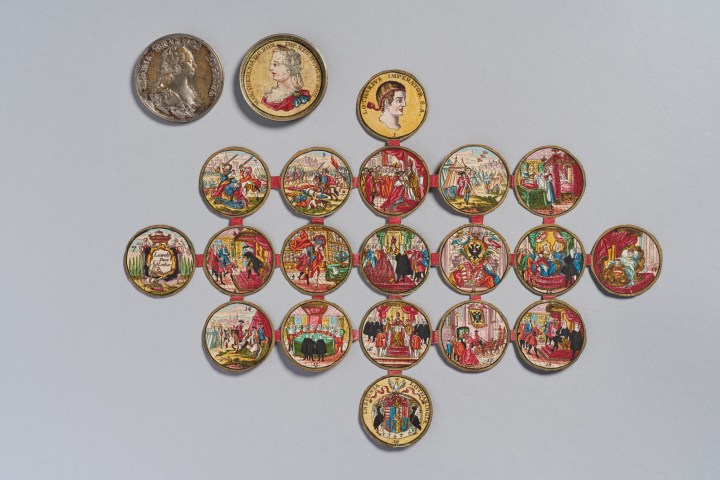
Matthäus Donner / Andreas Vestner, Maria Theresa Box Medal (Schraubmedaille) containing hand-coloured drawings; silver, hand-coloured drawing on paper inside the medal (Vienna, Kunsthistorisches Museum, Coin Collection, inv.no. 5955/1914B).
◊ ◊ ◊ ◊ ◊
Press release (via Art Daily) for the exhibition now on view at the KHM:
In Her Majesty’s Hands: Medals of Maria Theresa
Kunsthistorisches Museum, Vienna, 28 March 2017 — 18 February 2018
Curated by Anna Fabiankowitsch and Heinz Winter
The Kunsthistorisches Museum’s Coin Collection holds both the largest and by far the most important collection of coins minted under Maria Theresa; it is the best place, and now is the best time, to host an exhibition that presents the monarch’s life in medals to celebrate what would have been her 300th birthday.
 The exhibition focuses on the most important topoi in Maria Theresa’s private and public life. It presents her in the company of her large family, running the gamut of events from dynastic marriages to heart-breaking calamities. It showcases her role as a ruler forced to fight several wars for her inheritance and, together with her son and co-regent Joseph II, as a pioneering social reformer. The artefacts on show also illustrate the extent of Maria Theresa’s realm, which comprised many different ethnicities and cultures.
All these topoi are reflected in medals that emblematise historical events with the help of allegories. Maria Theresa was already widely glorified and celebrated during her lifetime, but the exhibition also documents how she was portrayed by her enemies. So-called satirical medals, which were passed around in private, turned Maria Theresa into an object of derision.
The exhibition focuses, too, on the historical background of medal production to illustrate the requisite technical skills, expenditure, and effort; introduce the most important protagonists; and document the range, purview, and media-value of Maria Theresa’s medals.
Maria Theresa (1717–1780) became a legend during her lifetime, and few female rulers were depicted more frequently or diversely. Her many likenesses—among them portraits, engravings, medals, and medallions—were designed to preserve her memory for posterity, turning her into an 18th-century media-star.
Medals played a central role in this propaganda effort controlled by the imperial court. Among the period’s foremost artistic mass media, medals were minted under the aegis of the court, and they continue to reflect the ruler’s political aims and the way she saw herself. Over three hundred different medals were produced during Maria Theresa’s reign to commemorate or celebrate either members of the imperial family or political events, both national and international.
Medals functioned as a way to commemorate important events of her reign, and as they were minted in large numbers, the material is noted for its longevity and their handy format made it easy to disseminate them, they were regarded as a historical record that would last forever. Contemporaries called these miniature memorials show- or commemorative coins, and they evolved into much sought-after and frequently exchanged collectors’ pieces. The monarch presented them as signs of imperial favour, in recognition of the recipient’s merits or achievements, or to strengthen diplomatic ties, and the majority of the medals produced in Vienna were destined for the court—ending up in Her Majesty’s hands.
Zuhanden Ihrer Majestät: Medaillen Maria Theresias (Vienna: Kunst Historisches Museum, 2017), 100 pages, 15€.

Curator Anna Fabiankowitsch during preparations for the exhibition
Photo by Lukas Beck
Exhibition | Living Rooms: The Period Room Initiative
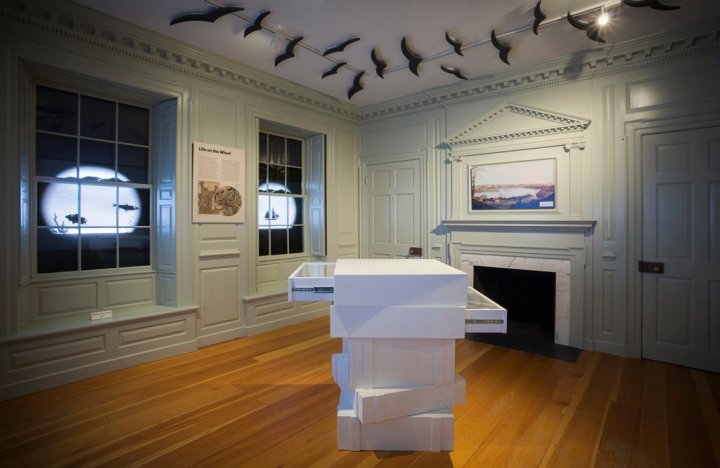
Providence Parlour, ca. 1760–70; painted pine
(Minneapolis Institute of Art)
◊ ◊ ◊ ◊ ◊
I’m glad to note that former Enfilade intern Mattie Koppendrayer contributed portions of the research for the room on ‘Science and Sociability’. Along with these fascinating installations of Mia’s period rooms, the museum’s eighteenth-century offerings for the fall will include the exhibition Eyewitness Views: Making History in Eighteenth-Century Europe, which recently closed at The Getty and opens in Minneapolis on September 10. –CH
Now on view at Mia:
With Living Rooms, a multi-year initiative, Mia is reinvigorating its period rooms for today’s visitors, placing the past in dialogue with the present, while simultaneously broadening the conversation to include other histories—of marginalized people, of the senses, and even of time itself.
Just Imported: Global Trade in 1700s New England
Minneapolis Institute of Art, 22 April 2017 — 15 April 2018
The Providence Parlor once occupied prime real estate on a wharf in 1700s Providence, Rhode Island. Its owners, brothers Joseph and William Russell, operated a prosperous merchant business that imported and exported goods by sea. Their store, The Sign of the Golden Eagle, offered a resplendent selection of imported fabrics, exotic spices, fine housewares, and hogsheads of rum, among other goods. Their market was the world, and the world, their market, made possible by trade winds, war profiteering, and the labor of enslaved people. With their wealth, the Russell Brothers built the first three-story home in Providence, with views of the harbor. Originally installed at Mia in 1923, the parlor, along with its original inhabitants and harborside location, is brought back to life through a naturalistic soundscape, multi-sensory discovery cabinet of mercantile curios, and animated shadow puppets.
Read more here»
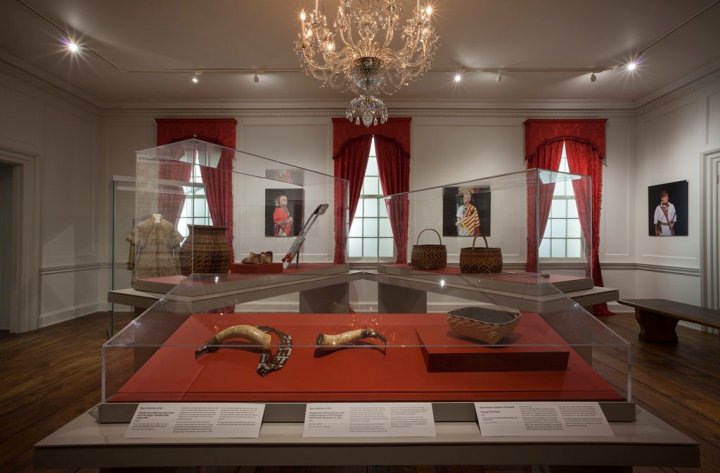
Charleston Drawing Room, ca. 1772; cyprus
(Minneapolis Institute of Art)
◊ ◊ ◊ ◊ ◊
The Many Voices of Colonial America
Minneapolis Institute of Art, 22 April 2017 — 15 April 2018
The Charleston Dining and Drawing Rooms came from the 1772 home of Colonel John Stuart, who served as Superintendent of Indian Affairs for Britain’s southern colonies and was also an owner of enslaved Africans. For over 80 years, the rooms have been interpreted as late-1700s interiors featuring high-style Chippendale and Federal-style American and English furniture and objects. This new temporary exhibition replaces a stylistic approach by reinserting African and Native American presence in these spaces. In the Charleston Drawing Room, Cherokee art of the Colonial era and contemporary Cherokee art that responds to this moment of history reveal stories of diplomatic relations and travel between the Cherokee Nation and the British Crown. In the Charleston Dining Room, West African and African American objects tell important stories of Charleston’s dependence on enslaved West Africans’ indigenous knowledge of rice cultivation for commercial gain and as a source of nourishment during this time—foreshadowing the legacy of African cuisine in contemporary America.
Read more here»
In addition, see this Mia blog posting by Alex Bortolot (Content Strategist at the Minneapolis Institute of Art, and a specialist in the arts of Africa), “Who Is an American? Here’s one way museums can ask—and answer,” available here»
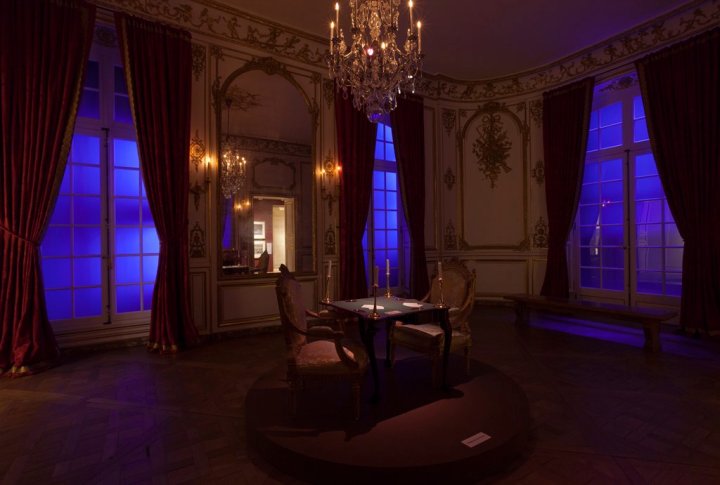
Grand Salon from the Hôtel de la Bouëxière, 1733–37; painted and gilt wood, plaster, marble and iron
(Minneapolis Institute of Art)
◊ ◊ ◊ ◊ ◊
Up All Night in the 18th Century
Minneapolis Institute of Art, 22 April 2017 — 15 April 2018
In the 1700s, European cities witnessed a gradual but profound shift in daily life: people stayed up later and partied harder into the night. Many of their nocturnal soirees were private affairs, hosted in elite homes by invitation only. The Grand Salon from the Hôtel de la Bouëxière will be prepped for one of these exclusive parties with a games table for card-playing (the night-loving aristocrat’s favorite diversion), candlesticks, and the required stimulants: coffee and chocolate. Of course, staying up late meant burning the midnight oil, so artificial lighting with candles and fire increased in importance during this time. New lighting in the Salon will simulate the effects of flickering flames, revealing the warm glow of gilded paneling and metalwork in a ‘nighttime’ setting.
Read more here»
Additional information on the Grand Salon is available here»
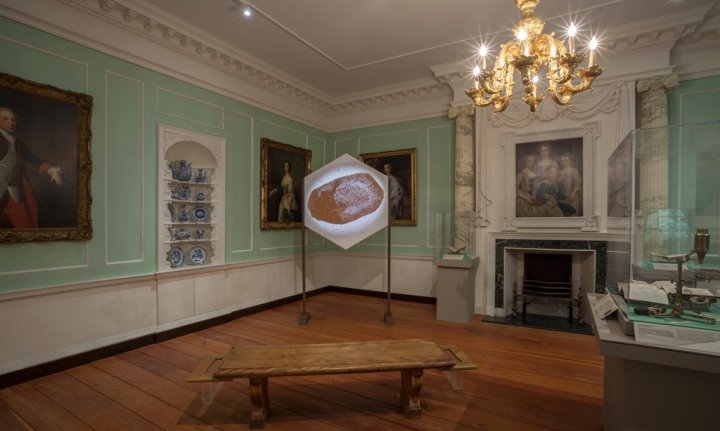
Georgian Drawing Room, ca. 1740; painted pine
(Minneapolis Institute of Art)
◊ ◊ ◊ ◊ ◊
Science and Sociability in 1700s England
Minneapolis Institute of Art, 22 April 2017 — 15 April 2018
In 1700s England, the home was a place where genteel men and women studied and conversed about natural history; only later did science move exclusively to the laboratory, where it became a predominantly male profession. This temporary exhibition presents Mia’s British rooms as places for the pursuit of science. Women often engaged with scientific discoveries and cultivated observational skills through embroidery and drawing—common pursuits for women of leisure. The c. 1730 Queen Anne Room will feature works on paper and textiles made by women. The adjoining c. 1740 Georgian Drawing Room will be arranged for a ‘scientific party’ where curious men and women socialized amidst telescopes, microscopes, an electrostatic generator—an experimental instrument that generated an electric charge—and, of course, tea.
Read more here»
In addition, see this Mia blog posting by Nicole LaBouff (Assistant Curator, Textiles Department of Decorative Arts, Textiles and Sculpture), “Science Is for Lovers: Why the planet needs scientists and passionate amateurs to work together,” available here»
and this posting by Peter Heering (Professor of Physics at the Europa Universität Flensburg in Germany and the former president of the International History, Philosophy, and Science Teaching Group), “Social Science: How to recreate an Enlightenment-era ‘science party,” available here»










leave a comment