Exhibition | John Trumbull: Visualizing American Independence

Press release (1 November 2016) from the Wadsworth Atheneum:
John Trumbull: Visualizing American Independence
Wadsworth Atheneum Museum of Art, Hartford, 5 November 2016 — July 2017
Three historic scenes by America’s first history painter, John Trumbull, are central to a new installation at the Wadsworth Atheneum Museum of Art that explores the visual interpretation of the Revolutionary War (1775–83). John Trumbull: Visualizing American Independence features more than 30 objects taken from the museum’s permanent collection, including additional work by Trumbull, as well as works by modern artists who revisited the legacy of the war in the twentieth century in observance of major anniversaries such as the bicentennial of George Washington’s birth in 1932 and the nation’s bicentennial in 1976. The installation opens November 5, 2016 and is on view through July 2017.
John Trumbull (1756–1843) served in the Continental Army during the Revolutionary War and later created a series of eight paintings devoted to the subject, explaining once to Thomas Jefferson that he hoped the paintings would “diffuse the knowledge and preserve the memory of the noblest series of actions which have ever dignified the history of man.” After completing a second edition to adorn the rotunda of the United States Capitol in Washington, D.C., Trumbull began a third and final series in 1831. Due to his failing health, Trumbull was able to complete only five of the paintings, all of which were purchased by the trustees of the Wadsworth Atheneum. Trumbull’s Revolutionary War scenes were some of the museum’s inaugural objects and were displayed when the first gallery opened in 1844. Three of those paintings—The Death of General Montgomery in the Attack on Quebec, December 31, 1775; The Declaration of Independence, July 4, 1776; and The Capture of the Hessians at Trenton, December 26, 1776—are included in the installation. The Death of General Warren at the Battle of Bunker’s Hill, June 17, 1775 is on view in the museum’s Morgan Great Hall, and The Death of General Mercer at the Battle of Princeton, January 3, 1777 is scheduled for loan to a peer institution.
Trumbull’s role as artist-historian encouraged later generations of artists to address the American Revolution, securing the legacy of its heroes. “Trumbull set the stage for later generations of artists to reinterpret the Revolutionary War and enhance the iconography of American independence,” says Erin Monroe, the Robert H. Schutz, Jr., Associate Curator of American Paintings and Sculpture.
One of the most frequently portrayed subjects from this period is George Washington, whose image—especially after his death—became so symbolic that memorial portraits elevated him to a divine figure. Many portraits were made into engravings and mass-produced, providing artists with easy accessibility to Washington’s likeness for transfer onto textiles, decorative arts, jewelry, postage stamps, currency, and other objects. John Trumbull: Visualizing American Independence features a range of such renditions, including several nineteenth-century ceramic jugs decorated with Washington’s image and a 1975 color lithograph by Alex Katz, titled Young Washington, from the Kent Bicentennial Portfolio, Spirit of Independence.
Exhibition | Fashionable Likeness: Pastel Portraits in Britain
Press release (21 October 2016) from The Getty:
Fashionable Likeness: Pastel Portraits in 18th-Century Britain
Getty Center, Los Angeles, 1 November 2016 — 7 May 2017
Curated by Julian Brooks and Ketty Gottardo with assistance from Alessandra Nardi
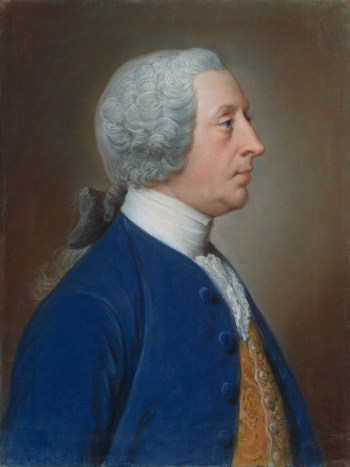
William Hoare, Portrait of Henry Hoare, ‘The Magnificent’, of Stourhead, ca. 1750–60, pastel on paper. Unframed: 61 × 45.7 cm (Los Angeles: The J. Paul Getty Museum, 2013.47.1).
In eighteenth-century Britain, portraits were commissioned by an increasingly wide cross-section of society, including the newly rich, as a visible symbol of their wealth and cultural aspirations. Fashionable Likeness: Pastel Portraits in 18th–Century Britain explores the topic of portrait drawing through a number of works in the Getty Museum’s permanent collection and select loans.
“Eager to affirm their elevated social status, sitters in 18th-century Europe were frequently portrayed in the latest fashion, wearing opulent outfits topped with powdered wigs and elaborate hairstyles,” explains Timothy Potts, director of the J. Paul Getty Museum. “With its unique texture and luminosity, pastel was the perfect medium to capture the sitters’ evanescent expressions and the symbols of their stature—the richness of their silk dresses and velvet coats. As well as its rich artistry, this exhibition also provides an insight into the carefully calibrated social structure of the day.”
“For artists and sitters, pastel painting offered practical advantages over oil, as it required fewer sittings and did not need to dry between sessions,” says Julian Brooks, co-curator of the installation. “In addition, ready-made pastel sticks were easily portable and cost less than oils.”
The first artist to become internationally renowned for pastel portraits was the Venetian artist Rosalba Carriera, whose work was much sought after by collectors across Europe. Praised for her talent at capturing a vivid likeness, Carriera employed a subtle technique of smoothing and blending hues that influenced a generation of British pastelists. Among those was John Russell, who trained with Francis Cotes and later authored Elements of Painting with Crayons (1772), one of the earliest English treatises on the pastel technique.
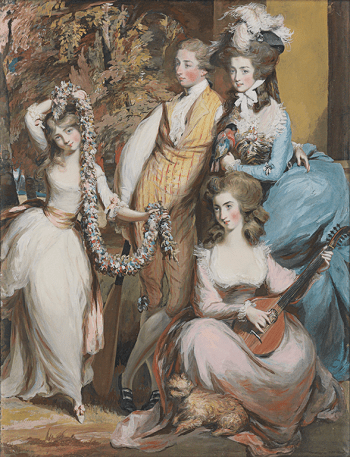
Daniel Gardner, Portrait of Mary Sturt of Crichel and Her Three Eldest Children, ca. 1777, pencil, pastel, and opaque watercolor on paper (Private collection).
In a sumptuous and vibrant family portrait by Daniel Gardner, Portrait of Mary Sturt of Crichel and Her Three Eldest Children (about 1777), Gardner perfectly illustrates English high society’s taste for fashionable costumes. Mary Sturt’s son, Humphry, wears a ruffled necktie and double-breasted striped waistcoat with large pointed lapels. His matching pair of breeches fastened at the knee feature a stylish rosette instead of the usual buckle, details only made possible with the use of pastels. “This portrait is a magnificent example of Gardner’s very original technique,” says Ketty Gottardo, co-curator of the installation. “Unusual for a pastelist, he mixed pastel powder with alcohol and applied it with a brush to paint faster, only rendering the faces in dry pastel.”
Fashionable Likeness: Pastel Portraits in 18th–Century Britain is curated by Julian Brooks, senior curator of drawings at the J. Paul Getty Museum, and Ketty Gottardo, former associate curator of drawings at the J. Paul Getty Museum now at The Courtauld Gallery in London. They were assisted by former graduate intern Alessandra Nardi.
Exhibition | On Time
Now on view at The Grolier Club:
On Time: The Quest for Precision
Linda Hall Library of Science, Engineering, and Technology, Kansas City, 2012
The Grolier Club, New York, 14 September — 19 November 2016
Curated by Bruce Bradley
From sundials to atomic clocks, the exhibition On Time: The Quest for Precision explores the history of precise timekeeping through rare books that taught readers techniques of timekeeping, announced new inventions, and provided instructions on the construction and use of timekeeping instruments. On view at The Grolier Club from September 14 through November 19, 2016, the works are drawn from the comprehensive collections of the Linda Hall Library of Science, Engineering, and Technology, Kansas City, Missouri.
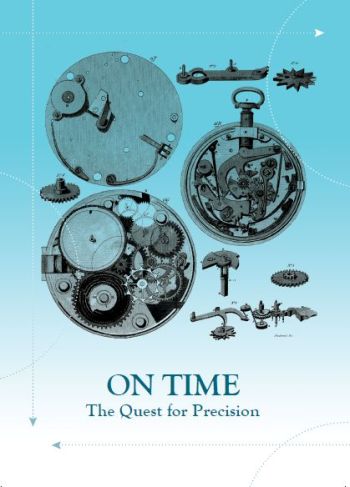 Curator Bruce Bradley tells a timely story with 86 illustrated books dating from the fifteenth century to the present that graphically and artistically depict the sweep of timekeeping. “These books are fascinating and ornate, as well as informative about the innovations that have led to increasingly precise timekeeping devices,” notes Mr. Bradley. As a complement to the printed books, the exhibition includes a small selection of historical clocks and timepieces from the collection of Grolier Club member Fortunat Mueller-Maerki.
The early books describe techniques for timekeeping with fantastic illustrations of sundials and water clocks. The sunflower clock described and illustrated by Athanasius Kircher in his book, Magnes siue De arte magnetica opus tripartitum (Rome, 1641) shows a detailed, full-page engraving of the sunflower clock floating on a piece of cork with its roots in the water. Vegetable magnetism supposedly caused the flower to follow the sun, so that a pointer fixed in the center would indicate the hour on a clock dial. A book that featured more traditional types of sundials is Sebastian Münster’s Horologiographia (Basel, 1533). This comprehensive treatise was first issued as Compositio horologiorum in 1531, but it was popular enough to warrant this second enlarged edition just two years later. Both editions illustrate all manner and variety of sundials with beautiful woodcuts, some of which are attributed to Hans Holbein the Younger.
Early mechanical clocks offered several advantages over sundials, such as portability and the ability to show the time during cloudy weather and at night. They lacked precision, however, and had to be readjusted periodically to synchronize them with local solar time. Even after the appearance of mechanical clocks, books about sundials and how to make them remained popular. Demand for them continued throughout the sixteenth century and into the seventeenth.
A book that described and illustrated some of the best astronomical instruments of the sixteenth century is Tycho Brahe’s Astronomiae instauratae mechanica (Nuremberg, 1602). Of the four clocks in his observatory, two of the smaller clocks are shown in the plate of the famous mural quadrant that Brahe used for making observations of star positions. Brahe explained that he used two clocks to reduce errors in recording the exact moment of observation.
The sixteenth century also saw the first printed depictions of mechanical clocks, published in books by the Italian natural philosopher Girolamo Cardano. The innovation that made mechanical clocks possible, the escapement mechanism, was first illustrated in a seventeenth-century book by Robert Fludd. An English clergyman, William Derham, produced the first practical manual on clock making, The Artificial Clock-Maker (London, 1696), which was popular enough to go through several editions in the early eighteenth century. Much of Derham’s knowledge of clocks came from his friend, the natural philosopher Robert Hooke, who was involved in priority disputes over horological innovations such as the anchor escapement and the balance spring regulator for watches.
Pendulum clocks represented a revolution in timekeeping devices. They had greater accuracy than any other clocks and became standard pieces of scientific equipment, particularly for astronomical observatories. Christiaan Huygens designed the first successful pendulum clock and described it in his classic book on display in the exhibition, Horologium oscillatorium (Paris, 1673). It includes a famous woodcut of the clock’s mechanism.
Another milestone was the marine chronometer built by John Harrison in the eighteenth century. The Principles of Mr. Harrison’s Time-Keeper (London, 1767), includes a preface by Nevil Maskelyne, Astronomer Royal, who insisted on detailed accuracy in the engravings of the chronometer’s mechanism, so others could make duplicates of the watch.
In the twentieth century, Nature, a scientific journal known for publishing important new advances and original research, published the description of the first atomic clock, designed and built by Louis Essen with Jack Parry at the National Physical Laboratory in Teddington, England. Atomic clocks are more precise than the Earth’s rotation and led to a new definition of the second at the 1967 meeting of the International Bureau of Weights and Measures in Paris.
Accompanying the illustrated books and journals are a variety of intricately designed horological objects. Included are a selection of sundials, a clepsydra or water clock, a variety of clock maker’s tools, weight driven clocks, marine chronometers, examples of American railroad-grade pocket watches, and an uncommon Accutron desk clock.
A 60-page illustrated catalogue is available which includes short essays and descriptions by Mr. Bradley for each book in the exhibition. The exhibition and its associated catalogue are supported by a generous grant from the Ascher Family Foundation and by the Linda Hall Library Foundation.
Linda Hall Library is among the world’s foremost independent research libraries devoted to science, engineering, technology, and their histories. Founded in 1946 through an endowment created by Linda and Herbert Hall, the library is a not-for-profit, privately funded institution, and is open to the public free of charge. Scholars, technologists, engineers, researchers, academic institutions and businesses, nationally and internationally, use Linda Hall Library’s collections to investigate, invent, and increase knowledge. The library’s holdings range from rare books to private papers, including extensive collections in diverse areas such as aeronautics, astronomy, engineering standards, a resource center for patents and trademarks and more. In addition to the library’s resources, hundreds of people attend the library’s public programs throughout the year to expand their awareness and understanding of science and technology.
The Grolier Club of New York is America’s oldest and largest society for bibliophiles and enthusiasts in the graphic arts. Founded in 1884, the club is named for Jean Grolier, the Renaissance collector renowned for sharing his library with friends. The club’s objective is to foster the literary study and promotion of arts pertaining to the production of books.
Bruce Bradley, On Time: The Quest for Precision (Kansas City: Linda Hall Library, 2016), 64 pages, ISBN: 978-0976359067.
Display | All Must Have Prizes, 1750–1850

John Milton, God Speed the Field, 1790, Duke of Athol’s Farming Prize.
Now on view at the Ashmolean:
All Must Have Prizes, 1750–1850
Ashmolean Museum, Oxford, 14 June — 13 November 2016
This display of medals and prizes from the mid-eighteenth century tell us about the ideals of personal and professional improvement through competition during the time in which they were made. Their images and inscriptions reveal the hopes and aspirations of those who created and competed for them.
Exhibition | Amazons of the Revolution
The exhibition blurb, as translated by Julia Douthwaite, author of the blog A Revolution in Fiction:
Amazons of the Revolution: Women in the Turmoil of 1789
Amazones de la Révolution: des femmes dans la tourmente de 1789
Musée Lambinet, Versailles, 5 November 2016 — 19 February 2017
Curated by Martial Poirson
 Fish-wife, soldier-girl, rioter, fire-starter, criminal, madwoman… these are some of the pejorative labels used to describe the women who joined the revolutionary struggle in 1789. Cloaked in suspicions regarding their lack of femininity, the so-called Amazons of the Revolution have long been used as a scapegoat for things that went wrong. This exhibit brings together a unique group of objects, art-works, and rare writings from the archives to reveal the dark fantasies projected onto revolutionary women, from the 1790s to our day. In a time when categories of gender are finally being understood as a confining cultural construct, this exhibit is particularly useful, for it demonstrates without a doubt that the ‘national novel’ behind the French State has always relied on the contributions of women—either as victims, unwelcome meddlers, or even murderers—to justify the revolutionary past.
In history books as in the popular media, the gendering of revolutionary violence has helped rationalize brutality, and keep it out of sight, so that the pantheon of national heroes and narratives remains untarnished. This exhibit pays homage to the extraordinary women whose political efforts led to the guillotine–Charlotte Corday, Olympe de Gouges, Théroigne de Méricourt, and Manon Roland—but it also highlights the contributions of the unsung heroines behind famous events as well as those women who fought to restore the rule of Crown and Church. The women of this exhibit performed all kinds of duties–from reporting on Tribunal proceedings in coded messages knitted to their confederates (as in the terrifying tricoteuses of Dickens’s Tale of Two Cities)–to meekly submitting to the gallows, as martyrs of their faith—yet all are worthy of our time and attention. With a collection spanning the centuries as well as the gamut of visual media (engravings, sculptures, paintings, video games, cartoons, and mangas), this exhibit has something to offer all ages.
◊ ◊ ◊ ◊ ◊
Readers interested in the topic may find useful the first chapter, “From Fish Seller to Suffragist: The Women’s March on Versailles,” in Julia Douthwaite’s The Frankenstein of 1790 and Other Lost Chapters from Revolutionary France (Chicago: The University of Chicago Press, 2012), recently published in French as Le Frankenstein français et la littérature de l’ère révolutionnaire.
◊ ◊ ◊ ◊ ◊
Le visiteur de la Salle du Jeu de Paume, après avoir lu sur les murs les noms des représentants du Tiers-Etat aux Etats généraux de 1789, ne manque pas de se faire une remarque : aucun nom ou visage de femme ne figure dans ce berceau de la République ! Pourtant, chacun sait combien les femmes ont compté dans le déroulement des événements révolutionnaires.
C’est à ces quelques femmes d’exception que rend hommage l’exposition Amazones de la Révolution, présentée par le Musée Lambinet. Poissarde, femme-soldat, émeutière, incendiaire, criminelle, aliénée… Ces stéréotypes esquissent le portrait à charge de la combattante révolutionnaire, usurpant attributs de la masculinité et codes de la virilité. Ils occultent les sévices exercés sur des femmes désignées comme bouc émissaires et contribuent à les évincer de la sphère publique. Objets, oeuvres et archives qui en attestent font apparaître les fantasmes engendrés par la violence des femmes, tout en soulignant leurs échos contemporains.
Cette exposition explore les zones d’ombre de l’historiographie et les présupposés du « roman national », mettant en lumière le rapport des femmes à la violence des événements révolutionnaires et leur implication—victimes ou bourreaux—dans la brutalité des événements. Tout en faisant place aux femmes d’exception telles que Charlotte Corday, Olympe de Gouges, Théroigne de Méricourt ou Manon Roland, elle met en perspective les figures collectives de la Révolution et de la Contre-Révolution. Des Tricoteuses aux Merveilleuses, des insurgées aux suppliciées, des allégories aux caricatures, toutes ont imprégné la culture à travers les siècles, tant dans la gravure, la peinture, la sculpture ou les arts décoratifs que dans le cinéma, le jeu vidéo, la bande dessinée ou la publicité.
Cette exposition a pour ambition de proposer des éléments de compréhension de l’émancipation contrariée des femmes au cours de la séquence historique qui s’ouvre en 1789 : elle leur donne une visibilité nouvelle tout en les excluant de la sphère politique, au motif, précisément, de leur participation active aux événements.
Exhibition | Marie-Antoinette: A Queen in Versailles
Press release from the Musée National des Châteaux de Versailles et de Trianon:
Marie-Antoinette: A Queen in Versailles / Une Reine à Versailles
Mori Arts Center Gallery, Tokyo, 25 October 2016 — 26 February 2017

Adolf Ulrik Wertmüller, Marie-Antoinette in Amazon Dress, 1788 (RMN-Grand Palais / Château de Versailles).
Japan is most certainly the country, outside France, where the figure of Marie-Antoinette is most popular, notably thanks to the character imagined by Riyoko Ikeda in her manga The Rose of Versailles. The Palace of Versailles and Nippon Television have joined forces to mount an exhibition dedicated to this iconic figure in French history.
Through a large number of works of art from the Versailles collections—paintings furnishings, objets d’art, drawings, and engravings—as well as loans from other public and private collections in France and abroad, the exhibition will provide, for the very first time in Japan, a wide-ranging evocation of the life of Marie-Antoinette, from her youth in Vienna to her tragic end.
Portraits of the queen and members of the royal family by the court’s finest portrait artists—in particular François-Hubert Drouais, Louis Michel Vanloo, and Joseph Siffred Duplessis—will familiarise visitors with the people among whom Marie-Antoinette lived in France [including] King Louis XV (the grand-father of Louis XVI) and her brothers-in-law, the Counts of Provence and Artois, along with the artist Élisabeth-Louise Vigée-Lebrun, who captured the queen’s essence in her works, won her trust, and left us some of the finest (official and more intimate) portraits of Marie-Antoinette.
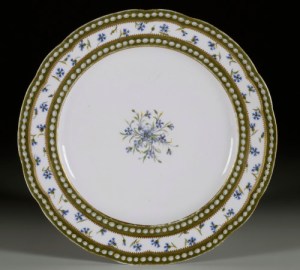
‘Pearls and Cornflower’ (perles et barbeaux) Plate, Manufacture Royale de Sèvres (RMN- Grand Palais / Château de Versailles).
The queen’s own tastes will also feature prominently in the exhibition. Assisted by the royal administration of the Crown Furniture Inventory, Marie-Antoinette gathered some of the finest craftsmen around her, such as cabinet-maker Jean Henri Riesener, joiner Georges Jacob, and bronze-maker Pierre-Philippe Thomire, to design the precious furnishings or objects for the sumptuous, refined decor she liked to surround herself with. The variety of tableware designed by the Sèvres Royal Porcelain Works are featured, and more particularly the ‘Japan’ service inspired by Imari porcelain or the famous ‘Pearls and Cornflower’ dinner service made for Trianon. The most original and spectacular feature of the exhibition will be its presentation of the Queen’s Private Apartment, laid out from 1782 onwards on the ground floor on the Marble Courtyard. The bedroom and bathroom will be fitted out with a large part of their furnishings, while the stucco library which has now disappeared will be reproduced in 3D. This exhibition of almost 150 works provides an insight, for the first time in Japan on such a scale, into the riches and innovation that marked the creations inspired by Marie-Antoinette.
Display | Garnitures: Vase Sets from National Trust Houses

Five-piece vase set, porcelain, China, ca. 1690, H: 26.9 cm; rescued from Clandon Park, Surrey, the night of the fire, 29 April 2015 (The Mrs. David Gubbay Collection, Clandon Park, Surrey, National Trust, 1440409.1-5 / National Trust Images/ James Dobson).
◊ ◊ ◊ ◊ ◊
Now on view at the V&A:
Garnitures: Vase Sets from National Trust Houses
Victoria and Albert Museum, London, 11 October 2016 — 30 April 2017
This ground-breaking display at the Victoria and Albert Museum, organised in collaboration with the National Trust, explores the phenomenon of matching sets of vases and garnitures. In the 1650s, assembled sets of Chinese porcelain beakers, bottles, bowls, and jars—often in odd numbers—were used in elite European interiors as an integral part of the decorative scheme— displayed on chimney-pieces, cupboards, tables, or over doors. Specifically for the display, a mid-seventeenth-century garniture in the French taste has been recreated from Chinese porcelain of the 1630s. When imports of Chinese porcelain officially ceased between 1657 and 1683, European potters at Delft and Nevers copied the exotic Asian forms but unified the elements with matching patterns to form sets of from three to eleven vessels. In the Netherlands, merchants also ordered jars and beakers from Japan, and, in England, sets were ordered from London silversmiths. In France, merchants in luxury goods applied matching metal mounts to form sets from assembled objects and vessels. When the export trade resumed in the 1680s, ornamental jars and beakers with matching patterns were produced in Jingdezhen specifically for the West. The fashion continued throughout the 1700s, with almost every ceramic manufactory producing examples. It came to its conclusion during the Arts and Crafts period, when the singular vase became the rage and sets were broken up and dispersed.
A day-long symposium on ceramics and interiors is planned for 17 March 2017. The display, publication, and symposium are generously sponsored by The Headley Trust.
Patricia Ferguson’s blog entry on the display is available here»
◊ ◊ ◊ ◊ ◊
Patricia Ferguson, Garnitures: Vase Sets from National Trust Houses (London: V&A Publishing, 2016), 64 pages, ISBN: 978-1851779000, £10.
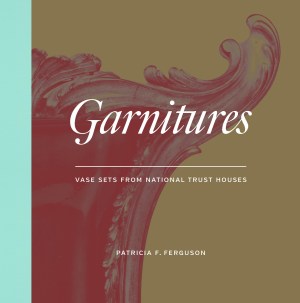 This exquisite book brings together some of the National Trust’s most important sets of garnitures, showing them in their historic context and drawing on their rich narratives. Following an introductory essay, the catalogue records the 15 garnitures in the display borrowed from 13 National Trust properties: Blickling, Norfolk; Dunham Massey and Tatton Park, Cheshire; Nostell Priory, Yorkshire; Ickworth, Suffolk; Kingston Lacy, Dorset, Stourhead, Wiltshire, Saltram, Devon, Clandon Park, Surrey, Scotney Castle and Knole, Kent; Petworth, West Sussex; and Upton House, Warwickshire (with more information here). The entries are richly supported by engraved sources, paintings and photographs of vase sets and garnitures in situ. As many have never been published before, the publication will be an important souvenir of a unique exhibition.
Patricia F. Ferguson, an adviser on ceramics to the National Trust, has been researching their ceramics collection for a publication on elite ceramic patronage in Britain. She has an MA in Chinese ceramics from the School of Oriental and African Studies and works as a curatorial consultant in the Asian department of the V&A.
◊ ◊ ◊ ◊ ◊
This 4-minute film showcases rare surviving examples of vase sets and ceramic ornaments from National Trust houses being displayed on furniture and in period rooms at the V&A that would have been typical at the time of their manufacture. Reino Leifkes, curator of ceramics at the V&A, discusses this ceramic phenomenon and its rise to the height of fashion.
Exhibition | Emma Hamilton: Seduction and Celebrity
The Emma Hamilton exhibition opens next week in Greenwich, with walking tours part of the programming:
Walking Tour | The Life of Emma Hamilton
London, offered 18 November and 3 December 2016, 11am–1pm
Take a walk around St. James’s and Mayfair for glimpses into Emma Hamilton’s life. Celebrity, mistress and muse, Emma was an extraordinary woman. In this guided walk, we’ll be looking at her life, her love affair with Nelson, and her connections to London Society. Adults £20 / members £16.
More information is available here»
Exhibition | 1,000 m2 of Desire: Architecture and Sexuality

From the Centre de Cultura Contemporània de Barcelona:
1,000 m2 of Desire: Architecture and Sexuality
1.000 m2 de Desig: Arquitectura i Sexualitat / 1.000 m2 de Deseo: Arquitectura y Sexualidad
Centre de Cultura Contemporània de Barcelona, 25 October 2016 — 19 March 2017
Curated by Adélaïde de Caters and Rosa Ferré
The exhibition looks at the way Western society has planned, built, and imagined spaces for sex from the 18th century to the present day. With some 250 exhibits, including drawings and architectural models, art installations, audiovisuals, books, and other materials, the exhibition explores the power of spaces as the driving force of desire and shows how architecture has been a tool that controls behaviour and creates gender stereotypes in our patriarchal society.
 It presents some of the projects that have subverted traditional models and advocated utopias of sexual cohabitation or private spaces designed solely for pleasure. It looks afresh at the proposals of Claude-Nicolas Ledoux, Charles Fourier, De Sadeand Guy Debord, the radical architecture of the 1960s and 1970s, Carlo Mollino, Adolf Loos, Nicolas Schöffer, Wilhelm Reich, Playboy architecture, and works by contemporary architects and artists.
1000m2 of Desire underpins the need to reappraise, for contemporary times, the validity and interest of some of the radical, speculative projects that seem to speak directly to us today, even though some of them date back more than 200 years. It invite us to consider how sexualities are constructed in accordance with specific cultural codes subject to norms that govern bodies and discourses and the nature of the space of desire and pleasure in our society. The exhibition highlights the way certain forms of resistance to established norms have largely originated from informal architecture and the appropriation of places. It shows how architectural practice has been dominated by men until very recently and, as a result, how spaces designed for pleasure have been imagined from male desires and fantasies. Architecture as the physical design of a space and setting makes up a substantial part of our sexual fantasies. Many of the exhibits have never been created before and are constructed through language or the projected image.
The exhibition is divided into three thematic sections—sexual utopias, libertine refuges, and sexographs—and includes several independent spaces that act as ‘mini exhibitions’, each one curated by different specialists: a recreation of Nicolas Schöffer’s Centre for Sexual Leisure (Eléonore de Lanvandeyra Schöfferand Guillaume Richard), a reading room containing libertine novels (Marie-Françoise Quignard), an installation dedicated to Playboy Magazine and its architecture (Beatriz Colomina and Pep Avilés), and an archetypal 1970s’ porn cinema (Esther Fernández). It also presents William Kentridge’s new installation Right into Her Arms, which the South African artist created for his production of Alban Berg’s Lulu.
Sexual Utopias (18th–20th Centuries)
The exhibition begins with some of the speculative projects by architects, thinkers, artists and communities who have sought to have an impact on sexual behaviour by monitoring spaces. It examines the sexual utopias of the 18th century such as the temple of pleasure, the Oikema, imagined by the architect Claude-Nicolas Ledoux; the Parthenions, which Restif de la Bretonne organised according to detailed rules in his treatise on prostitution, Le Pornographe; and Charles Fourier’s settings for erotic and gastronomic orgies. Fourier’s proposal reveals an imagination, a radicalism and extreme relevance with the phalanstery as the engine of a utopian community governed solely by its inhabitants’ desires. The exhibition also features one of the Marquis de Sade’s cabinets which reveals how he constructed his narrative utopia of excess through his passion for architecture and the performing arts.
Reformist or subversive, these sexual architectures of the 18th and early 19th centuries are contrasted and establish a certain continuity with more contemporary utopias from the modus vivendi of hippy communities to the radical architecture of the 20th century: Ettore Sottsass, the Archigram and Superstudio groups, Rem Koolhaas/OMA, Haus-Rucker-Co and Ricardo Bofill’s Taller de Arquitectura.
The exhibition also seeks to put the spotlight on the visionary work of Nicolas Schöffer who was closely associated with the Situationists and part of the French radical architecture movement in the 1960s. He designed a utopian city, the Ville Cybernétique (1955–69), which contained its own Centre for Sexual Leisure. A vast installation recreates this space made up of sex, volts, dancing cybernetic sculptures, and perfume.
Libertine Refuges (18th–20th Centuries)
This section explores the power wielded by spaces as driving forces of desire and analyses the nature of private realms conceived entirely as settings for pleasure, from the French aristocracy’s petites maisons of the 18th century, with their rooms, décor, and specialist furnishings, to the bachelor pads suggested by Playboy Magazine. It shows the role of architecture as a sensorial experience in seduction strategies and how sophistication in the design of constructional and mechanical devices can fire the erotic imagination.
Architecture and storytelling worked osmotically during the 18th century in a game of mutual fascination. The exhibition presents the architecture of two iconic novels in this regard, La Petite Maison (1758) by Jean-François de Bastide and Point de Lendemain (1777) by Vivant Denon.
The reading room containing libertine novels is presented in this section of the exhibition. Devised by the specialist Marie-Françoise Quignard, it features novels by Nerciat, Crébillon, Servigné, Choderlos de Laclos, and De Sade, among others. The libertine novel, related to the materialistic philosophy of the day, has a single objective: to celebrate desire and the enjoyment of the body. Entering the libertine’s chamber is like entering an imaginary world where the characters are subjected to all the fantasies of desire. It is also like stepping into the atmosphere of enclosed places: into boudoirs, convent cells or brothels where we follow the narrator, the clandestine observer, while the story unfolds.
The exhibition devotes a whole section to Playboy, curated by Beatriz Colomina. The magazine defined a new identity for men that included how they should dress, what they should listen to, drink and read, as well as the environment they ought to live in as well as the furnishings and interior décor. From Frank Lloyd Wright to Mies van der Rohe and including John Lautner and Ant Farm, alongside designs by the Eames, George Nelson, Eero Saarinen and Harry Bertoia, architecture and design are presented as tools capable of altering a code of conduct. As a media machine that had an enormous impact by treating women and buildings as objects of fantasy and desire, Playboy made a significant contribution to the transformation of ‘intimacy’ into a public spectacle. This section reproduces Hugh Hefner’s legendary bed (in contrast to the traditional double bed invented in the 18th century which remains the dominant setting for our sex lives today). According to another of the leading specialists in the Playboy phenomenon, Beatriz Preciado: “The round, revolving bed, connected to a radio-cum-phone-cum-hi-fi system, was used as a place for orgies as well as an office for Hefner who ran his business for years in his pyjamas and without leaving the house. The bed has become a true multimedia platform, the direct predecessor of our laptop computer and a media extension of our libido, as well as a new centre of production and consumption.”
The exhibition also reveals that the architecture of the Modern Movement is a project based on masculinity, which underplays its erotic dimension. Beatriz Colomina sums it up by saying “women are the ghosts of modern architecture.” Adolf Loos designed a bedroom for his wife, Lina, as if it were a fur-lined case and dreamt up a Parisian house for Joséphine Baker. The exhibition also presents the enigmatic and sensualised home interiors designed by Carlo Mollino, and, as a counterpoint to these intimate spaces, the home of Rudolph Schindler in California, which features an experimental programme for two couples living together, with outdoor beds/sleeping baskets.
Sexographs (20th–21st Centuries)
Following in the wake of Guy Debord’s Situationism, the exhibition presents a number of maps of contemporary passions through pieces by architects and artists (such as Bernard Tschumi, ecoLogicStudio [Claudia Pasquero and Marco Poletto], Jean-Didier Bergilez, Danli Wang, Pol Esteve, Marc Navarro and Ania Soliman). It reveals public spaces coded for sex, among them parks, streets, and public toilets. The exhibits in this section include two impressive series of photographs: The Valley by Larry Sultan and The Park by Kohei Yoshiyuki.
The screening room was one of the spaces transformed by the discourses of the sexual revolution of the late 1960s. It was a space that embraced an increasing sexualisation until the advent of the first legal porn films. The so-called ‘porn chic’ that emerged in the United States in the 1970s opened up spaces for the consumption of pornography to the female gaze and envisaged an experience of collective viewing that continued until the mid-1980s, when video technology moved porn into people’s homes. The exhibition features an archetypal porn cinema of the 1970s, where clips from legendary X-rated films will be shown, curated by Esther Fernández,
We will see how venues for sexual encounters (from luxury resorts to brothels, whorehouses-cum-hotels on highways, bathhouses and gay dark rooms, discotheques and bars, oubliettes and BDSM spaces, as well as sex shops) are all highly ritualised social systems. They are domains in which initiation and transgression act as the driving force of desire: a particular type of lighting, smells and music are part of this informal architecture. They are designed for and, at the same time, govern particular practices. They are all spaces of representation that reflect group mythologies.
But what are the spaces for sex today? Undoubtedly cyberspace, with internet porn and encounters apps for every taste, is growing in importance. Now that we are fully steeped in the technological utopia, artists, such as Yann Mihn, are engaged in a search for telepathic ecstasy. Mihn is working on the prototype of a machine that will enable total immersion in virtual reality and stimulation (teledildonics), his “NooScaphe-X1 Cybersex immersion engine”.
In Hacer el amor en abstracto: la arquitectura de la cultura de baile, the architect and artist Pol Esteve examines the spatial experience of discotheques and raves and the way in which a combination of technologies such as stroboscopic lights, music and drugs can produce orgasmic effects and a displaced sexuality.
Ingo Niermann proposes a community of sex volunteers with his platform of an army of love, thearmyoflove.net, who will create situations and spaces of satisfaction for those who are ‘usually excluded’, people with physical problems or with a body that does not match conventions of attractiveness.
Desire in the 21st century is the desire of others expressed through recognition and in the competition for representation. From the selfie to Instagram, we are compelled to look sexy and happy; the internet makes the laborious construction of the image of our private lives compulsory. Do sexual images on the web represent or replace relationships by sublimating them? Is the hypersexualisation of society, as it is represented by the media, substituting actual sexual life? Society seems to have plunged into a narcissistic depression in which the internet functions as a masturbatory machine. In the Western context, in which permissiveness is no longer transgression but the norm, what role does space play in reviving transgressive eroticism, in re-eroticising society?
This project explores the interstices of freedom in certain non-normative spaces for desire, such as the queer movement, and the way these constitute revolutionary resistance to commodified scenarios and to the control of increasingly all-encompassing social structures.
Adélaïde de Caters, Rosa Ferré, Beatriz Colomina, Marie-Françoise Quignard, Pol Esteve, Ester Fernández Cifuentes, Ingo Niermann, Fulvio Ferrari, and Rem Koolhaas, 1,000 m2 of Desire: Architecture and Sexuality / 1.000 m2 de Desig: Arquitectura i Sexualitat / 1.000 m2 de Deseo: Arquitectura y Sexualidad (Barcelona: CCCB and Direcció de Comunicació de la Diputació de Barcelona, 2016), 200 pages, ISBN: 978-8498037500 (Català / English), ISBN: 978-8498037517 (Castellano / English), 20€.
S E L E C T E D O B J E C T S
The exhibition has received loans from prestigious international institutions, including FracTurbulence Orleans, the MoMA Architecture Department New York, the Bibliothèque Nationale de France (BNF), the Biblioteca Nacional de España (BNE), and from the collections of the architects who have taken part in the project and given generously of their time.
Architectural Originals
• Drawings by Jeremy Bentham and his Panopticon
• The Campo Marzio by Giovanni Battista Piranesi
• Drawings by Jean-Jacques Lequeu, Pierre-Adrien Pâris, Charles Fourier, Ettore Sottsass, Superstudio, Archigram, Madelon Vriesendorp, Ant farm, Douglas Darden, Coop Himmelb(l)au, and Haus-Rucker-Co, among others
Original Photographs
• Polaroids by Carlo Mollino
• The Valley series by Larry Sultan
• The Park series by Kohei Yoshiyuki
Installations
• Centre for Sexual Leisure (CLS) with original works by Nicolas Schöffer
• METAfolly Pavilion by ecoLogicStudio
• Right into Her Arms, a new work by William Kentridge for the exhibition
• In front of the Green Door by Johannes Wohnseifer
• Hacer el amor en abstracto: la arquitectura de la cultura de baile by Pol Esteve
• Army of Love, Ania Soliman
• Playboy installation with a reproduction of Hugh Hefner’s bed
• Reproduction of Wilhelm Reich’s Orgone
Maquettes and Models
• Reproduction of the city of the Royal Saltworks at Arc-et-Senans and the Oikema Temple of Pleasure
• Reproduction of the room in the Château de Silling where stories are told in The 120 Days of Sodom by the Marquis de Sade
• Models of the Playboy Townhouse and of Hugh Hefner’s private jet Big Bunny
• Model of the Villa Rosa by the Coop Himmelb(l)au
Treatises on Architecture
• Fransesco Colonna, Hypnerotomachia Poliphili ou Le Songe de Poliphile (first edition published in Venice in 1499)
• Jacques-François Blondel, De la distribution des maisons de plaisance et de la décoration en général (1737–38), 2 volumes
• Claude-Nicolas Ledoux, L’architecture considérée sous le rapport de l’art, des mœurs et de la législation (1804), 2 volumes
• Nicolas Le Camus de Mézières, Le génie de l’architecture, ou L’analogie de cet art avec nos sensations (1780)
Libertine Books
• Crébillon, Le Sofa, 1742
• Boyer d’Argens, Thérèse philosophe, 1748
• Julian Offray de la Mettrie, L’art de jouir, 1751
• Jean-Baptiste-Marie Guillard de Servigné, Les sonnettes ou Mémoires du marquis D**, 1751
• Marquis de Sade, La philosophie dans le boudoir, 1795
• Marquis de Sade, Histoire de Juliette, 1797
Prints from the 18th and 19th Centuries
• Rebus sur l’Amour by Stefano Della Bella (18th century)
• Le Phallus phénoménal and Le Roi Phallus malade et défait reçoit la visite de ses médecins by Dominique Vivant Denon, 1793–94
• Works by unknown artists and printmakers, such as Portes et fenêtres (19th century)
• Le verrou and Les heureux hasards de l’escarpolette by Jean-Honoré Fragonard
Audio-Visual Materials
• Documentaries on Bentham’s Panopticon and hippie communes by Andrés Hispano and Félix Pérez Hita
• Virtual 3D reproduction of the house designed by Adolf Loos for Joséphine Baker
• Playboy’s Progress, an animated work by Olivier Otten
• Documentaries by Ant Farm, Haus-Rucker-Co and Superstudio
• Films such as Un chant d’amour by Jean Genet and Army of Love by Ingo Niermann
Exhibition | Emperors, Scholars, and Temples
From
Emperors, Scholars, and Temples: Tastemakers of China’s Ming and Qing Dynasties
The Nelson-Atkins Museum of Art, Kansas City, 12 August 2016 — 9 July 2017

Coat, early 18th century, Chinese. Brocade, 54 x 81 inches (Kansas City: The Nelson-Atkins Museum of Art; William Rockhill Nelson Trust, 35-184/1)
During the Ming (1368–1644) and Qing (1644–1911) dynasties, the arts of China reached full maturity. Painting, calligraphy, porcelain and textiles flourished, and new styles and techniques emerged. The imperial court, scholars, and temples supported this profusion of creativity, each establishing distinctive, yet overlapping artistic styles. Emperors held court in the Forbidden City in Beijing in unparalleled splendor. Courtiers, empresses, and concubines wore extravagant garb and beautiful jewelry. Across the empire, an educated class of scholars pursued elegant and cultured lifestyles. Buddhism was also an inspiration for the arts. Thousands of ornate temples stored precious relics and images of Buddhist deities. Presenting rarely seen objects from the Nelson-Atkins Chinese collection, the exhibition explores currents of taste during this five hundred-year period.










 Enfilade
leave a comment