Exhibition | Pearls on a String
Press release (24 July 2015) for the exhibition now on view at The Walters:
Pearls on a String: Artists, Patrons, and Poets at the Great Islamic Courts
The Walters Art Museum, Baltimore, 8 November 2015 — 31 January 2016
Asian Art Museum, San Francisco, 25 February — 8 May 2016
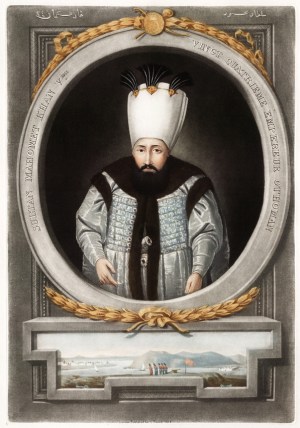
Portrait of Ottoman Sultan Mahmud I, 1815 (Baltimore: The Walters Art Museum)
The great Mughal, Safavid, and Ottoman empires flourished during a time of rapid change and artistic innovation in the Islamic world, as people, ideas, and technologies spread across Europe and Asia. At the heart of the empires’ courts were networks of individuals—writers, poets, artists, craftsmen— who produced extraordinary works of art for the ruling elite. From November 8, 2015, through January 31, 2016, the Walters Art Museum will present Pearls on a String: Artists, Patrons, and Poets at the Great Islamic Courts, the first major exhibition to focus on these influential and often charismatic individuals. The free exhibition features more than 120 works including paintings, calligraphy, textiles, ceramics, and jeweled luxury objects. Dating from the 16th to the 18th century, these exquisite works of art were created in historic India, Iran, and Turkey, a vast geographic area that extends from the Bay of Bengal to the Mediterranean Sea.
“Pearls on a String seeks to broaden public engagement with the cultural histories of Muslim societies by demonstrating how human imagination and collaboration can ignite extraordinary artistic creativity,” said Amy Landau, curator of the exhibition.
Three Vignettes
Pearls on a String is organized in a series of vignettes that spotlight a 16th-century writer, a 17th-century artist, and an 18th-century patron. Through poignant quotes, startling juxtapositions of artwork, and subtle references to the protagonists’ architectural surroundings, the exhibition will offer a rare glimpse into their worlds. The individuals also inform the exhibition’s poetic title: viewed independently, each is a gleaming ‘pearl’, yet collectively they constitute an even more vibrant ‘string of pearls’.
• Writer Abu’l Fazl (1551–1602): A prolific writer, visionary historian and intimate at the court of the third Mughal emperor Akbar in India, he was the most powerful voice in defining Akbar’s policies of political inclusion in the context of a demographically diverse empire.
• Painter Muhammad Zaman (c. 1650–1700): At the court of Safavid ruler Shah Sulayman, this imperial artist radically changed the course of Persian painting by introducing farangi-sazi, a European style, into the Persian tradition.
• Patron Sultan Mahmud I (1696–1754): An Ottoman ruler and active patron of the arts and architecture, this once-forgotten sultan commissioned fanciful jeweled objects as well as lavish libraries and mosques that define Istanbul’s skyline to this day.
“The Walters’ initiative to organize its first international loan exhibition dedicated to Islamic art springs from the quality of the museum’s collection, its intellectual resources and its dedication to providing free access,” said Julia Marciari-Alexander, the Andrea B. and John H. Laporte Director of the Walters Art Museum.
Loans and Support
Loans from national and international institutions include the Victoria and Albert Museum, London; the British Library, London; the Aga Khan Museum, Toronto; the Metropolitan Museum of Art, New York; and the National Gallery of Art, Washington, D.C. Approximately a third of the works are from the collection of the Walters Art Museum, which has one of the most comprehensive collections of Islamic art in North America. The exhibition was organized by the Walters Art Museum in partnership with the Asian Art Museum, and will be on view at the Asian Art Museum in San Francisco February 25 through May 8, 2016.
Pearls on a String has been generously supported by the National Endowment for the Humanities: Celebrating Fifty Years of Excellence; the Institute of Museum and Library Services; the National Endowment for the Arts; the Gary Vikan Exhibition Endowment Fund; Ellen and Edward Bernard; Douglas and Tsognie Hamilton; the Herb Silverman Fund; the Maryland Humanities Council and several anonymous donors.
◊ ◊ ◊ ◊ ◊
The catalogue is distributed by the University of Washington Press:
Amy Landau, ed., Pearls on a String: Artists, Patrons, and Poets at the Great Islamic Courts (Baltimore: Walters Art Museum, 2015), 256 pages, ISBN: 978-0295995243, $60.
 Pearls on a String presents the arts of historical Islamic cultures by focusing on specific people and relationships among cultural tastemakers, especially painters, calligraphers, poets, and their patrons. Through a series of chapters, the book spotlights certain historical moments from across the Islamic world. Each chapter pivots around patrons and their social networks. These independent sections allow different voices and perspectives to emerge, enabling the reader to see that Islamic societies are not monolithic but made up of a tapestry of individuals with distinct and varying views. Pearls on a String pays particular attention to individuals from different sectors of society, giving voice to anonymous artists and translators, merchants, and women of the harem. Islamic historical sources reinforce the book’s themes of writing in Islamic societies, artistic patronage, biographical traditions, and human connectivity.
Amy Landau is associate curator of Islamic and South Asian Art at the Walters Art Museum, Baltimore. Contributors include Paul Losensky, Sussan Babaie, Avinoam Shalem, Glaire Anderson, Mariam Rosser-Owen, Persis Berlekamp, Vivienne Lo, Wang Yidan, Willem Flinterman, Jo Van Steenbergen, David Roxburgh, Qamar Adamjee, Audrey Truschke, Bora Keskiner, Unver Rustem, and Tim Stanley.
Exhibition | Artist and Empire: Facing Britain’s Imperial Past
Opening this week at Tate Britain:
Artist and Empire: Facing Britain’s Imperial Past
Tate Britain, London, 25 November 2015 — 10 April 2016
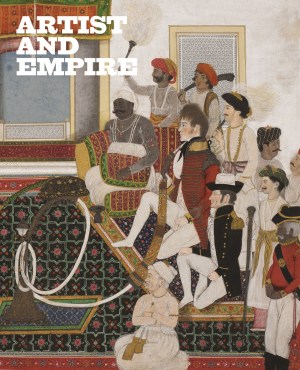 This autumn Tate Britain presents a major exhibition of art associated with the British Empire from the 16th century to the present day. In 21st-century Britain, ‘empire’ is highly provocative. Its histories of war, conquest and slavery are difficult and painful to address but its legacy is everywhere and affects us all. Artist and Empire will bring together extraordinary and unexpected works to explore how artists from Britain and around the world have responded to the dramas, tragedies and experiences of the Empire. Featuring a vast array of objects from collections across Britain, including maps, flags, paintings, photographs, sculptures and artefacts, the exhibition examines how the histories of the British Empire have shaped art past and present. Contemporary works within the exhibition suggest that the ramifications of the Empire are far from over. The show raises questions about ownership, authorship and how the value and meanings of these diverse objects have changed through history, it also asks what they still mean to us today.
Historic works by artists such as Joshua Reynolds and George Stubbs are shown with objects including Indian miniatures and Maori artefacts, as well as contemporary works by Hew Locke and Sonia Boyce. Through this variety of artworks from a complex mix of traditions, locations and cultures the fragmented history of the Empire can be told.
Alison Smith, David Blayney Brown, Carol Jacobi, Artist and Empire: Facing Britain’s Imperial Past (London: Tate, 2015), 240 pages, ISBN: 978-1849763431, $65.
◊ ◊ ◊ ◊ ◊
From Tate Britain:
Artist and Empire: New Dynamics, 1790 to the Present Day
Tate Britain, London, 24–26 November 2015
Tate Britain’s major conference, held in collaboration with Birkbeck, University of London and culture at King’s College London, marks the opening of the exhibition Artist and Empire. Scholars, curators and artists from around Britain and the world consider art created under the conditions of the British Empire, its aftermath, and its future in museum and gallery displays.
Scholarship of art associated with the British Empire has expanded over the last two decades, across a huge span of disciplines and locations. This conference takes the historic opportunity of the exhibition, featuring diverse artists from the sixteenth century to the present day, to bring together people to meet and share the latest research being developed around this subject. The papers, roundtables and audience discussions will consider the cosmopolitan character of objects and images, and the way geographical, cultural and chronological dislocations have in many instances obscured, changed or suppressed their history, significance and aesthetics. We will also explore how approaches to contemporary art, archives, curation and collecting can help develop new ways to look at them now.
T U E S D A Y , 2 6 N O V E M B E R 2 0 1 5
18.00 Opening Conversation
Introduction by Nicholas Serota, Director, Tate
Frank Bowling OBE, Artist and Writer, with Zoe Whitley, Curator, International Art, Tate Modern
W E D N E S D A Y , 2 5 N O V E M B E R 2 0 1 5
9.00 Registration and refreshments
9.30 Introduction
9.40 Panel 1 | Displaced Practices: Artists and Exchanges
Chaired by Felix Driver, Professor of Human Geography at Royal Holloway
• Michael Rosenthal (Emeritus Professor of Art History at the University of Warwick), Augustus Earle: Seeing Straight
• Geoff Quilley (Professor of Art History at the University of Sussex), Inside Empire Looking Out: The View from Dent’s Veranda
• Partha Mitter (Emeritus Professor of Art History at the University of Sussex), Art Education in India
11.20 Refreshment break
11.40 Panel 2 | Moving Objects: Collecting, Archives, Display
Chaired by John Mack, Professor of World Art Studies at the University of East Anglia and Chairman of the Sainsbury Institute for Art
• Alison Inglis (Associate Professor in Art History at the University of Melbourne), Collecting and Displaying British Art in the Australian Colony
• Zachary Kingdon (Curator of the African Collections at the World Museum in Liverpool), Unofficial Exchanges: Investigating West Africans’ Gifts to UK Museums in the Early Colonial Period
• Nick Thomas (Director of the Museum of Archaeology and Anthropology, Cambridge), Artefacts of Encounter: Rethinking Objects and Collections
13.20 Lunch break
14.00 Panel 3 | Face to Face: Figures, Portraits and Identities
Chaired by Elizabeth Edwards, Research Professor in Photographic History and Director of Photographic History Research Centre, De Montfort University
• Temi Odumosu (Marie Curie Postdoctoral Fellow at Copenhagen University), This Is How You See Her? Rachel Pringle of Barbados by Thomas Rowlandson’s Hand
• Gillian Forrester (Senior Curator of Prints and Drawings at the Yale Center for British Art), Noel B. Livingston’s Gallery of Illustrious Jamaicans
• Ruth Phillips (Canada Research Chair in Modern Culture and Professor of Art History at Carleton University), Sir Henry Acland Mi’kmaq Woman from Nova Scotia and a Mi’kmaq Dressed Doll: The Tensions of Imperialism and Indigenous Survivance and Resistance
15.40 Refreshment break
16.00 Plenary: Reflecting on the Future
Chaired by Augustus Casely-Hayford, Historian, Writer and Curator
Catherine Hall, Professor of Modern British Social and Cultural History at University College London
Zareer Masani, Historian and Writer
T H U R S D A Y , 2 6 N O V E M B E R 2 0 1 5
9.00 Registration and refreshments
9.30 Introduction
9.40 Panel 4 | Confronting Empire: Curating Artistic Legacies
Chaired by Sarah Victoria Turner, Assistant Director for Research at the Paul Mellon Centre
• Elisabeth Lalouschek (Artistic Director of the October Gallery)
• Devika Singh (Smuts Research Fellow at the Centre of South Asian Studies, Cambridge University)
10.55 Refreshment break
11.15 Panel 5 | Archived Futures: Mediating Collections and Archives
Chaired by Hammad Nasar, Head of Research and Programmes at the Asia Art Archive in Hong Kong
• Brook Andrew (Artist), Re-envisioning Archives and Aboriginal Culture
• Caroline Bressey (Director of the Equiano Centre, Department of Geography at UCL)
• Shaheen Merali (Writer, Curator and Co-founder of Panchayat), Panchayat
12.55 Lunch break
13.35 Panel 6 | Curating in Transnational Contexts in London
Chaired by Professor Paul Goodwin, Director of the Research Centre for Transnational Art, Identity and Nation (TrAIN) at the University of the Arts London
• The India Festival (Victoria and Albert Museum, June 2015 — March 2016)
Kriti Kapila, Lecturer in Social Anthropology and Law at King’s College, London
• West Africa: Word, Symbol, Song (British Library, October 2015 — February 2016)
Toby Green, Lecturer in Lusophone African History and Culture at King’s College, London, Marion Wallace, Lead Curator, African Collections, British Library, Co-curator
• Artist and Empire: Facing Britain’s Imperial Past (Tate Britain, November 2015 — April 2016)
Javed Majeed, Professor of English and Comparative Literature at King’s College London, Alison Smith, Senior Curator of British Art at Tate Britain
14.50 Refreshment break
15.10 In Conversation: Reflecting on Artists and Empire
Chaired by Achim Borchardt-Hume, Director of Exhibitions, Tate Modern
• Lubaina Himid, MBE (Artist, Curator, Professor of Contemporary Art at the School Art, Design and Fashion University of Central Lancashire)
• Yinka Shonibare, MBE (Artist and Curator)
16.05 Plenary: Reflecting on the Future
Chaired by Paul Gilroy, Professor of American and English Literature, King’s College London
Baroness Lola Young of Hornsey OBE
Mike Phillips, Novelist, Historian and former curator at Tate
Panellist TBC
Exhibition | Olafur Eliasson: Baroque Baroque

Olafur Eliasson, Wishes versus Wonders, 2015, as installed at the Winter Palace of Prince Eugene of Savoy, Vienna, 2015
Photo by Anders Sune Berg
◊ ◊ ◊ ◊ ◊
Press release for the exhibition now on view in Vienna’s Winter Palace:
Olafur Eliasson: Baroque Baroque
Winter Palace of Prince Eugene of Savoy, Vienna, 21 November 2015 — 6 March 2016
With works from Thyssen-Bornemisza Art Contemporary (TBA21), Vienna and Juan & Patricia Vergez private collections, Buenos Aires
Olafur Eliasson: Baroque Baroque brings together a significant selection of artworks by Danish-Icelandic artist Olafur Eliasson from the private collections of Thyssen-Bornemisza Art Contemporary and Juan and Patricia Vergez and presents them within the grand baroque setting of the Belvedere’s Winter Palace. The former city residence of Prince Eugene of Savoy (1663–1736), was an important site of artistic and scientific patronage in baroque Vienna. Baroque Baroque is an encounter between artworks, aesthetics, and worldviews from two vastly different epochs. The exhibition challenges viewers’ habits of perception and proposes that reality can be understood as unstable and evolving, as a process of constant negotiation. Surprising affinities between Eliasson’s works and their temporary settings become evident as the juxtapositions explore the relationships between object and viewer, representation and experience, actual and virtual, giving rise to a concept of the baroque superimposed on itself—the Baroque Baroque.
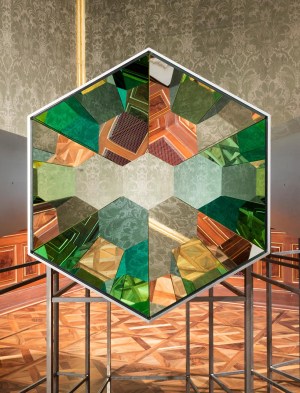
Olafur Eliasson, Seu planeta compartilhado (Your shared planet), 2011, as installed at the Winter Palace of Prince Eugene of Savoy, Vienna in 2015. Photo by Anders Sune Berg.
While emphasizing the way spaces are constructed by history and tradition, Eliasson’s works address the viewer in her embodied experience. Through the use of projections, shadows, and reflections, the artworks foreground the relationship between body, perception, and image. They anchor agency in the body and mind in motion as they invite the viewer’s active engagement by mirroring, fragmenting, and inverting her position within space.
Eliasson says, “I find it inspiring that the baroque exhibited such confidence in the fluidity of the boundaries between models of reality and, simply, reality. The presentation of my works at the Winter Palace is based on trust in the possibility of constructing reality according to our shared dreams and desires and on faith in the idea that constructions and models are as real as anything.”
TBA21 Founder, Francesca von Habsburg says: “This exhibition brings together several elements that I think support the vision of collectors and their responsibility as well as their ability to create art projects that defy traditional categorization. Both Patricia and Juan Vergez and I have been collecting and supporting Olafur Eliasson for many years with great enthusiasm, as he is indeed a renaissance man of many talents! In this presentation we wanted to introduce a parallel, that Olafur himself has mirrored in the exhibition rooms, that juxtaposes the precious Baroque cultural heritage of Vienna with the work of an artist that I feel very close to.”
In the entrance Vestibule, the light installation Die organische und kristalline Beschreibung (1996) floods the walls, floor, and ceiling with swelling washes of blue and yellow light, an ocean of color that loosens the viewer’s sense of the stability of her environment. In Yellow corridor (1997), monofrequency light is used to heighten the precariousness of our relationship to visible space. Eliasson’s optical machines and installations—such as Kaleidoscope (2001), New Berlin Sphere (2009), Your welcome reflected (2003), and Seu planeta compartilhado (Your shared planet, 2011)—reflect the artist’s ongoing investigations of color, perception, transformation, and deconstruction, an inquiry that is particularly interesting in relation to the baroque context. A site-specific intervention in the form of a continuous mirror traversing the enfilade of grand rooms further disorients the viewer by folding and re-folding the complex spaces it produces. Wishes versus wonders (2015), a steel half-ring mounted to the mirror wall in the Hall of Battle Paintings, stages an encounter between reality, illusion, and the elaborate artifice of the surroundings, simultaneously multiplying lines of potentiality.
Within this terrain of doubling and paradox, Eliasson calls into question our received habits of seeing and experiencing space. His artworks make us wonder and reconsider, giving meaning to the enigmatic doubling inherent in Baroque Baroque.
Belvedere–The Winter Palace of Prince Eugene of Savoy
Prince Eugene’s Winter Palace [begun in 1697] is one of the most magnificent baroque edifices in Vienna and is the fourth exhibition venue of the Belvedere Museum. Originally built as a lavish urban residence for Prince Eugene of Savoy (1663–1736), then acquired in the eighteenth century by Empress Maria Theresa before being used for the Court Treasury and later as the Ministry of Finance, this baroque palace underwent extensive renovation before reopening as a public museum in October 2013. Since then the Belvedere has staged numerous exhibitions at the Winter Palace, placing particular emphasis on programs and projects that create a dialogue between the baroque setting and contemporary art. Artistic interventions result in inspiring new artworks created in situ that draw on the palace’s unique ambiance and history. Vital starting points have been the city palace’s architecture, the prince’s former collections, and the holdings of the Belvedere.
Exhibition | The Jane Austen Reading Room
Now on view at Mia:
Living Rooms: The Jane Austen Reading Room
Minneapolis Institute of Art, 21 November 2015 — 26 June 2016

This installation situates Jane Austen in a unique period room setting. Taking up two of Mia’s well-loved English interiors—the Queen Anne room and the Georgian Drawing room—this display will discuss Austen’s habits as a reader and writer, recreate scenes from her novel Emma (celebrating its 200th birthday in 2015), and invite museum visitors to read works that Austen read, wrote, or inspired. This project is part of Living Rooms, an initiative to present Mia’s historic interiors and decorative arts collections in new ways.
Exhibition | Italian Dreams: Watteau and French Landscape Painting
From the website for Valenciennes:
Réveries Italiennes: Watteau et les paysagistes français au XVIIIe siècle
Italian Dreams: Watteau and French Landscape Painting in the Eighteenth Century
Musée des Beaux-Arts, Valenciennes, 25 September — 17 January 2016
Curated by Martin Eidelberg
 La Ville de Valenciennes a la chance d’avoir vu naître l’un des artistes français les plus illustres : Jean Antoine Watteau (1684–1721). La réouverture de son musée des Beaux-Arts, qui conserve un ensemble d’œuvres du peintre, est couronnée par le don exceptionnel d’une œuvre tout récemment redécouverte d’Antoine Watteau, La Chute d’eau, rare paysage du peintre des fêtes galantes inspiré des cascades de Tivoli près de Rome, qui témoigne de la fascination de l’artiste pour l’Italie, pays où il n’eut pourtant jamais l’occasion de se rendre !
L’exposition Rêveries italiennes, propose ainsi de souligner les emprunts que le maître fit tout au long de sa carrière au modèle italien, soit à travers l’exemple des peintres vénitiens du XVIe siècle qui constituèrent pour l’artiste une source importante d’inspiration, soit à travers le filtre des œuvres réalisées à Rome par ses contemporains. Autour d’un ensemble de peintures et de dessins d’Antoine Watteau, des œuvres des XVIe, XVIIe et XVIIIe siècles montreront comment ce peintre des songes puisa dans la culture artistique européenne pour créer des œuvres qui ouvriront la voie à une nouvelle école de paysage, née au siècle des Lumières, autour de Natoire, Boucher, Fragonard et Hubert Robert. À partir des rêveries italiennes de Watteau, l’exposition valenciennoise souhaite ainsi éclairer sous un jour nouveau la fécondité d’un modèle artistique qui, bien au-delà d’une iconographie séduisante, mena à l’éclosion du Romantisme.
L’exposition s’intègre dans la programmation liée à l’élection de la cité voisine belge de Mons comme capitale européenne de la culture pour l’année 2015. Elle bénéficie également du soutien exceptionnel du Musée du Louvre, qui a accordé pour l’occasion un prêt conséquent d’œuvres et a proposé, dans le cadre de la programmation du Louvre Lens, une exposition venant en écho à l’initiative valenciennoise, consacrée à Antoine Watteau et la fête galante, Dansez, embrassez qui vous voudrez. Fêtes et plaisirs d’amour au siècle de Mme de Pompadour, du 5 décembre 2015 au 29 février 2016.
Commissariat scientifique
Martin Eidelberg, Professeur émérite d’Histoire de l’Art, Rutgers University
Commissariat général
• Emmanuelle Delapierre, anciennement conservatrice du musée des Beaux-Arts de Valenciennes, actuelle conservatrice du musée des Beaux-Arts de Caen
• Vincent Hadot, directeur du musée des Beaux-Arts de Valenciennes
• Virginie Frelin-Cartigny, Attachée de conservation du Patrimoine, musée des Beaux-Arts de Valenciennes
Martin Eidelberg, Réveries Italiennes: Watteau et les paysagistes français au XVIIIe siècle (Heule: Snoeck, 2015), 163 pages, ISBN: 978-9461612397, 29€ / $55.
More information is available at Culture.Fr, and the press release is available as a PDF file here»
Exhibition | Dance, Kiss Whom You Wish

François Boucher, Les Charmes de la vie champêtre, ca. 1735–40
(Paris: Musée du Louvre)
◊ ◊ ◊ ◊ ◊
From the exhibition press materials, via Claudine Colin Communications:
Dansez, embrassez qui vous voudrez: Fêtes et plaisirs d’amour au siècle de la Pompadour
Dance, Kiss Who You Wish: Parties and Pleasures in the Time of Madame de Pompadour
Musée du Louvre-Lens, 5 December 2015 — 29 February 2016
Curated by Xavier Salmon
 Rustic decor, elegant young people and refined leisure pursuits: the 2015–16 winter exhibition at the Louvre-Lens celebrates the genre of the fête galante and the pastoral. Popularised in the first half of the 18th century, first by Antoine Watteau, then by François Boucher, these themes achieved great success until the French Revolution. First adopted by painters, they spread quickly to other disciplines—in particular the decorative arts—and became widespread throughout Europe. Thanks to exceptional loans from the Louvre Museum and around twenty prestigious institutions, this exhibition is able to bring together 220 works.
The bucolic design of the exhibition combines paintings, graphic arts, furniture, ceramics, tapestries, and stage costumes. From the roots to the latest developments, the exhibition traces the fortunes of a delicate, seductive genre, which enchanted Europe in the Age of Enlightenment. A tribute to French taste and the joy of living!
◊ ◊ ◊ ◊ ◊
From ArtBooks.com:
Xavier Salmon, Dansez, embrassez qui vous voudrez: Fêtes et plaisirs d’amour au siècle de Madame de Pompadour (Milan: Silvana, 2015), 320 pages, ISBN: 978-8836631544, $75.
Cet ouvrage rend hommage au genre de la Fête galante, popularisé par Antoine Watteau (1687–1721) et qui connut en France et en Europe un succès non démenti tout au long du Siècle des Lumières. Répondant à une soif de liberté et à un assouplissement des moeurs pendant la Régence, ce thème clamait la joie de vivre, les délices de l’amour, l’alchimie des sentiments et le besoin de paraître. Dans le sillage de Watteau, le genre de la Fête galante fut adopté par son élève Jean-Baptiste Pater ainsi que par ses suiveurs Nicolas Lancret, Bonaventure de Bar ou Pierre-Antoine Quillard. D’autres maîtres en proposèrent à leur tour des variations, pastorales chez François Boucher, mélancoliques chez Jean-Honoré Fragonard ou délicatement sentimentales chez Louis-Joseph Watteau de Lille. Le thème fournit aussi un exceptionnel répertoire de sujets aux manufactures de porcelaine, notamment celles de Sèvres. De Meissen à Venise, il connut en Europe un succès non démenti. Peintres, tel Dietrich, Troost ou Gainsborough, sculpteurs, comme Ferdinand Tietz ou Giovanni Bonazza déclinèrent à l’envi tant en peinture, en dessin, qu’en sculpture, ces sujets aimables qui célébraient les sentiments partagés. Les Arts appliqués s’emparèrent aussi de la thématique et s’attachèrent à la multiplier, en rendant hommage à la fois au goût français et au bonheur de vivre.
Exhibition | Palladian Design: The Good, the Bad and the Unexpected

Chiswick House by Lord Burlington, 1729
(London: RIBA Collections)
◊ ◊ ◊ ◊ ◊
Press release (23 July 2015) for the exhibition now on view at RIBA:
Palladian Design: The Good, the Bad and the Unexpected
Royal Institute of British Architects, London, 9 September 2015 — 9 January 2016
The Renaissance architect Andrea Palladio is the only architect who has given his name to a style, one that is still in use around the world after nearly 500 years. From the US Capitol to a 21st-century Somerset cowshed, Palladian Design: The Good, the Bad and the Unexpected introduces Palladio’s design principles and explores how they have been interpreted, copied and re-imagined across time and continents from his death in 1580 right up to the present day.
Focusing on his legacy, RIBA’s exhibition explores how architects such as Inigo Jones and Lord Burlington turned Palladianism into a national style. The style was adopted in the design of houses, churches, and public buildings around the world from New Delhi to Leningrad. Palladianism became so widespread that it seeped into people’s unconscious references and desires: elements were found popping-up in American Negro Churches and terraced housing and homes in the UK. The 20th century saw a revival of traditional Palladian mansions while the 21st century has seen his design principles being utilised in a more abstract way. The exhibition asks many questions about what makes a building ‘Palladian’. Does a building have to look classical to be Palladian? Is it the design principles or the social and political connotations of tradition, power, and establishment that have led to the enduring popularity of the style? The exhibition is structured chronologically around three themes: revolution, evolution, and the contemporary. It includes 50 original works, including drawings, models, and busts.
The first part of the exhibition introduces Palladio and outlines his unique system of architecture. It charts the development of Anglo-Palladianism from 17th-century England, through to the transformation of Palladianism into a national style by the mid-18th century. It also explores the role of books in spreading Palladio’s ideas—both his own Four Books of Architecture and later publications that spread Palladian style beyond Britain. Highlights include Palladio’s A Design for a Palace (1540s) and projects for low-cost housing in Venice (1550s), original drawings by Inigo Jones include a preliminary design for the Queen’s House at Greenwich (1616), Colen Campbell’s original pen and wash design for Mereworth Castle, Kent (1723), and an original drawing of Lord Burlington’s Chiswick House (1729).
The second part of the exhibition follows Palladio’s legacy worldwide in a series of themes that explore how others have either followed his guidelines to the letter or employed them more creatively. It looks at how Palladian design has been adopted for commercial viability and in the service of politics and religion—both in western countries and in colonial and post-colonial contexts. Away from the centres of power, people turned their hand to Palladian self-builds with anonymous builders using pattern books to fuse Palladian elements with local vernacular traditions. Highlights include the original 1721 model of St Martin-in-the-Fields church by James Gibbs, a perspective of Catherine the Great’s Pella Palace near St Petersburg by Ivan Starov (c.1786), a watercolour perspective of Stormont in Belfast by Sir Arnold Thornely (1927), and Palladio’s original designs for the Villa Valmarana (c.1560) and the Palazzo Antonini (c.1560).
The last section of the exhibition follows the story of 20th- and 21st-century Palladianism. Despite the rise of modernism, Palladianism survived in Britain and America as a domestic style both for landed families and the newly rich who commissioned grand classical homes to evoke a sense of history and confer status. Highlights include a linocut perspective of Kings Walden Bury, Essex by Raymond Erith and Quinlan Terry (1971) and photographs and models of houses built since the 1960s. The exhibition goes on to explore post-modern Palladianism, where the style has been referenced historically, playfully or ironically. Key exhibits include works by Swedish architect Erik Asplund and Belgian architect Charles Vandenhove alongside other new buildings on the continent and in Canada. The exhibition ends by examining contemporary abstract Palladianism—buildings that contain no visual references to classical architecture but follow Palladian design principles in terms of proportion or planning. It asks whether a building has to look like a Palladian building in order to be one? It will include a newly commissioned film comparing Palladio’s Villa Caldogno with Brick House (2005) by Caruso St John and looks at a selection of contemporary buildings, ranging from a model of an underground house in Mongolia by OFFICE Architects to offices in Switzerland by Peter Märkli.
The exhibition coincides with the 300th anniversary of the publication of two books key to the spread of Palladianism worldwide: Giacomo Leoni’s first full translation into English of Palladio’s I Quattro Libri dell’ Architettura and Colen Campbell’s survey of English architecture Vitruvius Britannicus, both published in 1715. These books paved the way for a flood of cheaper pattern books that enabled anyone, from Russian royalty to a American carpenters, to create Palladian designs.
The RIBA Collections contain over 350 drawings and sketches by Andrea Palladio, the world’s largest assemblage of his drawings—85% of all those in existence. The exhibition is designed by Caruso St John Architects. The design takes its inspiration from the interior of Palladio’s villas and the way that his Four Books of Architecture have been used by generations of architects. The palette will reference Villa Caldogno’s frescos. Palladian Design is generously supported by the Blavatnik Family Foundation, The Headley Trust, and the American Friends of the British Architectural Library.
Exhibition | Alessandro Magnasco (1667–1749)
Opening next week at Galerie Canesso:
Alessandro Magnasco (1667–1749), The Mature Years of a Nonconformist Painter
Galerie Canesso, Paris, 25 November 2015 — 31 January 2016
Palazzo Bianco, Genoa, 25 February — 5 June 2016
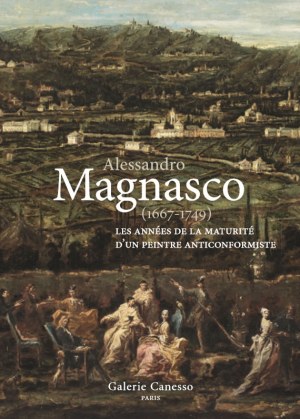 Alessandro Magnasco (1667–1749), les années de la maturité est une exposition centrée sur les plus belles œuvres de la production tardive de ce peintre anticonformiste. L’exposition a le privilège de bénéficier d’un partenariat exceptionnel avec les Musei de Strada Nuova de la ville de Gênes, lieu de naissance de l’artiste. Elle débute à la Galerie Canesso à Paris (du 25 novembre 2015 au 31 janvier 2016) pour faire ensuite étape au Palazzo Bianco de Gênes (du 25 février 2016 au 5 juin 2016).
Artiste à l’œuvre originale et extravagante, Magnasco a été découvert au début du XXe siècle et il est considéré, à certains égards, comme l’un des précurseurs de Goya (1746–1828), des Expressionnistes et l’un des pères du fantastique et du macabre. La fascination de l’artiste pour les atmosphères sombres, la dissolution des formes et un propos moral sévère met en évidence sa dissidence par rapport à la culture figurative contemporaine. Néanmoins, son œuvre riche et variée ne peut se définir par ces seuls caractères. Les réalisations de l’artiste impressionnent, tant du point de vue du langage pictural extrêmement personnel, que de celui des sujets qu’il est le seul à aborder en Europe entre les XVIIe et les XVIIIe siècles. Ses compositions parcourues de petites figures en mouvement nous portent vers l’art de Guardi (1712–1793) et des Vénitiens du Settecento. L’exposition présentera une vingtaine de tableaux, certains à découvrir pour la première fois en France.
Exhibition | Revolution under a King: French Prints, 1789–92
From UCL:
Revolution under a King: French Prints, 1789–92
UCL Art Museum, London, 11 January — 10 June 2016
Curated by David Bindman and Richard Taws
 We are pleased to announce that in January 2016 we’ll be opening the exhibition Revolution under a King: French Prints, 1789–92, featuring a selection of prints from the early, highly volatile years of the French Revolution, curated by Professor David Bindman and Dr Richard Taws, in collaboration between UCL Art Museum and UCL History of Art. It is well known that a chain of key historical events characterised the French Revolution, making it effectively the biggest political media event of its time. These events were communicated extensively throughout Europe in print culture and the combination of image and text, employed extensively in newspapers and graphic works, made for powerful satire and caricature.
It is, however, not always realised that the pivotal moment, the Fall of the Bastille, was in fact followed by three years in which the king of France still nominally presided over the dissolution of the old feudal order. It is this period that is the focus of the exhibition, tracing the early years of the Revolution from the ‘June Days’ of 1789, through the Fall of the Bastille, to the eventual deposition of the Louis XVI in 1792. The exhibition will consist of vivid coloured prints of major events from the period, and a selection of medals, including one made from ‘chains of servitude’ supposedly found in the ruins of the Bastille.
Exhibition | Rise and Fall: The Earl of Mar and the 1715 Jacobite Rising
Press release (9 November 2015) for exhibitions now on view in Edinburgh:
Rise and Fall: The Earl of Mar and the 1715 Jacobite Rising
Calum Colvin: Jacobites by Name
Scottish National Portrait Gallery, Edinburgh, 14 November 2015 — 27 March 2016

Sir Godfrey Kneller, Portrait of John Erskine, 6th Earl of Mar, with His Son Thomas, Lord Erskine (Collection of Earl of Mar & Kellie at Alloa Tower, National Trust for Scotland)
The 300th anniversary of the 1715 Jacobite Rising will be marked by two fascinating new displays at the Scottish National Portrait Gallery this winter. A key player in the rising, John Erskine, 6th Earl of Mar, will be the focus of Rise and Fall, while Calum Colvin, one of Scotland’s leading contemporary artists, will explore the visual imagery and legacy of the Jacobite Risings of 1715 and 1745 in Jacobites by Name.
Responsible for initiating and subsequently ending the Rising, the Earl of Mar (1675–1732) was an extraordinary individual, passionate about both politics and the arts. Born in Alloa, Clackmannanshire, he was a Member of Parliament and later Secretary of State for Scotland, before being deprived of office by the new Hanoverian king, George I, in 1714. Mar raised the standard of rebellion against the Hanoverians, and from September to December 1715 he was effectively ruling Scotland.
The 1715 Rising is a key date in the power struggle between the Protestant Hanoverians and of the exiled Stuarts. It was a major attempt by the Jacobites—the supporters of King James VII (of Scotland) and II (of England) and his heirs—to regain the throne for the Stuart claimant, James Francis Edward Stuart. However victory eluded Mar and he ultimately fled to France with James Stuart in 1716, where he remained until his death in 1732.
At the centre of Rise and Fall will be two large and impressive portraits of the Earl and his wife, Frances Pierrepont (of around 1714), by Sir Godfrey Kneller, the leading portrait painter in England of the time. These imposing paintings usually hang at the National Trust for Scotland property Alloa Tower—the ancestral home of the Earls of Mar and Kellie—and were commissioned by Mar himself. Although he is often defined by his political and military career, Mar was a man of fine taste and an enthusiastic patron of the arts, with a talent for amateur architecture and garden design.
Prints, drawings and miniatures also on show in Rise and Fall bring alive this cataclysmic episode of Scottish history and shed light on the life and interests of the Earl of Mar. Key loans have come from the collection of the current Earl and Mar of Kellie and the National Records of Scotland.

Calum Colvin, Lochaber no More, 2015
The Scottish National Portrait Gallery’s outstanding Jacobite collection has been used to inspire a contemporary intervention which complements Rise and Fall by the renowned Scottish artist Calum Colvin. His Jacobites by Name inventively combines photography with painting and installation. The result includes new works such as Lochaber no More (2015) which links two images of Charles Edward Stuart, commonly known as Bonnie Prince Charlie, the second Jacobite pretender to the throne and instigator of the failed 1745 Jacobite Rising. The first of the images shows Charles as a young man and the other much older.
To make his photographic works, Colvin constructs a set in his studio, using furniture and ornaments, and then paints images on to these three-dimensional objects. When seen through the lens of his camera, a two-dimensional image is formed, a blend of reality and illusion. Lochaber no More is a powerful evocation of the passage of time and the melancholy of lost Jacobite hope, while fragments of burned tartan hint at the tragic outcome of the last rising. In his work, Colvin also alludes to the tradition of secret symbolism and optical illusionism in Jacobite-related art; because support for the exiled Stuarts was dangerous and could lead to accusations of disloyalty to the Crown, ‘secret’ portraits of the Pretenders were to be discovered on folded fans, sewn discreetly onto articles of clothing, or concealed inside the lid of a closed box.
Colvin was born in Glasgow and studied art in Dundee and London, before coming to prominence in the mid-1980s. He has exhibited extensively in Europe and the United States and has worked on commissions for the National Galleries of Scotland.
Christopher Baker, Director of the Scottish National Portrait Gallery said: “The Jacobite struggle remains potent and romantic 300 years after the key events that defined it. These complementary displays connect powerful portraiture of the 18th century with contemporary responses, and remind us in an engaging and inspiring way of a turbulent period in Scottish history. We are especially grateful to the National Trust for Scotland, the Earl of Mar and Kellie and the artist Calum Colvin for their generosity and commitment to the project.”
Calum Colvin commented: “This new body of work investigates the traces of Jacobite material culture, portraiture and visual illusion to be found in Scottish museums up and down the country. I wanted to take a fresh look at this material with a view to re-interpret the matrix of symbols and allusions that they carry and, through a range of different types of contemporary making, bring them into the digital age. The works are contrasted with the existing collection in the Scottish National Portrait Gallery and question the role of this familiar iconography in Scottish national culture.”
About the National Trust for Scotland
One of Scotland’s leading conservation charities, the National Trust for Scotland cares for some of the nation’s most important heritage sites, from grand castles to humble homes and wild coastline. With more than 100 properties packed with paintings, textiles, ceramics, sculpture and fine furniture, the Trust holds Scotland’s biggest collection of in-situ artworks. Amongst its gems include many fine pictures by artists including Raeburn, Batoni and Peploe to name a few. Some of Scotland’s finest contemporary works, including pieces by Ken Currie, Julia Douglas and Julie Roberts, are on currently on display at Drum Castle in Aberdeenshire while Aberdeen Art Gallery undergoes a major refurbishment.
About Alloa Tower
Alloa Tower is the ancestral home of the Erskine family, the Earls of Mar and Kellie. The tower is the largest, oldest keep in Scotland and was originally built to guard the nearby ferry crossing on the River Forth. The Erskines were aides to the Stuart monarchs and guardians to the royal children—Mary, Queen of Scots and James VI both spent part of their early lives at Alloa Tower. It was Mary who granted the earldom to the Erskines in 1565. Since its construction around 1368, Alloa Tower has been altered many times and provides a rich variety of architectural styles and historic collections. Once part of a much larger mansion, with extensive gardens modelled on those of Versailles, among the features within the tower are a sweeping, eighteenth-century Italianate staircase, a medieval oak beamed roof, a dungeon and a well. It also houses collections of important paintings, on loan from the Erskine family, including the two full length portraits by Sir Godfrey Kneller on display here.
In 2015 the fourteenth-century Alloa Tower in Clackmannanshire was acquired by the National Trust for Scotland (NTS), having previously been managed by NTS working in partnership with the Clackmannanshire Heritage Trust, with financial support from Clackmannanshire Council. From 1988, Alloa Tower was restored from a semi-derelict state and first opened to the public in 1996. It is this partnership, and the philanthropic endeavours over many years of the current Earl of Mar and Kellie and his father, that have enabled NTS to secure the tower’s long-term future.










 Enfilade
leave a comment