Exhibition | Turner’s Wessex: Architecture and Ambition
Press release for the exhibition now on view at Salisbury:
Turner’s Wessex: Architecture and Ambition
The Salisbury Museum, 22 May — 27 September 2015
Curated by Ian Warrell

J.M.W. Turner, The Choir of Salisbury Cathedral, 1797, watercolour, 65 x 51 cm (The Salisbury Museum)
Visitors to The Salisbury Museum this summer will be treated to a highly original and fascinating exhibition on J.M.W. Turner. Newly discovered facts and a wealth of material never previously assembled together revises the traditional outline of Turner’s formative years. Turner’s Wessex: Architecture and Ambition reveals new insights into Turner’s ambitious and innovative work as a very young man and his complex relationships with extremely wealthy patrons. “We are astonished to discover that Turner began his career here in Salisbury, painting the town, its magnificent cathedral and the extraordinary Fonthill Abbey nearby,” said Adrian Green, Director of The Salisbury Museum.
Building on recent successes with Constable and Cecil Beaton exhibitions, The Salisbury Museum showcases J.M.W. Turner’s meteoric rise at the turn of the nineteenth century, working for two of England’s wealthiest men as they embarked on extravagant building projects and historical research on a very grand scale in the Wessex region.
Salisbury is likely to be a magnet for visitors throughout 2015, as across the green from the museum at Salisbury Cathedral the Magna Carta celebrates its 800th anniversary. Exceptional National Trust properties such as Stourhead will be open to visitors nearby, and 20 minutes away the ancient monument of Stonehenge continues to cast its mysterious spell.
Turner first visited Salisbury in 1795 when he was 20 years old. As his career developed, he returned to paint Stonehenge and its surrounding landscape. Set in the vast Wessex plains, his depictions of the ancient stones proves to be among his most hauntingly atmospheric works.
The first of Turner’s patrons in the Salisbury area was Sir Richard Colt Hoare, a gentleman-antiquarian who inherited the Stourhead estate in 1784. In the late 1790s when Turner was barely out of his teens, Sir Richard commissioned him to paint a series of watercolours of Salisbury and its newly restored cathedral, which was then the subject of much controversy. Wiltshire owes much to Colt Hoare for his involvement in the first archaeological survey of the landscape around Salisbury and the books he published on the history of Ancient and Modern Wiltshire.
But it was another local patron, William Beckford, described by Byron as “England’s wealthiest son,” who from 1798 gave Turner his most valuable early commissions, and engaged him to paint the gothic folly he was building at Fonthill Abbey. With characteristic bravado, Turner worked on the largest sheets of paper available, bringing all his daring experimental skill to bear, always pushing at the boundaries of technical achievement. His depictions of Beckford’s legendary tower—part of which fell down in 1800—provide a unique record of its construction. The exhibition includes a series of sketches Turner made on site, usually held in the Tate archive.
The third part of the exhibition charts Turner’s delightful work in the wider Wessex region—spanning Wiltshire, the Dorset coast, Hampshire and the Isle of Wight. It includes surprising images such as his exquisite watercolours of fish, and witty caricatures made along with other members of the Houghton Club. Many of the waterolours relate to Turner’s popular topographical views, which reached a wide audience as engraved prints and continue to do so today. The exhibition culminates in a record of the historic visit made by the French King Louis Philippe to Queen Victoria in 1844—the first visit by a French King to England in roughly 500 years.
The exhibition has been selected by the distinguished Turner scholar Ian Warrell, working in collaboration with the team at Salisbury Museum, and builds a vibrant and dramatic picture of the brilliant young artist, driven by self-belief and limitless ambition, grafting his way in a complex world. The Salisbury Museum is proud that the unmatched collection of Turner watercolours of Salisbury cathedral at the heart of the exhibition is being seen together for the first time since 1883. The exhibition offers a unique view into how Wiltshire’s great patrons provided a crucial springboard to the career of one of England’s best-loved artists.
◊ ◊ ◊ ◊ ◊
From Scala:
Ian Warrell, Turner’s Wessex: Architecture and Ambition (London: Scala, 2015), 208 pages, ISBN: 978-1857599305, £25/ $40.
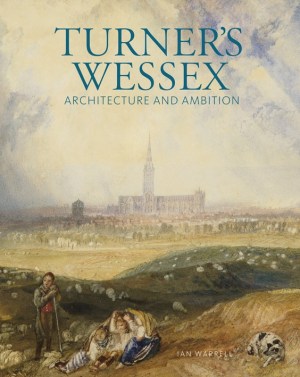 Turner was only 20 in 1795 when he first visited Salisbury. This book focuses on the important commissions that resulted from his contact with the region, which provided the foundations for his success. Reunited here are his inventive watercolours of Salisbury Cathedral painted for Sir Richard Colt Hoare, widely dispersed since 1883. Turner’s matchless ability to depict architecture also attracted the attention of the eccentric art lover and writer, William Beckford. The problematic construction of Beckford’s legendary but short-lived neo-gothic abbey at Fonthill was uniquely recorded in Turner’s sketches and watercolours.
As his career developed, Turner repeatedly revisited an area that captivated him. His depictions of Stonehenge, in particular, proved to be among his most hauntingly atmospheric works. In this beautifully illustrated book many rarely seen works are brought together, illuminating this formative and fascinating period in Turner’s output.
Ian Warrell is an independent curator, specialising in British art of the nineteenth century. He is the author of many books on Turner, most recently Turner’s Sketchbooks.
Exhibition | Korea Mania: A Traveller’s Tale
On view in Sèvres:
Corée Mania: Roman d’un Voyageur
Cité de la Céramique, Sèvres, 21 January — 20 July 2015
Curated by Stéphanie Brouillet
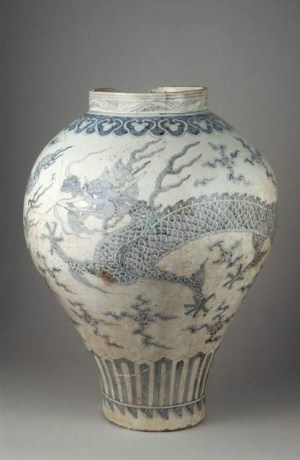
Dragon Jar, Korean, 18th century (MNC28154 Sèvres – Cité de la céramique / RMN)
Cité de la céramique célébre en 2015 les Années croisées France-Corée, en organisant deux expositions: l’une patrimoniale avec Roman d’un voyageur, l’autre contemporaine à travers la présentation des œuvres de Yik-Yung Kim et Yeun-Kyung Kim.
Du 21 janvier au 20 juillet, l’exposition Roman d’un voyageur s’articule autour de la figure emblématique du diplomate Victor Collin de Plancy (1853–1922), premier consul de France en Corée qui collecta de nombreux objets et œuvres d’art coréens. L’exposition invite à un double voyage : celui vers la péninsule coréenne, au cœur de l’Extrême-Orient, à la découverte d’une culture ancienne et raffinée, et l’autre sous la forme d’une plongée dans le temps, vers le « royaume ermite » de la fin de l’époque Choson, à la fin du XIXe siècle.
De nombreuses céramiques dont certaines exceptionnelles du 1er siècle de notre ère à nos jours, dont la grande jarre à décor de dragon du XVIIIe siècle, considérée comme un chef-d’oeuvre des collections nationales conservées par l’établissement, sont présentées ainsi que du mobilier, des instruments de musique, des objets quotidiens, des photographies, des peintures, des documents d’archives qui évoquent le pays et son art de vivre.
Une journée d’étude sur le céladon, à la fois sous l’angle historique mais aussi scientifique, prévue à l’automne, viendra ponctuer cette saison coréenne à la Cité de la céramique.
Le commissariat est assuré par Stéphanie Brouillet, conservatrice du patrimoine chargée des céramiques asiatiques à Sèvres. La scénographie est confiée au designer Vincent Dupont-Rougier.
A summary in English is available from the Asia Europe Museum Network (ASEMUS):
◊ ◊ ◊ ◊ ◊
The catalogue is published by Loubatières:
 Roman d’un Voyageur, Victor Collin de Plancy: L’histoire des Collections Coréennes en France (Carbonne: Loubatières, 2015), 263 pages, ISBN: 978-2862667195, 39€.
Victor Collin de Plancy fut le premier représentant de la France en Corée entre 1888 et 1906. Interprète puis diplomate, il se passionna pour l’histoire et l’art de ce pays resté longtemps fermé pour les Occidentaux. Désireux de le faire connaître en France, il rassembla un grand nombre d’objets—céramiques, manuscrits, livres, meubles ou costumes—dont il fit don à des institutions françaises au rang desquelles figure le Musée national de la céramique. Il fut également au cœur d’un petit groupe de voyageurs passionnés par la Corée qui, à leur tour, enrichirent les collections françaises.
A preview of the catalogue is available here»
The Burlington Magazine, May 2015
The eighteenth century in The Burlington:
The Burlington Magazine 157 (April 2015)
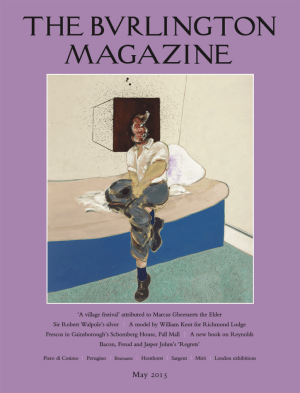 A R T I C L E S
• Tessa Murdoch, “Power and Plate: Sir Robert Walpole’s Silver,” pp. 318–24.
• Julius Bryant, “Queen Caroline’s Richmond Lodge by William Kent: An Architectural Model Unlocked,” pp. 325–30.
R E V I E W S
• Duncan Robinson, Review of Mark Hallet, Reynolds: Portraiture in Action (The Paul Mellon Centre for Studies in British Art, 2014), pp. 341–47. Available at The Burlington website for free.
• Stephen Lloyd, Review of Cory Korkow with Jon Seydl, British Portrait Miniatures: The Cleveland Museum of Art (D. Giles, Ltd., 2013), pp. 349–50.
• Richard Wolfe, Review of the exhibition Shifting Patterns: Pacific Barkcloth Clothing (British Museum, 2015), pp. 361–62.
• Jamie Mulherron, Review of two exhibitions: Charles de La Fosse: Le Triomphe de la Couleur (Versailles and Nantes, 2015) and Bon Boullogne (1649–1717): Un chef d’école au Grand Siècle (Dijon, 2014–15), pp. 365–67.
New Book | Ireland: Crossroads of Art and Design, 1690–1840
In connection with the exhibition now on view the Art Institute of Chicago, Yale University Press is distributing the catalogue (congratulations, Ireland, on an inspiring weekend). –CH
William Laffan and Christopher Monkhouse, eds., with Leslie Fitzpatrick, Ireland: Crossroads of Art and Design, 1690–1840 (New Haven: Yale University Press, 2015), 288 pages, ISBN: 978-0300210606, $50.
 This groundbreaking book captures a period in Ireland’s history when countless foreign architects, artisans, and artists worked side by side with their native counterparts. Nearly all of the works within this remarkable volume—many of them never published before—have been drawn from North American collections. This catalogue accompanies the first exhibition to celebrate the Irish as artists, collectors, and patrons over 150 years of Ireland’s sometimes turbulent history.
Featuring the work of a wide range of artists—known and unknown—and a diverse array of media, the catalogue also includes an impressive assembly of essays by a pre-eminent group of international experts working on the art and cultural history of Ireland. Major essays discuss the subjects of the Irish landscape and tourism, Irish country houses, and Dublin’s role as a center of culture and commerce. Also included are numerous shorter essays covering a full spectrum of topics and artworks, including bookbinding, ceramics, furniture, glass, mezzotints, miniatures, musical instruments, pastels, silver, and textiles.
William Laffan is an art historian and author, and former editor of Irish Architectural and Decorative Studies: The Journal of the Irish Georgian Society. Christopher Monkhouse is the chair and Eloise W. Martin Curator, Department of European Decorative Arts, at the Art Institute of Chicago.
Exhibition | Shifting Patterns: Pacific Barkcloth Clothing
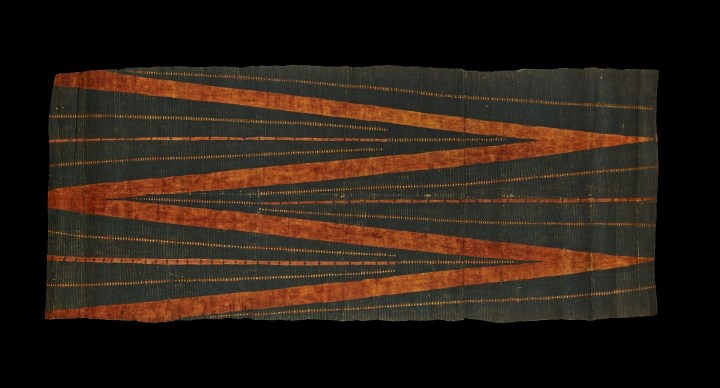
Barkcloth, kua’ula, Hawaiian Islands, Eastern Polynesia, late 18th Century
(London: The British Museum)
◊ ◊ ◊ ◊ ◊
Now on view at The British Museum:
Shifting Patterns: Pacific Barkcloth Clothing
The British Museum, London, 5 February — 6 December 2015
Discover a selection of textiles from the Pacific made from barkcloth. Used to wrap, drape and adorn the body in a myriad of styles and designs, these garments demonstrate the long history of barkcloth, and its ongoing relevance today.
In the islands of the Pacific, cloth made from the inner bark of trees is a distinctive art tradition. Probably brought to the region at least 5,000 years ago by some of the first human settlers, its designs reflect the histories of each island group and the creativity of the makers. Spanning the region from New Guinea in the west to Rapa Nui (Easter Island) in the east, the exhibition will show a selection of 77 garments, headdresses, masks and body adornments from the Museum’s collection. Dating from the 1700s to 2014, the pieces on display include those worn as everyday items and ceremonial costumes linked to key life cycle events such as initiation and marriage.
Barkcloth is generally made and decorated by women, but garments intended for ritual purposes may be made by men. This is particularly true in the masking traditions of Papua New Guinea. The Baining people who live on the large island of New Britain continue to make masks for day and night dances. In the exhibition, an elaborately decorated Baining mask made in the 1970s demonstrates how barkcloth can be used in dramatic three-dimensional creations.
Imported cloth and the changes brought by colonial activities across the region have had different impacts on the art form. In some locations, such as Tonga, barkcloth making never completely stopped. In others, such as Hawaii, the practice has actively been revived and Hawaiian kapa is now worn for high profile hula performances. The exhibition considers these recent developments, and shows a barkcloth dance skirt made in 2014 by Hawaiian practitioner Dalani Tanahy alongside some fine examples of early Hawaiian cloth, including a cloth with striking red and black designs thought to have been made in the late 1700s.
New arenas for cultural expression continue to emerge through barkcloth creations, as urban Pacific Island designers incorporate barkcloth elements and patterns into garments intended for the catwalk. A stunning wedding dress made by New Zealand-based Samoan designer, Paula Chan Cheuk illustrates this movement and reflects the continuing relevance of barkcloth as a flexible, resilient art tradition.
Exhibition | Napoleon’s Artists in Australia
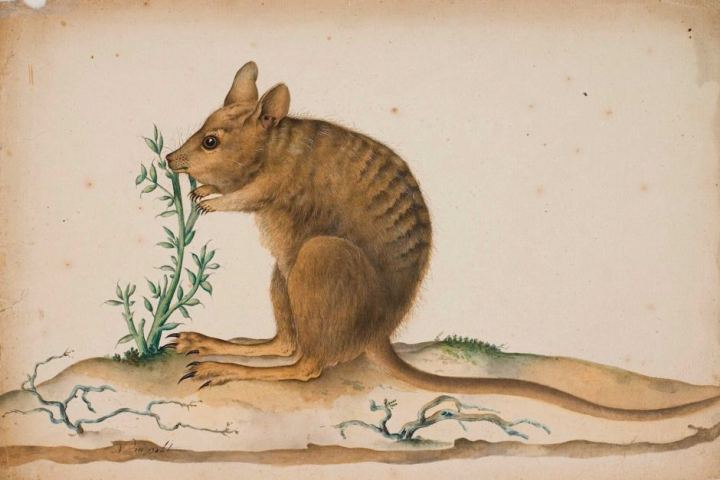
Lagostrophus fasciatus (Banded Hare Wallaby), Péron and Lesueur, 1807, Watercolour and ink on paper, Western Australia (Muséum d’Histoire Naturelle du Havre).
◊ ◊ ◊ ◊ ◊
Press release (15 May 2015) from the National Museum of Australia:
Napoleon’s Artists in Australia
South Australian Maritime Museum, Adelaide, from July 2016
Tasmanian Museum and Art Gallery, Hobart, from early 2017
National Museum of Australia, Canberra, from September 2017
TBA
Exquisite illustrations by French artists made during Nicolas Baudin’s exploration of Australia will come to Australia as the result of a deal clinched in Canberra between the Museum of Natural History in Le Havre, France and six Australian museums. Under the Memorandum of Understanding (MOU) between the French and Australian museums, stunning original watercolours and drawings by Baudin expedition artists Charles-Alexandre Lesueur and Nicolas-Martin Petit will be showcased at venues across the country.

New Holland – Mororé, Nicolas-Martin Petit, Pierre noire or charcoal and sanguine on paper (Muséum d’Histoire Naturelle du Havre)
The French artists explored Australian waters between 1800 and 1804 with the expedition of Baudin, who was commissioned by Napoléon Bonaparte, First Consul of France, to investigate Nouvelle Hollande—particularly its uncharted southern coast. As Baudin’s two ships charted the continent’s coastline, the artists captured the wonders of a new land in vivid watercolours of animals, people, and landscapes.
The working title of the planned exhibition is Napoleon’s Artists in Australia. Most of the anticipated 100 illustrations have never been displayed in Australia before. The project was instigated by the Museum of Natural History in Le Havre and the South Australian Maritime Museum (Adelaide). It also involves the Australian National Maritime Museum (Sydney), the Western Australian Museum (Perth), the Queen Victoria Museum and Art Gallery (Launceston), the Tasmanian Museum and Art Gallery (Hobart), and the National Museum of Australia (Canberra).
Minister for the Arts, Senator the Hon George Brandis QC, welcomed the collaboration. “This partnership will allow audiences across the country to see unique depictions of life in Australia though French eyes,” said Senator Brandis.
National Museum of Australia director Mathew Trinca said that the illustrations are a rare window into the lives of the First Australians before European settlement. “These illustrations provide unique insights into life in Australia before European colonisation and I’m excited to be involved in bringing them to the country,” said Dr Trinca.
A delegation from France, led by the Mayor of Le Havre, Edouard Philippe, was on hand in Canberra to sign the MOU.

New Holland – Mororé, Nicolas-Martin Petit, Pierre noire or charcoal and sanguine on paper (Muséum d’Histoire Naturelle du Havre)
Museum of Natural History director, Cedric Cremiere said: “It is wonderful that after that first French encounter with Australia more than 200 years ago, we can share these discoveries and sense of wonder with Australian audiences.”
The French Ambassador to Australia, Christophe Lecourtier, said Lesueur was a magnificent artist, a pioneering naturalist and an astute observer.
“These extraordinary illustrations will be showcased in six Australian museums thanks to a fruitful partnership with the Muséum d’Histoire Naturelle du Havre—which was created to house Lesueur’s work—and for which we have the pleasure to thank, the Mayor of Le Havre, Mr Edouard Philippe. Mr Philippe is here with us today on his first ever visit to Australia. This is an extraordinary opportunity for the public to discover Australia, as the first explorers and French navigators did, more than 200 years ago,” said Ambassador Lecourtier.
Illustrations featured in the exhibition will include: evocative portraits of Indigenous Australians in NSW and Tasmania; images of Indigenous baskets and watercraft; whimsical watercolours of strange marine invertebrates; highly accurate profiles of the coastline; and drawings of Australian mammals such as Kangaroo Island’s dwarf emu, which have now disappeared. The exhibition will open in Adelaide in July 2016, before touring the country until May 2018. It will open in Canberra at the National Museum of Australia in September 2017.
Exhibition | Unbuttoning Fashion

◊ ◊ ◊ ◊ ◊
Now on view at Les Arts Décoratifs:
Déboutonner la mode
Les Arts Décoratifs, Paris, 10 February — 19 July 2015
For the first time, the Déboutonner la mode exhibition at Les Arts Décoratifs is unveiling a collection of over 3,000 buttons unique in the world, and also featuring a selection of more than 100 female and male garments and accessories by emblematic couturiers such as Paul Poiret, Elsa Schiaparelli, Christian Dior, Jean Paul Gaultier and Patrick Kelly. Acquired in 2012, this collection was classified as a Work of Major Heritage Interest by the Consultative Commission on National Treasures.

Button, late eighteenth century, wax on painted metal
(Paris: Les Arts Décoratifs)
Although small in size, the priceless materials and skills involved in making these pieces dating from the 18th to the 20th century can make them fully-fledged objets d’art. Produced by artisans ranging from embroiderers, soft furnishers, glassmakers and ceramicists to jewellers and silversmiths, they crystallise the history and evolution of these skills. The button has also fascinated famous painters, sculptors and creators of jewellery, inspiring them to produce unique miniature creations for the great couture houses.
This collection, gathered by Loïc Allio, is exemplary in its variety, richness and eclecticism. Its exceptional pieces include a portrait of a woman in the Fragonard manner, a trio of buttons inspired by La Fontaine’s fables by the silversmith Lucien Falize, a set of eight birds painted on porcelain by Camille Naudot, and a series of 792 pieces by the sculptor Henri Hamm. The jewellers Jean Clément and François Hugo and the artists Jean Arp and Alberto Giacometti all produced pieces for the famous fashion designer Elsa Schiaparelli, as did Maurice de Vlaminck for the couturier Paul Poiret. Couture houses such as Dior, Balenciaga, Mme Grès, Givenchy, Balmain and Yves Saint Laurent enlisted the talents of the jewellers Francis Winter and Roger Jean-Pierre, and the exhibition also features creations by Sonia Delaunay and Line Vautrin.
Structured chronologically, the exhibition reveals the incredible history of the button, showing via this extraordinary collection how it perfectly reflects the creativity and humour of a period. Pictures, engravings, drawings and fashion photographs emphasize its importance on the garment and how crucial it is in creating the balance of a silhouette.

Button, attributed to Fragonard, late eighteenth century, miniature on ivory (Paris: Les Arts Décoratifs)
Since its appearance in the 13th century, the button has maintained its key role on the garment. Its production and use gradually developed but the golden age of the button in France did not come until the late 18th century, when it became a luxury item often more expensive than the garment itself. More than a mere ornament, it was also a means of conveying penchants and opinions, via humorous, intimate and even political messages (portraits of the royal family, scenes showing storming of the Bastille, etc.). However, not until around 1780 and the French craze for all things English, did the button appear in female fashion, on dresses and bodices with cuts inspired by male garments.
In the 19th-century male wardrobe the art of the button gave way to the art of buttoning. Now smaller and more discreet, the button came to denote the degree of refinement of a garment or level of distinction of its wearer. The attention paid to its positioning is particularly apparent on that most essential component of the male wardrobe, the waistcoat. With the industrial revolution in the second half of the 19th century button manufacturing developed into a full-scale industry mass-producing all sizes and colours of buttons for every type of garment and accessory.
Women’s buttons remained much more modest in size but their number increased. They now also appeared on ankle boots, gloves and eventually lingerie as the number of undergarments increased around 1850. Their number was precisely noted in fashion magazines and their description in contemporary literature established them as objects of coquetry and even seduction. In parallel, silversmiths and jewellers created valuable buttons, sometimes presented in caskets like jewellery and reflecting the artistic movements of the period, especially Art Nouveau.
The first floor of the exhibition ends with the 1910s and the return of the so-called ‘Empire’ line under the influence of the avant-garde-inspired couturier Paul Poiret, for whom the importance of a detail, for instance a button and its precise positioning, is dictated by a “secret geometry that is the key to aestheticism.”
The exhibition continues with the fashion of the 20s, featuring Art Deco buttons and the emergence of the paruriers, creators of accessories, jewellery and buttons, each with their own style and preference for different materials. Their close collaborations with the great couturiers are highlighted in a display featuring creations for Elsa Schiaparelli, Jean Clément and Jean Schlumberger. François Hugo’s designs for Schiaparelli include uncut stones set in bent and compressed metal. He also enlisted the talents of artists such as Pablo Picasso and Jean Arp for original creations. The decline of the button began in the 80s as couturiers returned to more minimal creations in which the button regained its original use.
In counterpoint to creations by artists, the exhibition emphasizes the manner in which certain couturiers creatively used and interpreted the button in their own way, ranging from Gabrielle Chanel and Christian Dior to Cristobal Balenciaga and the ‘jewellery buttons’ of Yves Saint Laurent. And of course there are also exquisite 21st-century examples, notably Jean Paul Gaultier’s trouser suit entirely covered with small mother-of-pearl buttons, and the coats by Céline subtly revisiting double-breasted buttoning.
Despite the emergence and increasing use of new types of fastenings such as the zip, the pressure button and velcro, the button is ever-present and still has many years to come.
◊ ◊ ◊ ◊ ◊
From Les Arts Décoratifs:
Véronique Belloir, ed., Déboutonner la mode (Paris: Les Arts Décoratifs, 2015), 164 pages, ISBN: 978-2916914541, 45€.
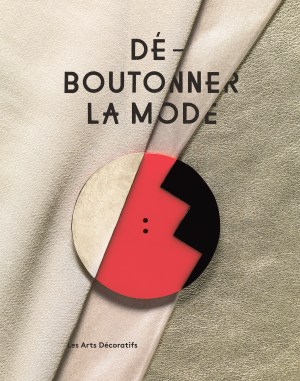 Il est des objets avec lesquels nous entretenons des rapports tout en délicatesse, entre conscience et émotion. À plus d’un titre, le bouton est de ceux-là, de ceux que l’on conserve parfois, sans bien savoir pourquoi, au fond d’une poche ou dans une boîte. Sur un vêtement, qu’il soit masculin ou féminin, son rôle est loin d’être anodin : élément structurant l’équilibre des formes, il entre en résonance avec une ligne, celle d’une boutonnière, d’une couture ou celle du vêtement lui-même. L’histoire du bouton révèle bien d’autres aspects méconnus. Qu’il soit modeste et utile ou précieux et décoratif, sa place évolue au fil du temps en fonction des convenances, des règles de savoir-vivre ou des variations de mode.
Sous la direction de Véronique Belloir, chargée de collections au musée Galliera. Auparavant conservatrice au musée des Arts décoratifs, en charge des collections mode 1800-1940, elle a fait classer la collection de boutons de Loïc Allio en 2012. Textes de Loïc Allio, Véronique Belloir, Raphaèle Billé, Farid Chenoune, Michèle Heuzé, Geoffrey Martinache, Sophie Motsch, Hélène Renaudin. Photographies de Patrick Gries. Référence dans le milieu de l’édition d’art, il excelle dans la photographie d’objets complexes, monumentaux ou minuscules, en répondant à de nombreuses commandes pour le monde du luxe, du design et de l’art contemporain.
Exhibition | Gilbert Stuart: From Boston to Brunswick
From the Bowdoin College Museum of Art
Gilbert Stuart: From Boston to Brunswick
Bowdoin College Museum of Art, Brunswick, Maine, 9 July 2015 — 3 January 2016
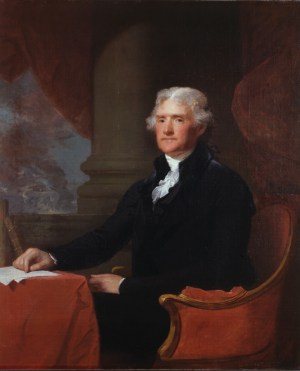
Gilbert Stuart, Portrait of Thomas Jefferson
(Bowdoin College Museum of Art)
This exhibition brings together a selection of oil paintings by Gilbert Stuart (1755–1828) from the Museum’s collection, including his famous portraits of Thomas Jefferson and James Madison.
The preeminent portraitist of the early republic, Stuart created fashionable likenesses of the period’s most important political, military, and social figures. Each of works included in the exhibition was completed after Stuart’s move to Boston in 1805. Collectively, they provide insight into the artist’s relationship with other artists and collectors in the region, including members of the Bowdoin family.
Exhibition | Costumes by Bellange and Berain
From Chantilly:
Fastes de cour au XVIIe siècle: Les costumes de Bellange et Berain
Château de Chantilly, 13 May — 13 August 2015
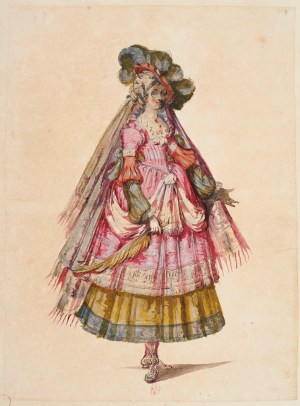 This exhibition is the first public showcasing of a portfolio acquired by the Duke of Aumale in 1854, which is now kept in the Condé museum in Chantilly. The portfolio features 23 exceptional drawings by Jacques Bellange (c. 1575–1616), depicting the Lorraine region festivities for the wedding of Henri de Bar and Marguerite de Gonzague (1606), as well as a series of 34 prints by Jean Berain (1640–1711) featuring watercolour, gold and silver highlights and magnificently depicting the splendours of the courts of Lorraine and France from the beginning to the end of the 17th century.
Paulette Choné and Jérôme de La Gorce, Fastes de cour au XVIIe siècle: Les costumes de Bellange et Berain (Saint-Remy-en-l’Eau: Éditions Monelle Hayot, 2015), 264 pages, ISBN: 978-2903824945, 49€.
Paulette Choné, professeur émérite des Universités, a enseigné l’histoire de l’art moderne à l’Université de Bourgogne. Philosophe, spécialiste de la civilisation des XVIe et XVIIe siècles, elle a consacré une large partie de ses travaux à l’art lorrain, aux fêtes de cour, aux études emblématiques qu’elle a contribué à mettre à l’honneur en France.
Jérôme de La Gorce est directeur de recherche au CNRS, historien d’art et musicologue. Auteur de plusieurs livres, il s’est spécialisé dans les arts de l’éphémère en étudiant notamment les dessins relatifs aux fêtes, aux spectacles et aux cérémonies aux XVIIe et XVIIIe siècles.
Exhibition | A Golden Age of China: Qianlong Emperor, 1736–1795

Jin Tingbiao, Chinese active (c. 1750–68), and Giuseppe Castiglione (attributed to), Italian 1688–1766, worked in China 1714–66, The Qianlong Emperor Enjoying the Pleasures of Life, poem inscribed by Qianlong Emperor in the spring of 1763, coloured inks on silk, 168 x 320 cm (The Palace Museum, Beijing, Gu5278)
◊ ◊ ◊ ◊ ◊
From the press release (26 March 2015) for the exhibition:
A Golden Age of China: Qianlong Emperor, 1736–1795
National Gallery of Victoria, Melbourne, 27 March — 21 June 2015
Hidden treasures from Beijing’s Palace Museum in the Forbidden City have come to Melbourne for the first time, in an Australian exclusive exhibition. A Golden Age of China: Qianlong Emperor, 1736–1795 tells the story of China’s foremost art collector Qianlong Emperor, one of China’s most successful rulers, fourth emperor of the Qing dynasty (1644–1911) and longest living emperor in Chinese history.
This exhibition provides an unprecedented opportunity to explore a rich concentration of more than 120 works from the Palace Museum’s art collection, which is built on the imperial collection of the Ming and Qing dynasties and holds some of China’s most rare and valuable works of art in its collection. . . .

Giuseppe Castiglione, Portrait of Qianlong Emperor in Ceremonial Court Robe, 1736, coloured inks on silk, 239 x 179 cm (The Palace Museum, Beijing, Gu6464)
The Qianlong Emperor’s long 60-year reign (1736–1795) was a particularly fascinating time in China’s history. Under his rule, China was the wealthiest and most populous nation in the world. Qianlong’s ability to preserve and foster his Manchu warrior-huntsman traditions whilst adopting the Confucian principles of political and cultural leadership, resulted in the successful governing of 150 million Chinese people.
It was his ability to adopt Chinese ways, yet honour his Manchu traditions that made him one of the most successful emperors of the Qing dynasty. He studied Chinese painting, loved to paint, and particularly loved to practice calligraphy. He was a passionate poet and essayist, and over 40,000 poems and 1300 pieces of prose are recorded in his collected writings. Qianlong wrote more poetry in his lifetime than all the poets in the Tang dynasty (618–906) combined, a dynasty known for its golden age of poetry. Aside from his own art practice, Qianlong combined his passion for collecting art with his role as preserver and restorer of Chinese cultural heritage. He also embraced the arts of other cultures: European, Japanese and Indian. Giuseppe Castiglione, an Italian Jesuit brother, exerted a great deal of influence over the arts in the court
academy of the Qianlong Emperor.
The exhibition puts the spotlight on Qianlong’s reign and art in five separate sections: Manchu Emperor, Son of Heaven, Imperial art under the Emperor’s patronage, Imperial art of religion and Chinese scholar, art connoisseur and collector. Visitors can enjoy a lavish display of paintings on silk and paper, silk court robes, precious-stone inlayed objet d’art and portraits of the Qianlong Emperor, Empress and imperial concubines; paintings of hunting scenes, court ceremonies and the private life of the Qianlong Emperor; and paintings of the Emperor as scholar and art collector. The exhibition also presents paintings and calligraphy by the Emperor himself as well as classical paintings in his collection. The exhibition includes a sumptuous display of ceremonial weapons of swords, bows and arrows, a chair made of antlers’ horns, silk court robes and ceremonial hats, amongst other ceremonial and palace treasures.










 Enfilade
leave a comment