Exhibition | A Golden Age of China: Qianlong Emperor, 1736–1795

Jin Tingbiao, Chinese active (c. 1750–68), and Giuseppe Castiglione (attributed to), Italian 1688–1766, worked in China 1714–66, The Qianlong Emperor Enjoying the Pleasures of Life, poem inscribed by Qianlong Emperor in the spring of 1763, coloured inks on silk, 168 x 320 cm (The Palace Museum, Beijing, Gu5278)
◊ ◊ ◊ ◊ ◊
From the press release (26 March 2015) for the exhibition:
A Golden Age of China: Qianlong Emperor, 1736–1795
National Gallery of Victoria, Melbourne, 27 March — 21 June 2015
Hidden treasures from Beijing’s Palace Museum in the Forbidden City have come to Melbourne for the first time, in an Australian exclusive exhibition. A Golden Age of China: Qianlong Emperor, 1736–1795 tells the story of China’s foremost art collector Qianlong Emperor, one of China’s most successful rulers, fourth emperor of the Qing dynasty (1644–1911) and longest living emperor in Chinese history.
This exhibition provides an unprecedented opportunity to explore a rich concentration of more than 120 works from the Palace Museum’s art collection, which is built on the imperial collection of the Ming and Qing dynasties and holds some of China’s most rare and valuable works of art in its collection. . . .

Giuseppe Castiglione, Portrait of Qianlong Emperor in Ceremonial Court Robe, 1736, coloured inks on silk, 239 x 179 cm (The Palace Museum, Beijing, Gu6464)
The Qianlong Emperor’s long 60-year reign (1736–1795) was a particularly fascinating time in China’s history. Under his rule, China was the wealthiest and most populous nation in the world. Qianlong’s ability to preserve and foster his Manchu warrior-huntsman traditions whilst adopting the Confucian principles of political and cultural leadership, resulted in the successful governing of 150 million Chinese people.
It was his ability to adopt Chinese ways, yet honour his Manchu traditions that made him one of the most successful emperors of the Qing dynasty. He studied Chinese painting, loved to paint, and particularly loved to practice calligraphy. He was a passionate poet and essayist, and over 40,000 poems and 1300 pieces of prose are recorded in his collected writings. Qianlong wrote more poetry in his lifetime than all the poets in the Tang dynasty (618–906) combined, a dynasty known for its golden age of poetry. Aside from his own art practice, Qianlong combined his passion for collecting art with his role as preserver and restorer of Chinese cultural heritage. He also embraced the arts of other cultures: European, Japanese and Indian. Giuseppe Castiglione, an Italian Jesuit brother, exerted a great deal of influence over the arts in the court
academy of the Qianlong Emperor.
The exhibition puts the spotlight on Qianlong’s reign and art in five separate sections: Manchu Emperor, Son of Heaven, Imperial art under the Emperor’s patronage, Imperial art of religion and Chinese scholar, art connoisseur and collector. Visitors can enjoy a lavish display of paintings on silk and paper, silk court robes, precious-stone inlayed objet d’art and portraits of the Qianlong Emperor, Empress and imperial concubines; paintings of hunting scenes, court ceremonies and the private life of the Qianlong Emperor; and paintings of the Emperor as scholar and art collector. The exhibition also presents paintings and calligraphy by the Emperor himself as well as classical paintings in his collection. The exhibition includes a sumptuous display of ceremonial weapons of swords, bows and arrows, a chair made of antlers’ horns, silk court robes and ceremonial hats, amongst other ceremonial and palace treasures.
Exhibition | Thé, Café ou Chocolat?
From the Musée Cognacq-Jay:
Thé, Café ou Chocolat? l’essor des boissons exotiques au XVIIIe siècle
Tea, Coffee, or Chocolate? The Boom of Exotic Drinks in the Eighteenth Century
Musée Cognacq-Jay, Paris, 26 May — 27 September 2015
Curated by Rose-Marie Herda-Mousseaux
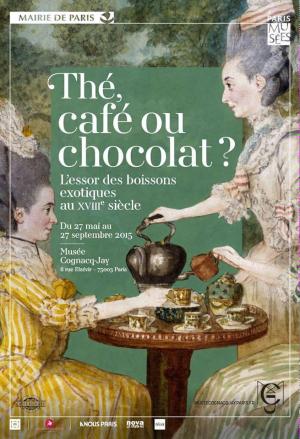 Praised for their medical and therapeutic virtues, the ‘exotic’ beverages, introduced to Europe in the 17th century became a real cornerstone of pleasure and social life during the 18th century. Drinks made with cocoa, coffee and tea—plants not grown in Europe—became an integral part of aristocratic and the upper middle class society following their official introductions to the courts of Europe. As an imported material, their high purchase price in the 17th and 18th centuries classed tea, coffee and chocolate as luxury goods and enhanced their prestigious. This was reflected in items of furniture and tableware designed for the consumption of these new drinks. Porcelain tea sets and other beautiful and luxurious pieces were produced in specialised manufactories. The rise of these products also created a new need for places designed for the public consumption of these drinks, such as cafes, and new mealtime additions such as at breakfast and afternoon tea, that spread throughout society. This exhibition offers a new overview of these beverages and their entry into the rituals of everyday life, presenting works by many iconic 18th-century artists such as Boucher and Chardin.
Louées pour leurs vertus médicales et thérapeutiques, les boissons dites « exotiques », introduites au XVIIe siècle en Europe, ont été associées aux plaisirs et aux sociabilités du XVIIIe siècle. Les boissons issues du cacaoyer, du caféier et du théier—plantes exogènes à l’Europe—ont fait partie intégrante des sociabilités de l’aristocratie et de la haute bourgeoisie dès leurs introductions officielles auprès des cours d’Europe. En tant que matière importée, leur coût d’achat classe au XVIIe et au XVIIIe siècles le thé, le café et le chocolat parmi les produits de luxe et ajoute à leur consommation celle de l’image affichée du prestige. Leur consommation s’est matérialisée dans l’apparition de mobiliers et de nécessaires ou services produits dans les manufactures. Elle a aussi permis l’existence de lieux de consommation publique, les cafés, et de nouvelles pratiques de table, telles le petit déjeuner et le goûter, qui se diffusent progressivement dans la société. Organisée autour de trois axes—« Vertus et dangers des boissons exotiques », « Cercles de consommation » et « Nouveaux services »—cette exposition propose une nouvelle lecture de ces boissons entrées dans les rituels du quotidien, en présentant des oeuvres de nombreux artistes emblématiques du XVIIIe siècle comme Boucher ou Chardin.
Commissaire: Rose-Marie Herda-Mousseaux, conservateur du patrimoine et directrice du musée Cognacq-Jay, avec la collaboration scientifique de Patrick Rambourg, chercheur et historien spécialiste de la cuisine et de la gastronomie, et de Guillaume Séret, docteur en histoire de l’art, spécialiste de la porcelaine de Sèvres.
Rose-Marie Herda-Mousseaux, Patrick Rambourg, Guillaume Séret, Thé, Café ou Chocolat? l’essor des boissons exotiques au XVIIIe siècle (Paris Musées, 2015), 176 pages, ISBN: 978-2759602834, 35€.
The press release (a 14-page PDF file) is available here»
Exhibition | From Sèvres to Fifth Avenue
Now on view at The Frick:
From Sèvres to Fifth Avenue: French Porcelain at The Frick Collection
The Frick Collection, New York, 28 April 2015 — 24 April 2016
Curated by Charlotte Vignon
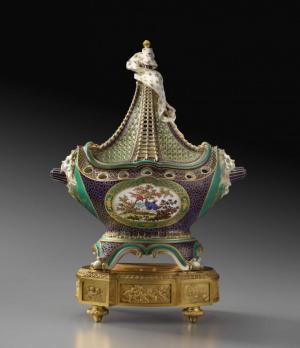 Between 1916 and 1918, Henry Clay Frick purchased several important pieces of porcelain to decorate his New York mansion. Made at Sèvres, the preeminent eighteenth-century French porcelain manufactory, the objects—including vases, potpourris, jugs and basins, plates, a tea service, and a table—were displayed throughout Frick’s residence. From Sèvres to Fifth Avenue brings them together in the Portico Gallery, along with a selection of pieces acquired at a later date, some of which are rarely on view. The exhibition presents a new perspective on the collection by exploring the role Sèvres porcelain played in eighteenth-century France, as well as during the American Gilded Age.
Exhibition | Drawn from the Antique: Artists and the Classical Ideal
From the Teylers Museum:
Drawn from the Antique: Artists and the Classical Ideal
Teylers Museum, Haarlem, 11 March – 31 May 2015
Sir John Soane’s Museum, London, 25 June — 26 September 2015
Curated by Adriano Aymonino and Anne Varick Lauder
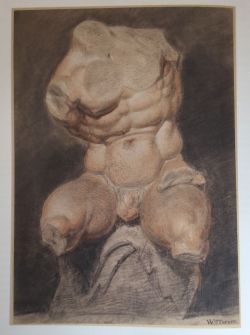
J.M.W. Turner, Study of the Belvedere Torso, black, red, and white chalks (London: V&A)
Famous statues from classical antiquity such as the Apollo Belvedere, the Laocoön and the Venus Pudica were for many centuries the chief attractions of Rome. These ‘heroes’, or plaster copies of them, were depicted in innumerable paintings, drawings and prints. It was above all the heroic nude from antiquity that inspired artists from all over Europe to produce new—in some cases trail-blazing—creations. Young artists depicted antique sculptures, or copies of them, as part of their training: this was believed to be the best way of learning how to render the classical ideal. The exhibition will include paintings and drawings of academies of art, workshops, and individual studios in which artists are hard at work vying with the ancients.
The works on display are of outstanding quality. Some of them have never been exhibited before. For this exhibition, the private collector and art dealer Katrin Bellinger has provided on loan a substantial proportion of her collection of works featuring artists’ studios. Bellinger, whose husband is the well-known entrepreneur Christoph Henkel, is a leading actor in the international art trade, specialising in old drawings. Besides the works from Katrin Bellinger’s private collection, the exhibition also includes loans from museums including the British Museum, the Rijksmuseum, and the Victoria and Albert Museum.
A useful review is available at Lowell Libson, Ltd.
◊ ◊ ◊ ◊ ◊
The catalogue will be available from Artbooks.com:
Adriano Aymonino and Anne Varick Lauder, Drawn from the Antique: Artists and the Classical Ideal (London: Sir John Soane’s Museum, 2015), 256 pages, ISBN: 978-0957339897, $50.
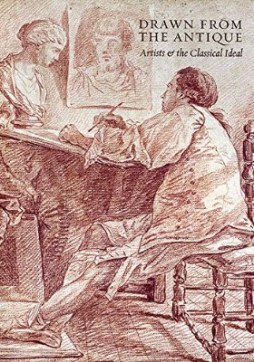 This exhibition and the accompanying catalogue examine one of the most important educational tools and sources of inspiration for Western artists for over five hundred years: drawing after the Antique. From the Renaissance to the nineteenth century, classical statues offered young artists idealised models from which they could learn to represent the volumes, poses and expressions of the human figure and which, simultaneously, provided perfected examples of anatomy and proportion. For established artists, antique statues and reliefs presented an immense repertory of forms that they could use as inspiration for their own creations. Through a selection of thirty-nine drawings, prints and paintings, covering more than four hundred years and by artists as different as Baccio Bandinelli, Federico Zuccaro, Hendrick Goltzius, Peter Paul Rubens, Michael Sweerts, Charles-Joseph Natoire, Henry Fuseli and Joseph Mallord William Turner, this catalogue provides the first overview of a phenomenon crucial for the understanding and appreciation of European art.
Exhibition | Drawn with Spirit: Pennsylvania German Fraktur
The exhibition at the Philadelphia Museum of Art closed last week; the catalogue is distributed by Yale UP:
Lisa Minardi, with an interview by Ann Percy, Drawn with Spirit: Pennsylvania German Fraktur from the Joan and Victor Johnson Collection (New Haven: Yale University Press, 2015), 364 pages, ISBN: 978-0300210521, $65.
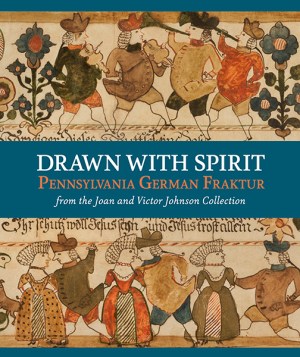 Among the most beloved forms of American folk art, fraktur is a Germanic tradition of decorated manuscripts and printed documents noted for its use of bold colors and whimsical motifs. This publication makes a landmark contribution to the study of Pennsylvania German fraktur, and offers the most comprehensive study of the topic in over 50 years. The featured objects, most of which have never been published, accompany significant new information about the artists who made these works and the people who owned them. An introductory essay sets the renowned Johnson Collection within the context of collecting and scholarship on Pennsylvania German folk art and then highlights major new discoveries, including connections between fraktur and related examples of furniture and prints. An interview with the collectors offers valuable insights into the formation of this special group of objects, which includes birth and baptismal certificates, bookplates, religious texts, writing samples, house blessings, cutworks, and printed broadsides. The splendid color illustrations reveal schools of artistic and regional influence, giving a nuanced understanding of how artists took inspiration from one another and how designs were transferred to new locations. Detailed catalogue entries include extensive information about each piece as well as complete translations.
Lisa Minardi is an assistant curator at Winterthur Museum and a specialist in Pennsylvania German art and culture.
Exhibition | Handel: A Life with Friends
From the Handel House Museum:
Handel: A Life with Friends
Handel House Museum, London, 1 July 2015 — 10 January 2016
Curated by Ellen Harris
 What was it like to live next to the great composer Handel? Who would call at his house? Who did he visit? In this new exhibition, Handel scholar Ellen Harris will explore the composer’s domestic life at 25 Brook Street and the many friends and neighbours who visited him at the new, fashionable residential district called ‘May Fair’.
Handel’s music brought this disparate group of men and women together, as amateur performers in their own homes and as audiences at performances of his operas and oratorios. With important loans from national, local and private collections, the exhibition—inspired by Ellen Harris’s new book George Frideric Handel: A Life With Friends—will offer a rare glimpse into the public and private lives of some of Handel’s closest friends.
◊ ◊ ◊ ◊ ◊
From Norton:
Ellen T. Harris, George Frideric Handel: A Life with Friends (New York: Norton, 2014), 496 pages, ISBN: 978-0393088953, $40.
 An intimate portrait of Handel’s life and inner circle, modeled after one of the composer’s favorite forms: the fugue.
During his lifetime, the sounds of Handel’s music reached from court to theater, echoed in cathedrals, and filled crowded taverns, but the man himself—known to most as the composer of Messiah—is a bit of a mystery. Though he took meticulous care of his musical manuscripts and even provided for their preservation on his death, very little of an intimate nature survives.
One document—Handel’s will—offers us a narrow window into his personal life. In it, he remembers not only family and close colleagues but also neighborhood friends. In search of the private man behind the public figure, Ellen Harris has spent years tracking down the letters, diaries, personal accounts, legal cases, and other documents connected to these bequests. The result is a tightly woven tapestry of London in the first half of the eighteenth century, one that interlaces vibrant descriptions of Handel’s music with stories of loyalty, cunning, and betrayal.
With this wholly new approach, Harris has achieved something greater than biography. Layering the interconnecting stories of Handel’s friends like the subjects and countersubjects of a fugue, Harris introduces us to an ambitious, shrewd, generous, brilliant, and flawed man, hiding in full view behind his public persona.
Ellen T. Harris is professor emeritus at MIT and has served on the music faculties of Columbia University and The University of Chicago. Her previous books include Handel as Orpheus: Voice and Desire in the Chamber Cantatas, and she has spoken at Lincoln Center and appeared on PBS NewsHour and BBC Radio 3. She lives in Newton, Massachusetts.
Exhibition | A Year in the Life of Handel: 1738
 From the Handel House Museum:
A Year in the Life of Handel: 1738
Handel House Museum, London, 1 October 2014 — 28 June 2015
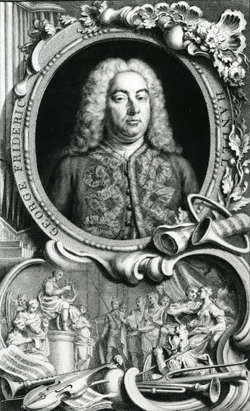
Our series of exhibitions looking in depth at a single year in Handel’s life continues with 1738. It was a year of varying fortunes for Handel—the Italian opera was failing and he was turning increasingly to the new form of the English oratorio. But at the same time a magnificent statue of him was unveiled at Spring Gardens in Vauxhall, celebrating his pre-eminent position in London society. It was the year in which Handel helped create the Fund for Decay’d Musicians, the roots of the new Methodist ministry were established, and Fortnum and Mason invented the Scotch Egg.
Once again a team of Handel House Volunteers will research and curate the exhibition, and the story of 1738 will be told through images and objects from the Handel House Collection, together with loans from other museums.
Exhibition | Pope Pius VII and Napoleon at Fontainebleau
From Napoleon.org and the Château de Fontainebleau:
Pie VII Face à Napoléon: La Tiare dans les Serres de l’Aigle
Château de Fontainebleau, 28 March — 29 June 2015
Curated by Christophe Beyeler and Jean Vittet
The Château of Fontainebleau hosted Pope Pius VII twice: first as a guest as he travelled to Napoleon’s coronation in 1804 and then as prisoner between 1812 and 1814. From 1796 until 1814, Rome and Paris were most notably embroiled in a bitter struggle over iconography. The exhibition at Fontainebleau looks at their diplomatic gifts, stolen artistic treasures, and the official French propaganda celebrating the Concordat of 1801 and defending the invasion of the Papal States in 1808 and the arrest of Pius VII in 1809. Napoleon I and Pius VII finally came head-to-head in 1812 at Fontainebleau. The exhibition contains nearly 130 items, some never displayed before, including loans from the Vatican museum and the papal sacristy.
◊ ◊ ◊ ◊ ◊
Le château de Fontainebleau a accueilli par deux fois le pape Pie VII, comme hôte sur le chemin du sacre en 1804, puis comme prisonnier entre 1812 et 1814. L’appartement des Reines-Mères, baptisé depuis lors « appartement du Pape », en conserve aujourd’hui le souvenir.
 Fontainebleau est à cet égard l’un des lieux qui incarne le mieux les relations tumultueuses entre Rome et Paris, dont l’une des expressions est la « guerre d’image » que se livrent les deux puissances, de 1796 à 1814.
L’exposition évoque d’abord la mainmise des Français sur quelques-uns des trésors de la collection pontificale, la célébration du concordat de 1801 par l’imagerie officielle ou encore l’iconographie subtile des cadeaux diplomatiques lors du sacre de 1804. La guerre de propagande, qui atteint son paroxysme avec l’invasion des États pontificaux en 1808 et l’arrestation de Pie VII en 1809, est ensuite décryptée à travers l’image d’une Rome antique renaissant grâce au « César moderne ». Le Pape, retenu à Savone depuis 1809, est conduit à Fontainebleau en 1812, où les deux protagonistes s’affrontent. L’Empereur parvient à arracher en janvier 1813 un éphémère concordat au Pape qui, libéré en 1814, est accueilli à Rome par une imagerie triomphaliste.
Près de 130 œuvres, parmi lesquelles des acquisitions inédites, ainsi que des prêts exceptionnels des musées du Vatican ou de la Sacristie pontificale, illustrent un affrontement où se combinent enjeux religieux, politiques et artistiques. En écho, sur les lieux mêmes de sa détention, les éléments retrouvés et restaurés du mobilier qu’a connu Pie VII sont rassemblés pour la première fois depuis le Premier Empire.
The 13-page press package is available here»
◊ ◊ ◊ ◊ ◊
The catalogue is available from Dessin Original:
Christophe Beyeler, ed., Pie VII Face à Napoléon: La Tiare dans les Serres de l’Aigle (Paris: RMN, 2015), 248 pages, ISBN: 978-2711862474, 39€.
The Burlington Magazine, April 2015
The eighteenth century in The Burlington:
The Burlington Magazine 157 (April 2015)
 A R T I C L E S
• Marie-Anne Dupuy-Vachey, “Fragonard’s ‘Fantasy Figures’: Prelude to a New Understanding,” pp. 241–47.
• Yuriko Jackall, John K. Delaney, and Michael Swicklik, “Portrait of a Woman with a Book: A Newly Discovered ‘Fantasy Figure’ by Fragonard at the National Gallery of Art, Washington,” pp. 248–54.
R E V I E W S
• Richard Wrigley, “Reassessing François-André Vincent,” — Review of recent exhibitions of Vincent’s work at Montpellier, Tours, and Paris and two books: Jean-Pierre Cuzin, François-André Vincent, 1746–1816: Un Peintre entre Fragonard et David (Arthéna, 2013) and Elizabeth Mansfield, The Perfect Foil: François-André Vincent and the Revolution in French Painting (University of Minnesota Press, 2012), pp. 265–68.
• François Marandet, Review of Christian Michel, L’Académie Royale de Peinture et de Sculpture (Librairie Droz, 2012), p. 276.
• Julia Poole, Review of Joanna Gwilt, Vincennes and Early Sèvres Porcelain from the Belvedere Collection (V&A Publishing, 2014), pp. 276–77.
• Stephen Duffy, Review of France Nerlich and Alain Bonnet, eds., Apprendre à Peindre: Les ateliers Privés à Paris, 1780–1863 (Université Francois Rabelais, 2013), p. 277.
• Reinier Baarsen, Review of the exhibition Eighteenth Century, Birth of Design, Furniture Masterpieces, 1650–1789 / 18e, aux sources du design, chefs-d’œuvre du mobilier 1650 à 1790 (Château de Versailles, 2014–15), pp. 285–86.
• Gauvin Alexander Bailey, Review of the exhibition With Body and Soul / Mit Leib und Seele (Munich: Kunsthalle, 2014–15), pp. 286–88. Available at The Burlington website for free.
• Xavier Salomon, Review of the exhibition Goya’s Tapestry Cartoons in the Context of Court Painting / Goya en Madrid: Cartones para Tapices (Madrid: Prado, 2014–15), pp. 290–91.
• Catherine Whistler, Review of the exhibition, The Poetry of Light: Venetian Drawings from the National Gallery of Art, Washington / La Poesia della Luce: Disegni Veneziani dalla National Gallery of Art di Washington (Venice: Museo Correr, 2014–15), pp. 293–94.
Exhibition | Consuming Passions: Luxury Shopping in Georgian Britain
From Fairfax House:
Consuming Passions: Luxury Shopping in Georgian Britain
Fairfax House, York, 28 May — 31 December 2015

Meissen Chocolate pot, ca 1735 (National Trust, #1245591.1)
The Georgian age, an era of wealth, industry and empire, saw consumerism—the appetite to acquire, to possess, and to display—becoming an increasingly important social and economic phenomenon. Greater numbers of the aspiring middle classes saw their disposable income increase and shopping for luxury items became a way of displaying one’s status in society. The selection and purchase of goods was transformed into a pleasurable pursuit in its own right and shopping became a fashionable leisure and social activity for both sexes.
Consuming Passions: Luxury Shopping in Georgian Britain seeks to explore the world of luxury consumption and Georgian polite shopping in the eighteenth century. Focusing on luxury objects and commodities—such as those required to furnish, fill and decorate homes in the latest taste, to clothe and accessorise, to entertain or simply satisfy the desire for the novel, a significant component of the exhibition will look at the retail experiences and shopping practices of wealthy Georgian Society. Taking its cue from the Fairfaxes, who were discerning customers and from whose household we are fortunate to have a rich archival depository to draw upon, the exhibition will examine the broader retail landscape of Georgian Britain as well as that of burgeoning provincial centres of polite society.










 Enfilade
leave a comment