The Burlington Magazine, March 2015
The eighteenth century in The Burlington:
The Burlington Magazine 157 (March 2015)
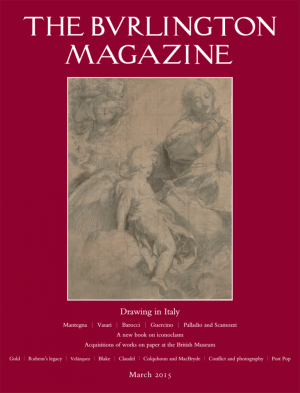 A R T I C L E S
• Veronica Maria White, “Guercino’s Beggar Holding a Broken Jug: A Drawing from the Gennari Inventory of 1719,” pp. 169–71.
• Andrew Hopkins, “Palladio and Scamozzi Drawings in England and Their Talman Marks,” pp. 172–80.
• Andrea Tomezzoli, “From Venice to Newport: A Painting by Giambettino Cignaroli Lost and Found,” pp. 181–85.
R E V I E W S
• Simon Watney, Review of Stacy Boldrick, Leslie Brubaker, and Richard Clay, eds., Striking Images: Iconoclasms Past and Present (Ashgate Publishing, 2013), pp. 186–89. Available at The Burlington website for free.
• David Scrase, Review of Laura Giles, Lia Markey, and Claire Van Cleave, eds., Italian Master Drawings from the Princeton University Art Museum (Yale University Press, 2014), pp. 197–98.
• Frances Parton, Review of the exhibition Gold (London: Queen’s Gallery, 2014–15), p. 202.
• David Scrase, Review of the exhibition William Blake: Apprentice and Master (Oxford, Ashmolean, 2014–15), pp. 206–07.
Display | The Curious Neoclassical Vision of Ennemond-Alexandre Petitot
Now on at the V&A:
The Curious Neoclassical Vision of Ennemond-Alexandre Petitot
Victoria and Albert Museum, London, 25 March — 6 December 2015
Curated by Sarah Grant
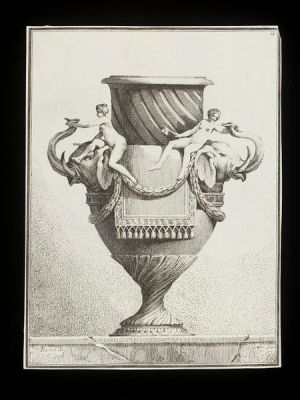
Ennemond-Alexandre Petitot, Suite de Vases (1 of 30 designs), etching by Benigno Bossi, 1770s (London: V&A)
This display showcases 24 prints and drawings by French-born architect and designer, Ennemond-Alexandre Petitot (1727–1801) who was responsible for some of the most captivating and eccentric neoclassical ornamental designs ever produced.
Petitot received a classical training in Lyons, Paris and Rome and won the prestigious post of court architect to the Duke of Parma in 1753. He executed a diverse range of commissions for the ducal palace and other important interiors, bringing a distinctly French aesthetic to the architecture and gardens of Parma. In two famous suites of ornament prints published in the 1770s Petitot gave full reign to his imagination and ensured his legacy as one of the most original exponents of Neoclassicism. These prints and a number of Petitot’s drawings and works by other influential architects and designers form the focus of this display.
Display | Blue and White: British Printed Ceramics
Now on at the V&A:
Blue and White: British Printed Ceramics
Victoria and Albert Museum, London, 31 January 2015 — 3 January 2016
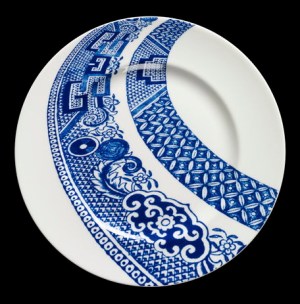
Plate, transfer-printed in enamel, ‘Border’ designed by Robert Dawson. Made by Josiah Wedgwood & Sons, Stoke-on-Trent, 2005 © Victoria and Albert Museum/WWRD United Kingdom Ltd/Robert Dawson
Blue-and-white printed ceramics are a pronounced British phenomenon with continued appeal for potters, artists and consumers. At its very best ceramic printing in blue results in a high-quality, technically precise and aesthetically pleasing decoration, enabling a rapid design response to society and culture.
This display features the wide variety of designs and decoration used in blue-and-white printed ceramics in Britain from the 1750s to present day, in both industrial and art production, demonstrating how these objects reflect British society, culture and interpret the wider world.
The display has been generously supported by The Headley Trust and includes loans from The Potteries Museum and Art Gallery, The Spode Museum Trust, The Wedgwood Museum and private collections.
Display | The Lost Art of Writing
The last weeks for this display at the V&A:
The Lost Art of Writing
Victoria and Albert Museum, London, 6 September 2013 — 4 May 2015

Inkstand, Sheffield plate, ca. 1810 (London: V&A)
“Beautiful Writing pleases everyone, it makes one sought after,” explained the French writer Père Gregoire Martin in 1761.
Having a fine writing hand was not only a useful skill but the sign of an educated and genteel person
This small display in the Metalware gallery explores some of the objects used in writing, from a medieval penner to an ingenious 18th-century globe inkstand and a pen rest designed by the architect Alfred Waterhouse. These objects, made to serve the art of writing, have been displaced by the new virtual world of icons and toolbars.
Exhibition | Asia in Amsterdam
From the Rijksmuseum:
Asia in Amsterdam: The Asian Culture Shock of the Golden Age
Rijksmuseum, Amsterdam, 16 October 2015 — 17 January 2016
Peabody Essex Museum, Salem, Massachusetts, 2016
At the start of the Golden Age, Dutch merchants used their business acumen to establish lucrative trade agreements with Asia. This trade saw all sorts of exotic treasures, such as porcelain, lacquerware, ebony, ivory and silk, arriving in the Dutch Republic, where no one had ever seen such design and materials before. Asia in Amsterdam shares the sensation that these luxury items caused, while also presenting the history behind this first global market. When Dutch ships sailed the entire globe, when young men risked their lives to become rich in Batavia, and when the phrase Made in China meant something else altogether. Amsterdam plaid a central role in the story: the capital city became the marketplace for Asian luxury goods. And not just for the Republic, but for all of Europe. The Peabody Essex Museum in Salem, Massachusetts has one of the most beautiful Asian export art collections in the world and is the Rijksmuseum’s partner for this exhibition.
Exhibition | Paper Architectures

Filippo Juvarra, Premier projet pour la chapelle Saint Hubert à la Venaria Reale, Turin, vers 1716. Plume et encre brune, 15,9 x 31,3 cm, inv. CD 73 (Paris: Les Arts Décoratifs).
◊ ◊ ◊ ◊ ◊
From the Musée des Arts décoratifs:
Paper Architectures: Drawings from Piranesi to Mallet-Stevens
Architectures de Papier: Dessins de Piranèse à Mallet-Stevens
Musée Nissim de Camondo, Paris, 26 March — 21 June 2015
Curated by Basile Baudez
For the first time at the Musée Nissim de Camondo, in conjunction with the Salon du Dessin, the theme of which this year is architecture, the Musée des Arts décoratifs Graphic Arts Department is featuring a selection of its finest works. They give an idea of the wealth and diversity of architectural drawings, ranging from those that record a key phase in the creative process or a highly finished drawing for a client to a architectural ‘tableau’ painted for the Salon, a sketchbook fantasy or a visual compendium compiled for architectural students. Architectural drawings show the diversity of their purposes: the solving of a structural problem, the reinterpretation of archeological decoration, a description of an industrial process or the design of a garden. All these drawings, acquired or donated to the Musée des Arts décoratifs since its founding, plunge us into the heart of a strange, fascinating and highly varied world.
William Bartram Exhibition Slated for 2018
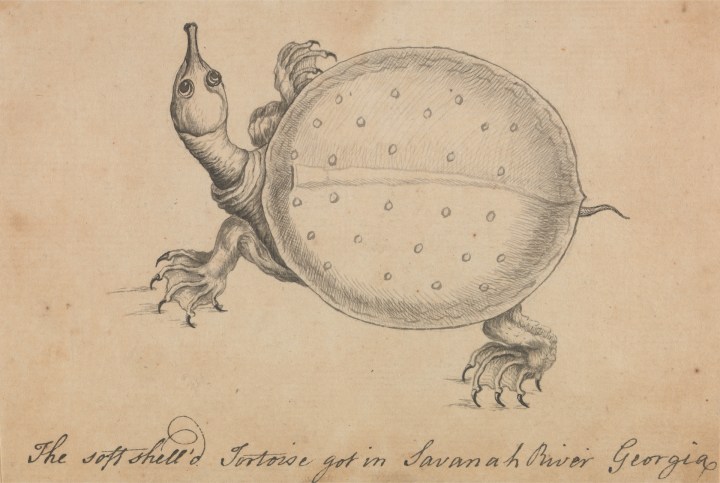
William Bartram, The Soft Shell’d Tortoise Got in Savanah River Georgia, ca. 1773, Gray and black wash over graphite on medium, cream, slightly textured laid paper (New Haven: Yale Center for British Art, Gift of Charles Ryskamp)
◊ ◊ ◊ ◊ ◊
From the YCBA:
This spring [2015], Laurel Waycott, a second-year PhD student in the History of Science and Medicine, and Jacob Stewart-Halevy, a sixth-year student and PhD candidate in the History of Art, will work with Amy Meyers, Director of the Center, and Florence Grant, Postdoctoral Research Associate in the Director’s Office, on the first major exhibition of the work of William Bartram (1739–1823). A Philadelphia-based naturalist, Bartram was the first American-born artist to depict the flora and fauna of North America extensively. The exhibition is scheduled to open at the Center in 2018.
Waycott and Stewart-Halevy have chosen to study Bartram because of his distinctive position in eighteenth-century American natural history, both as a keen observer of American species and their environmental relationships, and as a correspondent with the natural history communities of Great Britain and the Continent.
“I am hoping to explore the dynamic among literary description, personal narrative, and imaginative naturalism in Bartram’s early efforts to catalogue North American species. The contradiction between the meticulous and the fanciful in his animal and botanical drawings seem key to the environmentalism of the moment,” said Stewart-Halevy.
Waycott says studying at the Center will add a unique dimension to her research into the intersections of art, science, and nature, and that the exhibition offers a wonderful opportunity to bring the intertwined histories of science and art to a wider public.
Meyers also appreciates the fresh perspectives the students will bring to the project. “I look forward to working with Laura and Jacob, who will inflect our study of Bartram with exciting new approaches to his life and work. Their cross-disciplinary training will enable us to interpret his contributions to the development of colonial and early republican art and science in important ways.” said Meyers.
Exhibition | Drawings of Alexandre-François Desportes (1661–1743)
Soon to be on view at the Petit Château at Sceaux:
L’Œil du Maître: Esquisses d’Alexandre-François Desportes (1661–1743)
des collections de la Cité de la Céramique
Musée du Domaine Départemental de Sceaux, 20 March — 28 June 2015
Curated by Dominique Brême
 Du 20 mars au 28 juin, le musée du Domaine départemental de Sceaux vous propose une exposition au Petit-Château sur le peintre des chasses de Louis XIV et de Louis XV et de leur meute royale : Alexandre-François Desportes, représentant brillant du ‘grand goût français’. Les animaux, les paysages et l’art de vivre sont les trois thématiques abordées dans cette exposition au travers de soixante esquisses et dessins, établissant un lien entre l’artiste, associé à la décoration des grandes résidences royales et princières, et le domaine de Sceaux.
Cours d’histoire de l’art : L’âge d’or de la nature morte française, par Dominique Brême, directeur du Domaine départemental de Sceaux et commissaire de l’exposition.
Mercredi 8 avril : Genèse et expansion de la nature morte en Europe
Mercredi 15 avril : Le modèle des Écoles du Nord
Mercredi 6 mai : La nature morte en France au XVIIe siècle
Mercredi 13 mai : Alexandre-François Desportes
Mercredi 3 juin : Nicolas de Largillierre et Jean-Baptiste Oudry
Mercredi 10 juin : Jean-Siméon Chardin
Exhibition | On the Road to Italy: Robert to Corot
Now on view at Amiens:
Sur la route d’Italie: Peindre la nature d’Hubert Robert à Corot
Musée d’Art et d’Archéologie d’Évreux, 26 April — 21 September 2014
Musée de Picardie, Amiens 13 February — 31 May 2015
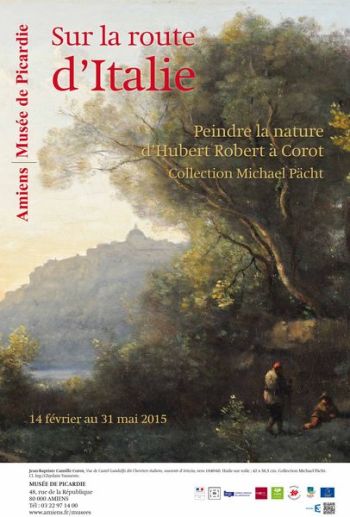 Pour la première fois, la collection de paysages français de l’éditeur Michael Pächt est présentée au public dans une exposition événement organisée en partenariat avec l’Institut national du patrimoine et le musée d’Art et d’Archéologie d’Evreux. Fasciné par le paysage français de la fin du XVIIIe siècle et de la première moitié du XIXe siècle, grand admirateur de Corot, dont il a rassemblé quelques-unes des plus belles pages peintes sur le motif, Michael Pächt a retracé, au gré d’achats guidés par la passion de l’amateur, une chaîne iconographique, stylistique et humaine, dont les relations maître-élève et les amitiés constituent les maillons. Les affinités électives entre artistes, les parentés, les héritages et les ruptures reprennent vie, introduisant le visiteur dans l’intimité qui se crée entre le peintre et la Nature.
D’Hubert Robert à Corot en passant par Michallon, Bidault, Granet et Rousseau, la collection Pächt nous plonge dans la grande aventure de la peinture de plein air à travers les oeuvres de ceux qui firent le voyage en Italie avant de trouver une terre d’élection dans la forêt de Fontainebleau, en Picardie ou dans le Sud de la France. Une centaine d’oeuvres, peintures, dessins, estampes, ainsi que quelques rares clichés-verre de Corot et de Rousseau, viennent animer la Galerie Puvis de Chavannes le temps d’un partage entre un amateur et un public auquel il livre un peu de sa passion.
Paysages français des collections du Musée de Picardie
L’exposition se prolonge avec une sélection de peintures choisies dans les réserves parmi les plus grands chefs-d’oeuvre du musée. Cet accrochage met également à l’honneur les esquisses inédites de Charles Larivière et d’Albert Maignan qui laissèrent de leur séjour en Italie, aux deux extrémités du XIXe siècle, des toiles imprégnées de la lumière du Sud.
Commissariat général
Olivia Voisin, conservateur du patrimoine, chargée du département Beaux-Arts
Florence Calame-Levert, directrice du musée d’Évreux
François Bridey, directeur adjoint du musée d’Évreux
Commissariat scientifique
Gennaro Toscano, directeur du département des conservateurs, Institut national du patrimoine, Paris
◊ ◊ ◊ ◊ ◊
Published by Gourcuff Gradenico and available from Artbooks.com:
Gennaro Toscano, Sur la route d’Italie: Peindre la nature d’Hubert Robert à Corot (Montreuil, Gourcuff Gradenico, 2014), 180 pages, ISBN: 978-2353401789, 29€.
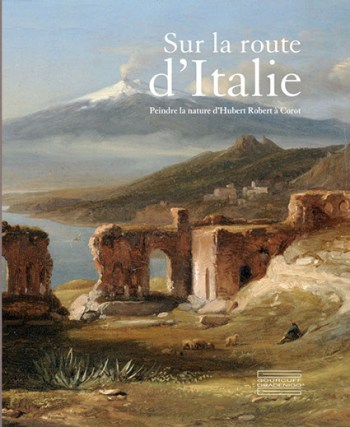 Cet ouvrage présente un ensemble extraordinaire de paysages d’artistes français ayant effectué le voyage en Italie (fin XVIIIe et xixe siècle). Les quelque 26 artistes renommés (Hubert Robert, Granet, Constantin d’Aix, Bertin, Michallon, Corot, Coignet, Rousseau Harpignies…) présents dans la collection ont la caractéristique commune d’avoir peint la nature en plein air en France et en Italie. Montée en partenariat avec l’Institut national du patrimoine (Inp), une exposition se déroulera du 26 avril au 14 septembre 2014 au musée d’Art, Histoire et Archéologie d’Évreux, puis au printemps 2015 au musée de Picardie à Amiens. Cet ensemble de paysages peints en France et en Italie est pour la première fois présenté au public et permet de s’interroger sur la constitution d’une collection particulièrement riche.
En marge de l’exposition, les services de la direction de la culture et de la ville d’Evreux et d’Amiens métropole s’associent pour programmer une «saison italienne». Plusieurs événements verront donc le jour au musée et dans d’autres institutions italiennes, permettant d’explorer la thématique du voyage en Italie ou d’éclairer les relations artistiques entre la France et l’Italie (littérature, Beaux-Arts, musique). Richement illustrée cette publication, solide du point de vue scientifique, s’adresse aussi à un public large et constitue une réflexion sur la peinture de paysage du XVIIIe au xixe siècle.
Exhibition | American Neoclassic Sculpture at the Boston Athenæum

Now on view at the Boston Athenaeum:
American Neoclassic Sculpture at the Boston Athenæum
Boston Athenæum, 26 February — 16 May 2015
Curated by David Dearinger
American Neoclassic Sculpture at the Boston Athenæum, on view at the Boston Athenæum February 26 through May 16, 2015, reveals a collection that is among the oldest and most significant of its kind in the United States, one that helped establish an ‘American taste’ in the visual arts. The exhibition includes more than thirty work: sculptures by the three ‘founders’ of American Neoclassicism—Horatio Greenough (Boston’s first professional sculptor), Thomas Crawford, and Hiram Powers—along with works by their followers, works by such European Neoclassicists as Jean-Antoine Houdon and Bertel Thovaldsen, and marble copies of ancient works including the Venus de Medici and the Apollo Belvedere.
Featured works include Horatio Greenough’s Elizabeth Perkins Cabot (1832–33), Venus Victrix (1837–40), and The Judgment of Paris (1837–40); Thomas Crawford’s Adam and Eve (1855); Bertel Thorvaldsen’s Ganymede and the Eagle (ca. 1830–50); and Jean-Antoine Houdon’s George Washington (ca. 1786). A series of sculpted portraits of Daniel Webster by John Frazee, Hiram Powers, Thomas Ball, and Shobal Vail Clevenger explores the range of treatments, from real to ideal, used in Neoclassic portraiture.
Organized by David Dearinger, the Boston Athenæum’s Susan Morse Hilles Curator of Paintings and Sculpture, American Neoclassic Sculpture is the first time these important works have been shown together. The show presents sculptures, many acquired directly from the artists themselves, that helped establish Neoclassicism as the first ‘national style’ of the young United States. Neoclassic taste, based on the work of ancient Greek and Roman artists, dominated the West starting in the 1750s, after sensational archaeological discoveries at Pompeii, Herculaneum, and elsewhere revealed the styles the ancient Romans favored in vivid detail. It was the latest in a series of classical revivals since the fifth-century fall of Rome. In the young United States, the idealized design language of the classical world seemed the perfect translation of the heady notions of the American Revolution, including the democracy of ancient Greece and the civic virtues of Republican Rome. The proliferation of ancient forms in the United States—columns, capitals, acanthus leaves, imposing pediments, togas (even on George Washington), drapery, idealized faces, and perfect torsos—infused the freshly-minted American republic with the grandeur and gloss of historic destiny.
Almost as soon as it was founded in 1807, the Boston Athenæum began to acquire art along with books and periodicals— slowly at first and then, starting in the 1820s, with increasing vigor. At the same time, the Athenæum and some of its members became major patrons and promoters of American Neoclassic sculptors. “Boston was a particular hotbed of activity,” Dr. Dearinger says of this period. “The city had patrons who were enthusiastic about classical literature and American history. So neoclassical sculpture fit right in. Boston was considered a great place for sculpture. Sculptors came up from New York and New Jersey to meet potential Boston collectors. There was nothing like it anywhere else at the time. “Leading Massachusetts politicians like Charles Sumner and Edward Everett were major patrons, not out of self-interest but as promoters of native-born sculptors and their work,” Dearinger continues. “They supported American sculptors in every way they could, for patriotic reasons, because they felt culture was important to a democratic society and because the work embodied democratic ideals.”
Meanwhile,the Boston Athenæum was commissioning pieces and buying directly from the artists, helping to get things started. Until the Museum of Fine Arts, Boston, opened in 1876, the Boston Athenæum served as the city’s only public art museum. The Athenæum featured works by American sculptors in its annual art exhibitions and, by the time of the Civil War, had established a reputation as a leading and reliable supporter of American sculpture. By 1860, the Athenæum owned one of the largest publicly-accessible collections of sculpture in the country. Among those early Athenæum acquisitions were sculptures: free-standing or in relief, made of plaster or marble. They included fine, full-size copies of approved ancient pieces such as the Venus de Medici and the Apollo Belvedere, as well as idealized figures and busts of important historical personages, modeled or carved by leading modern European neoclassicists. Special connections in Europe also helped the Athenæum acquire plaster casts of important ancient works made directly from the originals in European museums and private hands.
With the maturation of sculpture in America beginning in the 1820s, the work of native Neoclassic sculptors began to be represented in the Athenæum’s collection. Eventually, this included important works by the three ‘founders’ of American Neoclassic sculpture, Horatio Greenough (1805–1852), Thomas Crawford (1814–1857), and Hiram Powers (1805–1873), as well as examples by their followers, many of them born in or around Boston: Richard S. Greenough (1819–1904), Thomas R. Gould (1818–1881), Harriet Hosmer (1830–1908), Chauncey B. Ives (1810–1894), and William Wetmore Story (1819–1895). By then, many American sculptors had moved to Italy to live and work in Florence or Rome, where the cost of living was lower and Puritan standards of behavior did not need to be observed. The change also brought the Americans closer to their classical models and to good sources of the best white marble, which was not available in the United States. Connections to Boston, however, remained as strong as ever. “New Englanders in general were better represented on the Grand Tour than other Americans,” Dr. Dearinger says. “In the 1820s, 40s, and 50s, many of these intrepid seekers of culture were publishing travel books. Chapters in them describe visits to American studios in Italy, places which became, eventually, mandatory European tour stops.” Many works were purchased by American collectors right out of those studios. Nathaniel Hawthorne’s novel The Marble Faun, written after long sojourns in Florence and Rome, and Henry James’s Roderick Hudson, both describe the lives of American sculptors in Italy.
The installation of American Neoclassic Sculpture includes sections summarizing the ancient roots of Neoclassicism, early European interpretations of it, the rise of Neoclassicism in America, the tension between the classical and the real in portraiture and in images of children, the Neoclassicist’s preference for themes from literature and religion, and the special role that Boston—and the Boston Athenæum—played in the patronage of American sculptors during the first half of the nineteenth century. The installation design also reflects early nineteenth-century ideas of how best to display Neoclassic work. “Deep, deep red or deep, deep blue were considered the best wall colors for setting off white marble works,” Dearinger says. “Sculptors were sometimes involved in designing the settings for their own works in their patrons’ homes and they really cared about it. We know of projects where the artist worked out the light source, chose the deep red fabric rugs, even selected the color of the benches.” The dark blue gallery walls and dramatic lighting of the Athenæum’s installation is designed to suggest those early environments. “If there is an overall theme of this exhibition, it is the fine line between the real and the ideal,” Dearinger concludes. “How does artist address both? In portraiture, a bust must look something like the person portrayed, so how does the artist judge where to stop along the boundary between reality and flattery?. The exhibition also explores how conservative protestant Americans were able to straddle the gap between their Puritan backgrounds and the seductive, sensuous tastes of the ancients.”










 Enfilade
leave a comment