Display | Visions of Rome: Lusieri and Labruzzi
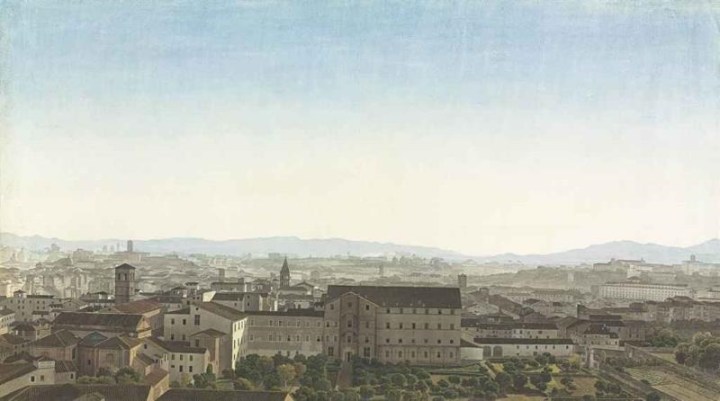
Giovanni Battista Lusieri, Panoramic View of Rome: Capitoline Hill to the Aventine Hill, ca. 1778–1779, watercolour, 55.2 x 97.8 cm. (22 x 39 inches) (London: The British Museum).
◊ ◊ ◊ ◊ ◊
Press release from The British Museum:
Recent Acquisitions | Visions of Rome: Lusieri and Labruzzi
The British Museum, London, 12 December 2014 — 15 February 2015
The British Museum has acquired a rare early surviving work by one of the eighteenth century’s most innovative and technically gifted landscape artists, with the support of the Art Fund, the Ottley Group, the Oppenheimer Fund, Jean-Luc Baroni, the Society of Dilettanti Charitable Trust, and individual contributions.
Giovanni Battista Lusieri’s watercolour Panoramic View of Rome: Capitoline Hill to the Aventine Hill (ca. 1778–79) shows a panoramic view of his native city Rome from Piazza San Pietro in Montorio on the Janiculum, stretching from the Capitoline Hill on the left to the Aventine Hill on the right. It is one of three surviving views from a four-sheet 180 degree watercolour panorama of Rome from the Janiculum at different times of day from morning to evening. These were bought or commissioned by Philip Yorke (1757–1834), who became 3rd Earl of Hardwicke in 1790, during his time in the city in 1778–79. Panoramic View of Rome: Capitoline Hill to the Aventine Hill shows the panorama in the late afternoon with shadows lengthening in the now built over garden of the convent of San Callisto and San Michele in Trastevere in the foreground. (more…)
Display | Connecting Continents: Indian Ocean Trade and Exchange

Front and back of a pendant from Yemen made from a 1780 silver Maria Theresa thaler, 1950s. These coins were originally minted in the Hapsburg Empire but from the late 18th century onwards were used across the Indian Ocean (London: The British Museum). Click here for a high-resolution image.
◊ ◊ ◊ ◊ ◊
Press release from The British Museum
Connecting Continents: Indian Ocean Trade and Exchange
The British Museum, London, 27 November 2014 — 31 May 2015
Objects connected to the long history of trade in the Indian Ocean can be found throughout the British Museum. The new exhibition, Connecting Continents: Indian Ocean Trade and Exchange, is the first time a selection of these have been exhibited together to tell the story of how this vast oceanic space has connected people and cultures from Asia, East Africa, the Middle East and beyond. This intimate yet far-reaching exhibition features objects dating from around 4500 years ago to the present.
Connecting Continents: Indian Ocean Trade and Exchange explores trade from several perspectives. The exhibition features the commodities traded, such as textiles, precious stones and ceramics, which might have been found thousands of miles from their point of origin or production. Other objects on display indicate the use of foreign commodities, such as Roman jewellery made of South Asian sapphires and garnets. The exhibition also demonstrates how objects and their meanings change through these journeys. Coins, for example, were used in many ways—as money, bullion or incorporated into jewellery.

Model Boat Made of Threaded Cloves. Probably from Indonesia, 18th–20th century (London: The British Museum). Click here for a high-resolution image.
◊ ◊ ◊ ◊ ◊
A model boat, made entirely of dried cloves threaded together and displayed for the first time, is the centrepiece that embodies many of the themes in the exhibition. The clove tree is indigenous to Indonesia, from where this boat is likely to originate. The maker used this intricate technique to create a model of a traditional trading ship. These types of model were popular in the 18th and 19th centuries with Europeans, many of whom worked in the East India companies involved in the highly lucrative spice trade. Cloves, as well as cinnamon, pepper, ginger and other spices, have been central to Indian Ocean commerce for millennia. This single object, only half a metre long, illustrates the significance of spices within the Indian Ocean commercial world, the ships used to transport them and how this trade led to the interaction of different cultures.
The written records of merchants and travellers offer further insights into the nature of this trading system. The 14th-century Muslim pilgrim, Ibn Battuta, travelled to East Africa as well as to the Far East, describing in detail the commercial world and the cosmopolitan towns he encountered. Objects found in places Ibn Battuta visited form one section of this display.
The long duration of trade in the Indian Ocean is also demonstrated with beautiful jewellery incorporating carnelian beads from the Indus valley dating from around 2500BC found in the Royal Cemetery at Ur in Mesopotamia.
Pottery from India and East Africa from the 7th to 10th centuries AD found in Siraf on the Gulf coastline of southern Iran illustrates the global movement of people. At this time Siraf was one of the major trading posts on the Ocean rim and these everyday items were likely to have been used for cooking by foreign merchants who sailed long distances to engage in trade.
By thinking about history from the perspective of the ocean, areas which appear small on the map such as the Maldives, become highly significant when we realise they were vital points of refreshment for ocean-going vessels and acted as trading posts. Islands such as these, which are often only associated today with luxury tourism, were central to this early globalised economic system.
The compelling object histories in this display represent a huge geographical spread and tell this long and significant history. Every object in this small space contains myriad stories of interaction, movement, exchange and connection which has characterised the Indian Ocean for thousands of years.
Exhibition | Treasures from India: Jewels from the Al-Thani Collection
Press release (21 October 2014) from The Met:
Treasures from India: Jewels from the Al-Thani Collection
The Metropolitan Museum of Art, New York, 28 October 2014 — 25 January 2015
Curated by Navina Haidar

Flask, 1650–1700, North India, Rock crystal, inlaid with gold wire, rubies, and emeralds, with gold collar, stopper, and foot, 9.2 x 5.5 cm (The Al-Thani Collection).
Some 60 jeweled objects from the private collection formed by Sheikh Hamad bin Abdullah Al-Thani will be presented at The Metropolitan Museum of Art in the exhibition Treasures from India: Jewels from the Al-Thani Collection, opening October 28. The presentation will provide a glimpse into the evolving styles of the jeweled arts in India from the Mughal period until the early 20th century, with emphasis on later exchanges with the West. The exhibition will be shown within the Metropolitan Museum’s Islamic art galleries, adjacent to the Museum’s own collection of Mughal-period art.
“It is with great delight that we present to the public this selection of works representing several centuries of tradition and craftsmanship in the jeweled arts—from India’s Mughal workshops to the ateliers of Paris,” Thomas P. Campbell , Director and CEO of the Metropolitan Museum, said when announcing the exhibition.
Sheikh Hamad stated: “The jeweled arts of India have fascinated me from an early age and I have been fortunate to be able to assemble a meaningful collection that spans from the Mughal period to the present day. I am delighted that The Metropolitan Museum of Art will be exhibiting highlights from the collection, making the subject known to a wider audience.”

Box (dibbi), 1740–80, North India; Jade, inlaid with gold wire, rubies, emeralds, and crystal, 4.2 x 10.8 x 10.2 cm (The Al-Thani Collection)
The display will include historical works from the Mughal period in the 17th century and from various courts and centers of the 18th and 19th centuries, including Hyderabad; a group of late 19th- and 20th-century jewels made for India’s Maharajas by Cartier and other Western firms; and contemporary commissions inspired by traditional Indian forms. On view will be several antique gems that were incorporated into modern settings by Maison Cartier, jewelry designer Paul Iribe, and others. Contextual information will be provided through historical photographs and portraits of Indian royalty wearing works similar to those on view.
India has been a vibrant center for the jeweled arts for many centuries, with its own mines yielding gold, diamonds, and many other precious and semiprecious stones. India’s Mughal rulers and their successors appreciated ceremonial and functional objects made of luxury materials. Among the Mughal works will be an elegant jade dagger originally owned by two emperors—the hilt was made for Jahangir and it was re-bladed for his son Shah Jahan, builder of the Taj Mahal. In the 19th century, the dagger was in the collection Samuel F. B. Morse, inventor of the Morse code. The hilt features a miniature sculpture—a European-style head.
Historically, the gem form favored throughout India has been the cabochon. In the traditional kundan technique, a gem is set within a bed of gold, and often backed in foil to enhance its color. Another highlight of the exhibition will be a gem-set tiger head finial originally from the throne of Tipu Sultan (1750–1799), which incorporated numerous cabochon diamonds, rubies, and emeralds in a kundan setting.

Huqqa Mouthpiece, 1750–1800, North India, Jade, inlaid with gold, rubies, and emeralds; 7.1 x 1.9 cm (The Al-Thani Collection)
Also on view will be several examples of North Indian sarpesh and jigha (turban ornaments) from 1875–1900, brought together in a display that traces their evolution from traditional plume-inspired forms and techniques toward more Western shapes and construction. Silver foil backing was used; however, the diamonds were set using a Western-style claw or coronet, rather than the kundan setting. And a work designed by the artist Paul Iribe and made by goldsmith Robert Linzeler in 1910 in Paris recalls the kind of aigrette (decorative pin) that would have ornamented the turban of a Maharaja or Nizam. At the center is a large emerald, carved in India between 1850 and 1900.
The exhibition is organized by Navina Haidar, Curator, Islamic Art Department. Exhibition design is by Michael Batista, Exhibition Design Manager; graphics are by Sophia Geronimus, Graphic Design Manager; and lighting is by Clint Ross Coller and Richard Lichte, Graphic Design Managers, all of the Museum’s Design Department. The exhibition is made possible by Cartier.
The exhibition will be accompanied by a catalogue published by the Metropolitan Museum and distributed by Yale University Press. Written by Navina Haidar, with a foreword by Sheila Canby, the Patti Cadby Birch Curator in Charge of the Department of Islamic Art, and contributions from Courtney Stewart, Senior Research Assistant, it draws on a study of the collection called Beyond Extravagance, edited by Amin Jaffer, that was printed by Assouline Publishing in 2013.
◊ ◊ ◊ ◊ ◊
From Yale UP:
Navina Najat Haidar and Courtney Ann Stewart, Treasures from India: Jewels from the Al-Thani Collection (New York: The Metropolitan Museum of Art, 2014), 144 pages, ISBN: 978-0300208870, $40.
 India’s rich tradition of jeweled arts has produced extravagant and opulent creations that range from ornaments for every part of the body to ceremonial court objects such as boxes, daggers, and thrones. Starting with the Mughal rulers of India (1526–1858) and continuing to the present day, this artistic practice is characterized by an abundance of costly materials such as gold, ivory, jade, and precious stones of astounding size and quality, which artists have used to create unique and valuable works.
Treasures from India presents 60 iconic works from the world-renowned Al-Thani collection, accompanied by a text that introduces readers to their significance within the history of Indian jeweled arts. Included are some of the earliest pieces created for the imperial Mughals in the 16th century, others made for Maharajahs of the 18th through 20th centuries, and later Indian-inspired works created by Cartier in the 20th century. These examples represent the range and scope of the finest expression of the jeweled arts in India, and stand among the highest expressions of Indian culture and artistry.
Navina Najat Haidar is curator and administrator, and Courtney Ann Stewart is senior research assistant, both in the Department of Islamic Art at The Metropolitan Museum of Art.
Exhibition | Ornements: Chefs-d’oeuvre de la Collection Jacques Doucet
From INHA:
Ornements, XVe-XVIIIe Siècles: Chefs-d’oeuvre de la Collection Jacques Doucet
Institut national d’histoire de l’art, Galerie Colbert, Paris, 2 October — 31 December 2014
 La Bibliothèque de l’Institut national d’histoire de l’art, héritière de la Bibliothèque d’art et d’archéologie créée par le couturier Jacques Doucet (1853–1929) à partir de 1908, est aujourd’hui riche de plus de 25 000 estampes d’ornement, réunies en près de 700 volumes. Son fonds d’estampes couvre la production, tant française qu’italienne ou allemande, du XVIe au XVIIIe siècle. Sources importantes pour les historiens des arts décoratifs, de l’architecture, de l’estampe, ces œuvres ont fait l’objet d’un catalogage informatisé et d’une numérisation, dans le cadre du programme « Histoire de l’ornement » de l’INHA. L’exposition, organisée dans la salle Roberto Longhi de la Galerie Colbert, correspond à l’achèvement de ce programme et à la parution d’un livre consacré à la collection d’estampes d’ornement de l’INHA, publié en coédition par Mare et Martin et l’INHA.
À travers la présentation d’une cinquantaine d’estampes, où se déploie une multiplicité de motifs (rinceaux, frises, fleurs, volutes, grotesques, trophées, cuirs…), l’exposition permet d’éclairer les fonctions de l’estampe d’ornement, mais aussi le contexte de sa production et de sa diffusion, et enfin, son statut d’objet d’étude et de collection. Sont particulièrement mis en valeur les points forts de la collection Doucet, telles les estampes allemandes des XVIe–XVIIe siècles (Martin Schongauer, Virgil Solis, Albrecht Dürer), les gravures d’orfèvres « cosses de pois » du premier XVIIe siècle (Jean Toutin), mais aussi les estampes françaises du XVIIIe siècle représentant rocailles et chinoiseries (Pillement, Huquier), ainsi que leurs copies européennes. Des objets d’art permettent de resituer la place de l’estampe au sein du processus de création. Enfin, reliures remarquables, états rares, épreuves coloriées, illustrent l’histoire des praticiens, amateurs ou collectionneurs de ces estampes, tel Edmond Foulc, dont la collection fut acquise par Jacques Doucet en 1914.
Commissariat
Michaël Decrossas, Lucie Fléjou
Remerciement
Jérémie Cerman, Rose-Marie Chapalain, Sophie Derrot, Elli Doulkaridou, Ludovic Jouvet, Léonie Marquaille, Étienne Tornier, Céline Ventura-Teixeira, qui par leur travail de catalogage des recueils d’ornement des collections Jacques Doucet de la Bibliothèque de l’INHA permettent aujourd’hui cette exposition. Ainsi que la Cité de la céramique, Sèvres & Limoges, musée national de Sèvres et Les Arts Décoratifs pour leurs prêts.
◊ ◊ ◊ ◊ ◊
From INHA:
Michaël Decrossas and Lucie Fléjou, eds, Ornements, XVe–XIXe Siècles: Chefs-d’œuvre de la Bibliothèque de l’INHA, Collections Jacques Doucet (Paris: INHA-Mare & Martin, 2014), 384 pages, ISBN: 979-1092054378, 37€.
 Marquant l’aboutissement d’un programme de recherche porté par l’Institut national d’histoire de l’art depuis 2010, cet ouvrage réunit vingt-six essais abordant quelques-unes des questions les plus intéressantes posées par l’ornement entre le XVIe et le XIXe siècle, et sa place dans l’histoire de l’art, qu’il s’agisse des estampes d’ornement ou des styles d’ornement (rococo, rocaille, « à l’antique »), ou encore d’artistes comme Jean Lemoyne, Gabriel Huquier, Charles Percier et Pierre-François-Léonard Fontaine. Un chapitre de l’ouvrage est consacré à Jacques Doucet, le grand couturier collectionneur qui est à l’origine de la Bibliothèque de l’INHA, laquelle conserve un fonds exceptionnel d’environ 25 000 estampes d’ornement.
Avec la collaboration de Jean-François Bédard (Syracuse University, New York), Michèle Bimbenet-Privat (musée du Louvre), Jean-Gérald Castex (Cité de la céramique – Sèvres & Limoges), Jérémie Cerman (université Paris-Sorbonne), Catherine Chédeau (université de Franche-Comté), Michaël Decrossas (INHA), Marzia Faietti (Galleria degli Uffizi), Lucie Fléjou (INHA), Rossella Froissart (université de Provence), Jean-Philippe Garric (université Paris 1 Panthéon-Sorbonne), Marianne Grivel (université Paris-Sorbonne), Caroline Heering (université catholique de Louvain), Rémi Labrusse (université Paris Ouest Nanterre La Défense), Corinne Le Bitouzé (Bibliothèque nationale de France), Guy-Michel Leproux (École pratique des hautes études), Estelle Leutrat (université de Rennes 2), Marie-Pauline Martin (université de Provence), Véronique Meyer (université de Poitiers), Christian Michel (université de Lausanne), Odile Nouvel-Kammerer (musée des Arts décoratifs), Anne Perrin-Khelissa (université de Toulouse II – Le Mirail), Antoine Picon (Harvard University), Sébastien Quéquet (musée des Arts décoratifs), Kristel Smentek (MIT, Massachusetts), Carsten-Peter Warncke (Georg-August-Universität Göttingen)
Display | William Hogarth, 1697–1764
Now on view at Tate Britain:
William Hogarth, 1697–1764
Tate Britain, London, 27 October 2014 — 26 April 2015
Bristol Museum & Art Gallery, Summer 2015
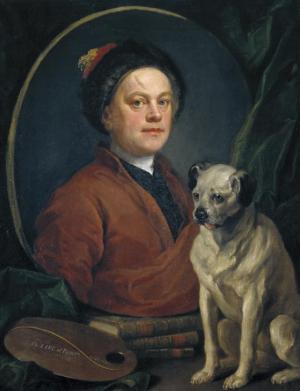
William Hogarth, The Painter and his Pug, 1745 (London: Tate, purchased 1824).
This display marks the 250th anniversary of the death of Hogarth. It includes almost all of his paintings in the Tate Collection, as well as prints, drawings and rarely seen items from the Tate Library and Archive.
The story of art in this country often begins with William Hogarth, who died in late October 1764. Satirist, printmaker, portraitist, history painter and art theorist, in the two hundred and fifty years since his death Hogarth has regularly been positioned as the founding father of British art. This persistent notion was reflected in the early years of Tate’s displays: for decades his was the earliest British work on show at Tate.
Hogarth first gained recognition painting scenes from the theatre. He went on to make his name with his darkly humorous ‘modern moral’ series depicting the declining fortunes of foolish or ignoble characters, and brought similar vivacity to the polite interiors of his ‘conversation piece’ portraits. In 1735 he founded an academy for artists and later wrote a treatise on the aesthetic theories he developed over the course of his career. Whether painting, printmaking or writing, he was concerned with forging and defending a distinctly British art.
In 1951 Tate mounted the first major exhibition of Hogarth’s work since 1814. Tate gained independence from the National Gallery in 1955 and started acquiring works in its own right, and further exhibitions and displays followed reflecting research into Hogarth’s life and art. From the early 1950s Tate also acquired work by earlier British artists, allowing Hogarth to be seen in the context of his predecessors: an innovative champion of British art, but by no means the first British artist.
Read more about Hogarth at the Tate
The online materials are useful, particularly Tim Batchelor’s account of the “Exhibitions and Displays” of Hogarth’s work at Tate (11 November 2014). –CH
Exhibition | Miniaturportraits um 1800
From the Wallraf-Richartz-Museum:
Im Blauen Salon: Miniaturportraits um 1800
Wallraf-Richartz-Museum & Fondation Corboud, Cologne, 14 November 2014 — 1 February 2015
 Mehr als 170 gemalte Porträts an einer Wand? Was klingt, wie ein Ding der Unmöglichkeit, wird im Wallraf wahr. Im Winter 2014/15 zeigt das Museum eine faszinierende Sammlung von Miniaturporträts aus dem 18. und 19 Jahrhundert: Da posiert der Musiker mit stolzer Miene am Klavier, ein Junge im Sonntagsstaat lächelt gequält und die feine Dame mit dem Silberblick schaut schüchtern am Betrachter vorbei. Das sind nur drei der en miniature gemalten Personen, aber sie lassen das breite Spektrum der Sammlung erahnen. Die kaum bierdeckelgroßen Werke kamen als Schenkung ans Wallraf und sind nun erstmals öffentlich zu sehen.
Miniaturporträts erfreuten sich vor rund 200 Jahren großer Popularität. Auf Pergament, Papier und sogar Elfenbein ausgeführt, dienten sie der Erinnerung an geliebte Mitmenschen. Die hochspezialisierten Maler hoben dabei gerne die besonderen Merkmale der Dargestellten lebendig hervor und schufen damit die vielleicht persönlichsten kunsthistorischen Zeugnisse überhaupt. Erst gegen Ende des 19. Jahrhunderts wurden die Miniaturporträts von der Fotografie verdrängt.
Exhibition | Glitterati: Portraits & Jewelry from Colonial Latin America
From the DAM:
Glitterati: Portraits & Jewelry from Colonial Latin America
Denver Art Museum, 7 December 2014 — 27 November 2016

Young Woman with a Harpsichord (detail), Mexico, 1735–50 (Denver Art Museum).
During the Spanish Colonial period in Latin America (1521–1850), precious gold and silver were crafted into elegant jewelry then embellished with emeralds from Colombia, coral from Mexico, and pearls from Venezuela. Wanting to demonstrate their wealth and status, people were painted wearing their finest dress and elaborate jewelry.
Women were adorned with tiaras, necklaces with pendants, and prominent earrings. Men proudly displayed hat ornaments, rings, watch fobs, and chatelaines (decorative belt hooks) with small tools similar to the modern Swiss Army knife. Priests wore gold crucifixes and rosaries while nuns had miniature paintings of the Virgin Mary and saints crafted into brooches, called nun’s badges. Inlaid and lacquered chests and boxes were used to store these luxury goods.
The portraits, furniture, and jewelry that are exhibited in Glitterati, drawn from the DAM’s world-renowned Spanish Colonial collection, tell the fascinating story of people and luxury possessions in the New World.
◊ ◊ ◊ ◊ ◊
From the conference page:
New England / New Spain: Portraiture in the Colonial Americas, 1492–1850
Denver Art Museum, 23–24 January 2015
The 14th Annual Mayer Center Symposium is organized by Dr. Donna Pierce, Mayer Curator of Spanish Colonial Art, Denver Art Museum, and Dr. Emily Ballew Neff, Saxon Director & Chief Curator, Fred Jones Jr. Museum of Art, University of Oklahoma.
Portraiture was an important art form in the Spanish colony of New Spain (Mexico) and in the British colonies of North America. Today, details in portraits—such as clothing, jewelry, and decorative arts—often reveal clues to the lives of both artists and sitters. At the symposium, scholars from both fields of study will present tandem talks addressing the evolution of portraiture as well as the similarities and differences in the colonial experience of the two regions.
S P E A K E R S
• Michael A. Brown (San Diego Museum of Art | San Diego) — Pieces of Home? How ‘Colonial’ Portraiture Developed in the Spanish and British Americas
• Elizabeth Mankin Kornhauser (The Metropolitan Museum of Art | New York) — The New England Portraits of Ralph Earl: Fashioning a Style for the New Citizens of the Young Republic
• Clare Kunny (Director, Art Muse | Los Angeles) — In His Own Image: A Humanist Portrait of Antonio de Mendoza
• Karl Kusserow (Princeton University Art Museum | Princeton) — Pride of Place: Selfhood and Surroundings in Early American Art
• James Middleton (Independent Scholar | New York) — Reading Dress in New Spanish Portraiture
• Paula Mues Orts (National School of Conservation, Restoration and Museography | Mexico City) — Corporate Portrait in New Spain: Social Bodies, the Individual, and their Spaces of Display
• Susan Rather (University of Texas | Austin) — Copies or Resemblances of Nature: The Limitations of Portrait Painting in Colonial British America
• Michael J. Schreffler (Virginia Commonwealth University | Richmond) — Cortes and Moctezuma: Words, Pictures, and Likeness in Sixteenth-Century New Spain
• Jennifer Van Horn (George Mason University | Fairfax) — Regional Tastes in a Transatlantic Market: Joseph Blackburn in New England and Bermuda
• Kaylin Haverstock Weber (Museum of Fine Arts, Houston | Houston) — Colonial Ambition Abroad: Benjamin West’s Portraits, 1763–1783
◊ ◊ ◊ ◊ ◊
Note (added 1 February 2016) — The catalogue has just been published by the University of Oklahoma Press:
Donna Pierce and Julie Wilson Frick, Companion to Glitterati: Portraits and Jewelry from Colonial Latin America at the Denver Art Museum (Norman: University of Oklahoma Press, 2016), 96 pages, ISBN: 978-0914738756, $15.
Exhibition | Masterpieces from the National Galleries of Scotland

Thomas Gainsborough, River Landscape with a View of a Distant Village, ca. 1748–50, oil on canvas, 30 x 60 inches (Edinburgh: Scottish National Gallery)
◊ ◊ ◊ ◊ ◊
Press release from Art Daily:
Masterpieces from the National Galleries of Scotland
The Frick Collection, New York, 5 November 2014 — 1 February 2015 (10 paintings)
de Young, Fine Arts Museums of San Francisco, 7 March — 31 May 2015
Kimbell Art Museum, Fort Worth, Texas, 28 June — 20 September 2015
The National Galleries of Scotland will send a selection of major works from the national collection to the United States over the next year. This touring show will raise the international profile of the Galleries and draw attention to the superb quality and range of works held within Scotland’s national collections. It is also hoped that the exhibitions will help attract interest and financial support for the proposed redevelopment of the Scottish National Gallery. The project plans to radically overhaul and significantly expand galleries devoted to the national collection of historic Scottish art whilst also greatly improving visitor circulation and facilities.
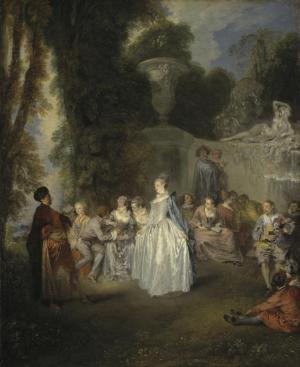
Jean-Antoine Watteau, Fêtes Vénitiennes, 1718–19, oil on canvas, 22 x 18 inches (Edinburgh: Scottish National Gallery)
In November 2014, ten masterpieces will go on display at The Frick Collection in New York. Masterpieces from the Scottish National Gallery will then travel with a further forty-five works to the de Young, Fine Arts Museums of San Francisco, to the Kimbell Art Museum in Fort Worth, Texas. The NGS has always maintained excellent relationships with partners all over the world and this tour will enable the NGS to strengthen these ties. The exhibition will include works by Raeburn, Ramsay, Constable, El Greco, Gainsborough, Reynolds, Velazquez, and Watteau. The Virgin Adoring the Sleeping Christ Child by Sandro Botticelli will also be included. This work has never before been on public view in the United States.
Sir John Leighton, Director-General of the National Galleries of Scotland commented: “At a time of intense international interest in Scotland, this tour to some of the most prestigious venues in the world will be a significant boost to the profile of the Galleries, highlighting the outstanding quality of the national collections and encouraging more visitors to discover the extraordinarily rich heritage and culture of our country.” Michael Clarke, Director of the Scottish National Gallery, said: “The excellence of our collections will achieve wider recognition through this tour. It will enable us to fly the flag for Scotland in a country whose history has been greatly enriched by Scots over the centuries.”
Exhibition | Treasures of British Art 1400–2000: The Berger Collection

George Stubbs, A Saddled Bay Hunter, detail, oil on panel, 22 x 28 inches (The Berger Collection at the Denver Art Museum)
◊ ◊ ◊ ◊ ◊
From the PMA:
Treasures of British Art, 1400–2000: The Berger Collection
Portland Museum of Art, Portland, Maine, 2 October 2014 — 4 January 2015
Dixon Gallery & Gardens, Memphis, Tennessee, 25 January — 19 April 2015
Brigham Young University Museum of Art, Provo, Utah, 14 August 2015 — 5 January 2016
Taft Museum of Art, Cincinnati, Ohio, 10 June — 1 October 2017
Joslyn Art Museum, Omaha, Nebraska 2 June — 9 September 2018
This fall, the Portland Museum of Art (PMA) will showcase a rich survey of British art spanning six centuries in the exhibition Treasures of British Art 1400–2000: The Berger Collection. Organized by the Denver Art Museum, the exhibition will feature 50 masterworks of British art by luminaries including Hans Holbein the Younger, Sir Anthony van Dyck, Thomas Gainsborough, Sir Thomas Lawrence, John Constable, Angelica Kauffman, and George Stubbs. The Berger Collection is one of the most impressive collections of British art in America, and this exhibition provides audiences the rare opportunity to see such a significant body of paintings in this region. The PMA is the first venue in this traveling show, which will be on view in Portland October 2, 2014 through January 4, 2015.
![00 3095 Berger Collection jacket [JW 5-29].indd](https://enfilade18thc.com/wp-content/uploads/2014/11/loadlarge-aspx.jpeg?w=310&h=378) With its diverse array of subjects and styles spanning six centuries of artistic practice, Treasures of British Art traces key developments in British art and culture through a chronological presentation of works. The earliest picture, a gilded altarpiece with a Crucifixion scene from circa 1395, is also an extremely rare surviving example of late Medieval religious painting—the type of object that was systematically destroyed in England when King Henry VIII broke away from the Roman Catholic Church. Portraiture has long been an important genre in British art, and this tradition is well-represented in the exhibition from the linear, decorative style of 16th-century portraits of Tudor royals and nobility, to the loosely brushed naturalism ushered in by Sir Anthony van Dyck and found in 17th- and 18th-century portraiture, to the expressionistic 21st-century image of the artist David Hockney by Adam Birtwistle. Marine paintings and landscapes of faraway places—including a monumental naval battle painting by Adriaen van Diest and a luminous harbor scene by John Constable—reflect not only shifting aesthetic approaches to the natural world, but also the importance of maritime life and overseas exchange in the history of the British Isles. History paintings, equestrian subjects, and other important genres of the British school in styles ranging from the traditional to modern round out the expansive breadth of the exhibition.
With its diverse array of subjects and styles spanning six centuries of artistic practice, Treasures of British Art traces key developments in British art and culture through a chronological presentation of works. The earliest picture, a gilded altarpiece with a Crucifixion scene from circa 1395, is also an extremely rare surviving example of late Medieval religious painting—the type of object that was systematically destroyed in England when King Henry VIII broke away from the Roman Catholic Church. Portraiture has long been an important genre in British art, and this tradition is well-represented in the exhibition from the linear, decorative style of 16th-century portraits of Tudor royals and nobility, to the loosely brushed naturalism ushered in by Sir Anthony van Dyck and found in 17th- and 18th-century portraiture, to the expressionistic 21st-century image of the artist David Hockney by Adam Birtwistle. Marine paintings and landscapes of faraway places—including a monumental naval battle painting by Adriaen van Diest and a luminous harbor scene by John Constable—reflect not only shifting aesthetic approaches to the natural world, but also the importance of maritime life and overseas exchange in the history of the British Isles. History paintings, equestrian subjects, and other important genres of the British school in styles ranging from the traditional to modern round out the expansive breadth of the exhibition.
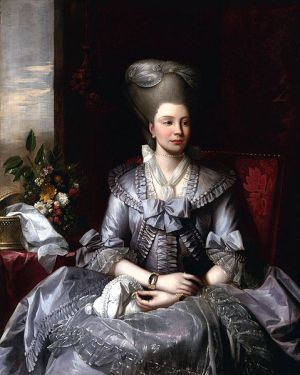
Benjamin West, Queen Charlotte, oil on canvas, 50 x 40 inches (The Berger Collection at the Denver Art Museum)
The Berger Collection is a major private collection largely of British art with a small but significant group of works by artists of other schools, including the French artist François Boucher and the American Winslow Homer. The late William M. B. Berger and his wife Bernadette Johnson Berger began amassing this collection in the mid-1990s out of their dual passion for British culture and for art’s potential to educate. Now owned by the Berger Collection Educational Trust and placed on long-term loan at the Denver Art Museum, the collection continues to expand through new acquisitions. The British paintings, drawings, and art objects number approximately 200 works and span more than six centuries—from the 14th to the 21st century. The very best paintings from this extraordinary collection have been selected for the traveling exhibition to fulfill the Berger family’s mission of sharing these masterpieces with a wide public audience.
The catalogue is available from ArtBooks.com:
Kathleen Stuart, Treasures of British Art, 1400–2000: The Berger Collection (Denver: Denver Art Museum, 2014), 120 pages, ISBN: 9780914738923, $50.
The exhibition is accompanied by a catalogue authored by Kathleen Stuart, Curator of the Berger Collection, with full-color plates and detailed entries on each of the works in the exhibition.
◊ ◊ ◊ ◊ ◊
Note (added 18 December 2014) — The original posting failed to include the Memphis and Provo venues.
Note (added 3 June 2018) — Earlier versions of the posting failed to include the Cincinnati and Omaha venues.
Exhibition | Gold

Gold tiger’s head ornament from Tipu Sultan’s throne, 1785–93; made from gold sheet over a wooden core with finely chased and punched decoration, set with rock crystal eyes, rock crystal teeth, and a hinged gold tongue, the mouth open as if roaring. Presented to William IV by the East India Company in 1831 (Royal Collection, inventory 67212)
◊ ◊ ◊ ◊ ◊
Press release (8 August 2014) from The Royal Collection:
Gold
The Queen’s Gallery, Buckingham Palace, London, 7 November 2014 — 22 February 2015
The beauty and symbolism of gold, from the Early Bronze Age to the 20th century, is celebrated in an exhibition opening at The Queen’s Gallery, Buckingham Palace in November. Through 50 items drawn from across the entire breadth of the Royal Collection, Gold explores the distinctive qualities that make this rare and precious metal an enduring expression of the highest status, both earthly and divine.
Over millennia and across diverse cultures, gold has been used to represent and reflect royal wealth and power. Among the most striking examples in the exhibition are the Rillaton gold cup, from a Bronze Age burial around 1700–1500 BC, a gold crown from Ecuador that pre-dates the Inca invasion, and a tiger’s head in gold and rock crystal from the throne of Tipu Sultan (1785–93), ruler of Mysore in India.
Many of the sacred and ceremonial items associated with the coronations of British monarchs incorporate gold. The exhibition includes a design from 1760 by Sir William Chambers and Giovanni Battista Cipriani for the Gold State Coach, the most expensive coach ever made, which has been used at every coronation since that of George IV. John Whittaker’s illustrated account of the Ceremonial of the Coronation of King George IV in the Abbey of St. Peter’s Westminster, 1823, is printed entirely in gold. Only six copies of the book were ever produced, and the project bankrupted the author. The painting Queen Victoria Receiving the Sacrament at her Coronation, 28 June 1838 by Charles Robert Leslie shows the Queen dressed in the shimmering Dalmatic Robe standing in a pool of golden sunlight.
Highly malleable and versatile, gold has been used to decorate every possible surface, from paper and silk to wood and silver. The exhibition shows gold incorporated into lacquer on a pair of 18th-century Japanese bowls and applied over carved gesso on a table by James Moore, who created furniture for Queen Anne and George I. A cigarette case by Carl Fabergé, presented to King Edward VII by the Dowager Tsarina of Russia in 1903, is made from three colours of gold that have been produced by mixing gold with other metals for a spectacular decorative effect.
The Padshahnama (Chronicle of the King of the World), 1656–57, is the finest Islamic manuscript in the Royal Collection. Written on paper flecked with gold, it forms an official record of the first ten years of the reign of Shah-Jahan, fifth Mughal emperor and builder of the Taj Mahal. Every year an amount equal to the Emperor’s weight in gold, silver and other precious items was distributed as alms, to prevent him suffering any corporeal or spiritual catastrophes. In a page from the manuscript in the exhibition, Shah-Jahan sits cross-legged in the pan of a set of golden scales.
Among other highlights of the exhibition are an early 16th-century Book of Hours illustrated with gilded miniatures by Jean Pichore, Simon van de Passe’s engraved gold portrait medallion of Elizabeth I, and two landscapes by the 17th-century artist Pier Francesco Cittadini which are drawn in pen and ink on paper covered in gold leaf. William Nicholson’s still life Gold Jug, 1937, is from the artist’s small series of works looking at the play of light on metallic surfaces.

Sir William Chambers, Pen and ink and watercolour design for the King’s State Coach, 1760; made for George III, bought from Colnaghi by the Prince Regent (later George IV), 12 June 1811 (Royal Collection, Inventory 917942)
◊ ◊ ◊ ◊ ◊
From the Royal Collection Trust and distributed by The University of Chicago Press:
Kathryn Jones, Lauren Porter, and Jennifer Scott, Gold (London: Royal Collection Trust, 2014), 120 pages, ISBN 978-1909741102, £25 / $40.
 Gold is the most coveted of metals, its rarity and radiant natural beauty making imbuing it with rich meaning throughout human history. For artists, gold has long been associated with the divine. For monarchs, it has been a means of symbolizing status and wealth. With Gold, Kathryn Jones, Lauren Porter, and Jennifer Scott have written a lively and highly informative cultural history of gold in the Royal Collection, one that explores its many manifestations throughout history and its use in promoting messages of power and wealth.
Drawing on the Royal Collection’s unparalleled collection of paintings, miniatures, jewelry, gold boxes, and drawings in and on gold, the book takes readers through the possibilities of this noble metal. Organized thematically, chapters include ‘Divinity’, which covers gold in devotional art; ‘Power’, which explores the role of gold as a symbol of status and wealth; and ‘Art’, which presents the craftsmanship and indestructible quality of gold objects. From Fabergé’s astonishing gold-mounted boxes to the nearly-four-thousand-year-old Rillaton Gold Cup and drawings in gold paint by Edward Burne-Jones, this lavish book—in its own gold binding—presents this most precious substance throughout history in one hundred full-color illustrations.










 Enfilade

leave a comment