Exhibition | Drawings of Alexandre-François Desportes (1661–1743)
Soon to be on view at the Petit Château at Sceaux:
L’Œil du Maître: Esquisses d’Alexandre-François Desportes (1661–1743)
des collections de la Cité de la Céramique
Musée du Domaine Départemental de Sceaux, 20 March — 28 June 2015
Curated by Dominique Brême
 Du 20 mars au 28 juin, le musée du Domaine départemental de Sceaux vous propose une exposition au Petit-Château sur le peintre des chasses de Louis XIV et de Louis XV et de leur meute royale : Alexandre-François Desportes, représentant brillant du ‘grand goût français’. Les animaux, les paysages et l’art de vivre sont les trois thématiques abordées dans cette exposition au travers de soixante esquisses et dessins, établissant un lien entre l’artiste, associé à la décoration des grandes résidences royales et princières, et le domaine de Sceaux.
Cours d’histoire de l’art : L’âge d’or de la nature morte française, par Dominique Brême, directeur du Domaine départemental de Sceaux et commissaire de l’exposition.
Mercredi 8 avril : Genèse et expansion de la nature morte en Europe
Mercredi 15 avril : Le modèle des Écoles du Nord
Mercredi 6 mai : La nature morte en France au XVIIe siècle
Mercredi 13 mai : Alexandre-François Desportes
Mercredi 3 juin : Nicolas de Largillierre et Jean-Baptiste Oudry
Mercredi 10 juin : Jean-Siméon Chardin
Exhibition | On the Road to Italy: Robert to Corot
Now on view at Amiens:
Sur la route d’Italie: Peindre la nature d’Hubert Robert à Corot
Musée d’Art et d’Archéologie d’Évreux, 26 April — 21 September 2014
Musée de Picardie, Amiens 13 February — 31 May 2015
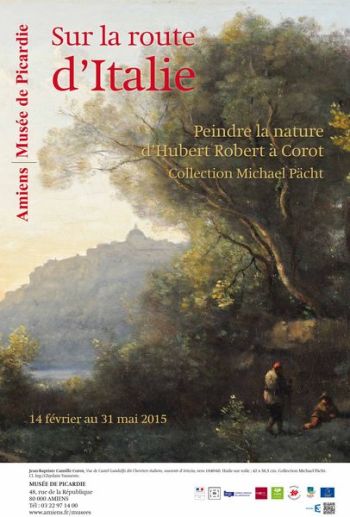 Pour la première fois, la collection de paysages français de l’éditeur Michael Pächt est présentée au public dans une exposition événement organisée en partenariat avec l’Institut national du patrimoine et le musée d’Art et d’Archéologie d’Evreux. Fasciné par le paysage français de la fin du XVIIIe siècle et de la première moitié du XIXe siècle, grand admirateur de Corot, dont il a rassemblé quelques-unes des plus belles pages peintes sur le motif, Michael Pächt a retracé, au gré d’achats guidés par la passion de l’amateur, une chaîne iconographique, stylistique et humaine, dont les relations maître-élève et les amitiés constituent les maillons. Les affinités électives entre artistes, les parentés, les héritages et les ruptures reprennent vie, introduisant le visiteur dans l’intimité qui se crée entre le peintre et la Nature.
D’Hubert Robert à Corot en passant par Michallon, Bidault, Granet et Rousseau, la collection Pächt nous plonge dans la grande aventure de la peinture de plein air à travers les oeuvres de ceux qui firent le voyage en Italie avant de trouver une terre d’élection dans la forêt de Fontainebleau, en Picardie ou dans le Sud de la France. Une centaine d’oeuvres, peintures, dessins, estampes, ainsi que quelques rares clichés-verre de Corot et de Rousseau, viennent animer la Galerie Puvis de Chavannes le temps d’un partage entre un amateur et un public auquel il livre un peu de sa passion.
Paysages français des collections du Musée de Picardie
L’exposition se prolonge avec une sélection de peintures choisies dans les réserves parmi les plus grands chefs-d’oeuvre du musée. Cet accrochage met également à l’honneur les esquisses inédites de Charles Larivière et d’Albert Maignan qui laissèrent de leur séjour en Italie, aux deux extrémités du XIXe siècle, des toiles imprégnées de la lumière du Sud.
Commissariat général
Olivia Voisin, conservateur du patrimoine, chargée du département Beaux-Arts
Florence Calame-Levert, directrice du musée d’Évreux
François Bridey, directeur adjoint du musée d’Évreux
Commissariat scientifique
Gennaro Toscano, directeur du département des conservateurs, Institut national du patrimoine, Paris
◊ ◊ ◊ ◊ ◊
Published by Gourcuff Gradenico and available from Artbooks.com:
Gennaro Toscano, Sur la route d’Italie: Peindre la nature d’Hubert Robert à Corot (Montreuil, Gourcuff Gradenico, 2014), 180 pages, ISBN: 978-2353401789, 29€.
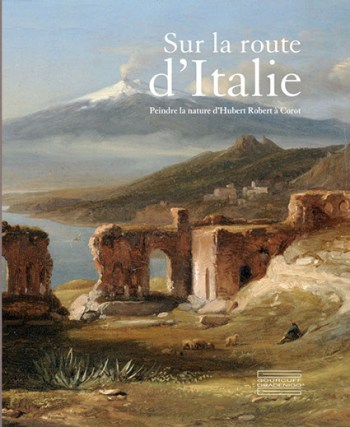 Cet ouvrage présente un ensemble extraordinaire de paysages d’artistes français ayant effectué le voyage en Italie (fin XVIIIe et xixe siècle). Les quelque 26 artistes renommés (Hubert Robert, Granet, Constantin d’Aix, Bertin, Michallon, Corot, Coignet, Rousseau Harpignies…) présents dans la collection ont la caractéristique commune d’avoir peint la nature en plein air en France et en Italie. Montée en partenariat avec l’Institut national du patrimoine (Inp), une exposition se déroulera du 26 avril au 14 septembre 2014 au musée d’Art, Histoire et Archéologie d’Évreux, puis au printemps 2015 au musée de Picardie à Amiens. Cet ensemble de paysages peints en France et en Italie est pour la première fois présenté au public et permet de s’interroger sur la constitution d’une collection particulièrement riche.
En marge de l’exposition, les services de la direction de la culture et de la ville d’Evreux et d’Amiens métropole s’associent pour programmer une «saison italienne». Plusieurs événements verront donc le jour au musée et dans d’autres institutions italiennes, permettant d’explorer la thématique du voyage en Italie ou d’éclairer les relations artistiques entre la France et l’Italie (littérature, Beaux-Arts, musique). Richement illustrée cette publication, solide du point de vue scientifique, s’adresse aussi à un public large et constitue une réflexion sur la peinture de paysage du XVIIIe au xixe siècle.
Exhibition | American Neoclassic Sculpture at the Boston Athenæum

Now on view at the Boston Athenaeum:
American Neoclassic Sculpture at the Boston Athenæum
Boston Athenæum, 26 February — 16 May 2015
Curated by David Dearinger
American Neoclassic Sculpture at the Boston Athenæum, on view at the Boston Athenæum February 26 through May 16, 2015, reveals a collection that is among the oldest and most significant of its kind in the United States, one that helped establish an ‘American taste’ in the visual arts. The exhibition includes more than thirty work: sculptures by the three ‘founders’ of American Neoclassicism—Horatio Greenough (Boston’s first professional sculptor), Thomas Crawford, and Hiram Powers—along with works by their followers, works by such European Neoclassicists as Jean-Antoine Houdon and Bertel Thovaldsen, and marble copies of ancient works including the Venus de Medici and the Apollo Belvedere.
Featured works include Horatio Greenough’s Elizabeth Perkins Cabot (1832–33), Venus Victrix (1837–40), and The Judgment of Paris (1837–40); Thomas Crawford’s Adam and Eve (1855); Bertel Thorvaldsen’s Ganymede and the Eagle (ca. 1830–50); and Jean-Antoine Houdon’s George Washington (ca. 1786). A series of sculpted portraits of Daniel Webster by John Frazee, Hiram Powers, Thomas Ball, and Shobal Vail Clevenger explores the range of treatments, from real to ideal, used in Neoclassic portraiture.
Organized by David Dearinger, the Boston Athenæum’s Susan Morse Hilles Curator of Paintings and Sculpture, American Neoclassic Sculpture is the first time these important works have been shown together. The show presents sculptures, many acquired directly from the artists themselves, that helped establish Neoclassicism as the first ‘national style’ of the young United States. Neoclassic taste, based on the work of ancient Greek and Roman artists, dominated the West starting in the 1750s, after sensational archaeological discoveries at Pompeii, Herculaneum, and elsewhere revealed the styles the ancient Romans favored in vivid detail. It was the latest in a series of classical revivals since the fifth-century fall of Rome. In the young United States, the idealized design language of the classical world seemed the perfect translation of the heady notions of the American Revolution, including the democracy of ancient Greece and the civic virtues of Republican Rome. The proliferation of ancient forms in the United States—columns, capitals, acanthus leaves, imposing pediments, togas (even on George Washington), drapery, idealized faces, and perfect torsos—infused the freshly-minted American republic with the grandeur and gloss of historic destiny.
Almost as soon as it was founded in 1807, the Boston Athenæum began to acquire art along with books and periodicals— slowly at first and then, starting in the 1820s, with increasing vigor. At the same time, the Athenæum and some of its members became major patrons and promoters of American Neoclassic sculptors. “Boston was a particular hotbed of activity,” Dr. Dearinger says of this period. “The city had patrons who were enthusiastic about classical literature and American history. So neoclassical sculpture fit right in. Boston was considered a great place for sculpture. Sculptors came up from New York and New Jersey to meet potential Boston collectors. There was nothing like it anywhere else at the time. “Leading Massachusetts politicians like Charles Sumner and Edward Everett were major patrons, not out of self-interest but as promoters of native-born sculptors and their work,” Dearinger continues. “They supported American sculptors in every way they could, for patriotic reasons, because they felt culture was important to a democratic society and because the work embodied democratic ideals.”
Meanwhile,the Boston Athenæum was commissioning pieces and buying directly from the artists, helping to get things started. Until the Museum of Fine Arts, Boston, opened in 1876, the Boston Athenæum served as the city’s only public art museum. The Athenæum featured works by American sculptors in its annual art exhibitions and, by the time of the Civil War, had established a reputation as a leading and reliable supporter of American sculpture. By 1860, the Athenæum owned one of the largest publicly-accessible collections of sculpture in the country. Among those early Athenæum acquisitions were sculptures: free-standing or in relief, made of plaster or marble. They included fine, full-size copies of approved ancient pieces such as the Venus de Medici and the Apollo Belvedere, as well as idealized figures and busts of important historical personages, modeled or carved by leading modern European neoclassicists. Special connections in Europe also helped the Athenæum acquire plaster casts of important ancient works made directly from the originals in European museums and private hands.
With the maturation of sculpture in America beginning in the 1820s, the work of native Neoclassic sculptors began to be represented in the Athenæum’s collection. Eventually, this included important works by the three ‘founders’ of American Neoclassic sculpture, Horatio Greenough (1805–1852), Thomas Crawford (1814–1857), and Hiram Powers (1805–1873), as well as examples by their followers, many of them born in or around Boston: Richard S. Greenough (1819–1904), Thomas R. Gould (1818–1881), Harriet Hosmer (1830–1908), Chauncey B. Ives (1810–1894), and William Wetmore Story (1819–1895). By then, many American sculptors had moved to Italy to live and work in Florence or Rome, where the cost of living was lower and Puritan standards of behavior did not need to be observed. The change also brought the Americans closer to their classical models and to good sources of the best white marble, which was not available in the United States. Connections to Boston, however, remained as strong as ever. “New Englanders in general were better represented on the Grand Tour than other Americans,” Dr. Dearinger says. “In the 1820s, 40s, and 50s, many of these intrepid seekers of culture were publishing travel books. Chapters in them describe visits to American studios in Italy, places which became, eventually, mandatory European tour stops.” Many works were purchased by American collectors right out of those studios. Nathaniel Hawthorne’s novel The Marble Faun, written after long sojourns in Florence and Rome, and Henry James’s Roderick Hudson, both describe the lives of American sculptors in Italy.
The installation of American Neoclassic Sculpture includes sections summarizing the ancient roots of Neoclassicism, early European interpretations of it, the rise of Neoclassicism in America, the tension between the classical and the real in portraiture and in images of children, the Neoclassicist’s preference for themes from literature and religion, and the special role that Boston—and the Boston Athenæum—played in the patronage of American sculptors during the first half of the nineteenth century. The installation design also reflects early nineteenth-century ideas of how best to display Neoclassic work. “Deep, deep red or deep, deep blue were considered the best wall colors for setting off white marble works,” Dearinger says. “Sculptors were sometimes involved in designing the settings for their own works in their patrons’ homes and they really cared about it. We know of projects where the artist worked out the light source, chose the deep red fabric rugs, even selected the color of the benches.” The dark blue gallery walls and dramatic lighting of the Athenæum’s installation is designed to suggest those early environments. “If there is an overall theme of this exhibition, it is the fine line between the real and the ideal,” Dearinger concludes. “How does artist address both? In portraiture, a bust must look something like the person portrayed, so how does the artist judge where to stop along the boundary between reality and flattery?. The exhibition also explores how conservative protestant Americans were able to straddle the gap between their Puritan backgrounds and the seductive, sensuous tastes of the ancients.”
Exhibition | Burnishing the Night: Mezzotints from the AIC
From the AIC:
Burnishing the Night: Baroque to Contemporary Mezzotints from the Collection
Art Institute of Chicago, 22 February — 31 May 2015

Thomas Frye, Young Man with a Candle, 1760 (Art Institute of Chicago)
Excelling in eerie effects and seductive textures, the late 17th-century medium of mezzotint blossomed from an amateur fascination and hobby of members of the nobility to the 18th century’s most popular reproductive printmaking method. Mezzotint engraving allowed artists to burnish soft highlights and volume into a textured copper plate that would otherwise print in a solid tone. This shading method contrasted dramatically with the standard intaglio medium, which involved either painstakingly incising engraved lines with a burin (a metal-cutting tool) or etching looser lines into a plate with acid. Ideal for nocturnal scenes, portraits, reproductions of paintings, lush landscapes, and garish anatomical and botanical studies, the versatile medium later lent itself to color printing and remains in use today.
Burnishing the Night brings together mezzotint prints, books with mezzotint illustrations, and other works on paper from the permanent collection that span the medium’s predominantly Northern European origins through its worldwide use in the 20th century. Several works in the show are by Irish mezzotint engravers, especially Thomas Frye, whose imaginative head studies will also be featured in this spring’s highly anticipated exhibition Ireland: Crossroads of Art and Design, 1690–1840. Frye’s evocative Young Man with a Candle from 1760 demonstrates the liquid effects made possible by the mezzotint medium, from the bulging, startled eyes to the dancing candlelit shadows and dripping wax. The viewer waits with bated breath along with this startled youth, enjoying the theatrical uncertainty of a ghost story, printed in velvet tones.
A complementary and concurrent installation in Gallery 208A, Printing Darkness and Light in the Dutch Republic, details how Rembrandt and other artists created their own dramatic “Dark Manner” or “Night Pieces” without the use of mezzotint.
Exhibition | Europe in Vienna: The Congress of Vienna 1814/15

Johann Nepomuk Höchle, Redoute paré during the Congress of Vienna, ca. 1815
(Vienna: Österreichische Nationalbibliothek)
◊ ◊ ◊ ◊ ◊
Press release for the exhibition:
Europe in Vienna: The Congress of Vienna 1814/15
Europa in Wien: Der Wiener Kongress 1814/15
Lower Belvedere and the Orangery, Vienna, 20 February — 21 June 2015
Curated by Sabine Grabner and Werner Telesko
The Congress of Vienna is one of the most important international mega events in European history. Two hundred years ago, Vienna became Europe’s political, cultural, and social hub for a period of several months. The Congress was hosted by Emperor Francis I of Austria. All of the major European powers sent their delegates in order to confer together about how to reorganise the continent, which had lost its stability during the Napoleonic Wars. Austria was represented by the Prince of Metternich, who also functioned as the president of the Congress. Its declared goal was to achieve peace in Europe and secure order on a long-term basis. The diplomatic negotiations were accompanied by a number of social events and various entertainments, the enormous splendour of which has been captured in numerous written and pictorial documents. Vienna was flourishing as a centre of cultural life, with many artists coming to the imperial capital and inspiring all genres of domestic art production.

Exhibition view Europe in Vienna: The Congress of Vienna 1814/15. Photo by Eva Würdinger.
Europe in Vienna: The Congress of Vienna 1814/15 will highlight both the political and social aspects of this extraordinary event, which kept all Europe on tenterhooks over several months. There is hardly another political, diplomatic and social event of the nineteenth century that was documented by such a great diversity of materials like the Congress of Vienna, which turned the metropolis on the River Danube into the hotspot of Europe for a brief period of time. When preparing the objects for the exhibition, the curators Sabine Grabner and Werner Telesko were confronted with the challenge of how to vividly present a diplomatic and historical process that was mainly perceived as a social event. The exhibits, which come from numerous different countries, range from reportage prints and caricatures to history paintings and portraits in various dimensions and media—from miniature to sculpture and life-sized oil paintings. The scope of the Congress of Vienna as a phenomenon of social and artistic ramifications will primarily be displayed in the form of artistic masterpieces from all genres. The thematic spectrum will take into account both the exciting chronology of events—from the European Wars of Liberation and the occupation of Vienna in 1805 and 1809 to the Battle of Leipzig of 1813—and an adequate representation of their protagonists, who came from the aristocracy and the bourgeoisie alike.

François Pascal Simon Gérard, The Imperial Count Moritz Christian Fries with His Wife Maria Theresia Josepha von Fries (née Princess of Hohenlohe-Waldenburg-Schillingsfurst) and Their Son Moritz, ca. 1805 (Vienna: Belvedere)
“For the Belvedere it was particularly important to illustrate the epochal event of the Congress of Vienna as comprehensively as possible, both as to its historical and political and its social and cultural implications,” says Agnes Husslein-Arco, Director of the Belvedere and 21er Haus. “It was seemed essential to us to vividly capture the cultural impact of the Congress and the atmosphere that prevailed in those days through private loans, which we mostly found in the surroundings of direct descendants of the diplomats and aristocrats involved. Besides such personal souvenirs as medals and snuffboxes, we will also present the portrait of Princess Dorothea of Courland, the Duchess of Dino, Talleyrand-Périgord and Sagan, by François Gérard and the portrait of Prince Charles Philip of Schwarzenberg I by Johann Peter Krafft. I am particularly delighted that we succeeded in receiving Ludwig van Beethoven’s score for his Eroica symphony from the archives of the Gesellschaft der Musikfreunde in Wien, as well as the elaborately designed final act of the Congress of Vienna, which will naturally be the exhibition’s centrepiece,” Agnes Husslein-Arco adds.
Among the exhibition’s further highlights will be the portrait of Prince Clement Wenceslas Lothar von Metternich, then foreign minister of the Austrian Empire and its future chancellor, by the period’s leading English painter Sir Thomas Lawrence, as well as the more-than-lifesized portrait of Emperor Alexander I of Russia by François Gérard from the Château de Malmaison near Paris, which is hardly ever allowed to travel abroad.
The Congress of Vienna as a Junction of Politics and Culture

Johann Nepomuk Schaller, Bust of Empress Maria Ludovica Beatrix, 3rd wife of Emperor Franz I of Austria, 1814 (Vienna: Belvedere)
The Congress of Vienna as a historic diplomatic event whose consequences affected Europe as a whole was generally perceived by the public as a social spectacle. Yet those in charge and the organisers at the Viennese court were well aware from the very outset that there was a close connection between its political and diplomatic dimension on the one hand and its abundance of diverse court festivities (fireworks, dances, masked balls, carousels, tournaments, ethnic festivals, hunts, sleigh rides, theatre performances, etc.) and private fêtes on the other, which boils down to the fact that it was easier to arrive at relevant political results with the protagonists discussing unsettled or delicate issues in a relaxed atmosphere behind the scenes.
“The special challenge about the Congress of Vienna as a theme lies in the interdependence between history and event culture. What makes it even more difficult is that then there was no sense of documentation as it exists today, which means that many events have come done to us in the form of narrative but cannot be visualised in the form of images,” says curator Sabine Grabner.
As to the pictorial representation of the event it is characteristic that the image or images of the Congress of Vienna do not exist—except for the famous engraving based on a work by Jean-Baptiste Isabey (1819), which in our textbooks at school was still used as the illustration of the Congress of Vienna, although it actually visualises a fictitious conference of diplomats.
The Congress of Vienna as a Major Society Event

Exhibition view Europe in Vienna: The Congress of Vienna 1814/15. Photo by Eva Würdinger.
Initially the official entertainment programme of the Congress of Vienna comprised primarily military festivities. Various military parades, military church parades, and manoeuvres were intended to demonstrate to the high-ranking guests the strength and splendour of the imperial army. In addition, however, numerous court festivities were held, including balls and concerts that took place at the imperial palace or in the residences of influential members of the higher aristocracy, such as Rasumofsky or Metternich. The programme also included hunts, fireworks, and sleigh rides. For the huge balls at the Hofburg, which were attended by as many as 10,000 guests, the Winter Riding School was transformed into a gigantic dance floor and connected to the Hofburg’s two ballrooms by an outside staircase. ‘In order to do justice to the essential qualities of the Congress as a historic and diplomatic event on the one hand and as a point of attraction for European society on the other, the exhibition deliberately concentrates on the numerous intersections between art and cultural history,’ guest curator Werner Telesko, Director of the Department of Studies in Art and Music History at the Austrian Academy of Sciences, points out.
The Congress of Vienna as an Epochal Political Event

Exhibition view Europe in Vienna: The Congress of Vienna 1814/15. Photo by Eva Würdinger.
As to the significance of the Congress for posterity, one must not neglect the dramatic political developments of the year 1815. For Napoleon’s flight from the island of Elba and the subsequent declaration against him, which was signed by all of the European states on 13 March 1815, seem to have contributed considerably to the pressure of the Congress to succeed. As of this day, the political fate of Napoleon was sealed in the form of this hitherto unprecedented closing of ranks of the major European nations and eventually turned out to be final in the legendary and decisive Battle of Waterloo in June 1815 All in all, the Congress proved a remarkable political success. The borderlines between the individual European powers were redefined on a long-term basis. Especially the power equilibrium that had been achieved in Vienna had a far-reaching impact on the entire continent. The negotiations helped settle a number of conflicting interests and tensions. For almost forty years, no further martial conflicts occurred on a European level, due to the stability that had been brought about. Initially, Russia, Austria, Prussia, and Great Britain had decided that France, Spain, and the lesser powers should not have a voice in the decision processes. Yet the experienced French diplomat Charles-Maurice de Talleyrand eventually succeeded in getting France to participate in the deliberations of the major powers, so that he was able to secure the political influence of the ‘Grande Nation’.
On the Conception of the Exhibition and Catalogue
The Belvedere’s exhibition intends to confront visitors with the epochal event of the Congress of Vienna within a comprehensive historical review spanning the period from Napoleon’s appearance on the European stage to the Battle of Waterloo. Works of art serve to present an important historical episode as a narrative marked by a high degree of drama and fascinating personalities. The exhibition concept refrains from treating the individual genres and themes separately but seeks to offer exciting multimedia crossovers. It is only on such a basis that the interdependencies between social life and cultural boom as central aspects of the Congress can be properly experienced and understood. The catalogue and the exhibition complement each other and should therefore be seen as a conceptual unity. The contributions to this opulently designed publication offer essential information about the most important historical and art historical facts and their connections, some of which are difficult or even impossible to convey in the exhibition. The exhibition, on the other hand, is meant as a guide through historical developments alongside which it visualises the highlights of social life and cultural accomplishments. With its thematic approach, Europe in Vienna is the only exhibition that recognises this complex event in its entirety on the occasion of the 200th anniversary of the Congress of Vienna in 2014/15.
“You have come in time to see great things happen. Europe is in Vienna.” This is how the French nobleman Charles Joseph de Ligne welcomed Count Auguste de La Garde, one of the famous chroniclers of the Congress. De Ligne’s assessment is not an invention or justification conjured up in retrospect but is confirmed by many contemporary sources. Because of its uniquely telling combination of Europe and Vienna, his wording has given the Belvedere’s exhibition its title.
◊ ◊ ◊ ◊ ◊
Published by Hirmer, the catalogue is distributed by The University of Chicago Press:
Agnes Husslein-Arco, ed., Europe in Vienna: The Congress of Vienna 1814/15 (Munich: Hirmer Publishers, 2015), 448 pages, ISBN: 978-3777423241, $65.
 From September 1814 to June 1815, Vienna was the undisputed center of Europe. As the Congress of Vienna convened, the city saw an unprecedented gathering of crowned heads and their ambassadors. Among them were a tsar, an emperor, and no fewer than five kings as the leaders of Europe attempted to remake the continent in the wake of the Napoleonic wars. In total, two hundred European countries came together to discuss the future of the European continent. And while the diplomats worked during the day, in the evening, Viennese society blossomed: there were balls, parties, sleigh rides, receptions, theatrical performances, musical events, and much more. Vienna was suddenly the heart not just of European diplomacy, but of European social life as well.
This book draws on an astonishing trove of documents, including historical photographs and paintings, to re-create the atmosphere of the Congress of Vienna. The incredible images and documents are supported by essays that shed light on the political, cultural, and social aspects of the gathering. The resulting volume not only takes readers to an unforgettable moment in the past, but also highlights the continuing effects of this historic gathering for Europe and the entire world.
Agnes Husslein-Arco is an art historian and director of the Belvedere Gallery in Vienna.
Exhibition | Building a Dialogue: The Architect and the Client

Joseph Michael Gandy, John Soane’s Designs for Holy Trinity Church, Marylebone, in variously Norman, Gothic and Neoclassical Manners (London: Sir John Soane’s Museum)
◊ ◊ ◊ ◊ ◊
Press release for the exhibition:
Building a Dialogue: The Architect and the Client
Sir John Soane’s Museum, London, 17 February — 9 May 2015
Sir John Soane’s Museum presents Building a Dialogue: The Architect and the Client, an exhibition exploring the delicate, complex, and sometimes difficult relationship between clients and architects, charting the development of the architectural profession from Elizabethan to Victorian times. Analysing exemplary projects by Sir John Soane and the work of and influence on the profession by some of the most illustrious British architectural pioneers—Sir Christopher Wren (1622–1723), William Chambers (1723–96), Robert Adam (1728–92) and his brother James Adam (1732–94)—Building a Dialogue will look at the intrinsic dynamics of architectural commissions in an unprecedented display of rare pieces from the Museum collection.

John Soane, Elevation of the façade of No. 13 Lincoln’s Inn Fields in London, ca. 1812 (London: Sir John Soane’s Museum)
The commissioning process for Soane’s buildings—including Dulwich Picture Gallery and Holy Trinity Church and Wren’s Royal Naval Hospital—will be presented through a unique body of work, which includes never before seen drawings, private and public documents, letters, correspondence, and models, in one of the most comprehensive surveys of the architecture profession ever displayed at Sir John Soane’s Museum. A key area of interest is the client’s role within the process. Client typologies will be examined through a series of historical case studies, focusing on different types of commissions: the private client, the public client, the State as a client, and (unusually) a posthumous client commission.
One of the exhibition’s highlights, a recently discovered drawing of the façade of the Museum, will be displayed for the first time. Conservators found the drawing in 2014 hidden behind a painting within a frame in the Museum. Soane produced very few drawings of his home at Lincoln’s Inn Fields, as typically these were part of the presentation process to the client; this newly discovered drawing is thus a rare and precious depiction of the architect’s own vision for the building.
Sir John Soane’s work at Dulwich Picture Gallery forms one of the exhibition case studies. The project and its construction presents a unique client-architect relationship, as Soane designed the gallery to the posthumous specifications of his friend Sir Francis Bourgeois. Bourgois stipulated in his will (following his death in 1811) that Soane be given the commission to design and execute the Picture Gallery.
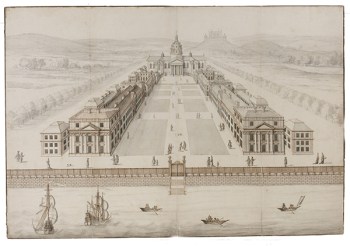
Leonard Knyff, Perspective presentation drawing of a design for an enlarged hospital with a central domed hall and chapel range, 1695, pen and ink (London: Sir John Soane’s Museum)
Problematic client relationships will also be explored through projects such as Soane’s Holy Trinity Church, Marylebone and Wren’s Royal Naval Hospital. Both these state-sponsored projects were characterised by radical changes to the architect’s initial vision brought about by the strong opinions of the patrons. In particular Wren’s initial concept of the Royal Naval Hospital envisaged demolishing Inigo Jones’s Queen’s House, something vetoed in the strongest manner possible by the King. Wren’s initial vision will be illustrated by drawings by Hawskmoor and Knyff, which have previously not been shown to the public. In the instance of Soane’s initial designs for Holy Trinity Church—one of three churches Soane undertook as part of a broader campaign of church building instigated by the Church Commissioners to celebrate the defeat of Napoleon in 1815—Soane’s classical vision was vetoed by both the parish and the Commissioners on grounds of cost and of style. Soane was forced to produce Norman and Gothic alternatives, both styles with which he was uncomfortable. On display will be Joseph Michael Gandy’s drawing showing the perspectives of eight designs for churches, including the various designs for Holy Trinity.

Robert Adam’s Admiralty Screen, 1760s (London: Sir John Soane’s Museum)
Early forms of ‘marketing’ will shape an important section of the display. In the early modern period architects transmitted ideas to prospective clients and to other architects through ‘pattern books’. The Thorpe Album is an exceptionally rare and important example of a late Elizabethan/early Jacobean architectural manuscript, which is central to our understanding of British architecture and how architectural ideas are transmitted in this early period. By the 18th century, however, recognisably modern ways of ‘marketing’ architectural projects and practices can be seen. The Adam brothers were pioneers in this field. They deployed cheap popular prints such as that of the Admiralty Screen in Whitehall to reach a broad audience of the general public while also producing ‘deluxe’ publications outlining their approach to design and architecture. The Works in Architecture of Robert and James Adam, published in 1778 by the Adam office, was intended to appeal to both prospective patrons and also to the architectural profession per se. The idea of persuading the general public as well as patrons is something that contemporary architects utilise as a strategy.
Another channel of communication with the public and with potential clients was given by the Royal Academy Annual Exhibition where architectural drawings were shown alongside paintings and watercolours. In order to make his architectural drawings stand out amongst the displays, Sir William Chambers highlighted them with distinctive blue borders. However, his drawings were still small in scale in comparison to the oil paintings and watercolours included in the Exhibition. Soane radically changed the way in which architecture was represented in the Annual Exhibition by utilising scale and heightened atmospheric effects in his office drawings. Utilising the visionary talent of his draughtsman Joseph Michael Gandy, Soane presented architectural projects such as his unexecuted plans for rebuilding Downing Street and Whitehall in an extremely theatrical, dramatic manner, ensuring that his architectural drawings would have as much impact as the oil paintings and watercolours displayed alongside them.
Abraham Thomas, Director of Sir John Soane’s Museum says: “Architectural drawings have a profound ability to record and articulate the various design discussions that occur within an office or between an architect and a client. I’m delighted that this exhibition not only draws upon gems from the Museum’s collection of over 30,000 architectural drawings but also reminds us that Sir John Soane’s home was the site of a busy architectural practice, embedded in the heart of the building, where such conversations happened every day. The exhibition also makes a connection between historical and contemporary contexts, by exploring the multi-faceted ways in which architects, especially Soane himself, have always engaged with, and re-defined, the notion of a ‘client’—showing us how design ideas have continued to express themselves through the drawing process, from Soane’s time through to the present day.”
Exhibition | Sweet 18: Contemporary Art, Fashion, and Design
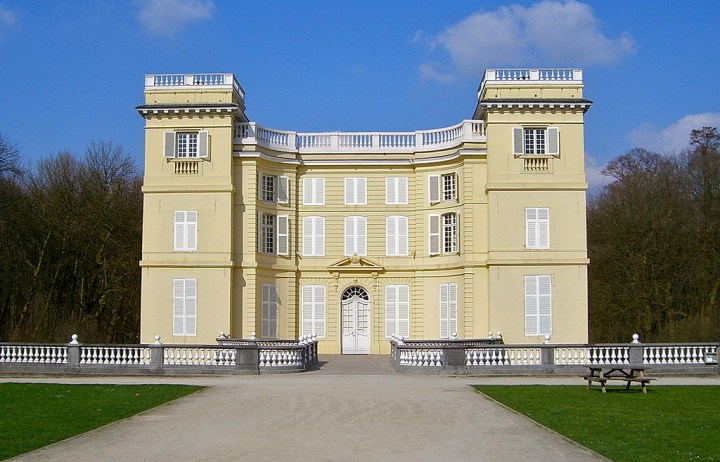
Kasteel d’Ursel at Hingene (Bornem), Belgium.
Photo from Wikimedia Commons, 4 May 2009.
◊ ◊ ◊ ◊ ◊
Press release for the exhibition:
Sweet 18: Contemporary Art, Fashion, and Design Inspired by the 18th Century
Kasteel d’Ursel, Hingene, Belgium, 1 May — 5 July 2015
Curated by Luisa Bernal, Dieter Van Den Storm, Wim Mertens, Tamara Berghmans, and Hélène Bremer
This spring the former summer residence of the aristocratic d’Ursel family will be the setting for the exhibition Sweet 18, presenting the 18th century through the eyes of fifty contemporary designers, artists, and fashion designers—from Erwin Olaf and Wim Delvoye to Walter van Beirendonck and Philippe Starck.

Jessica Harrison, Painted Lady (10), found ceramic, enamel paint, 22 x 17 x 13cm, 2014.
We all have somewhere in our minds the same images of the 18th century: wigs and hooped petticoats, towering hairstyles and elegant furniture, fine porcelain on lavishly decked tables, sensual portraits and frivolous paintings. The 18th century was the time of the Enlightenment and of the flowering of the arts and sciences. But it also created a playful, artificial world for aristocrats wanting to escape reality and immerse themselves in fantasy. A charmed world of pleasure, abundance, and voluptuousness, of pastel tints and curlicues, a world that inspires many an artist to this day. Spreading themselves over all three floors of the castle, these artists will show you the 18th century as you have never seen it before.
Sweet 18 has been brought together by the following team of curators: Luisa Bernal (art), Dieter Van Den Storm (design), Wim Mertens (fashion), Tamara Berghmans (photography) and Hélène Bremer (art).
Ode to Marie Antoinette
Whether it be for her extravagant lifestyle, influential fashion sense or her tragic death, French Queen Marie-Antoinette still speaks to our imagination. Director Sofia Coppola’s film spear- headed the revival. For pop stars like Madonna and Beyoncé, she is also a powerful icon. German illustrator Olaf Hajek gives his own take on her in the Black Antoinette series while top Dutch photographer Erwin Olaf offers up a gory portrait of the queen: beheaded.
Exuberant Fashion
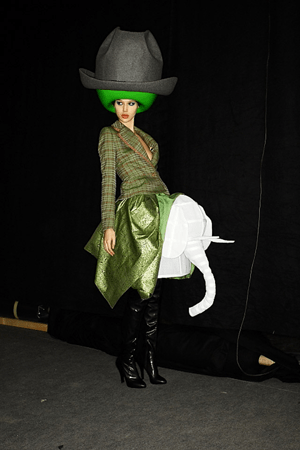
Walter Van Beirendonck. Foto: Ronald Stoops
The extravagant wardrobe of Marie-Antoinette is the springboard for many a contemporary fashion designer: from the minimalism of Japanese Yohji Yamamoto and eccentricity of German Bernhard Willhelm to French fashion houses Nina Ricci and Thierry Mugler. American artist Yasemen Hussein recreates one of her wigs in metal, and English milliner Stephen Jones is inspired by her to create his evocative hats. The outsized dresses, tight corsets, and tailored jackets of Belgian designers Walter Van Beirendonck and Olivier Theyskens also sample the 18th century.
Transparent Plastic en Burnt Wood
Dutch designer Hella Jongerius immersed herself in the archives of the German porcelain manufactory Nymphenberg to come up with plates which combine hand-painted patterns and little sculptured animals, all done in 18th-century style. Designer Maarten Baas literally set fire to a number of antique chairs before reworking them in lacquer. His Smoke Chair has become a classic. Even more famous is French star designer Philippe Starck’s Ghost Chair, which references a Louis XV chair in a pared-down, transparent design. Spanish designer Jaime Hayon’s lounge chair and an outlandish seat by British designer Nina Saunders also find a home in the exhibition. One absolute high point is L’ornement jamais by Swiss designer Philippe Cramer, an outstanding piece of pine furniture executed in 18th-century style and partially dipped in liquid gold.
Deformed Status Symbols
The fine china of Meissen, Sèvres, and Wedgwood remains to this day an inexhaustible source of inspiration. The sculptural groups of American artist Chris Antemann may look like replicas but reveal themselves on closer inspection to be rather wicked tableaux, full of forbidden fruit. British artist Jessica Harrison makes superficially sweet female figurines that are actually hideously mutilated, with their deformed heads and coloured tattoos. With War and Pieces, Dutch ceramicist Bouke de Vries offers a modern interpretation of the extravagant banquets that were thrown the night before a battle. British artist Amy Hughes’s Trésor découvert suggests treasure that has been lying buried for centuries under that same battlefield, treasure that has lost its gleam but has a story of the past and its rediscovery to tell.
Fêtes Galantes
In Stavronikita Project Austrian photographer Andreas Franke recreates 18th-century festivities. By situating them in the unusual setting of a sunken ship he emphasises the beauty that underlies decadence and decline. The tableaux of Canadian artist Ray Caesar border on the surreal, while the work of English painter Patrick Hughes plays games with the laws of perspective.
Pastoral Scenes

Richard Saja
Nothing is more typical of the 18th-century domestic interior than ‘toile de Jouy’, cotton wall- coverings depicting scenes of rural life. American artist Richard Saja pimps its little cowherds into clowns or punks, while the French Collectif Ensaders transforms them into figures of fantasy and Virginie Broquet gives them an erotic spin. Scottish design studio Timourous Beasties substitutes its idyllic villages with views of the London skyline, while French artist Joël Ducorroy reduces it to its bare essentials. American Beth Katleman brings toile de Jouy wallpaper to life in a vast 3D construction, introducing flea market finds into her installation to accentuate the strangeness of the effect.
Lavish Finery
British artist Jo Taylor translates the extravagant stucco ornament of the grand 18th-century house into three-dimensional porcelain objects. American Molly Hatch’s porcelain plates, when set together, form a landscape painting covering an entire wall. Taking as her inspiration the bizarre wigs of the French court, English artist Kathy Dalwood turns
casts of utilitarian objects into plaster portrait busts.
Made in Belgium
Belgian artists easily hold their own amongst all these international heavyweights. Isabelle Copet lays a gigantic lace collar in the pool behind the castle. In the park Michaël Aerts places an inverted statue of Louis XIV on a pedestal made of flight cases and builds a seven metre high obelisk from the same black cases. Two twisted sculptures by Wim Delvoye overlook the entrance hall. Zaza contributes a print. In the mirrored room Bart Ramakers has filmed a richly imaginative ballet on the theme of romantic love. Painter Jan Devliegher exhibits gigantic porcelain plates and Nick Ervinck has printed two stunningly designed vases in 3D. A design for a bedroom by architect Koen Deprez combines classic panelling and Fragonard paintings with Stanley Kubrick’s 2001: A Space Odyssey. Pieter Theuns (BOX) has composed music inspired by Mozart for the exhibition.
Kasteel d’Ursel
For nearly four centuries Kasteel van Hingene was the favourite summer residence of the aristocratic d’Ursel family. Every summer the Duke would travel with family and servants to his magnificent country house. Now it is the property of the Province of Antwerp, which is restoring it to its former glory. In 2014 Kasteel d’Ursel won the ‘Flemish Heritage Award’.
The exhibition begins on the first floor and leads you through the noble family’s former bedchambers. The service stairs bring you directly to the second floor where once the servants and the children of the family were accommodated. The circuit ends in the hall of mirrors and the reception rooms of the ground floor. The restored castle, with its characteristic Chinese interior decoration, is the perfect setting for this contemporary look at the 18th century.
Exhibition | Vivienne Westwood: Cut from the Past

◊ ◊ ◊ ◊ ◊
From Danson House:
Vivienne Westwood: Cut from the Past
Danson House, Bexleyheath, Kent, 1 April — 31 October 2015
The 18th century is the high point of art and culture. —Dame Vivienne Westwood
The impact of 18th-century art and design on the work of distinguished British fashion designer Vivienne Westwood is celebrated in a new exhibition at Danson House this spring. Vivienne Westwood: Cut from the Past brings together for the first time a number of her ground-breaking designs, and explores the collections that proved to be her turning point both critically and commercially.
Danson House, a splendidly restored Georgian villa, provides a tailor-made backdrop to the exhibition which highlights Westwood’s seminal work of the 1990s which was influenced by the 18th century. Designs and outfits on show make particular reference to the Rococo paintings of French artists Watteau and Boucher. Westwood’s passion for 18th-century design is also reflected in some earlier pieces from the ‘Cut, Slash and Pull’ and ‘Mini Crini’ collections, and the Malcom McLaren and Vivienne Westwood ‘Seditionaries’ Collection.
Caroline Worthington, Chief Executive, Bexley Heritage Trust said, “We are delighted to be working together with the Victoria & Albert Museum for the first time to bring cutting edge design back to Danson House for the 2015 season—just as the original owners, the Boyd family, did in the 18th century.”
◊ ◊ ◊ ◊ ◊
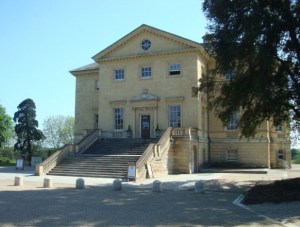 Danson House boasts a suite of rooms created for Sir John Boyd, a man besotted with his young bride. Enjoy this superb example of 18th-century architecture with its classical proportions, elegant interiors and rich symbolism celebrating love and marriage. Designed as a retreat from the hustle and bustle of central London, Danson House was completed in 1766. Sir John Boyd was a sugar merchant and vice-chairman of the British East India Company. Together with the notable architect Sir Robert Taylor, Boyd created this homage to the Golden Age of Antiquity, filling it with art and sculpture from his travels on the Continent. Today his home gives us a fascinating insight into fashionable
Georgian life.
Exhibition | Love Bites: Caricatures by James Gillray
From the Ashmolean:
Love Bites: Caricatures by James Gillray
Ashmolean Museum, Oxford, 26 March — 21 June 2015
Curated by Todd Porterfield

James Gillray, Design for a Naval Pillar, 1800
(New College, Oxford)
To mark the 200th anniversary of the death of British caricaturist James Gillray (1757– 1815), the Ashmolean presents more than 60 of Gillray’s finest caricatures from the outstanding collection of New College, Oxford.
James Gillray trained as a professional copyist at the Royal Academy and then staked his professional life on caricature, amongst the first generation of artists to do so. He produced more than a thousand prints, some the fruit of months of reflection, others banged out at lightning speed, responding to but also creating instant controversies on the very day of the event. His prints were divisive and partisan: in 1798 a Tory Lord would congratulate him for having “been of infinite service in lowering them [the Whigs] and making them look ridiculous,” while the exiled Napoleon, well aware of Gillray’s anti-French propaganda, was reported to have said that the British engraver did more than all the armies of Europe to bring him down.
Love Bites: Caricatures by James Gillray is curated by Professor Todd Porterfield of the University of Montreal. The exhibition has been generously supported by The Paul Mellon Centre for Studies in British Art and the Friends of the Ashmolean.
In connection with the exhibition, the Ashmolean Museum will host a conference, James Gillray@200: Caricaturist
without a Conscience?, on the 28th and 29th of March 2015.
Display | Elaborate Embroidery: Fabrics for Menswear before 1815
From The Met:
Elaborate Embroidery: Fabrics for Menswear before 1815
The Metropolitan Museum of Art, New York, 2 February — 19 July 2015
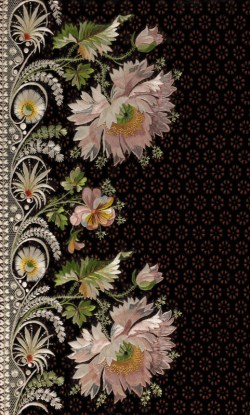 This installation features lengths of fabric for an unmade man’s suit and waistcoat, as well as a selection of embroidery samples for fashionable menswear made between about 1760 and 1815. During this period, France was the undisputed epicenter of the European fashionable world, and professional embroidery workshops there produced a dizzying array of colorful designs from which a man could choose. The installation features a copy of L’Art du Brodeur (The Art of the Embroiderer), which was published in Paris in 1770. This book contains detailed descriptions about subjects such as preparing fabric to be embroidered and the variety of threads used in a workshop, as well as illustrations of designs for men’s suits.
Seen together, the fabrics and the book provide a glimpse into the world of vividly colored and highly decorative fashion that was a key component of an upper-class European man’s life in the eighteenth and early nineteenth centuries.










leave a comment