Exhibition | The Generous Georgian: Dr Richard Mead
The conference Dr Richard Mead: Physician, Philanthropist, Collector takes place next Monday, October 20. While I noted the exhibition previously, I didn’t include the press release. It’s included below, and the image sheet is available here. I’m excited to be part of the conference programme and look forward to a few days in London. –CH
The Generous Georgian: Dr Richard Mead
The Foundling Museum, London, 26 September 2014 — 4 January 2015

Allan Ramsay, Dr Richard Mead, 1747
(London: The Foundling Museum)
For the last major exhibition of the Foundling Museum’s 10th anniversary year, the focus turns to the life and work of Dr Richard Mead (1673–1754), one of the most eminent physicians, patrons, collectors and philanthropists of his day, and a significant figure in the early history of the Foundling Hospital.
A leading expert on poisons, scurvy, smallpox and public health, Mead counted among his patients included Queen Anne, George II, Sir Isaac Newton and the painter Antoine Watteau. Mead was no stranger to daring acts and fierce controversies, with stories of drinking snake venom in his investigations into the effects of various poisons, and fighting a duel to defend his theory on smallpox treatment. He also possessed a deep-seated passion for the arts, demonstrated in a lifetime’s patronage of painters such as Allan Ramsay and a revered collection of masterpieces that included works by Dürer, Holbein, Rembrandt, Poussin, and Canaletto.
Smallpox was endemic in Georgian England, and killed an estimated 400,000 Europeans throughout the eighteenth century. Though vaccination against smallpox was developed by Edward Jenner at the end of the century, inoculation was promoted decades earlier. Dr Mead was an ardent and effective advocate of this procedure, which saved the lives of many, including foundlings. Of the 247 children who were inoculated at the Foundling Hospital, by 1756 only one had died of the disease.
Exploring Mead’s diverse contributions to Georgian society—the collector, the philanthropist and the physician—this exhibition reunites key objects from Mead’s life and collection, such as the ancient bronze Arundel Head (2nd Century BC) and Allan Ramsay’s half-length portrait of Mead, evidence of his significance in London’s cultural landscape.
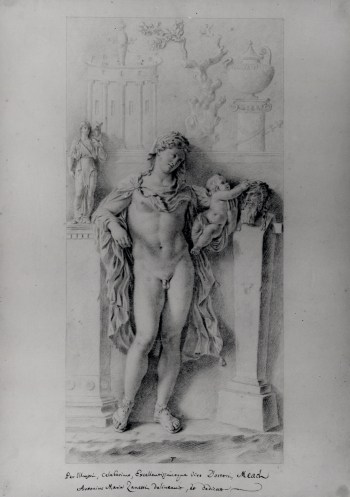
Antonio Maria Zanetti, Study of a relief decorated with a Hermaphrodite; in the Palazzo Colonna, ca.1721. Image courtesy of The Trustees of the British Museum, used with permission.
Items from the Foundling Museum archive, such as the minutes from the very first Governors’ meeting, and the logs of daily life at the Foundling Hospital in its first year, are also on display to illustrate Mead’s relationship with the Hospital and the important role he played in its early history. Mead dedicated considerable time and energy to the Hospital, encouraging his noble clients to support the charity, serving as a Governor and giving his clinical expertise pro bono. His contribution went even further, to attending sick children and advising on nurses’ salaries and what medicines to keep in stock.
His home on Great Ormond Street backed onto the Foundling Hospital grounds, and housed his magnificent collection of paintings, sculptures, antiquities, coins and a library of over 10,000 books. Painters and scholars were given access to Mead’s renowned collection which, in a time before public galleries, offered visitors a rare chance to view artistic masterpieces from around the world.
Mead’s generosity in every aspect of his life meant his family were burdened with huge debts following his death. Perhaps anticipating this, Mead’s will ordered for the sale of thousands of objects from his incredible collection – in an auction lasting 56 days! Through a number of key objects, we highlight a once-legendary collection which, compared to that of his contemporary and founder of the British Museum, Sir Hans Sloane, is not so well known today. This exhibition celebrates the energy, learning and wide interests of a truly generous Georgian who, according to his contemporary the writer Samuel Johnson, “lived more in the broad sunshine of life than almost any man.”
The Generous Georgian: Dr Richard Mead is supported by the Wellcome Trust, the City of London Corporation, the Royal College of Physicians, and Verita.
Exhibition | Canaletto, Bernardo Bellotto Paints Europe
Last fall, I noted this exhibition Canaletto, Bernardo Bellotto Paints Europe / Bernardo Bellotto Malt Europa, which opens this week at Munich’s Alte Pinakothek, Munich (17 October 2014 — 19 January 2015), but that was admittedly ages ago (thanks to Hélène Bremer for the useful reminder). And here’s the information for the catalogue. –CH
The German edition catalogue will soon by published by Hirmer; the English edition, distributed by The University of Chicago Press, will be available in January:
Andreas Schumacher, Canaletto, Bernardo Bellotto Paints Europe (Munich: Hirmer Publishers, 2015), 360 pages, ISBN: 978-3777422473, $75.
 In 1761, Bernardo Bellotto painted his famous panorama of Munich, signing the painting ‘Canaletto’—as he signed many of his paintings—in tribute to his uncle and teacher Giovanni Antonio Canal. In addition to the famous panorama, Bellotto completed over the course of several months two stunning palace views for the Duke of Bavaria, Maximilian III Joseph.
Placing Bellotto’s Munich paintings within the artist’s broader body of work, this well-illustrated book highlights the Italian painter and printmaker’s capacity to create paintings of European cities that are both remarkably realistic and compositionally idealistic. Depicting Dresden, Vienna, Turin, and Warsaw, the paintings demonstrate an elaborate attention to architectural and natural detail and a sophisticated understanding of the specific quality of light in each place. By juxtaposing the paintings with Bellotto’s preparatory sketches, the book also sheds light on his complicated process, which is thought to have included the use of the popular optical aid of that time, the camera obscura. Rounding out the book is a contemporary artistic reevaluation of the paintings through the medium of photography.
Bringing together many well-known works by the Venetian vedute with a trove of paintings rarely seen, including a series of highly idealized architectural depictions, the book illustrates his critical contribution to this important European tradition.
Andreas Schumacher is a director at the Alte Pinakothek, Munich, where he is responsible for the museum’s Collection of Italian Painting to the End of the Eighteenth Century. He is also an associate lecturer at the Institute for Art History at the University of Bonn, Germany.
◊ ◊ ◊ ◊ ◊
Exhibition | The Fabric of India
Next fall at the V&A (as noted by Courtney Barnes at Style Court) . . .
The Fabric of India
Victoria & Albert Museum, London, 3 October 2015 — 10 January 2016
Cincinnati Art Museum, 19 October 2018 — 6 January 2019
Curated by Rosemary Crill and Divia Patel
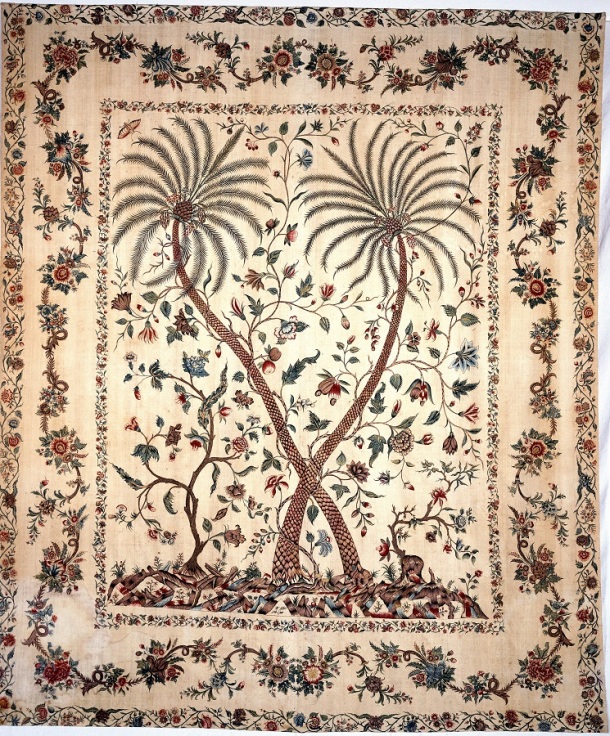
Chintz palampore, South-East India for export to Europe, ca. 1750–60 (London: V&A Museum no. IM 85-1937)
The highlight of the V&A’s India Season, this will be the first major exhibition to explore the dynamic and multifaceted world of handmade textiles from India from the 3rd to the 21st century. It will include a spectacular 18th-century tent belonging to Tipu Sultan, a stunning range of historic costume, highly prized textiles made for trade, and fashion by contemporary Indian designers such as Manish Arora and Rajesh Pratap Singh.
Over 200 objects will illustrate the skills, variety and adaptability of Indian textile makers and the enduring nature of techniques for dyeing, weaving and embroidery across India. Examples of textiles made for religious and courtly use will be shown alongside the finest pieces made for export to Europe, the Middle East and South-East Asia. The use of textiles and dress as a political tool of the Independence Movement and their relevance to Indian cultural identity will be explored, as will the impact of mass-production on handmade textiles.
The exhibition blog is available here»
Note (added 24 March 2015) — The original posting provided a slightly earlier beginning date for the exhibition (September 26th); it’s now been corrected.
Note (added 21 October 2018) –– The posting was updated to include the Cincinnati venue.
The Huntington Acquires Fuseli’s The Three Witches

Henry Fuseli, The Three Witches or The Weird Sisters, ca. 1782, oil on canvas, 25 x 30 inches (San Marino: The Huntington Library, Art Collections, and Botanical Gardens)
◊ ◊ ◊ ◊ ◊
Press release (7 October 2014) from The Huntington:
The Huntington Library, Art Collections, and Botanical Gardens announced today the acquisition of one of the best-known compositions by the Anglo-Swiss painter Henry Fuseli (1741–1825). In private hands since its creation around 1782, The Huntington’s version of Fuseli’s The Three Witches or The Weird Sisters appears to be a finished, full-size study, presumably made before the two other known full-size, final versions Fuseli made of the subjects. These are in the collections of the Kunsthaus Zurich, and the Royal Shakespeare Company, Stratford-upon-Avon, England. After months of conservation treatment at The Huntington, the new acquisition will go on public view for the first time on October 11 in the Huntington Art Gallery.
“Given the fame of The Huntington’s collection of 18th-century British paintings, it may come as a surprise that we did not already have a painting by Henry Fuseli—one of the most celebrated, notorious, and inventive artists of the period,” said Kevin Salatino, Hannah and Russel Kully Director of the Art Collections at The Huntington. “Finally we do, and a great one, a picture full of mystery and suspense. Its powerful composition packs an incredible punch, second in impact only to the artist’s famous painting The Nightmare at the Detroit Institute of Arts, which is from the same period. The acquisition of The Three Witches now fills a major gap in our collection.”
Acquiring a Fuseli has been a longstanding goal at The Huntington, as the finest examples of his work rarely appear for sale. Catherine Hess, chief curator of European art at The Huntington, said that Fuseli’s work has been sought not only because of his importance to the history of art, but also because of his relationships with Sir Joshua Reynolds and, especially, William Blake, both of whom are well represented in Huntington collections. Also, Fuseli’s fascination with the work of William Shakespeare dovetails with The Huntington’s stature as one of the premiere collections of early Shakespeare folios and quartos in the world. The Three Witches reveals a great deal about how the artist worked, said Hess. “Its surface is thickly textured with paint, and the strokes are varied and energetic, betraying a freedom and immediacy that shows Fuseli at his most experimental and expressive.” The painting depicts the pivotal moment in Shakespeare’s tragedy Macbeth (act 1, scene 3) when the protagonist encounters the demonic trio who foretell his fate.
“Fuseli revels in the play’s ominous mood, isolating and tripling the motif of hooded head, extended hand, and sealed lips,” said Hess. The witches’ mannish features are taken directly from the playwright’s description: “… you should be women, And yet your beards forbid me to interpret / That you are so.” They may also have been modeled on the male actors who would have played them on stage in Fuseli’s day.
The Huntington’s painting includes a gilded frame (likely added by early owners) with a quote from Aeschylus’ ancient tragedy, The Eumenides: “These are women but I call them Gorgons.” The quote also appears written on the reverse of the painting and was almost certainly provided by Fuseli, who prided himself on his erudition.
◊ ◊ ◊ ◊ ◊
R E L A T E D I N S T A L L A T I O N S
Wrestling with Demons: Fantasy and Horror in European Prints and Drawings from The Huntington’s Art Collections
The Huntington Art Gallery, San Marino, CA, 30 August — 15 December 2014
This focused exhibition explores the darker side of the imagination through a variety of works on paper depicting death, witchcraft, and the demonic in European art. In this group of 15 works spanning the 16th to the 19th centuries, artists such as Albrecht Dürer, Jan Lievens, Francisco de Goya, and William Holman Hunt tap into human fascination with the macabre in works of art that demonstrate our attempt to wrestle with the unknown.
Eccentric Visions: Drawings by Henry Fuseli, William Blake, and Their Contemporaries
The Huntington Art Gallery, San Marino, CA, 22 November 2014 — 16 March 2015
In an age of great drawing, Anglo-Swiss painter Henry Fuseli (1741–1825) and his circle in Britain helped to push the medium into new areas of expressiveness, invention, and boldness of conception. This small exhibition consists of about 30 works from The Huntington’s exceptional holdings of drawings and watercolors by Fuseli, William Blake, and the artists most closely associated with them, including George Romney, John Flaxman, Joseph Wright of Derby, James Barry, John Brown, and Richard Cosway. It complements the installation of The Huntington’s newly acquired painting by Fuseli, The Three Witches.
Exhibition | Sade: Marquis of Shadows, Prince of the Enlightenment
To the d’Orsay’s exhibition on the Marquis de Sade we can add this one now on view at the Institut des Lettres et Manuscrits:
Sade: Marquis of Shadows, Prince of the Enlightenment
The Spectrum of Libertinism from the 16th to the 20th Century
Institut des Lettres et Manuscrits, Paris, 26 September 2014 — 18 January 2015
Curated by Pascal Fulacher and Jean-Pierre Guéno
Yes, I am a libertine, I admit it freely. I have dreamed of doing everything that it is possible to dream of in that line. But I have certainly not done all the things I have dreamt of and never shall. Libertine I may be, but I am not a criminal, I am not a murderer. –Donatien Alphonse François de Sade
Sade and the Spectrum of Libertinism
Donatien Alphonse François de Sade was doubly a man of letters: a great novelist, a great letter writer, but above all a victim of the very special letters that were the lettres de cachet, often commissioned from monarchs or their ministers by the families of those who wanted to have troublesome offspring removed from the public sphere. Even more than the Marquis of Shadows, even more than his escapades and fantasies of debauchery, it was the Prince of the Enlightenment who never ceased to embarrass both his family, who continually persecuted him, his social caste, and the leading figures of his time, to the point where this troublemaker became a kind of literary man in an iron mask who spent more than half his adult life in prison before dying there. Apart from the fact that he was sentenced to life imprisonment in 1768, and twice to death in 1772 and in 1794, De Sade spent nearly twenty-eight years in prison between 1763 and 1814, between the age of 23 and his death at age 74, and this under three different regimes: the Monarchy, the Republic and the Empire. From the tower at Vincennes to Charenton insane asylum, despite the material means he had to improve his everyday life, he lived mostly in “execrable slums,” in a dozen jails including those of Saumur castle, Pierre-Encise citadel in Lyon, For-l’Eveque prison in Paris, Miolans fort in Savoy, the Bastille fortress, Sainte-Pélagie prison and Bicêtre prison in Paris, not forgetting the gaols of the Revolution. During the seventy-four years and six months of his life as in the two centuries that separate us from his death, it may seem paradoxical that we have demonised the Marquis de Sade to such an extent, and that we have for so long mixed the man with his work, to the point of confusing the man and the novelist with the criminal characters in his fiction.
 Certainly he was a libertine who indulged in licentious and dissolute sexual practices, but the man who lent his name to today’s definition of the word Sadism, “the tendency to derive pleasure from physical or emotional pain intentionally inflicted on others” would have been just one more profligate among the aristocrats of his time, had he not been primarily the eye of a kind of consciousness that managed to convey not just the pain of living, but the “pain of the century” (“mal du siècle”) as defined by Musset in the 19th century: through his escapades and provocations, then through his political writings, as through his philosophical writings, letters and novels, but also by example, or by the counterexample of his life, did Sade ever cease to express the evil that devours men, mostly from the Renaissance to modern times, that is to say, during the second half of the second millennium?
For the last four centuries, are those who call themselves libertines actually Epicureans, delinquents or hyper-aware individuals? Bon vivants, criminals or cursed existentialists? From the Marquis de Sade to Dominique Aury (aka Pauline Réage), author of Histoire d’O (The Story of O), to Théophile de Viau, Crébillon, Choderlos de Laclos and his Liaisons Dangereuses (Dangerous Liaisons), Mirabeau, Casanova, the Chevalier d’Eon, Musset, Maupassant, Baudelaire, Rimbaud, Verlaine, Pierre Louÿs and Joë Bousquet, the great figures of literature, poetry and thought have never ceased to celebrate the cannibalistic wedding of vice and virtue. Vice that feeds on virtue when it transgresses and deflowers it. Virtue that feeds on vice when it denounces and demonises it.
At the boundaries of fantasy, revolution, transgression, emancipation and moral suicide, between the realities of purgatory, the fantasised or dreaded delights of hell and the mythical nostalgia for paradise lost, between cynicism, pragmatism and hope, between Epicureanism and cruelty, between enlightenment and barbarism, between the obsession with God and its denial, do the case studies that adorn the spectrum of libertinism not illustrate the entire tragedy of the human condition, and do they not resemble in this respect all the major intellectual earthquakes of the 19th and 20th centuries, from romanticism to existentialism through surrealism?
The Exhibition
 Long before becoming a moral emancipation movement, libertinism was a terribly subversive spiritual liberation movement, since it questioned the existence of God, the legitimacy of kings’ rule by divine right, and all the dogmas of religion, morals and absolute power. From the outset, the exhibition reveals “The spectrum of libertinism,” leading the visitor from “libertinism of the spirit to libertinism of morals” through a set of subversive texts including the Decameron by Boccaccio, Pensées (Thoughts) by Pascal, Dom Juan by Molière, Contes et nouvelles (Tales and Novels) by La Fontaine, Les Lettres persanes (Persian Letters) by Montesquieu and La Nouvelle Héloïse (The New Heloise) by J.-J. Rousseau. Libertinage in the time of De Sade is also discussed in the letters and works of Crébillon, Casanova, the Chevalier d’Eon, Restif de la Bretonne, Choderlos de Laclos, Mirabeau and more.
Then, pride of place is given to the Marquis de Sade and his masterpiece, Les 120 journées de Sodome ou l’École du libertinage (The 120 Days of Sodom, of the School of Libertinism): the handwritten scroll on which this still-scandalous novel was written is on display here for the first time ever in France. Several letters by De Sade, to his wife, his mother-in-law, his lawyer, an actress, etc. are also displayed around the scroll, and give a better understanding of this enigmatic and highly controversial figure.
The last two parts of the exhibition shed light on the rehabilitation of the Marquis de Sade and his work, as well as the development of libertinism in the 19th and 20th centuries, from romanticism to surrealism through existentialism. The exhibition Sade: Marquis de l’ombre, prince des Lumières, L’éventail des libertinages du XVIe au XXe siècle also features over 120 exceptional pieces, letters and autograph manuscripts, first editions and rare, valuable illustrated books, drawings, photographs, etc.
◊ ◊ ◊ ◊ ◊
From Flammarion:
Gonzague Saint Bris and Marie-Claire Doumerg-Grellier, Sade: Marquis de L’Ombre, Prince des Lumières, L’Eventail des Libertinages (Paris: Flammarion, 2014), 176 pages, ISBN: 978-2081353817, 29€.
Consacré à l’histoire du libertinage, cet album en lien avec l’exposition du même titre, rassemble et présente lettres, manuscrits, livres rares et précieux, portraits et dessins érotiques consacrés aux «Cent vingt journées de Sodome» du marquis de Sade.
Exhibition | Sade: Attacking the Sun
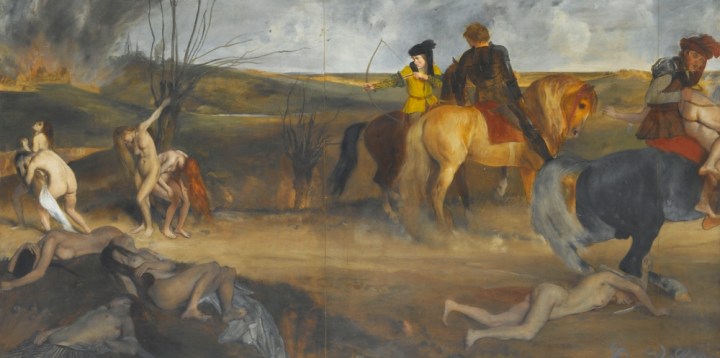
Edgar Degas, Scène de guerre au Moyen-âge, 1865
(Paris, Musée d’Orsay, RF 2208)
◊ ◊ ◊ ◊ ◊
From the d’Orsay:
Sade: Attacking the Sun / Attaquer le soleil
Musée d’Orsay, Paris, 14 October 2014 — 25 January 2015
Curated by Annie Le Brun, Laurence des Cars, and Leila Jarbouaï
Alphonse Donatien de Sade (1740–1814) completely transformed the history of both literature and the arts, first as an underground writer, and later by becoming a veritable legend in his lifetime. Following the analysis of the writer Annie Le Brun, a specialist of de Sade, the exhibition will be focusing on the revolution of representation opened up by the author’s writings. Topics addressed will be the ferocity and singularity of desire, deviation, extremes, the weird and the monstrous, desire as a principle of excess and imaginary recomposition of the world, through works by Goya, Gericault, Ingres, Rops, Rodin, Picasso…
The press release (as a PDF file in French) is available here»
◊ ◊ ◊ ◊ ◊
From Gallimard:
Annie Le Brun, Sade: Attaquer le Soleil (Paris: Éditions Gallimard, 2014), 336 pages, ISBN: 978-2070146826, 45€.
 Le propos de cet ouvrage est de montrer comment, avant d’avoir une importance majeure dans la pensée du XXe siècle, l’oeuvre du marquis de Sade a induit une part de la sensibilité du XIXe siècle, quand bien même le personnage et ses idées y auront-ils été tenus pour maudits. Car si Baudelaire, Flaubert, Huysmans, Swinburne, Mirbeau…, sans parler d’Apollinaire, s’y sont référés à titres divers, tout porte à croire que la force de cette pensée est aussi d’avoir rencontré, révélé, voire provoqué ce qui agite alors en profondeur l’expression plastique, concernant autant l’inscription du désir que son pouvoir de métamorphose. C’est l’image du corps en train d’être bouleversée de l’intérieur, annonçant une révolution de la représentation. Que ce soit évident chez Delacroix, Moreau, Böcklin…, ce qui est en jeu n’est pas sans inquiéter aussi Ingres, Degas ou Cézanne et bien sûr Picasso… Et cela tandis que Félicien Rops, Odilon Redon, Alfred Kubin se rapprochent d’une expression restée jusqu’alors marginale (curiosa ou folie), avant que le surréalisme, se réclamant de Sade, ne reconnaisse le désir comme grand inventeur de forme. A retrouver ce cheminement, il sera possible de mesurer combien à dire ce qu’on ne veut pas voir, Sade aura incité à montrer ce qu’on ne peut pas dire. Ou comment le XIXe siècle s’est fait le conducteur d’une pensée qui, incitant à découvrir l’imaginaire du corps, va amener à la première conscience physique de l’infini.
Annie Le Brun, commissaire général de l’exposition, auteur notamment, chez Gallimard, de Soudain un bloc d’abîme, Sade (1986), On n’enchaîne pas les volcans (2006), Si rien avait une forme, ce serait cela (2010), et Les arcs-en-ciel du noir : Victor Hugo (2012).
Exhibition | The Kama-Sutra: Spirituality and Eroticism in Indian Art
Though thematic rather than chronologically-based, the exhibition seems to include a substantial number of eighteenth-century objects, with some attention to the Western reception of the Kama-Sutra. From the Pinacothèque de Paris:
Le Kâma-Sûtra: Spiritualité et érotisme dans l’art indien
Pinacothèque de Paris, 2 October 2014 — 11 January 2015
Curated by Alka Pande and Marc Restellini

Acrobatic couple, Tamil Nadu; late 18th or early 19th century, carving on wood, 91 x 49 x 14.5 cm
(Collection of Michel Sabatier, La Rochelle)
For its Autumn-Winter season 2014–15, the Pinacothèque de Paris will put on an unusual exhibition: The Kama-Sutra: Spirituality and Erotism in Indian Art. Attributed to a Brahman who might have written it in the 4th century of our era, the Kama-Sutra makes up one of the major texts of medieval Hinduism and is not a pornographic book, as it is often described in the Western world. It is divided up into seven sections (adhikarana): society, social concepts, sexual union, as regards the spouse, as regards extra-marital relationships, as regards courtesans, as regards the arts of seduction.
Around 330 outstanding works including those of Shriji Arvind Singh Mewar, maharana of Udaipur and the remarkable collection of Beroze and Michel Sabatier—sculptures, paintings, miniatures, objects of daily life, and ‘pillow books’, illustrated works that were offered to the newlyweds until the 19th century in order to give them an erotic education—organized according to the seven sections of the Kama-Sutra, will be exhibited in the Pinacothèque de Paris. The exhibition, unadvised for minors, will explain the erotic aesthetics specific to the erotic aesthetics of Indian cultural life and to Hinduism. It will also attempt to understand why the Western world casts such a deformed look on that very unusual book.
From the French Embassy in New Delhi:
Alka Pande, renowned art historian and author of many books on erotic art, has been appointed as the curator for this exhibition. Dr. Alka Pande’s first book was itself an introduction to this great Sanskrit treatise, the Kama Sutra, that she wrote in 1999. Since then, she has been constantly exploring the frontier of love, desire, longing, sexuality and genders in her many books: Indian Erotica, a visual journey along the erotic art of the Indian subcontinent (2002); Ardhanarishvara: The Androgyn, an exploration of the frontiers of the genre, based upon the Hindu concept of Shiva as half-man half woman (2005); The New Age Kama Sutra for Women, her first attempt to transpose this text to the modern times (2008), Kama Sutra: The Quest for Love, a visual journey through some of the most explicit erotic works of art (2008); Leela: An Erotic Play of Verse and Art, an illustrated collection of Indian Poetry (2009); and Shringara: The Many Faces of Indian Beauty, a reflection on the Indian concept of feminine beauty (2011).
Marc Restellini is an art historian and a Modigliani scholar. He has been working in Japan for many years, and has been the artistic director of the Musée du Luxembourg in Paris, where he has exhibited masters like Rodin, Raphaël and Modigliani. In 2007, he has opened the Pinacothèque, the first private art museum in Paris, situated Place de la Madeleine. In less than a decade, it has become one of the most visited museum in Paris, close on the heels of the Louvre and the Pompidou Centre. What sets the Pinacothèque apart is the artistic vision of Marc Restellini whose ambition is to look at art history with an fresh perspective, creating bridges and transversality in the way exhibition are conceptualised, and reaching out to a wider public.
The press release (as a PDF file in French) is available here»
◊ ◊ ◊ ◊ ◊
Exhibiton | The Château de Versailles in 100 Masterpieces
From the exhibition website:
The Château de Versailles en 100 Chefs-d’oeuvre
Musée des Beaux-Arts, Arras, 27 September 2014 — 20 March 2016
Curated by Beatrix Saule
 Major pieces from the Château de Versailles’ collections on show in Arras for 18 months.
Paintings, sculptures, furniture, objets d’art… Visitors will discover works executed by the greatest artists of the seventeenth and eighteenth centuries made from the most precious of materials, like the bust of Louis XIV originally installed on the Ambassadors’ Staircase, the monumental Gobelins tapestries, the Dauphin’s fine writing desk, the original sculpture from the Latona Fountain, Marie-Antoinette’s porcelains, or the sculptural group Apollo Served by the Nymphs, a monument of seventeenth-century French sculpture. These masterpieces line the visitors’ route as they explore the various places and periods of the Château de Versailles. The exhibition is organised into six settings, constituting a veritable private tour of the royal residence:
• Marble, bronze, gold and silver
• Wood panelling and marquetry
• Water and fountains
• Parks and forests
• Flowers and fields
• Festivities and fireworks
Exhibition | Goya: A Lifetime of Graphic Invention

Francisco de Goya y Lucientes, Bulls of Bordeaux.
Spanish Fun. Plate No. 3. 1825, lithograph
(Dallas: Meadows Museum, SMU)
◊ ◊ ◊ ◊ ◊
Press release (18 September 2014) from the Meadows Museum:
Goya: A Lifetime of Graphic Invention
Meadows Museum, Dallas, 21 September 2014 — 1 March 2015
Curated by Alexandra Letvin
The Meadows Museum announces its fall exhibition, Goya: A Lifetime of Graphic Invention. On view from September 21, 2014, through March 1, 2015, the exhibition will launch the Meadows’ 50th anniversary year by presenting the entirety of the Museum’s holdings of printed works by Francisco José de Goya y Lucientes (1746–1828): 222 etchings, four lithographs, and three trial proofs.
The exhibition will provide visitors with a rare opportunity to view complete first edition sets of Goya’s four great print series—Los Caprichos (The Caprices, 1799), Los Desastres de la Guerra (The Disasters of War, 1810–19), La Tauromaquia (Bullfighting, 1816), and Los Disparates (The Follies, 1815–23)—as well as the Museum’s holdings of Goya’s paintings, which will be displayed alongside the prints. Curated by Meadows/Kress/Prado Fellow Alexandra Letvin, Goya: A Lifetime of Graphic Invention will also feature the Museum’s recent gift of a trial proof from Los Disparates, Disparate Puntual (Punctual Folly), and closely follows the Meadows’ acquisition of Portrait of Mariano Goya (1827), one of the artist’s final paintings, in 2013. The Meadows houses one of the largest public collections of Goya’s works in the United States, and the exhibition will enable visitors to experience for the first time the Meadows’ extensive Goya holdings at once, further enhancing the Museum’s role as a leader in the study and presentation of Spanish art.
“Goya’s mastery in prints marked a turning point in the evolution of graphic art and had a profound influence on the work of later artists, such as Manet and Picasso,” says Mark A. Roglán, the Linda P. and William A. Custard Director of the Meadows Museum and Centennial Chair in the Meadows School of the Arts. “As the Meadows Museum’s collection is one of the largest depositories of Goya’s works— including the recent acquisition of a late portrait of his grandson, which was a gift in honor of our anniversary—it seems appropriate to kick off the celebration with an exhibition of his genius.”
Goya, widely regarded as one of the most important artists in Western history, represents both the culmination of the Old Master tradition and the beginning of modernity. A witness to decades of political upheaval and social unrest, he began experimenting with printmaking in the late 1770s. The most ambitious endeavor of his early career was a group of 11 etchings (1599–1660) after paintings by Diego Velázquez housed in the Spanish Royal Collection, three of which will be featured in the exhibition alongside other examples of Goya’s early prints, including a rare trial proof for an unpublished etching. Shortly thereafter, following an illness that left him permanently deaf, Goya produced 28 drawings titled Sueños (Dreams), which formed the initial core and inspiration for the artist’s first large-scale print series, Los Caprichos. These 80 aquatint etchings engage a variety of themes—including the complex relationship between men and women, ignorance, superstitious beliefs, and witchcraft—and offer a view of human weakness and irrationality that is both deeply personal and imbued with critical social commentary.
“Over the course of his career, Goya produced almost 300 etchings and lithographs that reveal his personal vision, tireless invention, and enthusiasm for technical experimentation,” said Roglán. “This exhibition presents his printed oeuvre as an integral—indeed, defining—component of his life and career, and invites visitors to experience the Museum’s paintings by Goya in the context of his lifelong engagement with printmaking.”
Following the Napoleonic occupation of Spain and the abdication of Bourbon King Ferdinand VII in 1808, Goya began working on a group of small, compact etchings meditating on the atrocities of war—its causes, manifestations, and consequences—that underscore the senselessness of violence, which ravaged Spain during this decade of turmoil. Published posthumously as Los Desastres de la Guerra, these prints take on a documentary character, illustrating the effects of the conflict on individual soldiers and citizens, as well as arresting scenes of starvation, degradation, and humiliation. Concurrent to his work on Los Desastres, Goya began developing La Tauromaquia, a series of 33 aquatint etchings examining the art of bullfighting, today regarded as Goya’s largest and most technically accomplished printed works. Bullfighting, recognized as a quintessentially Spanish practice, had regained popularity during this time, and La Tauromaquia tells the story of the bullfighting tradition and culture from its origins in Spain to the legendary performances of contemporary masters. Etchings on the reverse of seven plates indicate that Goya had initially conceived La Tauromaquia in broader terms—Goya: A Lifetime of Graphic Invention will include prints of two of these additional designs to offer unique insight into Goya’s editing and selection process prior to publication. Goya revisited the subject of bullfighting a decade later, producing four large-scale lithographs known as the Bulls of Bordeaux (1825), which will also be on display.
Goya’s final print series, Los Disparates, comprises 22 etchings that depict a range of enigmatic, dreamlike subjects—from the playful to the monstrous—that continue to fascinate scholars and viewers alike. Commonly translated as “The Follies,” these works were created during the last years of the artist’s life and remain without conclusive interpretation. Seeking to match the prints’ thematic ambiguities, Goya’s technical approach pushed the medium of etching to its limits, employing aquatint to manipulate light and shadow to create a sense of haunting otherworldliness. Los Disparates was first published by the Royal Academy of San Fernando in Madrid in 1864, and it is unclear as to whether the artist intended these works to be published as a series. While Goya’s intentions may remain unknown, Goya: A Lifetime of Graphic Invention will illuminate an under-recognized aspect of Goya’s artistic legacy by showcasing the artist’s ongoing thematic and technical experimentation in the medium of printmaking, which helped to push the techniques of the Old Masters into the modern era.
This exhibition has been organized by the Meadows Museum, SMU. A generous gift from The Meadows Foundation has made this project possible.
Exhibition | The Hours of Night and Day: Bronze Reliefs
From the MIA:
The Hours of Night and Day: A Rediscovered Cycle of Bronze
Reliefs by Giovanni Casini and Pietro Cipriani
Minneapolis Institute of Arts, 13 September 2014 — 4 January 2015

Giovanni Casini and Pietro Cipriani, Apollo Descending (Evening), ca. 1720, bronze, 11 x 15 inches (on loan to the Minneapolis Institute of Arts)
The rediscovery of six bronze reliefs allegorically representing the Hours of Night and Day by Giovanni Casini and Pietro Cipriani is the largest and most important ensemble of Florentine bronze sculpture to come to light in a century. This unusual ensemble refers to Michelangelo’s cycle in the New Sacristy of San Lorenzo, and to several other painted and sculpted masterworks of the Baroque period. It demonstrates that Florentine bronze sculpture did not end with Giovanni Battista Foggini, Massimiliano Soldani Benzi, and Antonio Montauti. It reveals Pietro Cipriano as the last master of European rank and influence active in this field. The six reliefs were celebrated at the time of their creation, as attested, for instance, by copies in Doccia porcelain.
◊ ◊ ◊ ◊ ◊
From ACC Distribution:
Eike D. Schmidt, David Ekserdjian, Rita Balleri, and Monica Rumsey. The Hours of Night and Day: A Rediscovered Cycle of Bronze Reliefs by Giovanni Casini and Pietro Cipriani (Minneapolis: Books & Projects and th Minneapolis Institute of Arts, 2014), 208 pages, ISBN: 978-0989371858, $40.
 In this book’s breathtaking images, extensive documentation, and incisive analysis, a cycle of six highly important bronze reliefs representing The Hours of Night and Day is being published for the first time. Made in Florence at the beginning of the eighteenth century, these bronzes epitomize pre-modern notions about time, which are visualized through an elaborate array of mythological and allegorical components. In describing and deciphering the meanings and traditions of the scenes represented in these bronzes, the authors unveil a multi-faceted concept of time that is based upon the human perception of the Hours, while also pointing toward their otherworldly, magical dimension.
The Hours of Night and Day, a celebrated masterwork in its own time, is the result of a fortuitous collaboration between the painter and modeler Giovanni Casini and the bronze sculptor Pietro Cipriani. With the discovery of these long-forgotten bronzes, and of bronze versions after Greco-Roman statuary—most notably the Venus de’ Medici and the Dancing Faun now at the J. Paul Getty Museum, Los Angeles—it becomes apparent that Cipriani was one of the foremost bronze sculptors of his age. Finally, this book documents the legacy of these bronze reliefs in derivative works created for subsequent generations. As further testimony to the enduring appeal of Casini and Cipriani’s extraordinary creation, variations of the reliefs from The Hours of Night and Day became popular as decorations on vases and as porcelain reliefs throughout the eighteenth and nineteenth centuries, and on to the present day.
Eike D. Schmidt is the James Ford Bell Curator of Decorative Arts and Sculpture, and Head of the Department of Decorative Arts, Textiles, and Sculpture at the Minneapolis Institute of Arts. He is the author of numerous books and articles on Renaissance, Baroque, and Neoclassical sculpture. David Ekserdjian is Professor of Art History and the Head of the Department of the History of Art and Film at the University of Leicester, England. He has published extensively on bronze sculpture, the history of collecting, and Renaissance painting, prints, and drawings, with a particular specialisation in the artists Correggio and Parmigianino. Rita Balleri is a research associate at the University of Florence. She has published several articles and catalogue entries on Doccia porcelain and has collaborated with the Doccia Museum in Florence on various research projects and exhibitions. Her doctoral dissertation on the models for Doccia porcelain (2011) was the basis for her recent monograph, Modelli della Manifattura Ginori di Doccia: Settecento e gusto antiquario (2014).
C O N T E N T S
• Eike D. Schmidt, “Sparkles in the Twilight of the Medici: Allegories of the Hours of Night and Day by Giovanni Casini and Pietro Cipriani”
• David Ekserdjan, “Pietro Cipriani’s Venus de’ Medici and Dancing Faun and the Classical Tradition”
• Rita Balleri, “Bronze into Porcelain: The Enduring Legacy of Giovanni Casini’s Reliefs in the Manifattura Ginori di Doccia”










 Enfilade
2 comments