Exhibition | Small but Mighty! Models, Toys, and Miniature Ships
.
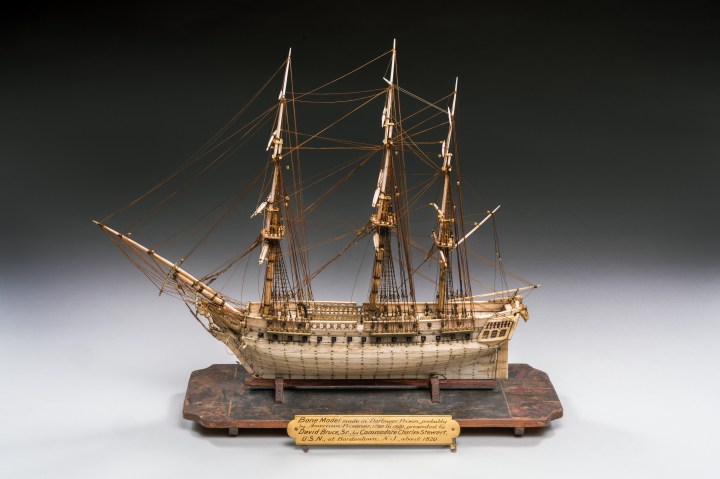
Attributed to an unknown French prisoner in Dartmoor Prison, Napoleonic War Model (Unidentified British Frigate), ca. 1790–1820, bone with a wooden stand covered in paper, 16 × 12 × 3 inches (Philadelphia: Independence Seaport Museum, Gift of Elizabeth Blaisdell, 1969.091).
◊ ◊ ◊ ◊ ◊
From the press release (3 February 2025) . . .
Small but Mighty! Models, Toys, and Miniature Ships
Independence Seaport Museum, Philadelphia, opening 20 March 2025
For centuries, people of all ages have been intrigued by model ships. Made for myriad reasons ranging from pure enjoyment to promotional tools, most are unique objects made by hand. Opening on 20 March 2025, a new permanent exhibition at the Independence Seaport Museum (ISM) will display nearly 50 rarely seen models dating from the early 19th century to the later 20th century, along with related paintings and prints. Primarily made of wood, the models were also fashioned out of paper, bone, and metal. Among the examples to be displayed are extraordinarily detailed and realistic models, such as the Heavy Cruiser USS Indianapolis, as well as highly stylized toy models intended for adults and children.
“Guests to the ISM over the years have remarked at the amazing range of ship models, toys, and pond models in our permanent collection,” said Peter Seibert, museum president and CEO. “This new exhibition has given us the opportunity to not only exhibit some of the public’s favorite examples along with many that have rarely ever been shown before. Young and old alike will love exploring these masterpieces of miniature craftsmanship.”
Over the centuries, ships models were used for various purposes. Some were design sources, known as half hulls, used in building larger vessels, while others were used for sport, such as pond models that were raced. Model ships were made as toys for children, and highly crafted, expensive models were intended as toys for adults. Other models were made to commemorate new vessels and were presented to shipbuilders or owners; some that were made by prisoners were used to exchange for food. Model ships were also used as tokens of remembrance either made by those who were on particular boats or those who were simply avid towards certain boats. Most of the models in the Independence Seaport Museum’s collection are ‘scratch built’, meaning that the craftsmen had to shape each piece from raw or lightly prepared materials rather than using premade parts. This method can be complex: metal casting is often used to produce the funnels, propellers, and other elements of a highly detailed model.
Among the most noteworthy ship models to be on view is the Heavy Cruiser USS Indianapolis. The legendary ship—launched on 7 November 1931 at the New York Shipbuilding Company in Camden, New Jersey to deliver the bomb to end World War II—was sunk by Japanese submarine 1-58 on 30 July 1945, after being hit by two torpedoes. Within just twelve minutes, the ship sank and the majority of the crew was launched into the water, while the remaining 300 or so crew members were left onboard. Three days later, a random sighting by a pilot led to the rescue of some of the sailors. (Today, the USS Indianapolis is most famous because its story was recounted in a scene in the movie Jaws.) This model of the Indianapolis, built in 1934–38 by Walter H. Gerber, a German mechanical engineer who originally worked at Cramp’s Shipyard in New York and then later transferred to Cramp’s Shipyard in Philadelphia, is massive in size: it measures 12 feet long by 17 inches wide. It was originally constructed as a radio-controlled, in-water model that had the capability to power its inside mechanics as well. The maker also has an interesting story: Gerber came under scrutiny from the United States government during World War II because he was fixated on the accuracy of the model and came from an enemy country. Afraid that information about the United States Navy would fall into the wrong hands, his actions were monitored and his home was raided, looking for cameras and other equipment supposedly to have been reported and/or voluntarily turned over to the government. Nothing of significance was found.
Another exquisite model of early shipbuilding is the Napoleonic War Model. Made entirely of bone by French prisoners in the British Dartmoor Prison, it was likely traded for food (prisoners were held on British prison ships during the Napoleonic wars; other similar models may have been made by American prisoners during the war of 1812). This model depicts an unidentified British frigate with 50 guns and has a decorative paper-covered wooden stand dating from about 1790 to 1820. With no provenance, it is assumed to be French and made for the British. The model, considered a folk-art masterpiece, was presented to David Bruce, Sr. by Commodore Charles Stewart, United States Navy, at Bordentown, New Jersey, in about 1820. Stewart was a Philadelphian who served in the navy for 63 years, playing key roles in the Quasi-War, Barbary Wars, and the War of 1812.
On 10 August 1893, the Steamer Priscilla, made by the Delaware River Iron Shipbuilding and Engine Works Company (John Roach & Sons) in Chester, Pennsylvania, for the Old Colony Steamboat Company, launched. Three years later, she was recreated as a child’s toy by R. Bliss Manufacturing Company in Pawtucket, Rhode Island, known for making inexpensive but realistic toys. One of these large toy ships made of chromolithographed paper attached to a wooden frame is equipped with wheels for motion, is a highlight of Small but Mighty! Measuring 37 inches long by 20 inches high and 5 inches wide, it is in pristine condition and illustrates the color and beauty of late 19th-century ships. This faithfully executed toy offered children a duplicate of the type of vessels actively used on America’s waterways. Toys such as these were sailed on the floors of large Victorian homes and enjoyed by children and, likely, adults as well.
The racing of small model yachts began in England in the 1870s, spread across the European continent, and eventually came to the United States. (New York’s Central Park Lake was built expressly for people to use in sailing pond models.) Organizations such as the Model Yacht Association determined rules and umpired regattas of two types: open water sailing and pond sailing. By 1950, five classes of model yachts were used, including the Marblehead or ‘M’ Class (also known as the 50/800 Class). Their small, manageable size made this sport appealing to those who could not handle a full-scale boat or those with limited financial resources. One such example of an ‘M’ Class model made in 1949, the Pond Yacht Almary II, is featured in the exhibition. It was made by Albert Link (born in Fishtown, Pennsylvania, 1909–1993) and is considered to be one of the biggest and best of its kind. Link worked as a machinist for Smith, Kline, and Beecham in Philadelphia. Link built approximately 15 model sailboats in his lifetime (the Almary II was his eighth) and raced them at Gustine Lake in Fairmont Park, Concourse Hunting Park, League Island Swimming Pool in Philadelphia as well as on Cooper River in Camden, New Jersey, and Long Island, New York. In 1950, he was a national prize winner at the New York Yacht Club and again in 1954 at Cooper River. He stopped racing that same year.
For children of all ages who are fascinated with model ships, Small but Mighty! Models, Toys, and Miniature Ships will delight and inform.
Exhibition | Versailles: Science and Splendour

From the press release for the exhibition, a reworking of Sciences et curiosités de Versailles, which was on view at the palace in 2010–11.
Versailles: Science and Splendour
Science Museum, London, 12 December 2024 — 21 April 2025
Curated by Anna Ferrari
A significant new exhibition unveils the fascinating stories of science at Versailles, exploring how scientific knowledge became widespread, fashionable, and a tool of power to enhance France’s prestige. Versailles: Science and Splendour invites visitors to discover the unexpected, yet vitally important, role of science at the French royal court through spectacular scientific objects and artworks. Many items will be on display for the first time in the UK, including Louis XV’s rhinoceros and a splendid sculptural clock representing the creation of the world. The sumptuous exhibition also sheds light on the contribution of women to physics, medicine, and botany in 18th-century France.
Versailles—the seat of royal power in France in the 17th and 18th centuries—was renowned for its opulent palace and gardens, but it was also a cradle of scientific spirit. Developed with support from the Palace of Versailles, the exhibition reveals the meeting of art and science in the court as it showcases more than 100 fascinating objects, from the extravagant to the everyday. The exhibition explores how Louis XIV, Louis XV, and Louis XVI encouraged scientific pursuit and readily drew on technological advances of their times, enhancing France’s prestige and extending its influence. The exhibition highlights significant figures, including stories of women in science, such as the pioneering midwife Madame du Coudray who trained thousands of midwives in rural France and Emilie du Châtelet, the eminent physicist and mathematician who translated Isaac Newton’s Principia.
Anna Ferrari, lead curator of Versailles: Science and Splendor, said: “We are delighted to bring Versailles to London in this new exhibition, which invites visitors to discover an unusual but crucial side of the palace’s history and grandeur. This exhibition will reveal fascinating stories of science at Versailles through more than a hundred treasures, bringing new attention to the relationship between science and power.”
Christophe Leribault, President of the Palace of Versailles, said: “The Sciences and Curiosities at the Court of Versailles exhibition, held in 2010 at the Palace of Versailles, made a lasting impression. It unveiled a lesser-known aspect of life at the former royal residence: the interest in sciences and the spirit of curiosity and innovation that animated the sovereigns and the entire court. Through this revisited version of the exhibition, we take pride in the fact that our collections and expertise can now cross the Channel to meet visitors at the Science Museum, inspiring them to visit or revisit the Palace of Versailles.”
Sir Ian Blatchford, Director and Chief Executive of the Science Museum Group, said: “Science was at the heart of the French royal court, from the engineering innovations needed to build the regal seat of power to the lavish scientific demonstrations staged for the kings. We are able to share these remarkable stories with Science Museum visitors for the first time thanks to a close partnership with the Palace of Versailles. In strengthening such cultural connections with European partners, we will continue to inspire people with incredible stories of science and culture around the world.”

Versailles: Science and Splendour as installed in London’s Science Museum.
◊ ◊ ◊ ◊ ◊
Harnessing Science
Versailles: Science and Splendour takes visitors on a 120-year journey through the evolution of science at Versailles, from the creation of the Academy of Sciences by Louis XIV in 1666, to Louis XV’s passion for exquisite scientific instruments, and Louis XVI’s ordering of the La Pérouse expedition to the Pacific in 1785.
Measuring time and space was one of the key tasks of the Academy of Sciences, reflecting the challenges of the time in Europe. Members of the Academy mapped the Earth and the skies as visitors can observe in a 1679 map of the Moon by Cassini, the precision of which remained unrivalled for over 200 years. The promotion of France’s power through scientific developments also served political purposes, with exquisite instruments given as diplomatic gifts across the world.
The exhibition also gives visitors the opportunity to see the magnificent gardens of Versailles in a new light. Recruited by Louis XIV, Academicians and experts used mathematics and engineering to transform the site into a statement of power and prestige. Of particular importance for Louis XIV was the creation of spectacular fountains and water features in the grounds, which required hydraulic engineering projects of unprecedented scale. A painting of the monumental Marly Machine, which supplied Versailles’ fountains with water from the river Seine, will impress upon visitors the magnitude of Louis XIV’s grand ambitions.
Understanding Nature

Louis XV’s Rhinoceros (Paris: Muséum national d’Histoire naturelle).
France’s imperial reach enabled Versailles to become a centre for the scientific study of plants and animals from around the world. The exhibition will display this growing interest in zoology and the kings’ luxurious taste, which pushed for inventive botanic engineering to allow exotic fruits, like pineapples, to grow at Versailles.
Visitors will also be able to learn the surprising story of Louis XV’s rhinoceros, on display in the UK for the very first time. Gifted by a French governor in India, this rhinoceros was perhaps the Versailles menagerie’s most pampered and famous resident. Acquired by the Muséum national d’Histoire naturelle in Paris during the revolution, it was dissected after its death in 1793, and has been held there for over two hundred years.
Versailles will also feature the medical advances supported by the kings. The royal family made precious contributions to these developments by submitting their own bodies to procedures. On display will be a scalpel designed specifically to operate on the Sun King, while the exhibition will cover the inoculation against smallpox which Louis XVI and his family underwent as soon as he ascended the throne.
Louis XV supported the training of midwives across France to reduce infant mortality and grow a populous and strong kingdom. Born outside the nobility, to a family of doctors, Madame du Coudray rose to prominence through her pioneering practical training of midwives. She employed sophisticated life-sized mannequins to demonstrate the mechanics of birth—part of the only surviving mannequin will be showcased in the exhibition. Madame du Coudray ultimately trained over 5,000 women, as well as physicians, across France.

Versailles: Science and Splendour as installed in London’s Science Museum.
◊ ◊ ◊ ◊ ◊
Embracing Knowledge
Scientific culture became widespread and fashionable at the courts of Louis XV and Louis XVI, with members of the royal family and of the aristocracy educated in physics, mathematics, and chemistry. Examples of Louis XV’s magnificent collection of instruments will be on display. Visitors will see a sophisticated and rare optical microscope made by the king’s brilliant engineer, Claude-Siméon Passemant, which is also a work of art with its gilt bronze rococo stand by the Caffieri sculptors.
Jean-Antoine Nollet, tutor of physics and natural history to the royal children during Louis XV’s reign, demonstrated principles of physics in sensational presentations at court. His air-pump, used to ‘make the invisible visible’, will be on display in the exhibition. Visitors will also learn about Emilie du Châtelet, an exceptional physicist and mathematician. Her translation of Isaac Newton’s Principia Mathematica into French, with her own additional commentary, remains in use today.
From the heart of government at Versailles, science was used strategically to assert imperial power on the world stage. The exhibition highlights technological developments in warfare and defence engineering, as well as the 1785 expedition of La Pérouse. Commissioned by Louis XVI, the expedition had a dual aim. It sought to establish trade connections around the Pacific as well as further scientific knowledge: mapping coastlines as yet uncharted by Europeans and collecting scientific data.
The exhibition also interrogates the surprising role of science in Versailles’ taste for spectacle. The palace provided an influential platform for scientific figures to present their work, as well as for the kings to display their power through extraordinary demonstrations, such as the flight of Etienne Montgolfier’s hot-air balloon at Versailles in 1783. One of the most complex pieces of engineering of its time, Pendule de la Création du Monde, presented to Louis XV in 1754, will also be on display. This exquisite astronomical clock exemplifies the intersection of scientific interest and royal opulence, boasting Versailles’ splendour through mechanical wonder.
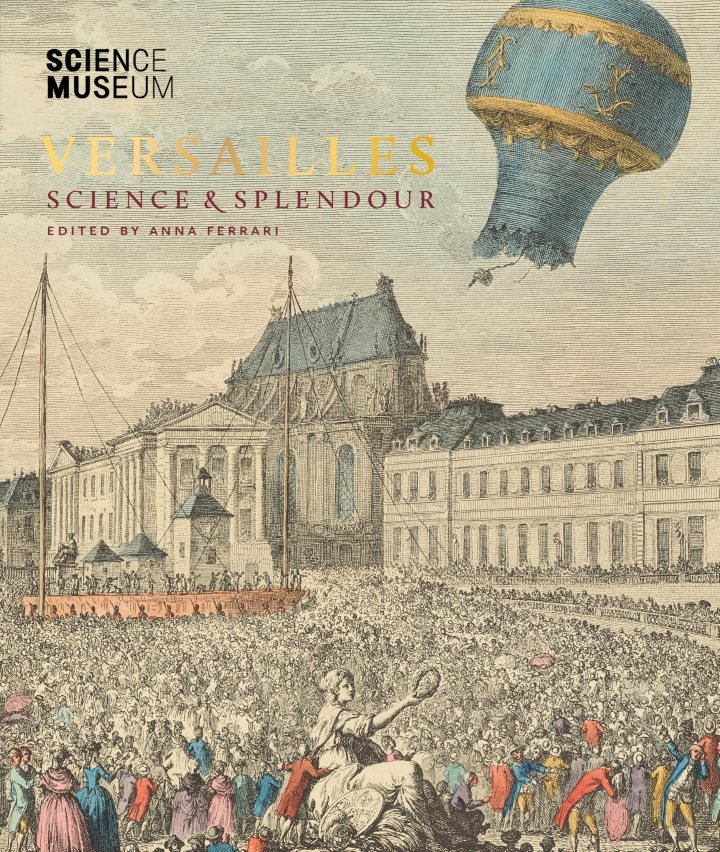
Anna Ferrari, ed., Versailles: Science and Splendour (Milan: Scala, 2025), 128 pages, ISBN: 978-1785515828, £30.
Published to accompany the exhibition at London’s Science Museum, this richly illustrated book breaks new ground in exploring the relationship between science and power at the French court of Versailles. It features sixteen short chapters by experts from Britain, France, and America.
Anna Ferrari is Curator of Art and Visual Culture at the Science Museum and lead curator of the exhibition Versailles: Science and Splendour. Trained as an art historian, she has previously curated and co-curated exhibitions at the Victoria and Albert Museum, the Royal Academy of Arts and the Sainsbury Centre for Visual Arts.
New Book | Hercules of the Arts
The exhibition was on view last year at Vienna’s Gartenpalais Liechtenstein. The catalogue is distributed by The University of Chicago Press:
Stephan Koja, ed., Hercules of the Arts: Johann Adam Andreas I von Liechtenstein and Vienna around 1700 (Munich: Hirmer Verlag, 2024), 240 pages, ISBN: 978-3777443638, $45. With contributions by Thomas Baumgartner, Reinhold Baumstark, Alexandra Hanzl, Claudia Lehner-Jobst, Katharina Leithner, Gernot Mayer, Cecilia Mazzetti di Pietralata, Andreas Nierhaus, Peter Stephan, Arthur Stögmann, and Silvia Tammaro.
 The life of one of Vienna’s foremost patrons of art.
This book focuses on Prince Johann Adam Andreas I of Liechtenstein (1657–1712). His skillful economic policies enabled him to increase his fortune, with which he purchased important artworks, invested in building projects and their artistic design, founded a city district, and developed Italian art and architecture in Vienna in around 1700. The prince was an important individual in his dynasty and a great patron and builder. He reorganized administrative structures and invested in businesses and innovative production techniques. He thus created the financial basis for the expansion of the art collection and the construction and furnishing of imposing buildings. To this day, the Gartenpalais and Stadtpalais in Vienna bear witness to the activities of this prince known as a Hercules of the arts.
Exhibition | Illusion: Dream–Identity–Reality
Now on view at the Hamburger Kunsthalle:
Illusion: Dream – Identity – Reality
Hamburger Kunsthalle, Hamburg, 6 December 2024 — 6 April 2025
Curated by Sandra Pisot and Johanna Hornauer

Henry Fuseli, Die Vision des Dichters (The Poet’s Vision), 1806–07, oil on canvas, 61 × 41.5 cm (Winterthur: Stiftung für Kunst, Kultur und Geschichte). The composition served as the frontispiece for William Cowper’s book, Poems (London: J. Johnson , 1808), volume 1.
With a large-scale exhibition spanning several epochs, the Hamburger Kunsthalle looks at the diverse facets of the theme of illusion in art from the Old Masters to the present day. Trompe-l’œil has been widely used in art since antiquity, flourishing in particular in the Renaissance and Baroque periods. And this technique continues to fascinate artists today, when the spread of fake news is almost normal, when people are confronted daily with manipulated images on the internet and virtual reality seems to be expanding our cosmos into infinity. We now live in the certainty that we can no longer trust our eyes, that images are deceptive and are used to depict what is desired rather than what is. But the exhibition shows how illusion means far more than merely deceiving the eye. It is manifested in the (illusionistic) self-love of Narcissus as well as in spatial illusions in architecture, in the play of concealing and revealing via the pictorial motifs of the curtain and the mask, in the meaning of the open or closed window onto the world, and in images of visions and dreams. Based on some 150 paintings, drawings, prints, photographs, sculptures, installations and video works, the show traces the many different forms taken by hyperrealism, reality, fiction, dream, transformation and deception. Among the exhibits are major works from the Hamburger Kunsthalle as well as loans from national and international collections.
Marcel Duchamp remarked succinctly in 1964: “Art is a deception.” And in 1976 Sigmar Polke wondered about the limits of human perception: “Can you always believe your eyes?” Against the backdrop of fake news and artificial intelligence, the exhibition also takes a look at illusion in twenty-first-century society, urging us to sharpen our senses and reflect on what is innately human: our viewing habits, expectations, conventions and vulnerability to visual seduction.
 Artists featured in the exhibition
Helene Appel, Hans Arp, Thomas Baldischwyler, Max Beckmann, Paris Bordone, Carl Gustav Carus, Marc Chagall, Jean-Baptiste Siméon Chardin, Adriaen Coorte, Lovis Corinth, Edgar Degas, Robert Delaunay, Johann Friedrich Dieterich, Gerrit Dou, Wilhelm Schubert von Ehrenberg, Lars Eidinger, Elmgreen & Dragset, James Ensor, Max Ernst, M. C. Escher, Juan Fernández, Charles de la Fosse, Caspar David Friedrich, Johann Heinrich Füssli, Xaver Fuhr, Jean-Léon Gérôme, Cornelis Gijsbrechts, Nan Goldin, Francisco de Goya, Andreas Greiner, Joachim Grommek, Duane Hanson, Vilhelm Hammershøi, Johann Georg Hinz, David Hockney, Samuel van Hoogstraten, Roni Horn, Gerard Houckgeest, Horst Janssen, Alexander Kanoldt, Howard Kanovitz, Anish Kapoor, Oskar Kokoschka, Jens Lausen, François Lemoyne, Lorenzo Lippi, Simon Luttichuys, Alfred Madsen, René Magritte, Tony Matelli, Stefan Marx, Adolph Menzel, Frans van Mieris d. Ä., Piet Mondrian, Ron Mueck, NEAL, Giovanni Battista Piranesi, Sigmar Polke, Gerhard Richter, Joachim Ringelnatz, Jan van Rossum, Pieter Jansz. Saenredam, Godfried Schalcken, Markus Schinwald, Oskar Schlemmer, Georg Schrimpf, Cindy Sherman, Kiki Smith, Antonie van Steenwinckel, Theodoor van Thulden, Nikos Valsamakis, Victor Vasarely, Wolf Vostell, Friedrich Wasmann, John William Waterhouse, Jacob de Wit, Francisco de Zurbarán.
From Hatje Cantz:
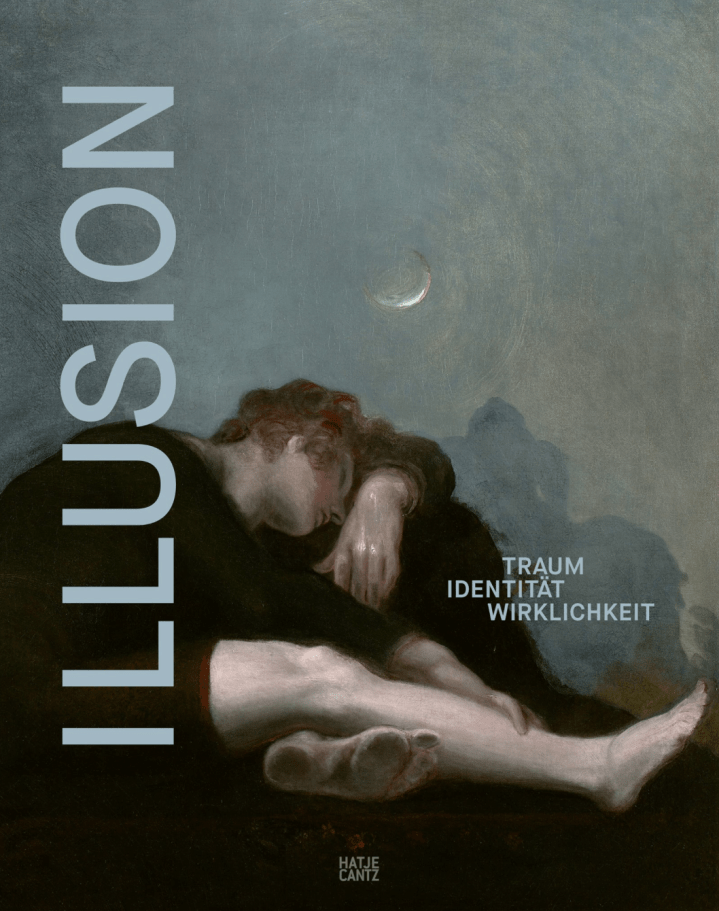
Sandra Pisot and Johanna Hornauer, eds., Illusion: Traum – Identität – Wirklichkeit (Berlin: Hatje Cantz Verlag, 2024), 320 pages, ISBN: 978-3775758451, €54. With contributions by Juliane Au, Markus Bertsch, Clara Blomeyer, Laura Förster, Johanna Hornauer, David Klemm, Brigitte Kölle, Kerstin Küster, Sandra Pisot, Jan Steinke, Andreas Stolzenburg, Ifee Tack.
Turner 250

.
J.M.W. Turner, The Battle of Trafalgar, 21 October 1805, 1822–24, about 10 × 14 feet framed
(Greenwich: National Maritime Museum, BHC0565)
◊ ◊ ◊ ◊ ◊
Press release (21 January 2025) from Tate:
This morning, cultural institutions across Britain announced Turner 250, a year-long festival of special exhibitions and events. Taking place throughout 2025, the programme celebrates 250 years since the birth of renowned painter JMW Turner. Whether visiting museums and galleries or tuning in on TV and online, everyone will have the chance to enjoy Turner’s greatest works, learn about his incredible life and career, and discover the many ways he continues to inspire creativity today.
Born on 23 April 1775, Joseph Mallord William Turner is widely considered to be the greatest and most influential British artist of all time. From humble beginnings, he travelled the length and breadth of the country to capture its dramatic scenery, redefining landscape painting in the process. Today he remains a touchstone of British cultural life—the face on the £20 note—and the painter behind some of the most iconic images of the natural world ever created.

J.M.W. Turner, Self-Portrait, ca.1799, oil on canvas, 74 × 58 cm (London: Tate, Turner Bequest 1856, N00458).
This announcement includes over 30 projects taking place this year, organised by venues large and small as well as by national organisations such as Tate, the BBC, and Art UK. Turner exhibitions will be held in London, Edinburgh, Leeds, Manchester, Liverpool, Norwich, Bath, and Sussex, highlighting key themes in his life and work and exploring his connections to other renowned historic figures like Jane Austen and John Constable. Turner’s legacy in modern and contemporary art will be celebrated with displays, commissions, and events in London and Margate, while the Turner Prize will be staged in Bradford as a highlight of the UK City of Culture programme. Books, films, and digital content will be released through the year, including a complete catalogue of Turner’s 37,500 sketches and watercolours on Tate’s website, a major new BBC documentary bringing the man and his art to life, and a screening of Mike Leigh’s award-winning film Mr. Turner at BFI Southbank. Talks and workshops will showcase new scholarship and ideas inspired by Turner, including an international conference at Tate Britain, a summit exploring art’s connection to the natural world at Turner Contemporary, and the Turner Society’s annual Kurt Pantzer memorial lecture. A keen international traveller, Turner will also have his 250th anniversary commemorated far beyond the UK, with celebratory shows being staged in Connecticut, Cincinnati, and Shanghai, as well as a special exhibition closer to home in Dublin.
Turner’s birthday on 23 April 2025 will be a particular highlight: the artists shortlisted for the Turner Prize will be announced that morning ahead of their show in Bradford in the autumn, an exhibition of Turner’s rarely-seen images of wildlife will open at Turner’s House in Twickenham, and a newly refreshed room will open in Tate Britain’s Clore Gallery, home to a permanent free display of 100 works by the artist.
Arts Minister Sir Chris Bryant said: “Turner was one of this country’s greatest artists. An innovator who created some of our best known canvasses, he reshaped British art. A talent of Turner’s stature requires a year of celebration, from the prize in his name to the back of the £20 note, his immense legacy continues to permeate through the arts and public life in Britain. The 250th anniversary of his birth will be an opportunity for the public to immerse themselves in our outstanding artistic heritage. I encourage everyone to take the time to find an event from the upcoming year to enjoy some of Britain’s finest artists from the past and present.”
Maria Balshaw, Director of Tate, said: “Turner is a standout figure in the story of British creativity. It is Tate’s privilege to care for the world’s biggest collection of his art and showcase it to the widest possible public. Over the course of this year, I’m delighted that we will be showing over 150 of his stunning works at Tate Britain as well as lending over 100 more to venues right across this country and beyond.”
Suzy Klein, Head of BBC Arts & Classical Music TV, said: “We’re thrilled to be working with Tate to celebrate Britain’s most celebrated artist and be granted unprecedented access to Turner’s vast collection of rarely seen sketches. I can’t wait to share this treasure trove with audiences, not only illuminating the workings of Turner’s unique creative mind but also offering an unprecedented view into the extraordinary era of change during his lifetime.”
Exhibition | J. M. W. Turner: Romance and Reality
 .
.
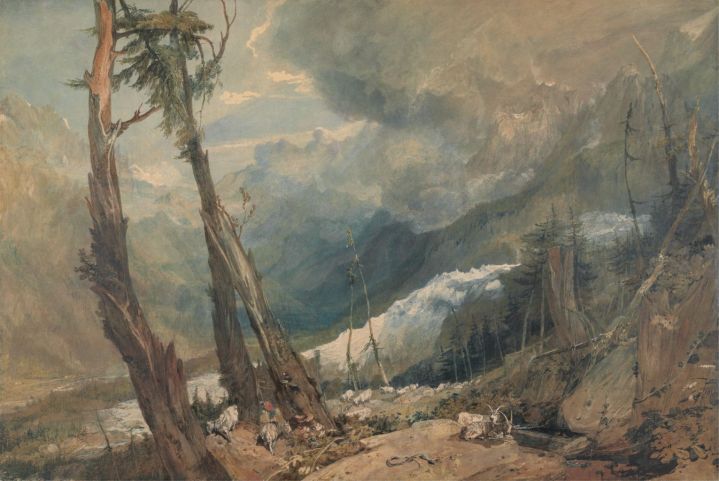
J.M.W. Turner, Mer de Glace, in the Valley of Chamonix, 1803, watercolor, graphite, gum, scraping out and stopping out on moderately thick, slightly textured, cream wove paper mounted on thick, smooth wove paper (New Haven: Yale Center for British Art, B1977.14.4650)
◊ ◊ ◊ ◊ ◊
Opening next month at the YCBA, which itself reopens after a two-year conservation project:
J. M. W. Turner: Romance and Reality
Yale Center for British Art, New Haven, 29 March — 27 July 2025
Dordrechts Museum, Spring 2026
The year 2025 marks the 250th anniversary of the birth of Joseph Mallord William Turner (1775–1851), possibly the most widely admired and influential British artist of all time.
Though Turner was trained within the English topographical tradition, his practice was deeply rooted in a wider European heritage of landscape painting. Turner pushed this inheritance to its limits in pursuit of his own expressive ends, astounding contemporaries with his bold and highly original compositions. His unique approach paved the way for a new form of landscape art, one that combined virtuoso brushwork with brilliant color, dazzling light effects, and an almost abstract sensibility. As a result, Turner came to be recognized as the most radical and innovative painter of his time and has continued to be so ever since.
This exhibition, the first show focused on Turner to be held at the Yale Center for British Art in more than thirty years, will showcase the museum’s rich holdings of the artist’s work. Unequaled in North America, this collection includes some of Turner’s most acclaimed oil paintings, notably his masterpiece Dort or Dordrecht: The Dort Packet-Boat from Rotterdam Becalmed (1818) and his celebrated later painting Staffa, Fingal’s Cave (1831–32). Alongside these major works, the exhibition will also feature outstanding watercolors and prints from the YCBA’s collection, including the artist’s only complete sketchbook outside of the British Isles.
Turner’s works are akin to painted poems, filled with incident, anecdote, and symbolism. Conveying both the beauty and cruelty of nature and human life, they shed fascinating light on the artist’s world and reveal an aesthetic—and moral—complexity that is at once discomforting and strangely modern.
The exhibition is generously supported by the Dr. Lee MacCormick Edwards Charitable Foundation.
From Yale UP:
Ian Warrell, with contributions by Gillian Forrester, Turner (New Haven: Yale University Press, 2025), 144 pages, ISBN: 978-0300279719, $40.
 This book, the inaugural installment in the Yale Center for British Art’s Collection Series, explores the museum’s astonishing Turner holdings—the largest outside the United Kingdom—in a manner that will engage the general reader and expert alike. Six sections of plates provide a comprehensive overview of the artist’s career, place the works within their historical and cultural context, and include new discoveries regarding the identification of locations, landscapes, and dates. Gillian Forrester’s supplementary essay offers a novel account of Turner’s innovative printmaking practice, illuminating his fraught collaborations with other printmakers. Complementing an exhibition at the YCBA and a satellite exhibition at the Dordrechts Museum (The Netherlands), both planned for the 250th year of Turner’s birth, this publication celebrates the artist’s unparalleled vision as exemplified in the YCBA’s world-class collection of his work.
Ian Warrell is an independent curator specializing in British art of the nineteenth century. Gillian Forrester is an independent curator specializing in British art from the eighteenth century to the present and former senior curator of prints and drawings at the Yale Center for British Art.
Exhibition | A Lively Mind: Jane Austen at 250
There’s no shortage of stimulating events marking this year’s 250th anniversary of Jane Austen’s birth, and readers will know this terrain much better than I. But for anyone tring to keep up, the following sites offer a useful starting place. –CH
• Ben Jureidini, “Is 2025 the Year of Jane Austen? From Society Balls to Blockbuster TV Shows, the 250th Anniversary of ‘Britain’s Greatest Author’ Is Set to Break Records,” The Tatler (6 January 2025). Miss Austen and The Other Bennet Sister on the BBC, a Dolly Alderton adaptation of Pride and Prejudice heading for Netflix, and a tourism boom for real-life regency balls, there’s something truly Austentatious about 2025. Link»
• “Worldwide Guide to Jane Austen 250th Events,” from the Jane Austen Centre in Bath, which focuses on the life and works of Jane Austen, as well as the Regency period in which she lived. Link»
• The Jane Austen Society, founded in 1940 by Dorothy Darnell with the purpose of raising funds to preserve the Cottage in the village of Chawton, Hampshire, where Jane Austen lived with her mother and sister Cassandra from 1809 to 1817. Link»
• The Jane Austen Society of North America, a non-profit organization staffed by volunteers and dedicated to the enjoyment and appreciation of Jane Austen and her writing. Link»
◊ ◊ ◊ ◊ ◊
Opening at The Morgan in June:
A Lively Mind: Jane Austen at 250
The Morgan Library and Museum, New York, 6 June — 14 September 2025
Organized by Dale Stinchcomb and Juliette Wells
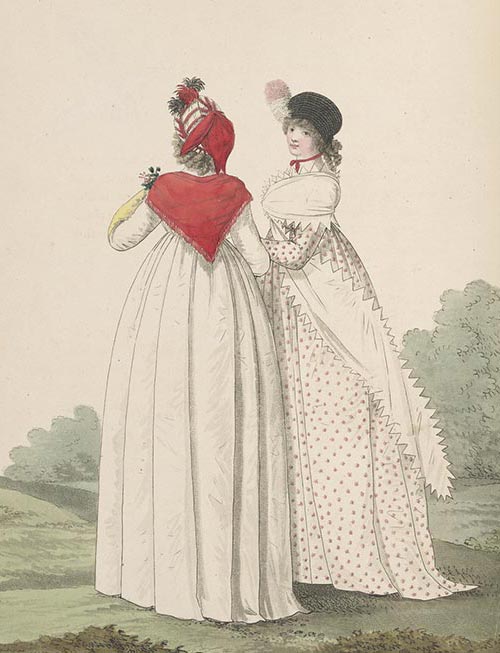
Morning Dresses from Gallery of Fashion (London: N. Heideloff, 1798), figs. 198, 199 (New York: The Morgan Library & Museum; PML 5680).
A Lively Mind immerses viewers in the inspiring story of Jane Austen’s authorship and her gradual rise to international fame. Iconic artifacts from Jane Austen’s House in Chawton, England join manuscripts, books, and artworks from the Morgan, as well as from a dozen institutional and private collections, to present compelling new perspectives on Austen’s literary achievement, her personal style, and her global legacy.
Beginning as a teenager, Austen cultivated her imaginative powers and her ambition to publish. Encouraged by her family, especially her father and her sister Cassandra, she persevered through years of uncertainty. Her creativity found expression in a range of artistic pursuits, from music-making to a delight in fashion. The story of how Americans first encountered and responded to Austen’s novels, unbeknownst to her, emerges from four surviving copies of an unauthorized edition of Emma published during her lifetime. Following Austen’s death, family members preserved their memories of her, while carefully guarding what was publicly revealed. Austen’s audience continued to grow as those who loved her novels helped new generations of readers to appreciate them. In addition to celebrating Austen, A Lively Mind commemorates the landmark gift of Austen manuscripts to the Morgan in 1975 by Alberta H. Burke and draws extensively on the extraordinary collection she bequeathed to Goucher College in Baltimore.
A Lively Mind: Jane Austen at 250 is organized by Dale Stinchcomb, Drue Heinz Curator of Literary and Historical Manuscripts, and Juliette Wells, Professor of Literary Studies at Goucher College. It is made possible by generous support from the Drue Heinz Exhibitions and Programs Fund, Cynthia H. Polsky, Martha J. Fleischman, the Caroline Morgan Macomber Fund, the Lucy Ricciardi Family Exhibition Fund, and Alyce Williams Toonk.
Exhibition | Better on Paper

.
John Pike, Fan: Land of Matrimony and Land of Celibacy, London, late 18th century, paper and wood
(Wellesley College Special Collections)
◊ ◊ ◊ ◊ ◊
From the press release for the exhibition:
Better on Paper: Recent Acquisitions of Prints, Drawings, Photographs, and Books
Davis Museum, Wellesley College, Massachusetts, 7 February — 1 June 2025
Curated by Amanda Gilvin and Ruth Rogers
Better on Paper is a new exhibition that spotlights and celebrates some of the thousands of newly acquired and previously unseen works of art on paper, including prints, drawings, photographs, books, and other objects, acquired by the Davis Museum and the Wellesley College Library Special Collections over the last decade. The exhibition emphasizes contemporary art, while also showcasing many new acquisitions of art from past centuries. More than 100 recent gifts and purchases will be on view in Better on Paper, along with two other new exhibitions at the Davis Museum all highlighting new acquisitions.
“Better on Paper presents a stunning array of visionary works of art from Wellesley’s collections in this collaboration between the College Library’s Special Collections and the Davis,” said Amanda Gilvin, the exhibition’s co-curator and Interim Co-Director, Sonja Novak Koerner ’51 Senior Curator of Collections, and Associate Director of Curatorial Affairs.
The exhibition calls attention to Wellesley’s decades-long leadership in the field of the study of photography, Gilvin said. She notes works that will be on view and are now part of the Davis collection include Nigerian artist Taiye Idahor’s Ekundayo; prominent African American photographer in the 1970s and 1980s Ming Smith’s Self Portrait, Harlem, NY; work by locally-based multimedia artist Jo Sandman; Chitra Ganesh’s Architects of the Future, City Inside Her; and Magdelena van de Passe after Crispijn de Passe the Elder’s Spring. Special Collections will present 18th-century publisher John Pike’s satirical fan The Land of Matrimony [and] Land of Celibacy and Swiss graphic designer Romano Hänni’s artist book It is Bitter to Leave Your Home: A True Story Depicted in Typographic Images.

.
Motonori Taki, Kōkei Saikyūhō [Emergency Remedies for the Benefit of People], Kyōto: Izumoji Bunjirō; Edo: Hanabusa Daisuke han, ca. 1790
(Wellesley College Special Collections)
◊ ◊ ◊ ◊ ◊
The Davis and the Wellesley College Library Special Collections have joined together to mount Better on Paper to pay homage to these new acquisitions that represent Wellesley’s commitment to inclusive excellence. Often collaborating with Wellesley faculty, staff, and students, curators have acquired the objects in the exhibition to support and expand the Wellesley College curriculum. The prints, drawings, photographs, books, and other objects in Better on Paper originate from around the globe, spanning diverse makers and approaches, and dating to many periods.
“It is a tremendous opportunity for the College Library’s Special Collections to be off the shelves and on view to a wider audience,” said Ruth R. Rogers, Curator of Special Collections and Visiting Lecturer, Art Department. “Better on Paper allows us to share a selection from the range of international, rare books, contemporary artists’ books, and other evidence of material communication that are the basis of teaching and research on campus.
Building these collections supports today’s Wellesley Method: object-based and human-centered learning across disciplines. “We invite you to study, learn, and teach in this exhibition—and to find out more about the many other works on paper in the Davis Museum and Special Collections,” Gilvin said.
Better on Paper was co-curated by Amanda Gilvin and Ruth Rogers with contributions from Nicole Berlin, Associate Curator of Collections, Alicia Bruce, Friends of Art Curatorial Project Manager and Researcher, Yuhua Ding, Kemper Assistant Curator of Collections and Academic Affairs, L. Goins ‘26, 2024 Summer Curatorial Intern, James Oles, Adjunct Curator of Latin American Art and Senior Lecturer, Art Department, Mariana S. Oller, Associate Curator of Special Collections, and Semente, Curator of Education and Public Programs. The exhibition is presented with generous support from the Anonymous ’70 Endowed Museum Program Fund, Marjorie Schechter Bronfman ’38 and Gerald Bronfman Endowment for Works on Paper, and Wellesley College Friends of Art at the Davis.
Exhibition | Nevers in the World
From the press release for the exhibition:
Nevers in the World
Davis Museum, Wellesley College, Massachusetts, 7 February — 1 June 2025
Curated by Nicole Berlin, with Alicia Bruce and Yuhua Ding
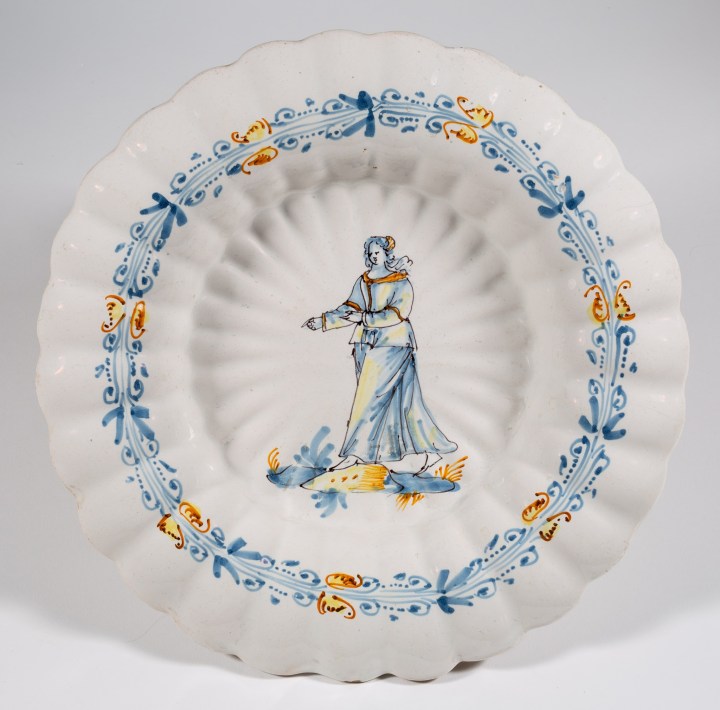
Gadrooned Dish, ca. 1700, Faience, made in Nevers (Davis Museum, Wellesley College, 2023.3.24).
Nevers in the World is an intimate exhibition of 11 newly-acquired seventeenth- to nineteenth-century French ceramics that were recently donated to the Davis Museum at Wellesley College. The French faience vessels are highly stylized glazed ceramics, created using a tin-glaze technique that originated in the Middle East, likely around Iraq, as a response to the vibrant white porcelain of China. Over time, this technique spread to Egypt, Spain, Italy, and eventually France, where it evolved into a distinctive art form.
The exhibition spotlights these beautifully glazed vessels, used mostly for dining tables, and illustrate a cross-cultural migration from their early origins in Iraq to the early iterations of Italian pieces and expanded color palettes and shapes by the French.
“When the generous gift of French faience arrived and our Curatorial team first saw it in storage, we were immediately excited by the many ways we could integrate it into both the permanent collection and a temporary exhibition,” said Nicole Berlin, Associate Curator of Collections at the Davis Museum and the Nevers show curator. “The vibrant colors, whimsical shapes, and the centuries-old ceramic glazing technique open up a wealth of creative possibilities for showcasing this remarkable collection.”
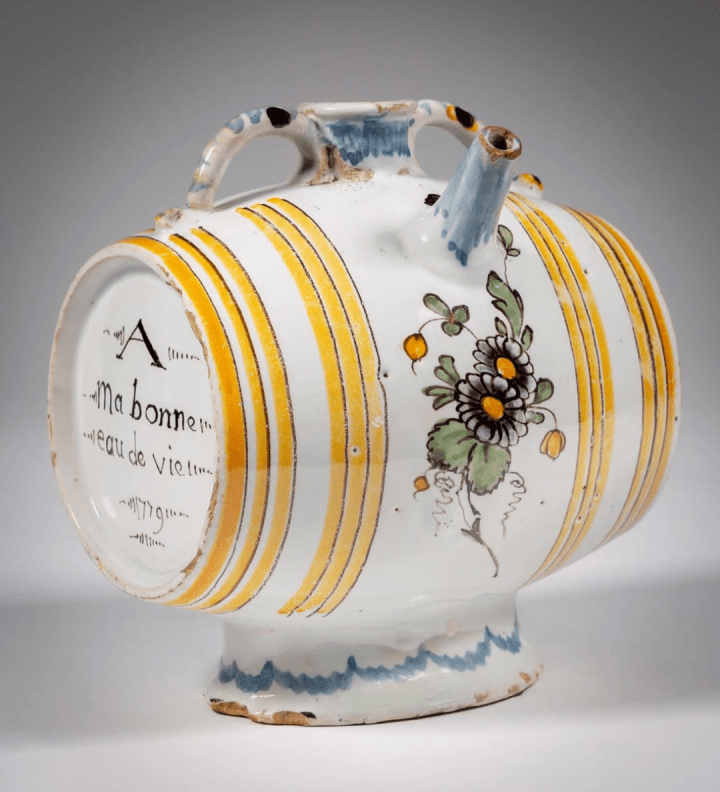
Spirit Cask, 1779, Faience, made in Nevers (Davis Museum, Wellesley College, 2023.3.26).
Nevers in the World is a selection of artworks from the generous bequest of the late Wellesley Trustee Emeritus Sidney R. Knafel, who spent decades assembling a world renowned collection of French ceramics. These objects demonstrate how artistic innovation can flourish through cross-cultural exchange. During the seventeenth and eighteenth centuries, a group of artisans in Nevers, France created extraordinary ceramic vessels using the faience technique. Invented nearly a millennium earlier, faience describes a glaze for ceramics that includes tin. In eighth-century Iraq, craftspeople discovered that adding tin to ceramic glaze produced an opaque, white surface suitable for colorful decoration. As the method spread across Asia and Europe, Italians called it maiolica. In France, it became known as faience, after the Italian city of Faenza.
In 1565, French aristocrat Henriette of Cleves married Italian politician Louis of Gonzaga, Duke of Nevers. The couple brought artisans from Italian maiolica centers to Nevers, where they introduced a style of storytelling through images in addition to tin-glaze. By 1600, European demand for Chinese porcelain spurred workshops in Nevers to attempt imitations in faience. Nevers artisans quickly developed a distinctive style that reached its zenith in popularity under King of France Louis XIV (1638–1715), when it featured in his elaborate dinner parties at Versailles. Today, these objects continue to tell stories about the people who made and used them.
Nevers in the World was curated by Nicole Berlin, Associate Curator of Collections with Alicia Bruce, Friends of Art Curatorial Project Manager and Researcher, and Yuhua Ding, Kemper Curator of Collections and Academic Affairs. This exhibition is supported by the Sandra Cohen Bakalar ‘55 Fund, the Judith Blough Wentz ’57 Museum Programs Fund, and Wellesley College Friends of Art at the Davis.
Decorative Arts Trust Announces 2025 Failey Grants
.
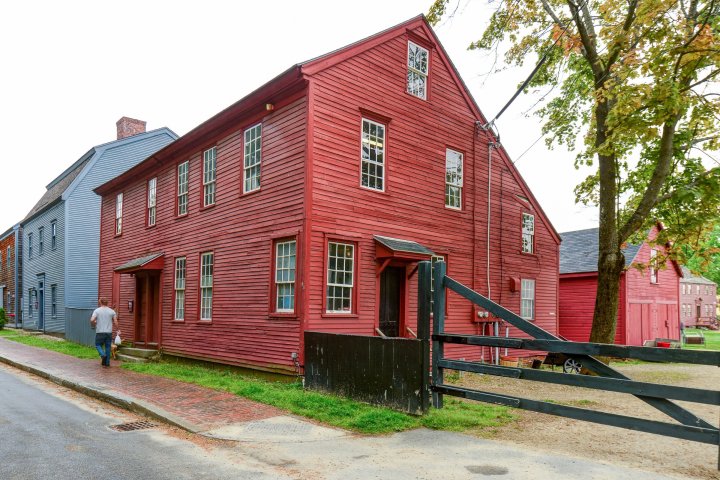
Strawbery Banke Museum in Portsmouth, New Hampshire is an outdoor history museum that preserves a neighborhood’s evolution of over 350 years, with most of the historic houses on their original sites. The Penhallow House—built in 1750 and moved to its present location in 1862—is Strawberry Banke’s only remaining ‘saltbox’. It was recently given a new foundation with a wet-proof basement to counteract rising sea and groundwater levels. In the 20th century, Penhallow House contained three apartments and the daily lives of an extended African-American family. Strawbery Banke intends to interpret the 20th-century Black experience in Penhallow House: the story of Kenneth ‘Bunny’ Richardson, a 20th-century story of Black Portsmouth and Civil Rights.
◊ ◊ ◊ ◊ ◊
From the December press release, with additional information available here:
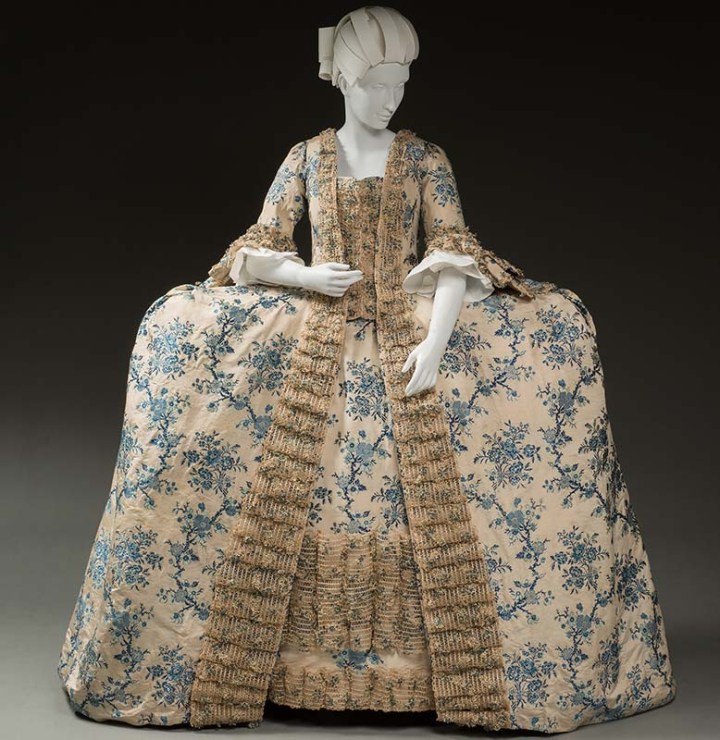
Formal dress (robe à la Française), 1765–70, French or Dutch, brocaded silk with knotted silk fringe and linen lining (Historic Deerfield, HD F.355).
The Decorative Arts Trust is pleased to announce the seven 2025 Dean F. Failey Grant recipients: the Birmingham Museum of Art in Birmingham, AL, for the Silver & Ceremony from Southern Asia, 1850–1910 exhibition; Historic Deerfield in Deerfield, MA, for the Body by Design: Fashionable Silhouettes exhibition; Honolulu Museum of Art in Honolulu, HI, for quilt conservation; the Museum of the American Revolution in Philadelphia, PA, for flag conservation; Strawbery Banke Museum in Portsmouth, NH, for Penhallow House wallpaper; Telfair Museums in Savannah, GA, for The Moss Mystique: Southern Women and Newcomb Pottery exhibition; and Wyck in Philadelphia, PA, for a Chinese desk conservation.
The Failey Grant program provides support for noteworthy exhibition and object-based conservation projects through the Dean F. Failey Fund, named in honor of the Trust’s late Governor. Failey Grant applications are due October 31 annually.










 Enfilade
leave a comment