Conference | Gardens and Empires
◊ ◊ ◊ ◊ ◊
Next month at the British Library:
Gardens and Empires
British Library, London, 27–28 June 2025
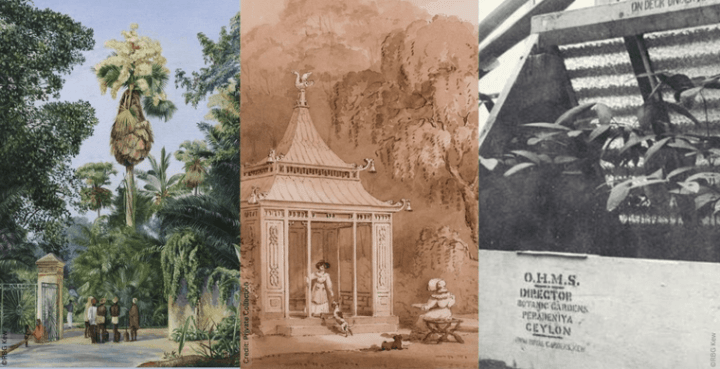
The histories of plants and gardens are deeply entangled with the histories of empires. This two-day conference investigates the impacts of these global connections on gardens around the world. It investigates the influence of global networks of science, commerce, and horticulture on the plants, designs, and practices found in the gardens of European and non-European empires, at home and abroad. The conference includes talks about the impact and influence of empires in gardens all over the world including East Asia, India, North America, South America, Australia, the Caribbean, and Europe. The speakers share the stories of the plants, people, and powers that shaped the gardens of empires. A keynote lecture will be delivered by Advolly Richmond (BBC Gardener’s World), and a roundtable discussion on the legacies of empire will be chaired by Sathnam Sanghera (author of Empireland and Empireworld).
Tickets include an exclusive visit to the British Library exhibition Unearthed: The Power of Gardening. Also included are refreshments each day and an evening reception on Friday, 27 June in the wonderful surroundings of The Story Garden, a dynamic community garden created by Global Generation, hidden behind the British Library.
f r i d a y , 2 7 j u n e
10.00 Opening Remarks
10.05 Welcome — Gerard Lemos (Chair of Trustees, English Heritage)
10.15 Keynote Lecture
• Guns and Roses: Humphry Repton at the Warley Estate — Advolly Richmond (Independent Researcher)
10.45 Coffee/Tea Break
11.10 Session 1 | The Circulation of Ideas around and between Empires
Chair: Mark Nesbitt (Royal Botanic Gardens, Kew)
• Where Empires Meet: Power, Identity, and Cultural Negotiation in Huế (Vietnam) Gardens — Tami Banh (University of Pennsylvania)
• Traveling Plants: Taiwanese Garden Spaces under Japanese Rule — Jing-Wen Chien (National Taiwan University)
• Transnational Influences on Urban Greenspace Development: The Role of Kew Gardens in Shaping Modern Greenspace Systems in Shanghai, Hong Kong, and Singapore — Minqian Zheng (Academic Researcher), Fei Mo* (Shanghai Jiao Tong University), and Xinyuan Yu (Academic Researcher)
12.30 Lunch Break
13.30 Session 2 | The Circulation of Ideas around and between Empires
Chair: Gerard Lemos (English Heritage)
• Mughal Garden or English Park? The Genesis of the Victoria Memorial Gardens, Kolkata — Caroline Cornish (Royal Botanic Gardens, Kew)
• From the Shores of Empire: Shells and Coral in the Grottos of 18th-Century Gardens — Emily Parker (English Heritage)
• Forced Plants and Displaced People: The British Empire’s Impact on North American Botany — Kimberly Glassman (Queen Mary University of London and Royal Botanic Gardens, Kew)
14:50 Coffee/Tea Break
15.15 Session 3 | The Circulation of Ideas around and between Empires
Chair: Romita Ray (Syracuse University)
• Paleis Het Loo: From Royal Showcase towards a Decolonized Botanical Garden — Renske Ek (Paleis Het Loo)
• The Race for American Trees and the Prince’s Garden at Aranjuez, 1797–1809: A Story of Rivalry, Emulation, and Oblivion among the Gardens of the Atlantic Colonial Powers — Francisco Javier Giron Sierra (Universidad Politécnica de Madrid, Escuela Técnica Superior de Arquitetura)
• Augusta of Saxe-Gotha’s ‘World in Microcosm’: Political Gardening at Kew, 1750–1770 — Joanna Marschner (Historic Royal Palaces)
16.35 Introduction to Unearthed: The Power of Gardening — British Library Curators
16:50 Exhibition View — Unearthed: The Power of Gardening
18:00 Evening Reception at The Story Garden (pizza and canapés provided)
s a t u r d a y , 2 8 j u n e
9.30 Session 4 | People and Economics
Chair: Advolly Richmond (Independent Researcher)
• Horticulture, Empire, and Race: Thomas Dawodu and Ferdinand Leigh in Lagos, Jamaica, and Kew — Kate Teltscher (University of Roehampton and Royal Botanic Gardens, Kew)
• Pineapples, Prestige, and Imperial Politics: The 3rd Duke of Portland’s Gardening Practice at Welbeck Abbey, Nottinghamshire, Britain — Susanne Seymour (University of Nottingham)
• The Links between Scottish Country Estates and the Profits of Transatlantic Slavery, 1707–1850 — Catherine Middleton (Historic Environment Scotland)
11.00 Coffee/Tea Break
11.30 Session 5 | Plant Mobilities
Chair: Felix Driver (Royal Holloway, University of London)
• On ‘Exotics’ and ‘Civilisation’: The 19th-Century Transatlantic Exchange of Ornamental Plants — Diego Molina (Royal Holloway, University of London)
• Palms, Rubber, and Orchids: Introduced and Created Plants in the Singapore Botanic Gardens — Timothy Barnard (National University of Singapore)
12.30 Lunch Break
13.30 Session 6 | Legacies of Empire and Colonialism
Chair: Judy Ling Wong (Black Environment Network)
• Creole Gardens as Decolonial Practice, Regrowth, Resistance, Recycling, and Repair — Ananya Jahanara Kabir (King’s College London) and Rosa Beunel-Fogarty (King’s College London)
• A Private Empire: Interpreting European Gardens Funded by Leopold II’s Personal Ownership of the ‘Congo Free State’ — Jill Sinclair (Independent Researcher)
• Converting the ‘Wilderness’ in Colonial Western Australia — Lisa Williams (Independent Researcher) and Emma-Clare Bussell (Independent Researcher)
15.00 Coffee/Tea Break
15:30 Session 7 | Roundtable: Legacies of Empire and Colonialism
Chair: Sathnam Sanghera (Journalist and Writer)
• Fiona Davidson (Royal Horticultural Society)
• Corinne Fowler (University of Leicester)
• Akiko Tashiro (Hokkaido University)
• Juliet Sargeant (Garden Designer)
Exhibition | Unearthed: The Power of Gardening

◊ ◊ ◊ ◊ ◊
Now on view at the BL:
Unearthed: The Power of Gardening
British Library, London, 2 May — 10 August 2025
Curated by Maddy Smith
From beautiful botanical illustrations to the world’s oldest mechanised lawnmower, ancient herbals to guerrilla gardening zines, Unearthed reveals how gardeners have cultivated more than just plants—they’ve sown the seeds of change. Dive into gardening’s role in our health and wellbeing, see how people have reimagined our homes, towns and cities to create green spaces, and uproot the tangled histories of the plants that grow in our gardens today.
Among an incredible collection of books, manuscripts, photographs, artworks and historical tools, highlights include:
• the first English gardening manual: Thomas Hill’s 1558 guide on how to tend a garden
• Charles Darwin’s vasculum, for collecting plant specimens on the Beagle voyage
• the only surviving illustrated Old English herbal
• an oil portrait of John Ystumllyn, one of Britain’s earliest documented Black gardeners
• Gertrude Jekyll’s boots: a trailblazing gardener, writer, artist, and one of the 20th century’s most influential garden designers
• striking botanical art by European, Indian, Chinese, and Caribbean artists
• four short films following Coco Collective, an Afro-diaspora led community garden that opened as a response to the Covid-19 pandemic
• a Victorian Wardian case, the mini travelling greenhouse that enabled thousands of living plant specimens to be moved around the world.
Unearthed celebrates gardening as a force for creativity, resilience, and community through the remarkable stories of the people and plants that shape our gardens.
Exhibition | Picturing Nature: British Landscapes
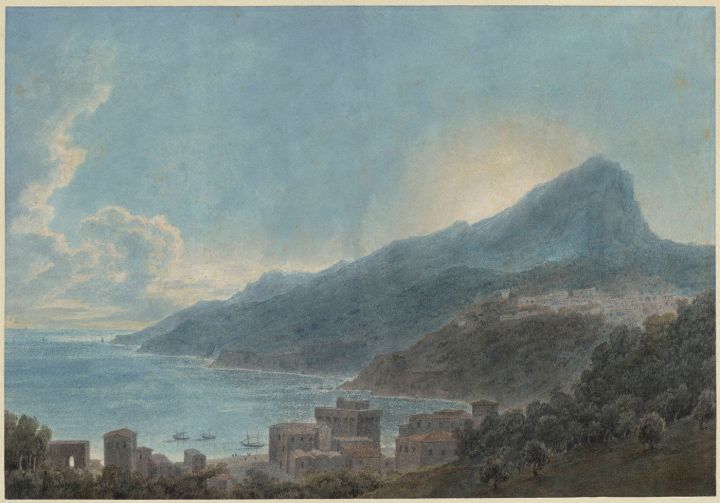
John Robert Cozens, View of Vietri and Raito, Italy, ca. 1783, watercolor over graphite on cream laid paper (The Museum of Fine Arts, Houston, The Stuart Collection, museum purchase funded by Francita Stuart Koelsch Ulmer in honor of Dena M. Woodall).
◊ ◊ ◊ ◊ ◊
Now on view at the MFAH:
Picturing Nature: The Stuart Collection
of 18th- and 19th-Century British Landscapes and Beyond
The Museum of Fine Arts Houston, 12 January — 6 July 2025
Featuring more than 70 works of art in a variety of media, Picturing Nature: The Stuart Collection of 18th- and 19th-Century British Landscapes and Beyond explores how the genre of landscape evolved during an era of immense transformation in Britain. This diverse collection of watercolors, drawings, prints, and oil sketches traces the shift from topographical and picturesque depictions of the natural world to intensely personal ones that align with Romantic poetry of the period. The exhibition spotlights the Stuart Collection, built over the past decade in collaboration with Houstonian Francita Stuart Koelsch Ulmer. This exceptional collection includes standout works by notable artists such as John Constable, John Robert Cozens, Thomas Gainsborough, J.M.W. Turner, and Richard Wilson, whose innovative approaches to watercolor raised its status as an art form and heralded a golden age for the medium.
Through the work of these luminaries and their contemporaries, Picturing Nature reveals how landscape emerged as a distinct artistic genre in England in the late 1700s, then reached its greatest heights the following century, attracting international response and inspiring both artists and collectors at home and abroad. Period publications and artist’s supplies, including drawing manuals and a mid-19th-century Winsor & Newton watercolor box, further illustrate the flowering of the landscape tradition.
Dena M. Woodall, Picturing Nature: The Stuart Collection of 18th- and 19th-Century British Landscapes and Beyond, $35. The online catalogue of the Stuart Collection is available here.
Exhibition | Raphael to Cozens: Drawings from Richard Payne Knight
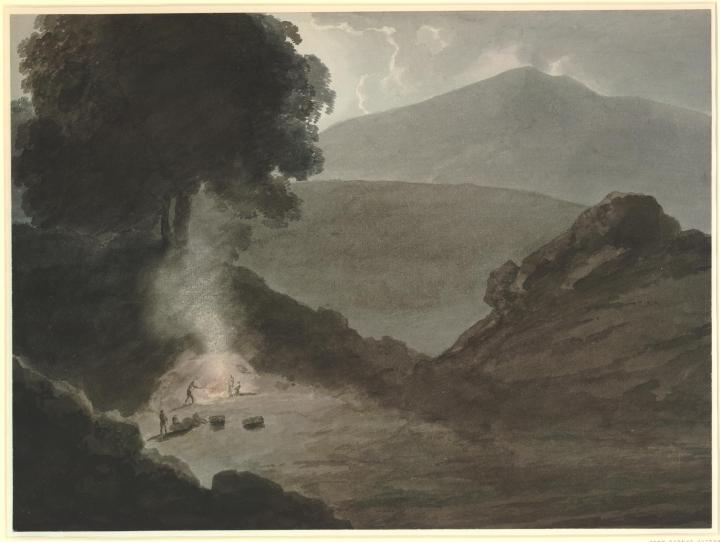
John Robert Cozens, Mount Etna from the Grotta del Capro; scene in a hollow on a hill-side, at left a group of figures gathered around a fire in a cave, above a clump of trees hiding the moon, beyond a further ridge rises a mountain, ca. 1777–78, watercolour over graphite with gum arabic and scratching out, 357 × 483 mm (London: The British Museum, Oo,4.38).
◊ ◊ ◊ ◊ ◊
Opening today at The British Museum:
Raphael to Cozens: Drawings from the Richard Payne Knight Bequest
The British Museum, London, 15 May — 14 September 2025
Raphael, Michelangelo, and Thomas Gainsborough are among the masters whose work will be on display at a new exhibition celebrating a transformative 19th-century bequest. The antiquarian and art collector Richard Payne Knight (1751–1824) bequeathed over a thousand drawings to the British Museum. The superb quality of his collection transformed the Museum’s graphic holdings and established it as a place where visitors could admire old master drawings alongside works of contemporary British art.
Born into a wealthy family of ironmasters from Herefordshire, Payne Knight was educated in the classics and complemented his studies, as many on the Grand Tour did, with extended travels in Italy. There he pursued his interests in ancient civilisations and languages, and formed the aesthetic sensibilities and tastes that would later shape his collecting and writing. His substantial financial means enabled him to acquire the best drawings available on London’s late 18th-century art market. The exhibition explores the breadth of Payne Knight’s intellectual interests through some of the most celebrated works from the bequest. Drawings by Renaissance and Baroque painters like Raphael, Michelangelo, and Claude Lorrain will be shown alongside work by Payne Knight’s contemporaries, including Thomas Gainsborough and John Robert Cozens. Together the drawings reveal Payne Knight’s enthusiasm for landscapes and for the romance of the classical past, as well as his admiration for the verve and spontaneity of the artists whose works he bought.
The exhibition marks the first time that a representative selection of this important bequest has been displayed since its arrival at the British Museum in 1824.
Exhibition | Colour and Line: Watteau Drawings
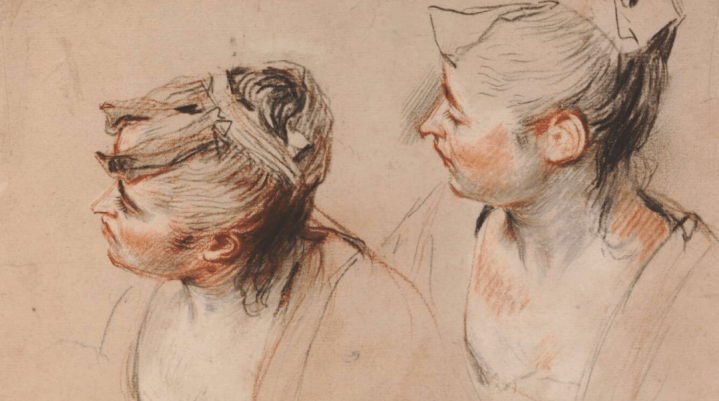
Antoine Watteau, Four Studies of a Young Woman’s Head, detail, 1716–17, drawing with black, red, and white chalks
(London: The British Museum, 1895,0915.941).
◊ ◊ ◊ ◊ ◊
Opening today at The British Museum:
Colour and Line: Watteau Drawings
The British Museum, London, 15 May — 14 September 2025
This Antoine Watteau (probably 1684–1721) was one of the most influential, prolific artists active in 18th-century France. In a short career lasting little more than a decade, he pushed painting in new directions that were to guide generations of French artists, blending genre, mythology and rococo frivolity in works so novel that they heralded a new genre: the fête galante.
Watteau won particular renown for the thousands of drawings he produced during his life. Drawing, as contemporaries realised, was his favourite creative outlet, bringing him ‘much more pleasure than his finished pictures’. He drew incessantly, and developed ideas about the value of drawing that were every bit as original as his paintings. Instead of making figure studies for a picture as academic practice dictated, Watteau drew speculatively, conceiving ideas that might be slotted into a picture months or even years later. The sheets he produced were to be enjoyed in their own right as the first, freshest iterations of ideas that he thought were dulled when translated into paint.
Nowhere were these qualities more appreciated than in Britain, and over the past two centuries British collectors have endowed the British Museum with one of the finest collections of Watteau drawings in the world. Featuring almost every autograph work in the collection, this display is the first exhibition of the Museum’s Watteau holdings to be held since 1980. Its varied contents demonstrate Watteau’s extraordinary talent as a draughtsman, his sophisticated, novel approach to drawing, and the prestige that his graphic works enjoyed among Europe’s connoisseurs.
Exhibition | Mama: From Mary to Merkel
From the press release for the exhibition:
Mama: From Mary to Merkel
Kunstpalast, Düsseldorf, 12 March — 3 August 2025
Curated by Linda Conze, Westrey Page, and Anna Christina Schütz

Marie-Victoire Lemoine, Portrait of Madame de Lucqui with Her Daughter Anne-Aglaé Deluchi, 1800, oil on canvas, 100 × 81 cm (Arp Museum Bahnhof Rolandseck, Rau Collection for UNICEF).
The exhibition Mama: From Mary to Merkel explores the many different aspects of motherhood over eight chapters. The focus is on the societal expectations that have always influenced motherhood and are reflected in art, culture, and everyday life. The approximately 120 works on display from the fourteenth century to the present day create a panorama that involves everyone, including fathers and those without children of their own. From the concept of the ‘good mother’ to care work and family configurations, the show illustrates how the role of mother quickly breaks down into different, highly individual perspectives that are nevertheless deeply intertwined in cultural history. A polyphonic sound installation uses pre-recorded voice messages to give space to personal experiences, memories, and visions.
“Everyone has a mother. By placing motherhood at the centre of an exhibition, the Kunstpalast is once again addressing a topic that directly touches the lives of our visitors and that everyone can relate to with their own experiences and opinions. The show combines seriousness with humour and art with everyday life and pop culture— thus tying in with the Kunstpalast’s mission statement on several levels,” says Felix Krämer, general director of the Kunstpalast.
Popular culture and art both emphasise societal expectations of mothers and the role of the GOOD MOTHER. We begin with figures of the Virgin Mary from the fourteenth to the eighteenth centuries. The image of Mary—probably the most prominent mother in Christian culture—remains a symbol of total maternal devotion today. The stereotype of the ‘good’ mother was established in the eighteenth century and is still widespread: contemporary artists in the exhibition explore the efforts involved in attaining this ideal. For a portrait of his mother, Aldo Giannotti (b. 1977) pressed a sign into her hands. The word ‘MOM’ on it only becomes an admiring exclamation of ‘WOW’ when she subjects herself to the strain of hanging upside down from the ceiling. Motherhood is a yardstick by which a woman’s achievement is measured—even if she is not a mother. A well-known example is Angela Merkel (b. 1954): nicknamed ‘Mutti’ (Mum) when she was German Chancellor, she can also be seen as Mother Theresa on the cover of Der Spiegel magazine.
The historical changeability of notions of ‘good’ motherhood is demonstrated by advice books from various decades of the twentieth and twenty-first centuries, whose recommendations to mothers are often fundamentally contradictory. ADVICE OR REGULATION—from the Weimar Republic to National Socialism, the early Federal Republic and the GDR to the present-day reunified Germany, this genre is characterised by both consistencies and inconsistencies. A bookshelf in the exhibition gathers advice literature from recent decades and invites visitors to pause and read.
“Ideals and role models, advice, expectations and emotions—the aim of this exhibition is to make the subject of motherhood tangible in all its artistic, cultural historical, social and, of course, highly personal dimensions,” agree the three curators of the show. Linda Conze, Westrey Page and Anna Christina Schütz have approached the topic from different angles, finding mothers and non-mothers in the Kunstpalast collection, supplementing these artists with important, sometimes international loans and bringing everything together to create a narrative. “Connections between the collectively selected works reveal continuities, but also the mutability of images of mothers, which are constantly being reappropriated, reinterpreted, contested and celebrated. We see the show as an invitation to open up a dialogue about care and motherliness and look forward to hearing the audience’s perspectives,” explains the curatorial team.
Looking after children is work. Nevertheless, CARE WORK remains mostly unpaid and has traditionally been automatically assigned to women. With a critical eye, artists have drawn attention to the fact that care is influenced by social norms and class affiliations. For a long time, only poor mothers breastfed their babies themselves, while wealthier women hired wet nurses. Around 1800, the idea that all women should take care of their babies themselves became prevalent; the presence of the biological mother became more important. In the present day, working mothers who focus “too much” on their careers are judged just as much as those who devote themselves entirely to their children and the household. The balancing of care and paid work as well as the role of caregiver and other identities is a recurring theme among the women artists in the exhibition. Several paintings in the exhibition are by Paula Modersohn-Becker (1876–1907), who was always fascinated by motifs of the bond between mother and child. However, she was also apprehensive about the effects of her own motherhood on her artistic work. In her sculpture of a body dissolving in the mechanics of a breast pump, Camille Henrot (b. 1978) focuses on the fine line between providing nourishment and self-sacrifice.
The exhibition delves deeper into the subject of the PLACES OF MOTHERHOOD: historical doll’s house kitchens are brought into dialogue with the video work Semiotics of the Kitchen by Martha Rosler (b. 1943), which examines the distance of the housewife’s domain from intellectual settings. Scottish artist Caroline Walker (b. 1982) portrays mothers with their newborns in the intimate yet isolating domestic sphere. Finnish artist Katharina Bosse (b. 1968) photographs herself in erotically charged poses with her toddler crawling beside her in natural landscapes. In this way, she disrupts the seemingly natural idyll that surrounds motherhood in art and cultural history.
Several women artists use their work to address the fact that the decision to (NOT) HAVE CHILDREN often could not and still cannot be made freely, despite all the progress that has been made. For centuries, female ‘nature’ was defined in a wide variety of societies by a woman’s ability to conceive and bear children. The Virgin Mary, whose life is depicted in Dürer’s Life of the Virgin, is both a female role model and a special case. Her actions are always centred on her son, whom she conceived by divine intervention.
The medical achievements and societal developments of the twentieth century allowed women to emancipate themselves from their socially prescribed destiny for the first time by taking the contraceptive pill or asserting their hard-fought right to terminate a pregnancy. Hannah Höch (1889–1978) paints her struggle with the decision to not have a child by Raoul Hausmann. Nina Hagen’s (b. 1955) protest against the expectations of fulfilling her duty as a mother in the song “Unbeschreiblich Weiblich” (Indescribably Feminine) is juxtaposed with Elina Brotherus’s (b. 1972) confrontation with her own involuntary childlessness.
For a long time, the physical bond between mother and child was unquestioningly viewed as a prerequisite for a motherly love that was regarded as intrinsic. The exhibition also shows that the often positively connoted intimate relationship between mother and child at all ages can also have a potentially traumatic side. In a series of photographs, Leigh Ledare (b. 1976) explores his CLOSENESS to his mother, who confronts her adult son with uncompromising desire. In a video work by performance artist Lerato Shadi (b. 1979), she and her mother lick sugar and salt off each other’s tongues and explore the space between repulsion and affection. The armchair by Italian designer Gaetano Pesce (1939–2024) promises a return to the mother’s womb, with the foot section connected to the main body of the furniture via an ‘umbilical cord’.
In German, the word MUTTERSEELENALLEIN describes the utmost loneliness. Mary, Our Lady of Sorrows, mourning her dead son Jesus Christ, is one of the central motifs in Western art history. Artists have repeatedly made reference to the so-called Pietà, appropriating and reinterpreting it as a motif. The loss of the child is juxtaposed with the loss of the mother, which artists of different generations have sometimes made an autobiographical theme and thus given expression and form to their personal grief. Finally, mutterseelenallein can also refer to anyone who has been denied motherhood, whether due to social norms, physical conditions or decisions that were not made voluntarily.
 The exhibition chapter FAMILY CONFIGURATIONS asks what influence family images have on motherhood. In the eighteenth century, the nuclear family rose to become the ideal of the Western world. In this model, the mother is the centre of care, while the father is responsible for financial support. Through processing their own personal or observed experiences, artists have questioned the dominance of this father-mother-child constellation. Alice Neel, who lived apart from her daughter, captures psychological subtleties in her family portraits that resist simple narratives. Oliviero Toscani’s photos for a campaign for the Benetton fashion brand around 1990 challenged conservative notions of family by placing homosexual parents at the centre. Queer lifestyles can inspire ways of thinking in which the burden of care is placed on several shoulders instead of being the sole responsibility of the biological mother. The circle of people who can be mothered also extends beyond biological relatives: foster, step-, adopted children and those in care are also looked after. In the complexity of modern living arrangements, the bond with a pet can be just as important as other relationships. Art reflects the shift from the question ‘Who is the mother?’ to ‘Who is mothering?’
The exhibition is an invitation to continue the dialogue about care and motherhood—for example in the diverse accompanying programme, which ranges from a midwife consultation in the exhibition to workshops with various collectives and organisations such as Düsseldorf family centres. One of Germany‘s most prominent mother figures has recorded the audio guide for the exhibition: Marie-Luise Marjan, aka ‘Mutter Beimer’ from the popular TV series Lindenstraße.
Mama: From Mary to Merkel is curated by Linda Conze, Head of Department of Photographs; Westrey Page, Curator Special Projects; and Anna Christina Schütz, Department of Prints and Drawings, Research Associate.
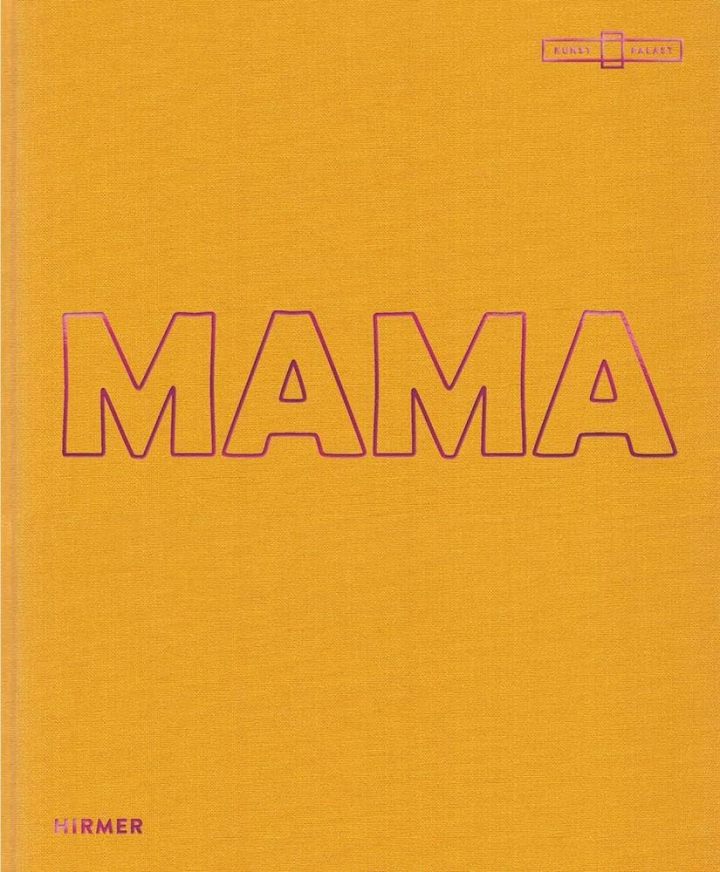
Linda Conze, Westrey Page, and Anna Christina Schütz, ed., Mama: Von Maria bis Merkel (Munich: Hirmer Verlag, 2025), 200 pages, ISBN: 978-3777444888, €45.
Exhibition | Rococo & Co: From Nicolas Pineau to Cindy Sherman
Closing soon at the Musée des Arts Décoratifs:
Rococo & Co: From Nicolas Pineau to Cindy Sherman
Musée des Arts Décoratifs, Paris, 12 March — 18 May 2025
Curated by Bénédicte Gady, with Turner Edwards and François Gilles
 This exhibition celebrates the restoration of a unique collection of nearly 500 drawings from the workshop of the sculptor Nicolas Pineau (1684–1754), one of the main proponents of the Rocaille style, which Europe adopted as Rococo. A practitioner of measured asymmetry and a subtle interplay of solids and voids, Nicolas Pineau excelled in many fields: woodwork, ornamental sculpture, architecture, prints, furniture and silverware. The presentation of this major Rococo figure is extended to include a workshop that plunges the visitor into the heart of the creation of Rococo panelling. Asymmetries, sinuous lines, chinoiserie dreams and animal images illustrate the infinite variations of the Rococo style. Finally, from the 19th to the 21st century, this aesthetic has found numerous echoes, from neo-styles to the most unexpected and playful reinterpretations.
The exhibition explores the evolution of the Rococo style and its reappearance in contemporary design and fashion, including Art Nouveau and psychedelic art. Nearly 200 drawings, pieces of furniture, woodwork, objets d’art, lighting, ceramics, and fashion items engage in a playful dialogue of curves and counter-curves. Nicolas Pineau and Juste Aurèle Meissonnier are joined by Louis Majorelle, Jean Royère, Alessandro Mendini, Mathieu Lehanneur, the fashion designers Tan Giudicelli and Vivienne Westwood, and the artist Cindy Sherman.
Bénédicte Gady, Turner Edwards, and François Gilles, eds., Nicolas Pineau 1684–1754: Un sculpteur de rocaille entre Paris et Saint-Pétersbourg (Paris: Éditions Les Arts Décoratifs, 2025), 504 pages, ISBN: 978-2847425123, €85.
The Burlington Magazine, April 2025
The long 18th century in the April issue of The Burlington:
The Burlington Magazine 167 (April 2025) | Art in Britain
e d i t o r i a l
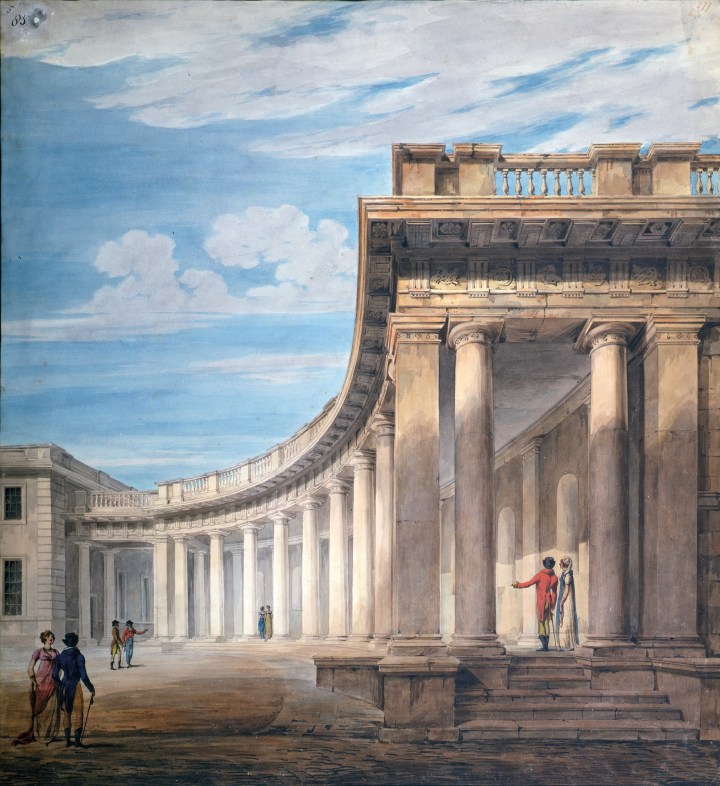
RA Lecture Illustration of the Colonnade at Burlington House, produced by the Soane Office. ca.1806–17, pen, pencil, wash and coloured washes on wove paper, 72 × 67 cm (London: Sir John Soane’s Museum).
• “Boughton’s Heavenly Visions,” pp. 327–29.
Boughton in Northamptonshire is an improbable dream of a house. It is an essay in restrained French Classicism that was gently set into the English countryside in the late seventeenth century, encasing an older building. The house was chiefly the creation of the francophile Ralph, 1st Duke of Montagu (1638–1709), who served as Charles II’s ambassador to the court of Louis XIV. Its most splendid internal feature is the so-called Grand Apartment, which consists of a parade of impressive state rooms.
a r t i c l e s
• William Aslet, “The Discovery of James Gibbs’s Designs for the Façade of Burlington House,” pp. 354–67.
A reassessment of drawings by Gibbs in the Ashmolean Museum, Oxford, demonstrates that, as well as the stables and service wings and celebrated colonnade, the architect provided an unexecuted design for the façade of Burlington House, London—an aspect of the project with which he has hitherto not been connected. This discovery deepens our understanding of one of the most important townhouse commissions of eighteenth-century Britain and the evolving taste of Lord Burlington.
• Adriana Concin, “A Serendipitous Discovery: A Lost Italian Portrait from Horace Walpole’s Miniature Cabinet,” pp. 368–75.
Among the portraits in Horace Walpole’s renowned collection at Strawberry Hill were a number of images of Bianca Cappello, a Medici grand duchess of some notoriety. Here the rediscovery of a late sixteenth-century Italian miniature once displayed in Walpole’s cabinet is discussed; long thought to depict Cappello, it is now attributed to Lavinia Fontana.
• Edward Town and Jessica David, “The Portraits of Alice Spencer, Countess of Derby, and Her Family by Paul van Somer,” pp. 376–85.
Research into a portrait at the Yale Center for British Art, New Haven, has revealed the identities of twelve Jacobean portraits attributed to the Flemish painter Paul van Somer. The portraits were probably commissioned by Alice Spencer, Countess of Derby, and create a potent illustration of her dynastic heritage. [The research depends in part upon the eighteenth-century provenance of these portraits.]
r e v i e w s
• Anna Koldeweij, Review of the exhibition Rachel Ruysch: Nature into Art (Alte Pinakothek, Munich, 2024–25; Toledo Museum of Art, 2025; MFA, Boston 2025), pp. 393–96.
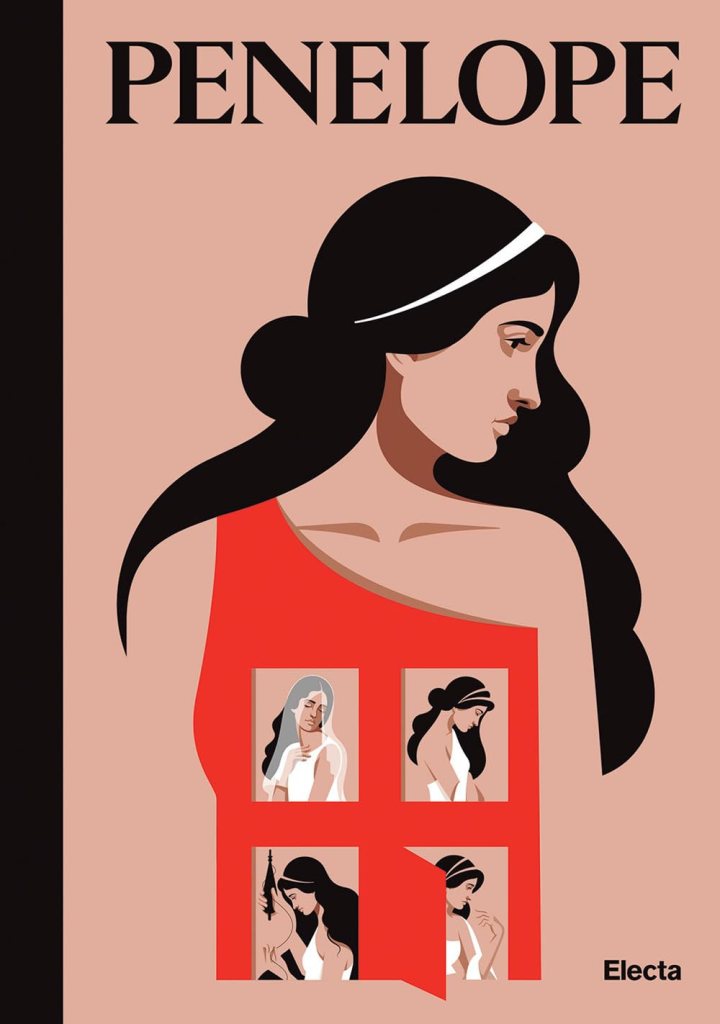
• Christine Gardner-Dseagu, Review of the exhibition catalogue Penelope, ed. by Alessandra Sarchi and Claudio Franzoni (Electa, 2024), pp. 404–07.
• Andreina D’Agliano, Review of the exhibition catalogue, Magnificence of Rococo: Kaendler’s Meissen Porcelain Figures, ed. by Alfredo Reyes and Claudia Bodinek (Arnoldsche, 2024), pp. 412–14.
• Stephen Lloyd, Review of Susan Sloman, British Portrait Miniatures from the Thomson Collection (Ad Ilissum, 2024), pp. 418–19.
• Natalie Rudd, Review of Discovering Women Sculptors, ed. by Marjorie Trusted and Joanna Barnes (PSSA Publishing, 2023), pp. 422–23.
Exhibition | Pastoral on Paper

Thomas Gainsborough, Landscape with Figures, Herdsman and Cattle at a Pool, and Distant Church, mid- to late 1780s, watercolor and gouache with lead white on beige laid paper, fixed with gum, varnished with mastic (The Clark, gift of the Manton Art Foundation in memory of Sir Edwin and Lady Manton, 2007.8.76).
◊ ◊ ◊ ◊ ◊
From the press release for the exhibition:
Pastoral on Paper
The Clark Art Institute, Williamstown, Massachusetts, 8 March — 15 June 2025
Curated by William Satloff, with Anne Leonard
The idyllic tranquility of the lives of shepherds became a prominent subject in literature, music, and the visual arts during the seventeenth and eighteenth centuries. A new exhibition at the Clark Art Institute, Pastoral on Paper, explores artistic depictions of rural life by considering their representations of the people and animals who inhabited the landscapes. The exhibition is on view in the Eugene V. Thaw Gallery for Works on Paper in the Clark’s Manton Research Center from March 8 until June 15, 2025.
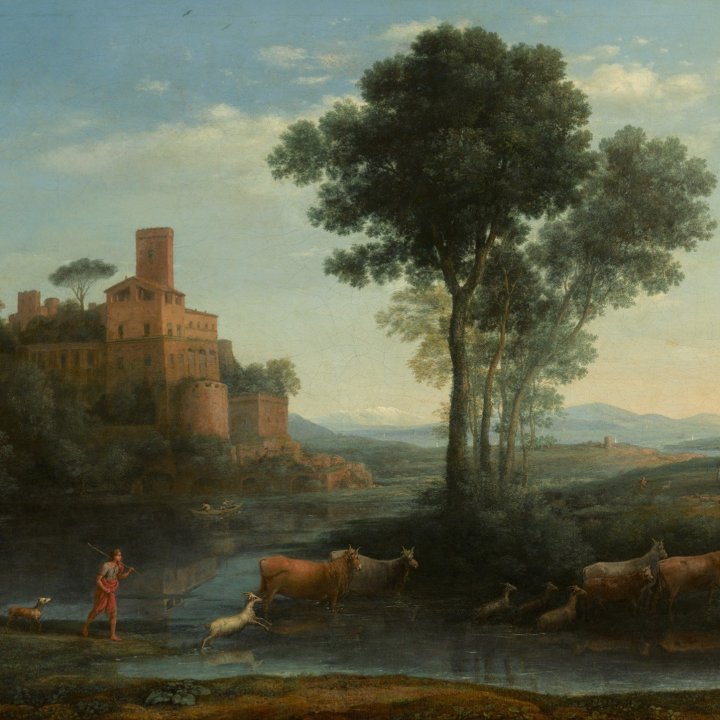
Claude Lorrain, Landscape with the Voyage of Jacob, 1677, oil on canvas (The Clark, 1955.42).
“The Clark’s works on paper collection is rich with beautiful drawings, etchings, and watercolors depicting these pastoral scenes,” said Olivier Meslay, Hardymon Director of the Clark. “We were delighted when our graduate student intern William Satloff proposed the concept of an exhibition that would give us the opportunity to share so many of these exceptional works of art together. Many of the objects in this presentation have not been on view in quite some time, so it will be a wonderful opportunity for our visitors.”
Satloff, a member of the Class of 2025 in the Williams College/Clark Graduate Program in the History of Art, curated the exhibition under the direction of Anne Leonard, the Clark’s Manton Curator of Prints, Drawings, and Photographs. Satloff has served as a curatorial intern at the Clark since 2023.
“In the Berkshires, we are fortunate to be surrounded by rolling hills, grazing cows, meandering streams, and picturesque barns,” said Satloff. “Moved by these same features, early modern artists created pastoral landscapes. The exquisite works in this exhibition offer an opportunity for us to reflect on our relationship with land both in art and in the world around us.”
Selected primarily from the Clark’s strong holdings of drawings by Claude Lorrain (French, 1604/5–1682) and Thomas Gainsborough (English, 1727–1788) and supplemented with select loans of Dutch Italianate artworks, the exhibition analyzes pastoral imagery to examine how artists construct their own visions of an idealized landscape. This exhibition features thirty-eight works, including nine drawings, three etchings, and one painting by Claude (Lorrain is typically referred to by his first name) and ten Gainsborough drawings.
Claude perfected the genre of idealized landscape, consolidating the developments of sixteenth-century Italian landscape painters and fusing a sensitive observation of nature with the lofty nobility of classical values. He lived and worked in Rome from the 1620s until his death; there, he influenced the Dutch Italianates—northern European artists who traveled to Italy and embraced the local style of landscape painting. A century later Thomas Gainsborough developed a new kind of nostalgic, pastoral landscape, inflecting the naturalism of Claude and the Italianates with a yearning for the bygone days of a simpler country life.
a c c e s s i n g a r c a d i a
The term ‘Arcadia’ derives from the mountainous Greek province of the same name, and according to myth, it was the domain of Pan, the half-man, half-goat satyr who was revered as the god of pastures and woodlands. In antiquity, Arcadia was known for its population of pastoralists—cowherds, goatherds, shepherds, swineherds—who were celebrated across the ancient world for the skillful singing they did while tending their flocks. The Latin poet Virgil wrote an immensely influential set of ten poems, the Eclogues, about the herdsmen of Arcadia.

Agostino Carracci, Omnia Vincit Amor, 1599, engraving on paper (The Clark, gift of Mary Carswell, 2017.11.1).
During the Renaissance, the intellectual movement known as humanism brought renewed interest in the culture—and particularly the poetry—of ancient Greece and Rome. Although Renaissance humanism waned in the sixteenth century, Virgil’s pastoral poetry continued to inspire artists and writers through the nineteenth century and beyond. Over time, ‘Arcadia’ developed into a general term for an idealized vision of rural life.
Agostino Carracci’s (Italian, 1557–1602) engraving, Omnia vincit Amor (1599), is a visual pun derived from a famous line in Virgil’s tenth Eclogue: “Love conquers all.” Amor is the Latin name for Cupid, the god of desire and erotic love. Pan is both the Greek name of Faunus, the shepherd-god of pastures and woodlands, and the Greek word for “all,” which in Latin is “omnia.” Taken together, Cupid’s victorious combat with the goat-legged god becomes a visual translation of Virgil’s poetry.

Nicolaes Berchem, The Cows at the Watering Place (The Cow Drinking), 1680, etching on paper (The Clark, 2023.15).
In The Cows at the Watering Place (The Cow Drinking) (1680), Nicolaes Berchem (Dutch, 1620–1683) conjures a timeless scene of rural life, full of tranquility and contentment. A shepherd has brought his cows and goats to drink from a stream on a warm, bright day. The animals wade and drink in the water, and a group of people lounge leisurely along the bank. The shepherd, recognizable by his long pole, talks with a seated man who has come to fill his jug, while a woman washes her feet in the stream. An overgrown ruin occupies the midground. At the top of this structure, beneath the vines, is a shadowy relief carving of a knight on horseback slaying a monster—an ambiguous reference to a gallant past.
Christoffel Jegher (Flemish, 1596–1652/53) collaborated with the celebrated Baroque artist Peter Paul Rubens (Flemish, 1577–1640) to produce the monumental woodcut Rest on the Flight into Egypt (after 1632), which corresponds closely to the right side of Rubens’s oil painting Rest on the Flight to Egypt with Saints (1632–35). Jegher presents the Christ Child sleeping contentedly in the Virgin Mary’s arms at the edge of a dense forest. Two putti, or cherubs, wrestle with a lamb, while a third motions them to be quiet. In the background, Joseph slumbers at the base of a twisting tree while the donkey drinks from a brook.
With its winding river, elegant trees, and grand Romanesque castle, the scene in Landscape with the Voyage of Jacob (1677) is an idealized vision of the countryside near Rome, where Claude spent most of his career. The tiny camels hint at a biblical story, perhaps Jacob’s journey into Canaan, but the other figures scattered across the landscape, such as the herdsman, cows, sheep, dog, and fishermen, give way to another revelation—that the painting is essentially a poetic celebration of the bounty of the natural world.
i d e a l i z e d l a n d s c a p e
Claude and Gainsborough were known to draw landscapes en plein air—meaning that they worked outdoors, directly from the natural environment. Though both artists studied natural features for inspiration, their approach to landscapes varied considerably. Claude’s idealized drawings featured a diffuse light and airy atmosphere aligned with the sensibilities of the Italian countryside. Gainsborough observed nature through a different lens, focusing on the English countryside. Still, each artist endeavored to draw a more pleasing, idealized landscape. Claude often added figures or trees in the foreground to create the illusion of deeper pictorial space. Gainsborough, too, would sometimes make adjustments to the observed landscape—for example, drawing a cluster of trees to one side to balance out the composition.
Claude was fascinated by how ancient and modern Rome melded in the landscape. The early Christian church of Sant’Agnese Fuori le Mura (ca. 300s–600s) attracted Claude on more than one occasion. By the seventeenth century, it was surrounded by farms and open pastures. In A View of Sant’ Agnese Fuori le Mura (1650–55), instead of showing the church surrounded by grazing animals, Claude used hills and trees to obscure any sense of historical specificity. While the identifiable architecture indicates the place from where the artist sketched, the building’s late-antique style imparts a temporal mystique evocative of Arcadia.

Thomas Gainsborough, Extensive Wooded Landscape with a Bridge over a Gorge, Distant Village and Hills, ca. 1786, black and white chalks with stumping on beige laid paper, fixed with skim milk and/or gum (The Clark, 2007.8.75).
Claude often went on sketching expeditions around the Roman countryside in the company of fellow artists. On several occasions, he traveled west from Rome along the Tiber River to the town of Tivoli. Nestled in the Sabine Mountains, Tivoli had long been admired for its ancient ruins and scenic vistas. The German painter Joachim von Sandrart (1606–1688) recounted an excursion he and Claude made to Tivoli: “we began to paint entirely from nature […] the mountains, the grottoes, valleys, and deserted places, the terrible cascades of the Tiber, the temple of Sibyl, and the like.” The Cascades of Tivoli (ca. 1640), on view in this section of the exhibition, depicts such a scene.
Gainsborough usually sketched the English landscape outdoors directly from nature, such as with Extensive Wooded Landscape with a Bridge over a Gorge, Distant Village and Hills (ca. 1786). This practice prompted artist Sir Joshua Reynolds (English, 1723–1792) to remark that Gainsborough, his bitter rival, “did not look at nature with a poet’s eye.” As such he went against the prevalent tendency in eighteenth-century England, where most artists derived their landscapes from Virgil’s Eclogues and Claude’s idyllic Italian scenes. Fashionable collectors displayed paintings and prints of idealized Mediterranean landscapes in their homes, setting the trend of “Italian light on English walls.”
r u i n s a n d c o t t a g e s
In pastoral works, architecture is often placed in the midground or background to suggest human habitation of a landscape. In the seventeenth century, pastoral architecture took the form of ruins, indicating that ancient people once held dominion over the land. These ruined buildings—surrounded by overgrown trees and shrubbery—invite viewers to reflect on the greatness of past civilizations, the transience of their glory, and the sublime power of time and nature. In the eighteenth century, pastoral landscapes also came to include cottages, barns, and shacks. By including architectural features within pastoral landscapes, artists may sometimes be making moral, social, and political statements about rural life and land management.

Jean Jacques de Boissieu, The Entrance to a Forest with a Cottage on the Right, 1772, etching and drypoint on laid paper (The Clark, 1993.3).
In A Wooded Landscape with a Classical Temple (ca. 1645), Claude constructs an imaginary landscape by placing ancient-looking architecture amid dense foliage and rolling hills. Although the bridge visible in the background has been identified as Rome’s famous Milvian Bridge (completed in 109 BCE), there are no clear referents for either the fortress pictured behind the bridge or the classical temple on the left.
Bartholomeus Breenbergh’s (Dutch, 1598–1657) Ruins in a Landscape (ca. 1620s) is an early example of Northern European artists’ fascination with ancient architecture. In the shadow of the cavernous ruin, the figures look tiny. Trees grow atop the ruin, juxtaposing the persistence of nature with the ephemerality of Rome’s greatness. Breenbergh moved to Rome in 1619, where he helped found the Roman Society of Dutch and Flemish Painters called the Bentvueghels (active ca. 1620–1720). This intellectual and social group, famous for its drunken initiation rituals, included several prominent Italianate landscape painters, such as Jan Asselijn (Dutch, 1610–1652) and Karel Dujardin (Dutch, 1626–1678).
In Dujardin’s The Ruins of a Temple, in the Foreground Two Men and a Dog (1658), two figures overlook a ruin-strewn landscape from a distance, allowing viewers to insert themselves within the pastoral scene rather than observing it as a spectacle. One of the foreground figures sits with a notebook and a writing instrument in his hand, suggestive of the sketching tours that seventeenth-century artists took throughout the countryside around Rome. Though the figure is representative of the common practice of working outdoors, Dujardin actually created this etching in his studio in the Hague.
Pastoral on Paper is organized by the Clark Art Institute and curated by William Satloff, Class of 2025, Williams Graduate Program in the History of Art.
Exhibition | Japanese Poetry, Calligraphy, and Painting
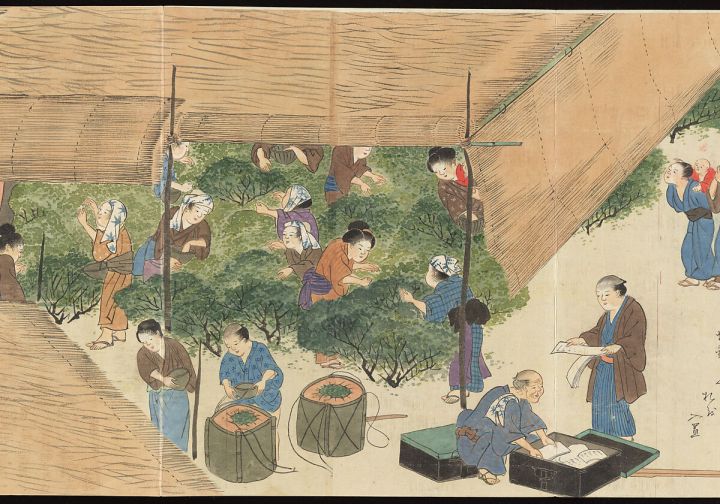
Saitō Motonari, Illustrations of Uji Tea Production, 1803, Edo period (1615–1868), handscroll (57 feet) of thirty-two sheets reformatted as a folding album (New York: The Metropolitan Museum of Art, 2023.237).
◊ ◊ ◊ ◊ ◊
Now on view at The Met:
The Three Perfections: Japanese Poetry, Calligraphy, and
Painting from the Mary and Cheney Cowles Collection
The Metropolitan Museum of Art, New York, 10 August 2024 — 3 August 2025
Curated by John Carpenter
In East Asian cultures, the arts of poetry, calligraphy, and painting are traditionally referred to as the ‘Three Perfections’. This exhibition presents over 160 rare and precious works—all created in Japan over the course of nearly a millennium—that showcase the power and complexity of the three forms of art. Examples include folding screens with poems brushed on sumptuous decorated papers, dynamic calligraphy by Zen monks of medieval Kyoto, hanging scrolls with paintings and inscriptions alluding to Chinese and Japanese literary classics, ceramics used for tea gatherings, and much more. The majority of the works are among the more than 250 examples of Japanese painting and calligraphy donated or promised to The Met by Mary and Cheney Cowles, whose collection is one of the finest and most comprehensive assemblages of Japanese art outside Japan.
The exhibition is made possible by The Miriam and Ira D. Wallach Foundation Fund.
Information on the objects exhibited can be found here»
◊ ◊ ◊ ◊ ◊
The catalogue is distributed by Yale UP:
John Carpenter, with Tim Zhang, The Three Perfections: Japanese Poetry, Calligraphy, and Painting (New York: The Metropolitan Museum of Art, 2025), 320 pages, ISBN: 978-1588397805, $65.
 In East Asian cultures, the integration of poetry, painting, and calligraphy, known as the ‘Three Perfections’, is considered the apex of artistic expression. This sumptuous book explores 1,000 years of Japanese art through more than 100 works—hanging scrolls, folding screens, handscrolls, and albums—from the Mary and Cheney Cowles Collection at The Metropolitan Museum of Art. John T. Carpenter provides an engaging history of these interrelated disciplines and shows evidence of intellectual exchange between Chinese and Japanese artists in works with poetry in both languages, calligraphies in Chinese brushed by Japanese Zen monks, and examples of Japanese paintings pictorializing scenes from Chinese literature and legend. Many of the works featured, including Japanese poetic forms, Chinese verses, and Zen Buddhist sayings, are deciphered and translated here for the first time, providing readers with a better understanding of each work’s rich and layered meaning. Highlighting the talents of such masters as Musō Soseki, Sesson Shūkei, Jiun Onkō, Ryōkan Taigu, Ike no Taiga, and Yosa Buson, this book celebrates the power of brush-written calligraphy and its complex visual synergy with painted images.
John T. Carpenter is the Mary Griggs Burke Curator of Japanese Art in the Department of Asian Art at The Metropolitan Museum of Art. He has been with The Met since 2011. From 1999 to 2011, he taught the history of Japanese art at the School of Oriental and African Studies (SOAS), University of London, and served as head of the London office of the Sainsbury Institute for the Study of Japanese Arts and Cultures. He has published widely on Japanese art, especially in the areas of calligraphy, painting, and woodblock prints, and has helped organize numerous exhibitions at the Museum, including Designing Nature (2012–13), Brush Writing in the Arts of Japan (2013–14), Celebrating the Arts of Japan (2015–17), The Poetry of Nature (2018–2019), and The Tale of Genji: A Japanese Classic Illuminated (2019).
Tim T. Zhang is Research Associate of Asian Art at The Metropolitan Museum of Art.
c o n t e n t s
Director’s Foreword
Preface
Becoming a Collector of Japanese Art — Cheney Cowles
Acknowledgments
Note to the Reader
Introduction
Inscribing and Painting Poetry: The Three Perfections in Japanese Art — John T. Carpenter
Catalogue
1 Courtly Calligraphy Styles: Transcribing Poetry in the Heian Palace
Entries 1–13
2 Spiritual Traces of Ink: Calligraphies by Medieval Zen Monks
Entries 14–31
3 Reinvigorating Classical Poetry: Brush Writing in Early Modern Times
Entries 32–59
4 Poems of Enlightenment: Edo-Period Zen Calligraphy
Entries 60–84
5 China-Themed Paintings: Literati Art of Later Edo Japan
Entries 85–111
Notes
Bibliography
Index
Credits










leave a comment