Exhibition | 100 Ideas of Happiness
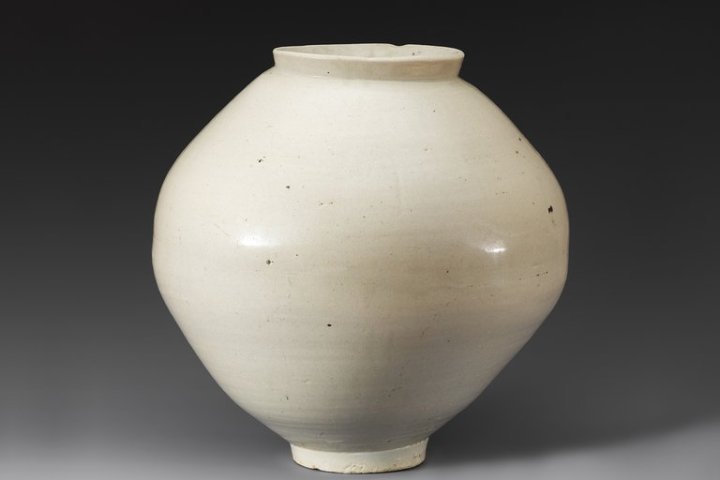
Moon Jar, white porcelain, Joseon Dynasty, 18th century
(Seoul: National Museum of Korea)
◊ ◊ ◊ ◊ ◊
From the press release for the exhibition:
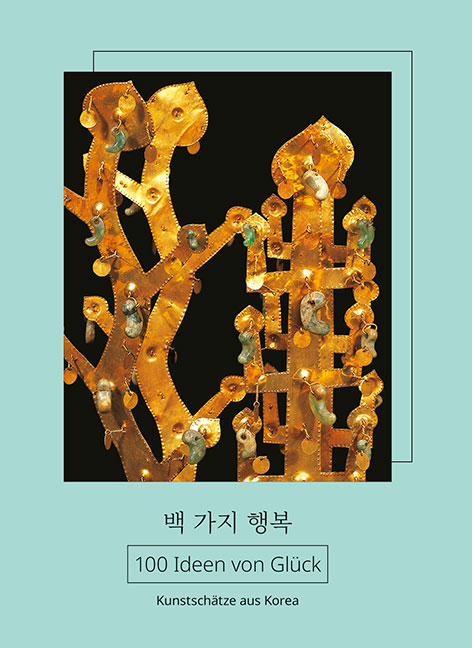
100 Ideas of Happiness: Art Treasures from Korea
Residenzschloss, Dresden, 15 March — 10 August 2025
For the first time in over 25 years, precious artifacts that give an overview of Korean art and cultural history are on display in Germany. The exhibition 100 Ideas of Happiness takes place thanks to a cooperation with the National Museum of Korea, which is supported by the Korea Foundation.
Embedded in the baroque Paraderäume (Royal State Apartments) and the Neues Grünes Gewölbe (New Green Vault) of the Dresden Residenzschloss (Royal Palace), the show opens up an exciting dialogue between cultures. The central theme is the timeless question of the various ideas of happiness—including the desire for eternal life, peace in this world and the next, inner strength or pure joie de vivre— as expressed in works of art through colours, symbols, and the choice of subject matter.
 On display are around 180 outstanding individual objects and groups of objects, including valuable grave goods, precious jewellery, royal robes, and exquisite porcelain from several eras of Korean history. The objects give a multifaceted impression of Korea’s artistic traditions from the time of the ancient kingdoms of Goguryeo, Baekje, and Silla (57 BC–935 AD) to the Joseon Dynasty (1392–1897). Numerous loans are on show for the first time in Europe. The central themes of the presentation are ancient funerary traditions, the role of Buddhism and Confucianism as state-endorsed religions, the legacy of ceramic art, and the significance of the traditional Korean attire, the Hanbok, in the past and present.
A tour of the exhibition through the Paraderäume concludes with a selection of Korean artworks from the ethnographic collections of the Staatliche Kunstsammlungen Dresden (Dresden State Art Collections). These include folding screens, armour, and weapons collected by German travellers in Korea at the beginning of the 19th century. They offer valuable insights into Korea at that time and document the beginnings of a cultural exchange between Korea and Germany. An important item is the folding screen from the GRASSI Museum of Ethnology in Leipzig. Its title is 100 Ideas for Happiness and Longevity and gave the exhibition its name.
The second exhibition venue within the Residenzschloss is located in the Sponsel Room of the Neues Grünes Gewölbe. Surrounded by the treasures of Augustus the Strong, a selection of precious gold jewellery from the royal tombs of the Silla Dynasty is displayed there. These objects—including the famous gold crown from Geumgwanchong, one of the most important royal tombs in Gyeongju, the ancient capital of the Silla kingdom—are among Korea’s national treasures. An elaborately decorated belt made of pure gold, a wing-shaped headdress, and magnificent earrings and rings (presented in the exhibition as an ensemble for the first time in many years) also come from this tomb. They are cultural and historical testimonies to the great significance of the Silla Kingdom.
Claudia Brink and Sojin Baik, 100 Ideen von Glück: Kunstschätze aus Korea (Dresden: Staatliche Kunstsammlungen Dresden, 2025), 216 pages, ISBN: 978-3954988631, €34.
Exhibition | Silver from Modest to Majestic

Daniel Garnier, Silver Chandelier, made in London, 1691–97, silver and iron (Colonial Williamsburg Foundation, Museum Purchase, 1938-42). Fashioned for King William III of England sometime between 1691 and 1697, this chandelier hung at St. James’s Palace in London. It is believed to have been sold for its silver value by King George III when it was seen as outdated. After remaining in private hands for more than a century, it was auctioned in 1924 to William Randolph Hearst, the prominent American newspaperman. Colonial Williamsburg acquired the chandelier shortly before WWII.
◊ ◊ ◊ ◊ ◊
From the press release (3 April 2025) for the exhibition:
Silver from Modest to Majestic
DeWitt Wallace Decorative Arts Museum, Colonial Williamsburg, 24 May 2025 — 24 May 2028
Work is currently underway at the Art Museums of Colonial Williamsburg on a new exhibition featuring more than 120 objects from the museum’s extensive collection of 17th- to 19th-century silver. Silver from Modest to Majestic will be on view in the museum’s newly relocated Mary Jewett Gaiser Silver Gallery, on the main floor of the museum until 24 May 2028.
The exhibition’s scope is wide-ranging, from a 49-lb chandelier made for a monarch to a simple spoon made by a Williamsburg silversmith, all displayed in brilliantly lit cases against dark blue backgrounds. While silver has long been associated with wealth and aristocracy, the items featured in this exhibition were crafted for use in nearly every setting imaginable ranging from churches, classrooms, and kitchens to businesses, battlefields, and bedrooms. One thing that every piece on display has in common is a powerful story. Some are objects of great beauty created with the highest level of skill, while others have lengthy pedigrees. Knowing who made a piece and who used it lets Colonial Williamsburg curators pinpoint that object in a time and a place, and then bring it forward through history, allowing it to tell its tale.
“Collecting objects where we know the ‘who, when, and where’ of their manufacture, plus their provenance, allows us to exhibit silver items which transcend the differences between artistic, historical, and functional,” said Erik Goldstein, Colonial Williamsburg’s senior curator of mechanical arts, metals and numismatics. “These particular objects are the pinnacle of early silver, no matter how humble they may be.”
This new exhibition replaces the museum’s previous silver exhibition, Silver from Mine to Masterpiece, which was on view from 2015 to 2023. While the former exhibition had a larger percentage of British silver, nearly half of the objects on display in the new exhibition are examples of early American-made silver, many of which were created for everyday use by ordinary people. Early colonists originally relied on imported British silver wares, but over time, the innovation, skill, and entrepreneurship of those early American tradespeople resulted in the establishment of a robust and exciting cohort of American silversmiths producing items that were touched by everyone from elite to enslaved individuals.
“Our collection of British silver is justly famous, but our decision to build a collection of American silver terrifically advances the museums’ goal of telling the varied stories of so many different craftspeople and consumers, each of whom influenced the tastes and styles of colonial America,” said Grahame Long, executive director of collections and deputy chief curator.

Punch Ladle, possibly made in Williamsburg, ca.1740–70, silver and wood (Colonial Williamsburg Foundation, Gift of A. Jefferson Lewis III in memory of Elizabeth Neville Miller and Margaret Prentis Miller Conner, 2023-101; photo by Jason Copes). This worn and lovingly preserved ladle, believed to have been made locally, descended in the Prentis family of Williamsburg.
◊ ◊ ◊ ◊ ◊
Visitors to Colonial Williamsburg will experience firsthand how the pieces featured in Silver from Modest to Majestic connect to the lives of Williamsburg’s 18th-century residents. One item in the exhibition—a silver punch ladle, owned by the Prentis family of Williamsburg and passed down in the family for 250 years—served as the model for a reproduction punch ladle created by Williamsburg’s silversmiths that visitors will find in the corner cupboard at the Williamsburg Bray School after it opens to the public in June 2025. Archaeological records show that Ann Wager, headmistress of the Williamsburg Bray School, had punch wares.
“Having the Prentis family’s original ladle gave us a wonderful opportunity to reproduce a piece that we know was used by an 18th-century Williamsburg family and put it in the context of the Bray School where it helps to tell that story,” said Goldstein.
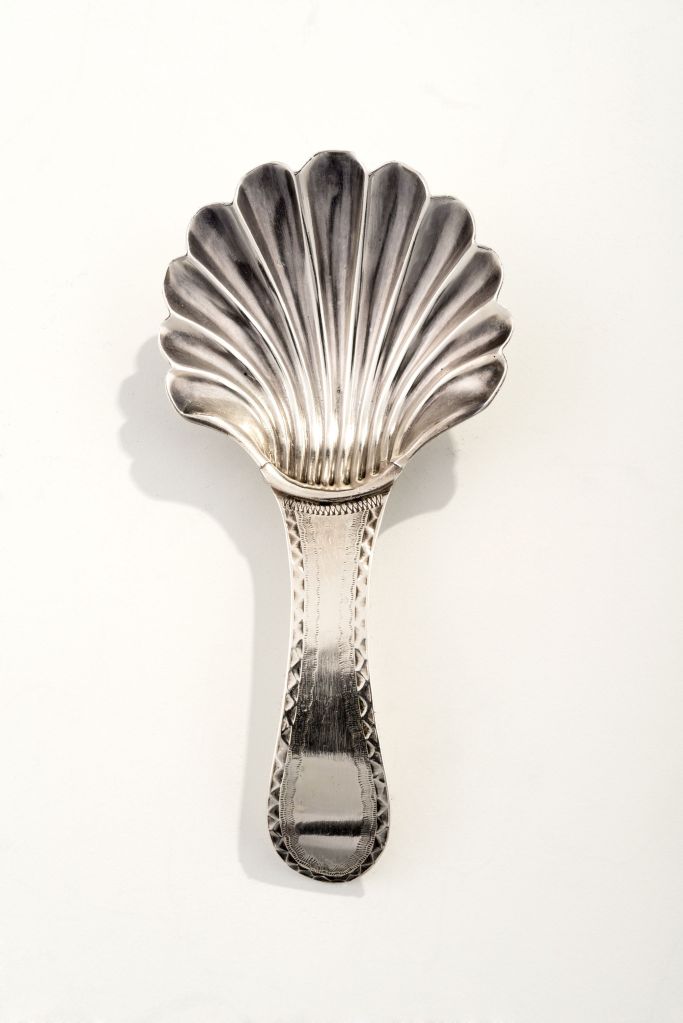
Caddy Spoon, marked by Hester Bateman (1708–1794), London, 1789–90, silver (Colonial Williamsburg Foundation, Gift of Mr. E. Palmer Taylor, 1998-92; photo by Jason Copes). Many now-anonymous British women worked in the silversmithing trade, producing small items like buttons or finishing and polishing larger wares. Standing out is Hester Bateman, who ran a thriving silversmith business after the death of her husband. She specialized in affordable items aimed at the rising middle class. When Bateman retired in 1790, the business was carried on by her sons and one of her daughters-in-law.
Other recently acquired highlights of the silver exhibition include the earliest-known Virginia-made horse racing trophy awarded to a horse named Madison in 1810; an Indian Peace medal struck by the U.S Mint during Thomas Jefferson’s presidency as a diplomatic gift for a Native American chief; and a church communion cup made in Massachusetts around 1670, the earliest piece of American silver in the Foundation’s collection. These pieces will join some of the extraordinary older items from the collection including a cache of British silver made between 1765 and 1771, which was discovered in 1961 in a field near Suffolk, Virginia. While the origins of the buried treasure, and the reason that no one ever returned to retrieve it, remain unknown to this day, this collection is a reminder of the high monetary—and not just aesthetic―value of silver in early America.
The objects on display in Silver from Modest to Majestic represent the work of a few dozen known silversmiths including Paul Revere (1735–1818), a hero of the American Revolution who learned the trade of silversmithing from his father; Myer Myers (1723–1795), the son of a Jewish refugee who became known as the leading silversmith of New York; and Hester Bateman (1708–1794), a female silversmith in London who ran a thriving business after the death of her husband, specializing in affordable items aimed at the rising middle class. Many items in the exhibition are unmarked, made by unknown makers including enslaved silversmiths. Even the items that are credited to known makers could have been made by smiths employed, apprenticed, or enslaved to the master of the shop. To learn exactly how the items in Silver from Modest to Majestic were created, visitors to the Art Museums of Colonial Williamsburg can visit the Silversmith shop in Colonial Williamsburg’s Historic Area where artisan historians preserve the trade by practicing it as their 18th-century counterparts would have.
This exhibition is generously funded by The Mary Jewett Gaiser Silver Study Gallery Endowment. Admission to the Art Museums of Colonial Williamsburg is free.
Exhibition | Pleasures Houses in the Paris Countryside
Now on view at the Museum of the Royal Estate of Marly:
Maisons de Plaisance des Environs de Paris de Louis XIV à Napoléon III
Musée du Domaine royal de Marly, Marly-le-Roi, 11 April — 31 August 2025
Curated by Anaïs Bornet
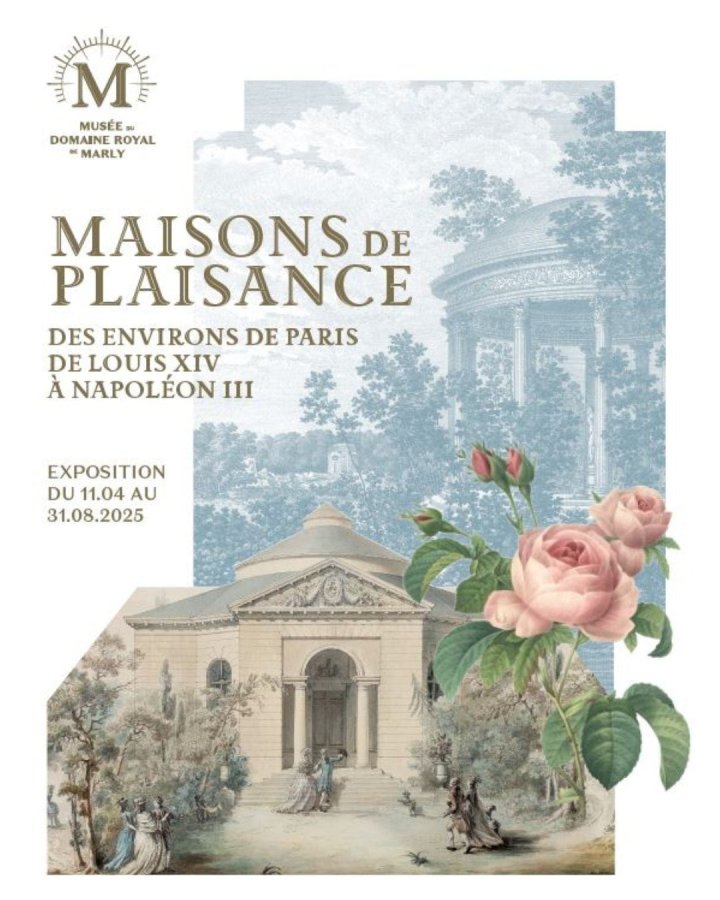 Dès la Renaissance, en Ile-de-France, une élite fortunée quitte la ville à la belle saison et s’installe dans de somptueuses résidences « aux champs » pour s’y détendre et s’y divertir. La maison de plaisance est un lieu de représentation autant que de détente. Elle incarne la richesse et le goût de son propriétaire. Estampes, peintures et objets décoratifs des XVIIe, XVIIIe et XIXe siècles témoignent de cette histoire qui a contribué à façonner le paysage francilien. Ces œuvres illustrent un art de vivre et les transformations sociales de la fin de l’Ancien Régime et du XIXe siècle : divertissements en vogue, désir d’intimité et de confort, place des femmes et développement de la bourgeoisie, lien avec la nature… Environ soixante-dix œuvres empruntées à des collections publiques et privées prennent place au sein du parcours permanent du musée du Domaine royal de Marly pour dialoguer avec ses collections.
Also, see the recent publication:
Anaïs Bornet and Francesco Guidoboni, eds., Maisons de plaisance des environs de Paris (Rome: Edizioni Artemide, 2023), 232 pages, ISBN: 978-8875754402, €30.
New Book | Maisons de plaisance des environs de Paris
Co-editor Anaïs Bornet has curated an exhibition on the same topic, which recently opened at the Musée du Domaine royal de Marly. From Edizioni Artemide:
Anaïs Bornet and Francesco Guidoboni, eds., Maisons de plaisance des environs de Paris (Rome: Edizioni Artemide, 2023), 232 pages, ISBN: 978-8875754402, €30.
Texts by Janine Barrier, Andrea Baserga, David Beaurain, Hervé Bennezon, Karine Berthier, Anaïs Bornet, Françoise Brissard, Roselyne Bussière, Ekaterina Bulgakova, Bernard Chevallier, Jérémie David, François de Vergnette, François Gilles, Francesco Guidoboni, Laetitia Jacquey-Achir, Desmond-Bryan Kraege, Louis-Joseph Lamborot, Marianne Mercier, Alexandra Michaud, Lucie Nottin, Claire Ollagnier, Camilla Pietrabissa, Jean Potel, Daniel Rabreau, Gabriel Wick.
 Autrefois situées « aux champs », les demeures de plaisance franciliennes—châteaux, maisons, pavillons aux dimensions variées—permettaient à une élite fortunée de quitter Paris lors de la belle saison, et de se détendre dans un environnement champêtre loin du tumulte de la ville. Avec l’annexion à la capitale de nombreuses anciennes résidences de villégiature, et le développement continu de la métropole parisienne menant au Grand Paris d’aujourd’hui, s’ouvrent de nouveaux questionnements sur les liens existants entre la ville et ce patrimoine autrefois éloigné.
Cet ouvrage collectif s’intéresse particulièrement aux maisons de plaisance bâties entre la moitié du XVIIe siècle et la fin du XIXe siècle, au sein des limites actuelles de l’Ile-de-France. Souvent méconnus et peu valorisés, les vestiges de la villégiature francilienne (non royale) de cette période se trouvent au cœur de l’actualité; ces bâtiments, pour certains encore préservés, se trouvent aujourd’hui face à diverses problématiques de conservation, d’adaptation aux nouveaux besoins, d’accueil du public, etc., mais sont également souvent menacés par les transformations urbaines qui répondent aux évolutions de la société du XXIe siècle.
Dans l’espoir de permettre aux franciliens de se réapproprier leur patrimoine, les textes réunis dans le présent volume s’attachent à offrir aux lecteurs un aperçu du phénomène de la villégiature en Ile-de-France, en retranscrivant l’histoire d’anciennes maisons de plaisance, certaines disparues, d’autres réhabilitées ou encore à l’avenir incertain, entre art de vivre, décors raffinés, jardins sophistiqués, réceptions et promenades dans des sites naturels aux vues panoramiques spectaculaires…
The table of contents can be seen here»
Exhibition | Biedermeier: The Rise of an Era
Now on view at the Leopold Museum, with the full press release available at Art Daily . . .
Biedermeier: The Rise of an Era / Eine Epoche im Aufbruch
Leopold Museum, Vienna, 10 April — 27 July 2025
Curated by Johann Kräftner with Lili-Vienne Debus
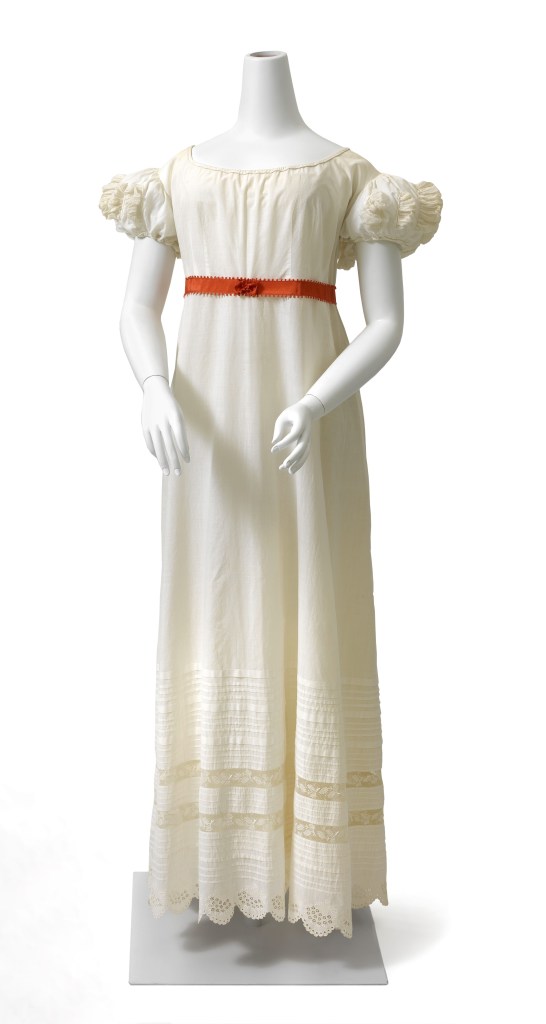
Day Dress, ca. 1816 (Wien Museum; photo by Birgit and Peter Kainz).
The fascinating era of the Biedermeier, which lasted from around the time of the Congress of Vienna in 1814/15 to the revolutions of 1848, delineates a period in Europe that was shaped by political upheaval and social revolts, which profoundly changed society. The congress resulted in the restitution of absolutism and princely rule, heralding a long phase of political restoration founded on a suppression of democratic aspirations. The resigned population turned away from politics and revolutionary ideals for fear of reprisals, seeking refuge in the private sphere. Themes of longing for security and harmony in everyday life entered the pictorial worlds of the Biedermeier.
Aside from all the political friction, the Biedermeier was also an era of great innovation and esthetical changes. The most important driving force was the industrial progress, which led to the construction of the first railway lines and spectacular suspension bridges, like the one connecting Buda and Pest. These technological revolutions resulted in decisive changes in the development of art. Many of these innovations did not emanate from Vienna as the center of the Habsburg Monarchy, but rather from the splendid cities of the crown lands, such as Budapest, Prague, Ljubljana, Trieste, Venice, and Milan.
The art of the monarchy was shaped by international exchange. Thus, the exhibition showcases not only the Viennese masters, including Ferdinand Georg Waldmüller and Friedrich von Amerling, but also Miklós Barabás and József Borsos from Budapest, Antonín Machek and František Tkadlík from Prague, as well as the artists active in Lombardy-Venetia Francesco Hayez and Jožef Tominc (Giuseppe Tominz).

Secretary, Bohemia, ca. 1820 (Prague: The Museum of Decorative Arts; photo by Gabriel Urbánek and Ondřej Kocourek).
Despite the severe poverty of the time, which affected large segments of the population, the simultaneous economic upturn yielded a bourgeoisie whose members wanted to be depicted in confident portraits. Alongside portraits celebrating realistic likenesses of the depicted and the documentation of their social status, the pictorial worlds were dominated by themes from everyday life: family portraits, genre paintings, and renderings of the artists’ own surroundings. Despite the Biedermeier’s typical restrictions to the microcosm of the everyday and one’s immediate surroundings, artists of the period also looked further afield to far-flung countries and cities in order to satisfy people’s curiosity and interest in foreign cultures. Featuring around 190 works from Austrian and international collections, ranging from paintings and graphic works to furnishings, glassware and dresses, the exhibition presents a varied picture of this era.
Curator: Johann Kräftner
Curatorial Assistance and Project Coordination: Lili-Vienne Debus
Johann Kräftner and Hans-Peter Wipplinger, eds., Biedermeier: Eine Epoche im Aufbruch / The Rise of an Era (Cologne: Walther König, 2025), 328 pages, ISBN: 978-3753308159, €40.
The catalogue, in German and English, includes essays by Lili-Vienne Debus, Sabine Grabner, Johann Kräftner, Stefan Kutzenberger, Michaela Lindinger, Fernando Mazzocca, Juliane Mikoletzky, Adrienn Prágai and Radim Vondráček, as well as a prologue by Hans-Peter Wipplinger.
◊ ◊ ◊ ◊ ◊
Note (added 23 April 2025) — This posting originally appeared April 22; it was moved back to April 21st for improved continuity with other posts.
Exhibition | Art and Power in the Age of the Doges of Genoa
Some 100 works—paintings, sculpture, and decorative arts—from the 17th and 18th centuries are now on view in Turin for this exhibition produced in collaboration with the National Museums of Genoa–Palazzo Spinola and the National Gallery of Liguria.
Magnificent Collections: Art and Power during the Age of the Doges of Genoa
Reggia di Venaria, Torino, 10 April — 7 September 2025
Curated by Gianluca Zanelli, Marie Luce Repetto, Andrea Merlotti, and Clara Goria, with Donatella Zanardo

Anton von Maron, Portrait of Maria Geronima Pellegrina ‘Lilla’ Cambiaso and Her Daughter Caterina, 1792, oil on canvas (Genoa: Palazzo Spinola di Pellicceria).
In mostra alla Reggia di Venaria le straordinarie raccolte d’arte di alcune delle più importanti famiglie del patriziato genovese (i Pallavicino, i Doria, gli Spinola, i Balbi) conservate a Palazzo Spinola di Pellicceria, insieme alle più recenti acquisizioni dei Musei Nazionali di Genova con prestiti da altri musei e collezioni private.
Un patrimonio unico di arte e storia che annovera celebri dipinti di Peter Paul Rubens, Antoon Van Dyck, Orazio Gentileschi, Guido Reni, Carlo Maratta, Luca Giordano, e poi ancora Hyacinthe Rigaud e Angelica Kauffman, oltre ai maestri della grande scuola figurativa genovese. Attraverso un centinaio di opere tra dipinti, sculture, argenti e arredi del Sei e Settecento, si proporrà un percorso espositivo, suddiviso in sei sezioni, riferito alle raccolte del palazzo poi divenuto museo, ma anche il racconto del secolo d’oro di Genova ‘la Superba’, teatro del Barocco, antica repubblica retta dai dogi, con la sua regalità e fasto. La mostra continua il grande filone dedicato alla storia, all’arte, alla cultura e alla magnificenza delle corti inaugurato dalla riapertura della Reggia e proseguito negli anni.
Gianluca Zanelli and Marie Luce Repetto, eds., Magnifiche collezioni: Arte e potere nella Genova dei Dogi (Genoa: Sagep Editori, 2025), 128 pages, ISBN: 979-1255902041, €18.
Exhibition | Music and the Republic
Now on view at the Musée des Archives Nationales:
Music and the Republic: From the French Revolution to the Popular Front
Hôtel de Soubise, Paris, 26 March — 14 July 2025
Curated by Marie Ranquet, Sophie Lévy, and Christophe Barret
 L’exposition Musique et République, de la Révolution au Front populaire—organisée avec le concours du Conservatoire national supérieur de musique et de danse de Paris—souhaite mettre en lumière les liens entre la musique et la construction de la République. De la Révolution, qui organise de nouvelles institutions et utilise la musique pour fonder un sentiment patriotique, au Front populaire de 1936, qui fait le pari de l’émancipation sociale du citoyen par l’accès aux loisirs et à la culture, la formation et la pratique musicale permettent à la fois le partage d’un patrimoine sonore commun et l’expression personnelle, parfois subversive.
Les Archives nationales retracent l’histoire de cette rencontre entre le citoyen et la musique. Des partitions inédites retrouvées dans les fonds des Archives nationales, des instruments de musique étonnants ou oubliés, des correspondances politiques, des commandes passées à des compositeurs prestigieux et de nombreux autres documents, racontent une histoire mouvementée : celle d’un siècle et demi de production, d’éducation et de pratique musicales, envisagées en regard de l’idée républicaine.
Commissariat scientifique
• Marie Ranquet, conservatrice en chef du patrimoine aux Archives nationales
• Sophie Lévy, responsable des archives au Conservatoire national supérieur de musique et de danse de Paris
Commissariat technique
• Christophe Barret, chargé d’expositions au département de l’Action culturelle et éducative des Archives nationales
Musique et République: De la Révolution au Front populaire (Paris: Éditions Snoeck, 2025), 168 pages, ISBN: 978-9461619464, €30. With contributions by Adrián Almoguera, Mathias Auclair, Rémy Campos, Myriam Chimènes, Peter Hicks, Sophie Lévy, Marie Ranquet, Émeline Rotolo, and Charles-Éloi Vial.
Exhibition | Hogarth’s Progress
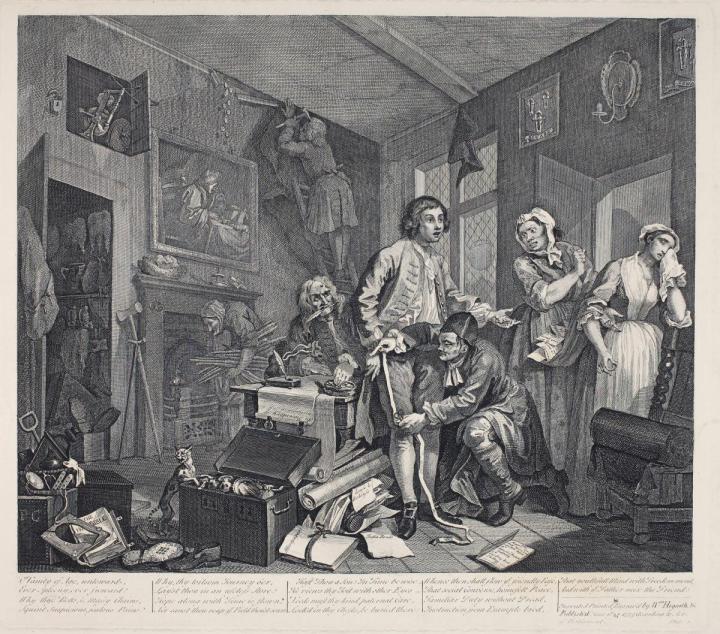
William Hogarth, The Rake’s Progress, Plate 1, published 25 June 1735, etching and engraving
(Allen Memorial Art Museum, Oberlin College, 1975.203)
◊ ◊ ◊ ◊ ◊
Now on view at Oberlin:
Hogarth’s Progress
Allen Memorial Art Museum, Oberlin College, Ohio, 31 January — 10 August 2025
Organized by Marlise Brown
English artist William Hogarth (1697–1764) used his art to hold up a moralizing mirror to all levels of 18th-century society. From rakes to harlots and aristocrats to the clergy—no one was exempt from his biting yet humorous art.
In 1731, Hogarth began creating a series of artworks that he termed ‘modern moral subjects’, which focused on the immoral bend of contemporary London while satirizing the vice and folly of his characters. This exhibition focuses on his first two ‘modern moral subjects’: The Harlot’s Progress (1732), which is a narrative in six scenes, and The Rake’s Progress (1735), which is completed in eight scenes. These sets, offered on subscription, sold out quickly because they were immensely popular with people from all walks of life in England.
Hogarth’s term ‘progress’ was inspired by the book The Pilgrim’s Progress, first published by the English author John Bunyan in 1678. However, unlike the protagonists in Bunyan’s moralizing Christian allegory, Hogarth’s ‘Harlot’ and ‘Rake’ do not grow or learn from life’s experiences. Instead, Hogarth’s narrative series exposes the shallowness of aristocracy, the vices and indulgences of modern London, and showcases complicated ideas in a new form of visual theater.
Organized by Marlise Brown, Assistant Curator of European and American Art.
The Burlington Magazine, March 2025
The long 18th century in the March issue of The Burlington:
The Burlington Magazine 167 (March 2025)
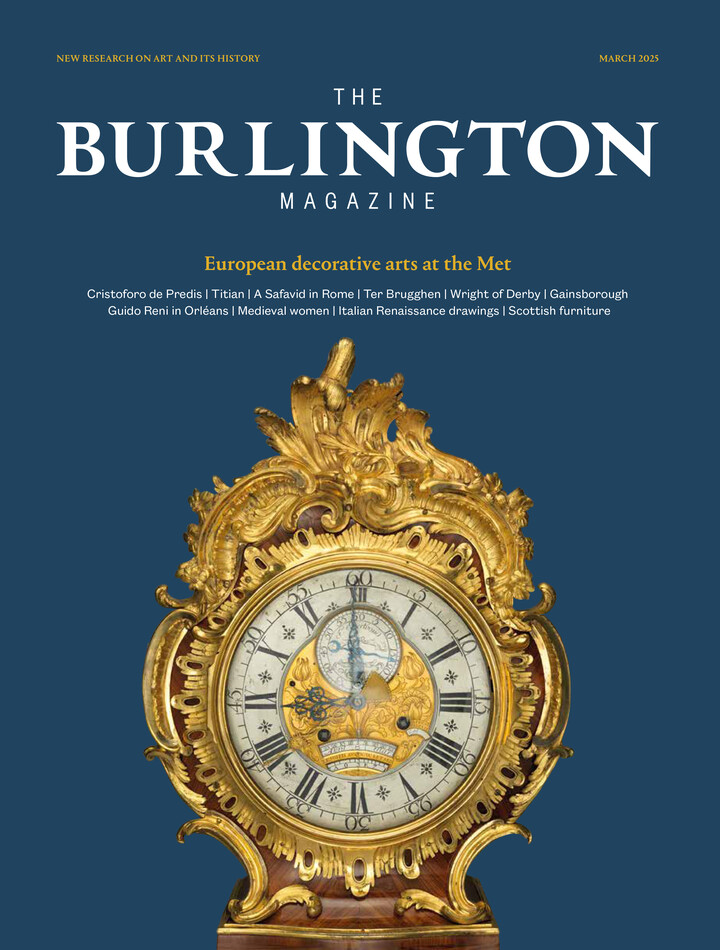
Cover of The Burlington Magazine with a recent acquisition at The Met: Longcase equation regulator, clockmaker: Ferdinand Berthoud, case maker: Balthazar Lieutaud, ca. 1752 (New York: The Metropolitan Museum of Art, 2016.28a–e).
e d i t o r i a l
• “A Frick Renaissance,” p. 203–05.
On 17th April 2025 the Frick Collection on Fifth Avenue re-opens after a long period of redevelopment. When an old friend has a face lift, the results can be disconcerting. Happily, the impact here is, however, reassuringly subtle—as the splendid Gilded-age character of one of New York’s iconic cultural institutions has been retained, while elegant new facilities have been deftly integrated.
a r t i c l e s
• Julia Seimon, “Two Boys with a Bladder in the J. Paul Getty Museum and Joseph Wright of Derby’s Early Candlelights,” pp. 242–57.
A careful re-assessment of Joseph Wright of Derby’s painting of Two Boys with a Bladder in the Getty’s collection, supported by documentary discoveries, clarifies the circumstances of the painting’s creation and first exhibition and has significant implications for dating several of the artist’s other painted and drawn works.
s h o r t e r n o t i c e s
• Oliver Fairclough, “Paul Sandby and Sir Watkin Williams-Wynn Revisited,” pp. 258–61.
• Christina Milton O’Connell, “Observations about the Abandoned Portrait beneath Gainsborough’s Blue Boy,” pp. 26–65.
r e v i e w s
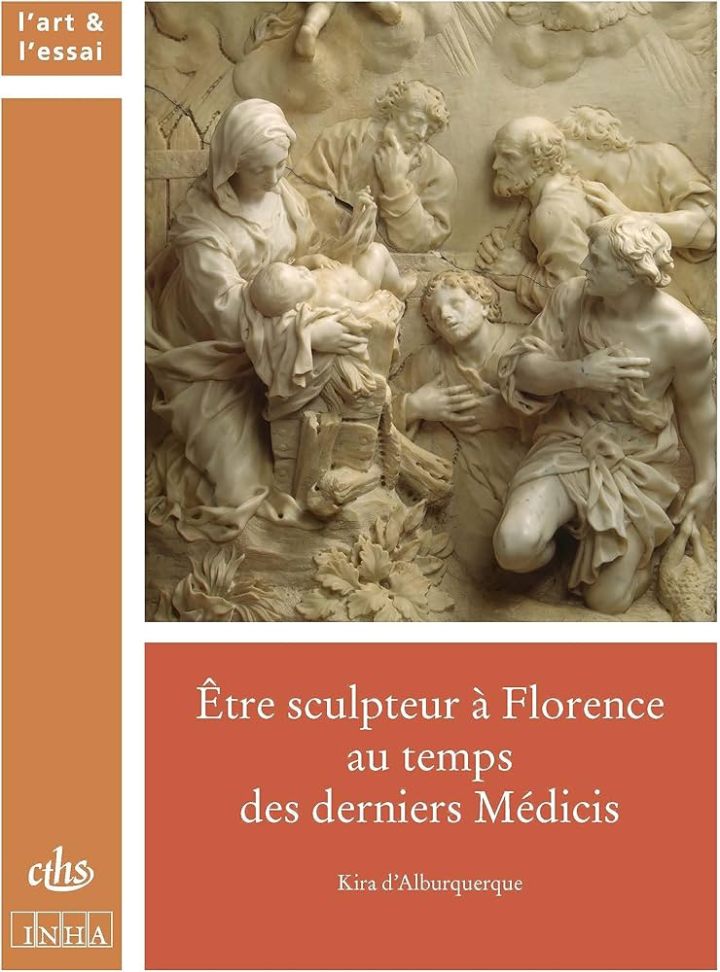
Cover of Être sculpteur à Florence au temps des derniers Médicis, featuring a photograph of Giovanni Battista Foggini’s Adoration of the Shepherds, ca. 1675, marble (Saint Petersburg: Hermitage).
• Nicola Ciarlo, Review of Kira d’Alburquerque, Être sculpteur à Florence au temps des derniers Médicis (CTHS, 2023), pp. 292–94.
• Adam Bowett, Review of Stephen Jackson, Scottish Furniture 1500–1914 (NMS Publishing, 2024), pp. 296–98.
• Penelope Curtis, Review of the exhibition catalogue Souvenirs de jeunesse: Entrer aux Beaux-Arts de Paris 1780–1980, edited by Alice Thomine-Berrada (Beaux-Arts de Paris, 2024), pp. 298–99.
• Alan Powers, Review of Edward McParland, The Language of Architectural Classicism: From Looking to Seeing (Lund Humphries Publishers, 2025), pp. 299–300.
• Max Marmor, Review of Julius von Schlosser, The Literature of Art: A Manual for Source Work in the History of Early Modern European Art Theory, translated by Karl Johns (Ariadne Press, 2023), p. 303.
s u p p l e m e n t
• Sarah Lawrence, “Recent Acquisitions (2014–24) of European Decorative Arts at The Metropolitan Museum of Art,” pp. 305–24.
Exhibition | Return to Turtle Island
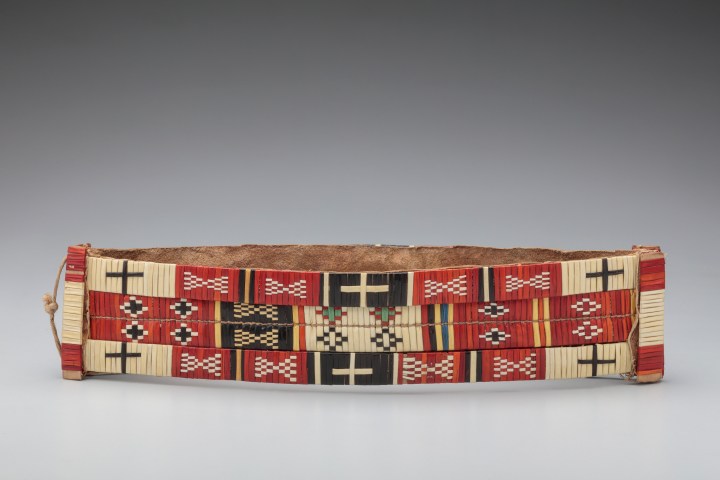
Ancestral Great Lakes artist, Quilled headband, mid-18th century; hide, birchbark, porcupine quills, natural dyes, and linen thread; 6 × 32 × 9 cm (Toledo Museum of Art, purchased with funds from The Joseph and Kathleen Magliochetti Fund, 2023.375).
◊ ◊ ◊ ◊ ◊
From the press release for the exhibition (the Rachel Ruysch show will also be on view at TMA starting April 12). . .
Return to Turtle Island: Indigenous Nation-Building in the Eighteenth Century
Toledo Museum of Art, 1 March — 29 June 2025
Curated by Johanna Minich, with the Great Lakes Research Alliance at the University of Toronto
The Toledo Museum of Art is pleased to present Return to Turtle Island: Indigenous Nation-Building in the Eighteenth Century, an exhibition that showcases recently acquired Eastern Woodlands objects and offers a rare exploration of early Indigenous artistry and diplomacy. This will be the first time these works, acquired by TMA in 2023, will be shown together by a public institution. The exhibition honors the remarkable journey of these cultural emissaries and welcomes them home.
Turtle Island, a name given to the North American continent by Anishinaabe, Haudenosaunee, and other Indigenous peoples, references the origin story of a landmass built on the back of a great turtle, symbolizing the interconnectedness of land and life.
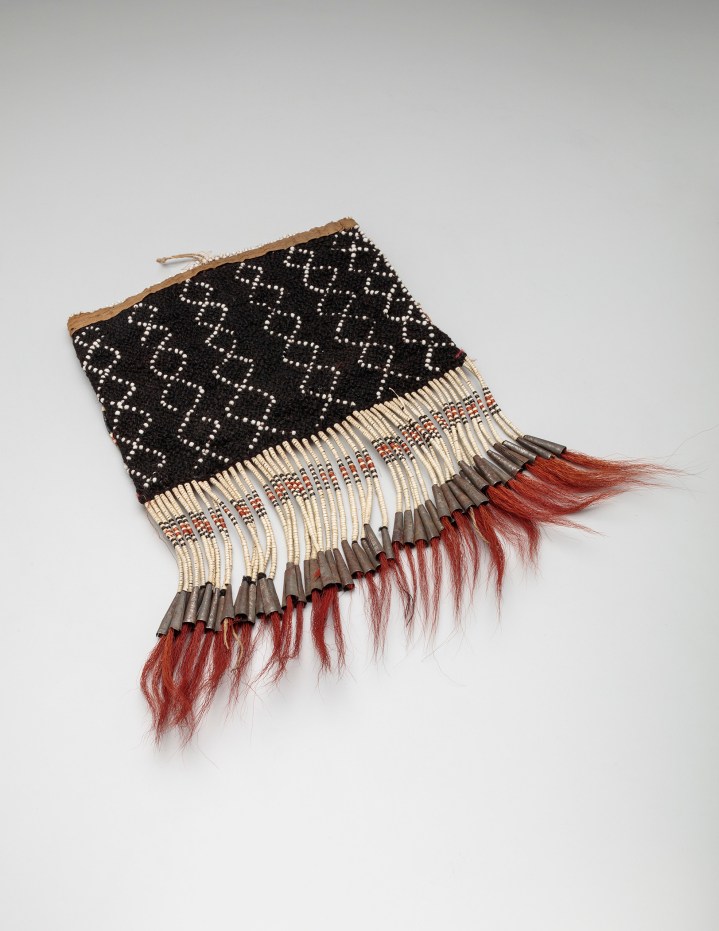
Ancestral Great Lakes artist, Quilled and beaded finger-woven pouch, mid-18th century; wool, birchbark, glass beads, silk, porcupine quills, natural dyes, tin, deer fur, and hide, 38 × 38 × 1 cm (Toledo Museum of Art, purchased with funds from the Florence Scott Libbey Bequest in Memory of her Father, Maurice A. Scott, 2023.357).
“Return to Turtle Island offers a unique window into a period of dynamic interaction between Indigenous and European communities in North America,” said Johanna Minich, the museum’s consulting curator of Native American art. “These objects represent far more than material goods—they serve as symbols of artistic knowledge, cultural exchange, and diplomacy that shaped early American history.”
Featuring 24 objects, including quillwork, beadwork, moosehair embroidery, and birchbark artforms acquired by TMA in 2023, this exhibition examines how Indigenous nations used these objects as tools of cultural expression, political alliance, and commerce during a time of dynamic interaction with European settlers.
“This exhibition exemplifies the Toledo Museum of Art’s strategy: That a relentless commitment to quality results in global and inclusive art history.” said Adam Levine, Edward Drummond and Florence Scott Libbey Director, President, and CEO. “By showcasing these extraordinary objects, we are fostering a deeper understanding of the interconnectedness of cultures and their enduring contributions to our shared history.”
The exhibition highlights the artistic skills of women and how their creative output was an integral part of nation-building, diplomacy, and economic sustainability. Indigenous leaders exchanged gifts and knowledge with their French and English allies during the sixteenth through eighteenth centuries, which had lasting implications for both Native and European communities.
Highlights include
• A quilled and beaded finger-woven pouch, a testament to the artistry of its makers.
• Beaded and quilled fingerwoven pictorial garter pendants, symbolizing the significance of proper attire when forming alliances.
• A birchbark model canoe and three dolls with assorted equipment, showcasing the cross-cultural artistic exchanges of the era.
The objects were originally collected through gift exchanges and purchases during the 18th century by Scottish officer Alexander Farquharson during his military travels through New York and Canada. For centuries, they remained in his family estate in Scotland before returning to North America in the early 2000s. TMA acquired the collection in late 2023.
To ensure the ethical conservation and presentation of these objects, TMA is collaborating with the Great Lakes Research Alliance (GRASAC) at the University of Toronto. Drawing on a network of Indigenous scholars and knowledge keepers, GRASAC provides guidance on the care and contextual display of these significant artworks.
“This collaboration with GRASAC ensures that the legacy of these objects is preserved with the utmost respect,” Minich added. “By working with descendants of their makers, we honor the original purpose of these works: sharing knowledge and strengthening relationships.”
Return to Turtle Island: Indigenous Nation-Building in the Eighteenth Century is made possible with the generous support of Presenting Sponsors Susan and Tom Palmer; Season Sponsors Taylor Automotive Family and the Rita Barbour Kern Foundation; Platinum Sponsor AGC of Northwest Ohio; and additional funding from the Ohio Arts Council, which receives support from the State of Ohio and the National Endowment for the Arts.










leave a comment