Exhibition | Fighting for Freedom
Now on view at the DAR:
Fighting for Freedom: Black Craftspeople and the Pursuit of Independence
Daughters of the American Revolution Museum, Washington, DC, 25 March — 31 December 2025
Gibbes Museum of Art, Charleston, Summer 2026 — Spring 2027
Historic New Orleans Collection, Summer — Fall 2027
Tennessee State Museum, Nashville, Winter — Spring 2028
Museum of the Shenandoah Valley, Winchester, Summer — Fall 2028
 The Daughters of the American Revolution (DAR) Museum is proud to present the exhibition Fighting for Freedom: Black Craftspeople and the Pursuit of Independence, in collaboration with the Black Craftspeople Digital Archive. This exhibition seeks to embrace the stories of all those who pursued independence by centering on the lives and experiences of Black craftspeople and artisans from the 18th and 19th centuries. It highlights the creations, contributions, and legacies of African Americans as they fought for freedom from the earliest calls for American independence and beyond. Fighting for Freedom spans the war years of the Revolution through the present, as African Americans have sought to pursue agency and liberty through craft. The underpinning idea of African American craft as a catalyst for freedom-seeking displays itself in a host of ways in this exhibition, encompassing furniture, metals, ceramics, textiles, art, tools, and personal accessories.
The Founders’ cries for liberty from tyranny and oppression resonated with African Americans and were embraced by Black craftspeople, both free and enslaved. “The Founding Fathers, while enslaving tens of thousands of people, unintentionally created a ripple effect,” states exhibition co-curator and founder of the Black Craftspeople Digital Archive Dr. Tiffany Momon, “and we hope that visitors will see just how important those cries for liberty were to Black craftspeople and how they pursued it despite being marginalized.”
Fighting for Freedom features more than 50 objects from public and private lenders and includes objects made by both free and enslaved craftspeople. With artifacts from the 18th, 19th, and 21st centuries, this exhibition tells the stories of countless known and unnamed figures whose skills and commitment created not only objects but independence in many forms.
◊ ◊ ◊ ◊ ◊
From UNC Press:
Torren L. Gatson, Tiffany N. Momon, and William A. Strollo, eds., Fighting for Freedom: Black Craftspeople and the Pursuit of Independence (Chapel Hill: The University of North Carolina Press, 2025), 176 pages, ISBN: 978-1469686257, $35. Contributors include Lauren Applebaum, Robell Awake, Lydia Blackmore, Aleia M. Brown, R. Ruthie Dibble, Philippe L. B. Halbert, Jennifer Van Horn, Alexandra Alevizatos Kirtley, and Susan J. Rawles.
Delving into diverse narratives of creativity, resilience, and triumph in the quest for freedom, this book underscores the evolution of freedom through the lens of material culture—by exploring how the very concept of freedom was shaped and redefined by enslaved and free craftspeople who relentlessly fought for their rights and the recognition of their humanity. Featuring ten essays by leading historians, museum curators, and material culture scholars and more than seventy color photographs of Black artistry, including paintings, metalwork, woodwork, pottery, and furniture, this book vividly illustrates how Black men and women persistently sought tangible expressions of liberty which have endured as symbols of their creators’ legacies in the ongoing struggle for freedom.
The Burlington Magazine, July 2025
The long 18th century in the July issue of The Burlington:
The Burlington Magazine 167 (July 2025)
e d i t o r i a l

Maria van Oosterwijck, Vanitas stilleven, ca. 1675, oil on canvas (Amsterdam: Rijksmuseum).
• “The Gallery of Honour,” p. 635. The gallery of honour in the heart of the Rijksmuseum, Amsterdam, has recently welcomed an impressive painting to its walls: Vanitas still life by Maria van Oosterwijck (1630–93). In a compelling sense the artist has long had a place in galleries of honour, as works by her were acquired by Emperor Leopold I, Louis XIV of France, and Cosimo III de’ Medici of Tuscany.
r e v i e w s
• Christian Scholl, “Germany’s Celebration of Caspar David Friedrich’s 250th Anniversary,” pp. 694–701.
In Germany, the 250th anniversary of Caspar David Friedrich’s birth was celebrated with a series of exhibitions. Key among them were those organised by the three museums with the most extensive holdings of the artist’s work: the Hamburger Kunsthalle, the Alte Nationalgalerie, Berlin, and the Staatliche Kunstsammlungen, Dresden. All three focused on stylistic, iconographic and technical aspects of the artist’s work rather than on Friedrich’s life, and each in its own way has thrown fresh light on his complex and enigmatic art.
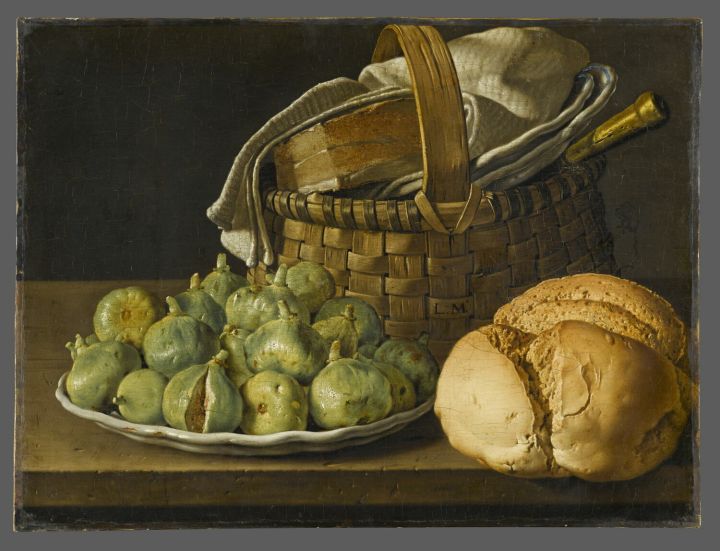
Luis Egidio Meléndez, Still Life with Figs, ca. 1760, oil on canvas (Paris: Musée du Louvre, on view at the Musée Goya, Castres).
• Robert Wenley, Review of the exhibition Wellington’s Dutch Masterpieces (Apsley House, London, 2025), pp. 713–15.
• Christoph Martin Vogtherr, Review of the exhibition Corot to Watteau? On the Trail of French Drawings (Kunsthalle Bremen, 2025), pp. 715–18.
• Elsa Espin, Review of the exhibition Le Louvre s’invite chez Goya (Musée Goya, Castres, 2025), pp. 718–20.
• John Marciari, Review of the exhibition Picturing Nature: The Stuart Collection of 18th- and 19th-Century British Landscapes and Beyond (Museum of Fine Arts, Houston, 2025), pp. 720–22.
• Kee Il Choi Jr., Review of the exhibition Monstrous Beauty: A Feminist Revision of Chinoiserie (The Metropolitan Museum of Art, New York, pp. 722–25.
• Deborah Howard, Review of Mario Piana, Costruire a Venezia: I mutamenti delle tecniche edificatorie lagunari tra Medioevo e Età moderna (Marsilio, 2024), pp. 732–33.
• Isabelle Mayer-Michalon, Review of Christophe Huchet de Quénetain and Moana Weil-Curiel, Étienne Barthélemy Garnier (1765–1849): De l’Académie royale à l’Institut de France (Éditions Faton, 2023), pp. 737–39.
Exhibition | The Grand Tour: Destination Italy

Pompeo Batoni, Portrait of Thomas William Coke, 1774, installed at Holkham Hall.
◊ ◊ ◊ ◊ ◊
From the press release (3 July) for the exhibition:
The Grand Tour: Destination Italy
Mauritshuis, The Hague, 18 September 2025 — 4 January 2026
The Grand Tour: Destination Italy features masterpieces from three of the UK’s most esteemed stately homes: Burghley House, Holkham Hall, and Woburn Abbey. The art in this exhibition was collected on tours in the 17th and 18th centuries, when young British aristocrats finished their education by spending several years travelling in continental Europe. The highlights will include an impressive portrait of Thomas William Coke by Pompeo Batoni (Holkham Hall), work by Angelica Kauffman (Burghley House), and two grand Venetian cityscapes by Canaletto (Woburn Abbey), all of them on display in the Netherlands for the first time.
Burghley House: Great Collectors
Visitors will encounter two extraordinary travellers from the Cecil family: John Cecil, the 5th Earl of Exeter, and Brownlow Cecil, the 9th Earl. In the 17th century John and his wife made four tours of Europe, collecting pieces for their stately home, Burghley House. They purchased all kinds of things, including furniture and tapestries, but above all they purchased lots of paintings for their grand house. Their trips were far from easy. The couple travelled with their children, servants, and dozens of horses. Grand Tours were not without their challenges. Sick servants would have to be left behind, horses died in the heat, and carriages broke down.

Nathaniel Dance, Portrait of Angelica Kauffman, 1764 (Burghley House).
Angelica Kauffman: Beloved, Talented, and in Demand
In the 18th century their great grandson Brownlow left for Italy after the death of his wife. He had a particular favourite, Angelica Kauffman, a Swiss-Austrian painter who worked in Italy for many years and was the star of her age beloved, talented, and in demand. The exhibition will include a magnificent portrait of her by Nathaniel Dance that shows her looking straight at the viewer. For many, meeting Kauffman was the highlight of their Grand Tour. Vesuvius can be seen in the background of her portrait of Brownlow. No visit to Naples was complete without a climb to the top of this volcano, which was a popular destination in the 18th century—the earliest example of ‘disaster tourism’. Pietro Fabris painted a detailed image of the eruption of Vesuvius in 1767, with a crowd in the foreground watching the awesome power of nature.
Holkham Hall: Home of Art
Thomas Coke, the 1st Earl of Leicester, was just fifteen when he embarked on his six-year Grand Tour (1712–1718). He travelled with a clear goal in mind: to collect art for the future Holkham Hall, which he had built after his return, in Palladian style, with Roman columns, façades resembling temples and strict symmetry. His artworks were displayed to their best advantage in his palatial country home. During his travels, he collected paintings, drawings, sculptures, books, and manuscripts. Coke was regarded as one of the most important 18th-century collectors of the work of Claude Lorrain, the French master of Italian landscapes, including the fabulous View of a Seaport and Amphitheatre. The top item in the exhibition is an impressive portrait of his great nephew Thomas William Coke, painted by Pompeo Batoni, a typical Grand Tour portrait with a Roman statue from the Vatican in the background.
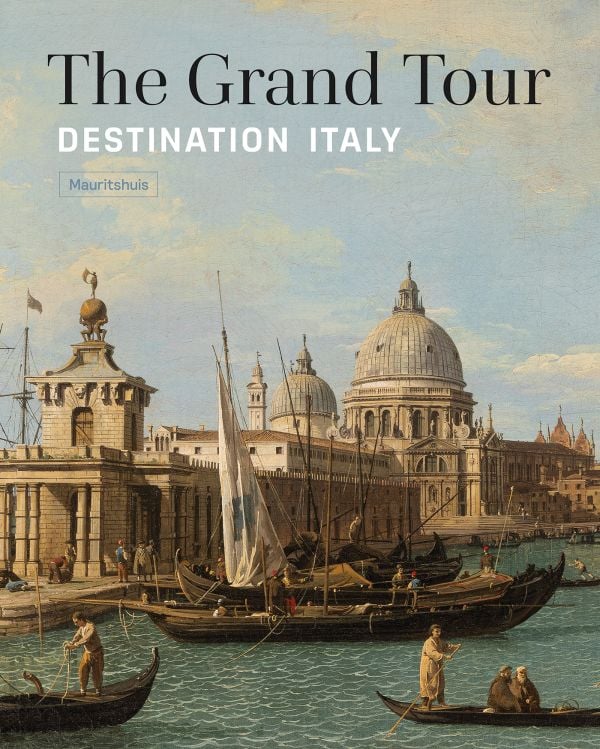
The cover of the catalogue includes a detail of Canaletto’s View of the Grand Canal in Venice, Looking West, with the Dogana di Mare and the Santa Maria della Salute, ca.1730–40 (Woburn Abbey).
Woburn Abbey: Obsession with Venice
The Grand Tour is synonymous not only with Rome, but also with Venice. John Russell, who became the 4th Duke of Bedford in 1735, visited the city on his Grand Tour (1730–31). Like many young aristocrats, he wanted a permanent memento to take home with him, and what could be more appropriate than a cityscape by Canaletto, the leading painter of 18th-century Venice? Eventually, John Russell commissioned an entire series comprising more than 24 paintings, the largest series of Canalettos still in existence. The paintings normally hang in the dining room at Woburn Abbey, the ancient family seat of the Russells.
The Grand Tour
These days many youngsters take a ‘gap year’ after high school, but a Grand Tour could easily last several years. Italy was the ultimate destination, with Rome, Florence, Naples, and Venice as the absolute highlights. En route, travellers would learn about art, architecture and culture, and collect artworks for their stately homes in England, just as we take back souvenirs nowadays. Yet these trips were not always innocent and high-minded. They are also known for their less salubrious distractions, including gambling and lustful pleasures. To keep the young men on the straight and narrow, they would be accompanied by chaperones. Such a ‘private tutor’ would mockingly be known as a ‘bear leader’. From the 18th century onwards, women also increasingly did the Grand Tour, sometimes with their entire family. The Napoleonic Wars (1803–15) brought the tradition of the Grand Tour to an end. In the 19th century, the advent of the steam train changed travel for good.
The catalogue is distributed by ACC Art Books:
Ariane van Suchtelen, The Grand Tour: Destination Italy (Waanders & de Kunst Publishers, 2025), 112 pages, ISBN: 978-9462626461, $45.
Exhibition | L’étoffe des Lumières
Now on view at the Musée Jean-Jacques Rousseau:
L’étoffe des Lumières: Vêtements et accessoires au XVIIIe siècle
The Fabric of Enlightenment: Clothing and Accessories in the 18th Century
Musée Jean-Jacques Rousseau, Montmorency, 5 April — 26 October 2025

Antoine Vestier, Portrait de femme, 1750–90, oil on canvas (Paris: Musée Cognacq-Jay).
Réalisée en partenariat avec La Dame d’Atours, spécialiste de la reconstitution historique, cette exposition met en lumière les transformations vestimentaires de l’époque à travers une sélection de costumes, d’accessoires, de gravures et de peintures. Reflet d’une société en pleine mutation, la mode du XVIIIe oscille entre luxe aristocratique et quête de simplicité, en écho aux idéaux de Jean-Jacques Rousseau. Philosophe des Lumières, à la fois familier des salons et critique des artifices, il prône un retour à l’authenticité qui inspire encore aujourd’hui. Les costumes raffinés de La Dame d’Atours dialoguent avec des œuvres prêtées par le Musée Cognacq-Jay et les collections montmorencéennes, offrant une immersion inédite à la croisée de l’histoire sociale, de la mode et des arts. Ce parcours enrichi de dispositifs ludiques invite petits et grands à découvrir cette époque fascinante sous toutes les coutures.
Exhibition | Marie Antoinette Style
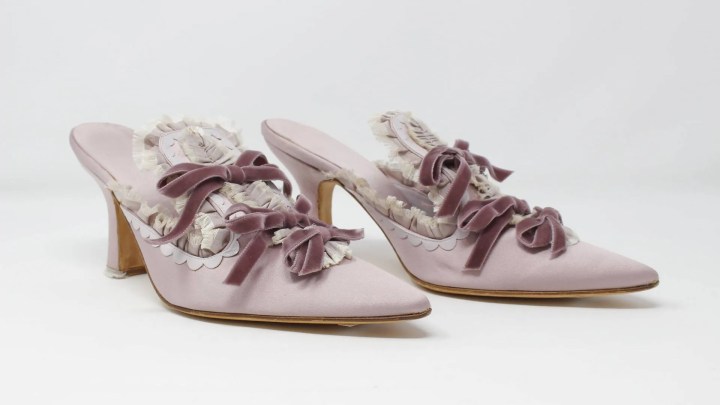
Manolo Blahnik, Antonietta, 2005.
◊ ◊ ◊ ◊ ◊
Curator Sarah Grant provides a preview of the exhibition with a focus on scent in a recorded talk from the study day The Museum and the Senses, held at the Barber Institute of Fine Arts (February 2025). From the press release for the exhibition:
Marie Antoinette Style
Victoria & Albert Museum, London, 20 September 2025 – 22 March 2026
Curated by Sarah Grant
Opening in September 2025 at V&A South Kensington, Marie Antoinette Style will be the UK’s first exhibition on the French queen Marie Antoinette (1755–1793). It will explore the origins and countless revivals of the style shaped by the most fashionable queen in history. Marie Antoinette not only contributed to the fashions, interiors, gardens, and fine and decorative arts of her own time, but continued to influence more than two and a half centuries of graphic and decorative arts, fashion, photography, film, and performance. This excessive, lavish, and feminine style will come to life through some 250 objects, including exceptional loans from the Château de Versailles never before seen outside France. Historical and contemporary fashion, alongside audio visual installations and immersive curation, will explore how and why Marie Antoinette, the person, has provided a constant source of inspiration. The exhibition will consider afresh the legacy of this complex figure whose style, youth, and notoriety have contributed to her timeless appeal. The exhibition will also trace the cultural impact of the Marie Antoinette style and her ongoing inspiration for leading designers and creatives, from Sofia Coppola and Manolo Blahnik to Moschino and Vivienne Westwood.

François-Hubert Drouais, Portrait of Marie Antoinette, Queen of France, in a Court Dress, 1773, oil on canvas (London: V&A, Jones Collection, 529-1882).
On display will be exceptionally rare personal items owned and worn by Marie Antoinette including richly embellished fragments of court dress, the Queen’s own silk slippers, and jewels from her private collection. Other highlights include personal effects such as the queen’s dinner service from the Petit Trianon, a selection of her accessories, and intimate items from her toilette case. A scent experience will re-create scents of the court and the perfume favoured by the Queen herself. The exhibition will also feature contemporary clothing including couture pieces by designers such as Moschino, Dior, Chanel, Erdem, Vivienne Westwood, and Valentino, along with costumes made for Sofia Coppola’s Oscar winning Marie Antoinette (staring Kirsten Dunst), as well as shoes designed for the film by Manolo Blahnik.
Sarah Grant, curator of Marie Antoinette Style, said: “The most fashionable, scrutinised, and controversial queen in history, Marie Antoinette’s name summons both visions of excess and objects and interiors of great beauty. The Austrian archduchess turned Queen of France had an enormous impact on European taste and fashion in her own time, creating a distinctive style that now has universal appeal and application. This exhibition explores that style and the figure at its centre, using a range of exquisite objects belonging to Marie Antoinette, alongside the most beautiful fine and decorative objects that her legacy has inspired. This is the design legacy of an early modern celebrity and the story of a woman whose power to fascinate has never ebbed. Marie Antoinette’s story has been re-told and re-purposed by each successive generation to suit its own ends. The rare combination of glamour, spectacle, and tragedy she presents remains as intoxicating today as it was in the eighteenth century.”
Presented chronologically, the first section, Marie Antoinette: The Origins of a Style, begins in 1770 and ends at Marie Antoinette’s execution in 1793. It sets the scene by presenting her life and the story of the beginnings of the style she shaped. On display will be key pieces of furniture, fashion, jewellery, porcelain, and musical instruments from her court, revealing her roles and interests as queen consort. It will consider the way in which she embraced some aspects of enlightenment thought, through her approach to maternity and childhood and support of new technologies. It will also address the ‘let them eat cake’ mythology and mythmaking that surround the queen to this day, drawing on recent research on early modern women, queenship, and celebrity. Highlights in this section include a replica of the Boehmer and Bassenge diamond necklace, from the diamond necklace affair of 1784–85, commissioned for Madame du Barry in 1772. The original necklace was famously stolen, broken up, and sold in Bond Street; the replica will sit alongside the Sutherland diamond necklace from the V&A collection, thought to be made from the original diamonds.
The first section will also display exceptionally rare loans that have never before left France, including personal effects such as the queen’s dinner service from the Petit Trianon, her accessories, and items from her toilette case. Other personal items include the queen’s armchair from the V&A’s collection with Marie Antoinette’s monogram and a jatte téton / bol sein or ‘breast cup’—one of four from the queen’s Sèvres Rambouillet dairy service delivered in 1787—which has led to the persistent though erroneous belief that it was modelled on the queen’s own breast, inspiring modern-day examples. Finally, this section includes the last note Marie Antoinette wrote before she died, on a blank page in her prayer book.
 The second section, Marie Antoinette Memorialised: The Birth of a Style Cult, explores the revival of Marie Antoinette’s style in the mid-1800s, at the impetus of Empress Eugénie. A romanticised and sentimental view of the queen took hold, and a phenomenal wave of interest continued throughout the century, peaking again in the 1880s and 1890s. Elements of Marie-Antoinette’s style became the ‘French’ or ‘French Revival’ style—the dominant style in Britain and North America for over fifty years. English collectors sought to acquire objects, furniture, and mementoes associated with the queen, and important collections of eighteenth-century French art were formed. Highlight objects include fancy dress costumes by Worth and other couturiers and photographs by Eugène Atget and Francis Frith.
Marie Antoinette: Enchantment and Illusion, the exhibition’s third section, looks to the late 19th century when the Marie Antoinette style entered a new phase of fantasy, magic, and fairy tales. The queen’s image came to embody escapism and beauty, as well as decadence and debauchery. Objects and artworks will illustrate this shifting narrative through the Art Nouveau and Art Deco periods, including the evening dress designs of couturiers such as Jeanne Lanvin and the Boué Soeurs, alongside luminous watercolour illustrations by Golden Age illustrators Erté, George Barbier, and Edmund Dulac.
The final section, Marie Antoinette Re-Styled, considers the modern and contemporary legacy of the Marie Antoinette style from the 20th century to the present day, in fashion, performance, and pop culture. Couture pieces by designers such as Moschino, Dior, Chanel, Erdem, Vivienne Westwood, and Valentino alongside photographs by Tim Walker and Robert Polidori will highlight Marie Antoinette’s continued influence on fashion globally. Costumes, accessories, film, and stills will bring to life the queen’s enduring legacy in film, stage, and even music videos. Artist Beth Katleman and designer Victor Glemaud will also showcase contemporary works inspired by elements of Marie Antoinette’s timeless style and period.
Support for the V&A is more vital than ever. Marie Antoinette Style is sponsored by Manolo Blahnik, with support from Kathryn Uhde.
Sarah Grant, ed., with forewords by Antonia Fraser, Manolo Blahnik, and Sofia Coppola, Marie Antoinette Style (London, V&A Publishing, 2025), 304 pages, ISBN: 978-1838510541, £40 / $70.
Exhibition | 1793–1794: Un Tourbillon Révolutionnaire
A second iteration of the exhibition on view previously at the Musée Carnavalet:
1793–1794: Un Tourbillon Révolutionnaire
Musée de la Révolution française, Vizille, 27 June — 23 November 2025
 Entre 1793 et 1794, « l’An II de la République » marque les débuts mouvementés de la toute première république française. Des idéaux de la Révolution aux grands procès politiques, de la liesse aux insurrections populaires, les premiers mois du nouveau régime emportent tout sur leur passage, jusqu’au quotidien des Français. Un véritable tourbillon révolutionnaire, nourri d’espoirs et de peurs.
Cette exposition revient sur des mois décisifs pour l’histoire de France : l’arrestation des Girondins, l’assassinat de Marat, l’exécution de Marie-Antoinette jusqu’à la chute de Robespierre. Voici donc « la Terreur », décryptée à la lumière des recherches historiques les plus récentes.
L’exposition 1793–1974: Un tourbillon révolutionnaire est une adaptation de l’exposition Paris 1793–1794: Une année révolutionnaire conçue par le musée Carnavalet – Histoire de Paris.
Exhibition | Traits of Genius
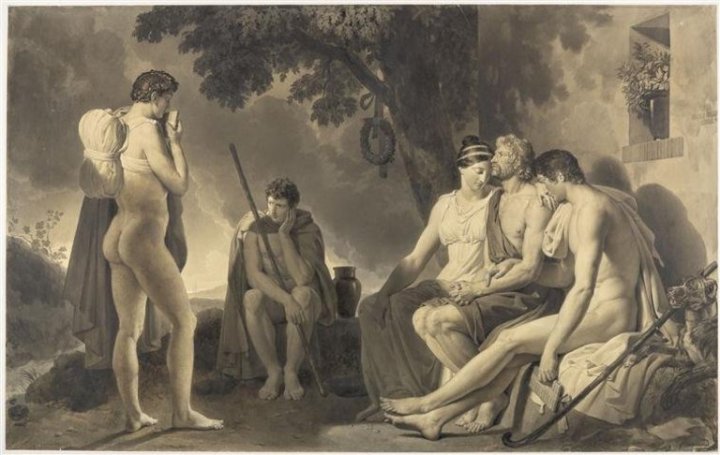
Alexandre-Évariste Fragonard, Pastorale / Homère et les Bergers, 1810; graphite, brown wash, black ink, and white highlights on beige paper; 55 × 88 cm (Louvre, INV 26657).
◊ ◊ ◊ ◊ ◊
The exhibition presents some sixty drawings by Jean-Honoré Fragonard, his wife Marguerite Gérard, and their son Alexandre-Évariste from the collections of the Louvre:
Les Traits du Génie: Dessins du Louvre par Jean-Honoré Fragonard,
Alexandre-Évariste Fragonard, et Marguerite Gérard
Musée International de la Parfumerie, Grasse, 27 June — 26 October 2025
Cet été, le Musée International de la Parfumerie vous invité à découvrir l’œuvre de Jean-Honoré Fragonard, l’un des plus grands peintres du XVIIIe siècle, à travers une exposition exceptionnelle. Né à Grasse en 1732, Fragonard a marqué son époque par son talent unique, tout en restant profondément attaché à sa ville natale. Bien que Paris ait été son principal lieu de vie, son mariage avec Marie-Anne Gérard, issue d’une famille de parfumeurs grassois, ainsi que ses séjours réguliers à Grasse, témoignent de l’attachement de l’artiste à sa ville d’origine.
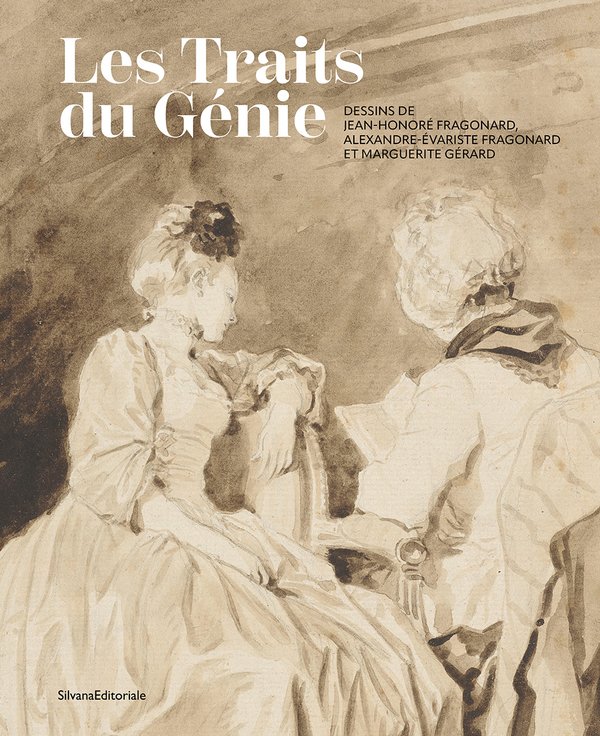 L’exposition propose une sélection de plus de soixante dessins de Fragonard, jamais exposés à Grasse et rarement montrés ailleurs. Ces œuvres, provenant des collections du département des Arts Graphiques du musée du Louvre, offrent un regard privilégié sur le processus créatif de Fragonard. Que ce soit des autoportraits, des souvenirs de voyages, des études de figures ou des projets d’illustration, les dessins de Fragonard nous donnent un aperçu de l’étendue du génie de l’artiste et offrent au visiteur grassois une proximité inédite avec l’essence de son œuvre.
Fragonard n’a pas seulement marqué l’histoire de la peinture. Son influence s’étend également aux arts décoratifs, et notamment à l’univers de la parfumerie, un domaine dans lequel Grasse occupe une place centrale. Pour illustrer ce lien, l’exposition présente une série de flacons de parfum en porcelaine du XVIIIe siècle, prêtés par la société Givaudan. Que vous soyez passionné d’art, d’histoire ou simplement curieux, cette exposition est une occasion unique de plonger dans l’univers de Jean-Honoré Fragonard, de découvrir ses œuvres et d’explorer les liens entre son art et l’univers du parfum.
From Silvana:
Laure Decomble, Olivier Quiquempois, Xavier Salmon, and Martine Uzan, Les Traits du Génie: Dessins de Jean-Honoré Fragonard, Alexandre-Évariste Fragonard et Marguerite Gérard (Milan: Silvana Editoriale, 2025), 200 pages, ISBN: 978-8836661534, €29.
c o n t e n t s
• Grasse et Jean-Honoré Fragonard — Olivier Quiquempois
• Crayonnages et lavis de Fragonard: Quelques considérations sur certains amateurs et collectionneurs — Xavier Salmon
Oeuvres
• Les Fragonard, une famille d’artistes — Laure Decomble
• Voyager et apprendre — Laure Decomble
• Regarder et inventer — Xavier Salmon
• Fragonard, illustrateur — Olivier Quiquempois
• Les Flacons de la Séduction — Martine Uzan
English Texts
Bibliographie
Exhibition | Adèle de Romance (1769–1846)
Now on view at the Fragonard Museum in Grasse (with more information available here, pp. 124–27):
Adèle de Romance: A Liberated Painter / Peintre Libre
Musée Fragonard, Grasse, 14 June — 12 October 2025
Curated by Carole Blumenfeld
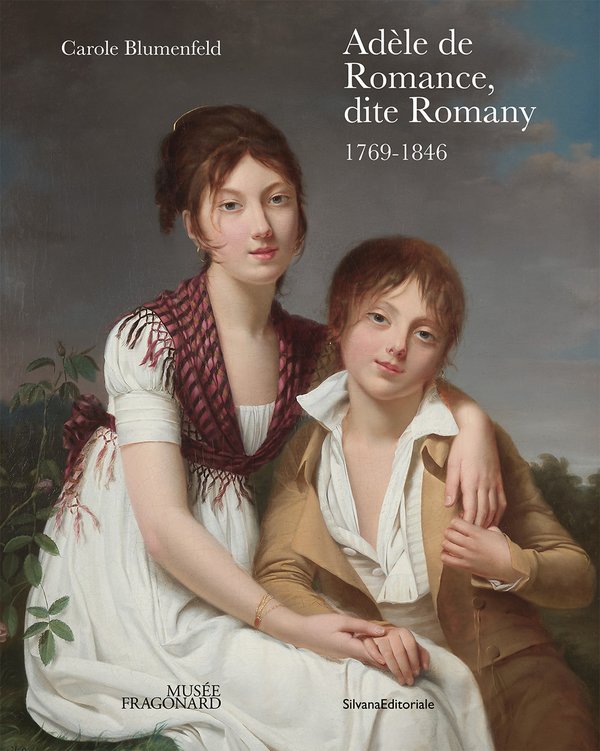 After dedicating the summer 2023 exhibition to the Lemoine sisters and their cousin Jeanne Élisabeth Chaudet, the Jean-Honoré Fragonard Museum will celebrate Adèle de Romance in 2025. This painter, whose life was as brilliant as it was tumultuous, embodies all the opportunities that the end of the 18th century and the beginning of the 19th century offered to talented artists.
Born from an illegitimate union between the Marquis Godefroy de Romance, Adèle de Romance (1769–1846) was eventually recognized and adopted by her father at the age of 8. Her younger half-sister, whose personal life perfectly met their father’s expectations, received many signs of trust from him. Despite this, Adèle de Romance now had a name and enjoyed one of the largest collections of Nordic and French paintings, including many works by Fragonard. Concerned with her education, the Marquis de Romance guided all her personal choices, from her passion for painting to the birth of her first child at the age of 18. Adèle then married the miniaturist François Antoine Romany, a mismatched union whose sole purpose was to give her a status. When her father left France in August 1791 to defend the counter-revolutionary ideas that mattered to him, Adèle de Romance was forced to conceal her partly aristocratic origins and to live… by her brushes.
After a divorce, which she willingly kept her married name, she began a series of small portraits of prominent figures. She took advantage of the fame of her subjects and, for four decades, played with a multitude of surnames, embracing public exposure and presenting dozens of works. Witnessing the upheavals of her time, she made the most of the political and social context that favored portraiture. Better than many other artists, she succeeded in capturing the desire for reinvention of the personalities she painted, presenting a gallery of portraits that reflected France. Adèle de Romance participated in a time when images were about to play an unprecedented role. Portraits, a rather insignificant genre in a monarchy—where only one person matters and everyone else is nothing—acquired a new level of interest in a Republic. It then became a vector of virtues, talents, services, and memories.
Adèle de Romance did not have the privilege of joining the royal collections, the birthplace of today’s national collections. Paying tribute to this painter who managed to live from her art first required finding her works. Thus, with the exception of the rich corpus preserved in the collections of the Comédie-Française, the paintings of Adèle de Romance held in French public collections are not only rare but rarely exhibited. Many of her portraits remained with the descendants of the sitters, who kindly allowed them to be displayed for the Grasse exhibition, thus honoring this woman who, very early on, understood that culture and artistic talents were a remarkable passport to being accepted, regardless of her origins, and having a voice in a world dominated by men.
From Silvana:
Carole Blumenfeld, Adèle de Romance, dite Romany, 1769–1846 (Milan: Silvana Editoriale, 2025), 232 pages, ISBN: 978-8836661121, €35.
Adèle de Romance appartient à cette caste ténue de femmes qui, sans jamais se poser en séditieuses, surent hanter les lisières du monde établi et frayer, dans les anfractuosités d’un ordre contraignant, un sentier d’autonomie patiemment conquis. Douée d’un discernement affûté et d’un sens exquis de la conjoncture, la portraitiste sut, avec adresse et aplomb, tirer parti des ondulations du temps et des vents favorables, pour jouer des équivoques de sa propre identité et en faire un atout, pour ses modèles et pour elle-même. Adèle de Romance devint pleinement maîtresse de son destin en peignant les visages d’autrui, qu’elle signait parfois de son nom de naissance, « de Romance », mais le plus souvent : « Romany », « Rom… », « Romanée », « de Romany » ou « DR »… Ces jeux de recomposition nominale, souples et ductiles, savamment dosés, relèvent d’une poétique du nom propre, où l’identité se dit autant par esquive que par assertion.
c o n t e n t s
Philippe Costamagna — Preface
Carole Blumenfeld — Peindre pour s’appartenir: Marie Jeanne de Romance, Adèle de Romance, dite Romany, Adèle Romanée, Adèle Romany-de-Romance, AR
Carole Blumenfeld — Catalogue des Oeuvres Exposées
Arbre généalogique d’Adèle de Romance
Chronobiographie
Liste des œuvres présentées aux Salons
Annexes
Index
Bibliographie
The Decorative Arts Trust Announces 2025 Publishing Grants
From the press release:
The Decorative Arts Trust is thrilled to announce the five recipients of our 2025 Publishing Grants. The Birmingham Museum of Art in Birmingham, Alabama; the Florence Griswold Museum in Old Lyme, Connecticut; The Preservation Society of Newport County in Newport, Rhode Island; and Victoria Mansion in Portland, Maine, received Publishing Grants under the ‘Collections and Exhibitions’ category. Dr. Mariah Kupfner received a Publishing Grant for ‘First-Time Authors’.
In August 2026, the publication of Roll Call: 200 Years of Black American Art will be an integral part of the 75th anniversary celebration of the Birmingham Museum of Art. Planned alongside a companion exhibition, the publication will also serve as a comprehensive survey of the Museum’s collection of works by African American and Black American artists who live(d) and work(ed) in America, including its superb holdings of Southern quilts and ceramics.
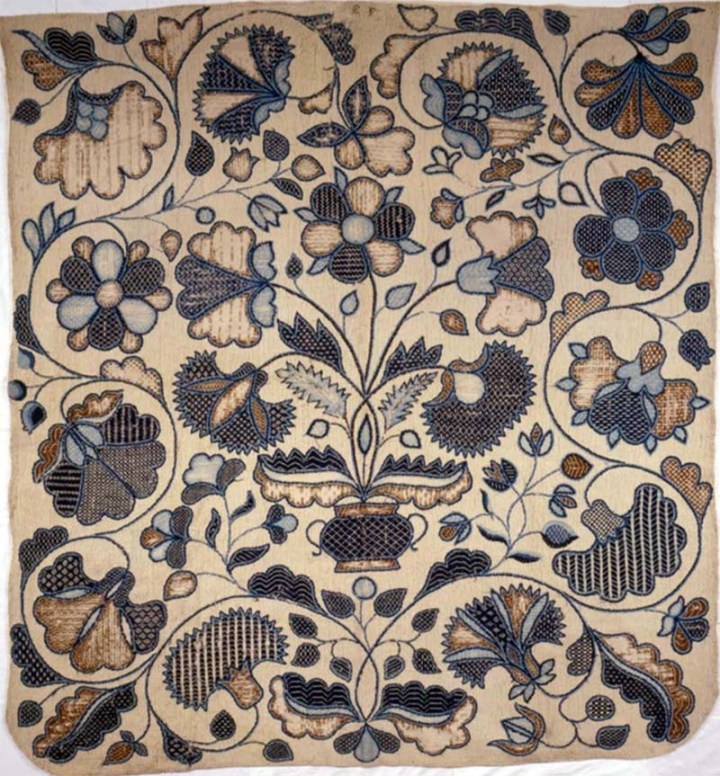
Elizabeth Foote, Bed rug, ca. 1778, Colchester, CT, hand-embroidered wool on plain woven wool ground (Courtesy of the Connecticut Historical Society, Gift of Mrs. J.H.K. Davis).
In 2022, the Florence Griswold Museum presented the exhibition New London County Quilts & Bed Covers, 1750–1825, which showcased exquisite, rarely-seen quilted petticoats, appliqued bed covers, bed rugs, and stuffed whitework quilts hand-crafted by women and girls of this region of Connecticut. The accompanying publication, set to be completed by April 2027, shares the scholarship generated for the exhibition, addressing an understudied and continuously evolving area of material culture that will open emerging areas of study for rising scholars.
Treasures of the Newport Mansions, the first ever collections catalogue for The Preservation Society of Newport County (PSNC), will span centuries and highlight the organization’s distinctive material content. Among the most significant in the United States, PSNC’s holdings uniquely encompass extraordinary objects within their original historical contexts. Presenting approximately 100 objects, the catalogue, which will be published by February 2027, will highlight advanced research made by experts and early-career scholars across multiple disciplines.
Victoria Mansion’s ‘Bold, Designing Fellows’: Italian Decorative Painters and Scenic Artists in the United States, 1820–1880 is inspired by many years of research on the Bolognese artist Giuseppe Guidicini. Previously unknown, Guidicini was responsible for the 1860 design and decoration of the wall and ceiling paintings that fill Victoria Mansion. The publication is set to be completed by May 2026 and will chronicle Guidicini’s history from his training in Bologna to his accomplishments in New York, Cincinnati, and Richmond.
Publishing Grant recipient Dr. Mariah Kupfner is an Assistant Professor of American Studies and Public Heritage at Penn State Harrisburg and earned her PhD from Boston University. She will publish Crafting Womanhood: Needlework, Gender, and Politics in the United States, 1810–1920 with the University of Delaware Press in August 2026. This publication looks closely at gendered textiles, reading them as essential sources of historical meaning and self-making.
Visit the Decorative Arts Trust’s website to learn more about the Publishing Grants program. Applications for the next round of grants are due by 31 March 2026.
Exhibition | Philadelphia, The Revolutionary City
From the APS:
Philadelphia, The Revolutionary City
American Philosophical Society Museum, Philadelphia, 11 April — 28 December 2025
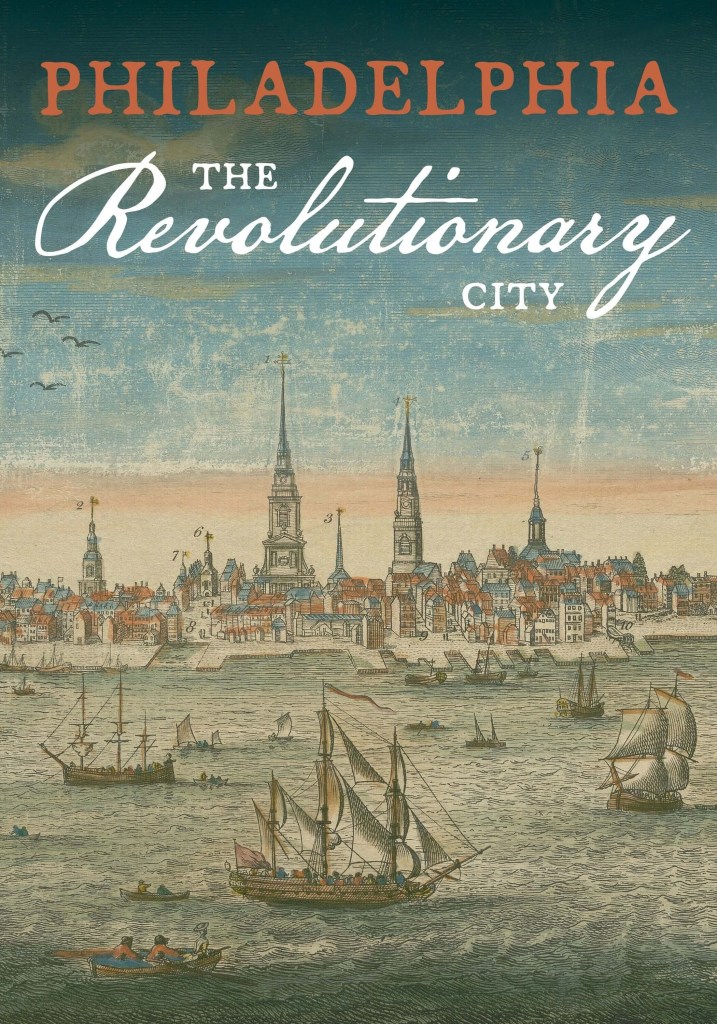 Philadelphia, The Revolutionary City illuminates the lived experiences of Philadelphians leading up to, during, and after the fight for independence. It showcases historic documents and material culture, ranging from diaries and newspapers to political cartoons and household objects. Beginning with the Stamp Act in 1765, the exhibition traces key events through the late 1780s and the impacts they had on communities living within and around the city. The exhibition features a range of voices and stories, offering windows into this turbulent period of change and presenting Revolution-era Philadelphia as a vibrant and growing city.
This exhibition is inspired by the innovative digital archive The Revolutionary City: A Portal to the Nation’s Founding, recently launched by the American Philosophical Society, the Historical Society of Pennsylvania, and the Library Company of Philadelphia, in partnership with the Kislak Center for Special Collections, Rare Books and Manuscripts and the Museum of the American Revolution. Philadelphia, The Revolutionary City brings together rare manuscript material and objects from the APS’s Library and Museum holdings, and the collections of these partners, as well as loans from regional institutions, and nearby historic houses and museums.
The related publication is distributed by the University of Pennsylvania Press:
Philadelphia, the Revolutionary City (Philadelphia: The American Philosophical Society Press, 2025), 110 pages, ISBN: 978-1606181225, $30. With contributions by Patrick Spero, Michelle Craig McDonald, John Van Horne, David R. Brigham, Caroline O’Connell, and Bayard Miller.
The book includes a fully-illustrated object checklist with information for each item as well as a curatorial statement about the project’s development. Additionally, it features three essays, one from each of the directors of the special collection libraries, focusing on key objects within each collection, plus an essay on the origins of the digital project and its ongoing work. Each essay offers a unique perspective on Philadelphia’s revolutionary history and a range of stories that can be found in these archives and on the digital portal.










leave a comment