Display | Capital Investment: Sir John Soane’s Model of Tyringham Hall
In conjunction with the London Festival of Architecture:
Capital Investment: Sir John Soane’s Model of Tyringham Hall, Buckinghamshire
Sir John Soane’s Museum, London, 3–28 June 2014
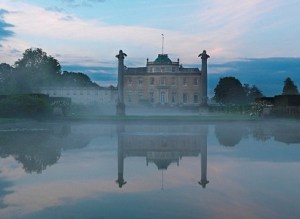 Sir John Soane revived the use of architectural models in Britain in his teaching and in his architectural practice. One of the more beautiful architectural models in Sir John Soane’s Museum is for Tyringham Hall, Buckinghamshire. Made by Joseph Parkins, c. 1793–94, in box wood, the highly detailed model was commissioned by Soane to present to his client William Praed, a Fleet Street banker. Soane designed and executed his country house from 1792 to 1800, and this model is an exceptional survival of a Soane Office ‘presentation model’ given to a client to explain volume, the arrangement of rooms and the play of light in the completed building (the model opens to reveal the interior arrangements of rooms and staircases). This is a rare opportunity to see this highly detailed presentation model which is not usually on display to the public. A model by a contemporary architect will be shown alongside to demonstrate the use importance of architectural models in today’s architectural practice.
Exhibition | The Splendours of Royal Coronations, 1610–1825

Palais du Tau, Reims (Photo by Ludovic Péron, 9 September 2007, Wikimedia Commons). From Wikipedia: “The building was largely rebuilt in Gothic style between 1498 and 1509, and modified to its present Baroque appearance between 1671 and 1710 by Jules Hardouin-Mansart and Robert de Cotte. It was damaged by a fire on 19 September 1914, and not repaired until after the Second World War. The Palace was the residence of the Kings of France before their coronation in Notre-Dame de Reims. The King was dressed for the coronation at the palace before proceeding to the cathedral; afterwards, a banquet was held at the palace. The first recorded coronation banquet was held at the palace in 990, and the most recent in 1825.”
◊ ◊ ◊ ◊ ◊
From the Palais du Tau à Reims (the 22-page press release is available as a PDF file here) . . .
Splendours of Royal Coronations from Louis XIII to Charles X
Sacres Royaux, de Louis XIII à Charles X
Palais du Tau, Reims, 28 May — 2 November 2014
Curated by Frédéric Lacaille and Benoît-Henry Papounaud
Le Centre des monuments nationaux présente, en partenariat avec le château de Versailles, l’exposition Sacres Royaux, de Louis XIII à Charles X au Palais du Tau à Reims du 28 mai au 2 novembre 2014.
 C’est au Palais du Tau, qui a accueilli à 33 reprises le roi la nuit précédant son sacre, que le Centre des monuments nationaux (CMN) a choisi de présenter cette exposition d’envergure, en partenariat avec le château de Versailles. Les visiteurs pourront y découvrir les cérémonies de sacres de 1610 à 1825, fondement essentiel de la monarchie absolue, qui consacraient le pouvoir, la puissance et la légitimité du roi. Ce partenariat d’exception avec le Château de Versailles donnera à voir de nombreuses œuvres encore jamais présentées au grand public.
Découvrez, au palais du Tau, séjour des rois pour leur couronnement, plus de 70 œuvres, témoins des fastes du règne des Bourbons, à l’occasion de cette exceptionnelle exposition en partenariat avec le château de Versailles. Au travers de tableaux, dessins, gravures, tapisseries, pièces d’orfèvrerie, éléments textiles et mobilier, l’exposition évoque les différentes étapes de la cérémonie du sacre des rois de France. Le calice des sacres, dit de Saint Remi (XIIème siècle), ou le manteau du sacre de Charles X, conservés au palais du Tau, sont mis en lumière aux côtés des collections du château de Versailles et de pièces prêtées par d’autres institutions, tel le Mobilier National, la Bibliothèque nationale de France ou le musée de l’hôtel Le Vergeur de Reims.
Le commissariat est assuré par Frédéric Lacaille, conservateur en chef au musée national des châteaux de Versailles et de Trianon, et par Benoît-Henry Papounaud, administrateur du Palais du Tau.
◊ ◊ ◊ ◊ ◊
Information about the catalogue is available as a PDF file here:
Frédéric Lacaille, Alexandre Maral, and Benoît-Henry Papounaud, Sacres Royaux, de Louis XIII à Charles X (Paris: Éditions du Patrimoine, 2014), 64 pages, ISBN: 978-2757703878, 12€.
Exhibition | Making Colour
Press release from The National Gallery for the exhibition:
Making Colour
The National Gallery, London, 18 June — 7 September 2014
Curated by Ashok Roy and Caroline Campbell

Moses Harris, Prismatic Colour Wheel, from ‘The Natural System of Colours’, hand-coloured etching, 1769/1776
(Royal Academy of Arts, London)
Making Colour, the first exhibition of its kind in the UK, offers visitors an exceptional opportunity to discover the wide-ranging materials used to create colour in paintings and other works of art. Using the National Gallery’s own paintings and loans from major UK cultural institutions, the exhibition traces the history of making colour in Western paintings, from the Middle Ages to the end of the 19th century. The exhibition brings together the worlds of art and science to explain how artists overcame the technical challenges involved in creating colour. Work on this subject has long been a specialism of the Gallery’s internationally recognised Scientific Department. Making Colour shows the material problems faced by artists in achieving their painterly aims, the breakthroughs they struggled for, and the difficulties they faced in creating works of art that were both beautiful and enduring. Making Colour looks at its subject from multiple perspectives. It examines the origins of paint sources—be it the natural world or human invention—and their supply, manufacture and application, as well as their permanence and colour effect.
The rich and diverse display with National Gallery paintings at its core is part of the ‘National Gallery Inspires’ programme of exhibitions. Drawn from the National Gallery collection, the exhibitions take a fresh view of National Gallery paintings alongside special loans and featuring world-leading research by Gallery experts. Making Colour shows the central importance of colour to painting, but also incorporates minerals along with textiles, ceramics and glass, demonstrating the material connections in these sister arts.
The exhibition begins by examining how theories of colour—such as an awareness of primary colour, or of the colour spectrum—have influenced painters’ use of pigments, and their quest for new materials. Visitors then journey from lapis lazuli to cobalt blue, ancient vermilion to bright cadmium red, through yellow, orange, purple and verdigris to deep green viridian in a series of colour-themed rooms. Finally, they enter a dazzling central room devoted to gold and silver. These metals were of fundamental importance to the colour effects of European painting through many centuries, although they do not appear on the traditional colour wheel.
Making Colour is illustrated at every stage by National Gallery paintings, complemented by selected objects on loan, such as Joseph Mallord William Turner’s paintbox. The exhibition includes Claude Monet’s Lavacourt under Snow (about 1878–81) on display with lapis lazuli figurines from the British Museum and the Ashmolean Museum, Oxford. Anthony van Dyck’s Lady Elizabeth Thimbelby and her Sister (1637) and elaborate majolica plates from the British Museum help to illustrate the story of yellow. In the red room Degas’s Combing the Hair (La Coiffure) (about 1896) and Masaccio’s Saints Jerome and John the Baptist (about 1428–29) are displayed alongside fragments of beautiful crimson velvet brocade on loan from the Victoria and Albert Museum, London.
The exhibition is complemented by a scientific experiment that introduces a new world of contemporary and scientific thought on colour. It deals with human colour perception, and the degree to which it is individually variable. It will also consider the ways in which the brain processes different visual information—for example in lighting paintings—and the impact that this has on our perception of colour.
The computer-controlled experiment in lighting and perception will be presented beside the Sainsbury Wing exhibition galleries, designed to demonstrate how we perceive and register colour, and to show that the eye and brain respond to colour in unexpected ways. The experiment has been developed with the advice of Professor Anya Hurlbert, Professor of Visual Neuroscience and Director of the Institute of Neuroscience, University of Newcastle and the support of the Wellcome Trust.
Ashok Roy, Director of Collections at the National Gallery, said: “Art and science really do come together in Making Colour. By exploring the materials that make up the array of artists’ pigments, we can begin to comprehend some of the historic circumstances and difficulties in creating colours that we now take for granted. The inclusion of objects such as early textiles, mineral samples and ceramics ensures an enticing display that provides a new angle from which to approach familiar works in the collection.”
Caroline Campbell, Curator of Italian Paintings before 1500 at the National Gallery, said: “Artists from the Middle Ages to the present day have sought to find suitable pigments and colours. This exhibition is a wonderful opportunity to celebrate this quest for colour. Thanks to the work of our Scientific Department, we can add another layer to our understanding of how artists created such beautiful images.”
Making Colour is curated by Ashok Roy, Director of Collections, and Caroline Campbell, Curator of Italian Paintings before 1500.
Study Day | Fame and Friendship: Pope, Roubiliac and the Portrait Bust
The exhibition Fame and Friendship: Pope, Roubiliac and the Portrait Bust (recently closed at YCBA) opens June 18 at Waddesdon Manor in Buckinghamshire (where it will be on display until 26 October 2014). In connection, Malcolm Baker will lead a special interest day on Thursday, 10 July.
From Waddesdon Manor:
Study Day | Fame and Friendship: Pope, Roubiliac and the Portrait Bust
Waddesdon Manor and Stowe Landscape Gardens, 10 July 2014
 Led by Professor Malcolm Baker, the curator of the exhibition, this day will begin with an in-depth look at Fame and Friendship: Pope, Roubiliac and the Portrait Bust, followed by lunch in the Manor Restaurant. In the afternoon, participants will travel to nearby Stowe Landscape Gardens to see the famous Temple of British Worthies and to explore the central role of the sculpture portrait bust in the creation and celebration of fame and friendship. The day will end with tea at Stowe. The price of your ticket (£70) includes coach travel from Waddesdon to Stowe and return to your car at Waddesdon; normal admissions charges apply to both Waddesdon and Stowe.
Malcolm Baker is Distinguished Professor of the History of Art, University of California, Riverside, and Honorary Senior Research Fellow at the Victoria and Albert Museum.
◊ ◊ ◊ ◊ ◊
In addition to The Marble Index: Roubiliac and Sculptural Portraiture in Eighteenth-Century Britain, Malcolm Baker’s major publication related to the exhibition and due out later this year from Yale University Press, a more tightly focused catalogue will be published by Paul Holberton:
Malcolm Baker, Fame and Friendship: Pope, Roubiliac and the Portrait Bust (London: Paul Holberton Publishing, 2014), 128 pages, ISBN: 978-0954731052, £15 / $25.
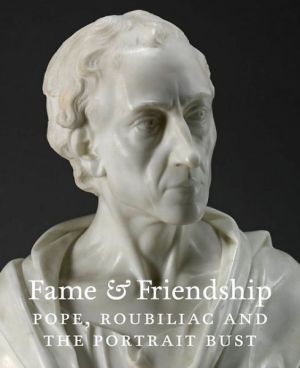 No literary figure of the eighteenth century was more esteemed than the poet Alexander Pope, and his sculpted portraits exemplify the celebration of literary fame at a period when authorship was being newly conceived and the portrait bust was enjoying new popularity. Accompanying an exhibition at Waddesdon Manor (The Rothschild Collection), this publication explores the convergence between authorship, portraiture, and the sculpted image in particular, by bringing together a wide range of works that foreground Pope’s celebrity status.
Pope took great pains over how he was represented and carefully fashioned his public persona through images, published letters and the printed editions of his works. Alongside some of the most celebrated painted portraits of the poet will be a selection of the printed texts which Pope planned with meticulous care. The publication focuses on eight versions of the same portrait bust by the leading sculptor of the period, Louis François Roubiliac.
The marble bust had long been seen as a form appropriate for the celebration of literary fame and Pope’s bust in part imitates those of classical authors whose works he both translated and consciously imitated in his own poems. More than any other sculptor, Roubiliac reworked the conventions of the bust, transforming it into a genre that was considered worthy of close and sustained attention. Nowhere is this seen more tellingly than in his compelling and intense portraits of Pope. Based on a vividly modelled clay original, the variant marble versions were carved with arresting virtuosity, recalling Pope’s own phrase, “Marble, soften’d into Life.” At the same time, the image was reproduced by both the sculptor himself and by others, in a variety of materials.
Multiplied and reproduced throughout the eighteenth century, Pope’s bust was the most familiar and visible sign of his authorial fame. At the same time, it was also used as a way of articulating friendship—a constant theme in Pope’s verse—and all the early versions of Roubiliac’s bust were probably executed for Pope’s closest friends. By bringing together the eight versions thought to have been executed by Roubiliac and his studio, and a number of other copies in marble, plaster and ceramic, this publication will offer the opportunity to explore not only the complex relationship between these various versions but the hitherto little understood processes of sculptural production and replication in eighteenth-century Britain.
Exhibition | Royal Spectacle at the French Court

C.-N. Cochin père, after C.-N. Cochin fils, Décoration du Bal Masqué donné par le Roy, plate 7 of Recueil des Festes, Feux d’Artifice, et Pompes Funèbres (Paris: Ballard, 1756). National Trust / Waddesdon Manor, 3176. Photo by Mike Fear. Depiction of the ball given by Louis XV in February 1745, on the occasion of the marriage of the Dauphin to Marie Thérèse Raphaëlle of Spain. Click here for a higher resolution image.
◊ ◊ ◊ ◊ ◊
From Waddesdon Manor:
Royal Spectacle: Ceremonial and Festivities at the French Court
Waddesdon Manor, Buckinghamshire, 26 March — 26 October 2014
Curated by Selma Schwartz and Rachel Jacobs
This exhibition marks the publication of the Catalogue of Printed Books and Bookbinding: The James A. de Rothschild Bequest at Waddesdon Manor (2013), highlighting illustrated books published on the occasion of court festivities, celebrations and spectacles. Lavishly illustrated books, with engravings of the largest format, document the many extravagant festivities and ceremonies staged for the French court during the 17th and 18th centuries to mark the life cycle of births, marriages and deaths. Fanciful theatrical stage settings are the backdrop for richly costumed processions, equestrian tournaments, theatre performances, church ceremonies and spectacular firework displays. The books themselves are often bound in exquisite bindings intended for the royal family and aristocracy. While focusing on France, the exhibition also includes some comparative material from other European courts.
Tours of the exhibition with one of the curators will take place on Friday 30 May, 11 July and 26 September. For more information on how to book, please click here.
◊ ◊ ◊ ◊ ◊
Note (added 18 June 2014) — A 45-page, illustrated checklist with details on the 58 exhibited works is available for download as a PDF file at the Waddesdon website.
Exhibition | China at Versailles: Art and Diplomacy in the 18th Century
From the Château de Versailles:
China at Versailles: Art and Diplomacy in the 18th Century
Château de Versailles, 27 May — 26 October 2014

Audience granted to the King of Siam’s ambassadors, 1 September 1686, at the Palace of Versailles, Etching on copper in black and burin At Pie. Landry rue St. Jacques at St. François de Sales, Almanac for the year 1687 (Paris, Bibliothèque nationale de France)
The Palace of Versailles presents China at Versailles: Art and Diplomacy in the 18th Century, organised for the 50th anniversary of the establishment of diplomatic relations between France and China. The exhibition follows the history of political and artistic exchanges between China and France during the 18th century. The paintings, furniture, lacquerware, porcelains and tapestries exhibited bear testimony to the extreme luxury of their time and are very rare today. The approximately 150 works gathered together for the exhibition illustrate France’s taste for Chinese artistic productions and reveal the interest among Europeans for descriptions of China throughout the 18th century.
A Political and Cultural Dialogue
In 1688, Louis XIV undertook a diplomatic policy that was to lead to high-level scientific and intellectual exchanges between France and China. By sending French Jesuits to the court in Beijing, the Sun King developed privileged, lasting relations with the Kangxi Emperor, his contemporary. Correspondence and exchanges intensified under the reigns of Louis XV and Louis XVI. The two countries developed unique diplomatic relations. The political and intellectual ties that were forged between France and China led to a veritable golden age of diplomatic relations between the two countries up to the French Revolution.

Claude-Louis Châtelet, View of the Chinese Ring Game; drawing in black chalk, watercolour and gouache; excerpt from Recueil des vues et plans du Petit Trianon à Versailles, under the direction of Richard Miquet, 1786.
Chinese Art at Versailles
Porcelains, wallpaper, lacquerware, fabrics and silks: Chinese artistic productions aroused a great deal of interest in France starting in the 18th century. Under the reign of Louis XIV, France’s taste for ‘lachine’ or ‘lachinage’ was attributed to the gifts brought from the Far East by the King of Siam’s ambassadors in 1686. This appetite for Chinese art can also be seen in what was later to be called ‘la chinoiserie’, a trend in tastes that took on various forms:
• imitations of Chinese art,
• influence of Chinese art on French art,
• adaptation of oriental materials to French tastes,
• but also the creation of an imaginary, peaceful China.
Although the French sovereigns, protectors of the arts, could not openly display their taste for China in the royal apartments, many pieces of Chinese artwork decorated their private apartments at Versailles and Trianon.
◊ ◊ ◊ ◊ ◊
Published by Somogy, the catalogue as described at the Château de Versailles:
Marie-Laure de Rochebrune, Anne-Cécile Sourisseau, and Vincent Bastien, eds., La Chine à Versailles: Art et Diplomatie au XVIIIe Siècle (Paris: Somogy éditions d’Art, 2014), 280 pages, ISBN: 978-2757208137, 39€.
 L’exposition La Chine à Versailles: Art et diplomatie au XVIIIe siècle retrace l’histoire des échanges politiques, scientifiques et artistiques entre la France et la Chine au siècle des Lumières.
Peintures, meubles, laques, gravures, porcelaines, livres précieux, tapisseries… les chefs-d’oeuvre exposés au château de Versailles témoignent du luxe raffiné de leur époque. Ils illustrent, dès le règne de Louis XIV, le goût français pour les productions artistiques chinoises. Ils révèlent aussi l’intérêt de la cour de Versailles pour l’Extrême-Orient, suscité par les descriptions que les jésuites envoyés en Chine rédigèrent dès la fin du XVIIe siècle.
Les cent cinquante oeuvres rassemblées dans cette exposition ‘évènement’ proviennent des plus grandes institutions françaises (musée du Louvre, musée Guimet, Bibliothèque nationale, etc.) et étrangères (collections royales anglaises, musée de l’Ermitage à Saint-Pétersbourg, etc.) ainsi que de collections particulières.
More information about the catalogue (in French) is available as PDF file here»
Exhibition | Exposed: A History of Lingerie
Press release (2 April 2014) from The Museum at FIT:
Exposed: A History of Lingerie
Museum at FIT, New York, 3 June — 15 November 2014
Curated by Colleen Hill
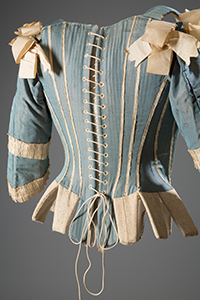
Corset (stay), silk, silk ribbon, whalebone, ca. 1770, possibly Europe
(New York: Museum at FIT)
The Museum at FIT presents Exposed: A History of Lingerie, an exhibition that traces developments in intimate apparel from the 18th century to the present. Exposed features over 70 of the most delicate, luxurious, and immaculately crafted objects from the museum’s permanent collection, many of which have never before been shown. Each piece illustrates key developments in fashion, such as changes in silhouette, shifting ideals of propriety, and advancements in technology.
The concept of underwear-as-outerwear is most commonly associated with the 1980s, but the look of lingerie has long served as inspiration for fashion garments. Exposed opens with several pairings of objects that underscore that connection. For example, a 1950s nylon nightgown, made by the upscale lingerie label Iris, is shown alongside an evening gown by Claire McCardell, also a 1950s garment, created in a similar fabric and silhouette. McCardell was one of the first designers to use nylon—a material typically marketed for lingerie—for eveningwear. A 2007 evening dress by Peter Soronen features a corset bodice, the construction of which is highlighted with bright blue topstitching. It is flanked by two 19th-century corsets, one made from bright red silk, the other from peacock blue silk.
The exhibition then continues chronologically. The earliest object on view is a sleeved corset (then called stays), circa 1770, made from sky-blue silk with decorative ivory ribbons that crisscross over the stomach. Stiffened with whalebone, 18th-century corsets straightened the back and enhanced the breasts by pushing them up and together. While they were essential to maintaining both a woman’s figure and her modesty, corsets also held an erotic allure.
Women’s undergarments were generally modest in the first half of the 19th century. This is exemplified by a dressing gown from circa 1840, made from white cotton. Although the dressing gown was simply designed and meant to be worn within the privacy of a woman’s boudoir, its full sleeves and smocked, pointed waistline mimic fashionable dress styles of the era. (more…)
Exhibition | Ai Weiwei in the Chapel
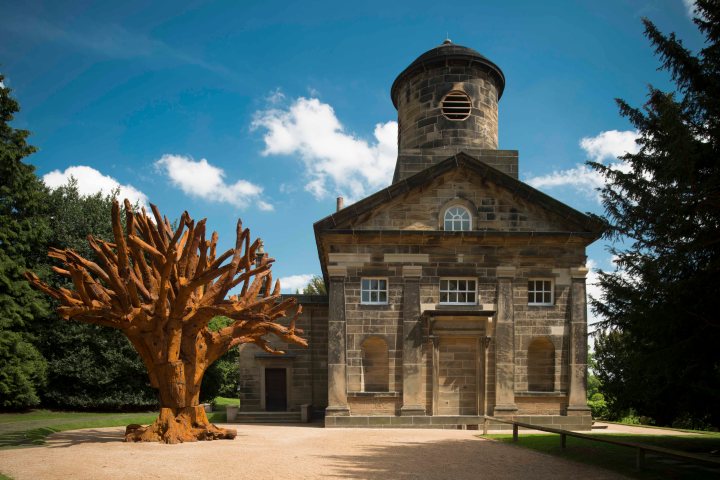
Ai Weiwei, Iron Tree, 2013, click here to enlarge.
Photo by Jonty Wilde, courtesy of Yorkshire Sculpture Park
◊ ◊ ◊ ◊ ◊
Press release (17 April 2014) from Yorkshire Sculpture Park:
Ai Weiwei in the Chapel
Yorkshire Sculpture Park, West Bretton, West Yorkshire, 24 May — 2 November 2014
Yorkshire Sculpture Park (YSP) is proud to announce an exhibition by Ai Weiwei, opening in the Park’s newly refurbished 18th-century chapel following a £500,000 restoration. The project, the first by Ai Weiwei in a British public gallery since Sunflower Seeds at Tate Modern in 2010, will be accompanied by poetry readings from the works of celebrated poet Ai Qing, Ai Weiwei’s father. Ai Weiwei in the Chapel opens to the public on Saturday 24 May 2014.
Iron Tree, 2013, a majestic six-metre high sculpture is presented in the chapel courtyard, while the installation Fairytale-1001 Chairs, 2007–14, is presented inside the chapel with three other works: the porcelain Ruyi, 2012; the marble Lantern 2014; and Map of China, 2009. The sculptures shown within the chapel relate to ideas about freedom and to the individual within society, whilst also connecting with the history and character of the building.
Iron Tree is the largest and most complex sculpture to date in the artist’s tree series, which he began in 2009. Inspired by the wood sold by street vendors in Jingdezhen, southern China, Ai’s trees are constructed from branches, roots and trunks from different trees. Although like a living tree in form, the sculptures are obviously pieced and joined together, being all the more poignant for their lack of life. Iron Tree comprises 99 elements cast in iron from parts of trees, and interlocked using a classic—and here exaggerated—Chinese method of joining, with prominent nuts and screws. Combining both the natural and crafted, the sculpture will rust over time and its installation in the secluded chapel garden makes a meditative space that gives pause for thought and is a powerful reminder of the cycles of nature.

Ai Weiwei, Fairytale-1001 Chairs, 2007, click here to enlarge.
Photo by Jonty Wilde.
◊ ◊ ◊ ◊ ◊
The second part of the exhibition, Fairytale-1001 Chairs, extends Ai’s major project for Documenta 12 in Kassel in 2007, for which he brought 1,001 Chinese citizens to Kassel for 20 days, representing each person with an antique chair. This transformational experience highlighted the complications of travel for ordinary Chinese citizens. Since his arrest in 2011, Ai’s own travel has been strictly limited and his passport is currently confiscated.
Unable to travel to Yorkshire, and working from plans and photographs of YSP’s chapel, Ai has selected 45 Fairytale-1001 Chairs and has conceived an installation of nine rows of five chairs in the nave. Spaced so that each chair is solitary, they give heightened awareness of the collective and the individual. The chairs date from the Qing Dynasty (1644–1912) and in this context challenge the class and ritual functions of such furniture, which originally was the preserve of privilege. In the stillness of the chapel, visitors are invited to take a seat and consider freedom, refuge, sanctuary and their antonyms, and to reflect on who may have sat before them, both on the chairs in China and within the 270-year-old Bretton Estate chapel. Through this simple act of participation, histories and cultures meet in a contemplative environment. As the artist has said, “those chairs are part of the fairytale—a symbolic gesture about memory and our past.”
Ai has selected two other works for the chapel. Ruyi translates to “as one wishes” and so alludes to wish-fulfilment. Sitting somewhere between fungal organic form and human internal organs, this lividly-coloured porcelain sculpture is one of a number of Ruyi made by Ai Weiwei that take the traditional Chinese sceptre of the same name, used by nobles, monks and scholars for around 2,000 years. Like talking sticks in other cultures, ruyi denoted authority and granted individuals the right to speak and be heard, so enabling orderly and democratic discourse.
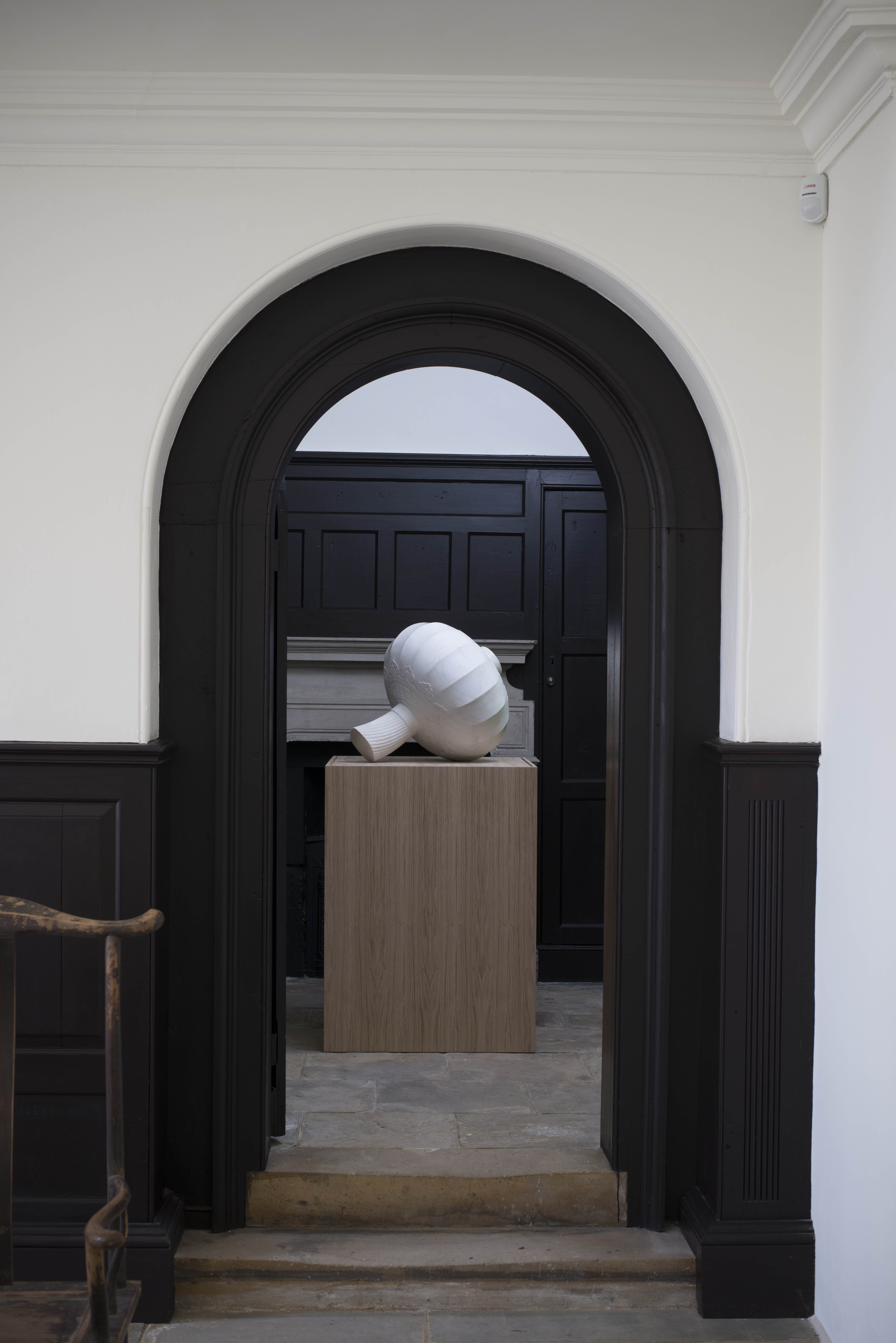
Ai Weiwei, Lantern, 2014. Photo by Jonty Wilde, courtesy Yorkshire Sculpture Park.
For some years the Chinese authorities have surrounded Ai’s home with surveillance cameras and every step he takes outside is recorded and monitored, resulting in 2010 with the series of works, Marble Surveillance Cameras. At around the same time, in a humorous gesture of mockery and defiance, he decorated the real CCTV cameras with red Chinese lanterns. For the chapel, Ai builds on this series and premieres the marble Lantern, carved in stone from the same quarries used by emperors to build the Forbidden City, and more recent rulers to build Mao’s tomb. Map of China, formed from iron wood reclaimed from Qing dynasty temples, shows China as an isolated land.
With the artist’s consent, we also present readings of works by Ai’s father, Ai Qing (1910–1996). Considered one of the most important 20th century Chinese poets, Ai Qing initially supported Mao Sedong. However, in 1958, he was found guilty of ‘rightism’ and with his family, including the baby Ai Weiwei, was sent to a labour camp and then exiled until Mao’s death, after which the family was able to return to Beijing. Readings will be made from across Ai Qing’s oeuvre, starting in 1932, and including important poems such as Snow Falls on China’s Land, My Wet-Nurse, and Wall. They demonstrate Ai Qing’s extraordinary ability to convey the strength of nature and the human spirit, even in adversity, and so connect with Ai Weiwei’s own life and this exhibition in particular.
About the Chapel
Built in 1744 by Sir William Wentworth, the Georgian sandstone chapel is historically important within YSP’s Bretton Estate. Nestled within the deer park, the Grade II* listed building was a part of the life on the estate during the 18th and 19th centuries, although it wasn’t until its acquisition by YSP in 2001 that it became more generally accessible. Artists shown here prior to restoration include James Lee Byars, Shirin Neshat and Jem Finer.
Restoration work carried out over the last nine months has transformed the gallery into a unique and versatile gallery space. Outside the building, work has included the renewal of the roof, repairs to eliminate water ingress and damp, and the renovation of external stonework. Inside the chapel, repairs have been made to the floor and internal timbers, while climactic conditions have been enhanced with the introduction of new lighting, heating and ventilation systems, and an environmentally friendly air source heat pump. Visitors to the Park will now enjoy improved access to the chapel with a new pathway from the visitor centre, wheelchair access into the building and an accessible toilet.
The £500,000 restoration of the chapel was supported by: English Heritage, Country Houses Foundation, The Wolfson Foundation, The Headley Trust, The Pilgrim Trust, the Holbeck Charitable Trust, The Leche Trust, The John S Cohen Foundation, Sir George Martin Trust, Kenneth Hargreaves Charitable Trust, Linden Charitable Trust, Jill Franklin Trust, and generous visitor donations. The lead professional advisor on the project was W. R. Dunn & Co Architects (RICS Conservation accredited building surveyor) and the appointed main contractor was William Anelay.
Exhibition | Paintings from the Society of Antiquaries of London
The summer kicks off the first of what’s planned as a regular feature of annual temporary exhibitions at the Society of Antiquaries of London:
Portraying the Past: Paintings from the Society of Antiquaries of London
Burlington House, Society of Antiquaries of London, 30 June — 1 August 2014
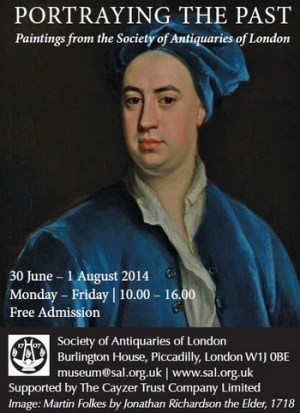 An exhibition of the Society’s collection of paintings including portraits of eighteenth-century antiquaries and rare fifteenth- and sixteenth-century portraits of medieval and Tudor monarchs and rulers of early modern Europe. These include the outstanding group of fifteenth- and sixteenth-century panel paintings bequeathed to the Society in 1828 by Thomas Kerrich, FSA, including portraits of Richard III, Henry VII and Henry VIII, as well as such works of international importance as the portraits of Jan van Scorel, by Antonis Mor, and of Mary I, by Hans Eworth.
Exhibition | Coypel’s Don Quixote Tapestries
Next February at The Frick:
Coypel’s Don Quixote Tapestries: Illustrating a Spanish Novel in Eighteenth-Century France
The Frick Collection, New York, 24 February — 17 May 2015
Curated by Charlotte Vignon
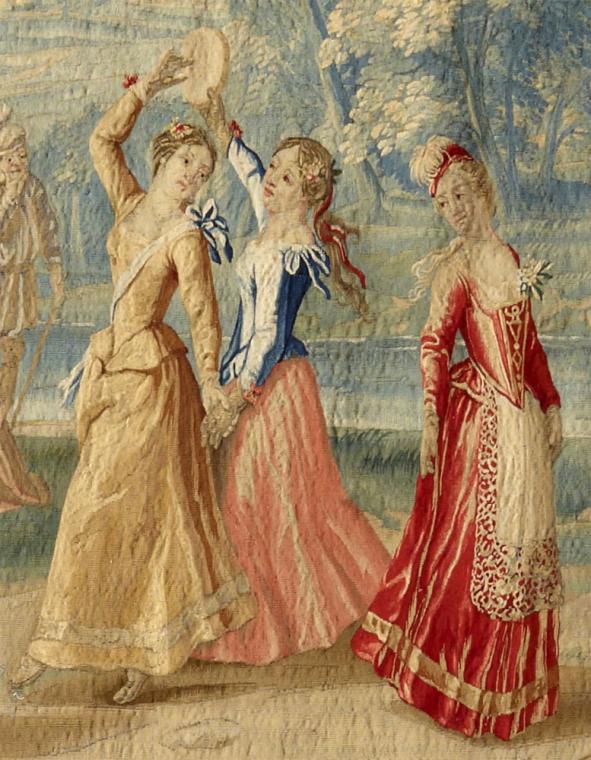
Peter Van den Hecke, The Arrival of Dancers at the Wedding of Camacho (detail), Brussels, ca. 1730s–40s. Tapestry,
123 x 219 inches (New York: The Frick Collection).
Photo by Michael Bodycomb.
A masterpiece of comic fiction, Cervantes’s Don Quixote (fully titled The Ingenious Gentleman Don Quixote of La Mancha) enjoyed great popularity from the moment it was published, in two volumes, in 1605 and 1615, respectively. Reprints and translations spread across Europe, captivating the continental imagination with the escapades of the knight Don Quixote and his companion, Sancho Panza. The novel’s most celebrated episodes inspired a multitude of paintings, prints, and interiors. Most notably, Charles-Antoine Coypel (1694–1752), painter to Louis XV, created a series of twenty-eight cartoons to be produced by the Gobelins tapestry manufactory in Paris. Twenty-seven were painted between 1714 and 1734, with the last scene realized just before Coypel’s death in 1751. In 2015 (the four-hundredth anniversary of the publication of the second volume of Don Quixote), the Frick will bring together a complete series of Coypel’s scenes, which will be shown in the Frick’s Oval Room and East Gallery. The exhibition with include the Frick’s two large tapestries inspired by Coypel—which have not been shown for more than ten years—and twenty-five other eighteenth-century paintings, prints, and tapestries from Coypel’s designs.
The accompanying publication will explore Coypel’s role in illustrating Don Quixote and the circumstances of his designs becoming the most renowned pictorial interpretations of the novel. It will also map the production of Coypel’s Don Quixote tapestries, from cartoons and engravings to looms in Paris and Brussels. The Frick will offer rich education programs that will include a series of lectures on eighteenth-century French and Flemish tapestries and on the illustration of Don Quixote over the centuries. Further programs will explore the history of the novel and its influence on artists working in a variety of media, including film, ballet, and opera. The exhibition is organized by the Frick’s Associate Curator of Decorative Arts, Charlotte Vignon.










 Enfilade
leave a comment