Exhibition | Recasting the Past: The Art of Chinese Bronzes, 1100–1900

Incense Burner in the Form of a Goose, Ming dynasty (1368–1644), early 15th century, bronze
(New York: The Metropolitan Museum of Art).
◊ ◊ ◊ ◊ ◊
From the press release (9 January) for the exhibition:
Recasting the Past: The Art of Chinese Bronzes, 1100–1900
The Metropolitan Museum of Art, New York, 28 February — 28 September 2025
Shanghai Museum, 3 November 2025 — 8 March 2026
Curated by Pengliang Lu
In ancient China, bronze vessels were emblems of ritual and power. A millennium later, in the period from 1100 to 1900, such vessels were rediscovered as embodiments of a long-lost golden age that was worthy of study and emulation. This ‘return to the past (fugu) was part of a widespread phenomenon across all the arts to reclaim the virtues of a classical tradition. An important aspect of this phenomenon was the revival of bronze casting as a major art form. Opening at The Metropolitan Museum of Art on 28 February 2025, Recasting the Past: The Art of Chinese Bronzes, 1100–1900 aims to be the most comprehensive study of Chinese bronzes during this period. This exhibition, co-organized by The Met and the Shanghai Museum, where it will open following its display in New York, will present the new aesthetic represented by these creative adaptations of the past, while exploring their cultural and political significance throughout China’s long history.
 “While bronze as an art form has long held a significant role throughout China’s history, this exhibition explores an often-overlooked time period when a resurgence of craftsmanship and artistic achievements revitalized the medium,” said Max Hollein, The Met’s Marina Kellen French Director and Chief Executive Officer. “Bringing together major loans from institutions in China alongside works from The Met collection, this exhibition offers viewers an important opportunity to better understand the lasting aesthetic and cultural impact of bronze objects.”
The exhibition will be divided into five thematic and chronological sections that explicate over 200 works of art—an array of bronze vessels complemented by a selection of paintings, ceramics, jades, and other media. Some 100 pieces from The Met collection will be augmented by nearly 100 loans from major institutions in China, Japan, Korea, Germany, France, the United Kingdom, and the United States to present the most comprehensive narrative of the ongoing importance of bronzes as an art medium throughout China’s long history. Featured in the exhibition are around 60 loans from institutions in China, including major works such as a monumental 12th-century bell with imperial procession from the Liaoning Provincial Museum, documented ritual bronzes for Confucian temples from the Shanghai Museum, and luxury archaistic vessels made in the 18th-century imperial workshop from the Palace Museum, Beijing.
The exhibition begins with the section “Reconstructing Ancient Rites,” which introduces how emperors and scholar-officials commissioned ritual bronzes from the 12th to the 16th century as part of an effort to restore and align themselves with antique ceremonies and rites. The exhibition continues with “Experimenting with Styles,” illustrating how the form, decoration, and function of ancient bronzes were creatively reinterpreted from the 13th to the 15th century. The next section, “Establishing New Standards,” will explore further transformations in both the aesthetic and technical direction of bronze making from the 15th to the 17th century. The fourth section, “Living with Bronzes,” will feature a display in the Ming Furniture Room (Gallery 218) to demonstrate how bronzes were used in literati life from the 16th to the 19th century. The last section, “Harmonizing with Antiquity,” will examine how the deep scholarly appreciation of archaic bronzes during the 18th and 19th centuries led to a final flourishing of bronze production.
Pengliang Lu, Brooke Russell Astor Curator of Chinese Art at The Met, said: “This exhibition attempts a long-overdue reevaluation of later Chinese bronzes by seeking to establish a reliable chronology of this art form across the last millennium of Chinese history. The exhibition will also distinguish outstanding works from lesser examples based on their artistic and cultural merits.”
Later Chinese bronzes have long been stigmatized as poor imitations of ancient bronzes rather than being seen as fundamentally new creations with their own aesthetic and functional character. This exhibition redresses this misunderstanding by showcasing their artistic virtuosity, innovative creativity, and wide cultural impact. Through archaeologically recovered examples and cross-medium comparisons to a wide range of objects, the exhibition demonstrates the ongoing importance and influence of bronzes as well as how they inspired the form and function of works in other media. Recasting the Past: The Art of Chinese Bronzes, 1100–1900 is curated by Pengliang Lu, Brooke Russell Astor Curator of Chinese Art at The Metropolitan Museum of Art.
The catalogue is distributed by Yale University Press:
Pengliang Lu, Recasting the Past: The Art of Chinese Bronzes, 1100–1900 (New York: The Metropolitan Museum of Art, 2025), 320 pages, ISBN: 978-1588397904, $65.
Exhibition | Being There
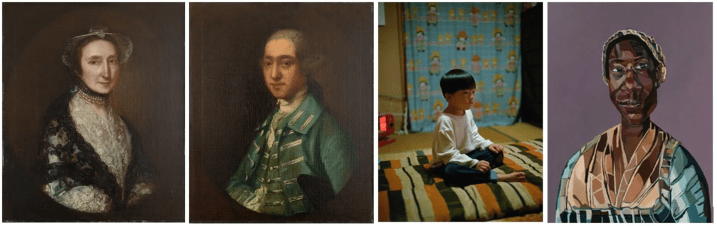
Left to right: Thomas Gainsborough, Portraits of Elizabeth Tugwell and Thomas Tugwell, each ca. 1763, oil on canvas; Paul Graham, Ryo, Japan, 1995, colour coupler print (Courtesy the artist and Anthony Reynolds); Joy Labinjo, She is my wife and truly best part, 2022, oil on canvas (Courtesy Tiwani Contemporary).
◊ ◊ ◊ ◊ ◊
Now on view at No. 1 Royal Crescent:
Being There
No. 1 Royal Crescent, Bath, 14 September 2024 – 23 February 2025
Curated by Ingrid Swenson
Our new exhibition Being There features four recently acquired portraits by Thomas Gainsborough (1727–1788) and eighteen portraits by contemporary artists. The exhibition is the first in The Gallery at No.1 Royal Crescent’s ambitious new programme of contemporary art exhibitions.
The four Gainsborough paintings are presented as key components of a kaleidoscopic group exhibition of portraiture featuring eighteen contemporary British artists selected by guest curator Ingrid Swenson MBE. The title for the exhibition, Being There, is intended to invite visitors to reflect on the experience of artists and their sitters or subject in the act of making the artwork, and to consider what similarities and differences there may be for the role of the artist in Gainsborough’s time and today. Artists in Being There are Michael Armitage, Frank Auerbach, Sarah Ball, Richard Billingham, Glenn Brown, Brian Dawn Chalkley, Kaye Donachie, Paul Graham, Maggi Hambling, David Hockney, Claudette Johnson, Chantal Joffe, Lucy Jones, Joy Labinjo, Melanie Manchot, Celia Paul, Gillian Wearing, and Shaqúelle Whyte.
Painted around 1763, the Gainsborough portraits depict members of the prominent Tugwell family from Bradford on Avon: clothier Humphrey Tugwell and his wife Elizabeth, along with their sons William and Thomas. It is exceptionally rare for a set of four portraits of members of the same family by Gainsborough to survive together. Rarer still is the fact that the sitters are not aristocratic visitors to fashionable Bath, but middle-class manufacturers from a small West Country town.The suite of portraits is remarkable for capturing two generations of a wealthy, upwardly mobile manufacturing family. Housed in their original frames carved by Carlo Maratta, these four portraits must be seen in person to be fully appreciated!
The four Gainsborough portraits were Accepted in lieu of Inheritance tax by HM Government in 2024 and allocated to Bath Preservation Trust.
Exhibition | Keeping Time: Clocks by Boulle

Attributed to André-Charles Boulle, movement by Claude Martinot, Mantel clock with Father Time (detail), ca. 1726
(London: The Wallace Collection)
◊ ◊ ◊ ◊ ◊
From the press release for the exhibition (and note the study day on January 31) . . .
Keeping Time: Clocks by Boulle
The Wallace Collection, London, 27 November 2024 — 2 March 2025
Curated by Alexander Collins
For the first time, the Wallace Collection has brought together its clocks by André-Charles Boulle (1642–1732), one of history’s greatest designers and cabinetmakers, in a display that explores the art and science of timekeeping. Five exceptional timepieces tell the story of how Boulle took advantage of scientific discoveries to create unique clock designs, whose influence spread throughout the world and across the centuries.
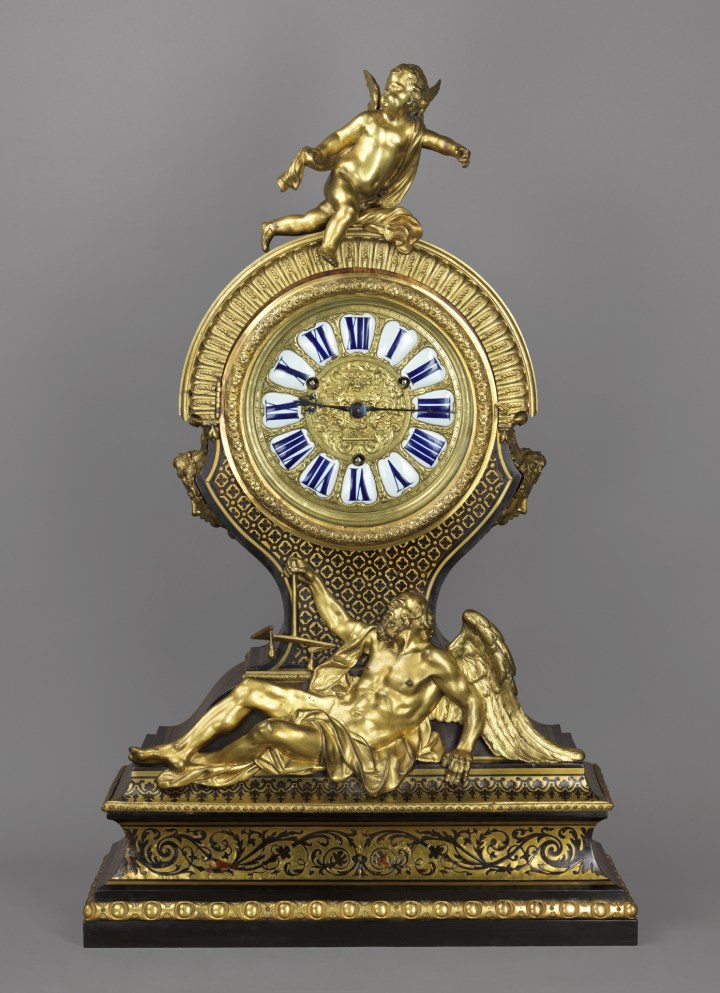
Attributed to André-Charles Boulle, movement by Claude Martinot, Mantel clock with Father Time, ca. 1726 (The Wallace Collection).
As the most famous cabinetmaker working for the court of the Sun King, Louis XIV (1638–1715), Boulle would eventually give his name to the specific style that signified the glittering spectacle of the Baroque—elaborate veneer designs incorporating turtleshell, brass, and other materials. Alongside his work as a royal furniture maker, Boulle also turned his attention to the clock, the accuracy of which had recently been revolutionised through the invention of the pendulum by Dutch scientist Christiaan Huygens (1629–1695) in 1656. As these sweeping weights called for larger clock cases, Boulle saw the opportunity to create bold and sumptuous designs.
Due to his position at court, Boulle was exempted from strict guild regulations, allowing him to work with great creative freedom. This artistic liberty was incredibly important, as the clocks not only had to demonstrate the wealth of their owners through the most luxurious materials available, but also had to show how intellectual they were. Therefore, Boulle infused his designs with narratives that chimed with scientific knowledge. Time and the natural laws of the universe are personified, for example Father Time as a bearded old man, and the Continents as figures from across the world. As well as creating innovative iconography, Boulle also reflected on the history of timekeeping by incorporating motifs such as gothic hourglasses in his clock cases.
The clocks are also products of collaboration involving the multi-disciplinary efforts of artists and craftspeople from all over 18th-century Paris. Each clock has a mechanism by a different leading clockmaker from Boulle’s time: Pierre Gaudron (died 1745), Jean Jolly (active about 1698), Claude Martinot (active about 1718), Louis Mynuël (1675–1742) and Jacques-Augustin Thuret (1669–1739). Some of these were Boulle’s neighbours in the workshops of the Louvre, as well as François Girardon (1628–1715), the king’s official sculptor, who supplied mounts of Father Time for Boulle’s clocks.
The clocks on display show the wide range of objects that Boulle turned his hand to. A monumental wardrobe from 1715 that encloses a clock, crowned with cherubs; two mantel clocks, one from around 1715 featuring Venus and Cupid, and another, from a decade later, with the figure of Father Time; as well as two extraordinary pedestal clocks.
The display opens ahead of an international conference on Boulle, to be held at the Wallace Collection in early 2025. One of the first major research events on the cabinetmaker in recent years, it will bring together specialists and conservators to consider the work of this fascinating artist, all within the same building where some of his greatest artistic achievements can be found.
Many of Boulle’s contemporaries also drew on the concept of time in their work. This will be explored in a complementary display in the museum’s Billiard Room, which is uniting two magnificent artworks: The Dance to the Music of Time (about 1634–36) by Nicolas Poussin (1594–1665), in which the Four Seasons dance to the song of Father Time, the composition of their rhythmic bodies echoing the workings of a clock movement; and The Borghese Dancers (1597–1656), where five female figures masquerade as the Hours, attendants to the goddesses of the Dawn and Moon.
Xavier Bray, Director of The Wallace Collection, says: “I am absolutely thrilled to be bringing great works of art by Boulle together for the first time. These clocks were at the cutting edge of 18th-century technology, combining exquisite artistry and mechanical expertise into a unique and innovative blend. Through Boulle’s clocks and the display, we hope visitors will be able to transport themselves into the world of Louis XIV, where luxury touched every element of the court, including something as essential and practical as timekeeping.”
Alexander Collins, Curatorial Assistant at the Wallace Collection and curator of the display, says: “Our research on these objects has revealed many unknown facets of their history, including bringing to life the multitude of artists and craftspeople who came together to make Boulle’s vision into a reality. The passage of time as a metaphor for life and death has been an important theme for artists since humanity discovered their creativity, and Boulle’s designs are important, and resonate with us today, because of this deep symbolism.”
◊ ◊ ◊ ◊ ◊
Boulle Study Day
Online and in-person, Friday, 31 January 2025
Delve into the world of baroque France and learn more about Boulle’s furniture with leading specialists, including curators and conservators from the Palace of Versailles, the Château de Chantilly, and C2RMF. You’ll explore the evolution of Boulle’s iconic designs, his materials and techniques, and his enduring legacy. This in-person event at the Wallace Collection will also be broadcast live on Zoom. Ticketholders will receive a link to a recording of the event, which will be available for two weeks. Full programme to follow: 10.00–17.00 GMT, with a drinks reception until 19.00.
Registration is available here»
Exhibition | Luisa Roldán: Royal Sculptor
Adam Busiakiewicz noted the exhibition at Art History News a few weeks ago:
Luisa Roldán: Escultora Real
Museo Nacional de Escultura, Valladolid, 29 November 2024 — 9 March 2025
Curated by Miguel Ángel Marcos Villán and Pablo Amador Marrero
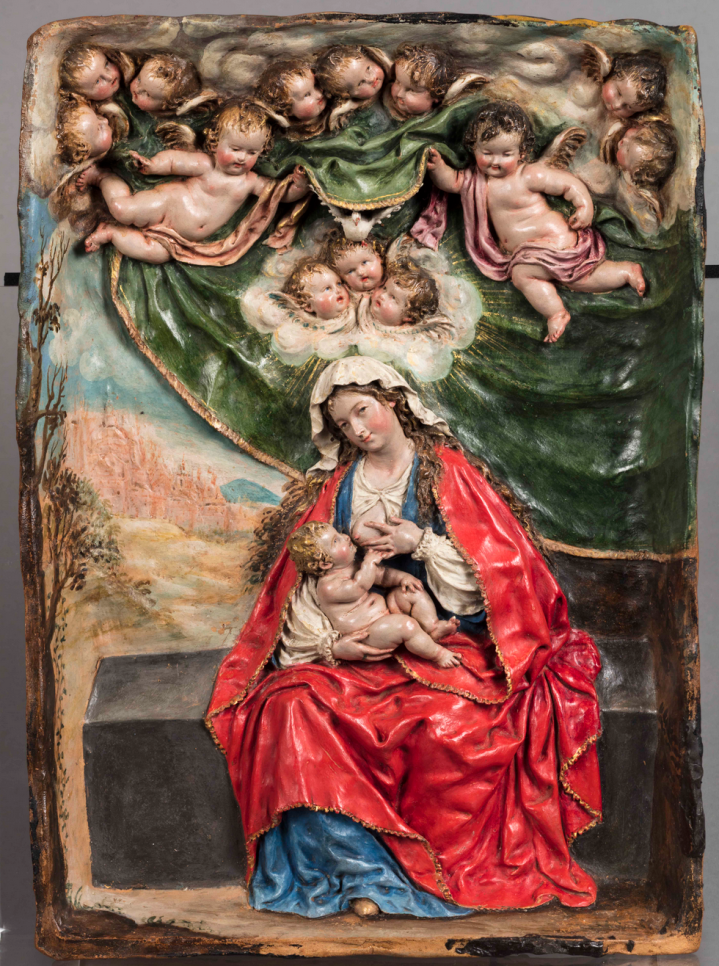
Luisa Roldán, Virgen con el Niño (Sevilla, Convento de San José).
Esta exposición permitirá al visitante adentrarse en una vida apasionante. Luisa Roldán (1652–1706) aunó excelencia, versatilidad y habilidad para romper las barreras de género y llegar a lo más alto como artista: fue nombrada escultora del rey por Carlos II, cargo que mantuvo con Felipe V. Además, fue la primera artista española en ingresar en la Academia de San Lucas en Roma, un hito nunca antes alcanzado por escultores hispanos.
Pero Luisa Roldán: Escultora real también es el producto de una reivindicación y de una necesidad de hacer presente la trayectoria de una de las más destacadas artistas españolas. De hecho, nunca cayó en el olvido y autores como Antonio Palomino (quien la conocería personalmente), Antonio Ponz o Juan Agustín Ceán Bermúdez alabaron su obra. Sin embargo, el hecho de que fuera considerada por muchos como autora de menor calidad que su padre, identificando con él buena parte de su producción, ha pesado en algunos de los estudios que se realizaron sobre su figura. Como también que se le adjudicaran sobre todo obras de devoción, delicadas y de pequeño formato en barro cocido, «más propias de su condición y sexo», según autores como el propio Ceán Bermúdez, dejando en un lugar secundario su rica y extraordinaria producción de obras en madera y de mayor formato.
La dedicación de Luisa Roldán al oficio de la escultura sólo fue posible por su nacimiento en el seno de una familia dedicada a esta disciplina. Su padre, Pedro Roldan fue el gran artista del mercado sevillano y de buena parte del andaluz durante la segunda mitad del siglo XVII. La artista, cuyas dotes para el oficio se desvelaron en época muy temprana, heredó de él la inquietud por el mejor conocimiento del arte. Tras dejar el taller paterno se estableció en Sevilla junto a su marido, Luis Antonio de los Arcos. De allí se trasladaron a Cádiz, metrópoli comercial del momento, y posteriormente el matrimonio y sus hijos fijaron su residencia en Madrid. Allí la escultora pudo entrar al servicio de la Corte, alcanzando el mayor éxito y reconocimiento al que cualquier artista de la época podía aspirar.
Miguel Ángel Marcos Villán and Pablo Amador Marrero, Luisa Roldán: Escultora Real (Valladolid: Museo Nacional de Escultura, 2024), €40.
Exhibtion | John Smart: Virtuoso in Miniature

John Smart | Left: Portrait of a Woman, 1772, watercolor on ivory, framed: 5.1 × 3.8 cm, F65-41/13. Center: Portrait of Muhammad Ali Khan Wallajah, Nawab of Arcot and the Carnatic, 1788, watercolor on ivory, framed: 5.4 × 4.5 cm, F71-32. Right: Portrait of Mr. Holland, 1806, watercolor on ivory, framed: 11.1 × 7.8 cm, F65-41/47.
◊ ◊ ◊ ◊ ◊
From the press release for the exhibition:
John Smart: Virtuoso in Miniature
Nelson-Atkins Museum of Art, Kansas City, 21 December 2024 — 4 January 2026
Curated by Aimee Marcereau DeGalan with Blythe Sobol and Maggie Keenan
A stunning array of jewel-like portrait miniatures by English artist John Smart (1741—1811), including signed and dated examples from nearly every year of his career, are being featured at The Nelson-Atkins Museum of Art in Kansas City in the exhibition John Smart: Virtuoso in Miniature. Included is a rare self-portrait of the artist, one of only nine known examples. It was made in 1793 while the artist was living in India. Timed to coincide with the final launch in spring 2025 of the digital Starr Catalogue of Portrait Miniatures—a groundbreaking resource dedicated to John Smart that reveals fresh discoveries across his career— this exhibition presents his work chronologically, showcasing new additions to the collection for the first time in nearly six decades. Presented to the Nelson-Atkins by Mr. and Mrs. John W. Starr in two major gifts in 1958 and 1965, and numerous additional gifts throughout the years, the Starr Collection of Portrait Miniatures illustrates the history of European miniatures across more than 250 objects.

John Smart, Self-Portrait, 1793, pencil on laid paper, oval image 19.8 × 17.5 cm (Kansas City: Nelson-Atkins Museum of Art, 2024.10).
“Visitors will be able to see Smart’s progression of style and technique and also explore themes of self-presentation,” said Julián Zugazagoitia, Director & CEO of the Nelson-Atkins. “The Starr family’s dedication to collecting the work of John Smart reflects their commitment to preserving the legacy of one of the most skilled portrait miniaturists of the eighteenth-century.”
Martha Jane Phillips and John W. ‘Twink’ Starr assembled one of the most comprehensive collections of works by English artist John Smart, including signed and dated examples from nearly every year of the artist’s career. Despite their persistent efforts, acquiring a self-portrait remained elusive. In 1954, they learned of the potential availability of a self-portrait in private hands, but they were too late; it was sold to the Museum of Fine Arts, Boston. Relentless in their pursuit, they appealed to successive Boston museum directors to sell or trade for the work, but they were unsuccessful. They ultimately acquired an oil painting of Smart by his near-contemporary Richard Brompton (English, 1734–1783), which they later donated to the Philbrook Museum in Tulsa, Oklahoma. The Starrs’ quest for a self-portrait, initiated on their twenty-fifth wedding anniversary, remained unrealized in their lifetime due to the rarity of such works.
“None of John Smart’s contemporaries painted as many self-portraits, which suggests Smart’s conscious understanding of what the vehicle of portraiture played in self-promotion,” said Aimee Marcereau DeGalan, Louis L. and Adelaide C. Ward Senior Curator, European Arts, and co-curator of this exhibition, along with Starr researchers Blythe Sobol and Maggie Keenan. “Smart was incredibly ambitious and self-confident, and this is the largest known self-portrait that he made. We are unbelievably thrilled to have been able to make this strategic acquisition.”
This self-portrait was acquired by a private London collector, who kept it until fall 2023, when it was consigned to a London dealer. With support from Starr family descendants, the Nelson-Atkins purchased this remarkable work in the year marking John and Martha Jane Starr’s 95th wedding anniversary—a fitting tribute to their enduring legacy.
John Smart: Virtuoso in Miniature facilitates a greater understanding of the artist’s stylistic evolution, working methods, and impact across two continents, while exploring the impact of British colonialism and the changing fashions of the eighteenth and early nineteenth centuries.
Print Quarterly, December 2024
The long eighteenth century in the latest issue of Print Quarterly:
Print Quarterly 41.4 (December 2024)
a r t i c l e s
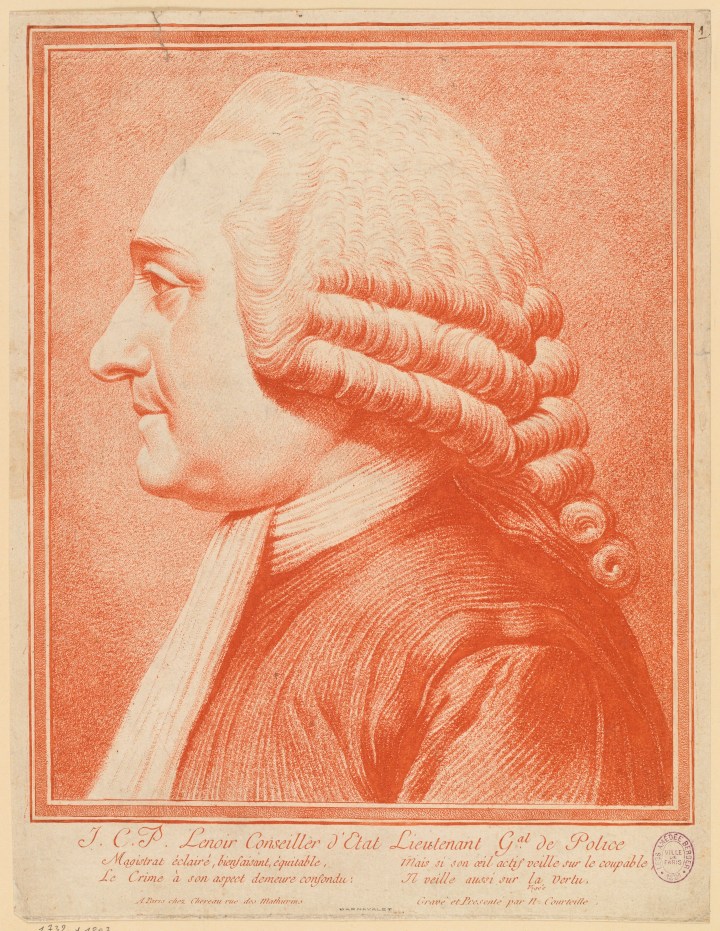
Nicholas de Courteille, presumably after Jean Pierre Bouch, Jean Charles Pierre Lenoir, 1779, soft-ground etching, 308 × 235 mm (Paris, Musée Carnavalet, Histoire de Paris).
• Dorinda Evans, “Jean Pierre Bouch, A Rediscovered Polymath”, pp. 394–407. This article attempts to compile the real identity and life story of the French artist Jean Pierre Bouch (1765–1820), whose diverse career included being a balloonist and pyrotechnician as well as portrait artist.
n o t e s a n d r e v i e w s
• Christian Rümelin, Review of Jean-Gérald Castex, ed., Graver pour le Roi: Collections Historiques de la Chalcographie du Louvre (Louvre éditions and Lienart éditions, 2019), pp. 434–37.
• Evonne Levy, Review of Bettina Wassenhoven, Gravuren nach Skulpturen – Skulpturen nach Gravuren (Konigshausen & Neumann, 2021), pp. 437–38.
• Simon McKeown, Review of Rosa de Marco and Agnès Guiderdoni, eds., Eliciting Wonder: The Emblem on the Stage (Librairie Droz, 2022), pp. 438–41.
• Clarissa von Spee, Review of Anne Farrer and Kevin McLoughlin, eds., The Handbook of the Colour Print in China, 1600–1800 (Brill, 2022), pp. 441–45.
• Nicholas JS Knowles, “The First British Caricature in Aquatint?,” pp. 445–47.
• Bénédicte Maronnie, Reviews of Chiara Casarin and Pierluigi Panza, eds., Giambattista Piranesi: Architetto senza tempo / An Architect out of Time (Silvana Editoriale, 2020); Moritz Wullen and Georg Schelbert, eds., Das Piranesi-Prinzip (E.A. Seeman Verlag, 2020); and Carolyn Yerkes and Heather Hyde Minor, Piranesi Unbound (Princeton University Press, 2020), pp. 469–73.
b o o k s r e c e i v e d
• Jennifer Milam and Nicola Parsons, eds., Making Ideas Visible in the Eighteenth Century (University of Delaware Press, 2021), p. 460.
• Ian Haywood, Queen Caroline and the Power of Caricature in Georgian England (Palgrave Macmillan, 2023), p. 460.
Exhibition | In Slavery’s Wake: Making Black Freedom
From the press release for the exhibition, recently covered by Jennifer Schuessler for The New York Times:
In Slavery’s Wake: Making Black Freedom in the World
National Museum of African American History and Culture, Washington DC, 13 December 2024 — 8 June 2025
Other venues will include museums in Belgium, Brazil, England, Senegal, and South Africa

The Smithsonian’s National Museum of African American History and Culture (NMAAHC) recently unveiled its first international touring exhibition, In Slavery’s Wake: Making Black Freedom in the World. Through powerful forms of artistic expressions, such as quilting, music and ironwork, the exhibition reveals healing traditions rooted in the resilience of enslaved people. Featuring more than 190 artifacts, 250 images, interactive stations, and newly commissioned artworks, In Slavery’s Wake offers a transformative space to honor these legacies of strength and creativity.
“This global exhibition is a profound journey through the African diaspora, reflecting on our shared history and envisioning a future shaped by resilience and freedom,” said Kevin Young, Andrew W. Mellon Director, Smithsonian National Museum of African American History and Culture. “It beautifully intertwines the past and present, inviting visitors to experience our heritage’s multilingual, multinational, and forward-looking spirit. This show reflects not just the impact of slavery but a celebration of the freedom-making efforts of the enslaved and abolitionists, embodying the humane and interconnected world we live in today.”
In Slavery’s Wake reckons with the impact of slavery and colonialism on present-day societies around the world and explores the often-overlooked efforts of the enslaved to force the end of slavery with legal emancipation and abolition as well as to provide a wellspring for descendants to draw upon to help create a better world for themselves and their communities through art, storytelling, music, protest, and communal healing. It delves into key questions about freedom and its expressions across six sections.
Organized by the National Museum of African American History and Culture’s Center for the Study of Global Slavery and the Ruth J. Simmons Center for the Study of Slavery and Justice at Brown University, the exhibition grew out of a decade-long collaboration between international curators, scholars, and community members who were committed to sharing stories of slavery and colonialism in public spaces. The collective worked across geographies, cultures, and languages, connecting the past and the present.
After its close in Washington, the exhibition will travel to museums in Belgium, Brazil, England, Senegal, and South Africa. Curatorial partners from each location contributed stories, objects and oral histories that reflect their local communities within this global history. It also incorporates a new collection of more than 150 oral histories filmed at each partner site, titled Unfinished Conversations. Voices from this international archive of everyday people’s memories and stories are featured throughout.
Paul Gardullo, Johanna Obenda, and Anthony Bogues, eds., with a foreword by Lonnie G. Bunch III, In Slavery’s Wake: Making Black Freedom in the World (Washington, DC: Smithsonian Books, 2024), 240 pages, ISBN: 978-1588347794, $40.
Exhibition | Gold and Silver Boxes in Dublin, 1662–1830

On view at Dublin Castle:
‘The Metal Stamp’d by Honest Fame’: Gold and Silver Boxes in Dublin, 1662–1830
Dublin Castle, 14 November 2024 — 31 March 2025
This exhibition is the first to present the work of the mostly forgotten artisans who worked in the small streets around Dublin Castle during the Georgian era making beautiful boxes in gold and silver for presentation to dukes, earls, and other luminaries. There are boxes made for heroes and villains alike—Edmund Burke, Henry Grattan, Luke Gardiner, Viscount Castlereagh, naval captains who fought the French, a city merchant who confronted Robert Emmet, and Henry Johnson, the victor in the bloodiest battle of 1798. The exhibition highlights the box makers’ inventiveness and ingenuity, showing the small luxuries they made for their fashionable and prosperous customers. In addition to loans from Irish collections, the exhibition brings sumptuous artefacts not seen here in centuries, such as the bejewelled gold Rathdowne box from 1823— back to Dublin from the US, UK, and continental Europe. The exhibition reveals Georgian Dublin as a vibrant place where hierarchical deference, civic politics, personal ostentation, sentimental attachment, anxieties about invasion, and rebellion all found expression in small, exquisitely made boxes.
Exhibition | Painted with Silk: The Art of Early American Embroidery
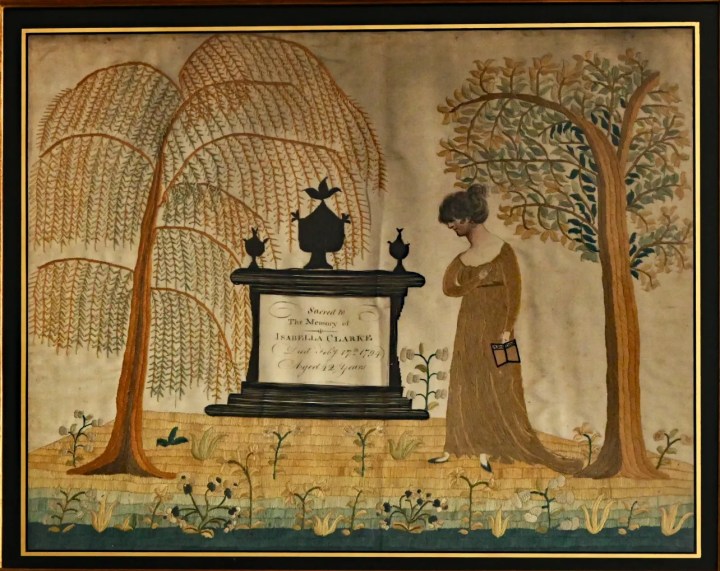
Sacred to the Memory of Isabella Clarke, Unidentified Member of the Clarke Family, Richmond, Massachusetts, ca. 1795 c
(Private Collection)
◊ ◊ ◊ ◊ ◊
From the press release for the exhibition:
Painted with Silk: The Art of Early American Embroidery
Detroit Institute of Arts, 13 December 2024 — 15 June 2025
Curated by Kenneth Myers
The Detroit Institute of Arts presents Painted with Silk: The Art of Early American Embroidery, a loan exhibition featuring a large selection of remarkably beautiful and well-preserved samplers and silk-on-silk embroideries produced by American girls and young women in the colonial and early national periods. Comprising 69 embroideries and one painting, Painted with Silk: The Art of Early American Embroidery will be on view from 13 December 2024 until 15 June 2025.
From the early 1700s until about 1830, the education of American girls from well-to-do families emphasized reading, writing, simple arithmetic, and needlework. For these girls, a finely worked embroidery worthy of being framed in their homes served as a kind of diploma. The samplers and silk-on-silk embroideries demonstrated both their mastery of an important practical skill and that they had achieved the self-discipline and refinement expected of the most privileged girls and young women in early American society. Juxtaposing historic embroideries with contemporary ones by the feminist artist Elaine Reichek, Painted with Silk draws attention to cultural assumptions and values related to gender, race, and class.
“Exhibitions at the Detroit Institute of Arts present opportunities to encourage inquiry about ourselves, our history, and our world, and this wonderful presentation is a rare chance to learn more about this important American artform” said DIA Director Salvador Salort-Pons. “The historic and contemporary embroideries displayed in the exhibition will highlight ways in which our values and assumptions are both like and unlike those of earlier Americans.”

These Are My Jewels: Having Educated Them with Care for the Service of Their Country, Catherine Langdon Wright (age 11), Susanna Rowson’s Academy, Boston, Massachusetts, 1808 (Private Collection).
Except for one painting and two early English samplers drawn from the DIA’s own collection, all the works in the show were hand-crafted by American school age girls between 1740 and about 1830. Embroidered with fine silk threads on linen, wool, or silk supports, and often framed for display, many of these embroideries became treasured family heirlooms which were passed from generation to generation. Since the early 1900s the most charming and beautiful of them have been sought out by collectors who treasured them as evidence of the skill and values of early American women. Almost all of the embroideries in Painted with Silk are on loan from private collectors eager to share their treasures with the DIA community.
The exhibition is installed in three galleries, beginning with simpler embroideries which were used to teach the alphabet and numbers, and leading to larger and more complex embroideries made with more complex stitches and paint to create more complicated pictures illustrating stories from the Hebrew and Christian Bible or contemporary literature. Many represent home as a place of safety and love. Others emphasize virtues, such as the need to obey and respect parents, teachers and other figures of authority. Some of the largest and most complicated celebrate famous women who sacrificed themselves for the good of their children or husbands.
Alongside the historic works, the exhibition presents a selection of contemporary embroideries by the acclaimed artist Elaine Reichek. Reichek originally trained as a painter but gave up the practice for embroidery—a medium historically associated with women and dismissed as a craft rather than art. Adapting the form of nineteenth-century schoolgirl samplers, Reichek developed a distinctive visual language which she uses to critique culturally dominant assumptions about society, gender, identity, and culture.
“Early American embroideries are fascinating survivors from our nation’s past,” said Kenneth John Myers, the DIA’s Byron and Dorothy Gerson Curator of American Art. “Often very beautiful, they are also inherently fragile. Silk threads can get stained, unravel, break or fade. Many surviving embroideries are in poor condition. But thanks to the generosity of several private collectors, the DIA team has been able to share an unusually large selection of very accomplished embroideries in exceptionally fine condition. And the embroideries by Reichek are fabulous.”
To complement the exhibition, the DIA will host several events, many intended for families, providing rich opportunities to learn more about American embroidery and history. Upcoming highlight events include:
Sunday, 15 December 2024
Curator Kenneth Myers will give an overview of the exhibition and discuss collecting with several of the private collectors who have lent embroideries for this show.
Wednesday, 12 February 2025, 6.30pm
Emelie Gevalt, a curator at the American Folk Art Museum in New York, will discuss the presence and absence of people of color in historic American schoolgirl embroideries.
Wednesday, 2 April 2025, 6.30pm
DIA curators Kenneth Myers and Katie Pfohl will host contemporary artist Elaine Reichek.
Exhibition | The Art of Dining: Food Culture in the Islamic World
I saw the exhibition last weekend at the DIA: so many amazing objects, especially from the Middle Ages, but also plenty of 18th-century treats (with a stunning catalogue). –CH
The Art of Dining: Food Culture in the Islamic World
LACMA, Los Angeles, 17 December 2023 — 4 August 2024
Detroit Institute of Arts, 22 September 2024 — 5 January 2025
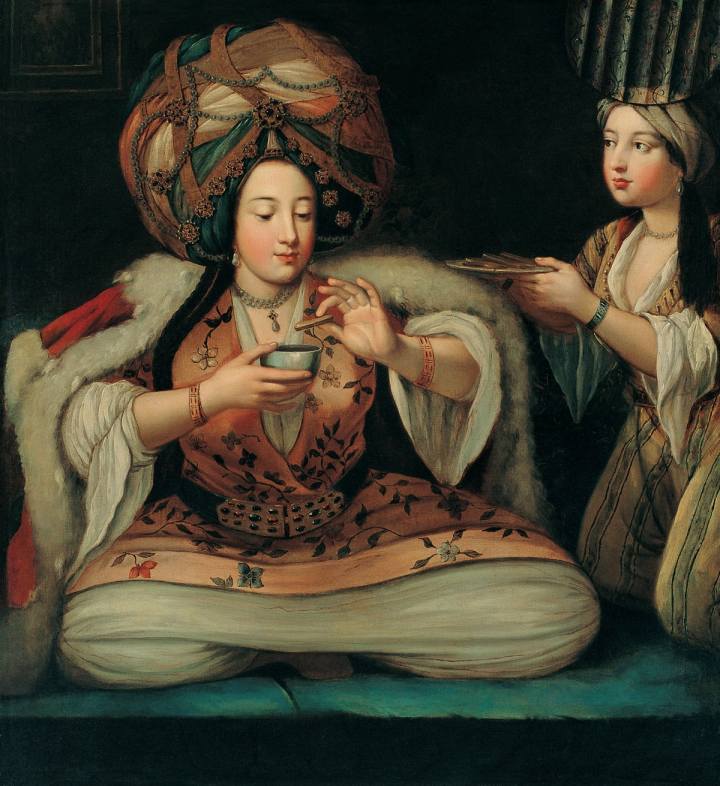
Unknown painter (French School), Enjoying Coffee, Turkey, first half of the 18th century (Istanbul: Pera Museum).
The Art of Dining brings together more than 200 works from the Middle East, Egypt, Central and South Asia, and beyond to explore connections between art and cuisine from ancient times to the present day. Paintings of elaborate feasts, sumptuous vessels for food and drink, and historical cookbooks show how culinary cultures have thrived in the Islamic world for centuries. Highlighting the relationship of these works to preparing, serving, and enjoying food, the exhibition engages multiple senses and invites us to appreciate the pleasures of sharing a meal.
Originally organized by the Los Angeles County Museum of Art (LACMA), the exhibition includes works from 30 public and private collections from across the U.S., Europe, and the Middle East, and 16 from the DIA’s collection.
Linda Komaroff, ed., Dining with the Sultan: The Fine Art of Feasting (DelMonico Books, 2023), 375 pages, ISBN: 978-1636810881, $85.










 Enfilade
leave a comment