Exhibition | Home, Land, and Sea: Art in the Netherlands
From the Manchester Art Gallery:
Home, Land, and Sea: Art in the Netherlands, 1600-1800
Manchester Art Gallery, 24 May 2013 — 23 May 2014
Curated by Henrietta Ward

Aelbert Cuyp, River Scene with a View of Dordrecht, oil on panel (Manchester Art Gallery)
Home, Land, and Sea: Art in the Netherlands, 1600-1800 is a new exhibition which brings together over 50 paintings from Manchester City Galleries’ exceptional 17th- and 18th-century Dutch and Flemish collection, one of the most important in the country. It includes exquisite paintings of everyday life, portraiture, landscapes, seascapes, and still lifes by Pieter de Hooch, Gerard ter Borch, Jacob van Ruisdael and many more. Some of these paintings have not been on display for tens of years, while others have benefited from recent conservation treatment.
For the first time these paintings will be juxtaposed with works by major contemporary artists such as Mat Collishaw’s Last Meal on Death Row, Texas series, sculptures of gnawed apples by Gavin Turk, and Rob and Nick Carter’s homage to Ambrosius Bosschaert: Transforming Still Life Painting. Alongside the seascapes will be Bachelor Machines Part I, a film by 2013 Northern Art Prize nominee Rosalind Nashashibi that focuses on the lives of an all-male crew on board the Gran Bretagna, a modern-day cargo vessel. This exhibition has been curated by Henrietta Ward, The National Gallery Curatorial Trainee supported by the Art Fund.
◊ ◊ ◊ ◊ ◊
From Hettie Ward’s blog for the exhibition, Manchester’s Dutch and Flemish Collection:
February’s Painting of the Month — Innocent Nostalgia or Outright Fraud?
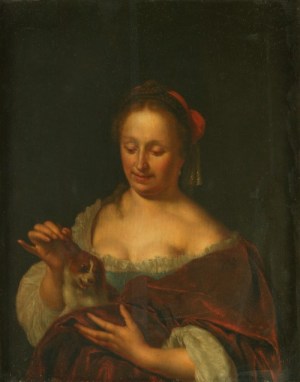
Willem van Mieris, Woman Pulling on a Dog’s Ear,
16 x 12.5 cm (Manchester City Galleries)
This month’s painting is an extension of my previous post which looked at the fineness that can be found in Dutch paintings, particularly the fijnschilders, such as Willem van Mieris (1662-1747). We have 2 works by Willem van Mieris in the collection: Interior with a Cavalier and Lady and the Painting of the Month: Woman Pulling on a Dog’s Ear, which both came to the Gallery through the Assheton Bennett bequest. Woman Pulling on a Dog’s Ear is miniscule and only measures 16 x 12.5 cm (27 x 23.4cm framed) and is so intricately painted that you can’t make out a single brushstoke.
The painting is a portrait of the artist’s mother, Cunera van der Cock, but it is actually a copy of a painting by his father, Frans van Mieris (1635-1681). The original is in the collection of Worcester Art Museum, USA, along with its companion piece A Soldier Smoking a Pipe, or self-portrait of the artist. The Worcester pair dates to 1662 and both measure 14 x 11cm. You can see them here. Willem van Mieris also made a copy of the companion piece, now in a private collection.
Willem’s painting is an incredibly good copy, and whilst the initial reaction is to dismiss Manchester’s version as being just that, there is actually a lot more to it which touches on elements of fraud — to a certain extent — and brings into question the whole value of a fake. It is with great thanks to the recent research of the art historian and academic Junko Aono that this painting can be reassessed and valued in terms of the 18th-century revival of the Dutch Golden Age, and turns it from being an interesting copy to a fascinating bit of history. Much of what I have learnt about this painting has come from her article ‘Reproducing the Golden Age: Copies after Seventeenth-Century Dutch Genre Painting in the First Half of the Eighteenth Century’ in Oud Holland Vol. 121, 2008, no. 1, and I urge you to read it yourselves if you can get hold of a copy. . . .
Read Ward’s full posting here»
Conference | A Window on Antiquity: The Topham Collection
From the conference progamme:
A Window on Antiquity: The Topham Collection at Eton College Library
The Paul Mellon Centre for Studies in British Art, London, 17 May 2013
In collaboration with the University of Buckingham and Eton College, to accompany the exhibition Paper Palaces: the Topham Drawings as a Source for British Neo-Classicism (Eton College Library, Verey Gallery, 3 May–1 November 2013)
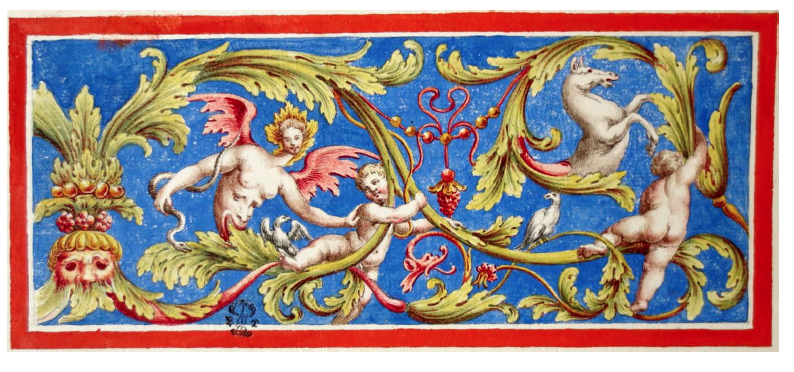
The Topham Collection
Consisting of 37 volumes and more than 3,000 items, the collection amassed by Richard Topham (1671-1730) is one of the most significant resources for the history of antiquarianism and for the culture and industry of the Grand Tour in Europe. This collection of drawings, watercolours and prints after antique sculptures and paintings in Rome and Italy is the largest of its kind assembled in England, surpassing in both scale and breadth those collected by other celebrated antiquarians such as John Talman, Dr Richard Mead or Thomas Coke, 1st Earl of Leicester.
Since its arrival at Eton in 1736 the Topham Collection has fascinated and served archaeologists, researchers investigating collections of antiquities and scholars of the history and reception of the classical tradition. The drawings have also attracted the attention of art historians, as Topham managed to assemble an extraordinary range of works by some of the best Italian draughtsmen of the first half of the eighteenth century, such as Pompeo Batoni, Giovanni Domenico Campiglia and Francesco Bartoli, or by artists who later excelled in other fields, including the architect William Kent. More recently it has also emerged that Francesco Bartoli‟s drawings of ancient ceilings and wall elevations in the collection were extensively copied and re-adapted by neo-classical architects such as Robert Adam, James Wyatt and Charles Cameron, becoming one of the most important sources for a decorative language that would spread over Europe.
However, despite the growing body of scholarship on the Topham Collection produced in recent decades, notably the work of the late Louisa M. Connor Bulman, a comprehensive study of the whole collection and of its role in eighteenth-century antiquarian and artistic culture is still wanting. This conference wishes to indicate new avenues of research and is intended as the first step towards an online catalogue of the whole collection.
◊ ◊ ◊ ◊ ◊
P R O G R A M M E
Abstracts are available here»
9:00 Registration
9:30 Lucy Gwynn (Eton College Library), Opening address and welcome
Session 1: The Topham Collection and Its Context: Antiquarianism and the Grand Tour Market
Chair: Ian Jenkins (British Museum) and Lucy Gwynn (Eton College Library)
9:50 Cinzia Maria Sicca (Università di Pisa), The Mind behind the collection: John Talman, antiquary and advisor to Richard Topham and Henry Hare, 3rd Baron Coleraine
10:20 Eloisa Dodero (Royal Collection Trust, Windsor Castle), Did Topham know of the ‘Museo Cartaceo’? The Paper Museum of Cassiano dal Pozzo and the Topham Collection of drawings
10:50 Novella Barbolani (Università di Roma La Sapienza) and Valentina Rubechini (Università di Firenze), Francesco Maria Niccolò Gabburri, John Talman and Richard Topham: artistic exchanges between Florence and Britain
11:20 Tea and Coffee
11:40 Bruno Gialluca (Independent Scholar), William Kent’s drawings after the Antique in the Topham and Holkham Collections
12:10 Lucia Faedo (Università di Pisa), The Topham Collection and the Roman palaces: British visitors to the Palazzo Barberini
12:35 Discussion
13:00 Lunch
Session 2: The Topham Collection and Its Archaeological Value
Chair: Helen Whitehouse (University of Oxford)
14:15 Mirco Modolo (Università degli Studi di Roma Tre), From philology to the market: the archaeological value of Francesco Bartoli’s drawings in the Topham Collection
14:45 Delphine Burlot (Institut National d’Histoire de l’Art-INHA, Paris), Forgeries of ancient paintings in the Topham Collection
Session 3: Richard Topham: His Library, Legacy and Influence
Chair: Richard Hewlings (English Heritage)
15:15 Paul Quarrie (Maggs Bros Ltd; Eton College Librarian 1977-1994), Richard Topham and his library
15:45 David Noy (University of Wales Trinity St David), Richard Topham’s will: a collector plans for the future
16:15 Adriano Aymonino (University of Buckingham), The Topham Collection as a source for British eighteenth-century classicism
16:40 Discussion
17:00 Drinks Reception
Exhibition | Des couleurs et du papier: France, Allemagne, Italie
From the Bibliothèque Mazarine:
Des couleurs et du papier: France, Allemagne, Italie (1700–1850)
Bibliothèque Mazarine, Paris, 2 April – 7 June 2013
Curated by Nadine Férey-Pfalzgraf, Florine Levecque, and Marc Kopylov
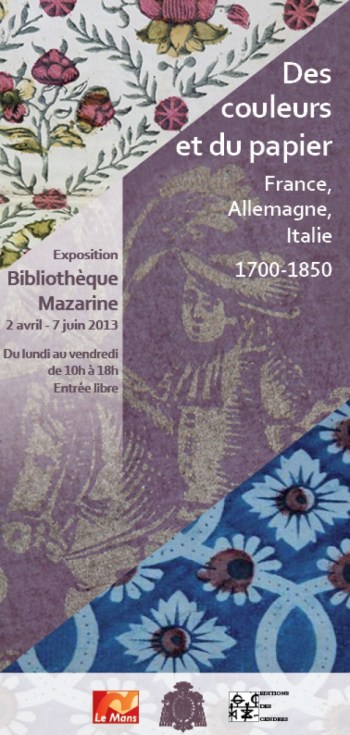 À la croisée de l’imagerie populaire et des papiers de tenture, un foisonnant univers graphique a vu le jour dans les ateliers des cartiers, dominotiers et graveurs d’images entre 1700 et 1850.
Les papiers dominotés imprimés à la planche de bois et rehaussés au patron, ont souvent servi de couverture d’attente aux livres brochés ; aussi, éphémères et fragiles, sont-ils rarement parvenus jusqu’à nous, quelques objets attestant également de leur utilisation dans les arts mobiliers ou décoratifs. En revanche, les papiers dorés gaufrés ou dorés vernis d’outre-Rhin, appréciés des relieurs pour habiller les gardes des livres de grande valeur, ont été plus largement conservés, protégés à l’intérieur des volumes.
Fort prisés au 18e siècle, ces papiers assuraient le succès des artisans les plus talentueux, qui n’hésitaient pas à signer leur production, cas rare à une époque où l’anonymat était de rigueur dans les petits métiers : on connaît ainsi les ateliers Sillé au Mans, Sevestre Leblond à Orléans, « Les Associés » à Paris ; Leopold à Augsbourg et Eckart à Nuremberg ; Bertinazzi à Bologne et Remondini à Bassano, qui finit par occuper une position de quasi monopole en Italie.
Panorama significatif des productions françaises, allemandes et italiennes au 18e siècle, l’exposition présente une sélection de papiers provenant des fonds de la Bibliothèque Mazarine et de la Médiathèque Louis Aragon du Mans, complétés par des prêts de collectionneurs privés. Elle prolonge et illustre les travaux pionniers d’André Jammes, et les recherches récemment publiées par Christiane et Marc Kopylov (Éditions des Cendres). Elle doit aussi susciter de nouvelles découvertes.
Exhibition | La Tauromaquia: Carnicero, Goya, and Picasso
Press release for the current exhibition at Penn:
La Tauromaquia: Carnicero, Goya, and Picasso
Arthur Ross Gallery, University of Pennsylvania, Philadelphia, 19 April — 28 July 2013

Antonio Carnicero, Colleción de las principals suertes de una corrida de toro, plate IV, 1790 (Arthur Ross Foundation)
In celebration of the Arthur Ross Gallery’s 30th anniversary, La Tauromaquia: Carnicero, Goya, and Picasso presents 70 master prints collected by the Arthur Ross Foundation. The prints explore the long-revered tradition of the Spanish bullfight by featuring the works of three extraordinary artists: Carnicero, Goya and Picasso, who interpreted this popular entertainment in very different ways. This is the first time all 70 prints are on display in a single exhibition, which runs from April 19 through July 28, 2013.
In the eighteenth century, the bullfight was both a sport and an entertainment in Spain, democratically beloved from royalty to the lower classes. A skilled matador often became a famed national hero, and his fighting in the corrida was considered a fully developed art form. As Ernest Hemingway wrote: “Bullfighting is the only art in which the artist is in danger of death and in which the degree of brilliance in the performance is left to the fighter’s honor.” Antonio Carnicero’s (1748-1814) seven etchings and title sheet from Colleción de las principals suertes de una corrida de toros (Collection of the main actions in a bullfight), executed in 1790, illustrate the highly ritualized stages of the bullfight. In 1816, at the age of 70, Francisco Goya published the first edition of 33 prints on La Tauromaquia in Madrid. His daring compositions and dramatic chiaroscuro accentuate the drama that unfolds in the ring. A century later, Pablo Picasso (1881-1973), turned to bullfighting for his subject matter. In a single afternoon in 1957 he completed 26 plates for La Tauromaquia, o arte de torear, Pepe Illo’s treatise, for the Ediciones La Cometa specialist collection.
La Tauromaquia: Carnicero, Goya and Picasso is the culmination of exhibitions celebrating the 30th anniversary of the Arthur Ross Gallery. The Gallery was the brainchild of Penn President Emeritus Mr. Martin Meyerson and Mr. Arthur Ross. In 1983, they established the Arthur Ross Gallery on the campus of the University of Pennsylvania for the benefit of the Philadelphia and University communities. It has since expanded to a much broader focus, embracing an eclectic program of changing exhibitions in all fields of the visual arts and cultural artifacts from around the world.
Exhibition | Young James Boswell in London, 1762–63
From The Lewis Walpole Library:
‘In the Midst of the Jovial Crowd’: Young James Boswell in London, 1762–1763
The Lewis Walpole Library, April — mid-October 2013
Curated by James Caudle, The Associate Editor, Boswell Editions
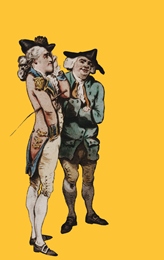 In autumn 1762, the ambitious, clever, jovial, and bumptious twenty-two-year-old Scotsman James Boswell traveled south from Edinburgh to London to seek his fortune in the capital. In his lively journal, he recorded his extraordinarily action-packed eight months there, and his efforts to become a permanent Londoner.
London in the Sixties (the 1760s) was a thrilling place, full of pleasures and dangers, wisdom and folly, high life and low life. This exhibition aspires to place visitors ‘in the midst of the jovial crowd’ in which young James Boswell felt so alive and happy. Prints by Hogarth and Rowlandson and others, and rare books and ballads, will bring to life the current events, everyday social life, and personalities celebrated in Boswell’s London Journal, unpublished until 1950, but now one of the best-loved works of eighteenth-century life-writing.
Exhibition | Time and Navigation
Press release (10 April 2013) for a new permanent exhibition at the National Air and Space Museum:
Time and Navigation: The Untold Story of Getting from Here to There
Smithsonian National Air and Space Museum, Washington, D.C., opening 12 April 2013
Curated by Paul Ceruzzi, Roger Connor, Andrew Johnston, and Carlene Stephens

Bond Chronometer, 1812. This was the first American-made marine timekeeper taken to sea. William Cranch Bond, a 23-year-old Boston clockmaker, crafted it during the War of 1812 (Smithsonian, National Museum of American History)
If people want to know where they are, they need a reliable clock. It might seem surprising, but knowing the accurate time is essential for determining position. A major exhibition opening April 12, Time and Navigation: The Untold Story of Getting from Here to There, explores how revolutions in timekeeping over three centuries have influenced how people find their way. This project is a unique collaboration between two of the Smithsonian’s largest and most popular museums: the National Air and Space Museum and the National Museum of American History.
“Time and Navigation is an ambitious exhibit because it traces the development of very complicated technologies and makes us think about a subject we now take for granted,” said Gen. J.R. “Jack” Dailey, director of the museum. “Today, the technology needed to accurately navigate is integrated into mobile computers and phones: hundreds of years of technological heritage tell your handheld device where you are in a seamless manner. This opens up new possibilities and challenging questions for the next generation of scientists and explorers who visit this exhibit to start thinking about.”
The gallery is organized into five sections and spans three centuries of efforts to travel on Earth and through the solar system. In each section the visitor will learn about pioneer navigators facing myriad issues, but one challenge always stands out: the need to know accurate time.
Navigating at Sea is an immersive environment that suggests a walk through a 19th-century sailing vessel. Visitors will learn how centuries ago navigators at sea relied on chronometers and measurements of celestial objects to determine location. This section includes a mariner’s astrolabe, dating from 1602; a Ramsden sextant and dividing engine; several chronometers; a model of Galileo’s pendulum clock, as well as the earliest sea-going marine chronometer made in the United States, produced by Bostonian William Cranch Bond during the War of 1812. It also features an interactive display that allows visitors to use a sextant to navigate with the stars. (more…)
Exhibition | Close to the Heart: British Miniatures
Press release from the The Barber Institute:
Close to the Heart: 17th- 19th-Century British Miniatures from UK Private Collections
The Barber Institute of Fine Arts, University of Birmingham, 1 February — 5 May 2013
Curated by Robert Wenley
 A tiny, exquisite portrait of 18th-century British actor, playwright and impresario David Garrick – set in one of the actor’s favourite rings – has gone on display at the Barber Institute of Fine Arts, University of Birmingham, this weekend, as part of a new exhibition of portrait miniatures. Believed never to have been displayed in public before, the oval portrait – barely 1cm tall and painted in the traditional sepia favoured for posthumous portraits – was commissioned following Garrick’s death in 1779 by his wife, the German singer Eva Marie Viegel, and then set in one of his rings, fashioned in a pink alloy. The item remained in Garrick’s family, passing from Mrs Garrick to the actor’s grandniece initially – until it was given, in 1897, to the unnamed private family collection in which it remains today.

Peter Cross, The Actress Anne Oldfield as Fame, ca. 1710
(Daphne Foskett Collection)
The miniature is one of 50 masterpieces of British portraiture from two outstanding private art collections on display at the Barber Institute of Fine Arts in the exhibition Close to the Heart: 17th- to 19th–century British Portraits from UK Private Collections. The long-term loan of the two collections – the Daphne Foskett collection and an unnamed private cache well known to experts – to the Barber Institute forms one of the finest, and largest, displays of miniatures in the UK outside of London.
Close to the Heart features miniatures ranging in date from around 1600 to 1850, include exquisite examples by leading names in the field such as Peter Oliver, George Engleheart, Richard Cosway, Sir William Ross and Richard Crosse. The exhibition, supported by auction house Bonhams, forms part of the year-long celebratory programme marking the 80th anniversary of the foundation of the Barber, the art gallery and original concert hall for the University of Birmingham.

Richard Crosse, Two Unknown Boys, possibly a self-portrait of the artist and one of his brothers (Daphne Foskett Collection)
Another gem is Richard Crosse’s tender and unusual watercolour on ivory, Portrait of Two Boys – thought to be a self-portrait with a brother – of 1759. Crosse was born a deaf-mute, and for many years relied on his older brother, James, to communicate with clients. It is believed that either James or a younger brother, Edward, is depicted here with Crosse.
Portrait miniatures were given as presents to close friends and family, exchanged during courtship and used to commemorate important events, such as an engagement, marriage or a long separation. They were often set in a gold pendant locket or frame, and worn on a chain or as a brooch pinned to the chest – symbolically close to the heart – or hanging from the waist. The reverse might feature the sitter’s initials in seed pearls or a lock of their hair arranged in a fancy design. If not worn, miniatures were kept in leather cases and stored in drawers. Larger ‘cabinet’ miniatures, sometimes with biblical or other ‘history’ subjects, were hung on walls like small-scale paintings.
Close to the Heart includes works ranging from the first few decades of the 17th century, by which time the form was well established, through its golden age from around 1760, when exhibiting societies were established, to later examples from t he 1840s – just before the emergence of photography, which all but killed off the form. The display also includes a handful of beautiful and fascinating foreign examples.
Exhibition curator Robert Wenley, the Barber’s Head of Collections and Learning, said: ‘The lenders have most generously placed their collections on long-term loan here, so, in future, we shall also be able to have differently themed annual displays of this fascinating form of painting, combining them with examples from the Barber’s own small collection of miniatures and other related paintings. We are also hoping to show these historical miniatures alongside a contemporary artist’s response to this traditional format, which should make for a very exciting intervention.’
Exhibition | Mexican Art at the Louvre
From The Louvre:
Le Mexique au Louvre: Chefs-d’oeuvre de la Nouvelle Espagne, XVIIe et XVIIIe siècles
Musée du Louvre, Paris, 7 March — 3 June 2013
Curated by Guillaume Kientz and Jonathan Brown
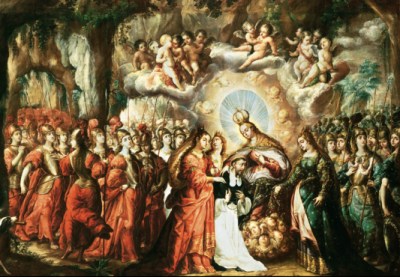
Cristobal de Villalpando, La Lactacion de Santo Domingo, © Rafael Doniz / Conaculta-INAHSinafo-Mex.
Mexican art, an area in which the Louvre’s Hispanic collection is intended to expand, will be showcased at the museum this spring. A selection of some ten of the finest works from this ‘sister’ school will be exhibited among the Spanish paintings. Among others, the monumental ‘Zurbaranesque’ work of José Juárez, the Baroque dynamism of Cristóbal Villalpando and the softness and delicacy of Rodríguez Juárez will introduce visitors to the many facets of New World art during this period and give them an understanding of its close yet independent relationship with Spanish art.
Although represented in national museums, Latin American art remains little known in France. The book that accompanies this exhibition, based on inventory work conducted by the Louvre and the French National Institute of Art History (the BAILA project), provides an overview of the major Latin American works in French museums, and explores the origins and evolution of this artistic school.
The Louvre’s press release (14 February 2013) is available here»
Exhibition | Napoleon and Europe
As noted at Art Daily:
Napoléon et l’Europe
Musée de l’Armée, Hôtel National des Invalides, Paris, 27 March — 14 July 2013
Curated by Émilie Robbe
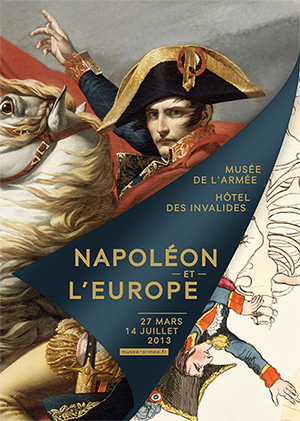 Napoleon Bonaparte (1769-1821) had a deep and lasting effect on the history of Europe, despite remaining in power for a mere fifteen years. The exhibition Napoléon et l’Europe [Napoleon and Europe], at the Musée de l’Armée from 27 March to the 14 July 2013, bears witness to Napoleon Bonaparte’s European ambitions between 1793 and 1815. The visit reveals his ambitious policies for expansion in Europe and the subsequent reactions by the various European countries, whether in support of, or against, such policies. The exhibition also highlights the consequences and the deep scars that such a conquest left on Europe.
Far removed from stereotype and biased opinion, this exhibition aims to present an influential episode in French and European history in a different manner; by combining the diverse, often-times opposing viewpoints of Napoleon’s contemporaries, on themes such as war, politics, diplomacy, the government, currency, propaganda and the arts… In order to recount or retrace this chapter of history, 250 artworks, objects and documents have been gathered together, on loan from fifty or so European museums and institutions, with more than half of these coming from outside France. Since the retrospective exhibition Napoléon held in 1969 at the Grand Palais, Paris, no other exhibition of this scope and ambition has been organized in France.
Conquest and Resistance
The entire exhibition is punctuated by or structured around two viewpoints that both question and mirror the other: the progressive and concrete creation of Napoleon’s Empire on the one hand, and the reactions of certain peoples and the main European powers to this direct quest for domination, on the other hand. From alliances to battles, from treaties to reform, this incredibly rapid succession of events is recounted in chronological fashion and explained in context. (more…)
Exhibition | Marquis de Marigny
I’m afraid this is another exhibition that slipped past me, but I include it here nonetheless. The catalogue is, at least, still available from Artbooks.com. -CH
◊ ◊ ◊ ◊ ◊
From the press release:
Le Naturel Exalté: Marigny, Ministre des Arts au Château de Menars
Expo 41, Loir-et-Cher, Blois, 30 June — 16 September 2012
 Ambitieux, fier, ombrageux : les qualificatifs ne manquent pas pour définir Abel-François Poisson de Vandières, marquis de Marigny et seigneur de Menars (1727-1781). Son destin, tracé à la plume de l’exception, en fait foi. Il eut la chance d’être le frère cadet de la maîtresse de Louis XV, titrée marquise de Pompadour, qui l’introduisit dès son adolescence à la cour du roi. À vingt-quatre ans, il est nommé directeur général des Bâtiments du roi, arts et manufactures. Un voyage en Italie en compagnie d’artistes et d’architectes engagés dans les débats esthétiques contemporains fut le déclic vers l’émancipation : Marigny commença alors à se constituer une collection d’exception. Sa galerie de statues était la 1ère de France après celle de Louis XV. Il dirigea surtout la politique des arts du royaume pendant 30 ans, laissant à l’humanité des chefs-d’oeuvre tels que la place de la Concorde, l’École Militaire, les jardins des ChampsÉlysées ou le Panthéon de Paris.
L’exposition Le naturel exalté. Marigny, ministre des arts au château de Menars, qui sera présentée à Expo 41, du 30 juin au 16 septembre 2012, est la 1ère rétrospective mondiale consacrée au frère de la Pompadour et ministre de Louis XV. Le visiteur découvrira le fonds exceptionnel des archives départementales de Loir-et-Cher, encore jamais dévoilé au public, constitué de centaines de dessins représentant l’aménagement des jardins du château de Menars en Loir-et-Cher, plusieurs tableaux majeurs en provenance du musée du Louvre ou du château de Versailles, ainsi que des oeuvres issues de la collection personnelle de Marigny. . .
◊ ◊ ◊ ◊ ◊
Christophe Morin, ed., Le Naturel Exalté: Marigny, Ministre des Arts au Château de Menars (Milan: Silvana, 2012), 192 pages, ISBN: 978-8836622658, €28 / $55.
 Abel-François Poisson (1727-1784), marquis de Vandières puis de Marigny est plus que le frère de la marquise de Pompadour. Directeur général des Bâtiments du roi à compter de 1751, il a rang de ministre et participe à la vie de cour autour de Louis XV. Courtisan zélé, il conserve ses fonctions au-delà même de la disparition de sa soeur, jusqu’en 1773. Il a toute la reconnaissance du roi qui lui offre un somptueux ” meuble ” pour décorer son hôtel de la rue Saint-Thomas-du-Louvre, ainsi que de nombreuses sculptures qui viendront embellir son château de Menars.
Le présent ouvrage rappelle, grâce aux contributions des meilleurs spécialistes de la question, la brillante carrière d’un grand commis de l’Etat au service de Louis XV. Pour la première fois, une exposition monographique sur le marquis de Marigny rassemble des oeuvres qui évoquent la carrière de l’homme public dont le rôle fut éminent dans la transformation radicale du goût au milieu du XVIIIe siècle.
L’autre versant de cette entreprise, tout aussi inédit, regarde le seigneur de Menars, ses collections et sa vie en Val de Loire. Ce ne sont pas moins de 90 dessins d’architecture qui sont présentés ici. Des oeuvres parfois majeures, parfois émouvantes, commandées par Marigny aux plus grands artistes du temps pour décorer le parc de sa maison de campagne. Grand seigneur sur ses terres, il aménage en effet le château de Menars, à sa mesure, réglant les moindres détails de son nouveau jardin anglo-chinois.










 Enfilade
leave a comment