Exhibition | The Art of Kandy: Sri Lanka’s Last Kingdom
From the press release for the exhibition . . .
The Art of Kandy: Sri Lanka’s Last Kingdom
Norton Simon Museum, Pasadena, 4 September 2026 — 8 February 2027
Organized by Lakshika Senarath Gamage
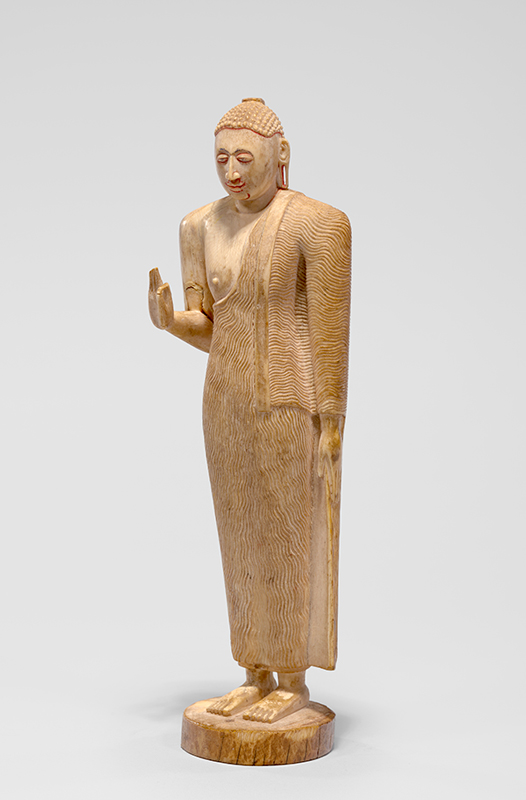
Sri Lanka, Buddha, 18th century, ivory with traces of pigment, 25 cm high (Pasaden: Norton Simon Museum).
The Art of Kandy: Sri Lanka’s Last Kingdom brings together 13 objects from the Norton Simon Museum’s collection of art from the kingdom of Kandy, the final royal capital of Sri Lanka before the onset of British colonial rule. From intricately carved ivory sculptures to gem-studded silver objects for the elite, this presentation of small-scale, portable works showcases the skill and ingenuity of the kingdom’s artisans. Kandyan craftsmen flourished under royal sponsorship, fostering the development of a creative and distinctive identity amid internal strife and pressures from foreign powers.
Founded in 1469, the kingdom of Kandy was re-established in 1592 and remained independent until its annexation into British Ceylon in 1815. Although Kandy was a remote kingdom in the central hills of Sri Lanka, it played a significant role in revitalizing the island’s social landscape. Kandyan kings formed marriage alliances with South Indian royals, negotiated trade with the Dutch who controlled the coastal regions, maintained diplomatic ties with Thai rulers to foster visits from Buddhist monks, and restored the Buddhist monastic order. Despite shifting political conditions, contested authority, and moments of usurpation, local and migrant artisans continued to create works in royal ateliers and regional workshops. Kandyan art developed alongside sustained exchange with South India, Southeast Asia, and European trading networks.
The art of this period blended local styles and motifs with South Indian designs, combining Buddhist and Hindu iconographies with pan-Asian symbolism. Patronage of Buddhist art and architecture was essential for a king to be considered a pious benefactor of the faith, and in turn, to legitimize their claim to the throne. Due to these factors, Kandyan art and architecture flourished by drawing from both foreign interactions and deeply rooted local traditions.
Figural sculpture developed a distinctive, robust flair—with eyes that gaze directly at the viewer, broad shoulders and imposing limbs—while mythical and composite creatures animated much of the visual culture. Among the highlights in the exhibition is an 18th-century standing ivory Buddha that exemplifies the hallmarks of Kandyan sculpture, including broad shoulders, a stern facial expression, and stylized drapery. The exhibition also features elaborately crafted objects that demonstrate the technical mastery of silversmiths, ivory carvers, and metalsmiths who likely worked in royal workshops. The works on view may have been commissioned for the royal court or made for Buddhist devotees to use as offerings.
“The Art of Kandy offers new perspectives on cultural exchange, artistic resilience, and the interconnected histories of South and Southeast Asia,” said Lakshika Senarath Gamage, Assistant Curator at the Norton Simon Museum. “The exhibition reveals how Kandyan artists drew from local traditions and international exchanges to create a distinctive visual language that continues to resonate today.”
Presented in an intimate gallery setting, this exhibition of Kandyan art reflects wide-ranging themes of royal sponsorship, Buddhist devotion, and creative imagination, illustrating how artisans and patrons of diverse backgrounds shaped an ongoing artistic legacy that transcends cultural and political boundaries.
Exhibition | A Light in the Dark: Joseph Wright of Derby
Opening this fall at The Getty:
A Light in the Dark: Joseph Wright of Derby
Getty Center, Los Angeles, 24 November 2026 — 14 March 2027
The British painter Joseph Wright of Derby is celebrated for his astonishing ability to capture the magic of light piercing the dark. In 1760s London he exhibited a series of remarkable pictures that catapulted the provincial artist to national fame. This exhibition reunites several of these works—including the Getty’s recently rediscovered Two Boys with a Bladder—and explores the technical innovations and artistic ambitions behind some of the most enthralling paintings of the 18th century.
From the Getty Shop:
Julia Siemon, ed., A Light in the Dark: Joseph Wright of Derby (Los Angeles: Getty Publications, 2026), 144 pages, ISBN: 979-8887120416, $30.
 The dramatic ‘candlelight’ paintings of Joseph Wright of Derby (1734–1797) cast a spell, enthralling viewers with striking scenes that portray human curiosity, the quiet intensity of domestic life, and the excitement of scientific discovery. With a variety of brushstrokes—dabbed here, whiskered there, and dragged elsewhere—Wright pushed boundaries with the transformative power of light. In 2020, the Getty Museum acquired the newly rediscovered Two Boys with a Bladder (1767), a luminous study of innovation, intimacy, and artistic brilliance that challenged established assumptions about Wright and sparked renewed interest in his experiments with light.
A Light in the Dark presents new research to uncover the origins of Two Boys and expand our understanding of Wright’s early candlelights, tracing the invention and initial development of his distinctive style. Whereas recent scholarship has maintained an outward approach that ties the artist’s oeuvre to places that he visited, this volume returns the focus to Wright himself—his biography, technique, and hometown of Derby—in a much-needed reexamination. Complete with fresh historical and technical evidence, this is a fascinating look into the inspirations, aspirations, and experiments behind some of the most remarkable paintings in the history of British art.
Julia Siemon is deputy director and chief curator at Bard Graduate Center. Her publications include, as editor and primary author, The Silver Caesars (2017), and, as contributing author, The Medici (2021), A Royal Renaissance Treasure and Its Afterlives (2021), and others.
The Magazine of the Decorative Arts Trust, Summer 2026
The Decorative Arts Trust has shared select articles from the summer issue of their member magazine as online articles for all to enjoy.
The Magazine of the Decorative Arts Trust, Summer 2026
 • “A Nation of Artists: 250 Years of Creativity” by Alexandra Alevizatos Kirtley Link»
• “Workshop of the World: Arts and Crafts in Philadelphia” by David L. Barquist and Colin Fanning Link»
• “Window to Revolution: Pennsylvania Germans and the War for Independence” by Lisa Minardi, Emily Sneff, Christopher Malone, and Sarah Bowen Link»
• “Seeking Profit and Power: Philadelphia, China Trade, and the Making of America” by Peter Seibert Link»
• “Challenging Masterpieces: Art and Identity in American Furniture” by Josh Lane Link»
• “Radical Americana: 45 Artists and 25 Philadelphia-area Sites Celebrate the Semiquincentennial” by Jennifer Zwilling Link»
• “The Politics of Taste: The Presidential Houses of Virginia and Washington” by Amy Hudson Henderson Link»
• “The Work of the Edinburgh Upholstery Company at Hopetoun House” by Stephen Jackson Link»
• “Philip Trammel Shutze: Atlanta’s Consummate Collector” by Michael Rose Link»
• “Novel Nature: How a Maritime Byproduct Defined the Elite 17th-Century Interior” by Lauryn Smith Link»
The printed Magazine of the Decorative Arts Trust is mailed to Trust members twice per year. If you would like a print copy, click here to become a Trust member.
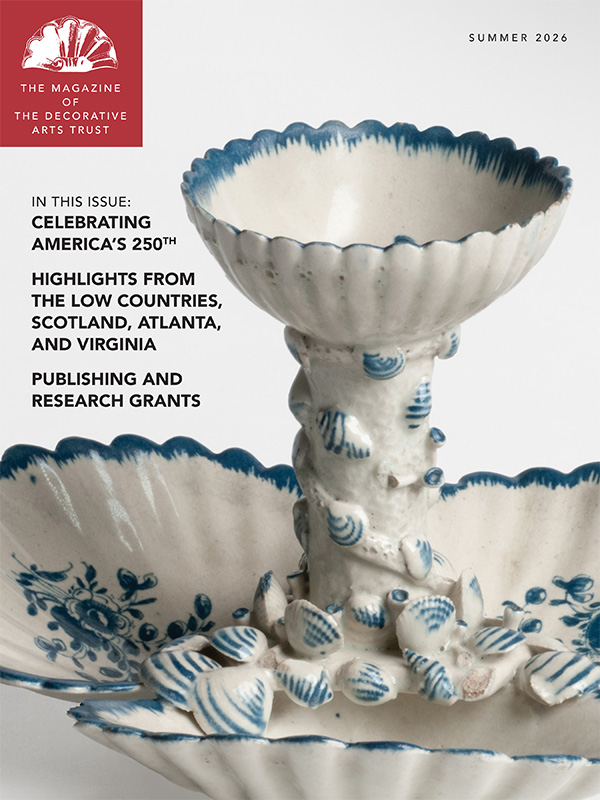
Pictured: The magazine cover shows a rare pickle stand featured in A Nation of Artists at the Philadelphia Museum of Art. Gousse Bonnin and George Anthony Morris founded the American China Manufactory in Philadelphia in 1770. Designed to serve pickled nuts and fruits during the dessert course of a meal, this small stand is made of more than 72 elements individually formed from a refined white clay called kaolin. The shells were molded from actual shells. Once assembled, the stand was then decorated with cobalt blue ornament, covered with a clear lead glaze, and fired at a high temperature. Bonnin and Morris’s ability to make soft-paste porcelain provided direct evidence that Americans could prosper without the assistance of Great Britain and its mercantile system, emboldening leaders such as Benjamin Franklin and Dr. Benjamin Rush. (American China Manufactory, Pickle Stand, 1770–72, Philadelphia. Soft-paste porcelain with underglaze blue decoration. 5 1/8 × 7 in. Philadelphia Museum of Art, Gift of a 7th-generation Philadelphian, 2014-166-1. Image courtesy of the Philadelphia Museum of Art.)
Exhibition | Challenging Masterpieces

From the press release for the exhibition:
Challenging Masterpieces: Art and Identity in American Furniture
Winterthur Museum, Garden & Library, Wilmington, Delaware, 26 September 2026 — 2 May 2027
Organized by Joshua Lane
Winterthur Museum, Garden & Library’s new exhibition, Challenging Masterpieces: Art and Identity in American Furniture, uses more than 70 objects from its own collection to show how the term masterpiece was constructed, who it left out, and how it’s being redefined today. Organized around a single question — What makes a masterpiece? — the exhibition traces how that label emerged among early 20th-century collectors, hardened into orthodoxy, and is now being reconsidered. The show unfolds across two galleries and two themes: the first traces how the idea of the aesthetic ‘masterpiece’ took hold in American antiques collecting in the early 20th century; the second carries that inquiry forward, showing how the definition has expanded from the 1970s to the present.
“We chose the exhibition title to spur reflection on masterpiece as an aesthetic category long governed by supposedly fixed standards,” said Lane. “As a historically and culturally constructed term, it’s open to interpretation, interrogation, and expansion. We’re not looking to overthrow the idea of a masterpiece. Rather, we want visitors to ask who gets to decide and to consider a more inclusive understanding of American antique furniture.”
Celebrating the breadth and depth of the furniture collection amassed by founder Henry Francis du Pont, Challenging Masterpieces will highlight design, materials, and workmanship while exploring the historical context of his collecting activities. In step with other collectors and curators of the time, du Pont favored high-style masterpieces made in cities such as Boston, Newport, and Philadelphia.
Arranged chronologically, the exhibition explores the emergence of the market for American antique furniture in the 1870s and examine the idea of the aesthetic masterpiece, tracing the maturation of this market from the 1920s, when du Pont began to collect, to his death in 1969. It then showcases how the collection expanded from the 1970s through the present and how the concept of ‘masterpiece’ continues to evolve.
Gallery One | Masterpieces
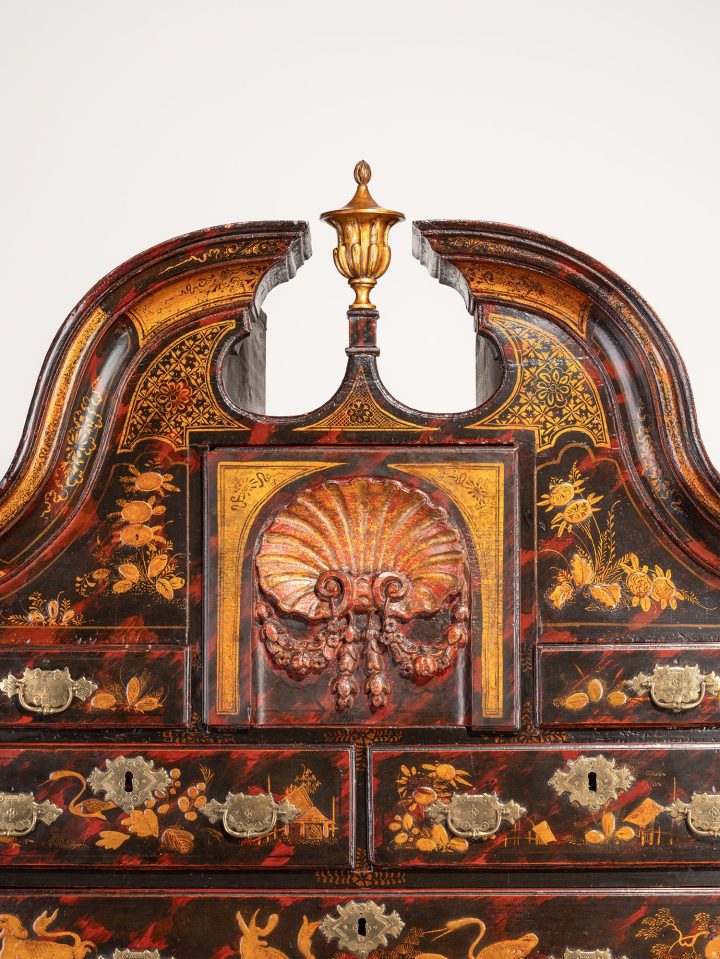
John Pimm, High Chest, detail, Boston, 1740–50, soft maple, black walnut, white pine, mahogany (Winterthur Museum. Gift of Henry Francis du Pont 1957.1084).
The exhibition opens with the ‘Van Pelt’ high chest (Philadelphia, 1765–80, carving attributed to John Pollard and Hercules Courtenay), which du Pont won at auction in 1929, bidding under the pseudonym ‘H.F. Winthrop’. Acquired for $44,000, the equivalent of roughly $830,000 in today’s dollars, it was then the highest price paid for a piece of American antique furniture.
The high chest anchors a gallery that goes on to explore the traditional meaning of ‘masterpiece’ through about a dozen miniature furniture forms, including a walnut dressing table once owned by Ralph Waldo Emerson and a mahogany miniature sideboard signed by New York cabinetmaker James Curtis on Christmas Eve 1823.
Long-recognized masterpieces on view include a wainscot great chair (Huntington, N.Y., 1720–40) that descended in the Conklin family and, according to family tradition, was used by George Washington during a 1790 visit to Long Island; a Newport tea table made by John Goddard in 1763; a Boston high chest by John Pimm (1740–50); and a Boston dressing bureau made by the celebrated cabinetmaker Thomas Seymour for the firm Isaac Vose & Son (1820–25).
Displayed alongside these examples of urban, high-style craftsmanship prized by early 20th-century collectors are period auction records, dealer correspondence, and the pages of The Magazine ANTIQUES that first popularized such objects as icons of American taste.
Gallery Two | Expanding the Canon
The second gallery, ‘The Challenge’, broadens the scope of ‘masterpiece’ to include work from underrepresented regions such as the American South and Midwest and objects that blur the line between professional shop production and folk art, including a rare 17th-century chest from Milford, Connecticut, built with tropical hardwood that was likely sourced through West Indian trade routes.
More recent acquisitions since 1970 join the conversation here, including a mid-18th-century Campeche chair from Campeche, Mexico; an early 19th-century armoire from Martinique; and a 19th-century quillwork side chair made by a Mi’kmaq artist in the Canadian Eastern Maritimes. Each is an example of global circulation of goods, materials, and design across the Americas.
The gallery makes room for pieces whose makers were never recorded, such as a marble-topped Philadelphia pier table (1815–30) and a New York side chair (1845–55), putting anonymous craftsmanship on equal footing with prominent names. Traditional prestige objects appear here too, encouraging visitors to think about how our ideas of quality, American craftsmanship, and value have changed over time.
Why now?
Lane began developing the exhibition in the midst of a broader, ongoing debate among art historians and museum professionals over the meaning and utility of ‘connoisseurship’ and ‘masterpiece’, terms increasingly scrutinized for reflecting the tastes of a narrow, historically homogenous circle of collectors rather than the full range of American craftsmanship.
The exhibition opens as Winterthur reflects on its founding vision. When du Pont opened his 175-room family estate to the public as a museum 75 years ago in 1951, he established what remains one of the most significant collections of American decorative arts in the world, now numbering more than 90,000 objects.
Challenging Masterpieces celebrates du Pont’s legacy while examining the priorities and blind spots that shaped it. Acting on a collecting policy the Board of Trustees expanded in 2018 to remove a long-standing 1840s cutoff date, Winterthur has since acquired objects that extend the collection’s scope from the Civil War era to the present, broaden geographic representation beyond the East Coast, and celebrate the creativity of previously underrepresented makers.
“Henry Francis du Pont built this collection with an extraordinary eye and an equally strong point of view about what counted. Part of our responsibility as stewards is to honor the collection he gave us and to keep asking harder questions about whose work belongs in it. Challenging Masterpieces shows visitors that a museum collection isn’t a finished statement; it’s an ongoing conversation,” said Alexandra Deutsch, Director of Collections, Winterthur Museum, Garden & Library.
Exhibition Features
Challenging Masterpieces pairs more than 70 examples of furniture drawn from Winterthur’s renowned collection with dynamic displays drawn from Winterthur Library’s manuscript and rare book holdings, including original auction records, dealer correspondence, and period photographs, alongside iPad features that reveal hidden marks, secret drawers, and construction details, and 3D didactic models that spotlight craft skill and design ingenuity. It offers a rare chance to see iconic pieces in a new light as they are temporarily relocated from the museum house to the galleries, some for the first time. Visitors will have a chance to gain a deeper understanding of diverse styles and aesthetics of antiques, at a time when ‘brown furniture’ is experiencing a mainstream revival that’s trending away from cookie-cutter, mass-produced furniture and more toward a high-low interior design mix and appreciation for antiques, vintage and preowned.
Developed by Joshua W. Lane, the Lois F. and Henry S. McNeil Curator of Furniture, Challenging Masterpieces: Art and Identity in American Furniture runs from 26 September 2026 until 2 May 2027.
Exhibition | Wood and Water: Furniture on Long Island, 1660–1860
◊ ◊ ◊ ◊ ◊
Now on view, with additional information available at The Magazine Antiques:
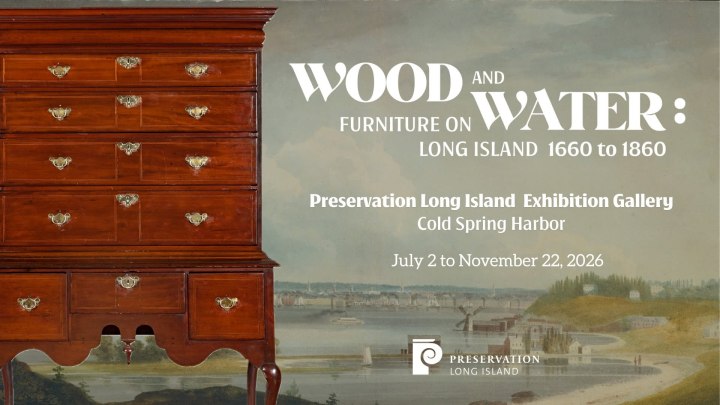
Wood and Water: Furniture on Long Island, 1660–1860
Preservation Long Island, Cold Spring Harbor, New York, 2 July — 22 November 2026
Over centuries, furniture has connected Long Islanders to each other and the world beyond their shores. Discover the work of the region’s many unsung craftspeople: Quaker joiners, Black makers, women upholsterers, Dutch turners, and Indigenous weavers. From the workshop to the home, these objects reveal networks of exchange, identity, and innovation during a time of profound change.
Wood and Water is presented in celebration of two significant milestones: the 50th anniversary of PLI’s landmark publication, Long Island Is My Nation: The Decorative Arts and Craftmen, 1640–1830, and the 250th anniversary of the signing of the Declaration of Independence.
Lauren Brincat and Steven Baltsas with Laini Farrare, Peter Fedoryk, and Katherine C. Hughes, Wood and Water: Furniture on Long Island, 1660–1860 (Cold Spring Harbor: Preservation Long Island, 2026), $35.
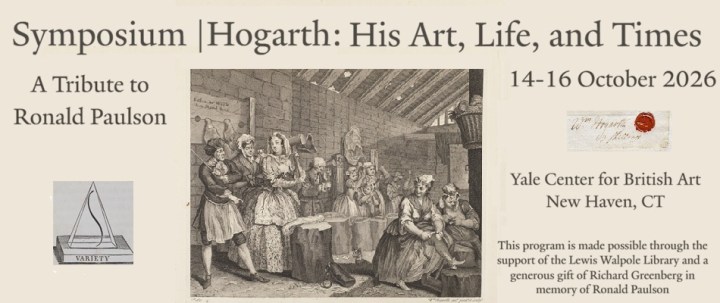
Symposium | Hogarth: A Tribute to Ronald Paulson
From the Lewis Walpole Library:
Hogarth: His Art, Life, and Times — A Tribute to Ronald Paulson
Yale Center for British Art, New Haven, 14–16 October 2026
Organized by Cynthia Roman
Presented by the Lewis Walpole Library in collaboration with the Yale Center for British Art, Yale Library, and the Beinecke Rare Book and Manuscript Library, this symposium celebrates the generous gift by Professor Paulson (1930–2024) of his papers together with a legacy endowment to establish a fellowship at the Lewis Walpole Library in memory of his son, Andrew Meredith Paulson.
Additional Programming
• Film screenings
• Study Room visits and gallery tours by advance sign-up
• Exhibition | Satire, Sympathy, and Social Critique: William Hogarth’s Progress Prints, on view at the Beinecke Rare Book and Manuscript Library (12 October 2026 — 30 May 2027)
Required registration can be completed here»
This program is made possible through the support of the Lewis Walpole Library and a generous gift of Richard Greenberg in memory of Ronald Paulson.
w e d n e s d a y , 1 4 o c t o b e r
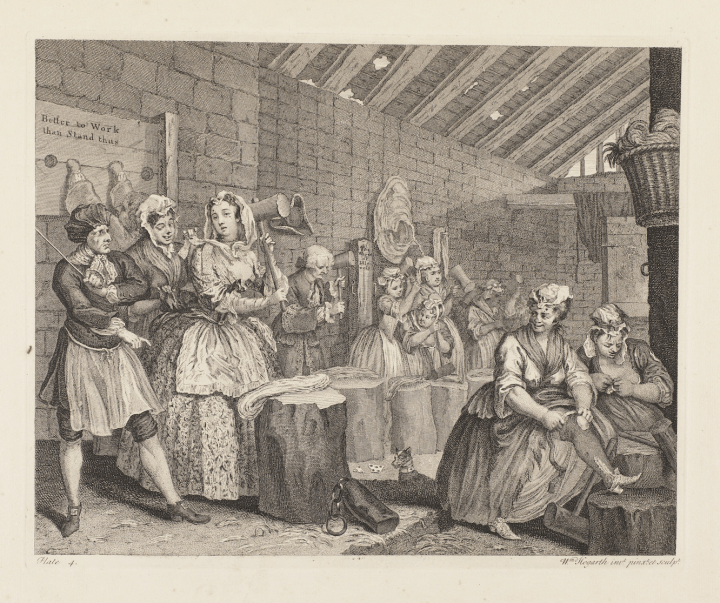
William Hogarth, The Harlot Beats Hemp in Bridewell Prison, from A Harlot’s Progress, plate 4, 1732 (The Lewis Walpole Library, Gift of Richard Greenberg).
4.30 Welcome
4.45 Panel 1 | Paulson’s Hogarth
Moderator: Jill Campbell (Professor of English, Yale University)
• Zirwat Chowdhury (Assistant Professor of 18th- and 19th-Century European Art, UCLA) — Lessing’s Hogarth, Hogarth’s Paulson
• Douglas Fordham (Professor of Art History, University of Virginia) — Breaking and Remaking Hogarth’s Bristol Altarpiece
• Caroline Patey (Professore Ordinario di Letteratura Inglese, Università degli Studi, Milano) — William Hogarth, the Novel Maker
6.15 Breakout Session
t h u r s d a y , 1 5 o c t o b e r
10.15 Panel 2 | Drawing
Moderator: Laurel Peterson (Assistant Curator of Prints and Drawings, YCBA)
• Zoë Dostal (Visiting Assistant Professor of Art, Amherst College) — Life Models, Hemp Rope, and the Line of Beauty
• Stacey Sloboda (Paul H. Tucker Professor of Art History, University of Massachusetts, Boston) — Boys Peeping at Nature: Drawing and Modeling at the St. Martin’s Lane Academy
• Jennifer Tonkovich (Eugene and Clare Thaw Curator, Morgan Library) — The Mutable Page: Hogarth’s Drawings
2.00 Breakout Session
3.45 Breakout Session
5.00 Reception at Beinecke Rare Books and Manuscript Library
Exhibition on view: Satire, Sympathy, and Social Critique: William Hogarth’s Progress Prints
f r i d a y , 1 6 o c t o b e r
10.15 Panel 3 | Nation and Empire
Moderator: Tim Barringer (Paul Mellon Professor of the History of Art, Yale University)
• Holly Shaffer (Associate Professor of Art and Architecture, Brown University) — The Two Tastes: Food and Art in Hogarth’s Analysis of Beauty
• Pierre Von-Ow (Associate Lecturer in Early Modern Art History, University of St. Andrews) — A New British Order: Hogarth’s Design for a Domestic Column Capital
• Catherine Roach (Associate Professor of Art History, Virginia Commonwealth University) — ‘Purely English’: Hogarth, Nation, and Empire in the Early Nineteenth Century
12.00 Breakout Session
2.00 Panel 4 | Social and Political Critique
Moderator: Miya Tokumitsu (Donald T. Fallati and Ruth E. Pachman Curator of the Davison Art Collections)
• Meredith Gamer (Associate Professor of Art History and Archaeology, Columbia University) — Hogarth’s Children
• Andrew Rudd (Director of Studies at Anglo Educational Services in London) — Hogarth, Walpole, and London’s Children’s Charities
• Phil Withington (Professor of Social and Cultural History, University of Sheffield) — Hogarth, Addiction, and Political Economy in Early Modern London
3.45 Breakout Session
Exhibition | Satire, Sympathy, and Social Critique
Opening this fall at the Beinecke Library:
Satire, Sympathy, and Social Critique: William Hogarth’s Progress Prints
Beinecke Rare Book and Manuscript Library, New Haven, 12 October — 30 May 2027
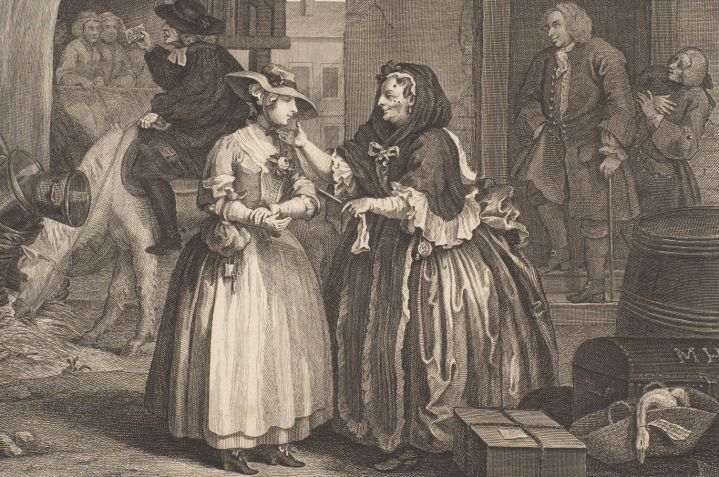
William Hogarth, A Scene outside the Bell Inn, from A Harlot’s Progress, plate 1, 1732.
Drawing from the rich William Hogarth collections of Yale’s Lewis Walpole Library, Satire, Sympathy, and Social Critique investigates the power and reverberating impact of the artist’s acclaimed ‘moral progress’ prints. Hogarth’s contemporaries immediately recognized these works for their ability to both entertain and call out cruelty and injustice, and artists and publishers over the following centuries have engaged with Hogarth’s modern moral subjects through appropriation and parody. The exhibition features six of Hogarth’s ‘moral progresses’, which are simultaneously satirical and empathetic, as well as additional archival context on the artist’s commitment to social and political advocacy. Selected examples of responses and reuses of Hogarth’s prints, both written and visual, from the 18th to the 21st centuries demonstrate the continued and enduring relevance of these works.
Exhibition | Portraits, from Botticelli to Lempicka
From the press release for the exhibition opening this fall at the Staatliche Museen zu Berlin:
Portraits! Surprising Encounters from Botticelli to Lempicka
Gemäldegalerie, Berlin, 16 October 2026 — 14 March 2027
Curated by Sven Jakstat and Stephan Kemperdick, with Marie-Luise Hugler
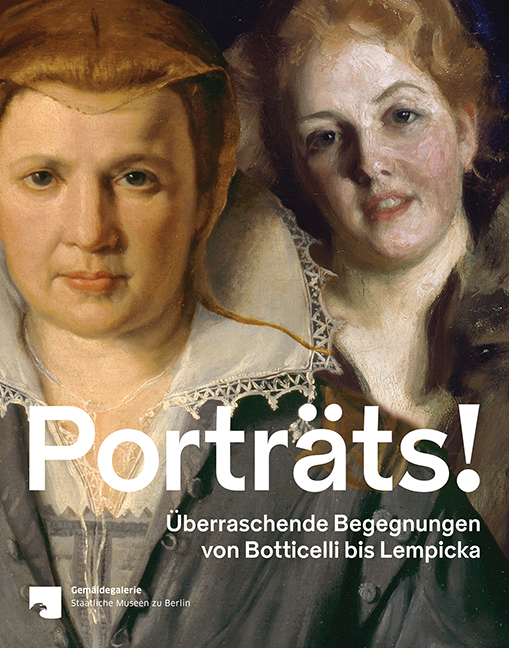 How do we see ourselves—and how have people in different historical periods wished to be seen? The special exhibition Portraits! Surprising Encounters from Botticelli to Lempicka at the Gemäldegalerie (Old Master Paintings) of the Staatliche Museen zu Berlin, invites viewers on a fascinating journey through the history of portraiture. Unusual juxtapositions of works spanning five centuries reveal striking similarities, bringing the pieces to life and providing opportunities to reflect on the presentation of the self and others, as well as on staging, roles, and character. Masterpieces by artists such as Botticelli and Lempicka, Mino da Fiesole and Rogier van der Weyden, Dürer and Giorgione, or Rubens and Gainsborough are brought into conversation with one another, revealing striking and often surprising affinities. Works that have never ‘met’ before come together for the first time, offering a fresh perspective on themes such as identity, beauty, status and power.
Portraits reveal more than just people’s outward appearance. They also reveal details about self-awareness, character, emotion and staged representation. Clothing, posture, and accessories act as codes for social, political and gender affiliation. By comparing portraits from different regions and eras, visitors can recognise, trace, and understand artistic decisions and visual strategies: What was considered beautiful, dignified or worthy of authority? How did these ideals evolve over the centuries? The exhibition reveals the variety of these responses, while also highlighting the surprising connections between them.
The exhibition’s starting point is the outstanding international collection of portraits at the Gemäldegalerie, which is complemented by a selection of loans from other museums of the Staatliche Museen zu Berlin, including the Alte Nationalgalerie (Old National Gallery) and the Neue Nationalgalerie (New National Gallery), the Ägyptisches Museum (Egyptian Museum) and the Skulpturensammlung (Sculpture Collection). It presents a multifaceted panorama of portraiture from the 15th to the 20th centuries. Around 90 masterpieces by artists such as Petrus Christus, Mino da Fiesole, Botticelli, Giorgione, Dürer, Cranach the Elder, Holbein the Younger, Titian, Sofonisba Anguissola, Rembrandt, Zurbarán, Anna Dorothea Therbusch, and Tamara de Lempicka encompass a wide variety of portraiture’s diverse aspects, ranging from glorious portraits of rulers to intimate scenes of friendship and proud self-proclamations. Each encounter tells its own story and invites wonder, comparison and discovery.
◊ ◊ ◊ ◊ ◊

Anton Raphael Mengs, Self-Portrait, 1779 (Berlin: Staatliche Museen).
Various forms and functions of portraits are examined in the four sections of the exhibition. The prologue highlights the astonishing constancy of mimetic portrait art, which has spanned many centuries, and also sheds light on the genre’s roots in Europe.
Portrait Types North and South of the Alps
The first section of the exhibition explorse the development of portraiture in Italy and the North during the Renaissance. Various prototypes emerged, such as the northern three-quarter profile used by Rogier van der Weyden and the strict profile preferred by Filippo Lippi. Differing tendencies towards naturalism and idealisation soon mingled and influenced the development of portrait painting in the following centuries.
Self-Representation of the Elite
Portraits were a powerful means of social representation and distinction. The clothing, poses, and size of a work all revealed the aspirations and status of the person depicted. Anthonis Mor’s prestigious, knee-length portrait of the Duchess Margaret of Parma, with her regal gaze, is on a par with Giambattista Moroni’s portrait of the nobleman Don Gabriel de la Cueva.
Family, Friendship, and Intimacy
On the one hand, the section on family, friendship and intimacy is dedicated to the private aspects of portraiture. Relatives, close friends, and loved ones are captured in images that serve as personal mementos. Sofonisba Anguissola’s mother, Bianca, engages with her daughter while she paints, in a manner that is similar to how the wife of the painter Eugen Spiro looked at her husband 380 years later. Portraits of the deceased offer a final glimpse of them.
Portraits of Art Collectors and Artists
The final section of the exhibition focuses on portraits of art collectors and artists. For centuries, self-portraits have not only served as a means of self-exploration, but also as a way of positioning oneself and one’s work within traditional contexts. Therbusch portrays herself as an intellectual, while Poussin and Anton Raphael Mengs use their self-portraits to reflect on their lives and artistic fame.
◊ ◊ ◊ ◊ ◊
Portraits is not just an art historical exhibition; it also reflects our current image-obsessed world. In the age of selfies and social media:how do we construct our identity? How do we read faces? And what does our view reveal about ourselves? The reflection of masterworks from the past provides the perfect opportunity to study and understand these current questions.
The exhibition is curated by Sven Jakstat and Stephan Kemperdick, with assistance from Marie-Luise Hugler. A richly illustrated catalogue provides an in-depth exploration of the works and their relationships with each other.
Porträts! Überraschende Begegnungen von Botticelli bis Lempicka (Petersberg: Michael Imhof-Verlag, 2026), 256 pages, ISBN: 978-3731915980, €49.
Exhibition | A King’s Carpet
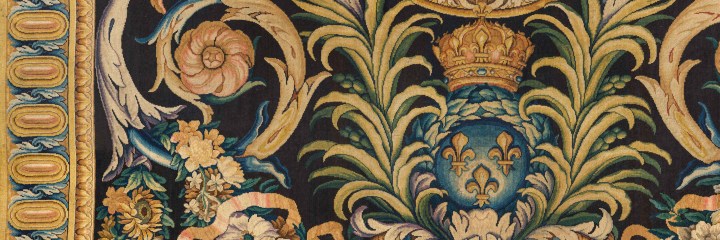
Grande Galerie carpet with landscapes (detail), Savonnerie Manufactory, after designs by Charles Le Brun, 1680; knotted and cut wool pile (symmetrical knot), overall (confirmed): H. 353 × W. 128 inches (New York: The Metropolitan Museum of Art, Gift of Mr. and Mrs. Charles Wrightsman, 1976.155.114).
◊ ◊ ◊ ◊ ◊
Opening at The Met in September:
A King’s Carpet: Louis XIV and the Savonnerie
The Metropolitan Museum of Art, New York, 8 September 2026 — 5 March 2028
Curated by Wolf Burchard and Elizabeth Cleland
In 1668, King Louis XIV of France commissioned the Paris-based Savonnerie manufactory to create the largest carpet ever woven. Composed of 92 individual pieces, the carpet was intended to cover the full span of the Grande Galerie of the Louvre, measuring 440 meters, six times the length of the Hall of Mirrors at Versailles. Not only was it a bold and unprecedented undertaking, but a unique chapter in the history of art. The first ever exhibition about the Savonnerie in the United States, A King’s Carpet sheds new light on The Met’s three carpets made as part of this ambitious scheme. Held in the iconic Wrightsman Galleries, it will explore the tumultuous history of these Baroque masterpieces from their conception and the harsh realities of their production to their dispersal after the French Revolution.
A project of unheard-of scale, the weaving of the 92 carpets necessitated the establishment of massive workshops and an expendable workforce of orphans and adolescents with sharp eyesight and nimble fingers. Woven over 20 years, the carpets were never rolled out in the space for which they were intended, Louis XIV having turned his attention away from the Louvre to Versailles. During the Revolution, many were stripped of their royal emblems or sold, some eventually finding new homes with prominent American collectors such as J. P. Morgan and Alva Vanderbilt.
This exhibition will present four complete carpets along with a selection of fragments, attesting to the scheme’s segmentation and dispersal. In addition, visitors will be able to observe textile conservators at work in an in-gallery temporary conservation studio as they repair and strengthen one of these monumental textiles.
As noted in the press release:
A King’s Carpet is curated by Wolf Burchard, Curator, Department of European Sculpture and Decorative Arts, and Elizabeth Cleland, Curator, Department of European Sculpture and Decorative Arts. The exhibition highlights a long-standing cooperative effort between The Metropolitan Museum of Art and the Mobilier national in Paris, which mounted a major exhibition on the Grande Galerie carpets for one week at the Grand Palais, Le Trésor retrouvé du Roi-Soleil / The Rediscovered Treasure of the Sun King (1–8 February 2026). The Grand Palais exhibition was curated by Wolf Burchard of The Met and Emmanuelle Federspiel and Antonin Macé de Lépinay of the Mobilier national, the three of who are currently preparing a comprehensive new monograph on Louis XIV’s Savonnerie carpets, to be released in 2027.
Exhibition | European Fans from the Taft Collection
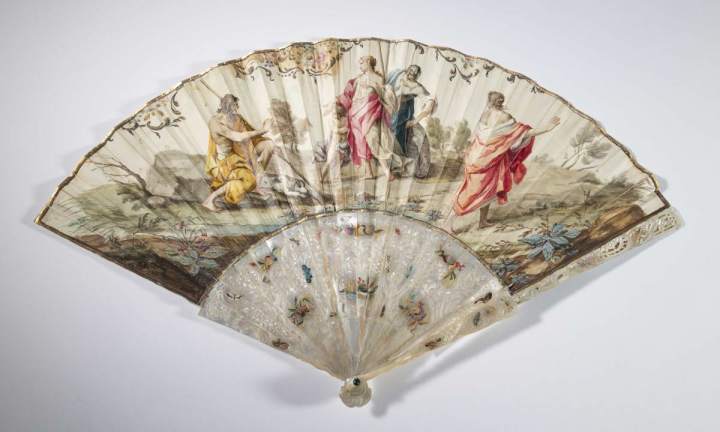
Fan with the Judgment of Paris, ca. 1725–50, gouache on parchment with paste emerald rivets and mother-of-pearl sticks
(Cincinnati: Taft Museum of Art)
◊ ◊ ◊ ◊ ◊
Now on view at the Taft:
Unfolding Elegance: European Fans from the Taft Collection
Taft Musem of Art, Cincinnati, 8 August — 29 November 2026
Featuring sumptuous decoration and beautifully detailed paintings, the nine 18th-century fans in Unfolding Elegance represent the pinnacle of fan-making in Europe and a level of craftsmanship that was unrivaled in later periods. The involvement of several dozen artisans to produce one fan demonstrates the value of what is now a lost art form. Skilled craftspeople carved, pierced, and embellished the supports with a variety of precious materials, while painters chose subjects that emphasized storytelling, drama, and exuberance. Drawn from the Taft’s collection, these rare examples depict classical myths, pastoral scenes, and biblical stories—paintings only seen when a woman unfurled and delicately fluttered her fan, perhaps to cool the air or flirt with a suitor. In addition to exploring the rich history of the fan, Unfolding Elegance also celebrates the year-long conservation project that made it possible to share these fragile objects with the public.










leave a comment