The Burlington Magazine, November 2024
The long 18th century in the November issue of The Burlington:
The Burlington Magazine 166 (November 2024)
e d i t o r i a l
 “The Life Cycle of Art History,” p. 1099.
Art history is withering. Art history is flourishing. Which of these statements is true? Very mixed impressions can be gathered from across the United Kingdom, where the future health and reach of the academic discipline is far from clear. Amid all this uncertainty, however, there are some inspiring developments that should be applauded.
a r t i c l e s
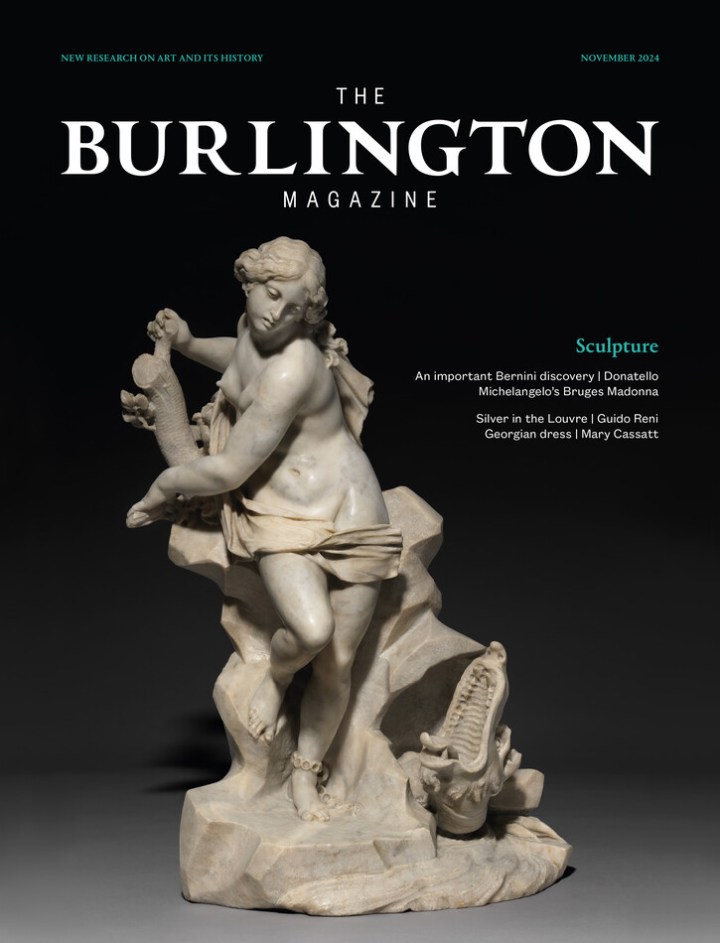
• Maichol Clemente, “‘Une pièce fort singulière’: The Rediscovery of Gian Lorenzo Bernini’s Andromeda and the Sea Monster,” pp. 1100–22.
An important early sculpture by Gian Lorenzo Bernini, Andromeda and the Sea Monster, is here attributed to him and published for the first time. It displays all the finesse and invention that characterises the work of his youth and is also notable for having been offered to Jean-Baptiste Colbert, First Minister of Louis XIV, before forming part of the collection of the Prince of Soubise [in the eighteenth century.]
r e v i e w s
• William Barcham, Review of the exhibition catalogue, Les Tiepolo: Invention et Virtuosité à Venise, edited by Hélène Gasnault with Giulia Longo and a contribution by Catherine Loisel (Beaux-Arts de Paris, 2024), pp. 1176–78.
• Erin Griffey, Review of the exhibition catalogue, Style & Society: Dressing the Georgians, by Anna Reynolds (Royal Collection Trust, 2023), pp. 1178–80.
• Philippa Glanville, Review of the catalogue of the Louvre’s silverware, Orfèvrerie de la Renaissance et des temps modernes: XVIe, XVIIe et XVIIIe siècles: La Collection du Musée du Louvre, by Michèle Bimbenet-Privat, Florian Doux, and Catherine Gougeon, with Philippe Palasi, 3 volumes (Éditions Faton, 2022), pp. 1186–87.
• Giulio Dalvit, Review of the catalogue, Galleria Borghese: Catalogo Generale I: Scultura Moderna, edited by Anna Coliva with Vittoria Brunetti (Officina Libraria, 2022), pp. 1192–93.
• Gauvin Alexander Bailey, Collective Creativity and Artistic Agency in Colonial Latin America, edited by Maya Stanfield-Mazzi and Margarita Vargas-Betancourt (University of Florida Press, 2023), pp. 1193–94.
• Charles Avery, Review of Die Bronzen des Massimiliano Soldani Benzi (1656–1740): Representationsstrategien des europäischen Adels um 1700, by Carina Weißmann (De Gruyter, 2022), p. 1195.
• Pierre Rosenberg, Review of the catalogue, French Paintings 1500–1900: National Galleries of Scotland, by Michael Clarke and Frances Fowle, 2 volumes (National Galleries of Scotland, 2023), pp. 1196–97.
Exhibition | The Art of French Wallpaper Design

Installation view of the exhibition The Art of French Wallpaper Design at the RISD Museum, November 2024.
◊ ◊ ◊ ◊ ◊
The exhibition is accompanied by an online publication:
The Art of French Wallpaper Design
RISD Museum, Providence, 16 November 2024 — 11 May 2025
The Art of French Wallpaper Design explores the vibrant, surprising designs that adorned walls in the 1700s and 1800s. Featuring more than 100 rare samples of salvaged wallpapers, borders, fragments, and design drawings, this exhibition reveals the creative process and showcases the extraordinary technical skills involved in producing these works, presenting an invaluable resource for artists and enthusiasts alike. This exhibition celebrates the vision and generosity of collectors Charles and Frances Wilson Huard, whose remarkable collection, assembled in the 1920s and ’30s, is now in the care of the RISD Museum. Accompanied by a comprehensive digital publication, The Art of French Wallpaper Design invites you to explore the remarkable innovation and craftsmanship of these historic pieces.
◊ ◊ ◊ ◊ ◊
Lyra Smith, ed., with contributions by Emily Banas, Brianna Turner, and Andrew Raftery, The Art of French Wallpaper Design (Providence: Rhode Island School of Design Museum, 2024), available online»
The vibrant designs of French papier peint (literally meaning painted paper) that adorned walls in the 1700s and 1800s were collected and donated to the museum by French artist Charles Huard and his wife, American writer Frances Wilson Huard. The Huard Collection is a rare resource due to the fragile and ephemeral nature of wallpapers. This free online publication explains the preservation methods used to take care of the wallpapers along with components made in the process, such as design drawings and woodblocks. The attentive care taken to preserve the materials made during each phase of the design process make the Huard Collection an ideal teaching collection.
Essays
• Introduction to French Wallpaper — Emily Banas
• About the Huard Collection — Emily Banas
• Conservation and the Huard Collection: Preserving the Processes of Making — Brianna Turner
• Printing Matters: Wallpaper in the Context of Printmaking — Andrew Raftery
The Collection
The RISD Museum contains one of the most significant collections of French 18th- and 19th-century wallpapers in the United States with approximately 500 wallpaper panels, borders, fragments, and design drawings. Here, you can browse the wallpapers by their collections, colors, motifs, or time periods.
The Making of Wallpaper
This video provides a guided, in-depth look at seven different wallpapers in the Huard Collection. Watch, listen, and learn about the hidden stories these wallpapers can tell us about their design, making, and use.
Exhibition and Book | Lost Gardens of London
Now on view at London’s Garden Museum:
Lost Gardens of London
Garden Museum, London, 23 October 2024 — 2 March 2025
Curated by Todd Longstaffe-Gowan
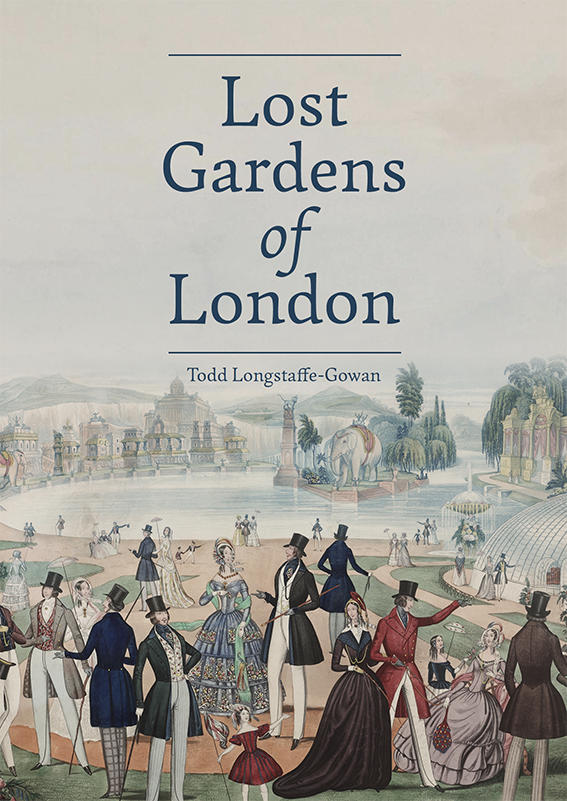 Did you know that Southwark once had a zoo? That for a short spell Britain’s first ecological park was built within a stone’s throw of Tower Bridge? Or that one of the capital’s most celebrated botanical gardens now lies beneath the platforms of Waterloo station? The exhibition Lost Gardens of London reveals the secret history of some of London’s most beguiling forgotten gardens.
Thousands of gardens have vanished across London over the past five hundred years—ranging from princely pleasure grounds and private botanical gardens, to humble allotments and defunct squares, artists’ gardens, eccentric private menageries, and the ecological parks of the twentieth century. Guest curated by landscape architect and historian Dr Todd Longstaffe-Gowan, Lost Gardens of London will explore this legacy and reveal tantalising glimpses of some of the rich and varied gardens that once embellished the metropolis. Paintings, prints, drawings, photographs, and maps bring these lost gardens to life, depicting changing trends and fashions in garden design while exploring London’s enduring love affair with nature, and how green spaces have always been a vital part of life in the capital.
In every borough, parks, gardens, and green open spaces have succumbed to new roads, street-widenings, railway encroachments and new buildings, or have simply been swallowed up by suburbia. Accompanying public programmes will explore how the remaining green spaces that may be taken for granted in London today have survived thanks to protests, community action, and legal protections being put in place. The exhibition is a timely reminder of the vulnerability of urban gardens and access to nature.
Lost Gardens of London coincides with a new book by Longstaffe-Gowan of the same name, published by the Modern Art Press (and distributed by Yale University Press).
Todd Longstaffe-Gowan, Lost Gardens of London (London: Modern Art Press, 2024), 272 pages, ISBN: 978-1738487806, £25 / $35.
Exhibition | Sculpture and Colour in the Spanish Golden Age

Luisa Roldán, known as La Roldana, The First Steps of Jesus, ca. 1692–1706, polychrome terracota
(Museo de Guadalajara)
◊ ◊ ◊ ◊ ◊
From the press release for the exhibition:
Hand in Hand: Sculpture and Colour in the Spanish Golden Age
Darse la mano: Escultura y color en el Siglo de Oro
Museo Nacional del Prado, Madrid, 19 November — 2 March 2025
Curated by Manuel Arias Martínez
When praising the wood sculpture of Christ of Forgiveness, carved by Manuel Pereira and polychromed by Francisco Camilo, the writer on art Antonio Palomino (1655–1726) concluded with the following opinion: “Thus painting and sculpture, hand in hand, create a prodigious spectacle.” The unique importance achieved by the synthesis of volume and colour in sculpture of the early modern period can be explained only by the role it played as an instrument of persuasion.
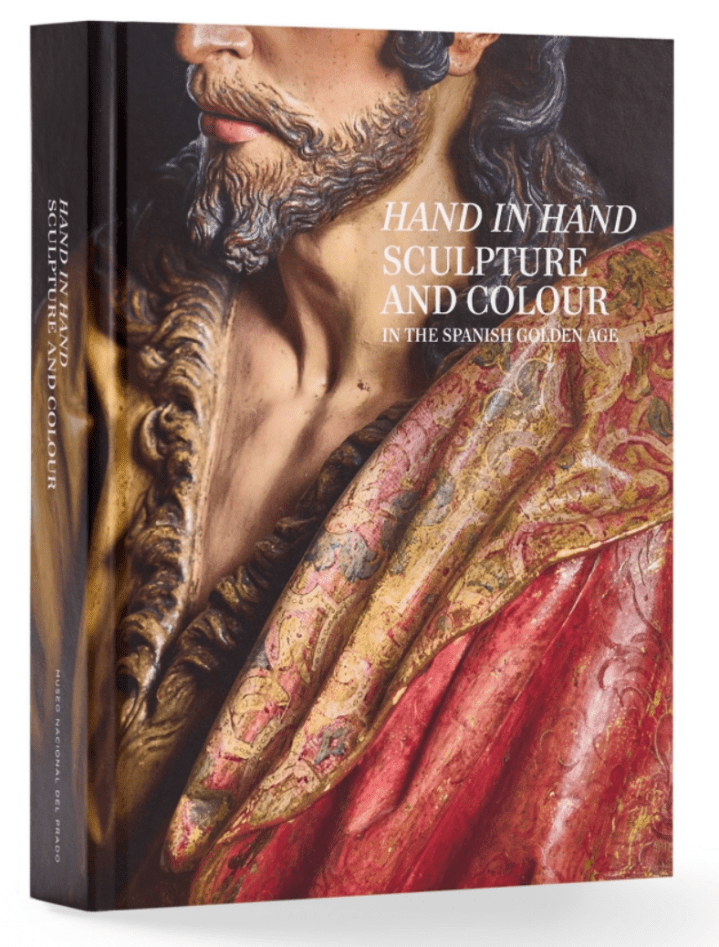 From the Graeco-Roman world onwards, sculptural representation was seen as a necessity. Divinity was present through its corporeal, protective, and healing image, which became more lifelike when covered with colour, an essential attribute of life in contrast to the inanimate pallor of death. In the words of the Benedictine monk Gregorio de Argaiz in 1677: “Each figure, no matter how perfect it may be in sculpture, is a corpse; what gives it life, soul, and spirit is the brush, which represents the affections of the soul. Sculpture forms the tangible and palpable man […], but painting gives him life.”
Religious sculpture existed in a context of supernatural connotations from the time of its execution. It was thus associated with miracles and divine interventions, with angelic workshops, and with craftsmen who had to be in a morally acceptable state in order to undertake a task that went beyond a mere artistic exercise, given that what was created was ultimately an imitation of the divine.
The exhibition now presented at the Museo Nacional del Prado offers an analysis of the phenomenon and success of polychrome sculpture, which filled churches and convents in the 17th century and played a key role as a support for preaching. The close and ideal collaboration between sculptors and painters is revealing with regard to the esteem in which colour was held, not merely as a superficial finish to the work but rather an essential element without which it could not be considered finished. Colour also made a decisive contribution to emphasising the dramatic values of these sculptures, both those made for altarpieces and for processional images. Theatrical gesturalism, together with the sumptuous nature of the clothing—whether sculpted, glued fabric, or real textiles—transformed these sculptures into dramatic objects filled with meaning.
Finally, the exhibition looks at other examples of the interrelationship between the arts in relation to polychrome sculpture, from the prints that helped disseminate the most popular devotional images to the Veils of the Passion [painted altarcloths of devotional images] which simulated altarpieces, and paintings that made use of striking illusionism to faithfully reproduce the sculptural images on their respective altars.
More information is available here»
Manuel Arias Martínez, Hand in Hand: Sculpture and Colour in the Spanish Golden Age (Madrid: Museo Nacional del Prado, 2024), 424 pages, ISBN: 978-8484806288 (English edition) / ISBN: 978-848480-6271 (Spanish edition) €37.
Exhibition | Sketching Splendor: American Natural History, 1750–1850
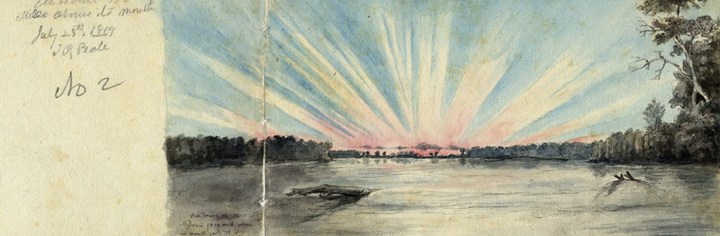
Titian Ramsay Peale, Sunset on Missouri, July 1819
(Philadelphia: American Philosophical Society, NH121 TRP, MSS.B.P31.15d)
◊ ◊ ◊ ◊ ◊
Now on view at the American Philosophical Society Museum:
Sketching Splendor: American Natural History, 1750–1850
American Philosophical Society Museum, Philadelphia, 12 April — 29 December 2024
Sketching Splendor: American Natural History, 1750–1850 explores how William Bartram, Titian Ramsay Peale, and John James Audubon made sense of nature’s complexities through their writings, drawings, and watercolors. It highlights their approaches to capturing the natural world during a time of rapid intellectual, social, and political change.
 Bartram, Peale, and Audubon relied on natural knowledge established by European, Euro-American, and Native American experts while balancing changing ideas of how reason and emotion impacted science. As both artists and naturalists, they freely expressed their ideas using science, art, and literature. Through a potent mix of scientific ideas, shifting worldviews, and professional freedom, their works embodied both experimentation and certainty. However, their interpretation of the natural world has also raised questions of national importance. Their world was not just one of intellectual excitement, but one of systematic injustice and a complex national history become visible as we peel back the layers. Sketching Splendor draws on the APS’s extensive holdings. Highlights of the exhibition include William Bartram’s map of the Alachua Savanna, Benjamin Henry Latrobe’s Rattlesnake Skeleton, Titian Ramsay Peale’s watercolors from the Long Expedition, and one volume of John James Audubon’s original Birds of America.
Anna Majeski and Michelle Craig McDonald, Sketching Splendor: American Natural History, 1750–1850 (Philadelphia: University of Pennsylvania Press, 2024), 112 pages, ISBN: 978-1606180402, $30.
Anna Majeski received a PhD in art history from the Institute of Fine Arts, New York University in 2022, where she completed a doctoral dissertation on a remarkable series of astrological fresco cycles completed in Padua between 1300 and 1440. Her research focuses on the intersections of art and science, image and knowledge in the early modern world, and has been supported by pre- and postdoctoral fellowships from the American Academy in Rome and the Harvard Center for Renaissance Studies, Villa I Tatti. She joined the American Philosophical Society, Library & Museum, as Mellon Foundation Postdoctoral Natural History Exhibition Research Fellow in October 2022.
Michelle Craig McDonald is the Librarian/Director of the Library and Museum at the American Philosophical Society, founded in 1743 and the oldest learned society in North America. The APS has more than 14 million pages of manuscripts and 300,000 printed volumes, with particular strengths in early American history, the history of science, and Native American and Indigenous cultures. McDonald earned her PhD in history from the University of Michigan where she focused on business relationships and consumer behavior between North America and the Caribbean during the 18th and 19th centuries. She is the co-author of Public Drinking in the Early Modern World: Voices from the Tavern (Pickering & Chatto/Routledge Press, 2011), and her current monograph, Coffee Nation: How One Commodity Transformed the Early United States, will be published by the University of Pennsylvania Press in spring 2025.
Exhibition | Buckland and Palladio: A Legacy of Design

Hammond-Harwood House in Annapolis, Maryland, designed by William Buckland in 1774. Buckland was inspired by Palladio’s Villa Pisani, Montagnana, as published in The Four Books of Architecture.
◊ ◊ ◊ ◊ ◊
Now on view:
Buckland and Palladio: A Legacy of Design
Hammond-Harwood House Museum, Annapolis, Maryland, 1 April — 30 December 2024
When William Buckland designed the Hammond-Harwood House in 1774, he was inspired by the designs of 16th-century Italian architect Andrea Palladio. The Hammond-Harwood House celebrates its 250th anniversary with an exhibition of early documents, paintings, and artifacts that provide context for Matthias Hammond’s house—including Buckland’s indenture papers and a drawing by Thomas Jefferson.
When the Hammond-Harwood House was designed for Matthias Hammond in 1774, Annapolis was in its Golden Age. There were 14 major houses either already built or underway for the politically active leaders of the Revolution: John Brice, Charles Carroll of Carrollton, William Paca, John Ridout, and Upton Scott. Hammond, a wealthy 25-year-old tobacco planter and delegate to the Maryland General Assembly, had a handsome inheritance and a keen business sense to purchase four acres in Annapolis to build his own “town house.”
Hammond hired the joiner, carpenter, and architect William Buckland to design his city home. Buckland had been indentured to George Mason since his arrival in Virginia in 1755 to complete Mason’s plantation home, Gunston Hall. Buckland left Mason with high recommendations and bought a farm in Virginia, set up a workshop, and worked on other estates, including Mount Airy, the Tayloe family plantation.
Buckland moved to Annapolis most likely at the urging of Tayloe’s son-in-law Edward Lloyd. Lloyd, a wealthy merchant and planter, had purchased a half-finished brick house in Annapolis begun by Samuel Chase, now known as the Chase-Lloyd House. Buckland agreed to complete its construction and devise the impressive interior that showcased his skill inspired by the designs of the 16th-century Italian architect Andrea Palladio (1508–1580).
Palladio was an Italian Renaissance architect who was influenced by Greek and Roman architecture and is considered to be, even today, one of the most influential figures in the history of architecture. His treatise, I quattro libri dell’architettura (The Four Books of Architecture), was first printed in Italian in 1570, followed by several reprints and a full English version published in London by Giacomo Leoni in 1715–1720.
In Buckland’s design for Hammond’s city house, he adapted the plans of the Villa Pisani at Montagnana from Palladio’s Four Books. The five-part plan house, composed of a central block with wings on each side and connected by a passage, was well-suited to the tastes and climates of the southern colonies. By 1760, the manor houses of the Chesapeake and Tidewater plantation owners were primarily of the five-part Palladian plan—essentially a Palladian country villa.
Although Buckland is thought to have designed many interiors in Virginia and Maryland, including Tulip Hill, Whitehall, and Ringgold House, little documentation exists. The Hammond-Harwood House is the only known commission for a full building design and attests to Buckland’s knowledge of English Palladianism and the current fashion in decoration.
The Burlington Magazine, October 2024
The long 18th century in the October issue of The Burlington:
The Burlington Magazine 166 (October 2024)
 e d i t o r i a l
• “Restoring the ‘belle époque’,” pp. 995–96.
The Musee Jacquemart-André is a treasure house that graces the Haussmann boulevards in Paris and is perhaps not nearly as well-known as it should be. The recent re-opening of the museum on 6th September, following a period of closure for conservation, therefore provides a welcome opportunity to draw fresh attention to this most romantic and beguiling of collections and the elegant building that houses it.
a r t i c l e s
• Jacob Willer, “Annibale Carracci and the Forgotten Magdalene,” pp. 1028–35.
A painting the collection of the National Trust at Kedleston Hall, Derbyshire, is published here as a work of Annibale Carracci’s maturity. Related to comparable compositions which derive from it, in collections in Rome and Cambridge, it was acquired in Florence in 1758 for the 1st Baron Scarsdale.
• Samantha Happé, “Portable Diplomacy: Louis XIV’s ‘boîtes à portrait’,” pp. 1036–43.
Louix XIV’s ambitious and carefully orchestrated diplomatic programme included gifts of jewelled miniature portraits known as ‘boîtes à portrait’. Using the ‘Présents du Roi’, the circumstances around the commissioning and creation of these precious objects can be explored and a possible recipient suggested for a well-preserved example now in the Musée du Louvre, Paris.
r e v i e w s
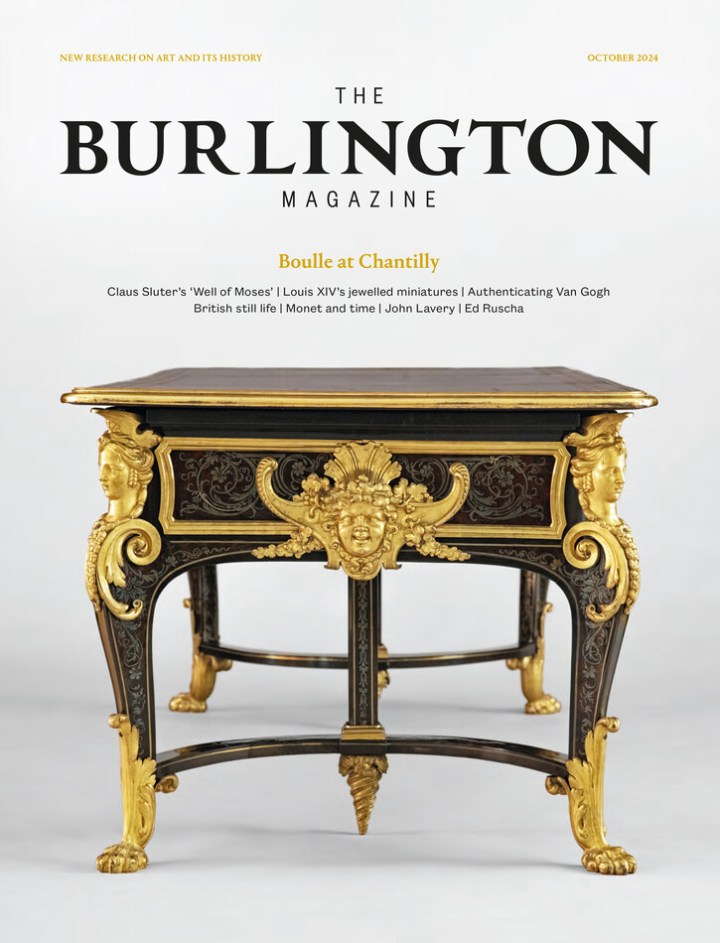
• Alexander Collins, Review of the exhibition André Charles Boulle (Musée Condé, Château de Chantilly, 2024), pp. 1056–59.
• Claudia Tobin, Review of the exhibition The Shape of Things: Still Life in Britain (Pallant House Gallery, 2024), pp. 1067–69.
Helen Hillyard, Review of of the recently renovated galleries of the Barber Institute of Fine Arts, Birmingham, pp. 1077–79.
• Colin Thom, Review of Steven Brindle, Architecture in Britain and Ireland, 1530–1830 (Paul Mellon Centre, 2024), pp. 1080–81.
• Christopher Baker, Review of Bruce Boucher, John Soane’s Cabinet of Curiosities: Reflections on an Architect and His Collection (Yale University Press, 2024), pp. 1087–88.
o b i t u a r y
• Christopher Rowell, Obituary for Alastair David Laing (1944–2024), pp. 1094–96.
Although renowned in particular for his expertise on the art of François Boucher, Alastair Laing had very wide-ranging art historical taste and knowledge, which he shared with great generosity of spirit. He curated some important exhibitions and brought scholarly rigour to his inspired custodianship of the art collections of the National Trust.
Exhibition | Furniture by Jean-Pierre Latz at the Dresden Court
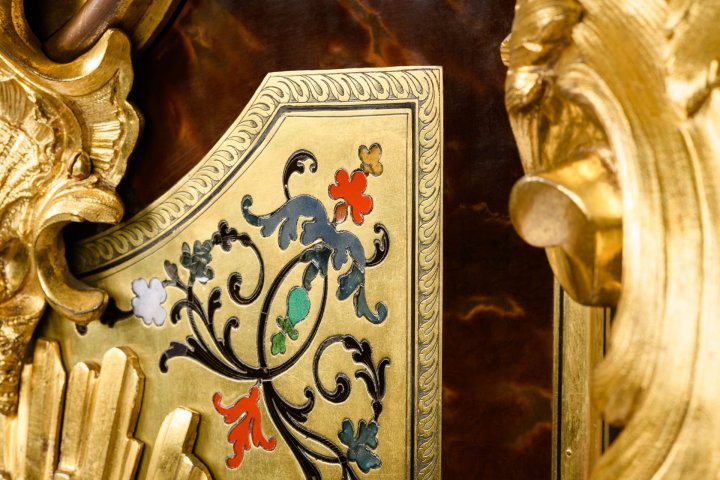
Pedestal detail, signed and dated: Jean-Pierre Latz, Paris, 1739 (Dresden, Inv. No. 37616-2).
◊ ◊ ◊ ◊ ◊
Now on view in Dresden:
Made in Paris: Furniture Creations by Jean-Pierre Latz at the Dresden Court
Fait à Paris: Die Kunstmöbel des Jean-Pierre Latz am Dresdner Hof
Royal Palace, Dresden, 19 October 2024 — 2 February 2025
In the impressive staterooms of the Dresden Residenzschloss (Royal Palace) the collection of Latz furniture shall be presented for the first time in its full extent at the special exhibition of the Kunstgewerbemuseum (Museum of Decorative Arts). This exhibition is the conclusion of the twelve years of comprehensive research and conservation project that the furniture has undergone.

Pendulum clock on pedestal, attributed to Jean-Pierre Latz, Paris, ca. 1739 (Dresden, Inv. No. 37679-1).
The Museum of Decorative Arts Dresden holds the largest and most important collection worldwide of magnificent furniture of the renowned Parisian cabinetmaker Jean-Pierre Latz (1691–1754). The collection contains approximately twenty object ensembles, consisting of thirty individual items. They demonstrate with striking effect the magnificence and representation at the Polish-Saxon court of King Augustus III (1696–1763) and of his prime minister, Count von Brühl (1700–1763).
The Second World War and its aftermath deeply affected the furniture collection of the museum when, apart from destruction, it suffered damages caused by evacuation and transportation. For many years, the necessary conservation and restorations could not be achieved because of a lack of resources; the furniture had to be put into storage and thus lapsed into oblivion. That is until now! For the first time since their wartime storage, eighty years ago, and after years of careful and thoughtful conservation and restoration, the highly important Dresden Latz collection will be shown in the splendour of the staterooms—the very stage where they once enhanced the representation of the Saxon monarchs.
Born in the Electorate of Cologne, an ecclesiastical principality of the Holy Roman Empire, Jean-Pierre Latz followed in the footsteps of many German cabinetmakers and went to Paris in 1719. Latz´s works are striking for a very distinct individual artistic signature and boast opulent, sculpturally conceived corpus forms, technically superb craftsmanship and great sculptural skill in the fashioning of bronze mounts, as well as consummate marquetry work. These high-quality technical aspects were combined in designs that reflect the exquisite taste of the royal and aristocratic customers and patrons in France and abroad. Impressive, elegant and playful as well, his furniture combines mythological themes from the antiquity with their symbolic connotations of the 18th century: monumental, playful and superb, they impressed with their costly materials. Sought after by the royalty in France and abroad, Latz´s furniture is among others still to be found in the former palaces of Augustus III (King of Poland & Elector of Saxony), Frederick the Great (King of Prussia; 1712–1786) and the presidential Quirinal Palace in Rome—originating from the former royal court in Parma.
Important loans from the former royal palaces in Potsdam and from the Palazzo Quirinale in Rom, combined with the splendid collection of Latz furniture of the State Art Collections Dresden, will enable us to present an unprecedented and probably one-time concerted show of outstanding masterpieces by Jean-Pierre Latz. The exhibition will be completed withhighlights from the State Art Collections to throw light on the official representation and demonstration of power at the Saxon Court through the vehicle of French luxury products.
Old artisanship always brings up fascinating issues for today´s museum public: how many different materials and techniques come together as a unity in Latz´s creations? The exhibition will use computer techniques to show how the furniture as a work of art can be digitally disassembled directly before the visitor´s very eyes, so that all its secrets can be penetrated and understood.
Exhibition | Stan Douglas: The Enemy of All Mankind
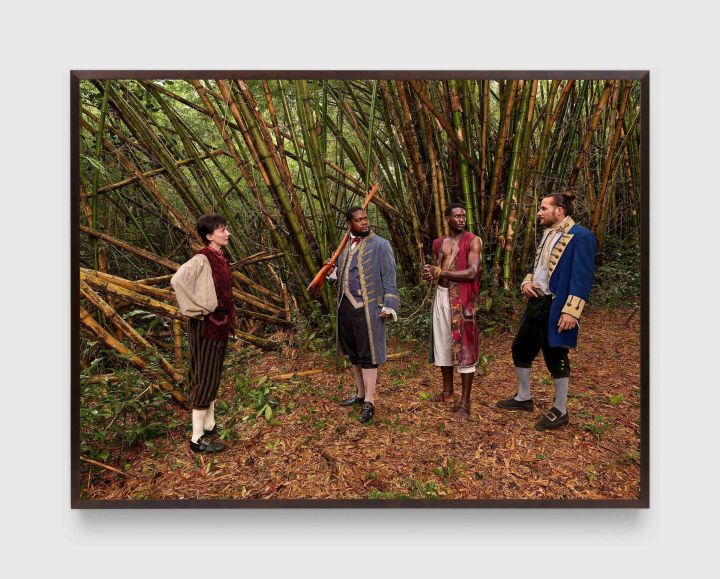
Stan Douglas, Act II, Scene XII: In which Polly Convinces Pirates Laguerre and Capstern to Release their Captive, Prince Cawwawkee, for a Prize Rather than go to War Against His People with Morano, 2024, inkjet print mounted on Dibond aluminum, 150 × 200 cm, edition of 5.
◊ ◊ ◊ ◊ ◊
From the press release for the show, which was covered by Walker Mimms for The New York Times (17 October 2024). . .
Stan Douglas | The Enemy of All Mankind: Nine Scenes from John Gay’s Polly
David Zwirner, New York, 12 September — 26 October 2024
David Zwirner is pleased to announce an exhibition by Stan Douglas, on view at the gallery’s 525 West 19th Street location in New York. Featuring a new photographic series, The Enemy of All Mankind: Nine Scenes from John Gay’s Polly, this will be the artist’s eighteenth solo exhibition with the gallery. In this stand-alone group of nine images, Douglas stages scenes from the eighteenth-century comic opera Polly, written by English dramatist John Gay (1685–1732), using the narrative as a vehicle through which to engage a wide range of themes that remain highly relevant today, including race, class, gender, and media. One work from the series debuted in David Zwirner: 30 Years, on view in summer 2024 in Los Angeles, and this will mark the first presentation of the body of work in its entirety.
Since the 1980s, Douglas has created films, photographs, and other multidisciplinary projects that investigate the parameters of their respective mediums. His ongoing inquiry into technology’s role in image making, and how those mediations infiltrate and shape collective memory, has resulted in works that are at once specific in their historical and cultural references and broadly accessible. Since the beginning of his career, photography has been a central focus of Douglas’s practice, used at first as a means of preparing for his films and eventually as a powerful pictorial tool in its own right. The artist is influenced in particular by media theorist Vilém Flusser’s notion of the photographic image as an encoded language that is determined by a specific set of technological, social, cultural, and political circumstances.
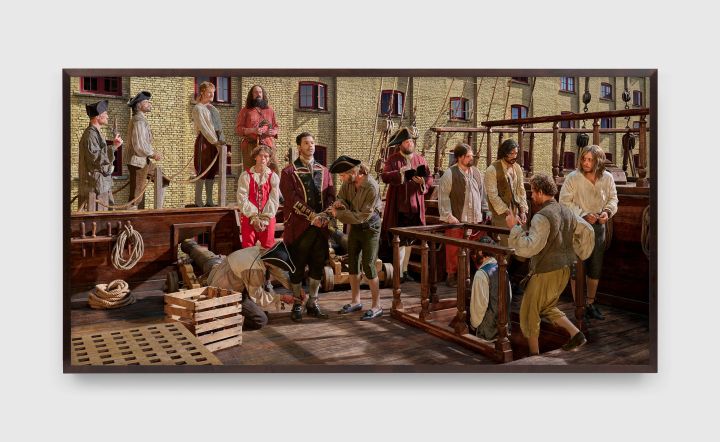
Stan Douglas, Overture: In which Convicted Brigand Captain Macheath is Transported to the West Indies Where He will be Impressed into Indentured Labour, 2024, inkjet print mounted on Dibond aluminum, 150 × 200 cm, edition of 5.
◊ ◊ ◊ ◊ ◊
A sequel to Gay’s well-known The Beggar’s Opera (which was later adapted as The Threepenny Opera), Polly was censored by the British government for its embedded satire and critique, particularly of policies around the parceling out of land; as a result, it was never produced during Gay’s lifetime. Douglas further notes that Polly was ahead of its time, as it “satirizes imperial patriarchal hierarchies of race and class—as well as gender norms, which it depicts as performative” (Douglas, in correspondence with the gallery, March 2024).
Gay’s stage play follows the eponymous Polly Peachum, who travels to the West Indies to search out her estranged husband, Captain Macheath, who has disguised himself as a Black man known as Morano and adopted the life of a pirate. Upon her arrival on the island, Polly is, unbeknownst to her, sold to a wealthy plantation owner as a courtesan. After eventually securing her freedom, she is advised to disguise herself as a young man to ward off unwanted male attention, and as a result becomes entangled in a series of skirmishes between the colonial settlers, the native population, and the pirates.
To create the photographs—which were shot in Jamaica using Hollywood-level production effects—Douglas enlisted a cast of actors to read from a loose script that he adapted for the chosen scenes, modifying certain characters and elements to bring the themes in line with the present day. For example, in Douglas’s version, Captain Macheath was a Black man passing as white in London who, once in the West Indies, drops the disguise and lets his hair grow out. Rather than posing the players, he photographed them continuously as they acted out and improvised the dialogue, then selected as the final images those that best embodied the ideas put forth in the narrative. The resulting large-scale photographs are dynamically realized, taking the form of sweeping tableaux where dramatis personae and setting collide in vivid color. Retaining Gay’s sense of comedic folly and satire as well as the underlying pathos of the story, the images bear traces of the various forms of media through which they have been filtered, employing formal elements drawn from theatrical, cinematic, and photographic conventions alike. Accordingly, Douglas positions the viewer as a spectator—a voyeuristic witness to the various narrative turns and apparent absurdities in which relationships are transactional and enemies expendable.
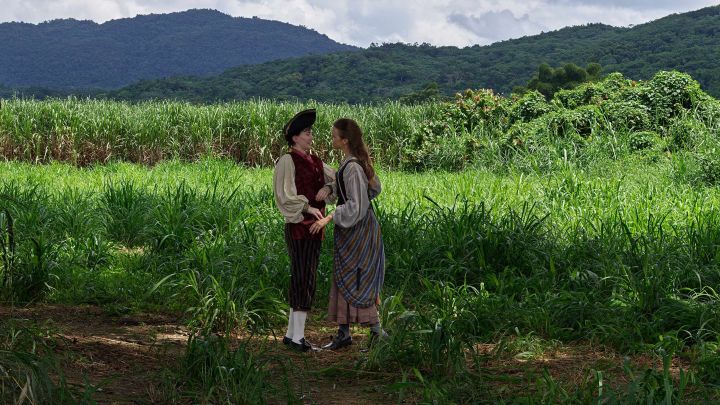
Stan Douglas, Act II, Scene VI: In which the Wife of Pirate Captain Morano, Jenny Diver, Attempts to Seduce Polly, who is Disguised as a Man to Avoid Molestation, detail, 2024, inkjet print mounted on Dibond aluminum, 150 × 150 cm, edition of 5.
◊ ◊ ◊ ◊ ◊
Douglas’s use of Polly as the basis for this project arose out of his long-standing interest in maroon societies, large groups of enslaved persons who banded together to run away and start new, proto-democratic societies. Contrary to their depiction in popular media, pirate ships occasionally functioned as collaborative maroon societies in their own right. The title of the series, The Enemy of All Mankind, is taken from a doctrine of eighteenth-century maritime law (in Latin, hostis humani generis) under which pirates could be attacked by anyone since they fell outside the protection of any nation, but its core notion of defining certain groups as enemies or outsiders resonates broadly today. In Polly, the pirates—in contrast to the settlers and indigenous people—are meant to embody immorality and evil, yet in pulling out specific strands of the narrative, Douglas points to a more nuanced understanding of such sweeping generalities.
Stan Douglas (b. 1960) was born in Vancouver and studied at Emily Carr College of Art in Vancouver in the early 1980s. Douglas was one of the earliest artists to be represented by David Zwirner, where he had his first American solo exhibition in 1993—the second show in the gallery’s history.
Douglas’s work has been the subject of solo exhibitions at prominent institutions worldwide since the 1980s. In 2022, the artist represented his native Canada at the Venice Biennale, where he debuted a major video installation, ISDN (2022)—now in the collection of the National Gallery of Canada, San Francisco Museum of Modern Art, and The Museum of Modern Art, New York—and a related body of photographs. Subsequently, the exhibition Stan Douglas: 2011 ≠ 1848 traveled around Canada with stops at The Polygon Gallery, Vancouver (fall 2022); Remai Modern, Saskatoon (February–April 2023); and the National Gallery of Canada, Ottawa (September 2023–October 2024). A solo exhibition also titled 2011 ≠ 1848 was subsequently staged in 2023 at De Pont Museum, Tilburg, the Netherlands. In 2023, this body of work inaugurated David Zwirner’s new Los Angeles location, and it is currently on view at the Parque de Serralves in Porto, Portugal, through 12 January 2025.
Douglas has been the recipient of notable awards, including the Audain Prize for Visual Art (2019); the Hasselblad Foundation International Award in Photography (2016); the third annual Scotiabank Photography Award (2013); and the Infinity Award from the International Center of Photography, New York (2012). In 2021, Douglas was knighted as a Chevalier of the Ordre des Arts et des Lettres by the French Minister of Culture, and in 2023 he was awarded an honorary doctorate by Simon Fraser University, Greater Vancouver. Work by the artist is held in major museum collections worldwide.
Exhibition | French Neoclassical Paintings from the Horvitz Collection

Claude-Joseph Vernet, After the Storm, 1788.
(Wilmington: Horvitz Collection)
◊ ◊ ◊ ◊ ◊
Now on view at the AIC:
French Neoclassical Paintings from the Horvitz Collection
Art Institute of Chicago, 19 October 2024 — 6 January 2025
Curated by Emerson Bowyer and Andrea Morgan
This exhibition showcases 25 paintings from the preeminent private collection of French 18th-century art in the United States: the Horvitz Collection. The selection of works focuses on Neoclassicism, an artistic style that emerged in the later 1700s and flourished through the 1820s, a period of tremendous political and social upheaval in France. This time was also the heyday of ‘history painting’, a genre of painting characterized by large-scale compositions portraying scenes from history, mythology, and religion. Neoclassical painters looked to the art, architecture, and literature of ancient Greece and Rome for inspiration, often as a lens through which to depict and comment upon contemporary events, and several works included in the exhibition were displayed to a broad public at the annual Paris Salons.
While these works were created more than 200 years ago and often depict ancient or mythological events, they also reference social and political challenges that remain relevant today, from the overthrow of an absolutist government during the French Revolution—which saw the groundwork laid for modern democracies—through to Napoleon’s Empire and the eventual restoration of Bourbon monarchy. This period also coincided with the rise of Enlightenment ideals, the democratization of knowledge, the spread of printed materials, and the origins of industrialization and increased urbanization.
French Neoclassical Paintings from The Horvitz Collection is curated by Emerson Bowyer, Searle Curator, Painting and Sculpture of Europe and Andrea Morgan, research associate. The exhibition complements a major survey of drawings from the same period, Revolution to Restoration: French Drawings from The Horvitz Collection.










 Enfilade
leave a comment