Exhibition | ‘Canaletto in Venice’ at the Musée Maillol
It’s a busy autumn for eighteenth-century Venice — whether you’re in Venice or Paris. Along with the exhibition at the Musée Jacquemart-André, Canaletto–Guardi: The Two Masters of Venice, museum-goers in Paris can also see Canaletto in Venice at the Musée Maillol. The latter is loosely connected with the Guardi exhibition, opening in Venice at the Correr Museum on September 28. Continuing this theme of pairs, Canaletto in Venice will include the Venetian Notebook, shown earlier this year at the Palazzo Grimani. Thanks to Pierre-Henri Biger for pointing out this latest Parisian offering. The full press release is available as a PDF file here.
◊ ◊ ◊ ◊ ◊
Canaletto in Venice
Musée Maillol, Paris, 19 September 2012 — 10 February 2013
Curated by Annalisa Scarpa
 The Musée Maillol pays homage to Venice with the first exhibition devoted exclusively to Canaletto’s Venetian works. The exhibition will be presented in partnership with the Foundation of Venice Civic Museums which is preparing to put on a Francesco Guardi retrospective at the Correr Museum in Venice to mark the 300th anniversary of that Venetian painter’s birth. Canaletto in Venice will be an exclusive occasion for visitors to enjoy the master’s vision of his city, brought to life through his paintbrush. Along the canals we discover places, islands, squares and monuments, views of a city that still retains its 18th-century charm. The Venetian painter certainly didn’t invent the veduta, or detailed cityscape, a genre that has ancient origins, but he helped to develop it by giving his paintings a modernity that allowed him to overtake his masters.
Canaletto (1697-1768) is the most famous of the Venetian vedutisti of the 18th century. Over the centuries Antonio Canal has never fallen from favour; his works have always been eagerly sought after by collectors. They seem to have an endless charm, unaffected by trends. Canaletto has the crystal clarity of a man who was faithful to the spirit of the Enlightenment, with a very personal vision of reality. His painting manages to capture the very essence of the light; it conveys a unique and sensual shimmering.
The exhibition will bring together more than 50 carefully selected works, from the greatest museums and some historic private collections. On display too will be his drawings and also the famous sketchbook from about 1731, a rare loan by the Gabinetto dei Disegni e Stampe Gallerie the Cabinet of Prints and Drawings of the Accademia Gallery in Venice, which will be displayed open but which can be fully explored on computers.
Visitors will also be able to see a copy, made by Venetian master craftsmen, of the optical chamber used by Canaletto to make his drawings, thanks to a partnership with the superintendence of the Polo Museale of the City of Venice and the research of Dario Maran. It is taken from Canaletto’s original device, which was often used on a boat, made with carefully placed lenses that offered highly precise images that were unique at that time. Visitors will be able to see for themselves just how effective it was.
In recent times Canaletto has had a central role in a series of ground-breaking exhibitions about the vedutisti, including the one in Rome curated by the much-missed Alessandro Bettagno with Bozena Anna Kowalczyk; The Splendours of Venice in Treviso in 2009, by Giuseppe Pavanello and Alberto Craievich; and more recently the outstanding shows in London and Washington, curated by Charles Beddington. The exhibition at the Musée Maillol aims to be the last in this decade-long cycle by allowing Canaletto alone to lead the spectator around his city through his view paintings. The works on display will show how the artist developed his style. The juxtapositioning of his paintings of the same view will show how his early style, heavily influenced by the artist Marco Ricci and also by his training as a theatrical scenery painter, gradually evolved into interpretations of reality. These were imbued with an atmosphere that was both subtle and sublime, paving the way for painting that was to conquer Europe.
◊ ◊ ◊ ◊ ◊
Annalisa Scarpa specialises in Venetian painting of the 18th century and Venetian view painting. After teaching at the University of Ca’ Foscari in Venice, alongside authorities on Venetian art such as Pietro Zampetti, Alessandro Brettagno and especially Terisio Pignatti, she spent many years studying Canaletto’s graphic art. With Ludovico Mucchi she published Nella Profondità dei Dipinti: La Radiografia nell’indagine Pittorica (The Profundity of Painting: Radiography in Art Research), analyzing more than 200 Venetian view paintings using radiography. She is the author of important works on 18th-century Venetian art, Marco Ricci, Sebastiano Ricci and Jacopo Amigoni. She has curated a number of major recent exhibitions: Settecento Veneciano at the Academia of San Fernando in Madrid and at the Museo ode Bellas Artes in Seville, as well as From Canaletto to Tiepolo at the Palazzo Reale in Milan. She is the curator of the Fondazione A. F. Terruzzi in Milan.
S C I E N T I F I C C O M M I T T E E
• Irina Artemieva, Curator of Venetian painting, the State Hermitage Museum, St Petersburg
• Charles Beddington, Art historian who was curator of two of the most recent and important exhibitions dedicated to Canaletto: Canaletto in England: A Venetian Artist Abroad 1746-1755 at Yale Centre for British Art, New Haven, 2006, and the Dulwich Picture Gallery, London, 2007; as well as Venice: Canaletto and His Rivals at the National Gallery in London, 2010 and the National Gallery of Art in Washington, D.C. in 2011.
• Alberto Craievich, Curator, Museo del Settecento Veneziano, Ca’ Rezzonico, Venice, and Professore Emerito of the University of Ca’ Foscari
• Alastair Laing, Curator of Paintings and Sculpture, the National Trust, London
• Filippo Pedrocco, Director, Museo del Settecento Veneziano, Ca’ Rezzonico, Venice
• Lionello Puppi, President of the Centro Studi Tiziano e Cadore, Pieve di Cadore
• Alain Tapié, Chief Curator of Cultural Heritage
Exhibition | The Princely Furniture of the Roentgens
Press release (15 August 2012) for the upcoming exhibition at The Met:
Extravagant Inventions: The Princely Furniture of the Roentgens
The Metropolitan Museum of Art, New York, 30 October 2012 — 27 January 2013
Curated by Wolfram Koeppe
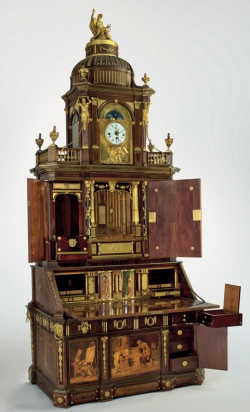
David Roentgen, Berlin Secretary Cabinet, ca. 1778–79. 11 ft. 9 in. (Kunstgewerbemuseum, Staatliche Museen zu Berlin)
Extravagant Inventions: The Princely Furniture of the Roentgens will be the first comprehensive survey of the Roentgen family’s cabinetmaking firm from 1742 to its closing in the early 1800s. Some 60 pieces of furniture, many of which have never before been lent outside Europe, and several clocks will be complemented by paintings, including portraits of the Roentgen family, and prints that depict the masterpieces of furniture in contemporary interiors. The exhibition and catalogue are made possible by the Anna-Maria and Stephen Kellen Foundation.
The meteoric rise of the workshop of Abraham Roentgen (1711-93) and his son David (1743-1807) is the most spectacular chapter in the history of innovative 18th–century Continental furniture-making. Their original designs, combined with their use of intriguing mechanical devices, revolutionized traditional French and English furniture types. From its base in Germany, the workshop served an international clientele. The Roentgens utilized a sophisticated business model, combined with intensive research on potential patrons’ personal taste and forward-looking marketing and production techniques.
In 1742 Abraham Roentgen opened a cabinetmaker’s workshop in the tiny village of Herrnhaag, in the Wetterau region near Frankfurt am Main. With only one journeyman on staff, the shop was concerned principally with the production of furniture for daily use. Abraham distinguished himself by adhering to the highest standards of quality, and soon he was producing veneered show-off pieces in the English Queen Anne style, which he had learned during his years as a journeyman in the Netherlands and England. The local nobility recognized the furnishings’ unusual appearance and quality. Abraham’s progressive designs and types, such as his fashionable tea chest and multi-functional table, were novelties in Germany and were an immediate success. Following his move to Neuwied-at-the-Rhine in 1750, Abraham took his innovative designs even further by adapting elegant French-inspired outlines that, combined with superb marquetry, fine carving, intricate gilded bronze mounts, and multiple mechanical devices, came to be recognized by contemporaries as hallmarks of the Roentgen brand. Roentgen’s playful and perfectly executed inventions became a favored status symbol in princely interiors throughout Europe.
Abraham’s son, David Roentgen, graduated quickly from his apprenticeship in his father’s workshop and eventually took over the enterprise between 1765 and 1768. He perfected the sophisticated structure and intricate marquetry designs of the furniture, and was appointed Ebéniste-Méchanicien du Roi et de la Reine at the court of Queen Marie Antoinette and King Louis XVI at Versailles in 1779. Having conquered the Western market, David revised his designs and reinvented his product line’s appearance as he looked eastward. Focusing on his new target, the Imperial residences of Catherine the Great in St. Petersburg, David Roentgen developed specific models catering to Russian taste. He caught the fancy of the Empress herself with his Apollo Desk (1783-84), which depicted her favorite dog as a gilded mount, and which David produced on pure speculation. After Catherine the Great paid a huge sum for the piece, Russian nobility hurried to catch up with its sovereign, ordering examples of ‘Neuwied Furniture’ by the dozens.
Abraham and David Roentgen’s story is a tale of international success, fame, luxury, and high honor but, in the case of David, it is also the tragedy of a deeply pious man who struggled to balance his ambitions and his glorious achievements with the regulations of his religious community, the Moravian brotherhood. At the pinnacle of David’s career, the workshop employed more than 130 specialists and the annual production amounted to that of the famous Meissen porcelain factory. His fortune shifted dramatically with the progress of the French Revolution, as Europe’s nobility struggled to stay afloat, and the market for luxurious furnishings collapsed.
Many of the works in Extravagant Inventions will be lent from distinguished international museums and royal collections. Six pieces from the Metropolitan Museum’s own collection of Roentgen furniture will be featured, in addition to two that are on long-term loan to the Museum. The exhibition will showcase many outstanding pieces, including a Writing Desk (ca. 1758-62) designed by Abraham Roentgen and considered to be one of the finest creations of his workshop; a spectacular Automaton of Queen Marie Antoinette (1784), a likeness of the queen at a clavichord that still functions and will be played at select times during the exhibition; and six intriguing objects from the Berlin Kunstgewerbe Museum that have never before traveled, most notably a mechanical Secretary Cabinet (1779) made for King Friedrich Wilhelm II of Prussia that is one of the most complex pieces of royal furniture ever produced.
The most complicated mechanical devices in the exhibition will be illustrated through virtual video animations. Additionally, working drawings and portraits of the cabinetmakers, their family, and important patrons—as well as a series of documents owned by the Metropolitan Museum that originated from the Roentgen estate—will underline the long-overlooked significance and legacy of the Roentgens as Europe’s principal cabinetmakers of the ancien régime.
◊ ◊ ◊ ◊ ◊
From Yale UP:
Wolfram Koeppe, ed., Extravagant Inventions: The Princely Furniture of the Roentgens (New Haven: Yale University Press, 2012), 304 pages, ISBN: 9780300185027, $75.
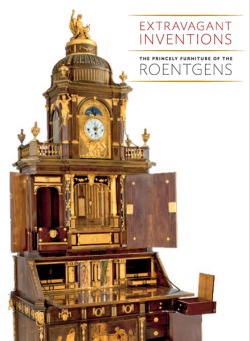 During the second half of the 18th century, the German workshop of Abraham and David Roentgen was among Europe’s most successful cabinetmaking enterprises. The Roentgens’ pieces combined innovative designs with intriguing mechanical devices that revolutionized traditional types of European furniture. An important key to their success was the pairing of the skilled craftsman Abraham with his brashly entrepreneurial son David, whose clients included Louis XVI and Marie Antoinette of France as well as Catherine the Great of Russia. This landmark publication is the first comprehensive survey, in nearly four decades, of the firm from its founding in about 1742 to its closing in the late 1790s.
The Roentgen workshop perfected the practice of adapting prefabricated elements according to the specifications of the customers. Detailed discussions of these extraordinary pieces are complemented by illustrations showing them in their contemporary interiors, design drawings, portraits, and previously unpublished historical documents from the Roentgen estate. This fascinating book provides an essential contribution to the study of European furniture.
Wolfram Koeppe is the Marina Kellen French Curator in the Department of European Sculpture and Decorative Arts at The Metropolitan Museum of Art.
◊ ◊ ◊ ◊ ◊
Lecture | The Legacy of David Roentgen
The Metropolitan Museum of Art, New York, 15 November 2012
David Linley (Chairman, Christie’s, UK), and Charles Cator (Deputy Chairman, Christie’s International)
David Roentgen (1743–1807) was known throughout Europe for his inventive and ingenious mechanical furniture, which found favor in the courts of France and Russia through the patronage of Marie Antoinette and Catherine the Great respectively. He was also famed for pioneering a new method of marquetry, created to give the impression of pietra dura. To mark the occasion of an extensive exhibition of Roentgen’s work, David Linley will share personal insights into Roentgen’s influence on his own furniture designs and his enduring influence on furniture makers today. Charles Cator will examine the collectors’ market for Roentgen from his rediscovery in the nineteenth century to today.
Exhibition | ‘England’s Green and Pleasant Land’ at Fan Museum
From London’s Fan Museum:
England’s Green and Pleasant Land
The Fan Museum, Greenwich, 11 September 2012 — 6 January 2013
 Drawing from The Fan Museum’s unrivalled collection of fans and fan leaves, England’s Green & Pleasant Land strikes a particularly jubilant note as Her Majesty Queen Elizabeth II’s Diamond Jubilee year draws to a close.
Beginning with a rare wood-block printed fan, The Hapy [sic.] Restoration, c. 1661, visitors are taken on an evocative journey through England’s cultural, social and political landscape, covering a period of some 250 years. The exhibition includes a number of fine 18th-century fans, upon which formal city squares, stately houses, and idyllic scenes of rural life are imaginatively depicted. Also on show is a delectable assortment of early printed commemorative fans with themes as diverse as political trials, royal births and even fortune telling!
Exhibition Celebrates Ferguson Gang’s Secretive Preservation Efforts
From the UK’s National Trust:
Taming the Tentacles
Shalford Mill, Surrey — 19, 23, 26, 30 September 2012

Shalford Mill, Surrey
Wearing masks and chanting Latin verse, the Ferguson Gang collected money to preserve buildings at risk of demolition. By the time the Gang’s activities wound down in 1946 they had preserved Shalford Mill, in Surrey, Newtown Old Town Hall on the Isle of Wight, Priory Cottages in Oxfordshire and donated some of the most beautiful stretches of the Cornish coastline to the National Trust. The exhibition is built on their essential strategy for life.
◊ ◊ ◊ ◊ ◊
The following account is excerpted from an August 2011 article from Surrey Life magazine:
Shalford Mill has been in the National Trust’s care since the early 1930s when it was bought for the organisation by an intriguing group of preservationists, called the Ferguson Gang. This group of mainly well-educated young women got together in the 1920s to raise money for philanthropic projects, which included saving Shalford Mill from demolition in 1932.
The members of the gang guarded their anonymity fiercely; giving each other various nicknames such as ‘Erb the Smasher’, ‘Bill Stickers’, ‘Red Biddy’ and ‘See Mee Run’. When it came to handing over the funds to the National Trust to purchase Shalford Mill, they did so secretly, wearing cloaks to deliver the money to the National Trust’s headquarters at Queen Anne’s Gate in London, and carrying bulging sacks packed with Victorian coins.
Having safeguarded its future, the gang went on to use Shalford Mill to hold their clandestine meetings. In fact, membership was limited to the number of people that could fit inside the mill. Here, they discussed future fund-raising tactics in private, while sitting around the drum of the millstones and enjoying picnics delivered from Fortnum and Mason.
Having eaten, the eccentric group would have a collection of all the coins they had managed to find. They would then wander round the mill in the small hours, searching for what they called ‘the four colours of the dawn’ (to this day, no one really knows what that meant), wrapped in veils and cloaks. . . .
The full article is available here»
Small Exhibition | Gems of European Lace, ca. 1600–1920
Press release (20 July 2012) for this exhibition now on at The Met:
Gems of European Lace, ca. 1600–1920
The Metropolitan Museum of Art, New York, 24 July 2012 — 13 January 2013
Oorganized by Devon Thein and Gunnel Teitel
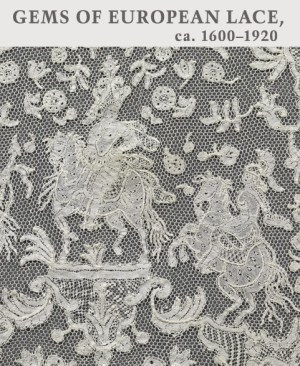
Cravat End or Rabat (det.), mid-18th century, Flemish, Linen, bobbin lace (point d’Angleterre). The quality of workmanship in this cravat end is consistent with its presumed exalted provenance. It is said to have been made for the Austrian empress Maria Theresa; given to her daughter the French queen Marie Antoinette; and then passed to the marquis de Chabert, a French admiral and astronomer, after which it descended in his family. The possibility of this association is supported by the crown at center resembling the Austrian archducal crown, though no further proof of the connection has been discovered. . . click on the image for more
A selection of 13 exceptional examples of handmade lace from the collection of The Metropolitan Museum of Art—one of the finest such collections in the United States—will be featured in the exhibition Gems of European Lace, ca. 1600–1920, opening July 24 in the Museum’s Antonio Ratti Textile Center. These delicate luxury textiles, created between 100 and 400 years ago, represent techniques and styles associated with some of the preeminent lacemaking centers of Europe.
Included in the installation are examples of the two major lacemaking techniques: needle lace (built up from a single thread that is worked in a variety of looping, or buttonhole, stitches) and bobbin lace (woven—or braided—together from multiple threads organized on individual bobbins). Beyond the two basic technical categories, lace is also often described with the name of the town or region where a particular style was first made.
The exhibition will include outstanding examples of Venetian (needle) lace, Brussels (bobbin) lace, and Devon (bobbin) lace. Of particular interest is a 19th-century handkerchief associated with King Leopold II and Queen Marie-Henriette of Belgium. The queen was a patron of the local lace industry. The best-quality lace was extremely expensive, due to the time-consuming and painstaking process of transforming fine linen thread into such intricate openwork structures. Rather surprisingly, the 17th-century English clergyman Thomas Fuller defended the wearing of lace and the nascent English lacemaking industry, writing that it cost “nothing save a little thread descanted on by art and industry,” and “saveth some thousands of pounds yearly, formerly sent over to fetch lace from Flanders.”
In the late 19th century, American women began to recycle antique lace for use in fashion. The American socialite and style setter Rita de Acosta Lydig, for example, often wore garments with insertions of antique lace. On view will be one of her dresses from 1920, completely made of lace in a horse-and-rider motif. As a result, many women began to collect and study lace, taking an interest not only in its artistry and complexity of construction but also in the historical and cultural contexts in which it was made and used. In large part, the collection of the Metropolitan Museum reflects the interest of these women who became serious collectors and who graciously donated their collections to the Museum.
The installation was organized by Devon Thein and Gunnel Teitel, volunteers in the Department of European Sculpture and Decorative Arts, under the supervision of Melinda Watt, Associate Curator, European Sculpture and Decorative Arts, and Supervising Curator, Antonio Ratti Textile Center. Established in 1995, the Antonio Ratti Textile Center at the Metropolitan Museum is one of the largest, most technically advanced, and well-equipped centers for the study, storage, and conservation of textiles in any art museum. Objects from the Metropolitan Museum’s collection of textiles are featured, on a rotating basis, in a small gallery at the entrance of the center.
Display | Jean-Henri Riesener (1734–1806)
Based on press releases from VisitParis and Art Media Agency:
Jean-Henri Riesener (1734–1806)
Biennale des Antiquaires, Grand Palais, Paris, 14-23 September 2012
Organized by Kraemer & Cie
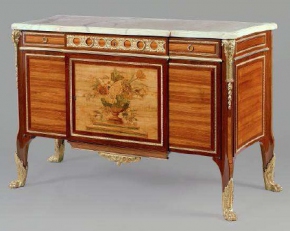 The Maison Kraemer, a Parisian gallery specialising in pieces from the 17th and 18th centuries, is organising the first ever exhibition to be entirely dedicated to the cabinet-maker Jean-Henri Riesener (1734-1806). It will run from the 14 to the 23 of September at stall 32 during the 26th Biennale des Antiquares. The solo exhibition is then to go on tour.
Introduced to the art of cabinetmaking by Jean-Francois Oeben, Riesener became a master in 1768, and was designated ‘carpenter to the King’ in 1774. He also supplied Queen Marie-Antoinette with furniture, creating for the Court and the Royal Family a collection of stunningly beautiful pieces of furniture, characterized the remarkable finesse in his use of gilt bronzes and precious inlay decorations. Riesener is one of the most commonly displayed cabinet-makers in museums throughout the world. Examples include the Louvre museum, the Château de Versailles, the Nassim de Camondo museum, the New York Metropolitan Museum and the Getty Museum in Los Angeles. At auction, his pieces regularly sell for remarkable prices:
• In 1999 a chest of drawers was sold by Christie’s for £7,041,500 or €8.5 million (with fees)
• In 2007 a chest of drawers was sold by Sotheby’s for €3,952,250 (with fees)
• In 2000, a desk was sold by Christie’s for £1,214,750 or €1.5 million (with fees)
• Recently, a chest of draws put up for sale by the auction house Sotheby’s in October 2011, estimated to be worth between €20-30 million, was sold for only €24,750.
Also see the article by Susan Moore for Apollo Magazine (September 2012) and the coverage (in French) at Artistik Rezo.
Display | Dead Standing Things at Tate Britain
I was fortunate enough to visit this terrific display earlier in the summer, but for anyone who hasn’t seen it, impressive points of access are available online, offering a fine model for extending an exhibition’s usefulness well beyond the physical site of the museum. A page from the University of York provides an online record, and the first-rate publication edited by Tim Batchelor with contributions by Caroline Good, Claudine van Hensbergen, Peter Moore, and Debra Pring is available free of charge as a PDF file. -CH
◊ ◊ ◊ ◊ ◊
From Tate Britain:
Dead Standing Things: Still Life 1660-1740
Tate Britain, London, 21 May — 16 September 2012
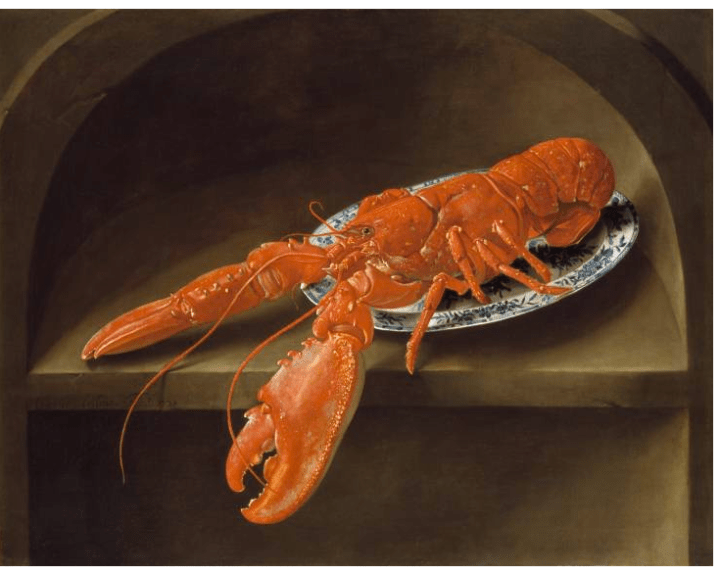
Charles Collins, Lobster on a Delft Dish
oil on canvas, 1738 (London: Tate)
◊ ◊ ◊ ◊ ◊
A familiar genre today, still life painting became established in Britain in the late seventeenth century. Writing in the 1650s, the author William Sanderson referred to such paintings as ‘dead-standing-things’, the term ‘still life’ (from the Dutch ‘stilleven’) only appearing in the following decades. Characterised as the detailed depiction of inanimate objects, the genre had been established in the Netherlands early in the seventeenth century and its introduction into Britain was through the work and influence of Dutch incomer artists. Pieter van Roestraten arrived in London from Amsterdam in the mid-1660s and became known for his ‘portraits’ of objects, particularly silver; another Dutchman known by the anglicised name of Edward Collier was active in London from the 1690s.
This period saw a shift in the way artists sold their works. The old system of artistic patronage by and commissions from the wealthy elite was, from the later 1680s, augmented by newly-emerging auctions. Sales at taverns, coffee houses and commercial exchanges provided artists with new opportunities. It also meant the ‘middling’ class of professionals and merchants could purchase art to furnish their homes and satisfy their social ambitions, with affordable and easily available still lifes a popular choice.
This is the second of two displays at Tate Britain organised as part of Court, Country, City: British Art, 1660-1735, a major research project run by the University of York and Tate Britain, and funded by the Arts and Humanities Research Council. This display has been devised by curator Tim Batchelor.
Exhibition | The Epic and the Intimate: French Drawings
Press release (19 June 2012) from the Georgia Museum of Art:
The Epic and the Intimate: French Drawings from the
John D. Reilly Collection at the Snite Museum of Art
Flint Institute of Arts, Flint, Michigan, 5 May — 29 July 2012
Georgia Museum of Art, Athens, 18 August — 3 November 2012
Crocker Art Museum, Sacramento, California, 30 June — 29 September 2013
Curated by Cheryl Snay and Lynn Boland
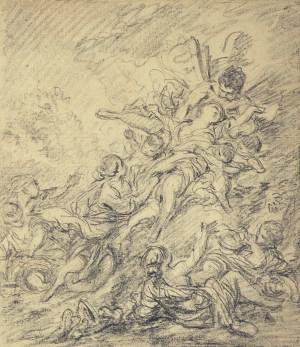
François Boucher, Boreas and Oreithyia, ca. 1749 or ca. 1769, black chalk (Snite Museum of Art, University of Notre Dame)
The Georgia Museum of Art (GMOA) at the University of Georgia will present the exhibition The Epic and the Intimate: French Drawings from the John D. Reilly Collection at the Snite Museum of Art from August 18 to November 3, 2012. Organized by Cheryl K. Snay at the Snite Museum of Art at the University of Notre Dame, this exhibition illustrates the history of French drawing from before the foundation of the Royal Academy of Painting and Sculpture in 1648 through the French Revolution of 1789 and its subsequent reforms of the 1800s. It includes works by Simon Vouet, Antoine Watteau, François Boucher, Jean-Honoré Fragonard and Jacques-Louis David.
“Each of these drawings is exquisite in its own right, and as a collection, they offer a compelling overview of the French Academy,” said Lynn Boland, GMOA’s Pierre Daura Curator of European Art and the in-house curator of the exhibition.
The drawings on display offer an opportunity to see a range of media, including chalk, colored chalks, ink and crayon; a variety of favored subjects, such as narrative compositions, portraits, landscapes and genre scenes; and types of drawings from figure and drapery studies to quick sketches of initial ideas to complex, multifigured, highly developed compositional works. From the grand “machines” that narrate epic history, such as Michael Dorigny’s Sacrifice to Juno or Anne-Louis Girodet de Roussy-Trioson’s Christ Led from Pilate, to the celebrations of singular, intimate moments, such as Watteau’s seated figure or Honoré Daumier’s observation of a woman putting bread in an oven, The Epic and the Intimate demonstrates an extensive range of both subject and medium. Later artists, including Pierre-Paul Prud’hon, Théodore Rousseau and Edgar Degas signal the transition into the modern era that glorified the individual and the local.
Snay explains, “Before drawing gained its autonomy from painting, sculpture and architecture in the 20th century, it was regarded as a means of ordering reality. It was understood to be the fundamental basis of all creative activity.” Many of the artists whose works appear in the exhibition belonged to the Académie royale de peinture et de sculpture (Royal Academy of Painting and Sculpture) in Paris, founded by the French government in 1648. Snay continues, “By holding government-sponsored exhibitions and commissioning large-scale projects, the Royal Academy monopolized the art market and became a model for many other academies in Europe and North America, ensuring France’s influence on material culture into the early 1900s.”
Exhibition | Dutch Country Houses
As noted at Art Daily:
Fresh Air!: City Dwellers and Their Country Houses
Naar Buiten! – Stedelingen en hun Buitenplaatsen
Geelvinck Hinlopen House, Amsterdam, 11 July 2012 — 4 February 2013

Jan van der Heyden, Elswout House and Gardens , ca. 1660 (Haarlem: Frans Hals Museum)
Since the Dutch Golden Age of the 17th century, those, who could afford it, fled the malodour of the city during the summer months. In a time span of three centuries, over 6000 summer residences appeared all over the country and especially around Amsterdam. Today, some 10% of these historic houses for the summer still survive. This exhibition tells the story of these houses, why they came into existence, how the city dwellers spend their time during summer and how the once spectacular gardens and parks of these houses are maintained and reconstructed today.
The leading theme of the exhibition concerns the rich and influential bourgeoisie families who once lived in the city palace Geelvinck Hinlopen Huis. Their palatial country houses were exemplary. Many still exist and often the gardens can be visited. Important exhibits, such as a painting of the country house and gardens of Elswout by Jan van der Heyden (1637-1712) on loan from the Frans Hals Museum, a huge painting of a city garden The Courtyard of the Proveniershuis (1735) by Vincent Laurensz van der Vinne II (1686-1742) on loan from the Rijksmuseum Twente and a large reverse glass painting of the country house of Soelen by Jonas Zeuner (1727-1814) on loan from the Amsterdam Museum, are on view. Connected to the exhibition is a new website, which stimulates visiting the gardens and parks of the country houses around Amsterdam, which are open for the public. . .
The full article is available here»
Exhibition | Fables and Magic: The Guidobono Brothers
From Cultura Italia:
Fables and Magic: The Guidobono Brothers, Painters of the Baroque
Palazzo Madama, Turin, 29 May — 2 September 2012
Curated by Mary Newcome Schleier, Giovanni Romano, and Gelsomina Spione
 From 29 May to 2 September, Palazzo Madama in Turin hosts Fables and Magic: The Guidobono Brothers, Painters of the Baroque, an exhibition focusing on the life and work of the two artists, Bartolomeo and Domenico Guidobono, best known for decorating the ceiling of Palazzo Madama, along with an extensive series of paintings on canvas held in the most prestigious European and American museums.
The Savona-born painters Bartolomeo and Domenico Guidobono were not well-known in Piedmont. Nevertheless, between the end of the 17th century and the beginning of the 18th, they were entrusted with several important commissions in Turin. Following in the footsteps of their father, the painter and ceramic artist Giovanni Antonio, who drew a salary from Victor Amadeus II, the two brothers introduced to Turin the light and festive decorative style typical of Genoese residences, with its emphasis on light effects and elements drawn from nature. Both lived in Turin twice, more precisely between 1685 and 1690, and again from 1702 to 1726, when they painted the frescoes decorating the vault ceiling of the apartments of the second Madama Reale, Marie Jeanne of Savoy.
Their work is illustrated by paintings, drawings, and engravings that highlight their meticulous approach to depicting the details of their subjects, which ranged from mythology to Biblical stories, sacred subjects, still lifes, and magic scenes. Flowers, fruits, birds, animals, objects, and details of still lifes are painted with a refined, light touch and ooze seductive mystery.
The exhibition is arranged chronologically and begins with the work of the older of the two brothers, Bartolomeo Guidobono (Savona 1654 – Turin 1709). During his first sojourn in Turin, he painted the frescoes of the presbytery of the Casanova abbey near Carmagnola and a painting for Palazzo Madama, which was originally located in the former apartments of the Madama Reale and is now lost. During his second sojourn, from 1702 to 1709, Bartolomeo decorated both the residences of the Savoy court and church altars in Turin and the Duchy of Savoy. It is in this context that his Genoese-inspired decorations were made, such as those of the convent of San Francesco da Paola and the Pilone cupola, the ceiling in the hall currently known as the Madama Felicita apartment in Palazzo Reale, which are featured in the exhibition thanks to video images.
Domenico’s style began to emerge more forcefully after his brother’s death in 1709. The artist, who maintained a close relationship with the Madama Reale Maria Giovanna Battista, became the undisputed protagonist of the decorations of the halls on the first floor of Palazzo Madama, known as the Guidobono halls – the Madama Reale’s Chamber, the Chinese Cabinet, and the Southern Veranda – which were decorated on the orders of the Duchess orders between 1708 ad 1721. Domenico Guidobono was active in Turin and the rest of the Duchy until the ascent of Filippo Juvara, who eventually marginalized him and caused him to return to Genoa and subsequently to Naples, where he died in 1746. The exhibition delves into the life and work of Domenico Guidobono through recently discovered documents and artwork. The history of his art can be traced thanks to a dowry inventory put together by his daughter Maria Beatrice in 1720, which lists the works from her father’s Turin workshop. Today, most of these works are held in foreign museums, including the Louvre in Paris and the Metropolitan Museum in New York City.
The exhibition is enhanced by works by Genoese masters and other artists who were crucial influences on the Guidobono brothers, such as Domenico Piola, Gregorio De Ferrari, and Daniel Seyter. There is also a selection of engravings by Rembrandt and Castiglione, the stylistic points of reference underlying Genoese painting, followed by a section on project planning with preparatory sketches by Piola and De Ferrari from the Cabinet of Drawings and Paintings in Genoa’s Palazzo Rosso.
◊ ◊ ◊ ◊ ◊
From Artbooks.com:
Catalogue: Clelia Arnaldi di Balme, Giovanni Romano, Mary Newcome Schleier, and Gelsomina Spione, Favole e Magie: I Guidobono, Pittori del Barocco (Milano: Silvana, 2012), 128 pages, ISBN: 9788836623952, $33.
Ai fratelli Bartolomeo e Domenico Guidobono, attivi tra la fine del Seicento e l’inizio del Settecento in Liguria e in Piemonte, è dedicato questo volume, che offre una retrospettiva completa e aggiornata sulla loro carriera di pittori, costellata di successi in vita, ma poco considerata dalla critica nei secoli successivi. I due fratelli, originari di Savona, hanno lasciato il segno della loro ispirazione più alta nei soffitti di Palazzo Madama a Torino, ma si deve a loro anche una vasta produzione di quadri da cavalletto, ora in gran parte dispersa in musei e collezioni private d’Europa e d’America. Giunti a Torino a seguito del padre – pittore e ceramista stipendiato da Vittorio Amedeo II –, introducono in Piemonte i caratteri leggeri e festosi della grande decorazione barocca genovese, che trae i suoi spunti dall’osservazione della natura e dallo studio degli effetti della luce. Favole mitologiche, storie bibliche e soggetti sacri, nature morte e scene di magia si accompagnano alla descrizione precisa di fiori, frutti, uccelli, animali, oggetti e brani di natura morta, con esiti di raffinata leggerezza e talvolta di seducente mistero. Il volume, che nel ricostruire la loro attività permette di fare il punto sulla fortuna critica e sugli studi svolti intorno ai due pittori, presenta, accanto alle opere dei Guidobono, anche quelle di altri artisti che rappresentarono un punto di riferimento per la loro formazione, come Domenico Piola, Gregorio De Ferrari e Daniel Seyter. Il volume è completato da una bibliografia.










 Enfilade
leave a comment