Exhibition | Antoine Watteau: The Music Lesson
From the exhibition press materials:
Antoine Watteau (1684–1721): The Music Lesson
BOZAR (Palais des Beaux-Arts), Brussels, 8 February — 12 May 2013
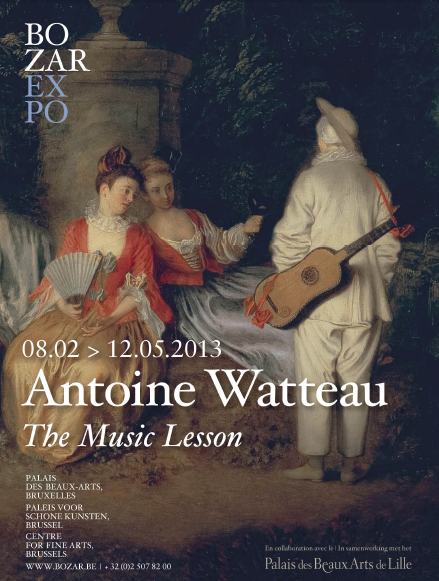 BOZAR EXPO presents, in cooperation with the Palais des Beaux-Arts de Lille, a major interdisciplinary project consisting of an ambitious exhibition, various concerts and debates, devoted to a great French master of the early 18th century, Antoine Watteau, with a particular focus on the musical scenes frequently depicted in the painter’s work. The exhibition’s general curator, the renowned orchestral conductor William Christie, is also at the heart of a cycle of eight concerts that will evoke the sensual atmosphere of Watteau’s canvases.
In the spring of 2013 BOZAR is presenting the first exhibition in Belgium to be devoted to Antoine Watteau (1684–1721). This not only offers an opportunity to see a number of his works; moreover, it sets his pictures to music; it also highlights the correspondence between the arts that was at the heart of his work as an artist. Almost a third of Watteau’s works feature musicians. Born to a humble family, he was a short-lived star of French 18th-century painting, dying at the early age of 37. Despite his short life and limited oeuvre, Watteau’s elegance and
genius left their mark on European art.
Antoine Watteau, father of the fêtes galantes
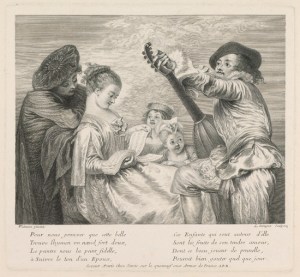
Louis Surugue after Antoine Watteau, The Music Lesson, etching. © Bibliothèque nationale de France
Little is known about his years of training in his native Valenciennes, a town that was open to both Flemish and French influences, as it only became attached to France in 1678. We can, however, be sure of the importance of his master, Claude Gillot (1673–1722). It was through him that Watteau, the “fils du Nord,” discovered Italian painting and the Commedia dell’Arte, which meant so much to him, even though he would never make the journey to Italy.
Watteau passed the bulk of his career in Paris, towards the end of the reign of the Sun King and during the Regency, a period in which the French capital experienced an aesthetic ferment and a renewed commercial enthusiasm for art. It was in that context that, in the 1720s, Watteau became a protégé of Pierre Crozat (1661–1740), one of his great patrons. Crozat helped to bring into being a musical circle in which both Italian and French music were acclaimed. His collection also helped Watteau to find himself as an artist, as he enthusiastically copied drawings it contained by Flemish and Venetian masters (Rubens, Van Dyck, Titian, and Campagnola). Their attention to colour, movement, and sensuality fascinated the young artist, who drew on those qualities to create a new style, less grandiloquent and less formal, imbued with a feigned lightness and an unprecedented elegance.
So there is nothing fortuitous about the presence of other disciplines – theatre, dance, and music, in particular – in Watteau’s paintings. They are very much present in the figures depicted in the fêtes galantes, whose language he invented: scenes of intimacy, conversation, and music set in an enclosed natural setting in which the human condition plays with appearances. Are we looking at aristocrats who have put on the costumes of actors or at theatrical scenes reconstructed in a bucolic setting? Watteau explores, as no one had done before him, a free combination of theatrical characters, whom he places away from the stage, somewhere between life and playing a role. Music is never far away in these fêtes galantes. The titles of works such as La Leçon de musique, Le Concert amoureux, and L’Accord parfait are highly evocative in this context.

Antoine Watteau, L’Enchanteur Huile sur cuivre (Troyes: Musée
des Beaux-Arts) © RMN-Grand Palais – © Jean Schormans
Antoine Watteau (1684–1721): The Music Lesson
The exhibition, which has a particular focus on the musical aspect of Watteau’s painting, brings together a unique selection of fifteen of the artist’s canvases and thirty of his drawings, some of which have not been seen by the European public for more than 50 years. It also presents fifty engravings by his contemporaries, including François Boucher, Benoît Audran II, and Charles-Nicolas Cochin, who produced the finest engravings of the 18th century and spread Watteau’s art throughout Europe. Thanks to them, we have reproductions of paintings of his that have since been lost and it is possible to offer an almost complete overview of his work. This unprecedented combination of original paintings, drawings, and engravings, as well as archival material, scores, and musical instruments of the same period, is a first. The exhibition itinerary is organised chronologically and thematically. The visitor first discovers the silent dimension of Watteau’s art and is thus better placed to appreciate its various musical tones later in the exhibition. The aesthetic experience is heightened as the visitor is immersed in the music of the time thanks to the audioguides and several listening points throughout the exhibition circuit. A special room is set aside for free concerts given by students of various Belgian and French conservatories on Thursday evenings. The intervention by Dirk Braeckman, leading Belgian photographer with an international reputation, establishes connections between Watteau’s work and contemporary art.
For additional information, including lenders, room texts, and programming details, see the 28-page press booklet (PDF).
◊ ◊ ◊ ◊ ◊
Note (added 20 March 2013): The catalogue is available through Artbooks.com:
Florence Raymond, ed., Antoine Watteau (1684-1721): La leçon de musique (Paris: Skira Flammarion, 2013), 272 pages, ISBN: 978-2081295834, $87.50.
Exhibition | Redouté’s Roses
If today has you thinking about roses . . . Thanks to Hélène Bremer for noting this exhibition at the Teyler’s Museum:
Redouté’s Roses
Teylers Museum, Haarlem, 19 January — 5 May 2013
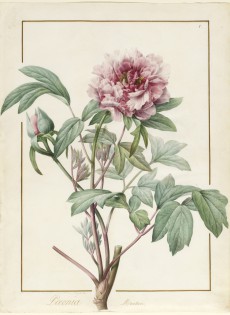 Pierre-Joseph Redouté (1759-1840) is the greatest botanical artist of all time. His drawings and watercolours of flowers and plants are unsurpassed in both scientific precision and beauty. Redouté assuredly earned his nicknames, ‘the Raphael of flowers’ and ‘the Rembrandt of Roses’. Redouté started drawing flowers in Paris’s Jardin des Plantes at the end of the eighteenth century, when European scholarship was in the throes of a real mania for botany. He provided illustrations of rare and exotic plants for books published by prominent scientists. These drawings made him so famous that he was able to publish two masterpieces of printing under his own name: Les Liliacées and Les Roses. Redoubté also gained royal recognition from none other than Queen Marie-Antoinette, and later from Empress Joséphine, Napoleon’s wife. No one could equal Redouté’s pictures of their opulent gardens with their glorious profusion of blooms. This exhibition is the first in the Netherlands to provide a variegated overview of
his work, with, at its heart, the beautiful books that the Teylers Museum
purchased immediately after their publication.
Exhibition | Life and Death in Pompeii and Herculaneum
If today has you thinking about ashes . . . The exhibition includes, incidentally, an exceptional bit of programming: the first live cinema event ever produced by a museum, offering an exclusive private view of the major exhibition on the 18 and 19 of June:
The British Museum will stage two unique live broadcasts to cinema audiences across the UK and Ireland with a special offer to school groups. Introduced by British Museum director Neil MacGregor this event will use a line-up of expert presenters to create a one-off experience including contributions from historian Mary Beard, Rachel de Thame revealing life in the garden, Giorgio Locatelli in the kitchen and Bettany Hughes in the bedroom. . .
◊ ◊ ◊ ◊ ◊
Press release from the British Museum:
Life and Death in Pompeii and Herculaneum
British Museum, London, 28 March — 29 September 2013
 In Spring 2013 the British Museum will present a major exhibition on the Roman cities of Pompeii and Herculaneum, sponsored by Goldman Sachs. This exhibition will be the first ever held on these important cities at the British Museum, and the first such major exhibition in London for almost 40 years. It is the result of close collaboration with the Archaeological Superintendency of Naples and Pompeii, will bring together over 250 fascinating objects, both recent discoveries and celebrated finds from earlier excavations. Many of these objects have never before been seen outside Italy. The exhibition will have a unique focus, looking at the Roman home and the people who lived in these ill-fated cities.
Neil MacGregor, director of the British Museum said “This will be a major exhibition for the British Museum in 2013, made possible through collaboration with the Archaeological Superintendency of Naples and Pompeii which has meant extremely generous loans of precious objects from their collections, some that have never travelled before. I am delighted that Goldman Sachs is sponsoring this important exhibition and am extremely grateful to them for their support.”
“It is a privilege to be partnering with the British Museum for this incredibly exciting exhibition, which offers a fascinating insight into daily life at the heart of the Roman Empire”, said Richard Gnodde, Co Chief executive of Goldman Sachs International. “We recognize the importance of supporting cultural platforms such as this and we are delighted to offer our support to help bring this unique experience to London.”
Pompeii and Herculaneum, two cities on the Bay of Naples in southern Italy, were buried by a catastrophic volcanic eruption of Mount Vesuvius in just 24 hours in AD 79. This event ended the life of the cities but at the same time preserved them until rediscovery by archaeologists nearly 1700 years later. The excavation of these cities has given us unparallelled insight into Roman life.
Owing to their different locations Pompeii and Herculaneum were buried in different ways and this has affected the preservation of materials at each site. Herculaneum was a small seaside town whereas Pompeii was the industrial hub of the region. Work continues at both sites and recent excavations at Herculaneum have uncovered beautiful and fascinating artefacts. These include treasures many of which will be displayed to the public for the first time, such as finely sculpted marble reliefs, intricately carved ivory panels and fascinating objects found in one of the main drains of the city.
 The exhibition will give visitors a taste of the daily life of the people of Pompeii and Herculaneum, from the bustling street to the family home. The domestic space is the essential context for people’s lives, and allows us to get closer to the Romans themselves. This exhibition will explore the lives of individuals in Roman society, not the classic figures of films and television, such as emperors, gladiators and legionaries, but businessmen, powerful women, freed slaves and children. One stunning example of this material is a beautiful wall painting from Pompeii showing the baker Terentius Neo and his wife, holding writing materials showing they are literate and cultured. Importantly their pose and presentation suggests they are equal partners, in business and in life.
The emphasis on a domestic context also helps transform museum artefacts into everyday possessions. Six pieces of wooden furniture will be lent from Herculaneum in an unprecedented loan by the Archaeological Superintendency of Napels and Pompeii. These items were carbonized by the high temperatures of the ash that engulfed the city and are extremely rare finds that would not have survived at Pompeii – showing the importance of combining evidence from the two cities. The furniture includes a linen chest, an inlaid stool and even a garden bench. Perhaps the most astonishing and moving piece is a baby’s crib that still rocks on its curved runners.
The exhibition will include casts from in and around Pompeii of some of the victims of the eruption. A family of two adults and their two children are huddled together, just as in their last moments under the stairs of their villa. The most famous of the casts on display is of a dog, fixed forever at the moment of its death as the volcano submerged the cities.
Follow updates on the exhibition via Twitter on #PompeiiExhibition and the Museum’s Twitter account @britishmuseum.
◊ ◊ ◊ ◊ ◊
Paul Roberts, Life and Death in Pompeii and Herculaneum (New York: Oxford University Press, 2013), 320 pages, ISBN: 978-0199987436, £16 / $45.
Exhibition | Eighteenth-Century Book Illustration in the Veneto
The exhibition presents 115 illustrated books and as many loose prints from the likes of Tiepolo, Piazzetta, Novelli, Fontebasso, and Balestra. From Padova Cultura:
Tiepolo, Piazzetta, Novelli: L’Incanto del Libro Illustrato nel Settecento Veneto
Musei Civici agli Eremitani and Palazzo Zuckermann, Padua, 24 November 2012 — 7 April 2013
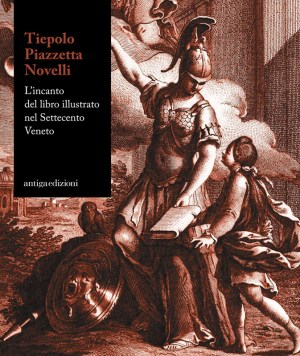 A Padova una meravigliosa galleria cartacea: 115 volumi illustrati del Settecento esposti accanto ad altrettanti fogli sciolti e incisioni, dipinti e disegni di grandi Maestri. Ecco la più completa mostra mai realizzata sul tema.
E’ dal connubio tra intelligenti editori come Giambattista Albrizzi e Antonio Zatta – per citarne solo alcuni – grandi e celeberrimi artisti come Tiepolo, Piazzetta, Novelli, Fontebasso o Balestra, e di abili incisori capaci di tradurre i segni e lo stile di questi in stampe di straordinaria complessità e varietà luministica, che nascono alcuni dei maggiori capolavori dell’editoria illustrata del Settecento. Un fenomeno ben sviluppato anche nel Seicento ma che nel XVIII secolo raggiunge nel Veneto vertici assoluti d’eleganza e raffinatezza, ammirati a livello internazionale.
Un fenomeno che, dal 24 novembre 2012 al 7 aprile 2013 a Padova, nelle sedi del Museo Civico agli Eremitani e di Palazzo Zuckermann, sarà esplorato e reso accessibile al grande pubblico in una mostra assolutamente unica per vastità e completezza di trattazione e certamente tra le più importanti esposizioni del genere mai realizzate in Italia: un viaggio affascinante e sorprendente, alla scoperta di quello che fu un aspetto fondamentale della vita culturale della Serenissima, ma anche di una produzione artistica spesso parallela a quella più appariscente della pittura da cavalletto o ad affresco, ma non meno suggestiva.
Oltre 115 volumi prodotti in Veneto o che hanno visto la collaborazione d’importanti artisti veneziani del Settecento – edizioni rare e preziose, arricchite da antiporte, incisioni, cornici, testatine, vignette o preziosi finalini – saranno dunque esposti accanto a quasi 120 tra stampe sciolte tratte dagli stessi volumi e incisioni autonome, in modo da favorire un’ampia documentazione della ricchezza illustrativa di questi volumi e dell’attività degli artisti ai quali si deve l’invenzione grafica delle opere. Maestri che saranno ricordati in mostra, ciascuno, anche attraverso uno dei loro significativi dipinti, a sottolineare e rimarcare la stretta connessione esistente tra la produzione artistica dei pittori coinvolti e i disegni da questi approntati per l’editoria: “una comune attitudine per il libero dispiegarsi della fantasia, applicata ora alle pagine di un libro invece che ai cieli dei soffitti affrescati o alle tele di grandi quadri di storia, una medesima audacia compositiva, un precoce interesse per forme di ornato rococò.”
Una mostra dunque ricchissima – realizzata grazie alle opere della Biblioteca Civica, dei Musei Civici agli Eremitani e della Biblioteca Universitaria, oltre a quelli di un’importante collezione privata e di alcuni selezionati istituti culturali del Veneto – che si sviluppa in 9 sezioni, adottando punti di vista diversificati e privilegiando, di volta in volta, un approccio cronologico, monografico e tematico.
The press release (a PDF file) is available here»
◊ ◊ ◊ ◊ ◊
The catalogue is available from ArtBooks.com»
Vincenza Cinzia Donvito and Denis Ton, Tiepolo, Piazzetta, Novelli: L’Incanto del Libro Illustrato nel Settecento Veneto (Crocetta del Montello: Antiga Edizioni, 2012), 480 pages, ISBN: 978-8888997940, $67.50.
Exhibition | Salvaging the Past: Georges Hoentschel
From the BGC:
Salvaging the Past: Georges Hoentschel and French Decorative
Arts from The Metropolitan Museum of Art
Bard Graduate Center, New York, 4 April — 11 August 2013
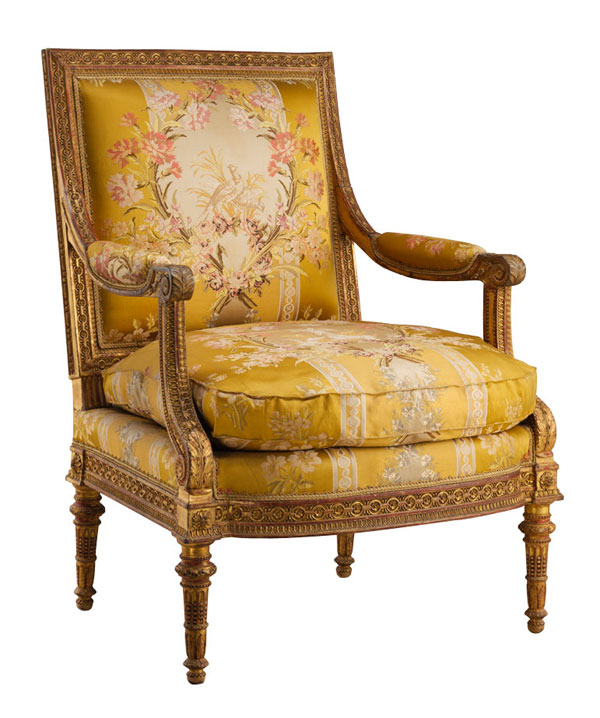
Georges Jacob; gilder: Louis–François Chatard. Armchair from Louis XVI’s Salon des Jeux, Château de Saint-Cloud, 1788. Carved and gilded walnut; gold brocaded silk (New York: The Metropolitan Museum of Art, Gift of J. Pierpont Morgan, 1906 — 07.225.107)
Focusing on a remarkable but little-known collection that entered the Metropolitan Museum as a gift of J. Pierpont Morgan in the early twentieth century, Salvaging the Past: Georges Hoentschel and French Decorative Arts from The Metropolitan Museum of Art features more than 200 objects of primarily medieval art and French eighteenth-century paneling, furniture, metalwork, textiles, paintings, and sculpture, as well as late nineteenth-century art pottery, most of which have rarely been viewed since the 1950s. The fourth in a series of collaborations between The Metropolitan Museum of Art and the BGC, the exhibition provides the first comprehensive examination of Georges Hoentschel—a significant figure in the history of collecting—and illuminates an understudied and critical chapter of the Metropolitan’s history.
Drawn primarily from the Metropolitan Museum’s holdings, with loans from other public and private collections in the United States and France, the exhibition tells the story of this unique collection in four sections. The first introduces Georges Hoentschel, who was an enterprising and successful decorator during the late nineteenth and early twentieth centuries, when France witnessed a great scientific, industrial, and social transformation and the newly moneyed bourgeoisie adopted a lifestyle based on an aristocratic model. As director of the Parisian decorating firm Maison Leys, Hoentschel catered to these affluent clients, creating for them interiors in historic French styles. In this section of the exhibition, ephemera, family papers, photographs, and a film presentation will outline his story within the context of Belle Époque Paris.
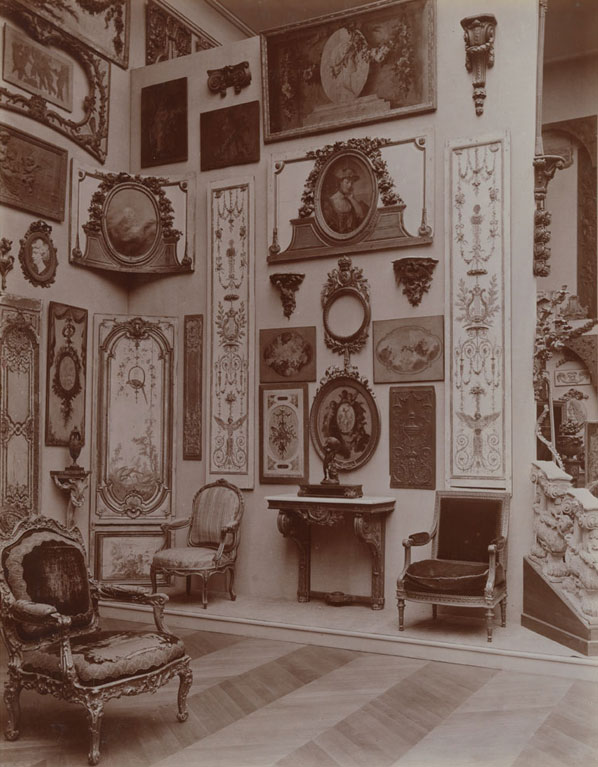
Section of the interior of 58 Boulevard Flandrin, Paris (ca. 1906) to be recreated in the Bard Graduate Center exhibition.
The second and largest section presents selections from the eighteenth-century holdings of the collection in installations inspired by historic photographs of Hoentschel’s densely arranged showroom-museum in Paris, where the objects served as models for his interior decorating business. Delicately carved woodwork, decorative paintings, and exquisitely chased gilt-bronze mounts are featured here. Highlights include a chair made for Louise-Élisabeth of Parma, daughter of Louis XV; an armchair made for Louis XVI; and a panel from shutters originally installed in a room outside the chapel at Versailles.
The third section displays medieval artworks, including sculpture, ivories, and metalwork, and includes one of the finest surviving examples of French Limoges enamelwork—a twelfth-century reliquary container, or chasse. Also shown here is Jean Barbet’s Ange du Lude, on loan from the Frick Collection, a rare bronze angel dated 1475, one of the most remarkable works from Hoentschel’s collection.
The final section presents examples of Hoentschel’s stoneware and those of his friend the sculptor and potter Jean-Joseph Carriès (1855–1894). Some of these ceramics were originally exhibited in the Union Centrale des Arts Décoratifs’ pavilion at the 1900 Exposition Universelle in Paris, for which Hoentschel created interiors in art nouveau style, unique in his oeuvre. A chair from this pavilion, loaned by the Musée des Arts décoratifs, Paris, is displayed, along with a selection of furnishing textiles used by Hoentschel in interior design commissions.
The exhibition is organized by the Bard Graduate Center: Decorative Arts, Design History, Material Culture and The Metropolitan Museum of Art.
◊ ◊ ◊ ◊ ◊
From Yale UP:
Daniëlle Kisluk-Grosheide, Deborah L. Krohn, and Ulrich Leben, eds., Salvaging the Past: Georges Hoentschel and French Decorative Arts from The Metropolitan Museum of Art (New Haven: Yale University Press, 2013), 320 pages, ISBN: 9780300190243, $85.
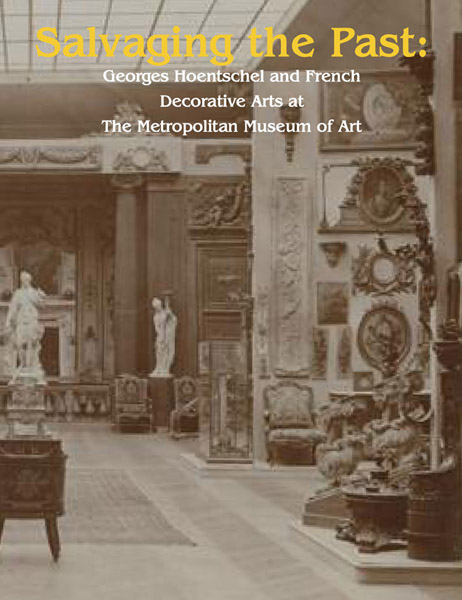 Georges Hoentschel (1855–1915) was a leading French interior designer in historic styles, head of a decorating firm, and ceramicist during the Belle Epoque. He found inspiration for his designs in medieval and 18th-century French art, which he avidly collected, amassing more than 4,000 pieces of furniture, woodwork, metalwork, sculpture, paintings, and textiles. After visiting Hoentschel in Paris, the American financier J. Pierpont Morgan acquired the collection and bequeathed it to the Metropolitan Museum of Art in 1906 and 1916–17. These works greatly enriched the museum’s medieval art department and became the nucleus of its decorative arts department, profoundly influencing American tastes in the early 20th century. Through texts, early documentary photographs, and images of newly conserved works, Salvaging the Past goes behind the scenes to explore the history and influence of this remarkable collection.
Daniëlle Kisluk-Grosheide is curator of European sculpture and decorative arts at The Metropolitan Museum of Art, New York. Deborah L. Krohn is associate professor of Italian Renaissance decorative arts at Bard Graduate Center. Ulrich Leben is a visiting professor and special exhibitions curator at Bard Graduate Center and associate curator for the furniture collection at Waddesdon Manor, Buckinghamshire.
Exhibition | In Search of Classical Greece: Travel Drawings
Press release from The British Museum:
In Search of Classical Greece: Travel Drawings of Edward Dodwell and Simone Pomardi, 1805–1806
The British Museum, London, 7 February – 28 April 2013
Curated by John Camp with Ian Jenkins and Kim Sloan

Edward Dodwell, Simone Pomardi, Panorama from the top of the Mousaion Hill, Athens, 1805.
This exhibition will look at Greece through the eyes of the classical scholar Edward Dodwell (about 1777–1832) and his Italian artist, Simone Pomardi (1757–1830). During their travels in 1805–06, they recorded the country and its people in a series of fascinating and spectacular drawings and watercolours. Kindly lent by the Packard Humanities Institute, these works have never been seen in public before. They represent a unique record of an important chapter in the rediscovery of ancient Greece on the eve of the creation of the modern Greek state.
Their landscapes, often featuring the ruins of classical sites, are peopled with modern Greeks and Turks at a time when Greece was under Ottoman rule. Especially fascinating and impressive are five rare surviving panoramas, measuring up to four metres in length, and providing 360 degree views of Corfu harbour, the Acropolis and of Athens and its surrounding countryside.
Dodwell and Pomardi’s travels were part of a great surge of interest in Greece at a time when Napoleon’s military occupation of Rome in 1796 had brought the age of the European Grand Tour to a sudden end. This exhibition will set Dodwell and Pomardi in the tradition of travel in Greece in the age of Enlightenment, examining the motivation and circumstance of such travel as well as its cultural consequences. It will be accompanied by a related display of drawings from the British Museum’s permanent collection exploring the theme of travel in Greece in the Ottoman era and just after the War of Independence.
Throughout the eighteenth century, generations of young men from Europe’s leading families had gone to Italy to complete an education that had comprised, in large part, the learning of Latin and Greek. Rome, Florence and Venice were the cities most visited and for the intrepid traveller there was also Naples. This was the principal city of southern Italy and the stopping-off point for viewing the newly discovered towns of Pompeii and Herculaneum, buried in the eruption of Mt Vesuvius in AD 79. When the occupation of Italy prevented Grand Tourists from visiting Italy, Dodwell and Pomardi, like many travellers, chose to go beyond the established Mediterranean regions of the Grand Tour. The understanding these travellers brought to the archaeological remains of ancient Greece encouraged the taste among British Hellenists for Greek architecture. This gave new vigour to the Greek Revival, already begun in the middle of the 18th century by the expeditions of the Society of Dilettanti. Hellenism, the love of ancient Greece, was to promote a new movement of Philhellenism, a sympathy for modern Greek people and a desire to realise the dream, as Byron put it, ‘that Greece might still be free’.
The beauty of its landscape and romance of its classical ruins were the primary reasons for travel to Greece under Ottoman rule. By the first decade of the nineteenth century a sympathy for the Greek-speaking peoples inspired European travellers to call for independence from Ottoman rule. In the years following the Greek War of Independence, many of the monuments recorded by Dodwell and his companions would change considerably as the new nation swept away the accretions of the late Roman, Christian and Ottoman eras and attempted to restore the purity of the classical remains. With hindsight these removals are controversial and they feed into a larger on-going debate around the creation of and the competing identities of modern Greece.
Dodwell was a talented amateur who signed many of the watercolours and drawings, even though some of them he worked on with Pomardi; others were Pomardi’s own work. Many of them were engraved in Dodwell’s own published accounts of his travels in 1819 A Classical and Topographical Tour Through Greece, During the Years 1801, 1805, and 1806. A few drawings exist in other collections, but the majority, over 800 in total, remained in the possession of Dodwell’s Irish descendants until they were purchased in 2002 by David Packard for the Packard Humanities Institute in Los Altos, California. He was advised by the distinguished American archaeologist John Camp, who has carefully catalogued the collection and made a representative selection of 67 works for the display here. He is the guest curator of this exhibition and the principal author of the accompanying publication which contains additional essays by the British Museum curators Ian Jenkins and Kim Sloan, and by Fani-Maria Tsigakou, Curator of Paintings, Prints and Drawings at the Benaki Museum, Athens.
◊ ◊ ◊ ◊ ◊
◊ ◊ ◊ ◊ ◊
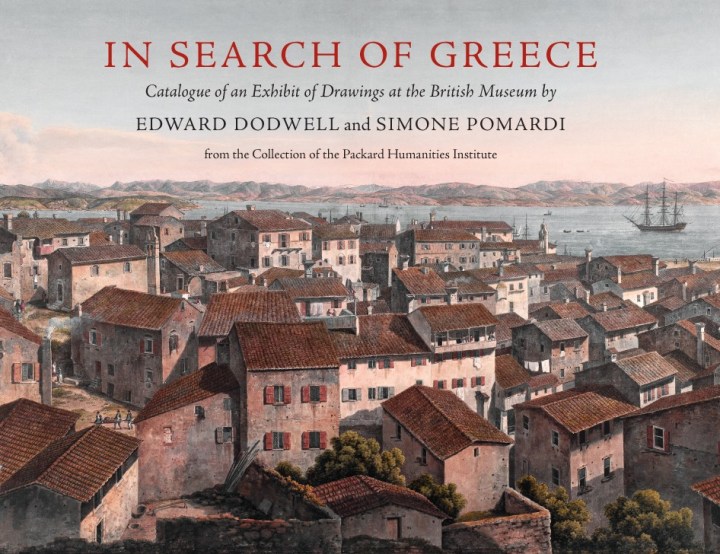
John McKesson Camp, with contributions by Ian Jenkins, Fani-Maria Tsigakou, and Kim Sloan, In Search of Greece: Catalogue of an Exhibit of Drawings at the British Museum by Edward Dodwell and Simone Pomardi from the Collection of the Packard Humanities Institute (Los Altos, CA: The Packard Humanities Institute, 2013), £25.
C H A P T E R S
• Introduction: The Road to Erudite Athens – Ian Jenkins
• Introduction to the Collection – John Camp
• Greece at the Eve of the Nineteenth Century: Poised between Myth and Reality – Fani-Maria Tsigakou
• Seen through a Glass Darkly: Dodwell and Pomardi’s Drawings and Watercolours of Greece – Kim Sloan
◊ ◊ ◊ ◊ ◊
John Camp — In Search of Classical Greece
The British Museum, London, 8 February 2013
Guest curator of the forthcoming Room 90 exhibition In Search of Classical Greece and Director of Athenian Agora Excavations, Professor John Camp, explores the reality of the Classical sites pre-independence, when well-to-do European travellers ‘re-discovered’ ancient Greece.
Friday 8 February, 18.30, BP Lecture Theatre (book early, as it’s expected to sell out)
Tickets £5 (Members/Concessions £3), book online here»
◊ ◊ ◊ ◊ ◊
Note (added 4 February 2013) — Additional information on programming for the exhibition is available (as a PDF) here»
Exhibition | A Handsome Cupboard of Plate: Early American Silver
From ACC Distribution:
A Handsome Cupboard of Plate Early American Silver in the Cahn Collection
Minneapolis Institute of Arts, 1 December 2012 — 24 March 2013
Nelson-Atkins Museum of Art, Kansas City, 20 April — 3 November 2013
Missouri History Museum, St Louis, 23 November 2013 — 2 March 2014
The DeWitt Wallace Decorative Arts Museum, Colonial Williamsburg, 3 May 2014 — 25 May 2015
Deborah Dependahl Waters, A Handsome Cupboard of Plate Early American Silver in the Cahn Collection (Cambridge: John Adamson, 2013), 128 pages, ISBN: 978-1898565116, $40.
 Strength in design and fineness of craftsmanship unify the early American domestic and presentation silver assembled by Paul and Elissa Cahn and published together for the first time. Beginning in Boston with a caudle cup marked by Jeremiah Dummer, America’s first native-born silversmith, and objects from the shop of patriot silversmith Paul Revere, the book then focuses on New York, where a distinctive style reflecting the Dutch heritage of that region emerged, and afterward on Philadelphia, where generations of the Quaker Richardson family supplied goods of the “best sort, but plain.”
Pride of place is given to the work of New York Jewish silversmith Myer Myers and his shop, including a presentation waiter made for Theodorus Van Wyck. Accompanying a touring exhibition of the Cahn collection, the book encapsulates some of the ethnic, religious, and political diversity of early America and sets
the silver in its social and historical context.
C O N T E N T S
Foreword by Kaywin Feldman, Director and President, Minneapolis Institute of Arts
The Cahn Collection of Early American Silver – An Appreciation by David L. Barquist, The H. Richard Dietrich Jr. Curator of American Decorative Arts, Philadelphia Museum of Art
A Handsome Cupboard of Plate: Early American Silver and Silversmiths – An Introductory Essay
Catalogue
I: Boston
II: New York
III: Philadelphia
Frequent Bibliographical References and Note on Digital Resources
Index
Deborah Dependahl Waters is an independent historian of American decorative arts, specializing in silver and furniture of the Mid-Atlantic region. Since 1987 she has been a member of the part-time teaching faculty for the Parsons-Cooper-Hewitt M.A. Program in the History of Decorative Arts and Design, and is currently president of New York Silver Society, Inc. She is the editor and an author of Elegant Plate: Three Centuries of Precious Metals in New York City (2000), and a contributor to Art in the Empire City: New York, 1825-1861 (2000), and Silversmiths to the Nation: Thomas Fletcher and Sidney Gardiner, 1808-1842 (2007), as well as lead author of The Jewelry and Metalwork of Marie Zimmermann (2011).
Exhibition | Charles Jennens: The Man behind Handel’s ‘Messiah’
From The Handel House Museum:
Charles Jennens: The Man behind Handel’s Messiah
The Handel House Museum, London, 21 November 2012 — 14 April 2013
Curated by Ruth Smith
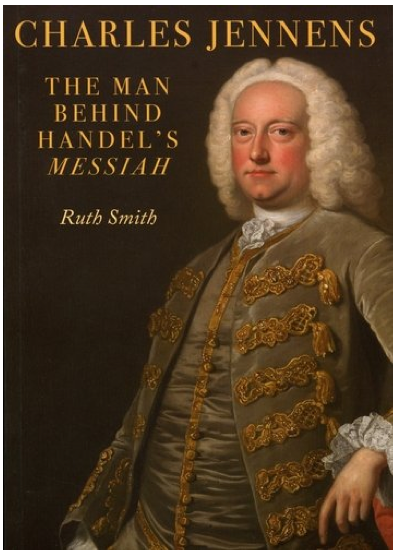 In a major new exhibition the Handel House Museum explores the life, work and character of Handel’s great collaborator Charles Jennens.
An enigmatic character, Jennens had an enormous influence on Handel’s life and work. As librettist for the oratorios Saul and Belshazzar, he provided the composer with words that inspired some of his most challenging and exciting music. His carefully chosen scripture selection for Messiah was to inspire Handel to even greater creative heights, and together these two men created one of the greatest musical works of all time.
The exhibition examines this relationship in detail, alongside other elements of Jennens’s life as a great landowner; the builder of a fine country house with extensive grounds; a major art collector; a Christian philanthropist; a devout defender of revealed religion; an encourager of other authors and composers; a loyal friend; and a forward-looking editor of Shakespeare.
Bringing together exhibits from throughout the UK and beyond, for the first time this landmark exhibition unites all known oil portraits of Jennens to stand beside Handel House’s own magnificent portrait by Thomas Hudson.
The exhibition’s curator is Dr Ruth Smith, author of Handel’s Oratorios and Eighteenth-Century Thought (Cambridge University Press), who has made a particular study of the life and work of Charles Jennens.
Ruth Smith, Charles Jennens: The Man behind Handel’s Messiah (London: Gerald Coke Handel Foundation, 2012), 71 pages, ISBN: 978-0956099822, £8.50.
◊ ◊ ◊ ◊ ◊
Jonathan Keates provides a review for the TLS (11 January 2013):
. . . Unfolding the mystery of Charles Jennens for us, this fine new exhibition, which also has a related walking tour and a series of talks and concerts, is the best so far within the Handel House’s limited space; it was mounted under the guidance of Ruth Smith, whose illuminating survey of his achievement accompanies the show. Besides evoking our admiration for him as aesthete, connoisseur, charitable patron, landscape gardener or devoted friend, she celebrates his work as the earliest variorum editor of Shakespeare’s plays. . . .
Exhibition | The Westminster Treasure: History in Silver, 1713–2013
From The Wallace:
The Westminster Treasure: History in Silver, 1713–2013
The Wallace Collection, London, 7 February — 28 April 2013

The Rosewood Cabinet 1827–77 © The Past Overseers’ Society, Westminster
The Wallace Collection will be displaying a unique set of silver inscribed boxes belonging to the Past Overseers’ Society, Westminster. The collection began in 1713 and, as ever larger cases were commissioned to hold the previous case, they were each covered with etchings of historical events, royal engagements and portraits. The silver is beautiful and the inscriptions are fascinating, intriguing and compelling. Come to the Porphyry Court to see three hundred years of idiosyncratic history continuing up to 2012 with the Diamond Jubilee and the Olympics.
◊ ◊ ◊ ◊ ◊
On Monday, 18th February, 2013, Joan Reid from Past Overseers’ Society, Westminster will talk about the unique set of silver inscribed boxes belonging to the Society currently on display in the Porphyry
Court. This special lecture will take place in the Lecture Theatre. Free,
no need to book.
Comments Off on Exhibition | The Westminster Treasure: History in Silver, 1713–2013
Exhibition Review | Versailles and the Antique
Reviewed for Enfilade by Hélène Bremer
Versailles et l’Antique
Château de Versailles, 13 November 2012 — 17 March 2013
Curated by Alexandre Maral, Geneviève Bresc-Bautier, Jean-Luc Martinez, and Nicolas Milovanovic, with scenography by Pier Luigi Pizzi

Galerie de Pierre basse (Room 1) Versailles et l’Antique
© EPV / Th. Garnier
The entrance through the Gallerie de Pierre Basse (Room 1) of the Palace of Versailles has been changed dramatically for the exhibition Versailles and Antiquity. The public is usually barred from this part of the palace, allowed only to peek down a rather dark hallway containing a collection of sculpture dedicated to heroes of French history. Instead, for now, these statues are discretely draped with white tissue, and the public enters alongside a selection of masterpieces from Louis XIVth’s sculpture garden. The finest marble sculpture from the collections of the French court, now in the collections of the Louvre and the Palace of Versailles, suggest a new Rome, created at Versailles by the Sun King and presently revived by the exhibition curators. This exceptionally ambitious show brings together not only marbles, but also bronzes, tapestries, paintings, drawings, decorative and ephemeral objects to explore the relationship between Versailles and Antiquity.
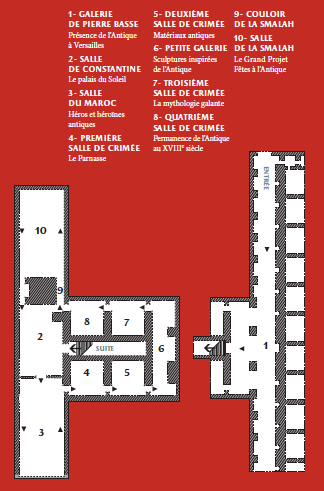 The renowned opera-stage-designer Pier Luigi Pizzi is responsible for the scenography of the installation. He has described the exhibition as a play in which the works of art are the characters and the stage breathes the spirit of the seventeenth-century French court. The subject of the play is the taste of the insatiable collector, Louis XIV. Within the spaces of the palace, Pizzi has managed to accommodate these ‘actors’, which here communicate with each other and invite visitors to follow along, from one spectacular scene to the next (though I imagine many may fail to appreciate the full production with not a single explanatory panel to be found in the whole exhibition).
In early modern Europe, all important courts collected antiquities in order to suggest their magnificence. Materials like porphyry, marble, alabaster, and bronze enhanced the prestige of such collections while tapestries and paintings comparing sovereigns with Classical gods and goddesses symbolized the court’s power.
In France this mode of collecting began with François I. After he failed to acquire the Laöcoon group in 1515 (and again in 1520) from Pope Leo X, his agent Francesco Primaticcio finally gained permission to make casts from the work, and a bronze copy was made for the Palace at Fontainebleau. The French collection of antiques grew only slowly under Henry II, who received the sculpture of Diane chasseresse from Pope Paul IV in 1556 (it serves as the emblem of the exhibition), and subsequent sovereigns largely lost interest altogether. In the seventeenth century, however, cardinals Richelieu and Mazarin assembled large collections of antiquities, most of which eventually entered the collection of Louis XIV. While the king had long been interested in collecting antiquities (under the guidance of Mazarin), his ambitions were fueled by a remark made by Bernini in 1665 during the sculptor’s visit to France. After Louis XIV showed him the royal collection, Bernini judged that it consisted of “ornaments for ladies.” Embarrassed, the king hurried to improve the collection, adding important, large, masculine (read powerful) sculpture. At the time it was not necessary to display genuine antique marbles; but instead, reassembled works and contemporary sculpture inspired by the antique could do as well. Within a short time, the collection at Versailles grew steadily, and the newly built Hall of Mirrors was adorned with gods and goddesses in marble, vases in porphyry as well as with classically-themed ceiling and wall paintings. References to antiquity intensified among all art forms, with Versailles celebrated as the new Rome.

Salle du Maroc (Room 3) Versailles et l’Antique
© EPV / Th. Garnier
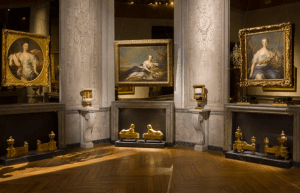
This exhibition claims to reconstruct a Versailles not seen since the French Revolution. On offer is not, however, a display of antiquities as they appeared at the court of Louis XIV, but the creation of an ambiance. Walking from the sculpture garden in the Gallerie Basse up the stairs to the Salle de Constantine (Room 2) with its reconstructed Palais de Soleil would have been a rather different experience in the seventeenth century. The importance of antiquity is nonetheless clear from the enormous quantity of objects on display. Using the rooms of the palace instead of temporary exhibition spaces preserves the court’s atmosphere. One wanders from intimate cabinets (Rooms 4 and 5) filled with precious objects and paintings, into a light-filled sculpture gallery dedicated to the gardens of Marly (Room 6), to rooms containing mythological paintings (Rooms 7 and 8). The exhibition includes a historical sequence, and dixhuitièmists will be especially interested in the Quatrième Salle de Crimée (Room 8) dedicated to the persistence of antiquity in the eighteenth century. In particular, the room examines eighteenth-century taste through paintings by Nattier and Drouais of court ladies disguised as Diana or Flore, along with the changing relationship between politics and aesthetics.
Quatrième salle de Crimée (Room 8) Versailles et l’Antique
© EPV / Th. Garnier
Near the show’s conclusion (Room 9), the presentation of the grand projet to reconstruct the palace during the eighteenth century is interesting for its references to the antique (especially to the monuments of Rome), but this architectural departure is probably a bit much for the average visitor at the close of such an extensive exhibition (180 of the 200 objects on display have already asked a lot of viewers’ attention). Showing this material in a separate venue may have helped insure it receives the attention it merits.
Finally, the Salle de la Smalah (Room 10), dedicated to the Fêtes à l’antique, displays an impressive table ornament in the form of a antique colonnade in front of a sculpture of Apollo, in turn flanked by an enormous barometer made for Louis XV and XVI. Rather, however, than providing a satisfying finale to the proposed play, this last installation left me feeling oddly alone on the middle of the stage, longing for a re-enactment.
◊ ◊ ◊ ◊ ◊
Alexandre Maral and Nicolas Milovanovic, eds., Versailles et l’Antique (Paris: Artlys, 2012), 336 pages, ISBN: 978-2854955125, 49€ / $95.
 Versailles was a new Rome in several ways: in its grandiose size, in its ambition to endure through the centuries, and in the many references to the great models of Antiquity. In the 17th century, Antiquity was an incomparable absolute, which the most ambitious sovereigns wished to rival: Louis XIV created Versailles as the seat of power to bring back the grandeur of Antiquity. The exhibition examines the presence of Antiquity in Versailles from two angles: the acquisition of antique fragments and commissions of copies by the kings, and the re-appropriation of antique models and figures by artists. It brings back to Versailles about fifty antiques that it possessed during the Ancien Régime. The interpretation of Antiquity and its mythology are evoked through about two hundred works from the principal French and foreign collections (the Louvre, Bibliothèque nationale de France, Musée des Beaux-Arts de Besançon, Uffizi Gallery of Florence, Archaeological Museum of Naples, etc.): sculptures, paintings, drawings, engravings,
tapestries, pieces of furniture, objets d’art.
Available from ArtBooks.com»
◊ ◊ ◊ ◊ ◊
The website of the Palace of Versailles provides additional information, including a series of videos. Full descriptions of each section of the exhibition are available as a PDF file here»










leave a comment