Exhibition: Goya’s Los Caprichos
From the Nassau County Museum of Art:
Francisco Goya: Los Caprichos
Nassau County Museum of Art, Roslyn Harbor, New York, 17 September — 27 November 2011
Curated by Robert Flynn Johnson

Francisco Jose de Goya. The Sleep of Reason Produces Monsters (Caprichos No. 43: El Sueño de la razon produce monstruos), 1796-97 Etching and aquatint, 1st Edition 1799 Plate dimensions 213 x 150 mm.
This exhibition features an early first edition of Los Caprichos, a set of 80 etchings by Spanish artist Francisco de Goya y Lucientes that was published in 1799. It is regarded as one of the most influential series of graphic images in the history of Western art. Francisco Goya: Los Caprichos was organized by Landau Traveling Exhibitions (Los Angeles), in association with Denenberg Fine Art (West Hollywood).
“Capricho” can be translated as a whim, a fantasy or an expression of imagination. In Goya’s use of the term, the meaning deepens, binding an ironical layer of humor over one of the most profound indictments of human vice ever set on paper. Enigmatic and controversial, Los Caprichos was created in a time of social repression and economic crisis in Spain. Influenced by Enlightenment thinking, Goya set out to analyze the human condition and denounce social abuses and superstitions. Los Caprichos was his passionate declaration that the chains of social backwardness had to be broken if humanity was to advance. The series attests to the artist’s political liberalism and to his revulsion at ignorance and intellectual oppression, mirroring his ambivalence toward authority and the church. Los Caprichos deals with personages populate a world on the margins of reason, where no clear boundaries distinguish reality from fantasy.
In his essay accompanying the exhibition, Robert Flynn Johnson, curator in charge, Achenbach Foundation for Graphic Arts, Fine Arts Museum of San Francisco, states:
Francisco Goya should be seen as the first modern artist–he chose to go beyond depictions of religion, mythology, and history, and even beyond observation of the visible world, turning instead toward the psychological demons that have always inhabited men’s souls. Until Goya, these demons had rarely been made artistically visible–Goya had the courage and the genius to depict them. Los Caprichos stands as the greatest single work of art created in Spain since the writings of Cervantes and the paintings of Velázquez over one hundred fifty years earlier.
Francisco Goya: Los Caprichos opens on Saturday, September 17 and remains on view through Sunday, November 27. The museum is offering several programs that will serve to enhance the viewer’s appreciation of the exhibition. Among these are daily screenings of Goya: Crazy Like a Genius, a film written by the prominent art commentator Robert Hughes, and lunchtime lectures followed by tours of the exhibition on October 13 and November 17. For details, visit the EVENTS section of the museum website.
The Eighteenth Century in the October Issue of The Burlington
The Burlington Magazine 153 (October 2011)
◊ ◊ ◊ ◊ ◊
Editorial
• The Holburne Museum, Bath
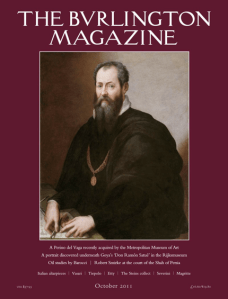 . . . Earlier this year, the Museum received extensive publicity when it re-opened after renovation and an extension carried out by Eric Parry Architects. This has included the daring and entirely successful moving of the central staircase of the house, to a few feet to the left, unblocking the vista through the ground-floor entrance to the gardens at the back; a beautiful full-height glass extension to the rear of the building that creates temporary exhibition rooms and a greater feeling of light and air; and the almost complete redisplay of the collections. While it has to be admitted that the Museum is distinctly eclectic and charmingly provincial (and in places still fussily crowded), in its renovated state its former shabby gentility has been vanquished. It now presents itself like Gainsborough’s Lord and Lady Byam, stepping out with the next generation, all in their finery, to greet the future.
The full editorial is available here»
◊ ◊ ◊ ◊ ◊
Articles
• Antonello Cesareo, “New Portraits of Thomas Jenkins, James Byres and Gavin Hamilton” — Two new portraits of Thomas Jenkins and James Byres by Anton von Maron and a self-portrait by Gavin Hamilton.
• Christopher Baker, “Robert Smirke and the Court of the Shah of Persia” — A watercolour study by Robert Smirke in the National Gallery of Scotland, Edinburgh, for a painting of the court of the Shah of Persia.
• Duncan Bull and Anna Krekeler, with Matthias Alfeld, Doris Jik, and Koen Janssens, “An Intrusive Portrait by Goya” — The discovery of an earlier three-quarter length portrait of a man by Goya beneath his Portrait of Ramón Satué (1823) in the Rijksmuseum, Amsterdam.
◊ ◊ ◊ ◊ ◊
Books
• Philip McEvansoneya, Review of N. Glendinning and H. Macartney, eds., Spanish Art in Britain and Ireland, 1750–1920: Studies in Reception in Memory of Enriqueta Harris Frankfort.
• Mark Stocker, Review of M. Kisler, Angels and Aristocrats: Early European Art in New Zealand Public Collections.
• Luke Herrmann, Review of M. and J. Payne, Regarding Thomas Rowlandson (1757–1827): His Life, Art & Acquaintance and P. Phagan, Thomas Rowlandson: Pleasures and Pursuits in Georgian England.
◊ ◊ ◊ ◊ ◊
Exhibitions
• Xavier F. Salomon, Young Tiepolo
Exhibition: Chinoiserie
From the Milwaukee Art Museum:
Way of the Dragon: The Chinoiserie Style, 1710–1830
Milwaukee Art Museum, 30 June — 6 November 2011
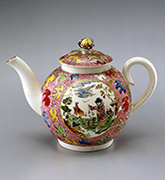
“Creamware Teapot”, ca. 1775, tin-glazed earthenware, London (Chipstone Foundation) Photo: Gavin Ashworth
Presented by the Chipstone Foundation, Way of the Dragon: The Chinoiserie Style, 1710–1830 explores how chinoiserie developed and subsequently degenerated in the eighteenth century. Chinoiserie objects represent Europe’s attempt to translate the arts and the ornament of China, Japan, and India, and was popular in all of Europe, but the English in particular were mesmerized by the allure of the exotic land and its people. Way of the Dragon investigates and questions European perceptions of China, as reflected in its decorative arts.
Exhibition: ‘Claude Lorrain: The Enchanted Landscape’
From the Ashmolean:
Claude Lorrain: The Enchanted Landscape
Ashmolean Museum of Art and Archaeology, Oxford, 6 October 2011 — 8 January 2012
Städel Museum, Frankfurt, 3 February — 6 May 2012
Curated by Jon Whiteley
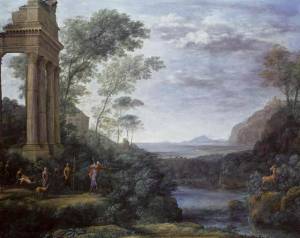
Claude Lorrain, "Landscape with Ascanius Shooting the Stag of Sylvia," 1682 (Oxford: Ashmolean Museum)
The Ashmolean’s major exhibition this autumn will be Claude Lorrain: The Enchanted Landscape, rediscovering the father of European landscape painting, Claude Gellée (ca. 1600–1682), or Claude Lorrain as he is best known.
In partnership with the Städel Museum, Frankfurt, the exhibition will bring together 140 works from international collections, created at different points in the artist’s career. By uniting ‘pairs’ of Claude’s paintings and making a comprehensive survey of his work in different media, the exhibition brings new research to bear on his working methods, to reveal an unconventional side to Claude which has previously been little known.
Born in France, Claude travelled first to Italy at the age of 13 or 14, settling in Rome for the rest of his life in 1627. The scenery of his great compositions was based on his studies of the ancient ruins and the rolling country of the Tiber Valley and the Roman Campagna. Claude’s ability to translate his vision of the countryside and the majesty of natural light with the aid of his brush won him the admiration of his contemporaries, above all else, as a ‘natural painter’. It has been his signature treatment of classical landscape and literature which has impressed itself on generations of artists and collectors, and which has made his name synonymous with great landscape painting.
ISBN: 9781848220928, $80
The cult of Claude which grew up in the 18th and 19th centuries, begun by British ‘Grand Tourists’, has left a profound mark on our history and landscape. English country houses are well stocked with both originals by Claude and with copies. Responding to aristocratic taste and fashion, designers such as Capability Brown, Henry Hoare and William Kent reproduced his ideal views in the parklands of great houses from Blenheim Palace, Rousham House and Stowe, to Stourhead and Chatsworth. Claude’s drawings were collected with no less enthusiasm by English connoisseurs, as a result, over 40% of his drawings are now in the British Museum. Claude’s influence on later artists is apparent in the work of Gainsborough, Turner and Constable, who described him as ‘the most perfect landscape painter the world ever saw’.
A lesser-known side to Claude is the eccentricity of his graphic art. Claude Lorrain: The Enchanted Landscape will exhibit 13 paintings alongside related drawings and etchings from international and private collections, and from the Ashmolean’s own extensive holdings. Claude was a dedicated graphic artist. He drew for the sake of mastering the world of nature but also because drawing was a pleasure in itself. Many of his drawings were made as works of art in their own right. During his own lifetime Claude’s fame grew rapidly. As a guard against forgeries, he made copies of his paintings in a book, the Liber Veritatis (Book of Truth), which, by the time of his death, contained 200 drawings. The book also gave him a collection of ideas which he could reuse when necessary. Although he made only 40 prints in total, all of which are on display, he took a serious interest in printmaking. Similar to his drawings, his principle focus was to explore the potential of the medium. His exceptional technique – a painterly brush-and-ink style replicating natural effects – was a novelty in contemporary printmaking. The spectacular ‘Fireworks’ series, ten etchings made during a week of firework displays in Rome, illustrate his experimental style and will be on show together in the Ashmolean’s exhibition.
Unlike contemporaries who had an academic training, Claude’s style and artistic process were unique to him. He worked frequently with existing materials progressing from one painting to another through a process of variation and combination. His sketching excursions provided him with a stock of motifs, including trees, hills, rivers and antique ruins, which became constant accessories in his paintings. Figure groups were shifted from one composition to another. Landscapes, like stage scenery, were taken out for reuse with a different set of characters. Elsewhere he would cut compositions in two or enlarge them with separate sheets. Occasionally, he would pick up a discarded study and add detail to make it a finished work of art, often with peculiar results.
Claude was also the first artist to specialise in painting ‘pairs’. Approximately half his compositions were made as companion pieces, the earliest of which, on display here, are Landscape with the Judgement of Paris and Coast View (both 1633). The idea of pairs is also found among his prints. While many of his pairs show a compositional correspondence, contrast played as great a role as similarity. Often an Arcadian landscape is combined with a maritime view, or a morning scene with an evening setting. The pairs were not always executed concurrently: his very last painting, the Ashmolean’s great Ascanius and the Stag of Sylvia (1682), was made 5 years after its companion, Aeneas’s Farewell to Dido in Carthage (1676) now in Hamburg.
Claude Lorrain: The Enchanted Landscape will display some of Claude’s greatest masterpieces, works which have made his art familiar and well-loved. In placing these beside his graphic art and exploring his singular methods of working, the exhibition aims to expose an unexplored dimension to one of the western canon’s most famous names.
“Claude’s art is recognisable to almost all of us, even if we are less familiar with his name, and this important exhibition will reintroduce us to one of the greatest painters of all time.” Dr Jon Whiteley, Exhibition Curator and Senior Assistant Keeper of Western Art, Ashmolean Museum.
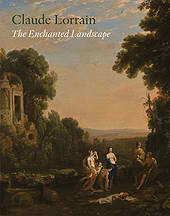
Catalogue: Martin Sonnabend, Jon Whiteley, and Christian Rumelin, Claude Lorrain: The Enchanted Landscape (London: Lund Humphries, 2011), 200 pages, ISBN: 9781848220928, $80.
◊ ◊ ◊ ◊ ◊
S E L E C T E D P R O G R A M M I N G
Colin Harrison (Senior Assistant Keeper of Western Art, Ashmolean Museum), Claude, Wilson, Turner
Saturday, 12 November, 11:00
Claude’s landscape paintings had a profound influence on British artists in the 18th and 19th century. This lecture focuses on his long-lasting inspiration, most apparent in the work of Richard Wilson (1714–1782) and J.M.W Turner (1775-1851).
Michael Clarke (Director of the Scottish National Gallery), Arcadia Revisited – Claude’s Enduring Legacy
Wednesday, 16 November, 2:00
Generally acknowledged as the founder of the European landscape tradition, Claude Lorrain was admired by many of the great European painters, especially Constable and Turner. His work exerted an enormous influence on later generations even eliciting praise from the Impressionist Camille Pissarro. This lecture charts the perennial attraction of an artist who ‘conducts us to the tranquility of Arcadian scenes and fairy land’ (Sir Joshua Reynolds).
Christopher Woodward (Director of the Garden Museum), Claude Lorrain and the Making of the English Landscape Garden
Wednesday, 7 December, 5:00
How did a French artist working in Rome in the 17th-century inspire the creation of 18th-century gardens such as Blenheim, Rousham and Stourhead? Christopher Woodward, Director of The Garden Museum and author of “In Ruins”, explores how Claude’s idyllic Italian scenes inspired the transformation of English gardens into visions of Arcadia.
Exhibition: Louis-Léopold Boilly (1761-1845)
From Art Media Agency:
Boilly (1761-1845)
Palais des Beaux-Arts de Lille, 4 November 2011 — 6 February 2012
 The Palais des Beaux-Arts in Lille will host the first international retrospective dedicated to Louis-Léopold Boilly (1761-1845). The event, celebrating the 250th birthday of the artist, will run from 4 November to 6 February. . . .
It is the first Boilly retrospective since the 1930s and it will feature works from numerous collections. It will underline the painter’s originality. His talent as a portraitist will also be highlighted, as well as his taste for trompe-l’œil and his role as the century’s chronicler, precursory to Daumier. The exhibition will feature more than 170 paintings, drawings, lithographs, miniatures and furniture. It will be divided into seven sections, in chronological and thematic order, recounting the painter’s itinerary.
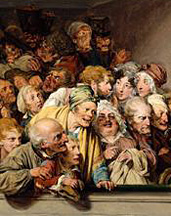
ISBN: 9782350391250
The full AMA posting is available here»
The exhibition press release (in French) is available here»
◊ ◊ ◊ ◊ ◊
Annie de Wambrechies, Louis-Leopold Boilly (1761-1845), exhibition catalogue (Paris: Chaudun, 2011), 304 pages, ISBN: 9782350391250, 42€ / $82.50 — The catalogue, scheduled for release in November, will be available from ArtBooks.com.
Exhibition: British Watercolors of Italy at RISD
From the RISD Museum of Art:
Distant Climes: 18th-Century British Views of Italy
Museum of Art, Rhode Island School of Design, Providence, 1 September 2011 — 3 June 2012
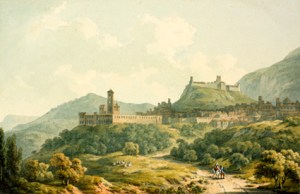
John "Warwick" Smith, "Assisi in the Province of Umbria," 1794 (Providence: RISD Museum of Art)
Around 1750, British watercolorists began to travel to Italy to visit its ancient sites and idyllic countryside. Distant Climes assembles Italian views by some of these early travelers, including Richard Wilson, Richard Cooper II, and John “Warwick” Smith.
Watercolor, then a relatively new medium for landscape painting, became essential to these artists as they recorded their impressions of Italy for themselves and for collectors back home. Most adopted the idealizing and classicizing concept of nature promoted by the previous generation of landscape and perspective painters working in Italy, including Claude Lorrain and Antonio Canaletto. Their watercolors also demonstrate an interest in form, composition, and atmosphere rather than the naturalistic color, and layered washes more indicative of watercolors made after 1800.
Exhibition: French Artists in Eighteenth-Century Rome
From the exhibition website:
Drawn to Art: French Art Lovers and Artists in 18th-Century Rome
National Gallery of Canada, Ottawa, 21 October 2011 — 2 January 2012
Musée des Beaux-Arts de Caen, 4 February — 23 April 2012
Curated by Sonia Couturier

Jacques-Louis David, "St. Jerome," 1779 Musée du Séminaire, Quebec City (deposited by the Fabrique Notre-Dame, inv. PE34.984) on loan to the National Gallery of Canada, Ottawa
In the 18th century, Rome was the principal crossroads for the European community and an important source of influence for French artists who rose to prominence in the Eternal City. This exhibition highlights the flowering of French art in 18th-century Rome, focusing on some 100 works, of which many are travelling to North America for the first time.
Visitors will have the opportunity to view an exceptional selection of drawings and prints as well as a number of paintings by many important French artists of the period, including Hubert Robert, Jean-Honoré Fragonard and Jacques-Louis David. After its presentation in Ottawa, the exhibition Drawn to Art: French Artists and Art Lovers in 18th-Century Rome will be on view at the Musée des Beaux-Arts de Caen, France from 4 February to 23 April 2012.
Catalogue: Sonia Couturier, ed., Drawn to Art: French Artists and Art Lovers in 18th-Century Rome (Milan: Silvana, 2011), 216 pages, ISBN: 9788836620548, $67.50. [available from artbooks.com]
◊ ◊ ◊ ◊ ◊
Academic Training

Jean-Baptiste Frédéric Desmarais, "The Shepherd Paris," 1787–88 (Ottawa: National Gallery of Canada) Photo © NGC
The Académie de France in Rome, founded in 1666, provided training for the most talented students from the Académie royale de peinture et de sculpture in Paris, for a period of about four years. This group of artists comprised the dozen recipients of the Grand Prix de Rome, awarded for excellence in painting, sculpture and architecture.
The students made copies of antiquities in public squares, gardens and the Capitoline Museum, and they visited the churches and palazzos of Rome to study Renaissance and Baroque masters. The Académie also offered a live model class, open to these pensionnaires (as they were called), external students and foreigners. Although the nude study was part of the curriculum, many of the resulting paintings of academy figures were of exceptional quality. Students’ work was regularly dispatched to the king of France to attest to their progress.
A number of French artists went on to successful careers in Rome or submitted proposals for major Roman projects. The length of time that both pensionnaires and independent artists spent in Rome varied depending on
their financial resources and patron support.
The Landscape of Rome and its Surroundings
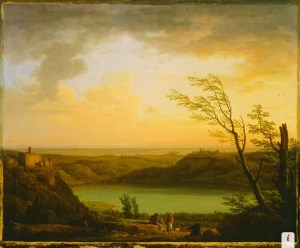
Claude-Joseph Vernet, "View of Lake Nemi," 1748 (Ottawa: National Gallery of Canada)
A revival of interest in the art of landscape was sparked in 1725 when Nicolas Vleughels, who took over as director of the Académie de France in Rome, encouraged young painters to sketch in situ. This desire to breathe new life into the landscape genre resulted in a variety of forms.
Rome and its environs provided painters and draughtsmen in search of picturesque views with a constant source of inspiration. Some artists offered an idyllic, pastoral vision, mixing imagination and reality, while others opted for a more objective portrayal of the land and its inhabitants, carefully reproducing the natural and built environment. During his Roman sojourn (1754–65), Hubert Robert made countless images of the surrounding landscape, building a vast repertoire of motifs. Like other French pensionnaires in the 1740s, he was influenced by the vedutisti Giovanni Paolo Panini and Giovanni Battista Piranesi. The masterful studies of atmospheric effects by Adrien Manglard, Claude-Joseph Vernet and Pierre-Henri de Valenciennes helped to bring landscape to the forefront in the following century.
Art Lovers, Patrons, and Artists

François-André Vincent, "Portrait of Pierre-Jacques-Onésyme Bergeret de Grancourt," 1774 (Besançon: Musée des beaux-arts et d'archéologie)
Rome was a cosmopolitan centre that attracted not only artists of diverse nationalities but also sophisticated sponsors and connoisseurs eager to hone their knowledge. A number of dilettanti emerged as key figures of this lively community, in which the most promising talents of the time flourished.
The well-established artistic relationships linking Paris and Rome were forged primarily through the directors of the Académie de France in Rome and reinforced by visiting amateurs, each with his own set of connections. The diplomatic realm also provided a fertile terrain for exchanges and development of the network.
Art tourists rarely stayed in Rome for more than a few months. They took full advantage of the resources offered by the Académie, which had available a pool of young artists keen to serve as guides. Certain visitors seem to have warranted special attention; the most important was the Marquis de Marigny, future director of the king’s buildings, who was in Rome in 1750–51 in preparation for his upcoming appointment.
Celebrations and Festivities
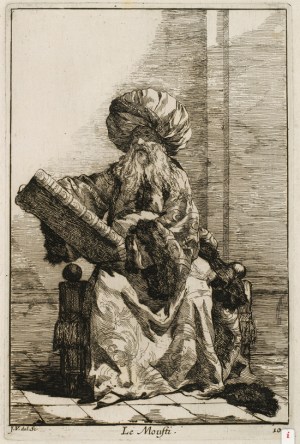
Jean-Marie Vien, 32 plates Illustrating the "Caravane du Sultan à la Mecque" during the Carnival in Rome, 1748, detail (Ottawa: National Gallery of Canada)
Life in Rome was punctuated by numerous celebrations and festivals, and the French artists made the most of them. Especially memorable were the extraordinary Turkish and Chinese masquerades organized by students at the Académie de France for Rome’s annual carnival. The caricatures produced offer a glimpse into a milieu full of camaraderie.
Various works illustrate the extravagant set pieces, parade floats and fireworks displays conceived for the secular celebrations and religious ceremonies that regularly transformed the city. Among the official ceremonies held to mark political events was the Chinea festival, commemorating the ceding of the kingdom of Naples by Pope Clement IV to Charles of Anjou in 1265. As the new king of Naples, Charles presented the papacy with a white mare known as a chinea (a “hackney” in English). When Naples passed into Spanish hands, the tradition was preserved. Temporary structures made of wood, canvas and stucco were built before the ambassador’s palace. These macchine, inspired by allegorical themes that glorified the kingdom of Naples, were lit up at night by fireworks.
Williamsburg Symposium on Maps and Prints of Early America
From The Colonial Williamsburg Foundation:
Symposium: More than Meets the Eye: Maps and Prints of Early America
DeWitt Wallace Decorative Arts Museum, Williamsburg, VA, 16-18 October 2011
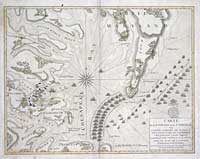 In conjunction with the exhibition More than Meets the Eye: Maps and Prints of Early America, Colonial Williamsburg will sponsor a symposium from October 16-18, 2011 that will feature lectures focusing on the men who created these objects, how they assembled and disseminated their information, and the factors that motivated them to create powerful and influential images. Speakers will include Philip Burden, Paul Cohen, Louis De Vorsey, Matthew Edney, William Gartner, and Henry Taliaferro. The conference begins with an opening reception Sunday evening followed by two days of lectures, Monday and Tuesday.
The conference brochure is available for download here»
Exhibition & Symposium: Drawings from the Louvre at the Morgan
I noted the show back in February, but I’m afraid tomorrow afternoon’s lecture series nearly slipped by me. From The Morgan:
◊ ◊ ◊ ◊ ◊
David, Delacroix, and Revolutionary France: Drawings from the Louvre
The Morgan Library and Museum, New York, 23 September — 31 December 2011
Curated by Louis-Antoine Prat and Jennifer Tonkovich with assistance from Esther Bell

ISBN: 9780875981598, $40
From the time of the French Revolution of 1789 through the reign of King Louis-Philippe and the establishment of the Second Empire in 1852, an incredible concentration of artistic talent brought its collective skill to bear on one of the most turbulent times in French history. This exhibition features some of the greatest examples of works on paper of the period from Paris’s famed Musée du Louvre. Included are eighty drawings by such noted artists as David, Prud’hon, Ingres, Géricault, Delacroix, and Corot.
Rarely does the Louvre allow such a major group of drawings, with so many iconic works, to travel. The exhibition will offer visitors a singular opportunity to experience the mastery of the era. The Morgan is the only venue for this important show.
David, Delacroix, and Revolutionary France: Drawings from the Louvre is organized by Louis-Antoine Prat, curator in the Department of Graphic Arts at the Musée du Louvre and Jennifer Tonkovich, curator in the Department of Drawings and Prints at The Morgan Library & Museum, with the assistance of Esther Bell, Moore Curatorial Fellow, The Morgan Library & Museum.
◊ ◊ ◊ ◊ ◊
Symposium — Drawing in the Age of Revolutions: New Perspectives
The Morgan Library and Museum, New York, 24 September 2011
This symposium coincides with the exhibition David, Delacroix, and Revolutionary France: Drawings from the Louvre, which offers the American public a rare opportunity to view some of the most celebrated French drawings from the Louvre. Through a series of brief talks, leading scholars will explore the diversity of draftsmanship during the period and present new research in the field. The program will conclude with a gallery conversation with curators and speakers, allowing for a closer examination of works on view.
The Art Market, Drawings Galleries, and Collectors
Louis-Antoine Prat, Curator, Department of Graphic Arts, Musée du Louvre, and Professor, Ecole du Louvre
Between Language and Painting: the Function of Drawing in the Later Work of Jacques-Louis David
Thomas Crow, Rosalie Solow Professor of Modern Art, and Associate Provost for the Arts, Institute of Fine Arts, New York University
The Louvre Drawings: A Cultural Historian’s Perspective
Stéphane Gerson, Associate Professor of French and French Studies, New York University
Drawing’s Stepchild: The Printed Image from David to Delacroix
Patricia Mainardi, Doctoral Program in Art History Graduate Center, City University of New York
In-Gallery Talks:
“Petits Souvenirs de Bonne Amitié”: Drawings and Friendship in Nineteenth-Century France
Esther Bell, Moore Curatorial Fellow, Department of Drawings and Prints, Morgan Library & Museum
Place and Memory in Nineteenth-Century French Drawings
Alison Hokanson, Research Assistant, Department of Drawings and Prints, Metropolitan Museum of Art
Winterthur Exhibition & Conference: ‘With Cunning Needle’
As noted at A Fashionable Frolick, Winterthur explores the past four centuries of embroidery with the exhibition and conference, With Cunning Needle:
With Cunning Needle: Four Centuries of Embroidery
Winterthur Museum, Delaware, 3 September 2011 — 8 January 2012

Apron, England, 1730-40, silk with gold and silver on silk. Winterthur Museum, 1987.84
In 2006 Plimoth Plantation in Massachusetts began an exciting and innovative project to accurately re-create a 17th-century embroidered woman’s jacket. The process of designing and making what has become known as the Plimoth Jacket has shed new light on the tools and methods employed by the skilled embroiderers of the 1600s. Using the Plimoth Jacket as a touchstone, With Cunning Needle delves into the designs, materials, techniques, and makers of embroidery over four centuries.
Explore each step in the process of creating needlework, from skeins of silk and pattern books to embroidered bed covers and silkwork pictures. Learn about the women and men who made these beautiful objects for themselves, their friends and families, and commercial sale. Discover “lost” skills that have been revived through the Plimoth Jacket project.
With Cunning Needle explores the history of embroidery and invites visitors to take a closer look at the wide array of styles, technology, and people reflected by this art form.
◊ ◊ ◊ ◊ ◊
From the conference webpage:
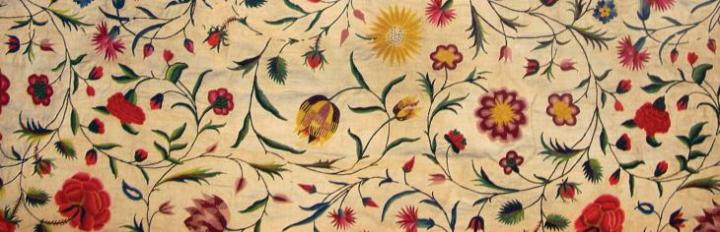
Embroidered petticoat fragment (detail), France, early 1700s. 2010.15. All Winterthur objects pictured on this page were purchased by the museum with funds provided by the Henry Francis du Pont Collectors Circle .
With Cunning Needle: A Winterthur Needlework Conference
Winterthur Museum, Delaware, 21-22 October 2011
L E C T U R E S (more…)










 Enfilade
leave a comment