Exhibition: ‘Scraps: British Sporting Drawings’ at the VMFA
From the VMFA:
Scraps: British Sporting Drawings from the Paul Mellon Collection
Virginia Museum of Fine Arts, Richmond, 18 June — 18 September 2011
Curated by Corey Piper

Thomas Rowlandson, "The Woolpack Inn, Hungerford, Berkshire," detail, 1796, pencil, pen, ink and watercolor (VMFA: Paul Mellon Collection, 85.1037). Copyright VMFA
Taking its title from a series of drawings and prints by Henry Alken depicting sketches of country life, Scraps: British Sporting Drawings from the Paul Mellon Collection features drawings and watercolors that showcase the passing moments of observation that comprise the rich world of British Sporting Art. Works in the exhibition range from pencil sketches which record the artist’s direct observation of animal subjects to more highly finished works which present a more fully developed vision of sport and country life.
The exhibition offers a broader view of artists well known for their sporting paintings and prints such as Henry Alken, James Seymour, Sawrey Gilpin, Edwin Landseer, James Ward and Thomas Rowlandson and reveals them to be skilled draftsmen as well as keen observers of the natural world and the realm of sport. Drawn entirely from the extensive holdings of works on paper in the Mellon Collection at VMFA, this exhibition offers a rare look into the working methods and personal vision of Britain’s greatest sporting artists. (more…)
Exhibition: ‘Revolution!’
From the New-York Historical Society:
Revolution! The Atlantic World Reborn
New-York Historical Society, 11 November 2011 — 15 April 2012
Details of additional venues to be announced later
Curated by Richard Rabinowitz

ISBN: 9781904832942, $65
Revolution! The Atlantic World Reborn, an international exhibition sponsored by the New-York Historical Society, will open in New York in November 2011 and travel to sites in Britain, France, the United States, and Haiti. Occupying about 3,500 square foot (325 m2), the exhibition will feature magnificent paintings, drawings, and prints from collections in a half-dozen countries; historical documents, maps, and manuscripts penned by participants in these revolutions; audio-visual presentations and computer-interactive learning stations; inventive and beautiful works of art commissioned for this exhibition; and curriculum materials for students from kindergarten through graduate school. The exhibition will be fully accessible in English, French, and Haitian Kreyol. Dr. Richard Rabinowitz of the American History Workshop, is Chief Curator of the exhibition. A beautifully illustrated catalog, with scholarly essays by leading scholars in revolutionary studies and edited by Professors Thomas Bender of NYU and
Laurent Dubois of Duke, will accompany the exhibition.

Noel le Mire, "General Washington," 1780, engraving (New York Historical Society)
The exhibition explores the enormous transformations in the world’s politics and culture between the 1763 triumph of the British Empire in the Seven Years War and the end of the Napoleonic Wars 52 years later. For the first time, this story will be told as a single global narrative rather than as chapters within national histories. Opposing the power and reach of European imperial authorities, the diverse men and women of the Atlantic world — natives of Africa, Europe, and the Americas — registered their grievances in both legal argument and violent protest. Their first major outbursts, comprised in the American Revolution, triggered an explosion of radical ideas. And these in turn drew many Britons to the antislavery crusade, then fomented a fierce antagonism to entrenched privilege among French revolutionaries, and finally spawned the astonishing insurrection on the island of Saint Domingue leading to the world’s only successful slave revolt and the establishment of the first nation fully committed to equality and emancipation, Haiti.

John Greenwood, "Sea Captains Carousing in Surinam," ca. 1752-58, oil on bed ticking (Saint Louis Art Museum)
Linking the attack on monarchism and aristocracy to the struggle against slavery, Revolution! explores how thousands of revolutionaries across the Atlantic world made freedom, equality, and the sovereignty of the people into universal goals. The eighteenth-century revolutionaries certainly did not succeed in obliterating every trace of the Ancient Regime, but they invented the notions of human rights, within a world of nation states, that still fire the desire for justice everywhere.
◊ ◊ ◊ ◊ ◊
Exhibition catalogue: Thomas Bender and Laurent Dubois, eds., Revolution! The Atlantic World Reborn (London: Giles, 2011), 288 pages, ISBN: 9781904832942, $65.
Exhibition: ‘Life, Liberty, and the Pursuit of Happiness’
Life, Liberty, and the Pursuit of Happiness: American Art from the Yale University Art Gallery
Speed Art Museum, Louisville, 7 September 2008 — 4 January 2009
Seattle Art Museum, 26 February — 24 May 2009
Birmingham Museum of Art, Alabama, 4 October 2009 — 10 January 2010
Yale University Art Gallery, New Haven, 29 July 2011 — 8 July 2012 (in three parts)

John Trumbull, "The Declaration of Independence, July 4, 1776," 1786–1820 (Yale University Art Gallery)
This exhibition draws upon the Gallery’s renowned collection of American paintings, decorative arts, and prints to illuminate the diverse and evolving American experience from the time of the settlements of the late seventeenth century to the World’s Columbian Exposition in 1893. The more than 200 works in this traveling exhibition—including treasures such as John Trumbull’s Declaration of Independence and Winslow Homer’s Morning Bell—now return to New Haven for a three-part presentation.
Exhibition and publication organized by Helen A. Cooper, the Holcombe T. Green Curator of American Paintings and Sculpture, with Robin Jaffee Frank, the Alice and Allan Kaplan Senior Associate Curator of American Paintings and Sculpture; Elisabeth Hodermarsky, the Sutphin Family Associate Curator of Prints, Drawings, and Photographs; and Patricia E. Kane, Friends of American Arts Curator of American Decorative Arts, all Yale University Art Gallery.
◊ ◊ ◊ ◊ ◊
Exhibition catalogue: Helen A. Cooper, ed., Life, Liberty, and the Pursuit of Happiness: American Art from the Yale University Art Gallery (New Haven: Yale University Press, 2008), 368 pages, ISBN: 9780300122893.
 The American experience—from its colonial beginnings to the modern age—has captured the imagination of all Americans, including its artists. This richly illustrated book explores works from the renowned collections of American paintings, decorative arts, prints, and photographs at the Yale University Art Gallery and creates a vivid portrait of a young country defining itself culturally, politically, and geographically.
Distinguished scholars shed new light on American history by examining some of the most familiar and revered objects in American art—paintings by Trumbull, Peale, Copley, Eakins, Church, and Homer; silver by Revere and Tiffany; furniture by Roux and Connelly; and photographs by Muybridge, among others. The authors discuss how issues of cultural heritage, patriotism, politics, and exploration shaped America’s art as well as its attitudes and traditions.
Exhibition: ‘Georges de Lastic: Amateur, Collector, and Curator’
As reviewed by Bénédict Ancenay for The Art Tribune (18 February 2011) . . .
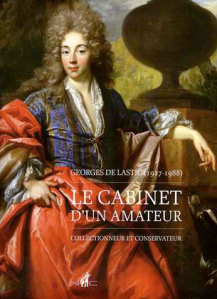
Georges de Lastic: Le Cabinet d’un amateur, collectionneur et conservateur
Musée de la Chasse et de la Nature, Paris, 7 December 2010 — 14 March 2011
Musée de la Vénerie, Senlis, 7 December 2010 — 14 March 2011
Musée d’Art Roger-Quilliot, Clermont-Ferrand, 4 October 2011 — 5 February 2012
ISBN: 978-2350391021, 42.00€
One man and two exhibitions, Georges de Lastic (1927-1988), a curator and collector, amply deserves this celebration in the two locations which distinctly marked his professional life. . . . An aesthete and historian, both in his professional and personal life, Georges de Lastic assembled a private collection which is now highlighted in the double exhibition presented at the Musée de la Vénerie in Senlis and the Musée de la Chasse et de la Nature in Paris. . . .
In 1970, Georges de Lastic inherited the château de Parantignat, his “little Versailles in Auvergne,” the residence for the Marquis de Lastic for over three centuries which, along with his Parisian apartment on quai de Bourbon, housed his collection of 17th- and 18th- century French paintings acquired over the years at the Drouot auction house and from various art dealers. The ensemble is made up mainly of three artists, the portraitists Nicolas de Largillierre and Hyacinthe Rigaud, representative of the “grand genre” in the Grand Siècle and the Regency, as well as François Desportes, an artist who illustrated the Sun King’s hunting parties. His wife, Françoise de Lastic and his son, Anne-François, who today are in charge of preserving the collection, accepted to lend over sixty paintings, drawings and sculptures. . . .
All of these magnificent pieces now on display to the general public will soon return to their private residence, but the catalogue will remain in testimony. The entries, under the supervision of Pierre Rosenberg, were all written by the most respected specialists of each of the artists in the exhibition. Curators, university scholars, historians or researchers, each has achieved a hymn to the glory of French painting during the Grand Siècle and Georges de Lastic’s refined taste.
A visit to the Marais, at the Musée de la Chasse et de la Nature, is a traditional part of any art lover’s itinerary. They should now add a trip to Senlis to better understand the range and complexity of the Lastic collection. This sidetrip will also allow visitors to rediscover the Musée de la Vénerie, which houses a valuable collection presented with great quality, thus going far beyond the misleadingly limited confines of its name in a historic city which has known how to preserve all of its charm.
The full review is available here»
◊ ◊ ◊ ◊ ◊
Exhibition catalogue: Pierre Rosenberg et al., Le cabinet d’un amateur, Georges de Lastic (1927-1988), collectionneur et conservateur (Paris: Chaudun, 2010), 240 pages, ISBN: 978-2350391021, 42€.
At the Louvre: New Multimedia Exhibition Highlights Sèvres Porcelain
Press release from the Louvre:
Sèvres Porcelain: An Art of Living in the 18th Century
Musée du Louvre, Paris, from 8 June 2011

Vase à fleurs "Duplessis," manufacture de Vincennes, ca. 1752 (Musée du Louvre, département des Objets d’art. N° d’inventaire OA 7610) © 2010 musée du Louvre / Martine Beck-Coppola.
Feast your eyes on the beauty of 18th-century Sèvres porcelain in the Louvre’s magnificent Napoléon III Apartments. Cuttingedge multimedia resources, designed in the context of the Museum Lab project, will help you discover how these porcelain pieces were made and provide an introduction to this aspect of the French art of living. Visit Rooms 93 and 95 on the first floor of the Richelieu Wing, where a multimedia experience awaits you! The displays entitled “Court dining in France” and “Manufacturing technique of soft-paste porcelain” will appeal to new and regular visitors alike, adding an entertaining, interactive dimension to their museum experience.
The manufacturing process of what was referred to as “white gold” was long a well-kept secret and the preserve of the most experienced craftsmen. The animated images in this display offer visitors an insight into traditional manufacturing techniques and the materials that were used to produce soft-paste porcelain since the founding of the Vincennes-Sèvres Manufactory in 1746.
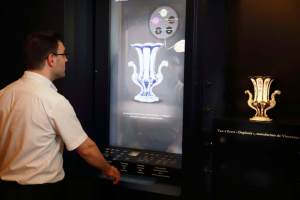 On April 21, 1757, Louis XV held a supper for his guests at the Château de Choisy. The dishes were presented “French style,” which meant that the food was served in successive courses, and guests could help themselves to soups and hors-d’oeuvre, medium and large entrées, roast meats and salads, hot and cold entremets, and desserts. Each course required a specific range of plates and hollow ware. This multimedia display invites museum visitors to the King’s table. They approach the touch-table, select their language, and experience the atmosphere of a royal supper served on Sèvres porcelain.
The porcelain technique was first mastered in France in the mid-18th century, at the Vincennes-Sèvres Manufactory. Technique, form and design constantly evolved as craftsmen emulated FarEastern then European models, and this is reflected in the pieces on display—a vase and tableware in “soft-paste” porcelain (so-called because of the fragility of the enamel). The quality of the colors and elegance of the decoration testify to the skill of the Manufacture’s craftsmen, while the various forms and functions evoke the sophistication of the French art of living in the 18th century. (more…)
Reviewed: ‘Thomas Gainsborough and the Modern Woman’
Benedict Leca, Aileen Ribeiro, and Amber Ludwig, Thomas Gainsborough and the Modern Woman, ed. Benedict Leca (London: Giles Limited, 2010) 196 pages, ISBN: 9781904832850, $49.95.
Reviewed for Enfilade by Susan M. Wager
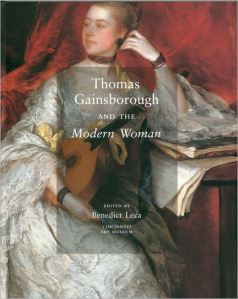 After a visit to Thomas Gainsborough’s studio in October 1760, the socially and culturally accomplished Mary Delany wrote, “There I saw Miss Ford’s picture—a whole length with her guitar, a most extraordinary figure, handsome and bold; but I should be sorry to have any one I loved set forth in such a manner.” The picture in question, Gainsborough’s Ann Ford of 1760, and the ambivalent reactions (like Mrs. Delany’s) it has engendered, is the central focus of Thomas Gainsborough and the Modern Woman. This lavishly illustrated catalogue, published to accompany an exhibition of the same name that originated at the Cincinnati Art Museum in 2010 before traveling to the San Diego Museum of Art earlier this year, was edited by Benedict Leca, Curator of European Painting, Sculpture, and Drawings at the Cincinnati Art Museum.
The portrait of Ann Ford—an eighteenth-century woman who garnered an ambiguous reputation by daring to organize public performances of her talent at the viola da gamba (unusual for a woman at the time)—was acquired by the Cincinnati Art Museum in 1927 and remains a highlight of the Museum’s collection. Leca has cleverly constructed an exhibition around the portrait, enriching our understanding of it through the juxtaposition of several well-selected loans. These include some of Gainsborough’s portraits of other “demireps”—women whose “social and sexual assertiveness combined with their flair for personal style and public exposure ran counter to propriety,” as defined by Leca. The catalogue’s three essays—by Leca, Aileen Ribeiro, and Amber Ludwig—all seem to be underpinned, implicitly, by the question: to what extent were these “demireps” in control of the constructed identities mediated through their painted portraits?
Leca’s approach to this question is decidedly optimistic. Drawing on compelling evidence such as Ann Ford’s published writings on the merits of the female sex, Leca argues that Gainsborough and Ford, in addition to some of his other female sitters, were equal partners in the production of images that challenged circumscribed gender codes and asserted female liberation from masculine control. Leca reads the correlation of Gainsborough’s signature loose brushwork—deemed “feminine” by his contemporaries—with painted passages of conventionally feminine accessories adorning sexually assertive women as the artist’s ironic and progressive rejection of masculinist norms. As Leca writes, Gainsborough’s portraits present “provocative women provocatively painted.”
Ribeiro’s essay considers how the costumes worn by Gainsborough’s demireps participated in the negotiation of reputation, class, and status. Ribeiro subtly complicates Leca’s reading of Ann Ford by evoking scholars who have suggested that paintings of accomplished women like Ford could be seen as relatively traditional presentations of ideal and precious objects of beauty, served up for the viewer’s delectation. Although Ribeiro ultimately disagrees with these readings, her essay nonetheless gestures toward the plurality of interpretations that can be gleaned from images of demireps.
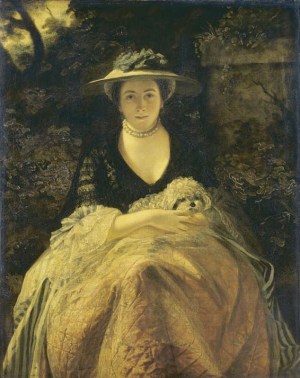
Joshua Reynolds, "Portrait of Nelly O'Brien," ca. 1762-64 (London: Wallace Collection)
Leca and Ribeiro mobilize two different portraits by Joshua Reynolds of the courtesan Nelly O’Brien to make divergent points about Ann Ford. Leca emphasizes the “subversive femininity” and “suggestiveness” of Ford’s pose by contrasting it to Reynolds’s 1762-4 portrait of O’Brien (The Wallace Collection). Whereas Reynolds dissembles the unsavory profession of O’Brien through the imposition of a pyramidal, closed, Marian pose onto her body, Gainsborough flaunts the immodesty and impropriety of Ford’s dynamic, crossed-leg attitude. Ribeiro, however, juxtaposes Ann Ford with a 1763-7 Reynolds portrait of O’Brien (The Hunterian Museum & Art Gallery, University of Glasgow) in order to underscore the formality of Ford’s dress in contrast to O’Brien’s “loose bed-gown.” The latter is far more scandalous than Ford’s costume, which would have been chosen precisely to shore up Ford’s ambiguous reputation. Conflicting readings like these do not detract from the overall thrust of the book; instead, they strengthen it, attesting to the complexity of the images under examination.

Joshua Reynolds, "Portrait of Nelly O'Brien," ca. 1763-67 (Glasgow: Hunterian Museum)
Indeed, complexity characterizes the images addressed by Amber Ludwig in her essay on how portraiture could attach the appearance of virtue to women with dubious reputations. Addressing pictures of Emma Hamilton, she underscores, for instance, tensions between the desires and personality of the sitter and the desires for propriety imposed by her husband or lover.
Thomas Gainsborough and the Modern Woman would be a welcome addition to the libraries of scholars and general readers alike. The catalogue’s clear prose is supplemented by sumptuous, full-color plates and extraordinarily high-resolution details, offering a worthy substitute for individuals who did not see the exhibition, or a handsome aide-mémoire for those who did.
◊ ◊ ◊ ◊ ◊
Susan M. Wager is a Ph.D. candidate in Art History & Archaeology at Columbia University. Her research examines eighteenth-century reproductions after François Boucher in the mediums of gems, porcelain, and tapestries at the intersection of consumer culture, natural history, antiquarianism and connoisseurship, and global exchange.
The Prado Publishes New Acquisitions Catalogue *Only* Online — It’s Free
Is this the future or just an experiment along the way? From the Prado’s website:
José Manuel Matilla, ed., No solo Goya: Adquisiciones para el Gabinete de Dibujos y Estampas del Museo del Prado 1997-2010, exhibition catalogue (Madrid: Prado, 2011), 383 pages, ISBN: 9788484802204.
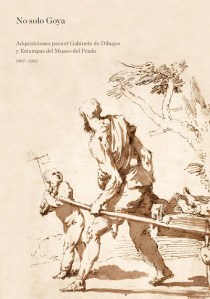 For the first time in the Museum’s history the catalogue has only been published in on-line format. An innovative new format has been designed that combines the benefits of the traditional printed book with the new possibilities offered by digital formats, such as links, attached archives, image enlargement, bibliographies and automatic searches.
The catalogue offers detailed descriptions and reproductions of the 111 works in the exhibition. The texts are written by curators at the Museum and by outside experts with whom the Museum is working on various projects that are currently in progress.
Exhibition: James Cook et al
From the museum:
Cook, Melville, and Gauguin: Three Voyages to Paradise
Maritime Museum of San Diego, 27 May 2011 — 1 January 2012
 Imagine what treasures one would have seen exploring the Pacific islands in centuries past? The Three Voyages to Paradise exhibit is inspired by those very visions as seen through the eyes of Captain James Cook, author Herman Melville, and painter Paul Gauguin.
Highlighting this extraordinary exhibit are original paintings created by the official expedition artists (William Hodges and John Webber), on James Cook’s second and third Voyages of Discovery. Scientific and navigation instruments from Cook’s time as well as personal effects and Cook memorabilia will also be displayed along with Charts and Pacific artifacts from the period. Paintings, engravings and whaling artifacts representative of Herman Melville’s episodic adventure in the South Seas will be interpreted using select examples of his writings.
Central to the exhibition will be a comprehensive collection of original oil and watercolor paintings, woodblock prints, engravings and sculpture by Paul Gauguin. This exhibit will comprise the largest display of three-dimensional Gauguin masterpieces currently seen anywhere in the world, including a newly discovered Gauguin wood carving on display for the first time in America.
This Week’s Romantic Objects Seminar in London: Blake and Varley
Philippa Simpson and Sibylle Erle, Varley’s Visionary Heads and Blake’s The Ghost of a Flea
Institute of English Studies, University of London, 15 June 2011

William Blake, "The Ghost of a Flea," ca. 1819-20, tempera heightened with gold on mahogany support (London: Tate Britain)
Romantic Objects is a seminar series that runs over two terms (Spring and Summer) on Wednesdays 5:30-7:30, as part of the inter-university seminar in Romantic Studies at Senate House, co-organized by Birkbeck and the Open University at the Institute of English Studies. This series of seminars will rethink Romantic period material culture in the tension between Romantic attempts to recenter aesthetic experience as subjective just as a new culture of exhibitions, viewing, and collecting practices defines the centrality of objects. The aim is to provide a forum for graduate students, scholars, and curators working in the period 1750-1850 or on questions relating to objects, exhibitions, material culture.
This week’s seminar features Dr Philippa Simpson (Tate Britain) and Dr Sibylle Erle (Bishop Grosseteste College, Lincoln) on John Varley’s Visionary Heads and William Blake’s The Ghost of a Flea. Erle and Simpson curated the current display of Blake and Physiognomy at Tate Britain. Erle is the author of Blake, Lavater and Physiognomy (2010). Simpson, an expert in late eighteenth-century exhibition culture and the
reception of the old masters, co-curated the exhibition Turner and the
Masters. The seminar takes place Wednesday, 15 June, 17:30-19:30, in
STB8 Stewart House, basement, 32 Russell Square. All are welcome!
Reading:
Alexander Gilchrist, Life of Blake (1863), pp. 249-57, (via Googlebooks)
◊ ◊ ◊ ◊ ◊
Sibylle Erle, Blake, Lavater, and Physiognomy (Oxford: Legenda, 2010), 244 pages, ISBN: 9781906540692, $89.

ISBN: 9781906540692
William Blake never travelled to the continent, and yet his creation myth is far more European than has so far been acknowledged. His early illuminated books, of the 1790s, run alongside his professional work as a copy-engraver on Henry Hunter’s translation of Johann Caspar Lavater’s Essays on Physiognomy (1789-98) — work in which Blake helped to make a likeness of a book about likenesses. For Blake, as for Lavater, Henry Fuseli, Joshua Reynolds, and others of his age, the art of the portrait was to find the right balance between likeness and type. Blake, Lavater, and Physiognomy demonstrates how the problems occurring during the production of the Hunter translation resonate in Blake’s treatment of the Genesis story. Blake takes us back to the creation of the human body, and interrogates the idea that ‘God created man after his own likeness’. He introduces the ‘Net of Religion’, a device which presses the human form into material shape, giving it personality and identity. As Erle shows, Blake’s startlingly original take on the creation myth is informed by Lavater’s pursuit of physiognomy: the search for divine likeness, traced in the faces of their contemporary men.
◊ ◊ ◊ ◊ ◊
Blake and Physiognomy
Tate Britain, London, 8 November 2010 — 17 April 2011
Curated by Philippa Simpson and Sibylle Erle
[There is] not a man who does not judge of all things…by their physiognomy;
that is, of their internal worth by their external appearance.
–Johann Caspar Lavater
Johann Caspar Lavater’s Essays on Physiognomy, translated into English in 1789, catalysed a vogue for the theory that people’s characters could be read in their features. Although this would seem to serve as a model of detached observation and scientific classification, Lavater saw these judgements as stemming from an instinctive understanding of expression and appearance. At the heart of his work was a strongly-held Christian belief, according to which all forms were divinely created, and derived from the one perfect God. Lavater’s ideas were also informed by eighteenth-century codes of racial stereotyping that are deeply troubling to the modern reader.
Many British artists, including William Blake, experimented with physiognomic systems in their work. Blake’s involvement, though, was closer than most. He not only engraved illustrations for the 1789 translation of Lavater’s book but, over thirty years later collaborated with his friend, artist and astrologer John Varley, on a publication entitled Zodiacal Physiognomy. This book sought to attribute character according to time of birth, and Varley used prints after Blake’s works to illustrate different star signs. These enterprises suggest that Blake’s visual language, which often seems highly innovative – even idiosyncratic – may be read in the context of broader pseudo-scientific and artistic trends.
Exhibition: ‘The First Actresses’ in London
Press release rom the NPG:
The First Actresses: Nell Gwyn to Sarah Siddons
National Portrait Gallery, London, 20 October 2011 — 8 January 2012
Curated by Gill Perry, supported by Lucy Peltz

John Hoppner, "Mrs. Robinson as 'Perdita'," 1782 © Chawton House Library, Hampshire
The first exhibition to explore art and theatre in eighteenth-century England through portraits of women will open at the National Portrait Gallery in October 2011. With 53 portraits, some brought together for the first time and others not previously seen in public, the exhibition will show the remarkable popularity of actress-portraits and provide a vivid spectacle of eighteenth-century femininity, fashion and theatricality. The First Actresses: Nell Gwyn to Sarah Siddons will show large paintings of actresses in their celebrated stage roles, intimate and sensual off-stage portraits and mass-produced caricatures and prints, and explore how they contributed to the growing reputation and professional status of leading female performers.
The exhibition will combine much-loved works by artists such as Joshua Reynolds, Thomas Gainsborough, John Hoppner, Thomas Lawrence, Johann Zoffany and James Gillray, with some newly discovered works such as the National Portrait Gallery’s new acquisition of the Three Witches from Macbeth by Daniel Gardner.
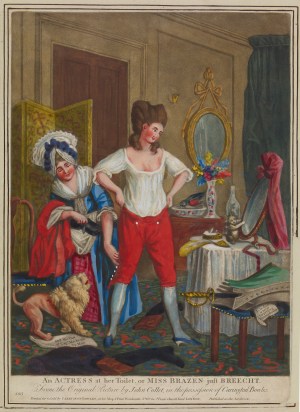
After John Collett, "An Actress at Her Toilet or Miss Brazen just Breecht," ca. 1779
Actresses featured in the exhibition include Nell Gwyn, Kitty Clive, Hester Booth, Lavinia Fenton, Peg Woffington, Sarah Siddons, Mary Robinson, Dorothy Jordan, Elizabeth Farren, Giovanna Baccelli and Elizabeth Linley. Highlights include a little known version of Reynolds’s famous portrait of Sarah Siddons as the Tragic Muse, Hogarth’s The Beggar’s Opera, Gainsborough’s portraits of Giovanna Bacelli and Elizabeth Linley. Important loans include works from the Garrick Club Library, the Royal Shakespeare Company, the National Gallery of Art, Washington, The Fitzwilliam Museum, Cambridge, Tate Britain, the V&A, as well as Petworth, Kenwood and Longleat Houses.
Starting with the emergence of the actress’s profession in the late seventeenth century, The First Actresses: Nell Gwyn to Sarah Siddons will show how women performers, in drama, as well as music and dance, were key figures within a spectacular celebrity culture. Fuelled by gossipy theatre and art reviews, satirical prints and the growing taste for biography, eighteenth-century society engaged in heated debate about the moral and sexual decorum of women on stage and revelled in the traditional association between actress and prostitute, or ‘whores and divines’. The exhibition will also reveal the many ways in which women performers stimulated artistic innovation and creativity and provoked intellectual debate.
As well as focusing on the eighteenth-century actress as a glamorous subject of high art portraits, and the ‘feminine face’ of eighteenth century celebrity culture, the exhibition will look at the resonances with modern celebrity culture and the enduring notion of the actress as fashion icon. As a counterpoint to the exhibition, an accompanying display will show photographic and painted portraits, drawn from the Gallery’s permanent collections, of some of today’s actresses, some of whom have agreed to be the exhibition’s ‘Actress Ambassadors’. A full list will be published prior to opening.
◊ ◊ ◊ ◊ ◊
An exhibition conference will take place on Friday, 11 November 2011.
Exhibition catalogue: Gill Perry with Joseph Roach and Shearer West, The First Actresses: Nell Gwyn to Sarah Siddons (London: National Portrait Gallery, 2011), 160 pages, ISBN: 9781855144118, £30.










 Enfilade
leave a comment