Exhibition: ‘Italian Master Drawings’ in Washington
Press release from the National Gallery in DC:
Italian Master Drawings from the Wolfgang Ratjen Collection, 1525–1835
National Gallery of Art, Washington D.C., 8 May — 27 November 2011
Curated by Margaret Morgan Grasselli

Canaletto, "The Giovedì Grasso Festival before the Ducal Palace in Venice," 1763/1766 (Washington DC: National Gallery, Ratjen Collection, Paul Mellon Fund 2007.111.55)
Splendors of Italian draftsmanship from the Wolfgang Ratjen Collection, spanning the late Renaissance to the height of the neoclassical movement, will be showcased at the National Gallery of Art, Washington. On view in the Gallery’s West Building from May 8 to November 27, 2011, Italian Master Drawings from the Wolfgang Ratjen Collection, 1525–1835 will include 65 stunning Italian compositions and study sheets by the most important artists of the period, from Giulio Romano and Pellegrino Tibaldi to Canaletto, all three members of the Tiepolo family, and Giovanni Battista Piranesi.
In 2007, the National Gallery of Art acquired 185 German and Italian works from the Ratjen Collection—one of the finest private European holdings of old master drawings—with the help of 12 generous private donors as well as the Paul Mellon Fund and the Patrons’ Permanent Fund. “We are delighted to celebrate the second part of the Gallery’s acquisition of this exceptional group of German and Italian drawings formed by the great European collector Wolfgang Ratjen,” said Earl A. Powell III, director, National Gallery of Art. “The Italian portion of the collection is an assemblage of works of beauty and power. Italian drawings were in fact Ratjen’s first love, and he worked on this part of his collection with attentive care throughout his years as a collector.”

ISBN: 9781907372216, $50
Wolfgang Ratjen formed his Italian collection of drawings over a period of about 25 years. He grew up with two that had been acquired by his family during his youth—works by Guercino and Giovanni Battista Tiepolo—and he began collecting himself in the early-1970s. He purchased his last Italian drawing, by Giulio Cesare Procaccini, in July 1997. Ratjen’s collection of Italian drawings is best described as a group of single outstanding works, including famous artists as well as artists of lesser renown. For a select few—such as Jacopo Palma il Giovane, Guercino, and Giovanni Battista Tiepolo—he acquired multiple sheets that conveyed different facets of the artists’ styles or represented a variety of media used.
Organized chronologically throughout three galleries, the exhibition will present works that span three centuries, from the last flowering of the Renaissance around 1530 to the height of neoclassicism in the early 19th century. The works represent a dynamic range of techniques, including quick pen and ink sketches, finely nuanced chalk studies, and highly
finished brush drawings. (more…)
Exhibition and Conference: ‘Palladio and His Legacy’
This show which was at the Morgan last summer opens at Notre Dame with a full conference this weekend. My sense is that the exhibition functions rather differently in these two venues — one might think not only about the reception of Palladio but also the reception of the exhibition. From the Snite website:
Palladio and His Legacy: A Transatlantic Journey
The Morgan Library and Museum, New York, 2 April — 1 August 2010
National Building Museum, Washington D.C., 2 September 2011 — 30 January 2011
Snite Museum of Art, Notre Dame, 5 June — 31 July 2011
Carnegie Museum of Art, Pittsburgh, 3 September — 31 December 2011
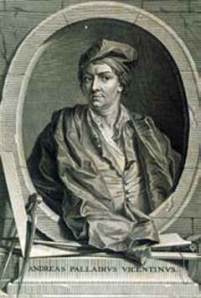
Conjectural portrait of Andrea Palladio, ca. 1715, engraved after Sebastiano Ricci (RIBA British Architectural Library)
This traveling exhibition organized by the Royal Institute of British Architects in association with the Centro Internazionale di Studi di Architettura Andrea Palladio, Vicenza, offers a rare opportunity to see thirty-one drawings by the famous 16th-century architect, Andrea Palladio, along with seven books, fifteen models of related buildings, and eight bas-reliefs of some of the drawings (3-D projections of architectural drawings).
The Late Italian Renaissance master Andrea Palladio (Italian, 1508–1580) is the most influential architect of the last 500 years. His architecture synthesized the lessons of the ancient Romans with the achievements of his predecessors and contemporaries, including Bramante, Raphael, and Michelangelo. Palladio’s mastery of the classical orders, proportion, and harmony was unparalleled. His projects in Venice and the surrounding region set new standards in design and redefined the potential of the art form, especially for domestic structures.
◊ ◊ ◊ ◊ ◊
From Vernacular to Classical: The Perpetual Modernity of Palladio
University of Notre Dame School of Architecture, 10-12 June 2011
Bringing together scholars, practitioners, educators, and students from various disciplines, the conference will explore how the Palladian tradition inspires the evolution of classical architecture. One of the most influential architects in history, 16th-century Italian Andrea Palladio’s impact is evident throughout the United States. Buildings such as the White House, the U. S. Capitol, the U.S. Supreme Court, and the National Gallery of Art bear his imprint. Thomas Jefferson’s Virginia home, Monticello, is modeled after Palladio’s famed Villa Rotonda in Vicenza, Italy. Conference participants will reconnect Palladian ideals to the living tradition that has informed these icons of American democracy and continue to shape vital paradigms for sustainable architecture and urbanism. Two exhibitions, Palladio and His Legacy: A Transatlantic Journey at the University of Notre Dame’s Snite Museum of Art and the New Palladians, an exhibition of 50 international classical architects’ work in the Bond Hall Gallery, also will be held in conjunction with the conference.
C O N F E R E N C E S C H E D U L E (more…)
Turkish Taste at the Frick Opens June 8
In conjunction with the exhibition at the Frick Collection, Turkish Taste at the Court of Marie-Antoinette (opening June 8), the museum is hosting a seminar on Monday, 27 June, 6:00-7:30 p.m. From the Frick’s website:
Carlotte Vignon and Adrienne L. Childs, Turkish Taste at the Court of Marie-Antoinette
The Frick Collection, New York, 27 June 2011
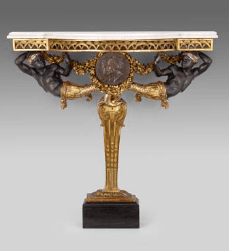
Small Console Table with Supporting Figures of Nubians (one of a pair), c.1780, gilded and painted wood and marble slab (NY: The Frick Collection), photo by Michael Bodycomb
This seminar will offer participants a detailed look at several objects from the special exhibition. Charlotte Vignon will discuss the Frick’s two French console tables, which feature Nubian slaves with pearl-accented turbans, floral garlands, and a frieze of crossed crescents, a symbol of the Ottoman Empire. She will also examine a pair of firedogs from Marie-Antoinette’s Turkish boudoir at Fontainebleau, on loan from the Musée du Louvre, and a pair of wall panels created for the Turkish cabinet of her brother-in-law, the comte d’Artois, from The Metropolitan Museum of Art. Click here to register at the regular rate of $100 per person. Members of The Frick Collection may click here to register at the discounted membership rate of $90 per person. Discounts will be applied upon verification of membership. To register over the phone, please call 212.547.0704.
Exhibition: The Düsseldorf Gallery and Its Catalogue
Press release from the Getty:
Display and Art History: The Düsseldorf Gallery and Its Catalogue
Getty Research Institute, Getty Center, Los Angeles, 31 May — 21 August 2011
Curated by Thomas Gaehtgens and Louis Marchesano
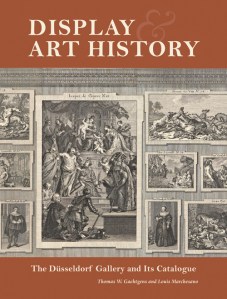
ISBN: 9781606060926, $20
Display and Art History: The Düsseldorf Gallery and Its Catalogue illustrates the making of one of the earliest modern catalogues, La galerie électorale de Dusseldorff (1778), a revolutionary two-volume publication that played a significant role in the history of museums and helped mark the transition from the Baroque to the Enlightenment.
Constructed by Elector Palatine Johann Wilhelm II von der Pfalz between 1709 and 1714, the Düsseldorf gallery is an early example of exhibiting an art collection in a nonresidential structure. It charted the course toward what would eventually become the institution of the public museum. The Düsseldorf gallery featured a new system of display in which the arrangement of objects was determined by art historical principles such as style and school, rather than subject. Published in the second half of the eighteenth century, the Düsseldorf catalogue represented this new display in numerous etchings; the accompanying text sought to educate a broader circle of readers.
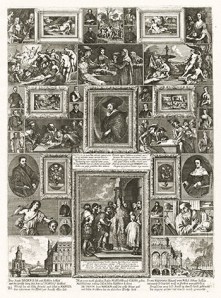
Fictive Wall of Paintings from the Imperial Collection in Vienna, Frans van Stampart and Anton Joseph von Prenner, etching. Prodromus (Vienna, 1735), pl. 21. 88-B2961
Display and Art History: The Düsseldorf Gallery and Its Catalogue, on view at the Getty Research Institute at the Getty Center from May 31 through August 21, 2011, showcases the exquisite watercolors, red chalk drawings, and architectural elevations that were used to produce this revolutionary catalogue. The exhibition explores their role in the printmaking process and underscores their value as precious works of art created by accomplished draftsmen. “We are most fortunate to have an almost complete set of preparatory drawings in our archives, which allows for the reconstruction of this ambitious enterprise and reflects a pivotal moment in the history of art as well as the history of the art museum,” says Thomas Gaehtgens, Director of the Getty Research Institute.
Prince-elector Johann Wilhelm II assembled one of the most important European art collections of the eighteenth century. He constructed a gallery to exhibit his nearly 400 paintings, 46 of which were by Peter Paul Rubens. At the time, many princes were reorganizing their substantial collections in order to convey the message that they not only possessed a wide variety of artistic treasures but were also able to care for them properly and make
them available for study.

Pierre-Louis de Surugue's etching after the "The Night" by Correggio, 1753–1757. Karl Heinrich von Heinecken, Recueil d'estampes d'apres les plus celebres tableaux de la Galerie Royale de Dresde..., vol. 2 (Dresden, 1757), pl. 1.
A generation later, Prince-elector Carl Theodor von der Pfalz, Johann Wilhelm’s nephew and successor, commissioned Lambert Krahe, director of the Düsseldorf Academy and gallery, to rehang the paintings collection following its storage during the Seven Years’ War (1756-63). Krahe broke with the Baroque tradition of decoratively covering entire walls with paintings. Instead, he displayed the paintings in a didactic, symmetrical arrangement ordered by schools, thus introducing a completely new and modern system of organizing art. Rather than hanging paintings frame-to-frame, Krahe integrated space between them, preserving their identity as separate works of art. This new display encouraged viewers to draw comparisons.
The Düsseldorf catalogue similarly fostered learning and education, in addition to celebrating the prestige of the collector. Produced by court architect Nicolas de Pigage, printmaker Christian von Mechel, and linguist Jean-Charles Laveaux, the catalogue illustrates Krahe’s display of paintings on the gallery walls. Unlike earlier catalogues that only provided brief inventories, Pigage’s publication offers an analysis of each painting that was aimed at an educated public. “In this sense, the catalog was very much a work of the Enlightenment, and the princely gallery, accessible to interested visitors,
became more like a museum as we understand it today,” says Gaehtgens.
Louis Marchesano, the GRI’s Curator of Prints and Drawings, adds, “The catalogue no longer simply represented princely magnificence; it now also fostered aesthetic reflection and art historical education.”
◊ ◊ ◊ ◊ ◊
Exhibition catalogue: Thomas W. Gaehtgens and Louis Marchesano, Display and Art History: The Düsseldorf Gallery and Its Catalogue (Los Angeles: Getty Publications, 2011), 104 pages, ISBN: 9781606060926, $20.
Johan Zoffany, More to Come — Exhibition, Catalogue, and Conference
From The Yale Center for British Art:
Johan Zoffany RA: Society Observed
Yale Center for British Art, New Haven, 27 October 2011 — 12 February 2012
The Royal Academy of Arts, London, 10 March — 10 June 2012
Curated by Martin Postle with Gillian Forrester and MaryAnne Stevens

Johan Zoffany, “The Drummond Family” (detail), ca. 1769 (New Haven: Yale Center for British Art)
Of all the major artists working in eighteenth-century England, none explored more inventively the complexities of Georgian society and British imperial rule than Johan Zoffany (1733–1810). Born near Frankfurt, Zoffany trained as an artist in Germany and Italy. In 1760 he moved to London, where he adapted brilliantly to the indigenous art culture and patterns of patronage, creating virtuoso portraits and subject pictures that proved to be highly desirable to a wide range of patrons. Zoffany’s work provides an invaluable and distinctive appraisal of key British institutions and edifices: the art academy, the Court, the theatre, the families of the aristocracy and bourgeoisie, and the burgeoning empire. Despite achieving considerable success in England, Zoffany remained in many ways an outsider, scrutinizing British society and its customs and mores. Restless and drawn to a peripatetic existence, he traveled for extended periods in his native Germany, Austria, Italy, and India. After his death there was no move to situate Zoffany as one of the key figures in the burgeoning British school of art; this exhibition aims to correct that oversight and will demonstrate his central importance to the artistic culture of eighteenth-century Britain and Europe. (more…)
New Website for Yale Center for British Art
The new website for the Yale Center for British Art sets high the standard for digital art historical resources. The site features an online catalogue of the Center’s holdings, allowing seamless searching across the art collections and related library materials, AND publication-quality images of all art objects in the public domain are available for free downloading. As outlined in the press release below, more content will be added in the coming months. And what better way to draw attention to the new site, than an exhibition? -CH
Connections
Yale Center for British Art, New Haven, 20 May — 11 September 2011
Curated by Matthew Hargraves and and Imogen Hart
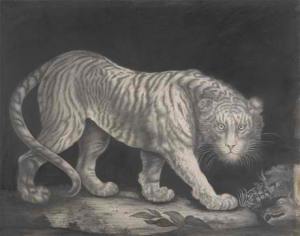
Elizabeth Pringle, "A Prowling Tiger," graphite, brushed black ink and white gouache, ca. 1800 (Yale Center for British Art)
To mark the launch of the YCBA’s online catalogue, Connections, a companion exhibition, replicates the experience of searching across the Center’s extraordinary collections. With more than two hundred paintings, sculptures, prints, drawings, rare books, and manuscripts from the early seventeenth to the early twentieth century, Connections presents familiar works as well as some surprises. Alongside popular collection highlights such as Rubens’s bravura oil sketch Peace Embracing Plenty will be rarely exhibited works, including outstanding prints and drawings by Thomas Gainsborough. The exhibition reveals the depth and breadth of material in the Center’s physical collections, which will now be accessible in a single searchable catalogue. Among the themes explored in the exhibition are: British Art in the 1630s; Hogarth and History; Sporting Art; the Academy and the Human Body; Egypt; British Modernism in the 1930s; Paul Sandby; George Stubbs; Thomas Gainsborough; and Samuel Palmer. The section devoted to George Stubbs (1724–1806) is representative of the exhibition in its span of different genres, as it showcases Stubbs’s extraordinary artistic range and some of the Center’s great treasures: paintings on canvas, copper, and earthenware; Wedgwood plaques and enamels; a selection of his technically innovative prints and drawings; anatomical studies; and books and manuscripts of midwifery and anatomy.
◊ ◊ ◊ ◊ ◊
Yale Center Offers Unprecedented Access to Largest Collection of British Art Outside the UK through New Online Catalogue

William Gilpin, leaves 33v–34r (with color chart laid in) from "Hints to form the taste & regulate ye judgment in sketching Landscape," manuscript, in pen and ink, with watercolor, ca. 1790 (Yale Center for British Art, Paul Mellon Collection)
Beginning May 20, the Yale Center for British Art, which houses the largest and most comprehensive collection of British art outside of the United Kingdom, will share its extraordinary holdings with the world through a new online catalogue. For the first time, visitors to the museum’s redesigned and expanded website—britishart.yale.edu—will have the ability to search across the Center’s entire collection of paintings, sculpture, prints, drawings, rare books, manuscripts, and works in the Reference Library. In addition, they will be able to download high-resolution images of objects in the public domain, free of charge. This new policy should transform scholarship in the field of British art by allowing universal access to the Center’s unparalleled collection. The launch of the Center’s online catalogue dovetails with Yale University’s recently announced “Open Access” policy, which will make high-quality digital images of Yale’s vast cultural heritage collections in the public domain openly and freely available. (more…)
Exhibition: The Captain Kidd Story
Pirates: The Captain Kidd Story
Museum of London Docklands, 20 May — 30 October 2011
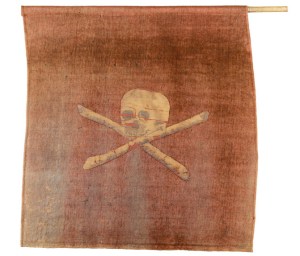 Focusing on the legendary privateer turned pirate, Captain Kidd, this exhibition reveals the surprising truth of how London’s corrupt political activities were entrenched in piracy. The launch date also coincides with the anniversary of Captain Kidd’s execution on 23 May 1701 in Wapping. From cannons and hidden treasure maps to female pirates and gibbet cages, the exhibition will explore the myths and mysteries surrounding common perceptions of pirates. 17th- and 18th-century English society will also be explored, looking at gruesome ritual executions and the greed and manipulation of the infamous East India Company. Over 170 objects will be displayed, including:
• Kidd’s last letter with the promise of hidden treasure
• A real pirate flag, the Admiralty Marshall’s Silver Oar and a gibbet cage
• A Vivienne Westwood outfit from her seminal 1981 ‘Pirates’ collection
• An original 1724 edition of Captain Johnson’s History of the Pyrates
• An early 18th-century cannon
• Images of the Quedah Merchant ship wreck, the vessel that was captured by Scottish privateer, William “Captain” Kidd on January 30, 1698. On May 23, Indiana University will place a dedication plaque on the actual shipwreck.
◊ ◊ ◊ ◊ ◊
From an IU press release (13 December 2007) . . .
Indiana University discovers 1699 Captain Kidd Shipwreck
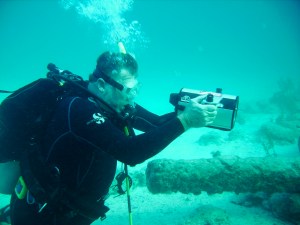
IU marine protection authority Charles Beeker examines possible wreckage from Capt. Kidd's Quedagh Merchant. Photo courtesy of Indiana University
Resting in less than 10 feet of Caribbean seawater, the wreckage of Quedagh Merchant, the ship abandoned by the scandalous 17th-century pirate Captain William Kidd as he raced to New York in an ill-fated attempt to clear his name, has escaped discovery — until now. An underwater archaeology team from Indiana University announced on 13 December 2007 the discovery of the remnants. IU marine protection authority Charles Beeker said his team has been licensed to study the wreckage and to convert the site into an underwater preserve, where it will be accessible to the public.
Beeker, director of Academic Diving and Underwater Science Programs in IU Bloomington’s School of Health, Physical Education and Recreation, said it is remarkable that the wreck has remained undiscovered all these years given its location, just 70 feet off the coast of Catalina Island in the Dominican Republic, and because it has been sought actively by treasure hunters. “I’ve been on literally thousands of shipwrecks in my career,” Beeker said. “This is one of the first sites I’ve been on where I haven’t seen any looting. We’ve got a shipwreck in crystal clear, pristine water that’s amazingly untouched. We want to keep it that way, so we made the announcement now to ensure the site’s protection from looters.” (more…)
Exhibition: Works from the V&A in Seoul
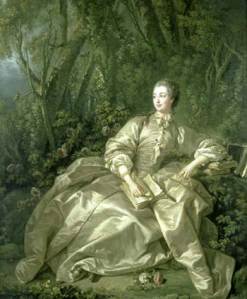
François Boucher, "Marquise de Pompadour," 1758 ©Victoria and Albert Museum / V&A Images
From the museum’s website:
Princely Treasures: European Masterpieces 1600-1800
National Museum of Korea, Seoul, 3 May — 28 August 2011
The exhibition Princely Treasures: European Masterpieces 1600-1800 from the Victoria and Albert Museum, presents 160 selected masterpieces from the collection of the V&A in London. The highlights of the collection include the Marquise de Pompadour by François Boucher and other works of art reflecting life in European courts between the 17th and 18th centuries.
Exhibition and Symposium: Early American Maps and Prints
From The Colonial Williamsburg Foundation:
More than Meets the Eye: Maps and Prints of Early America
DeWitt Wallace Decorative Arts Museum, Williamsburg, VA, 26 March 2011 — April 2012
 The exhibition features 35 maps, portraits, and other graphic images that invite the viewer to look more deeply into the subtle messages delivered by artisans depicting America. Maps, in particular, were regarded as scientific and authoritative documents, imparting a perception of power and control over the environment. As such, they also became important tools for swaying public opinion. The factors that motivated the production of individual maps often become apparent through close scrutiny of their decorative features and the information their creators chose to include–or omit.
In addition to objects from the Colonial Williamsburg collections, the exhibition includes an outstanding documentary source for the 1920s restoration of the historic town—the “Frenchman’s” map, loaned by the College of William and Mary. The Connecticut Historical Society has also kindly agreed to loan their copy of Abel Buell’s A NEW and correct Map of the
UNITED STATES of AMERICA, the first map of the thirteen states to be
published after the Congress of the Confederation ratified the treaty on
January 14, 1784.
◊ ◊ ◊ ◊ ◊
Symposium: More than Meets the Eye: Maps and Prints of Early America
DeWitt Wallace Decorative Arts Museum, Williamsburg, VA, 16-18 October 2011
In conjunction with the exhibition, Colonial Williamsburg will sponsor a symposium from October 16-18, 2011 that will feature lectures focusing on the men who created these objects, how they assembled and disseminated their information, and the factors that motivated them to create powerful and influential images. Speakers will include Philip Burden, Paul Cohen, Louis De Vorsey, Matthew Edney, William Gartner, and Henry Taliaferro. The conference begins with an opening reception Sunday evening followed by two days of lectures, Monday and Tuesday. A complete conference agenda will be posted as soon as it is available.
Raysor Print Collection Acquired by Richmond’s VMFA
This lovely show that just closed at the VMFA provided a tantalizing glimpse of a major new print collection recently donated to the museum. With a $150 million construction project completed last spring (a glowing review from Architectural Record is available here), the VMFA is now in the process of developing a first-rate study room for works on paper. Within the next year or so, the entirety of the Raysor Collection of 10,000 works should be relocated to its new home and the print room finished. Stay tuned. For anyone remotely near the museum, know that there is an outstanding new collection of prints in your area. Incidentally, I feel quite fortunate to have attended the big celebration gala at the beginning of last month(!), and I’m thrilled at the promise of the Raysor Collection. -CH
Art A Celebration of Print: 500 Years of Graphic Art
Virginia Museum of Fine Arts, Richmond, 29 January — 22 May 2011
Curated by Mitchell Merling
This exhibition celebrates the extraordinary gift of approximately 10,000 prints from the collection of collector, connoisseur, and scholar Frank Raysor, who grew up in Richmond. Over the past 35 years Raysor has amassed a collection which covers the history of printmaking, as seen in this exhibition, and which also contains special deep holdings in artists such as Charles Meryon, Félix Bracquemond, Seymour Haden and Wenceslaus Hollar. The collection will increase by one third the total number of objects in VMFA’s collection.
◊ ◊ ◊ ◊ ◊
Press release from the museum:
The Virginia Museum of Fine Art’s Collectors’ Circle named Richmond-raised Frank Raysor ‘Collector of the Year’ at a gala on Saturday, 2 April 2011. During the evening’s celebration, VMFA Director Alex Nyerges announced Raysor’s plans to bequeath more than $3 million to the museum. Raysor already has promised VMFA a gift of 10,000 prints that he has amassed throughout the past 35 years. In recognition of this unprecedented gift, the museum’s previous library is being named the “Frank Raysor Center for the Study of Works on Paper.” The center will house more than 15,000 works on paper and will provide the space and resources needed for the study of the history of western print-making, among other subjects. The study center will open after a complete renovation and refurbishment of the existing space. The gifted prints cover the history of print-making, spanning the 15th century to present day, and are by both European and American artists. The works will increase the museum’s total number of objects by one-third.
“The Virginia Museum of Fine Arts’ relationship with Frank Raysor dates back to his childhood visits,” Nyerges said. “In the past we have benefitted from a number of antiquities, which he donated in the early 1990’s. His rich and fascinating collection of prints is a gift for all Virginians.”
As Collector of the Year, Raysor joins a group of distinguished donors and museum supporters. Past recipients include: Linda H. Kaufman, Jane Joel Knox, Mrs. Nelson L. St. Clair, Jr., Robert and Nancy Nooter, Paul Mellon, Jerome and Rita Gans, Arnold L. Lehman and Nelson A. Rockefeller.
Raysor grew up in Richmond, attending Thomas Jefferson High School, before going on to Duke University and Harvard Business School. He has loaned works from his collection to special exhibitions at the Albuquerque Museum, the Yale Center for British Art and the J. Paul Getty Museum. In 1982, Raysor guest-curated a small exhibition at VMFA of 18th-century prints with classical subjects drawn from his collection in conjunction with the museum’s internationally important exhibition, Vases from Magna Graecia. In addition to his collecting, Raysor has made important contributions to print scholarship, including his collaboration on the catalogue raisonné of the works of Charles Meryon.










 Enfilade
leave a comment