Reviewed: New Publications on Meissen
Recently added to caa.reviews:
Ulrich Pietsch and Claudia Banz, eds., Triumph of the Blue Swords: Meissen Porcelain for Aristocracy and Bourgeoisie, 1710–1815 (Leipzig: E. A. Seemann, 2010), 400 pages, ISBN: 9783865022486, €49.90.
Ulrich Pietsch and Theresa Witting, eds., Fascination of Fragility: Masterpieces of European Porcelain (Leipzig: E. A. Seemann, 2010), 368 pages, ISBN: 9783865022479, €49.90.
Reviewed by Donna Corbin, Associate Curator, European Decorative Arts, Philadelphia Museum of Art; posted 22 April 2011.
‘Triumph of the Blue Swords, Meissen Porcelain for Aristocracy and Bourgeoisie, 1710–1815’ (the English-language version of ‘Triumph der blauen Schwerter. Meissener Porzellan für Adel und Bürgertum 1710–1815‘) and the accompanying exhibition at the Japanese Palace in Dresden (May 8–August 29, 2010) celebrate the three hundredth anniversary of the founding of the Meissen porcelain manufactory. The exhibition was conceived as one of three complementary exhibitions—the other two being ‘The Fascination of Fragility‘ (Ephraim-Palais, Berlin, May 9–August 29, 2010; catalogue reviewed below) and ‘All Nations are Welcome. Three Hundred Years of the Meissen Manufactory’ (Meissen, January 23–December 31, 2010)—organized for the anniversary year. The exhibitions were intended to commemorate the anniversary, to highlight the indisputably influential role Meissen played in the development of porcelain production across Europe in the eighteenth century, and to bring attention to the Staatliche Porzellan-Manufaktur Meissen that still exists today. . .
The full review is available here» (CAA membership required)
Reviewed: Portrait of the County of Dorset
Notice of the exhibition appeared here back in February. Alex Kidson’s recent review is, however, much more illuminating — and laudatory — than the general description.
Alex Kidson, “Review of Georgian Faces: Portrait of a County,” The Burlington Magazine 153 (April 2011): 274-75.
Anyone expecting . . . the kind of celebratory ‘treasures from local houses’ show that was a staple of regional museums until the later part of the last century is in for a surprise. The sixty-seven portraits that make up this exhibition are for the most part not masterpieces; but they have been selected with immense rigour. . . Gwen Yarker, the curator, for whom the show is a triumph, has lived in Dorset for many years, and her understanding of the history of the county is apparent at every turn. She has explicitly based her selection on the structure of the Revd John Hutchin’s ‘History and Antiquities of the County of Dorset’ of 1774, with its emphasis on social hierarchy, and has given full weight to eighteenth-century modes of patronage. She fearlessly prefers, for example, to include replicas over originals to remind us that our present-day obsession with ‘originality’ is not one that was shared in the eighteenth century. . . .
Yet in Yarker’s text [for the catalogue], as well as with her selection, art-historical revisionism is far from suppressed. . . . In fact, the show is full of art-historical trouvailles. . . . It seems almost an understatement to say that the exhibition is at the forefront of the current study of eighteenth-century British portraiture. More than that, in its concern for local detail, its accuracy, but also its willingness to confront problems and to speculate, it points the way forward for future research. In revealing just how powerfully the old county structure acts as a focus of inquiry, it occupies some of the same research terrain as the catalogues of the Public Catalogue Foundation, or some of the initiatives of the National Portrait Gallery’s Subject Specialist Network project Understanding British Portraits (which supported the exhibition’s study day); yet its impact is far more direct and forceful than theirs. . . What takes this exhibition out of the realms of the remarkable and into those of the miraculous is that it was accomplished on a budget of £1000. . . .
This Month’s ‘Burlington Magazine’
This month’s issue of The Burlington Magazine is devoted to British Art with the following eighteenth-century offerings:
 The Burlington Magazine 153 (April 2011)
- Richard Hewlings, “Nicholas Hawksmoor in Chester,” pp. 224-28.
- Hugh Belsey, “Reading the Caricature Groups of Thomas Patch,” pp. 229-31.
- Malcolm Warner, Review of British Paintings in the Metropolitan Museum of Art, 1575-1875, Katharine Baetjer, p. 257.
- Brian Allen, Review of James Barry, 1741-1806: History Painter, ed. Tom Dunne and William Pressly, pp. 258-59.
- Timothy Wilcox, Review of Constable, Jonathan Clarkson, pp. 259-60.
- Giles Waterfield, Review of The English Virtuoso: Art, Medicine, and Antiquarianism in the Age of Empiricism, Craig Hanson, pp. 266-67.
- Alex Kidson, Review of the exhibition Georgian Faces: Portrait of a County, pp. 274-75.
‘Paris: Life & Luxury’ Opens at the Getty
The Getty exhibition on life in an eighteenth-century Parisian townhouse opens next week. The image list is available here. Programming includes the following, as noted in the Press Kit:
Paris: Life & Luxury
J. Paul Getty Museum, Los Angeles, 26 April — 7 August 2011
Museum of Fine Arts, Houston, 18 September — 10 December 2011
Curated by Charissa Bremer-David with Peter Björn Kerber
 Evoking the elegant, prosperous world of Rococo Paris, this major, international loan exhibition brings to life activities that took place inside a Parisian town house over the course of a typical day—from dressing and letter writing to dining, music, and other evening entertainments. Paris: Life and Luxury unites prime examples of the extraordinary creative virtuosity of the period’s great artists and craftsmen, including furniture, fashion, silver, paintings, sculpture, musical instruments, clocks, and books. Rarely shown together, these objects literally and figuratively open up, allowing their functions and the parts they played in the fine art of eighteenth-century Parisian living to be understood by contemporary visitors.
L E C T U R E S
Blogging, Now and Then (250 Years Ago)
Thursday, April 28, 7:00 pm
Long before the Internet, Europeans exchanged information in ways that anticipated blogging. The key element of their information system was the anecdote, a term that meant nearly the opposite then from what it means today. Robert Darnton (Carl H. Pforzheimer University Professor and Director of the Harvard University Library at Harvard University) explains how anecdotes became a staple in the daily diet of news consumed by readers in 18th-century France and England.
Street Songs and Sedition in 18th-Century Paris: A Cabaret-Lecture
Saturday, April 30, 7:30 pm
In 18th-century Paris, most information traveled through oral systems of communication, and the most powerful means of transmission was song. Parisians composed new verses to old tunes nearly every day. The songs provided a running commentary on current events. In this presentation, Parisian cabaret artist Hélène Delavault sings historical songs and, with Robert Darnton (Carl H. Pforzheimer University Professor and Director of the Harvard University Library, Harvard University), explains their complex meanings.
Representing Interiors in French 18th-Century Portraits
Sunday, May 22, 3:00 pm
Xavier Salmon, Director of Patrimony and the Collections at the Château of Fontainebleau, explores the development and significance of domestic portraiture in 18th-century France. During this period, painters were careful to provide indications of the profession or social standing of their sitters, and the genre developed to showcase the subjects in domestic settings.
C O U R S E S
Life and Luxury in 18th-Century Paris
Saturday, July 16, 10:30 am—3:30 pm
Join this focused course exploring the domestic activities of the 18th-century French elite. Educators Noelle Valentino and Christine Spier, together with one of the exhibition’s curators, examine how decorative arts relate to the daily rituals of the period. Course fee: $35; $25 students.
Culinary Workshop: Taste of Paris
Thursday, June 16, 10:30 am – 2:00 pm; repeats June 17
Travel to an 18th century Parisian town house in the exhibition Paris: Life and Luxury and discover the prevailing culinary and artistic tastes of the prosperous world of Rococo Paris. Then prepare and enjoy a class meal inspired by period foods and recipes. Course fee $75. Open to 20 participants.
A R T I S T – A T – W O R K – D E M O N S T R A T I O N
Paris Fashion
Sunday, May 1, 15, & 29, and June 5 & 19, 1:00—3:00 pm
Join historic costume designer Maxwell Barr as he explores fashion in the prosperous world of 18th-century Paris. Barr demonstrates the extraordinary craftsmanship and virtuosity of the textiles and designs used to create period clothing. (more…)
Eighteenth-Century Easter Bunny at Winterthur
From ArtDaily:
Eighteenth-Century Drawing of an Easter Rabbit
Winterthur Museum, 21 April — 8 May 2011

Attributed to Johann Conrad Gilbert, "Easter Rabbit," second half of the eighteenth century (Winterthur Museum)
Winterthur Museum recently acquired one of the earliest known American depictions of the Easter Bunny, which was sold at Pook & Pook auction house in Downingtown, Pennsylvania. Together with the Christmas tree, the custom of the Easter rabbit and colored eggs was brought to America by immigrants from southwestern Germany in the 1700s, and has become a favorite American tradition. This delightful image is attributed to schoolmaster Johann Conrad Gilbert (1734–1812), who emigrated from Germany in 1757 and ultimately settled in Berks County, Pennsylvania. He likely made the drawing as a gift for one of his students. A similar drawing, also attributed to Gilbert, is in the collection of
Colonial Williamsburg.
These drawings are examples of a Pennsylvania German tradition of decorated manuscripts known as fraktur, which include birth and baptismal certificates, family records, writing samples, and bookplates. Lisa Minardi, a fraktur expert and assistant curator of the museum’s current exhibition, Paint, Pattern & People: Furniture of Southeastern Pennsylvania, 1725–1850, notes, “The Easter rabbit drawing is one of the rarest of all fraktur, with only two examples known, and is a major addition to Winterthur ’s collection.” “This important acquisition allows Winterthur to document the Germanic beginnings of a beloved American tradition,” adds J. Thomas Savage, Winterthur ’s director of museum affairs.
The full article at ArtDaily is available here»
Furniture Exhibition at Winterthur: ‘Paint, Pattern, and People’
Press release from Winterthur:
Paint, Pattern & People: Furniture of Southeastern Pennsylvania, 1725-1850
Winterthur, 2 April 2011 — 8 January 2012
Curated by Wendy Cooper and Lisa Minardi

ISBN: 9780912724690, $55
This landmark exhibition explores the colorful furniture of southeastern Pennsylvania along with the people who made, owned, inherited, and collected it. Featuring nearly 200 objects—including furniture, fraktur, needlework, and paintings—the show focuses on the culture and creativity of the area’s English- and German-speaking inhabitants. Paint, Pattern & People sheds new light on southeastern Pennsylvania’s highly distinctive local expressions of furniture and presents important objects for which the maker or family history is known. This well-documented furniture provides a new context to understand the objects as fully as possible and place them within specific locations. Although the exhibition is about furniture, it is not about dovetails and glue blocks but rather the people of the region who are the threads from which the story is woven. Thus the furniture in Paint, Pattern & People is the vehicle that transports us into the lives of our ancestors and leads to a greater understanding of our rich cultural heritage.
Due to William Penn’s policy of religious tolerance that attracted people of various faiths and ethnic backgrounds, Pennsylvania was the most culturally diverse of the thirteen colonies. Through the study of objects produced by this great mixed multitude, the extraordinary vibrance and variety of the region’s furniture comes into focus. Ethnicity, religious affiliation, personal taste, socioeconomic status, and the skill of the craftsman all influenced local forms, ornamentation, and construction. (more…)
Exhibition: ‘Picturing the Senses in European Art’
From the MFAH:
Picturing the Senses in European Art
The Museum of Fine Arts Houston, 10 April — 17 July 2011

Sebastiano Ceccarini, "Portrait of the Young Princes Marescotti of Parrano," 1745
Picturing the Senses in European Art, organized by the Sarah Campbell Blaffer Foundation, explores artists’ interest in evoking the five senses through both allegorical and realistic associations. The exhibition of 16th-, 17th- and 18th-century paintings and works on paper is drawn largely from the permanent collections of the Blaffer Foundation and the MFAH, and offers an opportunity to see some significant works that are not often on display while viewing others in a fresh context.
The theme of Picturing the Senses is simple and accessible, yet rooted in classical philosophy and art-historical tradition. “Picturing the Senses includes and reaches beyond the traditional scenes and cycles of the senses,” says Leslie Scattone, assistant curator of the Blaffer Foundation, “and covers a variety of subjects that evoke one or more of the senses. While all of the works are mediated through the sense of sight, many appeal to multiple senses, and the discovery of these can be an intriguing process.”
The five senses as a theme in art first emerged in the medieval period, when they were often associated with vice. During the 16th century, the senses began being treated as independent subjects, usually as allegories. A shift to more naturalistic depictions took place in the 17th century, paralleling intellectual developments of the time. (more…)
Exhibition: London’s Lost Museums at the Hunterian
Press release from the Hunterian:
London’s Lost Museums: Nature and Medicine on Show
Hunterian Museum at the Royal College of Surgeons, London, 1 March — 2 July 2011
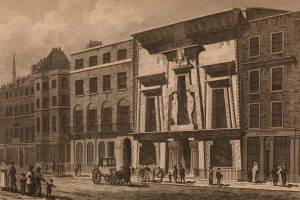
William Bullock's Egyptian Hall
London’s Lost Museums: Nature and Medicine on Show celebrates early natural history and anatomical collections once displayed in the capital, now ‘lost’ due to neglect, dispersal or destruction. With manuscripts, illustrations and specimens, the exhibition brings to life the contents, purpose and fate of seven historic collections and paints a portrait of curators and museum practices of the last 350 years. The exhibition also provides an opportunity to see fascinating objects such as a rare illustrated catalogue, Museum Regales’ Societis from 1681, a mummified foot believed to be from the Royal Society’s Repository, and hear about the devastating bomb damage inflicted upon the Hunterian Museum during
the Second World War.
As noted by Sarah Pearson, Curator at the Hunterian Museum, “Displays of natural history and anatomy have been popular in London since the 17th century and were curated for various reasons, some enhanced social and professional credentials while others were created to inspire wonder or to educate. Whatever their purpose, precious remains of collections forgotten, dispersed or damaged have found their way into today’s museums, including the Hunterian Museum, and so centuries on are still helping to explain the world of nature and medicine.”
The seven ‘lost’ natural history and anatomy museums featured in the exhibition are:
1. The Royal Society’s Repository – 17th to 18th century
2. Sir Hans Sloane’s Museum – 17th to 18th century
3. Sir Ashton Lever’s Holophusikon and the Museum Leverianum – 18th to 19th century
4. William Bullock’s Egyptian Hall – early 19th century
5. Joshua Brookes’ museum of anatomy and natural history – 18th to 19th century
6. John Heaviside’s anatomy museum – 18th to 19th century
7. The original College Museum at the Royal College of Surgeons – 19th to 20th century
◊ ◊ ◊ ◊ ◊
London’s Lost Museums Study Day
Hunterian Museum at the Royal College of Surgeons, London, 21 May 2011
For those inspired by the exhibition London’s Lost Museums, this study day offers the opportunity to learn more about museums that did not survive the test of time. Engage with the material and manuscript remnants of forgotten collections and tour the exhibition with its curators. Featuring speakers from across the heritage sector:
* Sam Alberti (Royal College of Surgeons) on lost medical museums
* Alan Bates (University College London) on lost anatomy shows
* Caroline Cornish (Royal Holloway) on Kew’s lost museums
* Stuart Eagles on the lost art museum at Ancoats
* Tim Knox (Sir John Soane’s Museum) on a lost architectural museum
* Frances Larson (Durham University) on Wellcome’s lost collection
* Chris Plumb (University of Manchester) on lost animal displays
£45/£35 concessions (MGHG members; College members, fellows and affiliates, full-time students). Includes refreshments and lunch. Bookings: 020 7869 6560. More information is available here»
Exhibition: Goya’s ‘Disasters of War’ in Barcelona
As noted at ArtDaily:
Goya: The Disasters of War / Los Desastres de la Guerra
Museu Diocesà de Barcelona, 24 March — 29 May 2011
Ibercaja, together with the Diocesan Museum of Barcelona, has organised this exhibition of the first complete series of The Disasters of the War: 80 engravings of the Aragonese painter Francisco Goya Lucientes (Fuendetodos, Zaragoza, 1746 – Bordeaux, 1828). These were painted during the Spanish Independence War, between 1810 and 1814, and are a graphical chronicle of those tragic events. However, Goya far-reaches the events and his existential and vital adventure, and he uses his art to make a declaration against all wars: he denounces the atrocities of the French army against the Spanish people, as well as the violence of the soldiers and the uncontrollable masses. The result of these paintings is the evidence of a surprisingly modernity for the times, a real crude disillusioned reflexion about mankind, finding itself in a limit situation that creates cruelty, death and misery and shows the failure of reason, strongly defended by the erudites. . . .
The full ArtDaily posting is available here»
Germanic Drawings at the Getty
From the Getty:
Spirit of an Age: Drawings from the Germanic World, 1770–1900
Getty Center, Los Angeles, 29 March — 19 June 2011
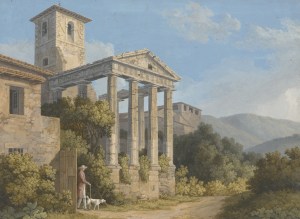
Jakob Philipp Hackert, "The Temple of Hercules in Cori near Velletri," 1783 (Los Angeles: The J. Paul Getty Museum)
Introducing recent acquisitions that represent a new area of the J. Paul Getty Museum’s collection, this exhibition features German and Austrian drawings made between 1770 and 1900. During that period, the Germanic world underwent profound changes—intellectual, social, economic, and political. Events such as the publications of Johann Wolfgang von Goethe, the Industrial Revolution, the formal unification of Germany into a nation state, and the invention of psychoanalysis shaped modern life and its representations in art.
In the early 1800s, the philosopher Georg Wilhelm Hegel professed that art was a fundamental mode of consciousness whereby humans could reach a profound understanding both of themselves and the world. Art, therefore, reflected the spirit of the age (“Zeitgeist” in German) in which it was created; this influential notion held sway over the 19th century. In fact, drawing—along with music—proved to be an essential expression of the period. It achieved an extremely high rank among the pictorial arts, sustained by the rise of art academies, which particularly emphasized draftsmanship as part of artistic training and practice. . . .
More information is available here»










 Enfilade
leave a comment