Settecento Paintings in New York
The following press release comes from Sperone Westwater (as noted at Art Daily) . . .
Italian Paintings from the 17th and 18th Centuries
Sperone Westwater Gallery, New York, 7 January — 19 February 2011
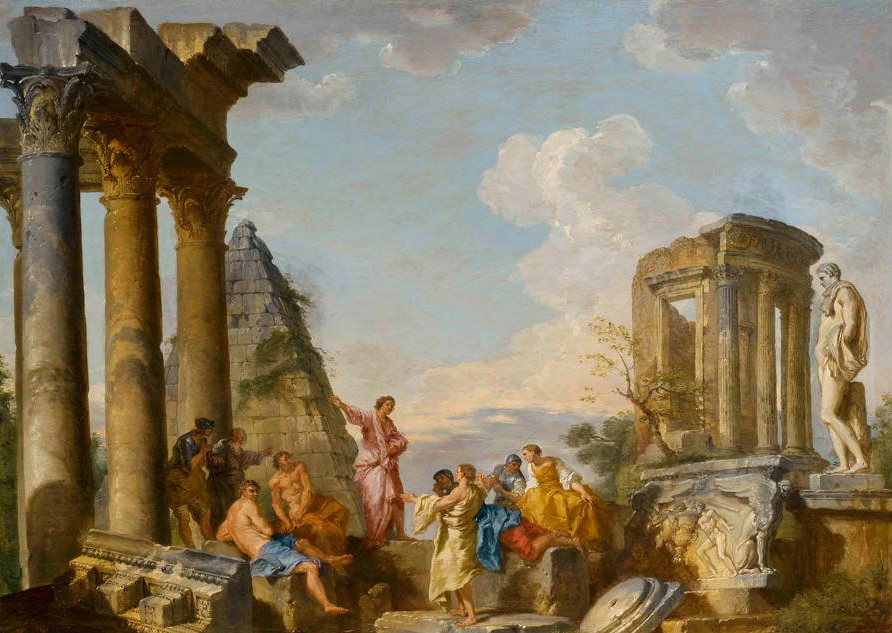
Giovanni Paolo Panini, "Architectural Capriccio with an Apostle Preaching," 1755-60, oil on canvas, 20 7/8 x 28 7/8 inches (52.9 x 73.5 cm). Courtesy Sperone Westwater, NY.
Sperone Westwater is pleased to announce an exhibition of Italian Paintings from the 17th and 18th Centuries in partnership with Robilant + Voena. This survey of Italian Old Master paintings, with notable masterpieces by painters such as Canaletto (1697-1768), Cavalier d’Arpino (1568-1640), Artemisia Gentileschi (1593-1653), and Michele Marieschi (1710-1743), intends to reassert the historical importance of Italian painting in the centuries following the Renaissance – a period which was to become an important foundation for modern art.
The exhibition unveils several new discoveries. One highlight is a very uncommon signed Portrait of an Unidentified Man (1630-1640) by Artemisia Gentileschi, among the most highly regarded female artists of the Baroque. It is exhibited alongside Tiberio Titi’s Portrait of Ferdinando Gonzaga, Duke of Mantua (ca. 1617) – also a new addition to his body of work. An early Francesco Guardi, Piazza San Marco, looking West, from the Campo di San Basso (1757-1758), a newly discovered work from the late 1750s, represents a period when he was still very much under Canaletto’s influence. When comparing this to Guardi’s later and previously unpublished painting, Venice. The Lagoon and the Fort of San Niccolo at Lido (1775-1785), it is possible to see how far the artist took his own individual interpretation of the Venetian veduta. Canaletto’s small and exquisite View of Dolo at the bank of the Brenta (1763) completes this set of important additions.
Other early masterworks will include two rare paintings by Cavalier d’Arpino, who first hosted Caravaggio in his studio after his arrival in Rome. The first, David with the Head of Goliath (1598) is a signed and dated work from the extensive Aldobrandini collection that was treasured by several papal Cardinals since its creation. It contrasts forcefully with d’Arpino’s Venus and Cupid (1602-1603), executed a few years later. Works by Battistello Caracciolo, Angelo Caroselli and Carlo Dolci further exemplify the prominence of religious narrative during the 17th century. Paintings by Marieschi, Panini and Joli also underline the 18th-century fascination with the veduta.
By jointly exhibiting Italian Baroque paintings and vedute from the 17th and 18th centuries in New York, Sperone Westwater and Robilant + Voena inaugurate a closer partnership between the two galleries. In 2011 both galleries will open a new shared space in London, 2nd Floor at 38 Dover Street, W1, with a joint show in 2011.
A fully illustrated, scholarly catalogue is being published on the occasion of the show. There will be an opening reception on 7 January from 6-8 pm. For more information, please visit www.speronewestwater.com or contact Maryse Brand at +1 (212) 999-7337 or maryse@speronewestwater.com.
Watteau and His Circle at The Wallace
From The Wallace:
Esprit et Vérité: Watteau and His Circle
The Wallace Collection, London, 12 March — 5 June 2011

Jean-Antoine Watteau, "A Lady at her Toilet (La toilette)," ca. 1716-18 (London: Wallace Collection)
In two exhibitions of great paintings, the Wallace Collection celebrates Antoine Watteau, the artist who died in his prime yet changed the course of French painting, and Jean de Jullienne, his publisher and one of France’s greatest collectors; a perfect accompaniment to the concurrent exhibition of Watteau drawings at London’s Royal Academy of Arts.
The exhibitions will consist of a redisplay of the great Watteau canvasses in the Wallace Collection, in the intimate setting of the West Gallery at Hertford House; and downstairs, in the Collection’s Exhibition Galleries, significant masterworks of the 17th and 18th centuries by artists, including Rembrandt, Rubens, Greuze and Vernet, drawn from the collection of Watteau’s publisher and most important dealer, Jean de Jullienne.
The relationship between Watteau, the most influential artist of his time, and Jean de Julienne, one of France’s most significant art collectors, represents a key moment in the development of French 18th-century painting and patronage. Within his short career, Watteau (1684-1721) changed the course of painting. He revitalized the Baroque style, and invented the fête galante, a novel category of genre painting depicting pastoral and idyllic compositions where stage characters of the French and Italian comedies mingle with fashionable contemporaries.
Jean de Jullienne (1686-1766), supported 18th-century contemporary artists. His strong interest in French art and Netherlandish painting, led the way for a new generation of rich Parisian collectors who had only loose connections with the French court. As a result, the 18th century saw the establishment of a new cultural avant-garde.
Jean de Jullienne is famous for his role as editor of and dealer in Watteau’s work, but a unique illustrated inventory of his collection from 1756, lent to the exhibition by the Morgan Library & Museum in New York and on display for the first time, demonstrates the breadth of his tastes. ‘Esprit et Vérité: Watteau and His Circle includes works by: Rubens, Rembrandt, Wouwermans, Netscher, Bourdon, Carle Van Loo, Greuze and Claude-Joseph Vernet from Jullienne’s collection; the Wallace Collection’s group of eight Watteau paintings, and two Watteau paintings from the Sir John Soane’s Museum, London and York Art Gallery. The Watteau paintings present a rare opportunity to reassess this artist’s impact on the course of art history.
Watteau’s artistic innovations went beyond his invention of the fête galante. The French tradition of depicting the female nude in a domestic setting, rather than as a goddess or a nymph, began in the 18th century. Watteau’s A Lady at her Toilet in the Wallace Collection is an early example of what might have been considered a controversial painting in its day and is one of only three surviving paintings by the artist in this new erotic genre. Watteau is said to have later repented and ordered that these paintings should be destroyed on this death.
Watteau died of tuberculosis, probably aged thirty-seven, and Jean de Jullienne was responsible for distributing engravings of Watteau’s work after his death, thus ensuring the artist’s longevity.
The exhibition will provide an opportunity to present new research on the Wallace Collection’s Watteau paintings and view them in the context of more recent developments in Watteau studies.
Watteau’s Drawings in London
From the Royal Academy of Arts:
Watteau’s Drawings: Virtuosity and Delight
Royal Academy of Arts, London, 12 March — 5 June 2011

Jean-Antoine Watteau, "Three Studies of a Young Girl Wearing a Hat," ca. 1716. Red and black chalk, graphite on paper. 138 x 246 mm. Collection of Ann and Gordon Getty
In March 2011, the Royal Academy of Arts will present the first retrospective exhibition of the drawings of Jean-Antoine Watteau (1684–1721) to be held in the UK. The display will contain over 80 works on paper produced by the French artist. Watteau is perhaps best known for his invention of a new genre: the fêtes galantes, small pictures of social gatherings of elegant people in parkland settings. He was also an exceptional draughtsman. His drawings were praised for their subtlety, freedom of execution, lightness of touch and grace, and remain widely admired today.
Watteau is particularly renowned for his mastery of the ‘three chalks’ or trois crayons technique, the subtle manipulation and expert balancing of red, black and white. The drawings on display will be presented chronologically to give a sense of the artist’s stylistic development. Together they will demonstrate the full range of his subject-matter, from theatre pieces, portraits, and shop interiors to fêtes galantes.
Chardin Exhibition in Ferrara and Madrid
Roderick Conway Morris reviews the Chardin exhibition currently in Ferrara for The New York Times, 22 December 2010, “Chardin’s Enchanting and Ageless Moments” . . .
Chardin: The Painter of Silence
Ferrara, Palazzo dei Diamanti, Ferrara, 17 October 2010 — 30 January 2011
Museo Nacional del Prado, Madrid, 1 March — 29 May 2011
ISBN: 9788889793107, $90
“We stop in front of a Chardin as if by instinct,” wrote Diderot in his review of the Paris Salon of 1767, “like a traveler weary of the road choosing, almost without realizing, a place that offers a grassy seat, silence, water and cool shade.”
Jean-Siméon Chardin’s small still lifes and genre scenes have been working their magic ever since the 18th century. And trying to explain how Chardin created his enchanting effects has never ceased to exercise writers on art.
The Louvre has the world’s largest collection of Chardins, and Pierre Rosenberg, formerly the director of the museum, has made a lifelong study of the painter. He is now the curator of “Chardin: Painter of Silence,” the first exhibition devoted to the French artist ever to be staged either in Italy or Spain (the show will travel on to the Prado in February). The event brings together 52 pictures (with four additional works and a few substitutions in the Madrid version). . . .
The full article is available here. Didier Rykner reviewed the exhibition for The Art Tribune in October. The catalogue is available at artbooks.com.
Exhibition: ‘Extravagant Display’ of Chinese Art at the Met
Thanks to Style Court for noting this one. From the Met:
Extravagant Display: Chinese Art in the Eighteenth and Nineteenth Centuries
Metropolitan Museum of Art, New York, 15 December 2010 — 1 May 2011
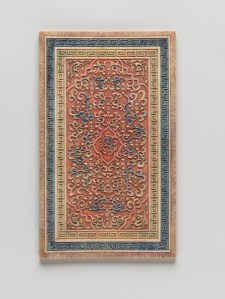
Tablet with Design for a Carpet, Qianlong period (1736–95), ivory with pigment, 13 inches (33 cm) high (Metropolitan Museum of Art; gift of James F. Ballard, 1923; 23.233.2)
The art of the Qing dynasty (1644–1911) has informed Western perceptions of Chinese taste and imagery for centuries, beginning in the late seventeenth century with the European craze for chinoiserie and continuing to this day. Ruled by the Manchus, a non-Han Chinese people from the far northeast, the Qing dynasty, in particular the reign of the powerful and erudite Qianlong Emperor (1736–1795), was a period of peace and prosperity that witnessed a spectacular flowering of the visual arts. Textiles, lacquers, ivories, jades, porcelains, and other objects were created both in palace workshops in Beijing and in specialized artistic centers such as the enormous kiln complex at Jingdezhen, Jiangxi Province.
Works in all media exhibit an appreciation for multilayered surfaces covered with dense, disciplined designs, many drawn from earlier periods in Chinese art. Included are figural scenes based on Chinese literature and history; popular gods and mythical creatures such as dragons and phoenixes; birds, bats, fish, deer, and other animals; trees, plants, and flowers; and geometric designs. Most of these motifs are imbued with meanings—usually auspicious—derived from long-standing cultural traditions. For example, the peony, which was first cultivated in the eighth century, alludes to spring and denotes wealth, while the chrysanthemum reflects autumn and symbolizes longevity. The pine tree, deer, and crane also evoke longevity, while squirrels, grapes, and gourds express a wish for generations of children. Other themes exploit the homonymic potential of the Chinese language, in which a word such as “bat” (pronounced in Chinese as “fu”) can symbolize “good fortune” (the character for which is also read as “fu”). This rich visual language enhanced the meaning of gifts, given seasonally and for important events such as birthdays, and of objects intended for display, either individually or in groups, thus creating specific messages for special occasions.
Drawn largely from the Museum’s permanent collection, this exhibition explores the vibrancy and innovation of Chinese art in the eighteenth and nineteenth centuries, underscoring the taste for extravagant imagery that characterized the period. In one room, theatrical costumes used in lavish court performances are on display, while objects in another room demonstrate the mastery with which Qing artists manipulated natural materials such as lacquer (made from tree sap), ivory, and bamboo. The third room features works in more resilient materials—jade and other hard stones, metals, and enamels—that were made not only for the court but as part of the extensive global trade in Chinese objects that marked this period in world history.
Christmas Dressed Period Rooms in London
From the Geffrye Museum:
Christmas Past: 400 Years Of Seasonal Traditions In English Homes
Geffrye Museum, London, 23 November 2010 — 5 January 2011
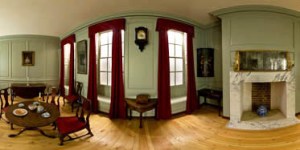
A parlour as envisioned from 1745 (sans Christmas decorations), London: Geffrye Museum. Photography Jonathan Greet. Click on the image for a panormic view.
Christmas Past offers visitors a fascinating insight into how Christmas has been celebrated in English middle-class homes from 1600 to the present day. Each year, authentic festive decorations transform the museum’s eleven period rooms, creating a vivid and evocative picture of how earlier generations of Londoners celebrated Christmas. The rooms provide the perfect setting for visitors to explore the origins of some of the rich and colourful traditions of Christmases past, from feasting, dancing and kissing under the mistletoe to playing parlour games, hanging up stockings, sending cards, decorating the tree and throwing cocktail parties.
◊ ◊ ◊ ◊ ◊
Visitors to the Geffrye can view our permanent display of eleven period rooms which span approximately 400 years from around 1600 to the present day. There is also a walled herb garden and a series of four period gardens, chronologically arranged to reflect the museum’s period rooms, which can be visited between 1 April and 31 October. To the front of the museum there is a large garden facing onto Kingsland Road, which is currently being refurbished. Additionally, there is a restored 18th-century almshouse, open to visitors on selected days, which has been taken back to its original condition and provides a glimpse into the lives of London’s poor and elderly in the 1780s and 1880s.
We know that not everyone is able to visit the Geffrye in person so we are always looking to create new ways for online visitors to experience the museum more fully. We have recently added panoramas of all the period rooms, gardens and almshouse rooms, which provide a highly detailed, immersive way to experience the museum. There is also our online Virtual Tour which offers a timeline through the museum and gardens and highlights significant objects and plants. You will also find short descriptions of all the rooms and gardens, adding context to the new visual material. . . .
Exhibition in Paris: Royal Spectacles
Description of the exhibition from the Académie de Paris website:
Dans l’atelier des Menus Plaisirs du roi: Spectacles, fêtes et cérémonies aux XVII et XVIIIe siècles
National Archives, hôtel de Soubise, Paris, 19 January — 24 April 2011
Curated by Pierre Jugie and Jérôme de La Gorce
 Du 19 janvier au 24 avril 2011, une sélection de 130 œuvres graphiques, pour la plupart inédites, essentiellement issues du fonds de la Maison du roi (série O1) aux Archives nationales, introduit le visiteur dans les coulisses des fastueux spectacles, fêtes et cérémonies royales.
Les Archives nationales ne conservent pas seulement les sources manuscrites les plus riches, relatives aux fêtes, aux spectacles et aux cérémonies, organisés aux XVIIe et XVIIIe siècles à Paris et à la cour de France. Elles abritent aussi une exceptionnelle collection de plus de sept cent soixante dessins, constituée en 1752 par les Menus Plaisirs, département de la Maison du roi chargé de créer et de financer ces prestigieuses manifestations dans les résidences du souverain et dans les grands sanctuaires de la monarchie qu’étaient la basilique Saint-Denis et au cœur de la capitale, la cathédrale Notre-Dame.
Le service des Menus Plaisirs, chargé d’organiser et de financer les spectacles et les fêtes de la Cour, employait les meilleurs artistes et techniciens de son temps, pour imaginer et réaliser les décors, costumes, machines et accessoires susceptibles de provoquer l’émerveillement des spectateurs. Les Menus Plaisirs étaient également sollicités pour la mise en scène des grandes cérémonies de pompes funèbres, dont l’exubérance même invitait à la méditation sur la vanité des gloires humaines. Par-delà la magie des représentations, le visiteur pourra admirer la variété, la qualité graphique des dessins et estampes présentés et apprécier l’ingéniosité de leurs auteurs pour
créer l’illusion et susciter le rêve. Cette exposition s’ouvre à l’occasion du tricentenaire de la mort de Jean Berain (1640 – 1711), dessinateur du Cabinet du roi ayant largement mis son talent au service des Menus Plaisirs. Elle correspond également à la mise en ligne de l’intégralité des huit recueils constitués en 1752 par Antoine Angélique Levesque, garde magasin des Menus Plaisirs, pour y réunir quelque 800 dessins et estampes des meilleurs artistes des fêtes et spectacles royaux aux XVIIe et XVIIIe siècles : à côté de Deruet, Gissey, Berain, Sevin, Meissonnier et des frères Slodtz, les Italiens Torelli, Vigarani, Pizzoli, Algieri et Servandoni. La sélection présentée permet de goûter au merveilleux de l’opéra français, d’admirer les grandes fêtes versaillaises ou d’impressionnantes décorations, dans l’écrin d’époque que constituent les salons rocaille de l’hôtel de Soubise, siège des Archives nationales depuis 1808. C’est aux relations qu’entretiennent l’art et la politique que peut aussi nous sensibiliser l’exposition.
◊ ◊ ◊ ◊ ◊
A journée d’étude on the Menus Plaisirs is scheduled for 8 February 2011. A full list of accompanying events can be found at the National Archives website.
Exhibition: Napoleon and Europe
From the Bundeskunsthalle’s website:
Napoleon and Europe: Dream and Trauma (Traum und Trauma)
Art and Exhibition Hall of the Federal Republic of Germany, Bonn, 17 December 2010 — 25 April 2011
Musée de l’Armée, Paris, March — June 2012
The source of all great mistakes and thence of all the great suffering of our time was that Napoleon was
perceived either as a demigod or as a monster or, more often than not, as both at the same time.
Friedrich von Gentz, 1814
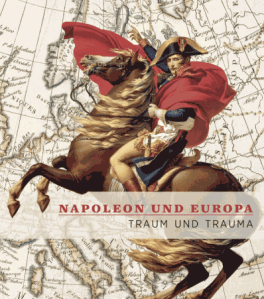
Exhibition catalogue, 368 pp, ISBN 9783791350882
During the nearly sixteen years of his reign, Napoleon Bonaparte (1769–1821), more than any other historical figure, redrew the very foundations of European history. and wrought changes that can be felt to this day – both positively and negatively. The exhibition, which has been panned and organised by the Art and Exhibition Hall of the Federal Republic of Germany, draws on a selection of high-calibre loans from all over Europe to present a comprehensive picture of Napoleon and his time. Painting and sculpture reached new heights of excellence in the Napoleonic era – both in the propaganda paintings by David, Gérard and Ingres and in the work of those who opposed the French emperor, among them Goya and the German Romanticists. Staying clear of well-worn clichés that paint Napoleon as a warmonger or a larger than life political genius, the exhibition aims to draw a more differentiated picture of the Napoleonic era between war, politics, administration, art theft and
cultural prosperity.
The exhibition is held under the patronage of Federal Chancellor Angela Merkel and the President of the French Republic, Nicolas Sarkozy. The exhibition was planned by the Art and Exhibition Hall of the Federal Republic of Germany, Bonn, in cooperation with the Musée de l’Armée in Paris and will be shown in Paris from March to June 2012.
The exhibition is subdivided into the following thematic chapters, which are explained in a microsite NAPOLEON:
- Generation Bonaparte
- Fascination and Revulsion
- Physical and Symbolic Birth
- The Dream of a Great Empire
- Blood and Sex: Europe, a Family Business
- Space, Law, Religion: New Ways of Controlling Space and the Mind
- Objects of Desire: Napoleon and the Appropriation of European Art and Heritage
- The Empire of Symbols
- Duels
- Nations – Emotions
- Symbolic and Physical Death
- Projections: A ‘Divided’ Icon
Additional information about the exhibition is available at ArtDaily. An article from The Wall Street Journal (12 November 2010) by J. S. Marcus addresses the show within the larger context of Bonn’s emergence as “a cultural hub.”
At The Walpole Library: ‘Illustrious Heads’
From the website of Yale University Library:
Illustrious Heads: Portrait Prints as History
The Lewis Walpole Library, Farmington, CT, 22 November 2010 — 29 July 2011
Curated by Cynthia Roman
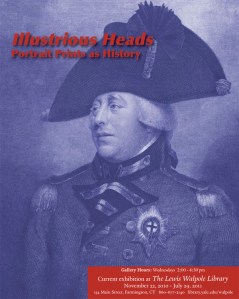 Engraved “heads,” or portrait prints, in close alliance with literary history and biography, carried substantial power as expressions of political and social preoccupations in eighteenth-century England. Published for both book illustration and independent issue, with and without text, portrait prints recorded and articulated a national past that was conceived as the “portraiture” of illustrious historical persons—a visual and literary representation of a sequence of notable individuals—rather than as a narrative representation of a series of significant political, diplomatic, or military events. Additionally, straight portraits—and increasingly caricatures—of contemporary persons played a vital role in negotiating topical political and social issues and documenting the surrounding discourse for posterity. The prints selected for this exhibition suggest the variety of portrait and caricature publications and present some of the diverse ways in which they were considered as repositories of history,
biography, and anecdote. The exhibition also explores the engagement of
eighteenth-century audiences with questions of sitter classification,
authenticity, provenance, and scarcity.
Shortlisted: Mrs. Delany!
 Warm congratulations to Mark Laird and Alicia Weisberg-Roberts. Their edited exhibition catalogue, Mrs. Delany and Her Circle (Yale Center for British Art, 2009) has been shortlisted for CAA’s 2011 Alfred H. Barr, Jr., Award! HECAA’s collective fingers are crossed for you!
Also, addressing the eighteenth century, Molly Emma Aitken’s The Intelligence of Tradition in Rajput Court Painting (New Haven: Yale University Press, 2010) is on the shortlist for the 2011 Charles Rufus Morey Book Award.
The winners of both prizes, along with the recipients of ten other Awards for Distinction, will be announced in December and presented on Thursday, February 10, 6:00–7:30 PM, in the Grace Rainey Rogers Auditorium at the Metropolitan Museum of Art in New York. The event is free and open to the public. The CAA Centennial Reception will follow
(ticket required).
Additional information from CAA News is available here»










 Enfilade
leave a comment