Exhibition | The Belvedere in Vienna
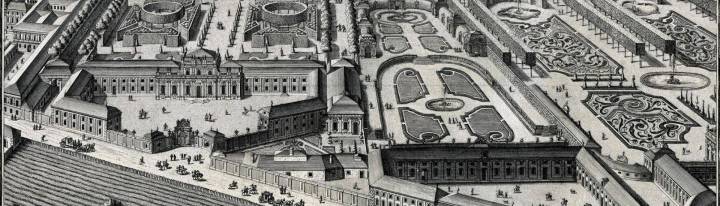
Salomon Kleiner, View of the Gardens of The Belvedere, detail, ca. 1731
(Vienna: Bibliothek des Belvedere)
◊ ◊ ◊ ◊ ◊
Opening in December at The Belvedere:
The Belvedere in Vienna: 300 Years a Place of Art
Lower Belvedere, Vienna, 2 December 2022 — 7 January 2024
It took more than a decade to build the summer residence of Vienna’s most famous general, Prince Eugene of Savoy. In 1723, construction of the upper palace drew to a close and the Belvedere estate was finally completed. The 300th anniversary of this event presents the perfect occasion for the museum to reflect on its history. Both as a museum and a landmark building, the Belvedere has stood for power and prestige throughout the ages, serving as the setting for courtly festivities, at times as a royal residence, and as the venue for the signing of the Austrian State Treaty in 1955. In an extensive exhibition, the museum will examine the building’s changing roles.
The show will mark the Belvedere’s 300th-anniversary year of 2023. Presented as a homage to an institution dedicated to the arts throughout the centuries, the exhibition casts a critical eye on historical developments and institutional changes. It illustrates the abundance and diversity of the museum, highlighting the collection’s evolution and the role of the holdings as symbols of power.
In 1777 when Marie Theresa opened the Imperial Picture Gallery in the Upper Belvedere to the public, she made a groundbreaking decision heralding a new age of enlightened absolutism: the collections would no longer be limited to courtly representation but would also serve to educate the general public. The Belvedere thrived during the succeeding centuries as both a place for the arts and a scene for glamorous events such as Marie Antoinette’s wedding. It was also the residence of the heir to the throne Franz Ferdinand, and the site where the Austrian State Treaty was signed. All of which is mirrored in its building and collection history.
The importance of the Belvedere as an art nexus over the centuries is examined in detail based on the rich holdings of the collection: they reflect the institution’s changing thematic concerns. The circulation and transfer of objects—additions and disposals of works from the collection due to museum reforms and barter transactions—provide further clues. This is particularly evident during the period from 1938 to 1945, when the museum was an agent and beneficiary of the Nazi state’s looting and cultural exploitation policy. Numerous works acquired after 1933 have been returned to the rightful heirs of the former owners since the enactment of the Austrian Art Restitution Law in 1998—the most notable example being Klimt’s Woman in Gold in 2006.
The Belvedere gallery and its collections reopened after World War II, once the damaged buildings and gardens were restored to their former glory. In 1955, the Austrian State Treaty was signed in the Upper Belvedere and presented to the public from the palace’s balcony.
The exhibition covers the period from the completion of the upper palace in 1723 to the present day, and illustrates the Belvedere’s role as a museum that honors the past, reflects on the present, and looks toward the future.
Display | Bedford Square: Creating Social Distance
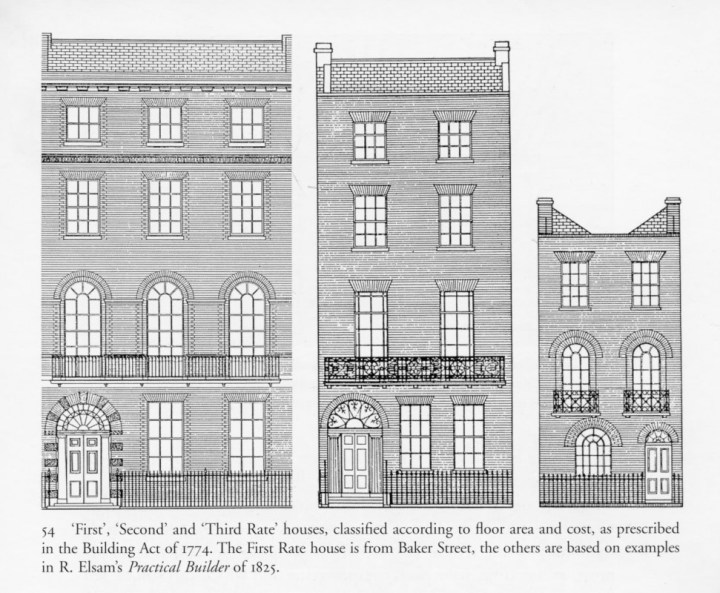
Alison Shepherd, Drawing of ‘First’, ‘Second’ and ‘Third Rate’ Houses, in John Summerson, Georgian London (Yale University Press, 2003), figure 54, image courtesy of Alison Shepherd / Trustees of the Estate of John Summerson..
◊ ◊ ◊ ◊ ◊
Now on view at the Paul Mellon Centre:
Bedford Square: Creating Social Distance
Drawing Room, Paul Mellon Centre, London, 31 January — 9 September 2022
Curated by Martin Myrone with Bryony Botwright-Rance
Bedford Square has always been acclaimed as an outstanding piece of urban planning. Built between 1775 and 1782, the fifty-three houses of the square—all but one arranged in apparently symmetrical order, in four ‘palace-fronted terraces’ around a gated, landscaped garden—are considered exemplars of Georgian architecture. The arrangement of the buildings remains intact, and many original architectural details and even interiors are preserved along with much of the character of the private garden, making Bedford Square one of the most complete survivals of Georgian London. Through literature on Bedford Square’s architectural history and records of its inhabitants, this Drawing Room display at the Paul Mellon Centre highlights the way that classic Georgian architecture created forms of social distancing: in its physical form; in creating closed and exclusive urban sites; through its internal spaces which separated inhabitants and allocated roles in highly predictable ways; and its aesthetic values which lay claim to supposedly timeless and universal principles of classical design and geometrical order.
The accompanying exhibition pamphlet by Martin Mryone is available for download at the PMC.
Exhibition | Young Gainsborough: Rediscovered Landscape Drawings
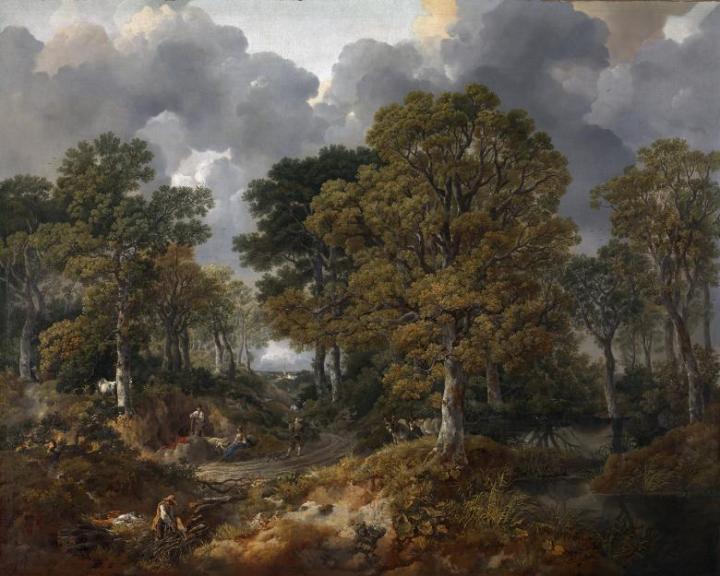
Thomas Gainsborough, Cornard Wood, near Sudbury, Suffolk, 1748, oil on canvas, 122 × 155 cm
(London: The National Gallery, NG925)
◊ ◊ ◊ ◊ ◊
Now on view at the National Gallery of Ireland:
Young Gainsborough: Rediscovered Landscape Drawings
York Art Gallery, 1 October 2021 — 13 February 2022
National Gallery of Ireland, Dublin, 5 March — 12 June 2022
Nottingham Castle Museum, 2 July — 25 September 2022
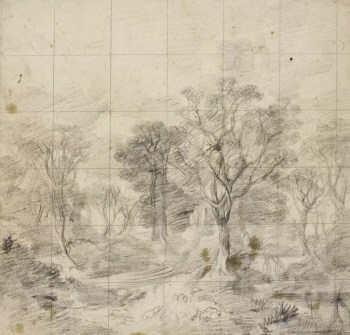
Thomas Gainsborough, Study for Cornard Wood, ca. 1748 (Royal Collection Trust).
In 2017 an exciting discovery was made among the drawings in the Royal Collection at Windsor Castle. The art historian Lindsay Stainton identified an album of 25 drawings—previously anonymous—as the work of the young Thomas Gainsborough (1727–1788), one of the greatest British painters of the eighteenth century. Sketched in the countryside around his native Suffolk or conjured from his imagination, these beautiful drawings from the late 1740s shed new light on our understanding of the artist’s early career. The drawings will be presented alongside paintings and works on paper borrowed from collections across the UK and Ireland, including the National Gallery’s recently conserved masterpiece Cornard Wood (1748). Together, they will shed new light on Gainsborough’s early landscape practice and the techniques that made him one of the country’s most significant and influential artists. In addition to the drawings from the Royal Collection Trust, the exhibition is supported by generous loans from the National Gallery, London; the Fitzwilliam Museum, Cambridge; the Whitworth Art Gallery, Manchester; and Colchester and Ipswich Museums.
The wall labels from the York installation are available for download here»
Exhibition | La Chine
Closing this weekend in Dresden at the Kupferstich-Kabinett:
La Chine: The 18th-Century China Collection in the Dresden Kupferstich-Kabinett
Residenzschloss, Staatliche Kunstsammlungen Dresden, 19 November 2021 — 8 May 2022
 In the early eighteenth century, when the legendary art collection of August the Strong (1670–1733), came into being, Asia was viewed with excited fascination in Europe.
In addition to today‘s world-famous porcelain wares, more than 1100 Chinese drawings and watercolour paintings on paper and silk, as well as woodcuts and coloured prints, were brought to Dresden. This important collection, along with 850 chinoiserie prints, is preserve in the Kupferstich-Kabinett of the Staatliche Kunstsammlungen Dresden. In the first inventory of the Kupferstich-Kabinett, drawn up in 1738, the objects were listed under the categories ‘La Chine’ and ‘La Chine européenne’.
An outstanding feature is the large collection of Chinese popular prints. In China itself, such New Year pictures, congratulatory leaflets, and theatre scenes were considered mere commodities, so that hardly any have been preserved. The prints were cheap to buy. With their wideranging symbolism, usually promising good fortune and prosperity, these sheets were hung up in homes for the New Year or passed on as a blessing, for example, and usually were not preserved. In Europe, Chinese folk art was seen as documenting the costumes and customs of distant lands. In the courtly sphere, the sheets were used as wall decorations, for example. They also served as models for chinoiserie prints. These provided motifs for decorations on buildings and furniture, as well as for porcelain painting.
Ines Beyer, Transformation
The first copperplate prints created in China were made by Matteo Ripa in collaboration with artists from the court painting workshops, on commission to the Kangxi Emperor, after woodcuts illustrating the Emperor’s own poems. The work by Ines Beyer entitled Transformation, based on the eighth view in the series, creates a link to the present day.
Cordula Bischoff and Petra Kuhlmann-Hodick, La Chine: Die China-Sammlung Des 18. Jahrhunderts Im Dresdner Kupferstich-Kabinett (Dresden: Sandstein Verlag, 2021), 256 pages, ISBN: 978-3954986286, €38.
Exhibition | Bestowing Beauty

Inkwell, Pakistan, Sindh, eighteenth century, steel, overlaid with gold (koftgari) (Houston: Hossein Afshar Collection at the MFAH). This inkwell is dedicated to Mir Fateh ‘Ali Sarkar-i Khan Talpur (r. 1783–1801/2), chief of the Talpurs, a tribe that conquered and ruled Sindh, in present-day Pakistan, from 1783 until 1843. The slit in the inkwell’s base, which makes it possible for a belt to pass through, suggests its portability and importance as part of courtly attire. The gold overlay, delicate decoration, and dedicatory inscription emphasize the power and prestige of the written word.
◊ ◊ ◊ ◊ ◊
From the Toledo Museum of Art’s press release for the exhibition:
Bestowing Beauty: Masterpieces from Persian Lands
The Museum of Fine Arts, Houston, 19 November 2017 — 11 February 2018
High Museum of Art, Atlanta, 12 December 2020 — 18 April 2021
Toledo Museum of Art, 23 April — 17 July 2022
Curated by Aimée Froom
This spring and summer the Toledo Museum of Art offers a spectacular exhibition of more than 100 objects drawn from one of the most significant private collections of Persian art. Bestowing Beauty: Masterpieces from Persian Lands showcases the artistic inventiveness of Persian culture across different media, featuring a broad array of textiles, ceramics, metalwork, lacquer, paintings, jewelry, and manuscripts from the Hossein Afshar Collection. Historically Persian lands—a wide swath of territory that at various times spanned from Cairo to Delhi, with its heart in what is now modern-day Iran—saw centuries of conquest and globalization. The art that resulted both reinforced Persian culture and assimilated these cross-cultural exchanges.
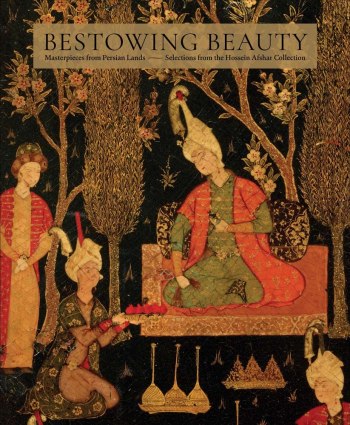 Woven throughout the stories of these extraordinary objects are experiences, ideas, and emotions shared by cultures across the globe. By evoking universal themes of love, loss, conflict, and spirituality the exhibition brings to life the rich heritage and enduring beauty of Persian art.
“Celebrating the cultural heritage of Iran at the Toledo Museum of Art with Bestowing Beauty represents a rare opportunity for our audiences to experience the grandeur and beauty of these objects in person,” said Diane Wright, the Museum’s senior curator of glass and contemporary craft. “An important area of trade and migration, Persian lands served as critical centers of artistic production and influence for centuries, which the exhibition brilliantly highlights through these extraordinary works of art.”
The visual and literary arts have held a privileged place in Iranian civilization for centuries. The Hossein Afshar Collection, which embraces a diverse range of treasures from the eve of Islam’s arrival in the seventh century to the end of the 19th century, was assembled to preserve and share Persian art and culture today and for future generations. The exceptional objects in Bestowing Beauty embody the history of trade and migration found in Persian art, as well as map the legacy of artistic and technological advancements across the region.
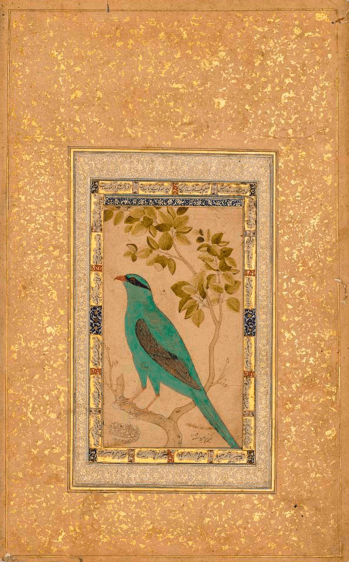
Signed ‘Ali-Quli’, Common Green Magpie, 1746–47, ink, opaque watercolor, and gold on paper (Hossein Afshar Collection at the MFAH).
The exhibition is divided into six sections:
Banquets and Battles features the exuberance of palace feasting and fighting, quintessential aspects of Persian kingship and perennially popular subjects in Persian art and literature. Feasts are portrayed across media, such as a 19th-century painting of a female juggler accompanied by a cat, and the exhibition also includes lavishly decorated serving vessels and utensils fashioned from metals and ceramic.
Faith and Piety explores how, after the advent of Islam, words from the Qur’an became paramount as a mode of expression. Exquisitely penned and sumptuously illuminated Qur’an manuscripts were produced across the Islamic world. Calligraphers also copied a variety of texts in addition to the Qur’an, such as sayings from the Hadith, Shi‘a invocations, literary manuscripts and poetry, all of which are included in the exhibition.
Art of the Word, the third section, delves into the different developments, styles and uses of calligraphy, enhancing the aesthetic form and rhythmic beauty of calligraphy. Words were woven into textiles, engraved onto metalwork, painted on ceramic objects and enamels, and carved into wood.
In Persian literature, love finds expression as a profound human connection and metaphor for a yearning for unity with the divine. Love and Longing traces how calligraphers and painters brought to life the rich corpus of Persian literature, from the exquisite miniature paintings from the Shahnama (Book of Kings), the Persian national epic, to couplets of lyric poetry and a pair of tightly embracing lovers on a slim lacquer pen case.
Kingship and Authority explores the kingly ideal, which figures prominently in Persian visual and literary culture. In addition to the Shahnama—the masterpiece that reflects the legends and virtues of Persian dynasties—court painters in the 19th century captured portraits of royalty and the ruling elite. This section also incorporates monumental silk carpets of the 16th and 17th centuries and an exquisite 19th-century pendant of gold, pearls, and gemstones.
The concluding section, Earth and Nature, examines the manifestations of flora and fauna that abound in the art of Iran. Its people were among the earliest civilizations to cultivate gardens. The garden’s symbolism—of paradise, of the promise of spring, of renewal—permeated Persian culture and can be seen in the exhibition through glorious depictions of lions, falcons, nightingales, roses, and fruit.
“The significance of Persian lands geographically, culturally and politically cannot be overstated,” said Sophie Ong, Hirsch curatorial fellow at the Toledo Museum of Art. “Bestowing Beauty draws attention to the splendor and complexity of Persian art, continuing TMA’s enrichment of the medieval world and beyond.”
Bestowing Beauty: Masterpieces from Persian Lands is organized by the Museum of Fine Arts, Houston.
Aimée Froom, ed., Bestowing Beauty: Masterpieces from Persian Lands—Selections from the Hossein Afshar Collection (New Haven: Yale University Press, with The Museum of Fine Arts, Houston, 2021), 304 pages, ISBN: 978-0300247022, $85. With contributions by Walter Denny, Melanie Gibson, David Roxburgh, Robert Hillenbrand, Mary McWilliams, Janet O’Brien, Marianna Shreve Simpson, Eleanor Sims, Margaret Squires, and Julie Timte.
Exhibition | Louis Chéron (1655–1725)
The exhibition closed last month, but the catalogue is still available:
Louis Chéron: L’ambition du dessin parfait
Musée des Beaux-Arts, Caen, 4 December 2021 — 6 March 2022
Curated by François Marandet
 Le musée des Beaux-Arts propose la première rétrospective consacrée à Louis Chéron, au travers d’une soixantaine d’œuvres issues de collections françaises et anglaises, couvrant une large période, de 1678 jusqu’aux années 1720.
Né à Paris en 1655, Louis Chéron quitte la France pour l’Angleterre en 1683. C’est à Londres qu’il vivra pendant trente ans, occupant là une place centrale au sein de la scène artistique. Les études académiques, les dessins d’invention, les projets d’illustration, les programmes pour de grands décors peints et les rares tableaux de chevalet conservés permettent de découvrir un artiste prolifique et précurseur. Contemporain de Louis Laguerre et de James Thornhill, à cheval sur deux siècles et deux nations, Cheron, souvent considéré comme un « suiveur de Charles Le Brun », reflète l’esprit classique français. Il annonce également, par ses dessins d’invention et sa peinture de chevalet proprement fantastiques, l’art de la génération suivante. En 1720, il crée sa propre école d’art à Londres, dont l’originalité est l’introduction de femmes nues comme modèles. Un peintre aussi célèbre que William Hogarth y suivra des cours.
The press packet is available as a PDF file here»
François Marandet, with prefaces by Emmanuelle Delapierre and Robin Simon, Louis Chéron (1655–1725): L’ambition du dessin parfait (Ballan-Miré: Illustria Librairie des Musées, 2022), 288 pages, ISBN: 978-2354040956, 30€.
Exhibition | The Luxury of Clay: Porcelain Past and Present
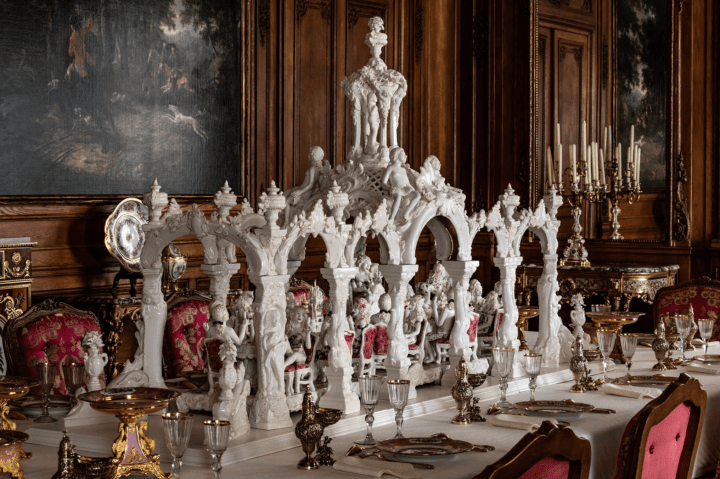
Chris Antemann, An Occasion to Gather, 2021–22; porcelain, 48 × 96 × 24 inches, installed in Hillwood’s Dining Room 2022.
◊ ◊ ◊ ◊ ◊
Now on view at Hillwood:
The Luxury of Clay: Porcelain Past and Present
Hillwood Estate, Museum & Gardens, Washington, D.C, 19 February — 26 June 2022
Curated by Rebecca Tilles
Hillwood founder Marjorie Merriweather Post valued porcelain objects for their beauty, exquisite design, and historic associations. While most were crafted for specific uses, these items are valued objects in their own right. Featuring more than 140 objects, the exhibition will trace the remarkable development of porcelain, from its origins in China to its discovery in Europe in the early 18th century, leading to contemporary artistic interpretations of this material.
 Often referred to as ‘white gold’, due to its natural color and high value, porcelain was originally produced by China in the 9th century. The exportation to Europe by the Portuguese and Dutch in the 16th century created a vast demand for these goods, heretofore unknown outside of Asia. The recipe for porcelain remained a mystery in Europe until the early 18th century, when the Meissen Manufactory in Saxony discovered the essential ingredient, kaolin, a soft white clay. From there, the secret traveled throughout Europe, to Vienna in 1718 under Claudius du Paquier and nationalized in 1744 by Empress Maria Theresa; to Saint Petersburg, Russia, in 1744 at the Imperial Porcelain Manufactory following Peter the Great’s visit to Saxony; to Berlin in 1763 at the Royal Porcelain Factory (KPM); and finally to France, at Sèvres in the late 1760s. With each new discovery came innovative colors, styles, and shapes, distinguishing factories from one another as each developed specialties. Moving chronologically through time, the exhibition will demonstrate how the discovery of this material in Europe shaped the luxury market and how the porcelain craze left a lasting impact on the art world.
Marjorie Merriweather Post (1887–1973) had an eye for beauty and a taste for exquisitely crafted objects when creating her collection. Beginning with Sèvres soft-paste porcelain, which she purchased in the 1920s–1960s, Post established herself as a cultivated and discerning collector of porcelain, later turning her attention to the collections of the Habsburg court and then acquiring Russian porcelain services during her time in the Soviet Union (1937–38), particularly diplomatic gifts and international commissions between Western European and Russian factories. At Hillwood, Post built the French and Russian porcelain rooms to house these treasures, displayed in special cases for all to see. Though Hillwood’s renowned collection of Sèvres was previously explored in the 2009 exhibition Sèvres: Then and Now, this is the first exhibition at Hillwood to investigate the full scope of her porcelain holdings.
The historical objects are complemented by a selection of modern-day examples. Drawing inspiration from examples from China, Germany, France, and more, contemporary artists such as Bouke de Vries, Cindy Sherman, and Roberto Lugo have continued the tradition of using porcelain to create beautiful works of art, and their pieces appear throughout the exhibition. Hillwood invited Chris Antemann to create new works to present in the dining and breakfast rooms in the mansion. In collaboration with Rebecca Tilles, curator, Antemann’s research led to large-scale porcelain centerpieces for the tables inspired by elements from the garden and collections at Hillwood. Additional works by Roberto Lugo and Eva Zeisel will be displayed in the entry hall, French porcelain room, and French drawing room.
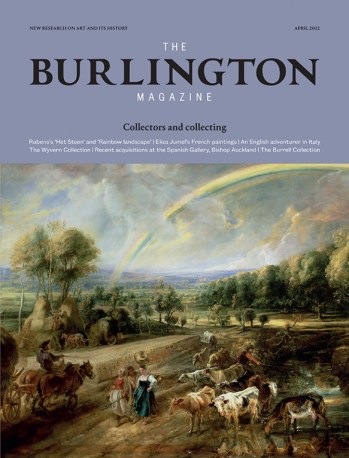
The Burlington Magazine, April 2022
The eighteenth century in the April issue of The Burlington . . .
The Burlington Magazine 164 (April 2022)
 A R T I C L E S
• Lucy Davis and Natalia Muñoz-Rojas, “The Provenance of Het Steen and The Rainbow Landscape by Rubens,” pp. 333–41. New documentary evidence elucidates the hitherto uncertain history of these two celebrated landscapes painted by Peter Paul Rubens ca. 1636. Having remained with this family after his death, they were purchased by the Marquess of Caracena, Governor of the Spanish Netherlands, and taken to Madrid. By 1706 they were in Genoa, in the collections of successively Bartolomeo Saluzzo (1652–1705) and Costantino Balbi (d. 1740). This article assimilates a number of archival discoveries that shed light not only on the provenance of these two paintings but also on two important Genoese collections.
• Lucia Bonazzi, “Richard Vickris Pryor in the Art Market of Napoleonic Europe,” pp. 342–49. The son of a Quaker family of brewers and wine merchants, Richard Vickris Pryor (1780–1807) spent his brief adult life in pursuit of paintings. A characteristic example of the sort of entrepreneur who sought to exploit the release of works of art onto the market in the wake of Napoleon’s campaigns, he scored his greatest success with the purchase of the Lechi collection in Brescia in 1802.
• Margaret Oppenheimer, “From Paris to New York: French Paintings from the Collection of Eliza Jumel,” pp. 350–61. Eliza Jumel (1775–1865), born in poverty, was one of New York’s richest women at her death in 1865. While in Paris in 1815–17 she formed the largest collection of European paintings yet assembled by an American, the largest part of them French. Sold in 1821, the collection has been all but forgotten, but it has proved possible to trace a number of the works she owned.
R E V I E W S
• Noémi Duperron, Review of the exhibition Le Théâtre de Troie: Antoine Coypel, d’Homère à Virgile (Musée des Beaux-Arts de Tours, 2022), pp. 394–96.
• Eric Zafran, Review of the exhibition Paintings on Stone: Science and the Sacred, 1530–1800 (Saint Louis Art Museum, 2022), pp. 396–99.
• Peter Y. K. Lam, Review of the exhibition catalogue Sarah Wong and Stacey Pierson, eds., Collectors, Curators, Connoisseurs: A Century of the Oriental Ceramic Society, 1921–2021 (Oriental Ceramic Society, 2021), pp. 402–03.
• Rowan Watson, Review of Richard Rouse and Mary Rouse, Renaissance Illuminators in Paris: Artists and Artisans, 1500–1715 (Harvey Miller, 2019), pp. 418–19.
• Richard Wrigley, Review of Iris Moon and Richard Taws, eds., Time, Media, and Visuality in Post-Revolutionary France (Bloomsbury, 2021), pp. 423–24.
• Philip Ward-Jackson Review of Bayerische Staatsgemäldesammlungen / Neue Pinakothek: Katalog der Skulpturen; Volume I: Die Sammlung Ludwigs I, Volume II: Adolf von Hildebrand (Deutscher Kunstverlag, 2021), pp. 424–25. “This is a vital link in the chain between Enlightenment celebrations of worthies and grand hommes and such later nineteenth-century sculptural pantheons as those on the Musée du Louvre, Paris, and the Albert Memorial, London . . .” (424).
O B I T U A R I E S
• Peter Cherry, Obituary for Jonathan Brown (1939–2022), pp. 427–28. As well as bringing many fresh insights to the study of the major Spanish artists from El Greco to Picasso, with a particular focus on Velázquez, Jonathan Brown made important contributions to the study of patronage and collecting and of the diffusion of the images and ideas in the wider Hispanic world. Much honoured in Spain as well as in his native America, he will also be remembered as a dedicated and assiduous teacher.
Exhibition | Moses Mendelssohn in His Time
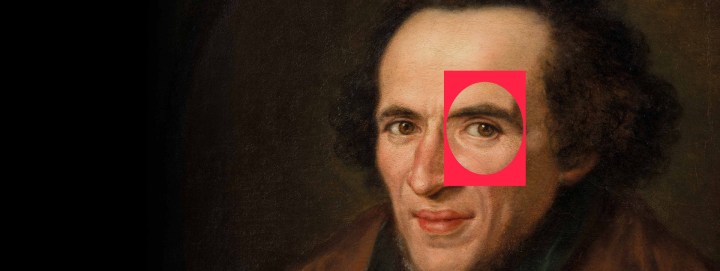
Johann Christoph Frisch, Portrait of Moses Mendelssohn, detail, 1783
(Jewish Museum Berlin, 2013.355.0; photo by Roman März)
◊ ◊ ◊ ◊ ◊
Opening this week at the Jewish Museum in Berlin:
‘We Dreamed of Nothing but Enlightenment’: Moses Mendelssohn in His Time
‘Wir träumten von nichts als Aufklärung’: Moses Mendelssohn in seiner Zeit
Jüdisches Museum Berlin, 14 April — 11 September 2022
Immigrant, Enlightenment philosopher, and self-made intellectual: in his time, Moses Mendelssohn (1729–1786) was already a European celebrity, and he remains a central figure in German Judaism to this day. This exhibition tells of Mendelssohn’s life in Berlin and shows him as a figure who integrated polarizing forces in the midst of historical upheaval and awakening.
With his Christian and Jewish friends, Moses Mendelssohn discussed philosophical and political questions. As an author he challenged his audience to think critically. As an observant Jew, he linked tradition with Enlightenment ideas, and championed secular education and civil equality for his ‘Jewish nation’. His translation of the Torah made religious knowledge accessible to all. The exhibition presents the era of the Enlightenment as a laboratory for radical change, in which human rights, freedom of opinion, and the diversity of individual ways of life were articulated and demanded. With his arguments for the emancipation of Jews, rights for minorities, and the separation of religion and the state, Mendelssohn opened paths into modernity—and provoked questions about Jewish identity that persist to this day.
Inka Bertz and Thomas Lackmann, eds., ‘Wir träumten von nichts als Aufklärung’: Moses Mendelssohn (Cologne: Wienand Verlag, 2022), 248 pages, ISBN 978-3868326901, €30.
Exhibitions | Contemporary Art at the Wellington Arch

Decimus Burton, Wellington Arch, Hyde Park Corner, 1826–30 (Photo by Beata May, June 2012, Wikimedia Commons). Together with Marble Arch, Wellington Arch was conceived by George IV in 1825 to celebrate Britain’s victories in the Napoleonic Wars. From 1846, the arch supported a massive equestrian sculpture by Matthew Cotes Wyatt depicting the Waterloo hero, a statue many people saw as painfully out of proportion for the arch. In the early 1880s, Wellington Arch was moved from its original nearby site to its current location, and the statue was relocated to Aldershot. Adrian Jones’s bronze quadriga was installed in 1912. For a fine essay grappling with the site as a war memorial, see Sharifa Rhodes-Pitts, “Peace Descending on the Chariot of War, Hyde Park Corner, London,” Bidoun (Winter 2008).
◊ ◊ ◊ ◊ ◊
From the press release (via Art Daily):
Contemporary Art at the Wellington Arch: Jordy Kerwick, Ibrahim El-Salahi, Matthew Burrows, and Marcus Harvey
Quadriga Gallery, Wellington Arch, London, April 2022 — January 2023
This year a programme of exhibitions curated by Vigo Gallery will be on display in London at Wellington Arch. The historic site, under the care of English Heritage, is hosting the exhibitions in its Quadriga Gallery from April 2022 to January 2023. Th installations include a series of epic paintings by Australian artist Jordy Kerwick, a group of never-before-exhibited works by Ibrahim El-Salahi created in the run up to his solo retrospective at Tate Modern, the much-anticipated exhibition of new paintings by #ArtistSupportPledge founder Matthew Burrows, and an exciting exhibition of specially commissioned work by YBA favourite Marcus Harvey. The partnership offers a new way for contemporary art to reach a larger audience and to encourage engagement with this important landmark in a new way.
Toby Clarke, Director of Vigo Gallery says: “It is a privilege to be able to bring contemporary exhibitions inspired by history to one of London’s most iconic landmarks and to work in partnership with English Heritage to create interesting opportunities for both the artists and public to experience this setting within a new context.”
Josephine Oxley, Keeper of the Wellington Collection for Apsley House and Wellington Arch added: “We welcome the opportunity to work in partnership with Vigo Gallery and are excited about the varied and diverse programme that they have put together. The exhibitions will give our visitors to the Wellington Arch a wholly new and exciting experience.”
Jordy Kerwick, Vertical Planes
6 April — 29 May 2022
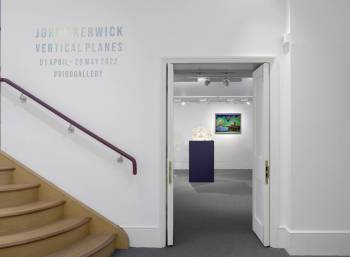 Jordy Kerwick’s brazen, colour saturated paintings transport you to a dream world of mythology, folk law, and misadventure. The artist explores his own domestic family frivolity through the lens of alternative bodies or forms. Snakes, bears, wolves, and tigers are juxtaposed with his favourite books, still life flowers, trees, and domestic arrangements within almost fairy-tale narratives. His two sons Sony and Milo, for example, are often represented as double-headed beasts.
The current exhibition is a playful reaction to the history—or alternate histories—of Wellington Arch and some of the characters it immortalises. Tigers, bears, snakes, and unicorns all take sides in the artist’s own version of the Battle of Waterloo, replacing key characters such as Napoleon and Wellington but leaving these characters ambiguous and interchangeable. The work was by Ken Webster’s book Vertical Planes (1989), which documents the author’s experience of receiving contact from people of the 16th-century and the future who had all inhabited the same cottage in Dodleston, Cheshire. Webster believed in parallel planes of existence all running simultaneously, an idea that also fascinates Kerwick.
Ibrahim El-Salahi, Black and White
1 June — 30 October 2022
This group of Black and White works on paper by Ibrahim El-Salahi from 2012 have never before been exhibited. They were completed in the lead up to his 2013 solo show at Tate Modern, when he became the first artist of African birth to be featured there in a retrospective exhibition. The works show the ‘godfather of African art’ at his best with a confidence of line reflecting over seventy years of creating his surreal multilayered visions.
Born in Sudan in 1930, Ibrahim El-Salahi is one of the most important living African artists and a key figure in the development of African Modernism. El-Salahi grew up in Omdurman, Sudan and studied at the Slade School in London. On his return to Sudan in 1957, he established a new visual vocabulary, integrating various Sudanese, Islamic, African, Arab, and Western artistic traditions.
2022 is an exciting year for the now Oxford-based El-Salahi. The artist has been selected to participate with 99 drawings in the 2022 59th Venice Biennale, The Milk of Dreams curated by Cecilia Alemani. Alongside the exhibition at Wellington Arch, Vigo will also show El-Salahi at their gallery in Masons Yard, London (June 2021), and his Pain Relief drawings will be the subject of a solo exhibition at the Norwegian Drawing Association (Tegnerforbundet), a show which will travel in an expanded format to The Drawing Center in New York in October. The Pain Relief canvases relating to these drawings will also be the subject of a solo exhibition at Hastings Contemporary (the Jerwood Gallery) from April to June. In a busy year the 91-year-old legend will further participate in group exhibitions at the Chrysler Museum of Art (October) and the Fisk University Galleries (October).
Matthew Burrows, In and Through
8 November 2022 — 8 January 2023
The paintings of Matthew Burrows explore a coalescence between stillness and movement. Work from the In and Through series has a preoccupation with watchfulness and the lines that delineate the landscape and our physiology. Burrows speaks of his work as an internal vigilance for place, creating images that meditate on the deep knowledge derived from repeatedly moving in and through the landscape. His relationship with habitat is not one of description or nostalgia, but one of dwelling and ritual. It is a process of mythologising, of drawing meaning from the particularities of the environment, of realising its wilderness and ours.
In 2020, a week before the first national lockdown, Burrows founded the Artists Support Pledge initiative, to help artists and makers through the COVID-19 pandemic. Artist Support Pledge has become a global phenomenon helping sustain thousands of artists across the globe during the pandemic. It has become a global movement empowering both artists and collectors. For his efforts, Matthew was awarded an MBE for services to Arts and Culture. Many are excited to celebrate this ‘artist’s artist’ who has contributed so much to his community.
Marcus Harvey, Waterloo Sunset
11 January — 19 March 2023
Marcus Harvey makes raw, expressive figurative paintings and sculptures. He seeks out imagery that is emblematic of a brutish but proud Britishness, iconic images—whether good, bad, or ambiguous—without commenting on his own relationship to them. Harvey’s most infamous work is Myra, a painting of the infamous child-murderer, which was exhibited as part of the groundbreaking 1997 exhibition Sensation. This chilling portrait derived much of its potency from the iconography of a photograph so engrained in the British psyche through years of media reproduction. A family man, Harvey was after sensation, and this painting regarded as so important in British art history is also one of the most misunderstood.
Recently, Harvey has started to work extensively with ceramics creating motifs and emblems of Britishness into collaged portraits of historical British figures, or foes, from history, from Nelson to Margaret Thatcher and Napoleon, to Tony Blair. He works the imagery, handling the clay in a battle to find its form through multiple firings. The result is tough but humorous sculpture, unapologetic and brash, political yet ambiguous, considered, and painterly.
Wellington and his eponymous boot fit snugly into Harvey’s ‘Punch and Judy’ ensemble as it fights to balance our nation’s patriotic sympathies with its dark imperial legacy. These complex and contradictory emotions will infuse the characters who will take temporary residence in the upper galleries of Wellington Arch.










 Enfilade
leave a comment