Exhibition | Flora Yukhnovich: Thirst Trap

Flora Yukhnovich, I’ll Have What She’s Having, 2020, oil on linen, 170 × 220 cm. Estimated to sell for £60,000–£80,000, the painting sold for £2,253,500 (Sotheby’s London, 14 October 2021).
◊ ◊ ◊ ◊ ◊
After only a handful of solo exhibitions, beginning in 2017, the British artist Flora Yukhnovich (b. Norwich 1990) has recently emerged as a leading contemporary painter, receiving coverage in both visual arts media and the popular press. The New York Times recently included her in a piece about speculators hoping to to ‘flip’ art at auction (in October, her painting I’ll Have What She’s Having sold at Sotheby’s for $3.1million).
I note Yukhnovich here at Enfilade because of her engagement with eighteenth-century painting, an engagement she attributes to Mary Sheriff. In a 2020 interivew with Immediations, published by The Courtauld, Yukhnovich references both Fragonard: Art and Eroticism (University of Chicago Press, 1990) and Enchanted Islands: Picturing the Allure of Conquest in Eighteenth-Century France (University of Chicago Press, 2018).
As Yukhnovich describes her artistic development during the interview:
“I then began looking at decorative design. At first it was about the very flatness of it, which I really enjoyed. Then it became about the ways in which paint itself can do things, like create drop shadows, or the different ways in which paint can be used to construct space. It became apparent to me that I was gravitating toward these things because they were related to femininity in a way, but they also all happened to be derived from a Rococo aesthetic. When I found [Sheriff’s] book on Fragonard, I realised that a lot of the Rococo seemed to tap into all these different elements that I had been looking at. The aesthetic of the Rococo feels very familiar to me, and there are lots of things that I, as a woman and also as a girl growing up, interacted with which seem to have a Rococo sensibility to them. I do not feel like that about many other art historical movements. That is why I landed on it. It was about a lot of different interests coming together.”
–CH

Flora Yukhnovich, Siren Song, 2022.
◊ ◊ ◊ ◊ ◊
From the press release for the the exhibition now on view in London at Victoria Miro:
Flora Yukhnovich: Thirst Trap
Victoria Miro, London, 1–26 March 2022
Flora Yukhnovich is acclaimed for paintings that, fluctuating between abstraction and figuration, transcend painterly traditions to fuse high art with popular culture and intellect with intuition. While in the past she has adopted the language of Rococo, dynamically reimagining aspects of works by eighteenth-century artists such as Tiepolo, Boucher, Lancret, and Watteau, new paintings draw upon various depictions of the Roman goddess Venus in mythology, art history, and contemporary culture. Rather than focus on individual points of reference, each work synthesises a multitude of influences that convey the shifting representations and significations of Venus herself. Here the Venus who embodies idealised female form and is goddess of love, maternal care, sexual reproduction, and erotic desire, meets the Venus of violent origin and hybrid gender—promiscuous and vengeful.
In Greco-Roman mythology, Venus emerges fully formed when Cronus throws Uranus’s dismembered testicles into the sea; she is carried to land from the boiling spume in a shell. The artist says, “I was immediately drawn to the idea of her body being made of water… this fluidity of form feels like a very painterly concept to me, a bit like creating seemingly solid figures out of wet paint. There is a tendency for water and the sea to be spoken about as female—fluid and soft but also capricious and destructive. I like the potential for strength or force in that association and it’s something I try and bring to these paintings.”
Travelling back and forth through art, mythology and philosophy, and echoing Venus’s storied representations through time, Yukhnovich’s references are revealed to be equally as fluid. One influence is Rubens’s The Feast of Venus, 1636–37, in the collection of the Kunsthistorisches Museum, Vienna, which depicts the festivities of Veneralia—the ancient Roman festival celebrated on 1 April to honour Venus Verticordia, an epithet that alludes to the goddess’s ability to change hearts from lustful to chaste. Venus as an embodiment of propriety contrasts with her promiscuity in another source painting, Boucher’s Mars and Venus Surprised by Vulcan, c.1754, in the Wallace Collection, which captures the moment when Vulcan, on hearing of his wife’s infidelity with Mars, ensnares the adulterous couple in a golden net, inviting other gods to enjoy their humiliation.
Such divergent attributes are enfolded with allusions in contemporary culture, from Federico Fellini’s La Dolce Vita to Doja Cat, which demonstrate the enduring potency of Venus as symbol and spirit. In Yukhnovich’s paintings these references are never revealed explicitly. Rather, they are conveyed compositionally or chromatically: variation is a driving force, her virtuosic mark-making—ranging from delicate flourishes to dramatic and muscular brushstrokes—heightens a sense of rhythmic sensuality. Bubbles—by definition one substance contained by another—are a recurring motif in these works; effervescent, capricious, unstable, or transformative, they denote changing states that mirror Venus’s turbulent arrival in mythology and her ever-shifting presence in culture thereafter. Paint, in Yukhnovich’s hands, becomes the perfect vehicle to conjure the multiplicity of a subject which, characterised by flux and transformation, is as elusive as it is seductive.
Born in 1990, Flora Yukhnovich completed her MA at the City & Guilds of London Art School in 2017. She had her first solo exhibition at Brocket, London, in December 2017 and has recently exhibited at Parafin, London, GASK, the Gallery of the Central Bohemian Region, Czech Republic, the Jerwood Gallery Hastings, and at Blenheim Walk Gallery, Leeds Arts University, UK. Previous solo exhibitions with Victoria Miro include The Venice Paintings and Barcarole, both held in 2020. Collections include Government Art Collection and The David Roberts Art Foundation. In 2018 she completed The Great Women Artists Residency at Palazzo Monti, Brescia. Work by the artist will feature in the survey exhibition Impressionism: A World View; Yukhnovich’s painting will be exhibited in galleries dedicated to ‘Contemporary Neo-Impressionists’, on view at The Nassau County Museum of Art, NY, from 19 March to 10 July 2022. In 2023 Yukhnovich will be the first artist to take part in a new series of solo exhibitions responding to the collections of The Ashmolean, Oxford, titled Ashmolean NOW.
Print Quarterly, March 2022
The long eighteenth century in the latest issue of Print Quarterly:
Print Quarterly 39.1 (March 2022) . .
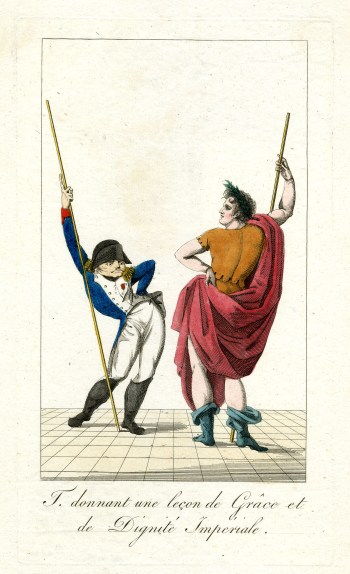
Charles Elie, T[alma] donnant une leçon de grâce et de dignité impériale (T[alma] giving a lesson in grace and imperial dignity), 1814, hand-coloured etching, 244 x 142 mm (London: British Museum).
A R T I C L E S
Antony Griffiths, “The Publication of Caricatures in Paris in 1814 and 1815, Part I: The Established Printsellers, Genty and Martinet,” pp. 31ff.
Two articles by Antony Griffiths on ‘The Publication of Caricatures in Paris in 1814 and 1815’—Part 1 in the March 2022 issue and Part 2 forthcoming—discuss the publication of caricatures in Paris during two years in which there were four regimes in power, and two occupations by foreign armies—a period which led to an unprecedented outpouring of social and political satire. Many works of great quality were produced, but most have only a title and do not reveal the names of the producers. The articles discuss how publishers and artists dealt with the political upheavals and identify some of the many participants who entered the field in these years. Part 1 deals with the caricatures published by members of the established print trade in Paris, and in particular Aaron Martinet and the newcomer Genty, who has previously been misidentified.
R E V I E W S
• Mark McDonald, Review of Juan Agustín Ceán Bermúdez, El Churriguerismo: discurso inédito (Alicante: Biblioteca Virtual Miguel de Cervantes, 2019), p. 79.
• Diana Greenwald, Review of Madeleine Viljoen, Nina Dubin and Meredith Martin, Meltdown! Picturing the World’s First Bubble Economy (Turnhout: Harvey Miller, 2020), p. 80.
• Ann V. Gunn, Review of John Bonehill, Anne Dulau Beveridge, and Nigel Leask, eds., Old Ways New Roads: Travels in Scotland 1720–1832 (Edinburgh: Birlinn, 2021), p. 81.
• Marcia Reed, Review of Troy Bickham, Eating the Empire: Food and Society in Eighteenth-Century Britain (London: Reaktion, 2020), p. 84.
• Nigel Tattersfield, Review of Graham Williams, Thomas Bewick Engraver & the Performance of Woodblocks (Kent: Florin Press, 2021), p. 86.
• Janis A. Tomlinson, Review of Mark McDonald et al., Goya’s Graphic Imagination (New York: The Metropolitan Museum of Art, 2021), p. 102.
Exhibition | A Shared Passion for Drawing
From:
Le partage d’une passion pour le dessin
Palais des Beaux-Arts, Paris, 22 March — 30 April 2022

Jean-Baptiste Greuze, Head of a Frightened Child, red chalk on beige paper (Beaux-Arts de Paris, acquired in 2013).
L’exposition dévoile un ensemble de 90 dessins, entrés dans les collections de l’École grâce à la générosité de l’association « Le Cabinet des amateurs de dessins des Beaux-Arts de Paris ». Le parcours, organisé à l’occasion des 15 ans de l’association, est présenté par écoles (italienne, nordique et française) à travers les siècles. Des œuvres d’Eugène Delacroix, Jean-Honoré Fragonard, Jean-Baptiste Greuze, Gerrit Van Honthorst, Giuseppe Penone ou encore Simone Peterzano sont ainsi à découvrir.
Les Beaux-Arts de Paris conservent la plus belle collection de dessins de France, après celle du musée du Louvre. Cette collection continue aujourd’hui encore de s’enrichir grâce à une politique d’acquisitions conçue à des fins pédagogiques ; ainsi que par des dons de professeurs, de jeunes artistes, et de l’association « Le Cabinet des amateurs de dessins des Beaux-Arts de Paris ».
Le partage d’une passion pour le dessin (ENSBA, 2017), 282 pages, ISBN: 978-2840565093, 39€.
Exhibition | Piranesi: A Dream of Stone and and Ink
Now on view at the Mazarin Library:
Piranèse et son empreinte : un rêve de pierre et d’encre
Bibliothèque Mazarine, Paris, 1 March — 14 May 2022
Curated by Yoann Brault with Olivier Thomas and Érik Desmazières
 Figure emblématique de cette « Académie de l’Europe » qu’est Rome au 18e siècle, Piranèse (1720–1778) occupe une place singulière dans notre héritage artistique et notre culture visuelle. Certes, il n’est pas seul à avoir fait accéder l’architecture figurée, réelle ou fictive, à un genre de plein droit. Mais cet artiste au génie impétueux et tourmenté, par la souplesse de sa technique, par ses effets dramatiques dans l’arrangement des lumières, ses disproportions et perspectives inattendues, a produit un univers visuel d’une puissance poétique inégalée.
Piranèse a nourri la veine française du néoclassicisme, et les efforts redoublés de ses fils ont permis de diffuser son oeuvre et d’étendre son influence depuis Rome ou Paris. Mais, après un demi-siècle de fascination, les productions de son génie n’ont pas échappé à l’usure de la curiosité et du goût. Dès la Restauration, les artistes du nouveau siècle se détournent de son empreinte. Bien qu’ici ou là tel amateur célèbre encore la « vigueur » de sa manière, on brocarde bientôt un oeuvre « improvisé avec facilité par l’imagination plutôt que produit par l’étude et par le temps » (Alfred Maury).
Cette déprise n’est pourtant pas totale. La poésie de ses planches, qui a tant et si précocement influencé l’art et la littérature préromantique, fait de Piranèse un passeur inopiné et, de ses Prisons, un motif obsédant que l’on retrouve en Angleterre puis en France, de Thomas De Quincey à Théophile Gautier. Il faut attendre l’entre-deux-guerres pour que le graveur recouvre la faveur des spécialistes, du public et des artistes qui y puisent à nouveau. Peut-être parce que son exploration inquiète du passé, son attrait pour le sublime et la démesure, pour la perte et la détresse, rejoignent les obsessions de notre temps.
Exposition organisée par les bibliothèques Mazarine et de l’Institut de France
Commissariat : Yoann Brault, avec la collaboration d’Olivier Thomas (bibl. de l’Institut)
Conseiller artistique et scientifique : Érik Desmazières (Académie des Beaux-Arts)
Exhibition | Antoine Coypel and the Theater of Troy
Now on view at the Musée des Beaux-Arts de Tours:
Le Théâtre de Troie: Antoine Coypel, d’Homère à Virgile
Musée des Beaux-Arts de Tours, 22 January — 17 April 2022
 L’exposition, présentée au musée des Beaux-Arts de Tours, en partenariat avec la Bibliothèque nationale de France, est une invitation à redécouvrir Antoine Coypel (1661–1722), peintre du roi Louis XIV et du régent Philippe d’Orléans. Aucune exposition monographique concernant Coypel n’a vu le jour jusqu’à présent, mais la connaissance de l’artiste a été récemment enrichie grâce à l’apparition sur le marché de l’art d’oeuvres inédites, à la redécouverte de tableaux que l’on croyait perdus et à la restauration de décors monumentaux, tel le plafond de l’hôtel d’Argenson, sur le point d’être révélé au public aux Archives Nationales. Sans prétendre à l’exhaustivité, l’exposition est une invitation à redécouvrir la personnalité attachante et la carrière prolifique d’Antoine Coypel, ainsi que les grands textes de l’Antiquité, d’Homère et de Virgile, ayant nourri son inspiration.
Autour de La Colère d’Achille et des Adieux d’Hector et Andromaque de Tours, une cinquantaine d’oeuvres des XVIIIᵉ et XIXᵉ siècles (tableaux, estampes, dessins, sculptures, objets d’art et planches gravées) sont réunies, grâce au prêt exceptionnel de la Bibliothèque nationale de France, du château de Versailles, des musées du Louvre, de Rennes, d’Angers, d’Arles, du Mobilier national et de l’École des Beaux-Arts de Paris.
Point d’orgue de l’exposition, la galerie d’Énée du Palais-Royal, chef-d’oeuvre d’Antoine Coypel aujourd’hui disparu, renaît au travers d’estampes spectaculaires de la Bibliothèque nationale de France. Les recherches approfondies menées pour reconstituer ce grand décor ont également permis de concevoir une maquette numérique de la galerie, en partenariat avec le musée Fabre de Montpellier, qui offre pour la première fois une proposition de reconstitution virtuelle en 3D très aboutie.
Une riche programmation culturelle (cycle de conférences, visites, spectacles de danse, musique, théâtre, cycle de péplums à la cinémathèque de Tours, cours d’histoire de l’art tout public, etc.) accompagnera toute la durée de cette exposition.
Le théâtre de Troie: Antoine Coypel, d’Homère à Virgile (Paris: Lienart éditions, 2022), 192 pages, ISBN: 978-2359063547, 23€.
Exhibition | La Fabrique des passions
Now on view at the Musée des Beaux-Arts de Tours:
La Fabrique des passions
Musée des Beaux-Arts de Tours, 17 December 2021 — 28 March 2022
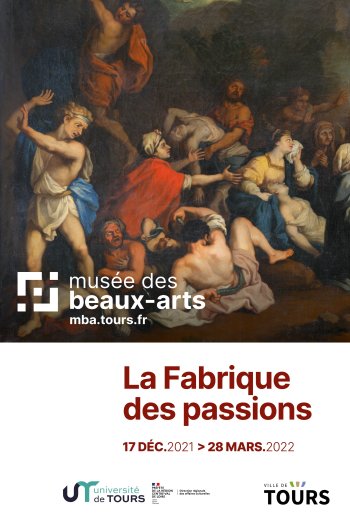 À partir du Serpent d’Airain (anonyme, 17ᵉ siècle) d’après Charles Le Brun, l’exposition La Fabrique des passions propose d’appréhender ce thème dans les arts du 17ᵉ au 19ᵉ siècle. Conformément à la pensée de René Descartes (Traité des passions, 1649), dont Charles Le Brun s’est inspiré, la passion—aujourd’hui synonyme d’émotion—se traduit comme l’expression incontrôlable d’un état affectif qui soumet l’âme et le corps. En 1668, Charles Le Brun, peintre du roi Louis XIV, donne une conférence à l’Académie royale de peinture et de sculpture dans laquelle il définit des modèles types d’expression des différentes passions.
Le parcours de l’exposition construit à partir d’oeuvres issues des réserves comporte trois entrées thématiques :
• les origines des passions dans les sources bibliques et mythologiques
• le théâtre comme nouvelle source d’inspiration des passions héroïques
• l’individualité des passions à travers les portraits et les études de têtes.
Origines des passions
Les origines des passions, observées à la fois d’un point de vue théorique, esthétique, religieux et historique, sont illustrées par trois oeuvres. Le Serpent d’Airain d’après Charles Le Brun, oeuvre maîtresse de l’exposition, présente les prémisses de la codification des passions. Les émotions—telles que l’admiration, l’effroi ou le ravissement—sont mises au service de la narration pour toucher le spectateur. Outre le travail sur l’expressivité des visages et des corps, l’intensité des couleurs participe à cette exaltation des émotions. Les origines des passions sont explorées à travers les thèmes fondateurs de la Bible. Aussi, pour mieux émouvoir, les artistes puisent-ils dans la culture du spectateur. Caïn et Abel (anonyme, 19ᵉ siècle), qui décrit le premier meurtre de l’histoire de l’humanité dans l’Ancien Testament, montre la brutalité de la passion débordante assimilée à la jalousie. La mythologie fournit d’autres sujets iconographiques propices à la mise en scène des passions à l’instar d’histoires légendaires de la Rome antique. L’Enlèvement d’une Sabine (anonyme, 19ᵉ siècle) d’après le chef-d’oeuvre du maniériste Jean de Bologne (16ᵉ siècle), sert ainsi de support plastique à la fabrique moderne d’une nouvelle esthétique des passions. Ici, la peur et la violence charnelle sont évoquées avec force.
Passions héroïques
Le théâtre, qui revisite la culture littéraire classique et savante aux 17ᵉ et 18ᵉ siècles, s’impose comme une nouvelle source d’inspiration de la figuration des passions héroïques. Les scènes de groupe, comme Les Funérailles de Pallas d’après Antoine Coypel (Louis Desplaces, 17ᵉ siècle), présentent une multitude de personnages qui incarnent le deuil, la tristesse et la désolation. Avec sa composition du dessin Briséis enlevée à Achille (18ᵉ siècle), Gaudar de Laverdine sublime les passions par un jeu de théâtralité des corps et des mouvements. Cléopâtre (huile sur toile, anonyme, 17ᵉ siècle) représente quant à elle la passion héroïque des femmes fortes, tout comme Polyxène (gouache, Guillaume Goudin, 18e siècle), princesse troyenne qui se sacrifie à la suite de la disparition de son bien-aimé.
Portraits et passions
Les portraits favorisent la focalisation progressive sur l’individualisation des émotions. À la suite du concours de têtes ouvert à l’initiative du Comte de Caylus (membre de l’Académie né en 1692 et mort en 1765), les études se consacrent désormais à la seule expressivité du visage. Jean-Baptiste Greuze apparaît comme l’archétype de l’artiste traitant de la tête d’expression (Tête de jeune femme, 18ᵉ siècle, copie), thème qui eut un grand succès à Paris et qui trouva également un écho à Tours comme en témoigne l’oeuvre d’Auguste Vinchon (Étude de femme, épisode de l’histoire de Venise, 19ᵉ siècle). L’exposition se conclut par un dessin d’Étienne-Pierre-Adrien Gois (plume et encre, 2ᵉ moitié du 17e siècle). L’autoportrait central, affichant une profonde expression méditative et introspective, est entouré de douze visages féminins et masculins, montrant la diversité des passions humaines. Les caricatures associées aux citations apportent un caractère comique et moralisateur à la lecture de l’image.
Entre théorie académique, théâtralisation et interprétation plus personnelle de la palette des émotions, ces oeuvres illustrent donc la manière dont les artistes se sont confrontés à la difficile codification des passions.
Commissariat
Andy Bodin, Alice Brozzoni, Emeline Chassine, Zoé Machado-Formiga, Marine Nabon, Elodie Poinha, Jurgen Poirier, Clara Roig, étudiant.e.s en Master 2 histoire de l’art, séminaire Pratique de l’exposition, à l’Université de Tours.
Lucie Gaugain, Maître de conférences en Histoire de l’art médiéval à l’Université de Tours, membre du CeTHiS, EA 6298
Delphine Rabier, ATER en Histoire de l’art moderne à l’Université de Tours, chercheur associé au CESR, UMR 7323
Coordination
Hélène Jagot, directrice des Musées-Château de Tours
Virginie Dansault, médiatrice, chargée des publics
Jessica Degain, conservatrice du patrimoine en charge des collections XVIIᵉ–XIXᵉ siècles
Catherine Pimbert, régisseuse des collections
Exhibition | Arte Sacra: Roman Catholic Art from Portuguese India
Now on view at NOMA:
Arte Sacra: Roman Catholic Art from Portuguese India
New Orleans Museum of Art, 13 March 2020 — 15 May 2022
Curated by Robert J. Del Bontà

Our Lady of the Rosary, 18th century, wood, with polychrome and gilt, 36 inches high (Collection Dr. Siddharth K. Bhansali).
In the centuries following the arrival of Francis Xavier, a Catholic missionary, in 1542, the state of Goa in western India became the administrative and economic center of a Portuguese empire that extended west to Africa and east to Malaysia, China, and Japan. The vast trade networks established by the Portuguese and Spanish allowed not only for the spread of Christianity, but also an unprecedented artistic exchange within these colonial empires. Works of art and valuable materials traveled between Spain, Portugal, and their colonies, leading to the development of new visual traditions informed by European imagery and local idioms.
European missionaries brought with them paintings, sculpture, and devotional objects for use in their evangelization efforts. Sculptures of saints and apostles, the Virgin Mary, Christ, and angels, made of wood and ivory, such as those seen in Arte Sacra, were created by Goan artists from Hindu and convert families. Initially based upon European prototypes, over time many works came to marry Christian imagery and symbols with local traditions. These works not only graced the interiors of European-style churches in Goa, but were also exported to Europe for use in religious establishments and for private devotion.
This exhibition, from the collection of Dr. Siddharth Bhansali, a New Orleans-based physician, reveals both the global influence of European seventeenth- and eighteenth-century styles, as well as the transformation of these styles in the hands of local artists creating a new visual tradition.
Robert J. Del Bontà, guest curator of Arte Sacra: Roman Catholic Art from Portuguese India, is an independent scholar of Indian art, who received his PhD from the University of Michigan in 1978. He has published numerous articles, contributed to scholarly publications, and curated exhibitions for the Berkeley Art Museum, the Portland Art Museum, and the University of Michigan Museum of Art. He provides a video tour of the exhibition here.
Exhibition | The Regency Wardrobe at the Royal Pavilion
From the press release for the exhibition:
The Regency Wardrobe at the Royal Pavilion
Royal Pavilion, Brighton, 19 March — 11 September 2022
 At the Royal Pavilion a display of costumes inspired by Regency history tell stories of seafront promenading, grand balls and musical evenings. Each unique piece is created by artist Stephanie Smart, using only paper and thread. The Regency Wardrobe is a collection of imagined garments whose design reflects the fashion, style, and history of the Regency era. With decoration directly inspired by aspects of its interiors, ball gowns, walking dresses, parasols, and bags bring life to the beautiful rooms of the Royal Pavilion.
The centrepiece of the exhibition is a new dress created for the Royal Pavilion and on display in the magnificent Music Room. Symphony of Stars is a stunning life-sized court dress inspired by the architecture of the Music Room and the Chinese wallpaper in the palace. Stars made of rolled paper decorate the border of the train, platinum in colour in honour of the platinum Jubilee of Queen Elizabeth II
The show taps into the current obsession with Regency fashion inspired by hit Netflix series Bridgerton, which returns this year and will fascinate fans of Jane Austen and Georgette Heyer. The exquisite and complex nature of the items on display spans the divide between historic research, fine art, and costume design to create unique works of art which are enhanced by the glorious setting of the Royal Pavilion.
Artist Stephanie Smart said: “The Regency Wardrobe has taken nearly three years to design and make. Throughout that the decoration and history of the Royal Pavilion has been a corner stone of my research. I’m very excited to be seeing the pieces on display in rooms that sum up the possibilities of the time and would have been known intimately by the Prince Regent himself.”
CEO of RPMT Hedley Swain said: “We are so pleased to have these beautiful, ethereal works of art at the Royal Pavilion, particularly as some of them were directly inspired by the interiors where they will now be on show. Stephanie’s creations not only complement the Regency history of the Royal Pavilion but add to its magical nature.”
In 2017 Stephanie formally established The House of Embroidered Paper, a unique fashion house/fine art studio. Each piece produced is a work of paper textiles, created using only paper and thread—inspired by period and place, history and story.
Developing her use of paper as a medium for garment construction, with embroidered and applied decoration, The Regency Wardrobe is Stephanie’s second major collection. It includes pieces which re-interpret the popular two-dimensional Regency art form of the paper cut silhouette as three-dimensional garments. Each one linked to a real woman from the time. By working closely with volunteers from The Regency Town House Heritage Centre, Hove and with special access to The Royal Pavilion Stephanie has created a collection that’s broader in scope in terms of its relationship to a particular area, and historical era, than any she has worked on previously.
Whilst the collection as a whole reflects social and cultural influences from the longer Regency era (1795 to 1837) and celebrates the bicentennial of the end of the formal Regency in 1820 the finale piece Symphony of Stars links directly to the year in which it will be displayed, 2022. Stars made of rolled paper decorate the border of the train, they are platinum in colour in honour of the platinum Jubilee of Queen Elizabeth II and placed in lieu of the notes of a symphony by British astronomer William Herschel, the bicentennial of whose death it is this year.
In order to inform her understanding of the pieces she makes Stephanie visits museum stores and private collections to see real garments from different periods of history. These are documented on her website under the title ‘The Hidden Wardrobe’.
Stephanie began working with heritage sites in 2016 when she began her collection titled Maison de Paier. As inspiration she collected stories from some of the present residents of the Grade 1 listed Elizabethan mansion, Danny House in Hurtspierpoint, Sussex. With WWII veterans amongst their number and with the history of the house itself to draw on, this collection included a 17th-century court dress, a 1950s swing dress, and a pair of gauntlets. The Victorian era dress from this collection Lady of the House can be seen on the Royal Pavilion’s upper floor. Based on that experience Stephanie has set up an ongoing research project The Talking Wardrobe with the ambition of collating stories over time from individuals regarding garments once worn as a basis for her future work. Stephanie’s work has twice been featured on the BBC’s South East Today.
Exhibition | Nuestra Casa

Installation view of Nuestra Casa: Rediscovering the Treasures of the Hispanic Society Museum & Library (2022). Shown is Francisco de Goya’s The Duchess of Alba, 1796–97.
◊ ◊ ◊ ◊ ◊
From the press release for the exhibition (with dates listed for variations of the exhibition in other locations). . .
Nuestra Casa: Rediscovering the Treasures of The Hispanic Society Museum & Library
Museo Nacional del Prado, Madrid, 4 April — 10 September 2017
Palacio de Bellas Artes, Mexico City, 25 June — 25 September 2018
Albuquerque Museum, 10 November 2018 — 31 March 2019
Cincinnati Art Museum, 25 October 2019 — 19 January 2020
Museum of Fine Arts Houston, 1 March 2020 — 3 January 2021
The Hispanic Society Museum & Library, New York, 17 February — 17 April 2022
Art Gallery of Ontario, Toronto, 8 June — 10 October 2022
Royal Academy of Arts, London, 21 January — 10 April 2023
Curated by Madeleine Haddon
The Hispanic Society Museum & Library (HSM&L) is pleased to present Nuestra Casa: Rediscovering the Treasures of The Hispanic Society Museum & Library, revealing hidden gems from the expansive, permanent collection of the museum that includes more than 750,000 objects. Curated by Dr. Madeleine Haddon, the exhibition is on view from 17 February until 17 April 2022. The objects featured in Nuestra Casa help to illuminate the wide array of arts, literature, and history of the Iberian Peninsula and Latin America from antiquity to modern day. During the museum’s recent renovation, a selection of these works toured the world, from the Museo Nacional del Prado in Madrid and the Museo del Palacio de Bellas Artes in Mexico City to the Albuquerque Museum, the Cincinnati Art Museum, and most recently the Museum of Fine Arts Houston. Now, with the opening of the HSM&L’s newly renovated exhibition space in the East Building Gallery, these objects will come home for the first time in five years before many of them continue on to the Art Gallery of Ontario and the Royal Academy of Art in London.
 The return of these objects to the HSM&L has prompted a re-examination of the works within the collection that have been historically defined as its masterpieces. The exhibition comes during a moment in which it is necessary for our traditional art historical and aesthetic hierarchies to be reassessed in order to make way for a new art history that fully incorporates the diverse populations to whom our public institutions belong. Nuestra Casa: Rediscovering the Treasures of The Hispanic Society Museum & Library shows that the HSML’s collection extends much beyond the artwork of El Greco, Goya, and Sorolla, for which it has historically been known, to masterpieces within a range of mediums by relatively unknown Latin American artists, at times still unidentified, who have previously received little recognition.
To evaluate and present these works through a new lens, the HSM&L brought on a guest curator for this exhibition, Dr. Madeleine Haddon has also written essays for the forthcoming exhibition catalogues Murillo: From Heaven to Earth (2022) at the Kimbell Art Museum and Travel, Respond, Assemble: Isabella Stewart Gardner (2023) at the Isabella Stewart Gardner Museum. Prior to MoMA, she was a Teaching Fellow at the University of Edinburgh in Edinburgh, Scotland. Dr. Haddon completed her PhD at Princeton University where her dissertation, “Local Color: Race, Gender, and Spanishness in European Painting, 1855–1927,” focused on the preoccupation with the intersection between race and color in 19th- and early 20th-century Spanish and French painting. Dr. Haddon received a Fulbright Award in support of her dissertation research in Madrid at the Museo del Prado and Museo Reina Sofia.
“Nuestra Casa only scratches the surface in terms the breadth of treasures that visitors will be able to come to the HSM&L to see once the museum fully reopens it doors, says Dr. Haddon. “Visitors will leave with an understanding of the HSM&L as the most significant collection in the United States in which to encounter and learn about the rich and diverse cultural heritage of the Spanish- and Portuguese-speaking world.”
The works featured in Nuestra Casa—many of which have previously not been featured regularly at the Museum—range in origin from Spain and Mexico to Puerto Rico, Peru, and beyond, all in chronology from the 10th to 20th centuries. These works include the 19th-century watercolors of Pancho Fierro and Miguel Viladrich Vilá’s The Man from Montevideo (1923–25), which represent people of color and the racial diversity of colonial Latin America. Additionally, the exhibition will showcase works that have always been considered among HSM&L’s masterpieces, such as Francisco de Goya’s Duchess of Alba (1797) and Diego Velázquez’s Portrait of a Little Girl (c. 1638–42).
Nuestra Casa shows that the HSM&L is itself as a treasure to be discovered within New York City’s vibrant Washington Heights neighborhood. The exhibition will leave visitors with a better understanding of the museum and its unparalleled collection that addresses nearly every aspect of cultures in Spain, Portugal, Latin America, and the Philippines, while also providing a rare opportunity to encounter and learn about the rich, diverse cultural heritage of the Spanish and Portuguese-speaking world through art and object.
Gloria de España: Tesoros del museo y la biblioteca de la Hispanic Society
Tesoros de la Hispanic Society of America (Madrid: Museo Nacional del Prado, 2017), 448 pages, ISBN: 978 -8484804079, 35€.
Mitchell Codding, Treasures From the Hispanic Society Museum & Library (Madrid: Ediciones El Viso, 2019), 376 pages, ISBN: 978-0875351643, £50 / $65.
Art Market | Court, Epic, Spirit: Indian Art, 15th–19th Century
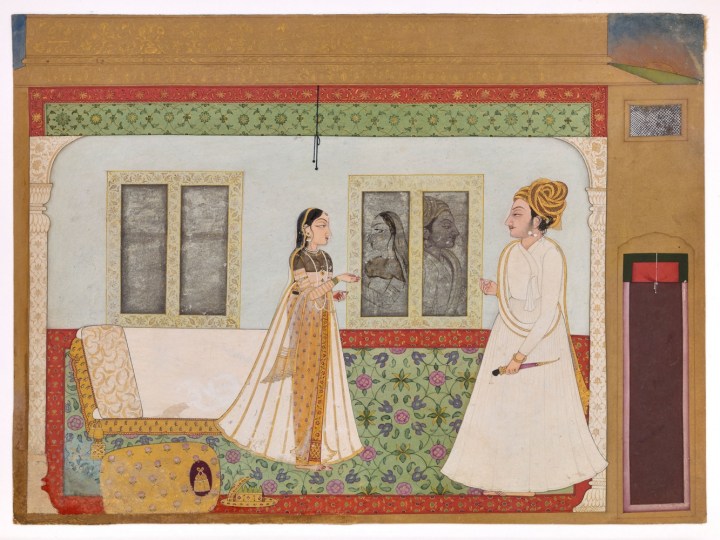
Return of the Unfaithful Lover, Khandidta Nayika, ca. 1720, Nurpur, opaque pigment and gold on paper, 20 × 26 cm.
◊ ◊ ◊ ◊ ◊
From Luhring Augustine:
Court, Epic, Spirit: Indian Art, 15th–19th Century
Luhring Augustine Tribeca, New York, 26 January — 24 March 2022
Luhring Augustine, in association with Francesca Galloway, is pleased to present Court, Epic, Spirit: Indian Art, 15th–19th Century, a show of historical artworks from India opening on January 26. It marks the first time that Luhring Augustine has partnered with the London-based gallery Francesca Galloway, internationally renowned in the field of Indian art. Court, Epic, Spirit presents a variety of artworks including textiles, paintings, and courtly objects. The title of the exhibition refers to three key lenses through which to view the arts of India. With these organizing principles as a guide, these exceptional and iconic works of art can be more fully considered and understood.
A fine and grand 17th-century panel from a lavish royal tent is among the exhibition’s featured objects. The panel is part of an important group thought to have been produced in the Deccan, a region of central India. For both Rajput and Mughal rulers, tents were immensely important, especially to the latter given the nomadic lifestyle required to govern their vast empire.
Indian painting is above all a storytelling medium, created to illustrate epic texts. These narratives, and the paintings that accompanied them were an integral aspect of the region’s cultural traditions throughout this period. A work of particular importance in the exhibition is a recently discovered 16th-century painting from the early Imperial Mughal manuscript of the great epic, the Hamzanama (‘Story of Hamza’), one of the supreme achievements of Indian art. Commissioned by a young Emperor Akbar, it is the only known folio depicting this episode and represents a significant addition to the scholarship, not least because it was painted by Dasvant, a master artist in the Imperial atelier.
Also significant to the artistic output of the region were artworks focusing on worship—some depicting and enabling acts of revery, and some imbued with spiritual power. Hindu ragamala paintings depict verses that in turn evoke a mode of music. Through a very unusual group of 17th-century ragamala paintings, most likely from the northern Deccan, the connection between sound, image, and spirit can be explored. Their wild sense of color and proportion, coupled with stark architecture and sumptuous textiles, lend these paintings an assured and individual aesthetic. Another highlight of the show will be a masterpiece of painting on cloth illustrating Dana Lila, or Krishna playfully demanding a toll from the gopis. This type of Deccani pichhvai, a painted cotton temple cloth, is rare, with only a handful of examples in museum collections around the world.
An additional highlight of the exhibition is the facade of a magnificent late 18th- or early 19th-century Mughal-style pleasure pavilion, a large-scale architectural marvel. The pavilion, installed at our Bushwick location, is available to view by appointment. Court, Epic, Spirit: Indian Art, 15th–19th Century will be on view at the Tribeca location through 24 March 2022 and will be accompanied by an illustrated catalogue.










 Enfilade
leave a comment