New Galleries of American Art to Open in Philadelphia
Looking ahead to next year at the Philadelphia Museum of Art:
New Galleries of American Art
Philadelphia Museum of Art, opening early 2021
A major re-installation devoted to the presentation of the museum’s extensive holdings of American Art spanning 1650 through 1840 will inaugurate the museum’s new 10,000 square foot suite of galleries for American Art, a distinctive feature of Frank Gehry’s Core Project of the Facilities Master Plan, which also includes new galleries for Contemporary Art, together adding more than 20,000 square feet of gallery space within the museum’s footprint.

Coffeepot, 1750–53, made by Philip Syng, Jr. (1703–1789) for Joseph Galloway (1731–1803), silver with wood handle, 12 inches high (Philadelphia Museum of Art, purchased with the John D. McIlhenny Fund, 1966).
The opening of these galleries in early 2021 will represent the first major expansion and reinterpretation of the museum’s renowned collection of American Art in over 40 years. Arranged chronologically and thematically, this new installation will showcase the rich diversity of cultures and creative traditions that contributed to the formation of early American artworks. New interpretations of this collection explore the artistic ties linking the Americas to Asia; the role of enslavement in the production and financing of art throughout the period; Philadelphia’s role as an influential cultural capital; and the stories and works of Black, women, and Indigenous artists, promoting the museum’s vision to bring the collection to life and advancing scholarship in the field.
The galleries begin by exploring how trade and colonization forcibly brought together Indigenous people, Europeans, and Africans, creating new cultures in the Americas. The first gallery contrasts the English Quaker culture of William Penn’s colony, as an outpost of the British empire, to the cultural traditions of the Lenape people in the Delaware Valley and the Spanish viceroyalty in Mexico. Another gallery explores how global connections were made and shaped by a network of trade that linked the Western hemisphere to Europe, Africa, and Asia. Further in, a gallery shows how some American artists developed a visual language based on the traditions of their European homelands. This gallery introduces painters John Singleton Copley, Charles Willson Peale, and Benjamin West, who demonstrated ambition, originality, and persistence in rising to international stature from provincial roots.
One gallery compares and contrasts the English and German cultures that thrived in both Philadelphia and southeastern Pennsylvania environs. Special displays highlight groups of miniatures, fraktur, and textiles to evoke the diversity and richness of domestic life.

Charles Willson Peale, Portrait of Yarrow Mamout (Muhammad Yaro), 1819, oil on canvas, 24 x 20 inches (Philadelphia Museum of Art, 2011-87-1).
The museum’s collection of the work of the Peale family—the most comprehensive in the country—includes a remarkable series of family portraits and representative works by America’s earliest professional women painters. The story of the Peale Museum, the country’s first public collection of art and natural history, will be told in portrait and still-life paintings and in cut silhouettes made by Moses Williams, an artist enslaved by the Peales.
One gallery explores Philadelphia’s role as the capitol of the new nation from 1790 to 1800, when Philadelphia led the country not only politically, but also through contributions to the development of a new and distinctively American sense of artistic style. Described as the Athens of America, the city reinterpreted the ancient classical past in its architecture and arts, drawing upon the legacy of democratic Greece and republican Rome to create a compelling visual language representative of the aspirations of the new nation.
Presidential China from 1780 to 1980 is displayed in new and beautifully-lit casework. Made for and used by United States presidents from George Washington to Ronald Reagan, the museum’s collection illustrates changes in national symbolism, the role of the presidency, and different modes of dining across three centuries.
The re-installation also addresses transformational changes beginning in the 19th century sparked by territorial expansion (and subsequent Indigenous displacement) industrialization and immigration. Serving this spirit of national ambition, a robust style of late classicism shaped the decorative arts, while technological developments made affordable production possible on a large scale. Philadelphia, with the largest free Black community in the country, was home to many Black artists. The natural world, seen as emblematic of American promise, sparked a new landscape tradition in Philadelphia in work by Thomas Doughty and Thomas Cole, fathers of the Hudson River School. The last section explores how European cultural traditions took on new forms in the young United States, especially through works created by the Pennsylvania Germans from about 1800 through 1850. On view will also be Edward Hicks’s Peaceable Kingdom, with its depiction of Penn’s treaty with the Indians, which revisits the mythology of Pennsylvania’s founding.
The reinstallation was planned by a cross-departmental curatorial team that has worked closely on the selection of works and contemporary understanding.
Curatorial Team
Kathleen A. Foster, Robert L. McNeil, Jr. Curator of American Art; Director, Center for American Art; David Barquist, Curator of American Decorative Arts; Alexandra Kirtley, The Montgomery-Garvan Curator of American Decorative Arts; Carol Soltis, Project Associate Curator; John Vick, Collections Project Manager; Rosalie Hooper, Collections Interpreter and Project Curatorial Assistant; with Jessica Todd Smith, Susan Gray Detweiler Curator of American Art and Manager of the Center for American Art; Elisabeth Agro, The Nancy M. McNeil Curator of American Modern and Contemporary Crafts and Decorative Arts.
Exhibition | Old Ways New Roads: Travels in Scotland, 1720–1832
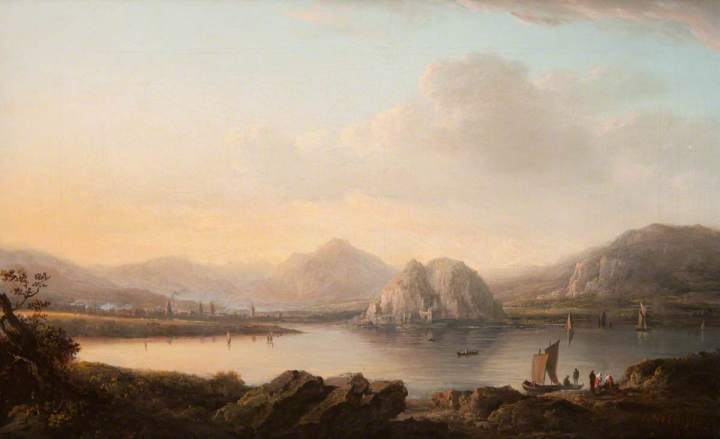
Alexander Nasmyth, Dumbarton Castle and Town with Ben Lomond, 1816, oil on canvas, 33 × 55 cm
(Glasgow: The Hunterian Art Gallery, University of Glasgow GLAHA_51732)
◊ ◊ ◊ ◊ ◊
Scheduled to open in January, the exhibition will instead be moved online with related programming soon to be announced (stay tuned); from The Hunterian:
Old Ways New Roads: Travels in Scotland, 1720–1832
(Online) The Hunterian Art Gallery, Glasgow, 29 January — 9 May 202
Curated by John Bonehill, Anne Dulau Beveridge, and Nigel Leask
Old Ways New Roads: Travels in Scotland 1720–1832 addresses the impact of Scotland’s new transport infrastructure on the development of travel, tourism and topographical descriptions of the nation between 1720 and 1832. Old Ways New Roads features paintings, prints, drawings, maps, manuscript tours, and other associated objects from The Hunterian and other public and private collections.
The laying out of new routes in the aftermath of the 1707 Act of Union and the 1715 Jacobite Uprising opened up Scotland (and especially the Highlands) not only to military occupation, but to the forces of commerce and trade and philosophical and scenic tourism. As a recent war zone, Scotland became imbued with aesthetic and topographical significance. Sites and places, old and modern, ruinous and thriving, were brought into view by travel along the military roads constructed by General George Wade and Major William Caulfield. Later, those designed by Thomas Telford under the aegis of the Commission for Highland Roads and Bridges, as well as canals and steam-boat routes, further opened up Scotland’s more inaccessible regions in the Romantic period. Old Ways New Roads traces how these dramatic ‘improvements’ to the Scottish landscape were variously documented, evaluated, planned, and imagined in word and image and more especially ‘framed up’ in terms of the experience of travel.
From Birlinn:
John Bonehill, Anne Dulau Beveridge, and Nigel Leask, eds., Old Ways New Roads: Travels in Scotland 1720–1832 (Edinburgh: Birlinn, 2021), 240 pages, ISBN: 978-1780276670, £20.
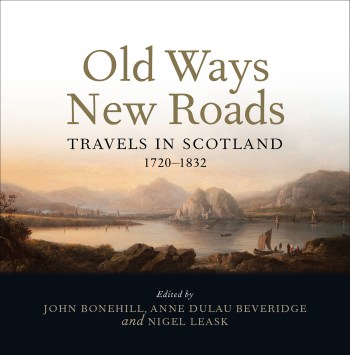 In 1725 an extensive military road and bridge-building programme was implemented by the British crown that would transform 18th-century Scotland. Aimed at pacifying some of her more inaccessible regions and containing the Jacobite threat, General Wade’s new roads were designed to replace ‘the old ways’ and ‘tedious passages’ through the mountains. Over the next few decades, the laying out of these routes opened up the country to visitors from all backgrounds. After the 1760s, soldiers, surveyors, and commercial travellers were joined by leisure tourists and artists, eager to explore Scotland’s antiquities, natural history, and scenic landscapes and to describe their findings in words and images. Here, a number of acclaimed experts explore how the Scottish landscape was variously documented, evaluated, planned, and imagined in words and images. As well as a fascinating insight into the experience of travellers and tourists, the book also considers how they impacted on the experience of the Scottish people themselves.
C O N T E N T S
Foreword
Notes on Contributors
Acknowledgements
Introduction
1 Writing the Scottish Tour 1720–1830, Nigel Leask
SECTION 1 | The Theatre of War, John Bonehill
2 The Ethnology of the ‘Old Ways’ in Gaelic Scotland, Hugh Cheape
SECTION 2 | Antiquities, Nigel Leask
3 Natural History, Fredrik Albritton Jonsson
SECTION 3 | Custom and Improvement, John Bonehill
4 Roads, Bridges and Designed Landscapes on the Highland Circuit, Christopher Dingwall
5 Scotland’s Prospects, John Bonehill
SECTION 4 | Picturesque Prospects and Literary Landscapes, John Bonehill and Nigel Leask
6 Portable Knick-knacks or the Material Culture of Travel, Viccy Coltman
7 Panoramas and Landscape, Christina Young
8 Picturesque Tours of Wales and Ireland, Mary-Ann Constantine and Finola O’Kane
Bibliography
Photograph Credits
Index
◊ ◊ ◊ ◊ ◊
Note (added 6 January 2021) — The original posting did not include the contents.
Exhibition | Sublime on the Small Scale
From The Morgan:
Sublime on the Small Scale
The Morgan Library & Museum, New York, 29 September 2020 — 12 September 2021

Gustaf Söderberg, The Grotto of Posillipo, Naples, 1820, oil on paper, irregularly cut, mounted to Masonite (Thaw Collection, Jointly Owned by The Metropolitan Museum of Art and The Morgan Library & Museum, Gift of Eugene V. Thaw, 2009).
In 1757, the British statesman and philosopher Edmund Burke published A Philosophical Enquiry into the Origin of Our Ideas of the Sublime and Beautiful, an aesthetic treatise that profoundly influenced artists across Europe well into the nineteenth century. Burke understood the Sublime as deriving from “whatever is fitted in any sort to excite the ideas of pain, and danger, that is to say, whatever is in any sort terrible…or operates in a manner analogous to terror.” He emphasized the powerful, even pleasurable, emotional response that could arise from the contemplation of such possibilities, particularly when considered from a place of safety.
Many artists turned to the natural world as their principal source of the Sublime, emphasizing its magnitude and power. While the Sublime is mostly associated with large-scale oil paintings intended to engulf and overwhelm viewers, artists frequently worked on a smaller scale to develop and experiment with their representations. They endeavored to render nature and its effects faithfully by sketching en plein air, particularly on their travels through dramatic landscapes. The oil sketches displayed here engage with a range of Sublime effects, from the impressive vastness of a mountain range and the thrill of rushing water to the terror of a raging storm.
Sublime on the Small Scale highlights works from the collection of oil sketches given jointly to The Morgan and The Metropolitan Museum of Art by Trustee Eugene V. Thaw.
Exhibition | Carmontelle (1717–1806)

Carmontelle, Self-Portrait, ca. 1762; graphite, watercolor, red chalk, and gouache on paper
(Chantilly: Musée Condé)
◊ ◊ ◊ ◊ ◊
From the Domaine de Chantilly:
Carmontelle (1717–1806), ou la Douceur de Vivre / And the Age of Pleasures
Musée Condé, Château de Chantilly, 5 September 2020 — 28 March 2021
Curated by Nicole Garnier
A playwright, draughtsman, and landscape architect, Louis Carrogis— known as Carmontelle—was a brilliant connoisseur whose many talents reflect the cultivated and cosmopolitan world in which he lived. The organizer of festivities for the Duke of Orléans, famous for his portraits and improvised comedies called Proverbes, Carmontelle designed the Parc Monceau in Paris for the Duke of Chartres and perfected transparencies or long rolls of paper depicting delightful landscapes.
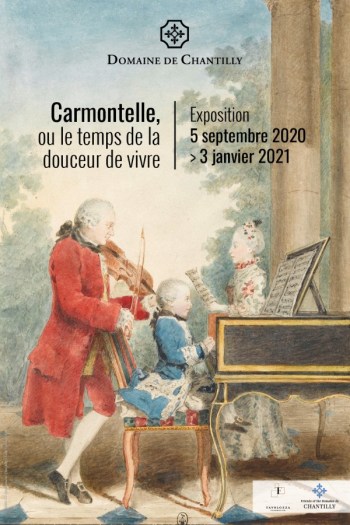 With sitters ranging from Mozart to Buffon, from Rameau to Baron Grimm, Carmontelle created a faithful portrait of mid-18th century Parisian society: princes of the blood, writers, philosophers, musicians, scientists, and elegant beauties of the ‘age of pleasures’—words coined by Talleyrand to describe the Ancien Régime. Thanks to Henri d’Orléans, Duke of Aumale (1822–1897), descendant of the Orléans who acquired the majority of this ensemble, the Condé museum at Chantilly has the best collection in the world of Carmontelle’s works with 484 drawn portraits and one transparency.
The son of a master cobbler, Louis Carrogis took the name ‘Carmontelle’ in 1744 after studying geometry. A topographer during the Seven Years’ War (1756–1763), he spent his spare time making portraits of the officers and organizing improvised comedies. In 1759, he entered the service of the Duke of Orleans as tutor to the young Duke of Chartres (1747–1793), the next Duke of Orléans and future Philippe Egalité; and from 1755 to 1784, he created ‘bad but accurate likenesses’ (Grimm) in gouache and watercolour of the entire court of the Orléans family at the Palais-Royal, Saint-Cloud, and Villers-Cotterêts. As an amateur draughtsman, Carmontelle preferred profile portraits for their ease of execution.
Nicole Garnier-Pelle, Carmontelle (1717–1806) ou le Temps de la Douceur de Vivre: Collection les Carnets de Chantilly n11 (Dijon: Éditions Faton, 2020), 96 pages, ISBN: 978-2878442779, €20.
Note: The exhibition, originally scheduled to close in January, has been extended until the end of March.
Exhibition | Lines from Life: French Drawings
From The Clark—and please note next Thursday’s conversation with Ewa Lajer-Burcharth and Anne Leonard, the details of which are included below:
Lines from Life: French Drawings from the Diamond Collection
The Clark Art Institute, Williamstown, Massachusetts, 12 July — 13 December 2020
Curated by Kristie Couser
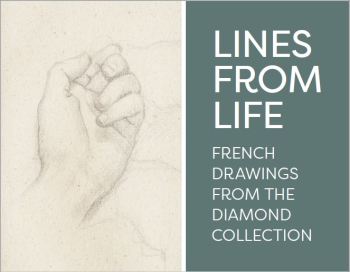 Nineteenth-century French figure drawings embody a conceptual tension between academic methods of drawing the human form and freer approaches that challenged those conventions. The curriculum of the state-sponsored École des Beaux-Arts (School of Fine Arts) in Paris and the esteemed Académie de France (French Academy) in Rome long considered drawings of the nude, studied and sketched live in the classroom, to be the ultimate measure of an artist’s skill. Modeled after ancient Greek and Roman sculpture and Renaissance examples, the predominantly white and male figure centered in works exploring historical, mythological, and religious themes was a physique that was not reflective of the diversity of human bodies. By midcentury many French artists—including those who originally trained in academic studios—signaled their creative independence with portraits and genre scenes representing ordinary and working people in natural poses. This exhibition traces transformations in figure drawing during a period in which these developing interests in Realism and contemporary life diverged from the idealism championed by public institutions.

François Louis Joseph Watteau (1758–1823), Sheet of Studies for ‘The Battle of Alexander’, ca. 1795; black chalk on off-white paper (The Clark Art Institute, Gift of Herbert and Carol Diamond, 2018.11.13).
The works on view span the nineteenth century and reveal the varied uses of figure drawing. Detailed studies addressing a model’s features and form commingle with swiftly drawn sketches that explore gesture and movement. Sheets bearing grid lines and handwritten annotations demonstrate the relationships between drawing and other media, including painting and printmaking. Many of these works illuminate the versatility of graphite, the primary instructional medium before the middle of the century. Compositions by artists associated with Realism, Impressionism, and other late nineteenth-century art currents evoke how the infusion of diverse media—chalk, charcoal, Conté crayon, and color pastel—often bolstered experimentation as artists increasingly depicted the people around them.
In celebration of the generous, ongoing gift of Herbert and Carol Diamond, this exhibition highlights works from the couple’s remarkable collection of more than 160 French drawings and sculptures, which they have assembled since 1964. The Diamonds’ particular fascination with the preparatory role of drawing broadens the Clark’s presentation of nineteenth-century French art—the cornerstone of the museum’s founding gift—and introduces works by artists not previously represented in the collection. Select figure studies from the Clark’s collection, which has continued to expand, join this display in the spirit of inviting a new look.
Lines from Life: French Drawings from the Diamond Collection is organized by the Clark Art Institute and curated by Kristie Couser, curatorial assistant for works on paper.
◊ ◊ ◊ ◊ ◊
Clark Connects with Ewa Lajer-Burcharth
(Online) Thursday, 6:00–7:00pm, 3 December 2020
Join Ewa Lajer-Burcharth for a conversation on nineteenth-century drawing and the role of the body image. Professor Lajer-Burcharth, whose research spans from eighteenth and nineteenth-century European art to contemporary art, as well as feminist and critical theory, will be in dialogue with Manton Curator of Prints, Drawings, and Photographs Anne Leonard.
Registration (required to receive Zoom log-in details) is available here.
Ewa Lajer-Burcharth is William Dorr Boardman Professor of Fine Arts in the Department of History of Art & Architecture at Harvard University. She specializes in eighteenth- and nineteenth-century French art and has written extensively on contemporary art.
Exhibition | Alexander von Humboldt and the United States

Now on view at SAAM:
Alexander von Humboldt and the United States: Art, Nature, and Culture
Smithsonian American Art Museum, Washington, DC, 18 September 2020 — 3 January 2021
Organized by Eleanor Jones Harvey
Renowned Prussian naturalist and explorer Alexander von Humboldt was one of the most influential figures of the nineteenth century. He lived for 90 years, published more than 36 books, traveled across four continents, and wrote well over 25,000 letters to an international network of colleagues and admirers. In 1804, after traveling four years in South America and Mexico, Humboldt spent exactly six weeks in the United States. In these six weeks, Humboldt—through a series of lively exchanges of ideas about the arts, science, politics, and exploration with influential figures such as President Thomas Jefferson and artist Charles Willson Peale—shaped American perceptions of nature and the way American cultural identity became grounded in our relationship with the environment.
Alexander von Humboldt and the United States: Art, Nature, and Culture places American art squarely in the center of a conversation about Humboldt’s lasting influence on the way we think about our relationship to the natural world. Humboldt’s quest to understand the universe—his concern for climate change, his taxonomic curiosity centered on New World species of flora and fauna, and his belief that the arts were as important as the sciences for conveying the resultant sense of wonder in the interlocking aspects of our planet—make this a project evocative of how art illuminates some of the issues central to our relationship with nature and our stewardship of this planet.

Charles Willson Peale, Self-Portrait with Mastodon Bone, 1824, oil on canvas, 26 × 22 inches (New-York Historical Society, Purchase, James B. Wilbur Fund).
This exhibition will be the first to examine Humboldt’s impact on five spheres of American cultural development: the visual arts, sciences, literature, politics, and exploration, between 1804 and 1903. It centers on the fine arts as a lens through which to understand how deeply intertwined Humboldt’s ideas were with America’s emerging identity. The exhibition includes more than 100 paintings, sculptures, maps, and artifacts as well as a video introduction to Humboldt and his connections to the Smithsonian through an array of current projects and initiatives.
Artworks by Albert Bierstadt, Karl Bodmer, George Catlin, Frederic Church, Eastman Johnson, Samuel F.B. Morse, Charles Willson Peale, John Rogers, William James Stillman, and John Quincy Adams Ward, among others, will be on display. The installation features a digital exploration of Frederic Church’s famous landscape, Heart of the Andes (1859), enabling visitors to engage with the painting’s details in new ways. The wealth of detail is a painterly extrapolation of Humboldt’s plant geography map. The mountain at the center of the work, Chimborazo, was referred to as ‘Humboldt’s Mountain’. The narrated, 2.5D animated projection enables visitors to appreciate the connections between Church’s painting and Humboldt’s ideas.
The exhibition also includes the original ‘Peale Mastodon’ skeleton, on loan from the Hessisches Landesmuseum Darmstadt, with ties to Humboldt, Peale and an emerging American national identity in the early nineteenth century. Its inclusion in the exhibition represents a homecoming for this important fossil that has been in Europe since 1847, and emphasizes that natural history and natural monuments bond Humboldt with the United States.
Alexander von Humboldt and the United States: Art, Nature, and Culture is organized by Eleanor Jones Harvey, senior curator at the Smithsonian American Art Museum. A major catalogue, written by Harvey, accompanies the exhibition. The book shows how Humboldt inspired a network of like-minded individuals who would go on to embrace the spirit of exploration, decry slavery, advocate for the welfare of Native Americans and extol America’s wilderness as a signature component of the nation’s sense of self. Harvey traces how Humboldt’s ideas influenced the transcendentalists and the landscape painters of the Hudson River School, and laid the foundations for the Smithsonian, the Sierra Club, and the National Park Service.
Eleanor Jones Harvey, Alexander von Humboldt and the United States: Art, Nature, and Culture (Princeton: Princeton University Press, 2020), 448 pages, ISBN: 978-0691200804, £62 / $75.
Online Exhibition | Participez à la vie des académies d’art
Announcing the exhibition:
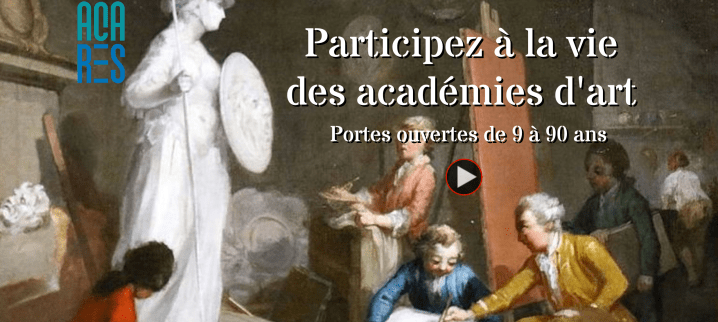
Participez à la vie des académies d’art… Portes ouvertes de 9 à 90 ans
An online exhibition of the ACA-RES programme
Organized by Émilie Roffidal and Anne Perrin Khelissa
How were artists and craftsmen trained in French art academies in the age of Enlightenment? The virtual exhibition Participez à la vie des académies d’art. Portes ouvertes de 9 à 90 ans is now available online. The result of a collective work combining research and training, the exhibition presents a selection of works from the teaching material and artistic production of art academies and provincial art schools in the 18th century. Most of the collections from these institutions were dispersed during the French Revolution between city museums, libraries, and other heritage collections such as art schools. Painted portraits of teachers, pupils, or amateurs are included, providing a more vivid testimony of the institutions. A whole little-known part of French heritage is honoured here.
This exhibition has been developed within the framework of the ACA-RES research programme on art academies and their networks in pre-industrial France (Les Académies d’art et leurs réseaux dans la France préindustrielle) supported by the FRAMESPA UMR 5136 laboratory of the Toulouse-Jean Jaures University, the Labex SMS, the Deutsches Forum Für Kunstgeschichte of Paris and the Centre National d’Histoire de l’art.
Print Quarterly, September 2020

Johann Jakob Mettenleiter, Double Portrait of Johann Elias Haid and Johann Jakob Mettenleiter, ca. 1778–84, oil on copper, 31 × 38 cm (image courtesy Boris Wilnitsky Fine Arts, Vienna).
◊ ◊ ◊ ◊ ◊
The eighteenth-century in the latest issue of Print Quarterly (with apologies for being so slow! -Craig).
Print Quarterly 37.3 (September 2020)
A R T I C L E S
Julie Mellby, “Audubon’s Copperplates for Birds of America”, pp. 283–93.
After a brief introduction to John James Audubon’s (1785–1851) life and the publication history of his famous Birds of America, this article explores the afterlife of the copperplates. Partly damaged during a fire and later sold as used copper, some of these objects were eventually acquired and restored by William E. Dodge II (1832–1903). Their history interestingly overlaps with the history of important American institutions, such as the Metropolitan Museum of Art and the Princeton University Art Museum.
Marianne A. Yule, “A Friendship Portrait of J. J. Mettenleiter and J. E. Haid”, pp. 294–99.
This piece focuses on a newly discovered painting and its related mezzotint, the only known collaborative work between the printmaker John Elias Haid (1739–1809) and the painter Johann Jakob Mettenleiter (1750–1825). It explores the history of the image and identifies all the prints depicted therein.
N O T E S A N D R E V I E W S
Peter Van Der Coelen, Review of Henk van Nierop, The Life of Romeyn de Hooghe 1645–1708: Prints, Pamphlets, and Politics in the Dutch Golden Age (2018), pp. 314–16.
The note, as the book it reviews, sheds light on the lesser known, yet extremely prolific Romeyn de Hooghe (1645–1708), a printmaker operating between the Netherlands and Paris. His prints depict the political events of the day, such as the French invasion of Holland, as well as fashionable pastimes, as exemplified by his illustrations for a treatise on wrestling. De Hooghe’s life and work attest to the rising dominance of France all over Europe in the age of Louis XIV, both politically and artistically.
Domenico Pino, Review of Xavier F. Salomon, Andrea Tomezzoli and Denis Ton, Tiepolo in Milan: The Lost Frescoes of Palazzo Archinto (2019), pp. 319–21.
The catalogue under review reconstructs a cycle of frescoes commissioned for an aristocratic Milanese palace and destroyed during World War II. The note focuses on one chapter in particular, analysing Giambattista Tiepolo’s (1697–1770) early career as a book illustrator in Verona and Milan in the 1720s and ’30s, reading it in the context of the cultural fervour that spread all over Italy following the war of Spanish succession.
Domenico Pino, Review of Canaletto & Venezia (2019), pp. 321–22.
The note offers an overview of eighteenth-century Venice and the cultural fervour it hosted. The exhibition catalogue explores in detail the artistic career of Canaletto (1697–1768), Giambattista Tiepolo (1697–1770) and Giambattista Piazzetta (1682–1754), and discusses the developments of artistic trends in furniture, glass, porcelain and architecture in Venice throughout the century up to the fall of the Republic in 1797.
Elizabeth Rudy, Review of Aude Prigot, La Réception de Rembrandt à traversles estampes en France au XVIIIe siècle (2018), pp. 322–25.
The note explores the impact Rembrandt had on artists from the eighteenth through to the twenty-first century. In particular it focuses on the practice of collecting his prints in eighteenth-century France and that of copying his composition in the later part of the century. The main case studies are five French artists, among them Claude-Henri Watelet (1718–86) and Dominique Vivant-Denon (1747–1825).
Exhibition | François Boucher: Rococo Artist

François Boucher, Shepherd and Shepherdess, 1760, oil on canvas, 81 × 65 cm
(Staatliche Kunsthalle Karlsruhe)
◊ ◊ ◊ ◊ ◊
Opening next month at the Staatliche Kunsthalle:
François Boucher: Künstler des Rokoko / Artiste Rococo
Staatliche Kunsthalle Karlsruhe, 14 November 2020 — 7 February 2021
François Boucher (1703–1770) est encore considéré de nos jours comme l’artiste rococo français par excellence. À l’occasion du 250e anniversaire de sa mort, la Kunsthalle de Karlsruhe présente la première exposition en Allemagne qui lui soit exclusivement consacrée.
 Bien que né dans un milieu modeste, Boucher s’est affirmé comme l’un des principaux artistes de son époque. Premier peintre du roi, il comptait parmi ses commanditaires la marquise de Pompadour ainsi que la margravine Caroline-Louise de Bade. Son style rayonna dans toute l’Europe et ses compositions furent reprises pour un grand nombre de tapisseries et de décors de théâtre, de meubles et de porcelaines.
La diversité des styles qu’il aborda et des sujets qu’il traita reste impressionnante jusqu’à l’heure actuelle. Ses élégantes scènes de genre ainsi que les représentations qu’il a données de paysages bucoliques et de sujets mythologiques se distinguent par leur inventivité, leur humour et l’ironie qui s’en dégage. Par leur exécution subtile et leur palette délicate, ses œuvres nous sensibilisent à la sensualité pouvant irradier d’une toile.
Ses dessins et ébauches à l’huile illustrent parfaitement sa manière de travailler. Tantôt puissantes et virtuoses, tantôt empreintes de retenue et témoins d’une introspection, ces esquisses s’affirment comme desœuvres d’art à part entière.
Artiste fascinant, Boucher, a ainsi développé un style très riche dont l’influence est perceptible jusque dans l’art moderne – Un style que l’exposition de la Kunsthalle permettra de redécouvrir.
L’exposition se complète par une installation sonore d’Elina Lukijanova qui reproduit des éléments stylistiques du Rococo à l’aide de bruits et de mots de notre époque.
Astrid Reuter, ed., François Boucher: Künstler des Rokoko (Cologne: Wienand, 2020), 336 pages, ISBN: 978-3868325812, 45€. With essays by Astrid Reuter, Barbara Bauer, Alexander Eiling, Peter Fuhring, Holger Jacob-Friesen, Melissa Hyde, Oliver Jehle, Françoise Joulie, Alastair Laing, Hans Plechinski, Aileen Ribeiro, Dorit Schäfer, Martin Schieder, Perrin Stein, Christoph Martin Vogtherr, and Kirsten Voigt.
Exhibition | The Torlonia Marbles
Notice of the exhibition appeared here at Enfilade last November; here’s the updated information; the catalogue is published by Electa.
The Torlonia Marbles: Collecting Masterpieces
I Marmi Torlonia: Collezionare Capolavori
Musei Capitolini at Palazzo Caffarelli, Rome, 14 October 2020 — 29 June 2021
Curated by Carlo Gasparri and Salvatore Settis
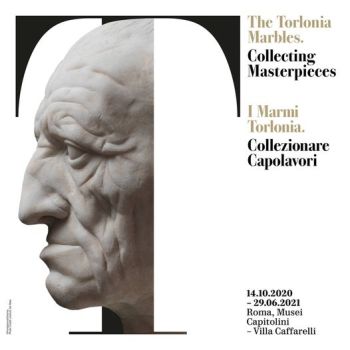 The Torlonia Marbles: Collecting Masterpieces presents 96 works selected from the 620 cataloged marbles belonging to the Torlonia Collection, the prestigious private collection of ancient sculptures, significant for the history of art, excavations, restoration, taste, museography, and archaeological studies. The exhibition is organized in five sections, telling the story of the collecting of ancient Greek and Roman marbles in reverse chronology beginning with the founding of the Torlonia Museum in 1875 by Prince Alexander Torlonia. The second section brings together the nineteenth-century finds of antiquity in the Torlonia properties. The next section addresses eighteenth-century collecting, with sculptures from the acquisitions of Villa Albani and the collection of the sculptor and restorer Bartolomeo Cavaceppi. A selection of sculptures owned by Vincenzo Giustiniani, one of the most sophisticated Roman collectors of the seventeenth century then follows, with the final section presenting pieces from collections of aristocratic families of the fifteenth and sixteenth centuries.










 Enfilade
leave a comment