Exhibition | Exotic Switzerland? Looking Outward
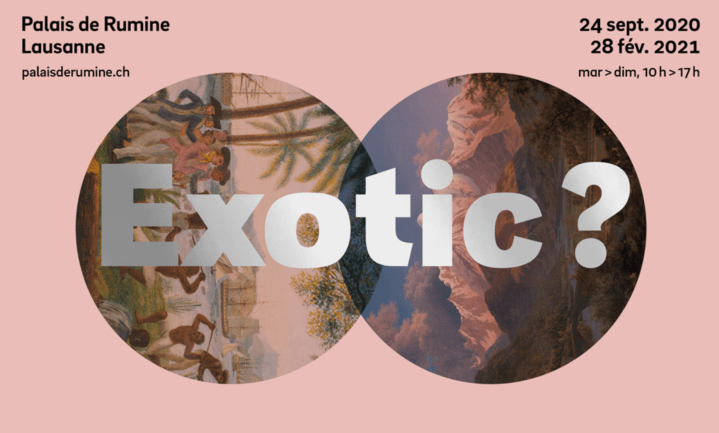
Opening next week at the Palais de Rumine:, with additional information, including programming, available here»
Une Suisse exotique? Regarder l’ailleurs en Suisse au siècle des Lumières
Exotic Switzerland? Looking Outward in the Age of Enlightenment
Palais de Rumine, Lausanne, 24 September 2020 — 28 February 2021
Organized by Noémie Étienne
What is exotic? How long has this word been used? How do we define what is exotic and what is not? Is Switzerland exotic? In Europe, the Enlightenment is a key period in building up this view, of which we are still the heirs. This era was that of both human rights and the quadrangular trade, including trade in enslaved people. It can be reread critically. Swiss history is often only considered within the borders of Europe, but the Swiss maintained close and complex ties with distant countries.
Why This Exhibition?
 This exhibition is the result of a collaboration between the team of Professor Noémie Étienne (Bern University, Swiss National Science Foundation) and the three museums of science and history of the Palais de Rumine. Exotic? will be presented in the large temporary exhibition rooms of the Palais. It offers a historical and critical perspective in order to understand the emergence of this view of the Other and the acts of classification that accompanied it. Indeed, nothing is ‘exotic’ in itself: exoticism is the product of representations, mediations, and translations, which assign a place to things and people in a given historical and political context. This exhibition depicts the image of a dynamic and complex Switzerland that became part of the world, mostly through individual initiatives. It also adds complexity to an idealised interpretation of the 18th century, which was certainly an era of great scientific and artistic innovation but also of the first economic globalisation, and colonisation.The issues of colonialism, power, gender, race and economy are at the heart of this exhibition, which aims at reflecting about Switzerland’s past, especially the careers of individuals who wished to take part in colonisation and international trade.
Who Were Swiss Travellers in the 18th Century?
Many Swiss People travelled beyond the borders, mostly individually. However, these journeys were often made under the aegis of a foreign crown and were often linked to economic, political, and religious networks that could go beyond the borders of the territory (Huguenot, banking, missionary, foreign service, and military networks). These travellers settled in the countries they visited and developed their careers in close cooperation with the peoples and territories concerned.The objects that were collected by artists and scientists in the 18th century were brought back to Switzeland and included in local collections. Two types of collection can be differentiated: on one hand, those made through intermediaries that accompanied British and French national explorations, and on the other hand those created directly by Swiss People. During these voyages, which lasted several years, the crews collected objects and specimens that they brought back to Europe and then traded or sold. At the same time, they kept travel journals and filled sketchbooks in which they described the objects and the contexts of what they collected as well as the peoples they encountered.
The nature of the objects that were collected by Swiss People has many commonalities with examples that can be studied in neighbouring countries. One of the characteristics was the use of collections for education, particularly due to the presence of cabinets in the Protestant Academies, such as in Lausanne and Zurich. This use was part of a pedagogical process that favoured a pragmatic view of things, and differentiated the cabinets of the Swiss Academies from the German ‘Wunderkammer’, the royal cabinets and the princely collections of European courts.
Innovation and Technology Transfer
The circulation of techniques and objects that came from the outside world promoted the development of new technologies all over Europe and especially in Switzerland. This was the case of the porcelain factories in Zurich and Nyon that produced for a local clientele. However, other factories that developed in Switzerland manufactured objects (watches, enamels) for export to China and Turkey. The cities of Basel, Geneva and Neuchâtel also produced printed textiles known as ‘Indian chintz’, imitating a technique used in India.
Is Switzerland Exotic?
Switzerland became gradually a subject of curiosity for travellers who were interested in its folklore and landscapes: it was therefore exotic for those who visited it. This movement was prepared from the 18th century onward by the inhabitants of the large cities: they built up an image of Alpine and rural cultures that was a great success and that can still be found today in advertising and in tourist marketing.
Public and Cultural Mediation
The exhibition aims at reaching all kinds of people, especially through a varied scientific and cultural programme, while putting forward a new approach to Swiss history. It will attempt to connect the images that were produced in the 17th and 18th centuries to imaginations by offering avenues for thinking about alterity today through a historical perspective and contemporary art (performances, sounds, images). In view of the sensitive subject, many mediation activities will accompany this exhibition: guided tours and workshops, of course, but also a play produced by high school students, short films made by the students of the Swiss film director Lionel Baier at the University of Art and Design ECAL, lectures in coffee grounds by the Women Telling The Future collective, lectures, and a partnership with the programme of the Vidy theatre.
Objects Displayed
The exhibition will bring together 150 pieces from more than 30 Swiss collections and cultural institutions. Most of these pieces are very rarely shown. The typologies of the objects are diverse: specimens of natural history, paintings, textiles, porcelains, non-European artefacts, archives, books and maps.
Contemporary Artists
There will be a selection of works by contemporary artists (Marie van Berchem, Fabien Clerc, Susan Hefuna, Senam Okudzeto and Uriel Orlow), giving a different perspective of the exhibited objects and of the more general aims of the exhibition.
Publications
The English edition of the catalogue is distributed in North America and Britain by The University of Chicago Press:
 Noémie Étienne with Claire Brizon, Chonja Lee, and Étienne Wismer, Une Suisse exotique ? Regarder l’ailleurs en Suisse au siècle des Lumières (Dijon: Les presses du réel, 2020), 376 pages, ISBN: 978-2889280520, 40€.
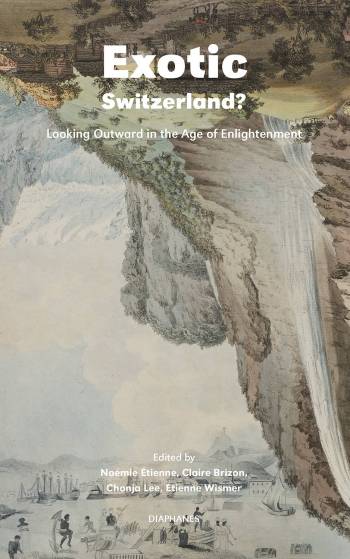
Noémie Étienne with Claire Brizon, Chonja Lee, and Étienne Wismer, Exotic Switzerland? Looking Outward in the Age of Enlightenment (Lausanne: Diaphanes, 2020), 256 pages, ISBN: 978-3035802276, $40.
Why is an object, an artwork, or a person deemed ‘exotic’? How is the gaze built upon those things or people who seem to belong to other regions or cultures? This notion is studied here in relation to a specific context: the Enlightenment era from the Swiss perspective. The publication brings together for the first time research from academics and specialists of the museum world in order to rethink this time period and this geography. It assembles contributions of essays as well as shorter texts centered on pictures, objects, books, and natural specimens from Swiss museum collections. ‘Exotic’, in this context, means that which comes from elsewhere and can be used and ‘improved’ for the benefits of European powers. This adjective invites us to reconsider both the long eighteenth century and the international history of Switzerland.
Noémie Étienne is professor of Early Modern Art History at the University of Bern. Claire Brizon is a doctoral student in art history at the University of Bern. Chonja Lee is a postdoctoral researcher at the University of Bern. Étienne Wismer is a doctoral student in art history at the University of Bern.
Exhibition | Royal Blue: William and Mary’s Finest Delftware
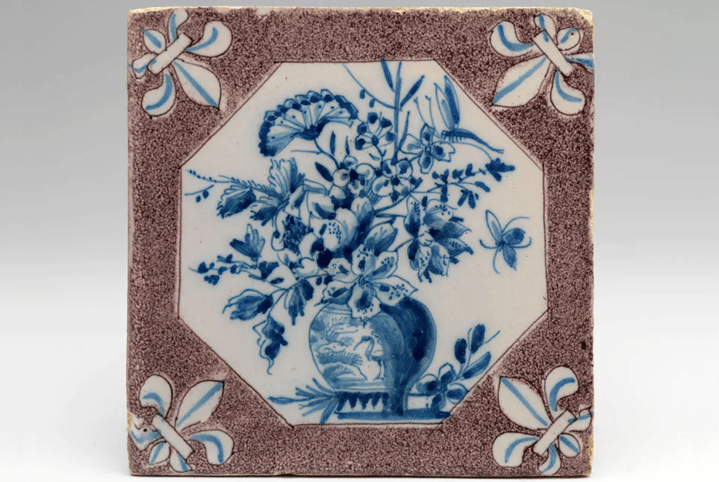
Tile from Princess Mary’s kitchen apartment in Palace Het Loo, ca. 1685
(Paleis Het Loo)
◊ ◊ ◊ ◊ ◊
Now on view at The Hague (with details on the related online lecture below). . .
Royal Blue: William and Mary’s Finest Delftware / Koninklijk Blauw: Het mooiste Delfts aardewerk van Willem en Mary
Kunstmuseum den Haag, 1 June — 22 November 2020
Curated by Suzanne Lambooy
Delft Blue, the iconic Dutch earthenware, is known all over the world. It remains popular to this day, and although we think we know its history, we continue to discover new things about it. Many of the greatest masterpieces of Delftware are in collections abroad, and so are seldom, if ever, seen in the Netherlands. That is all about to change this spring, however, as Kunstmuseum Den Haag brings many of them together for the first time in an exhibition that will include top items from Hampton Court Palace and the V&A in London. The public will be able to discover some of the finest Delftware ever commissioned: the Royal Blue made for William and Mary. To celebrate the 400th anniversary of Delftware, and as an ode to the friendship between Britain and the Netherlands, this spring Kunstmuseum Den Haag will present a story of Orange in blue and white, a tale of fragile diplomacy and breathtaking grandeur. Royal Blue will show how a 17th-century English queen continues to colour the Netherlands’ identity today.
British-Dutch Ties
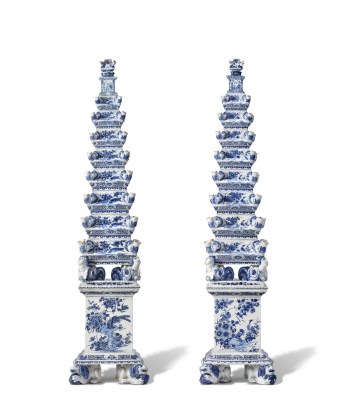
Pyramid-shaped Flower Vases, ca. 1690, Delft (Kunstmuseum den Haag).
From tall flower pyramids to garden vases and preserve dishes: in the late seventeenth century the potteries of Delft made the most beautiful tin-glazed earthenware in Europe. The heyday of Delftware coincided with the reign of William III (1650–1702) and Mary II Stuart (1662–1695). They collected both Chinese porcelain and the attractive, refined ceramic ware from Delft. Indeed, they were leading champions of the earthenware made in Delft. Mary, in particular, was a true ambassador for Delftware, and she commissioned special pieces from De Grieksche A pottery for her own collection. The exhibition will focus on the period 1689–1702, when stadtholder William III and Mary II Stuart were also king and queen of England, Scotland, and Ireland. Royal Blue will introduce visitors to the rich cultural heritage that grew out of the ties between the Netherlands and Britain in the seventeenth century.
Popular Collector’s Item
Chinese porcelain was occasionally seen in Europe from the fifteenth century onwards, but it was rare and costly. The United East India Company’s trade with Asia in the seventeenth century increased imports to the Netherlands, and ‘China’ became popular with collectors. Mary’s grandmother, Amalia van Solms, had a lot of porcelain on display in her residences. Mary, too, was an avid collector, and there were porcelain objects in every one of her eight palaces in the Dutch Republic. But she also collected Delftware. She admired the imitations of Chinese blue-and-white porcelain made by the potteries in Delft, which had succeeded in producing fine imitations of the shapes, colours, and decorations of porcelain. Fragments of the earliest blue-and-white ceramics collected by Mary have survived at Het Loo Palace.
Het Loo Palace
The exhibition has come about thanks to a unique collaboration with Het Loo Palace, which William and Mary had built in Apeldoorn in 1685–86 for use on hunting trips. The decorative arts, including ceramics, played an important role in the interior design of the palace. No complete Delftware objects have survived there, but the many fragments dug up in the gardens of Het Loo, and the similar items purchased on this basis, give a unique glimpse of the kind of Delftware that once graced the halls and chambers of the palace. These archaeological finds are quite extraordinary as they are the only surviving examples of Delftware owned by William and Mary anywhere in the world, and the earliest examples of royal Delftware in the Netherlands. Het Loo Palace is currently undergoing renovations and alterations, so its unique collection of Delftware is temporarily in The Hague. The baroque gardens of Het Loo will be open again from 31 March 2020, and the Delftware garden vases based on the seventeenth-century ones owned by the royal couple will be displayed there in their original setting from 1 June.
English Grandeur
Mary probably had a role in the creation and development of some exceptional pieces of Delftware. Decorations featuring crowns, the Orange-Nassau family coat of arms, and the monograms of William and Mary lend royal allure to the Delftware produced after they were crowned King and Queen of England, Scotland and Ireland. The influence of court-appointed designer Daniel Marot (1660/61–1752) can clearly be seen in this ‘Royal Blue’. Many other European monarchs followed Mary’s example in ordering personalised earthenware items from Delft.
Several of Mary’s flower pyramids from England are now kept at Hampton Court Palace. Mary had a pavilion in the garden there, known as the Water Gallery, which was decorated with Delftware. Besides highlights from Hampton Court Palace, the exhibition will also reunite the Delftware wall tiles from the Water Gallery which are currently in the collections of five different museums. Loans from Het Loo Palace, the Rijksmuseum, Museum Prinsenhof Delft, and many international museums will bring William and Mary’s Delftware together again for the first time.
Royal Symbol
Two magnificent pieces from Kunstmuseum Den Haag’s own collection—Delft Blue vases in the shape of William and Mary—will form the centrepiece of the exhibition. They were separated for 40 years in two different private collections until the museum reunited them in 2015. In Royal Blue they symbolise the important role the couple played in popularising Delft Blue. The commissions that De Grieksche A is known to have produced for Mary as queen are part of the Netherlands’ internationally renowned cultural heritage. They are still imitated in contemporary royal commissions, like the new state banquet dinner service Blossom Panache made in 2017, the design sketches and several pieces of which will be included in the exhibition, and also in an installation inspired by the wall coverings made for the Blue Drawing Room at Huis ten Bosch Palace in 2019.
◊ ◊ ◊ ◊ ◊
Suzanne Lambooy, Royal Blue: William and Mary’s Finest Delftware
French Porcelain Society Online Lecture, Saturday, 20 June 2020, 19.00 (BST)
The French Porcelain Society continues its series of weekly online lectures with Suzanne Lambooy, who will walk us through her exciting new exhibition Royal Blue: William and Mary’s finest Delftware, which opened on 1 June 2020 at the Kunstmuseum, in the Hague (formerly known as the Gemeentemuseum) and runs until 22 November 2020. It was one of the first museum exhibitions to open following lockdown! We hope that you can all join us. Members will receive an email invitation with instructions on how to join the online lecture. If you want to join, please contact us for more details on FPSenquiries@gmail.com.
Award Winning Exhibition | Spaces of Wonder, Wonder of Spaces
Recently announced by the Association of College and Research Libraries, with a full list of winners here. Congratulations, Christina Smylitopoulos! More information on the Bachinski / Chu Print Study Collection is available here.
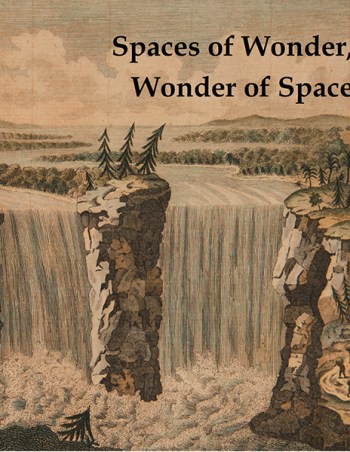
The exhibition catalogue Spaces of Wonder, Wonder of Space: Encountering the Eighteenth Century in Image, Object, and Text, edited by Christina Smylitopoulos, has been selected as a winner of the Katharine Kyes Leab & Daniel J. Leab Exhibition Award (Division Three) by the Association of College and Research Libraries (ACRL), Rare Books and Manuscripts Section (RBMS). This collaborative, multi-venue show was developed in conjunction with the 2018 Société canadienne d’étude du dix-huitième siècle / Canadian Society for Eighteenth-Century Studies conference held in Niagara Falls, Ontario, which was organized jointly by Mount Allison University (MAU; Sackville, New Brunswick) and the University of Guelph (Guelph, Ontario).
The show, which featured works from the Bachinski / Chu Print Study Collection and objects from the McLaughlin Library’s Archival & Special Collections and the Barker Museum of Veterinary History (October 2018 – April 2019) was funded by the Social Science and Humanities Research Council of Canada project Wonder in the Eighteenth Century (Christina Ionescu / Christina Smylitopoulos) and reflects the work of undergraduate students pursuing experiential learning opportunities, graduate students in Art/History, and faculty and curatorial colleagues from Mount Allison University the UofG’s College of Arts.
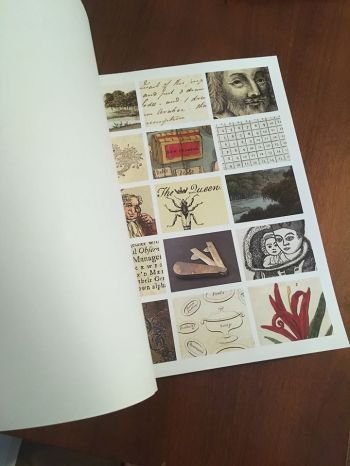 “The content and conceit of this publication is commendable. The central thesis concatenating the objects was compelling and original, offering a discussion not just of objects but also how they are perceived. The committee appreciated the collaborative approach to this topic, which gave space to a wide range of voices and approaches from students to faculty.” –Leab Awards Committee
Newly Installed British Galleries at The Met
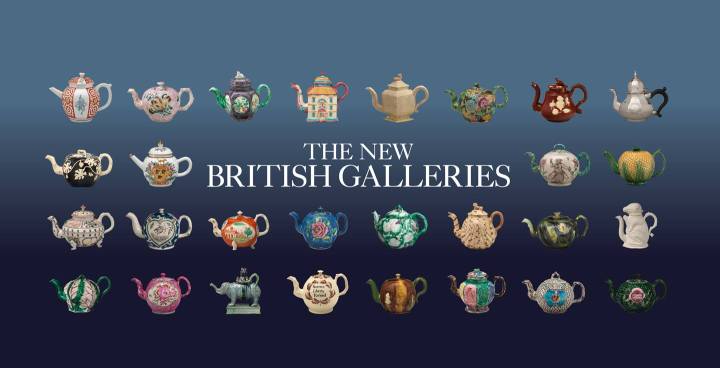
Press release (24 February 2020) from The Met, with the audio guide here:
A highlight of The Metropolitan Museum of Art’s 150th anniversary in 2020 is the opening of the Museum’s newly installed Annie Laurie Aitken Galleries and Josephine Mercy Heathcote Gallery—11,000 square feet devoted to British decorative arts, design, and sculpture created between 1500 and 1900. The reimagined suite of 10 galleries (including three superb 18th-century interiors) provides a fresh perspective on the period, focusing on its bold, entrepreneurial spirit and complex history. The new narrative offers a chronological exploration of the intense commercial drive among artists, manufacturers, and retailers that shaped British design over the course of 400 years. During this period, global trade and the growth of the British Empire fueled innovation, industry, and exploitation. Works on view illuminate the emergence of a new middle class—ready consumers for luxury goods—which inspired an age of exceptional creativity and invention during a time of harsh colonialism.
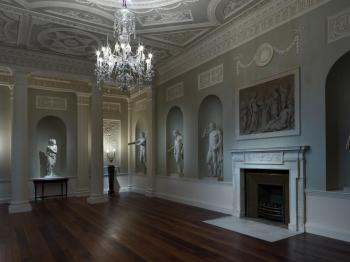
Installation view of The Met’s New British Galleries, Lansdowne Dining Room (Photo by Joseph Coscia, February 2020).
The British Galleries are reopening with almost 700 works of art on view, including a large number of new acquisitions, particularly works from the 19th century that were purchased with this project in mind. This is the first complete renovation of the galleries since they were established (Josephine Mercy Heathcote Gallery in 1986, Annie Laurie Aitken Galleries in 1989). A prominent new entrance provides direct access from the galleries for medieval European art, creating a seamless transition from the Middle Ages to the Renaissance. A 17th-century staircase with exquisite naturalistic carvings—brought to The Met in the 1930s from Cassiobury House, a now-lost Tudor manor—has been meticulously conserved and re-erected in the new galleries. Three magnificent 18th-century rooms from Kirtlington Park, Croome Court, and Lansdowne House have been transformed by new lighting and painstaking conservation and remain at the heart of the galleries.
“The Met’s extraordinary collection of British decorative arts is unparalleled on this side of the Atlantic, and the redesigned galleries will breathe new life into the collection in compelling and unexpected ways,” said Max Hollein, Director of The Met. “Especially on the occasion of The Met’s 150th anniversary, we are thinking deeply about the stories told in our galleries and how every object on display is an outstanding work of art but also embodies a history that can be read from multiple perspectives: a beautiful English teapot speaks to both the prosperous commercial economy and the exploitative history of the tea trade. The curators have created a new narrative for the galleries that sheds light on four centuries of extraordinary artistic achievement alongside the realities of colonial rule. The result is a thoughtful examination of the British Empire and its astonishing artistic legacy.”
Sarah Lawrence, the Iris and B. Gerald Cantor Curator in Charge of The Met’s Department of European Sculpture and Decorative Arts, said: “This ambitious narrative of bold creativity in an entrepreneurial society will have particular resonance in New York, where historic hubs of manufacture have recently been reinvigorated by new design practices and an innovative economy. The installation will demonstrate that this is a history that remains highly relevant, and that these extraordinary objects speak to us today with genuine eloquence.”
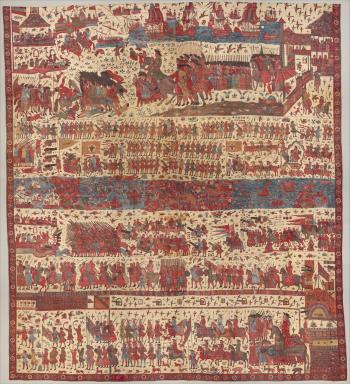
Hanging Depicting a European Conflict in South India, before 1763; Indian, Coromandel Coast, for British Market; cotton, plain weave (drawn and painted resist and mordant, dyed), 117 × 103 inches (New York: The Metropolitan Museum of Art).
Wolf Burchard, Associate Curator of British Furniture and Decorative Arts and lead curator for the new galleries, added: “One of the main reasons why The Met can justify having galleries of this scale dedicated solely to British art is that it is such an international story. It appears particularly timely to ask oneself the question of how best to convey Britain’s culture of creativity at a moment when the United Kingdom is reassessing its role on the European and global stage. We are reminded that the history of British art is far from an isolated one. For centuries, London’s flourishing economy encouraged the trading of foreign luxury goods and attracted countless artists and craftsmen from abroad, many of whom will be represented in The Met’s new British Galleries. Our aim is to present British decorative arts, sculpture, and design beyond royal and country house patronage, focusing on the ways craftsmen and manufacturers had to think outside the box, how to use new technologies, and how to market themselves. The galleries’ design creates an extremely stimulating new stage for our works of art to perform to their best of abilities and an excellent platform to shed new light on British art.”
The Collaboration
To create a narrative-rich setting that befits The Met’s impressive collection, the Museum collaborated with the design firm Roman and Williams Buildings and Interiors, recipient of the 2018 Sir John Soane Visionaries Award and 2014 National Design Award for Interior Design. This is the first museum project undertaken by the design firm, whose work—which ranges from homes and hotels to shops and a furniture collection—is characterized by a sensitivity to historical materials, period references, and the use of rich, layered colors. The stimulating partnership between these designers and The Met’s curators appropriately mirrors the collaborative spirit that developed between British designers, makers, and retailers.
The Narrative
From 1500 to 1900, Britain transformed itself from an isolated island nation into a dominant world power. Global trade stimulated wealth, created a cultural and economic elite beyond the aristocracy, broadened local tastes, and introduced new markets to resourceful British makers. Artists, manufacturers, and retailers—men and women—responded vigorously to these opportunities, developing new materials and technologies, adapting European and Asian styles, and taking bold, imaginative risks.
As early as the 16th century, Britain’s international trade produced a new class of professionals with luxury appetites and ready cash, exemplified in the first gallery’s carved oak paneling from Norfolk, commissioned by William Crowe, a merchant from Great Yarmouth. Foreign artisans started to arrive in England as the Protestant Crown sought to compete with the glories of papal Rome and the French courts. These foreigners had more formal training than their English peers, who still operated within the medieval guild system. Florentine Pietro Torrigiano (1472–1528) was just one of the many European artists and craftsmen who made their way across the English Channel and established themselves in Britain. His naturalistically painted terracotta bust, probably representing Cardinal John Fisher (executed for resisting Henry VIII’s Protestant Reformation), has just been conserved and greets visitors in the first gallery.
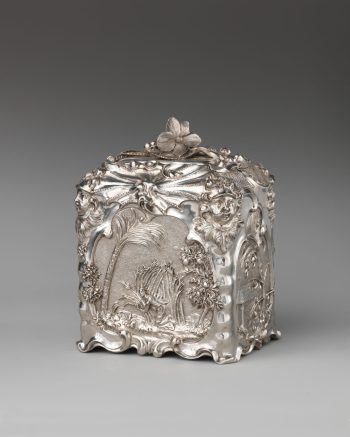
Paul de Lamerie (British, 1688–1751, active 1712–51), Silver Sugar Box, 1744/45 (New York: The Metropolitan Museum of Art).
In the 17th and 18th centuries, the British Empire’s expansion delivered excitement, curiosity, and ruthlessness. A gallery devoted to “Tea, Trade, and Empire” explores the period’s visual exuberance with 100 English teapots displayed in a pair of ten-foot-tall semicircular cases. Presiding over this display is a small but powerful figure of a merchant from 1719, modeled in China by the Cantonese artist Amoy Chinqua (active after 1716). Jaunty, prosperous, and proud, the East India Company entrepreneur who posed for this portrait represents the commercial interests that drove the expansion of the Empire. The goods they brought from China, India, and the West Indies included tea, sugar, coffee, and chocolate, as well as porcelain, cotton, mahogany, and ivory. Produced at great material and human cost, and then transported thousands of miles, these commodities were now affordable for a new middle class. The perimeter of this gallery examines the exploitation of both human and natural resources that accompanied that abundance.
With both the political and monetary power of British monarchs strictly curbed by Parliament, British artisans did not receive the same level of court patronage as their counterparts in Paris, Dresden, and St. Petersburg. Instead, 18th-century design in Britain was shaped by entrepreneurs who had the cleverness, technical expertise, and business acumen necessary to succeed. Nicolas Sprimont (1713–1771) founded the Chelsea Porcelain factory; James Cox (ca. 1723–1800) sold precious table ornaments, some for export to Turkey and China; Josiah Wedgwood (1730–1795) perfected the production of his pioneering pottery, achieving wide distribution within Continental markets; and Matthew Boulton (1728–1809) brought engineering skills to the manufacture of elaborate metalwork. All of these businessmen employed designers in the modern sense of the word: master sculptors, painters, architects, and draftsmen of immense skill and visual sophistication.
The final section of the galleries explores the massive shifts in scale, pace, and taste brought about by the Industrial Revolution during the 19th century. Once again, aesthetic and commercial priorities adapted to an immense new world of methods and customers. A highlight of this section are works acquired specifically for the new galleries, including a stunning marble portrait bust of literary giant Mary Shelley by Camillo Pistrucci, as well as objects by the visionary designer Christopher Dresser (1834–1904) that highlight his limitless creativity and mastery of industrial manufacturing in practically any medium imaginable. Examples by the great Gothic Revival designer A.W.N. Pugin (1812–1852) reveal his impassioned assertion of a national style. Other works represent movements against industrialization, revolts against labor abuses, and the demise of pure craft.
Support
Funding for the renovation included leadership commitments from Mr. and Mrs. Richard L. Chilton, Jr., Howard and Nancy Marks, the Estate of Marion K. Morgan, the Annie Laurie Aitken Charitable Trust, Irene Roosevelt Aitken, Mercedes T. Bass, Candace K. and Frederick W. Beinecke and The Krugman Family, Drue Heinz, Alexia and David Leuschen, Annette de la Renta, Kimba Wood and Frank Richardson, Denise and Andrew Saul, and Dr. Susan Weber.
Credits
The project’s curatorial team is led by Sarah Lawrence, the Iris and B. Gerald Cantor Curator in Charge, and Wolf Burchard, Associate Curator, both of The Met’s Department of European Sculpture and Decorative Arts. Prior to their arrival in early 2019, the project was overseen by Ellenor Alcorn (now Chair and Eloise W. Martin Curator of European Decorative Arts at the Art Institute of Chicago) and Luke Syson (now Director of the Fitzwilliam Museum in Cambridge, United Kingdom), with the assistance of Elizabeth St George (now Assistant Curator at the Brooklyn Museum).
Exhibition | Japan: Courts and Culture
Press release (12 November 2019) for the exhibition from the Royal Collection Trust:
Japan: Courts and Culture
The Queen’s Gallery, Buckingham Palace, London, 8 April 2022 — 26 February 2023
Curated by Rachel Peat
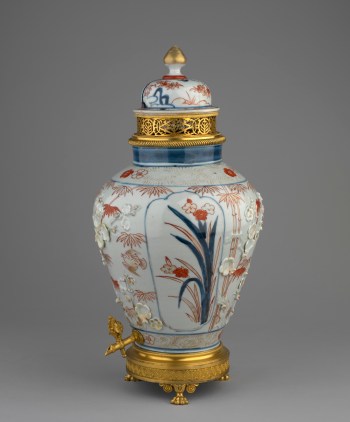
Arita, Hizen Province (Japan), Jar and Cover, 1690–1720, porcelain with moulded relief decoration and painted in underglaze blue, overglaze enamel, and gold; French mounts, 1780–1820, gilt bronze; 42.5 cm high, purchased for George IV in 1820 (Royal Collection Trust, RCIN 39239).
The Royal Collection contains one of the finest holdings of Japanese works of art in the Western world, significant for both the unique provenance and exceptional quality of the objects. Now, for the first time, highlights from the collection are brought together in the exhibition Japan: Courts and Culture, which tells the story of the diplomatic, artistic, and cultural exchanges between Britain and Japan from the reigns of James I to Queen Elizabeth II. Including rare examples of porcelain, lacquer, armour and embroidered screens, the exhibition offers a unique insight into the relationship between the imperial and royal courts over a period of 300 years.
The formation of the East India Company in 1600 paved the way for direct contact between Japan and England. In 1613, the first English ship to reach Japanese shores was captained by John Saris, who brought with him letters and gifts from James I for Shōgun Tokugawa Ieyasu, the military leader who governed Japan on behalf of the imperial family. Saris returned with a letter granting the English permission to live and trade in Japan, and with gifts for the King. These included a samurai armour, the earliest to arrive in Britain and the first surviving non-European work of art to enter the Royal Collection.
This first contact between England and Japan was short-lived. From the 1630s, for some 220 years, Japan closed to the West in an attempt to regulate foreign influence. During this time, the Dutch were the only Europeans permitted to trade directly with Japan through one small enclave at Nagasaki. Demand for exotic East Asian wares remained high in Europe, where the secrets of porcelain and lacquer manufacture were yet to be discovered.
The British royal family led the way in collecting highly prized examples of Japanese lacquer, porcelain, and textiles—much of which was produced specifically for the export market. In the 17th century, Mary II displayed Japanese porcelain in her apartments at Kensington Palace and Hampton Court Palace. In the 18th century, Queen Caroline, consort of George II, formed a significant collection of Japanese lacquer. A century later, George IV incorporated Japanese porcelain into the opulent decorative schemes at Carlton House in London and the Royal Pavilion, Brighton. Many of the pieces acquired by the King were given new functions through the addition of elaborate gilt-bronze mounts, turning a simple jar into a pot-pourri vase and animal figures into incense burners.
 When Japan reopened to the West in the 1850s, goods began to flow freely, and diplomatic and political links were re-established. Queen Victoria’s son, Prince Alfred, Duke of Edinburgh, was the first member of a European royal family to visit Japan when he arrived there in 1869 during a world naval tour. The Prince met the Emperor Meiji at the Imperial Palace, where an exchange of gifts took place, and was presented with samurai armour, including a helmet dating from 1537. In a letter to his mother, Alfred wrote: “To give you any account of this country, I feel quite at a loss. Every thing is so new & so quaint that I am quite bewildered.”
The next members of the British royal family to visit Japan were Queen Victoria’s grandsons Prince George of Wales (the future King George V) and his brother, Prince Albert Victor. In 1881, the teenage Princes were serving as midshipmen aboard HMS Bacchante and were granted shore leave to meet the Emperor Meiji and Empress Shōken. They returned with presents for their family, including a teapot and cups for their father, Albert Edward, Prince of Wales, and with diplomatic gifts from the Emperor. According to the official diary of the tour, compiled by their tutor, the Reverend John Dalton, the Princes had their arms tattooed during their visit to Japan—Albert Victor with ‘a couple of storks’ and George with a dragon and a tiger, a combination said to signify East and West.
In the early 20th century, a defensive Anglo-Japanese Alliance was formed to secure both nations’ interests in the Pacific. This was also a period of growing artistic exchange. The most significant cultural event was the 1910 Japan-British Exhibition in London, which included demonstrations of Japanese crafts, music, sports, and entertainments. More than eight million people visited the exhibition, including Queen Mary, consort of King George V, who was an enthusiastic collector of East Asian art.
The relationship between the Japanese and British imperial and royal families has continued to flourish through reciprocal royal visits, attendance at coronations, and the exchange of gifts. In 1902, Prince Komatsu Akihito attended the coronation of King Edward VII on behalf of the Emperor Meiji and presented the King with an embroidered folding screen of the four seasons. In 1911, Queen Mary received a coronation gift of a miniature cabinet bearing the imperial chrysanthemum crest, created by Akatsuka Jitoku, one of the most accomplished lacquerers of his generation. On the occasion of the coronation of Queen Elizabeth II in 1953, the Emperor Shōwa (Hirohito) sent Her Majesty a cosmetic box decorated with a heron by the great lacquer artist Shirayama Shōsai.
◊ ◊ ◊ ◊ ◊
In the United States and Canada, the catalogue is distributed by The University of Chicago Press:
Rachel Peat, ed., Japan: Courts and Culture (London: Royal Collection Trust, 2020), 320 pages, ISBN: 978-1909741683, $70.
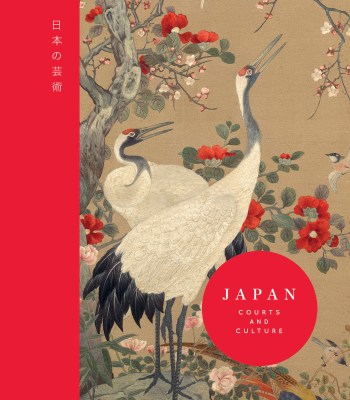
Japan: Courts and Culture tells the story of three centuries of British royal contact with Japan, from 1603 to c.1937, when the exchange of exquisite works of art was central to both diplomatic relations and cultural communication. With discussions of courtly rituals, trade relationships, treaties, and other matters of concern between the two nations, this book provides important historical and political context in addition to granting a new look at the works of art in question. Featuring new research on previously unpublished works, including porcelain, lacquer, armor, embroidery, metalwork, and works on paper, this book showcases the unparalleled craftsmanship of these objects, and the local materials, techniques, and traditions behind them. Japan: Courts and Culture is published to accompany a spectacular exhibition of the same name, which opens at The Queen’s Gallery, Buckingham Palace, in June 2020. The book’s stunning photography, contextual essays, and historical insights offer a highly visual record of a royal narrative and history that has not yet been widely documented.
Rachel Peat is assistant curator of non-European works of art at Royal Collection Trust.
C O N T E N T S
Foreword, HRH The Prince of Wales and Princess Akiko of Mikasa
British and Japanese Royal Family Trees
Map of Japan
1 Introduction, Rachel Peat
2 First Encounters, 1600–1639, Rachel Peat
3 Trade, 1639–1854, Rachel Peat
4 Porcelain, Melanie Wilson and Rachel Peat
5 Lacquer, Rachel Peat
6 Travel, 1854–1901, Rachel Peat
7 Samurai, Arms and Armour, Gregory Irvine
8 Metalwork, Kathryn Jones
9 Treaty, 1901–1937, Rachel Peat
10 Artistic Exchange, Kathryn Jones
11 Courtly Ritual, Caroline de Guitaut
12 Coda, Rachel Peat
13 Appendix: The Model of the Taitokuin Mausoleum, William H. Coaldrake
Glossary
Timeline of Key Events
Bibliography
Acknowledgements
Index
◊ ◊ ◊ ◊ ◊
Note (added 8 April 2022) — The posting has been updated to indicate the revised dates of the exhibition, which was originally scheduled to be on view from 12 June until 8 November 2020.
Exhibition | The Curator’s Bookcase
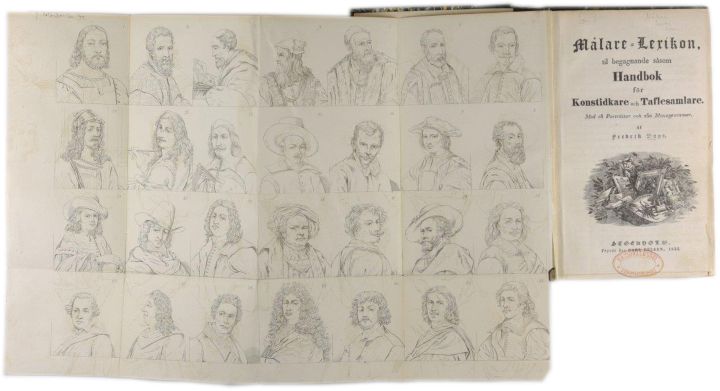
Fredrik Boye, Målare-lexikon til begagnande såsom handbok för Konstidkare och Taflesamlare, Painter’s Dictionary
(Stockholm, 1833)
◊ ◊ ◊ ◊ ◊
Now installed (if not on view) at the Nationalmuseum:
The Curator’s Bookcase: Stories from the Archives
Stockholm, Nationalmuseum, 19 February — 28 June 2020
Using examples from the Art Library’s older collection of books, The Curator’s Bookcase gives an insight into the emergence of art history as an academic discipline in the 19th century. General handbooks on art, biographies, and other examples of literature that kept the museum professionals of that time up to date are exhibited along with photographic reproductions from the Image Archive.
In the 19th century, art history emerged as an academic discipline. This took place in the first half of the century in Germany, and mid-century in Sweden and had a decisive impact on museum practices. Being an artist or a well-read connoisseur was no longer sufficient—academic studies were also required to become a curator. Thus, the museum practice was professionalised. The curators used a scientific approach to analyse, identify, and classify objects of art putting them in a historic context. The collections were presented chronologically and geographically in different schools. The Nationalmuseum gave the most space to the Italian, Dutch, French, and Swedish schools, which dominated the Royal collection donated in 1792 to the Museum, then known as the Royal Museum, one of the first public museums in northern Europe.
The growing interest in art history is reflected in the many books on this subject that were published and spread. Subjects of special interest were the Greco-Roman period and national ideals. Swedish museum curators had lively contacts with colleagues abroad, and it was part of their job to keep abreast with the latest research. The books displayed in this exhibition are from the Art Library’s older collection. They are mainly textbooks on art history, general handbooks, and monographic biographies. The books give an idea of the literature that would have been found in a curator’s bookcase. Several of these books are exquisitely and artistically bound and were published in limited, numbered editions. The exhibition also includes examples of older displays of the collections as photographic reproductions from the Image Archive.
The masterpieces of art have always been of great importance to museum professionals and artists. In the current exhibition on the 6th floor Inspiration: Iconic Works you can discover more about how contemporary artists have been inspired by the old masters. The Curator’s Bookcase is on display in the Old Library.
Exhibition | Hidden Valuables: Early-Period Meissen Porcelains
The catalogue is published by Arnoldsche and distributed by ACC Art Books:
Hidden Valuables: Early-Period Meissen Porcelains from Swiss Private Collections
Musée Ariana, Geneva, 7 February — 6 September 2020
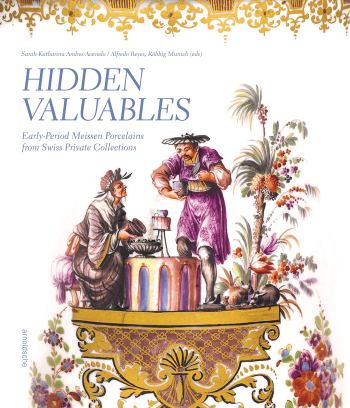 Switzerland is well-known for its host of remarkable collections of eighteenth-century European porcelain. Exemplary representatives of these are such extraordinary collector personalities as Albert Kocher or Dr Marcel Nyffeler. A number of these magnificent collections can be found today in Switzerland’s renowned institutions, and the ‘white gold’ from Saxony still fascinates Swiss connoisseurs. This exhibition is dedicated to their passionate collecting and exceptional treasures, while the catalogue is enriched with essays by renowned art historians and porcelain experts.
Sarah-Katharina Andres-Acevedo, Alfredo Reyes, and Röbbig München, eds., Hidden Valuables: Early-Period Meissen Porcelains from Swiss Private Collections (Stuttgart: Arnoldsche, 2020), 416 pages, ISBN 978-3897905863, £78 / $135.
New Book | Becoming America
Distributed by Yale UP (portions of the collection have been on view at The Huntington since October 2016) . . .
James Glisson, ed., with contributions by John Demos, Jonathan and Karin Fielding, Robin Jaffee Frank, James Glisson, Stacy Hollander, Christina Nielsen, Sumpter Priddy, Elizabeth V. Warren, and David Wheatcroft, Becoming America: Highlights from the Jonathan and Karin Fielding Collection of Folk Art (San Marino: The Huntington Library, Art Collections, and Botanical Gardens, 2020), 264 pages, ISBN: 9780300247565, $50.
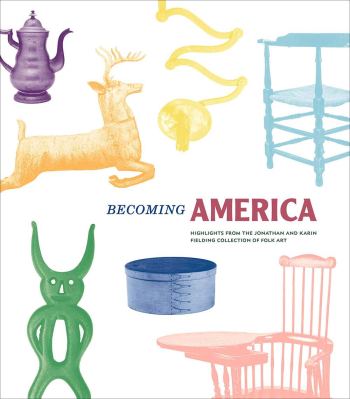 Becoming America offers a multifaceted view of one of the foremost collections of 18th- and 19th-century American folk and decorative art from the rural Northeast. Essays by leading specialists discuss the culture of furniture workshops, exuberant painted decoration, techniques of sewing and quilting, and poignant stories about the families depicted in the portraits. The collection itself includes Shaker boxes, a beaded Iroquois hat, embroidered samplers, metalwork, scrimshaw, handwoven rugs, ceramics, and a weather vane. The majority of these works have never before been published. With lively essays and profuse illustrations, this handsome volume brings to life the aesthetic of early Americans living in the countryside and is an essential exploration of the period’s taste and style.
James Glisson is interim chief curator of American art at The Huntington. Jonathan Fielding is the former director of the Los Angeles County Department of Public Health and Distinguished Professor at UCLA. Karin Fielding is a trustee of the American Folk Art Museum in New York.
The Burlington Magazine, March 2020
The eighteenth century in The Burlington:
The Burlington Magazine 162 (March 2020) — Drawings

Luigi Valadier, Pyx, 1769–71, gilt silver, 22 × 11 cm, one of eighteen pieces of a pontifical mass service belonging to the cathedral of Portalegre, Portugal (Church of S. Miguel, Castelo Branco).
A R T I C L E S
• Teresa Leonor M. Vale “A Portuguese Bishop’s Pontifical Mass Service by Luigi Valadier,” pp. 196–203. A gilt silver pontifical mass service belonging to the cathedral of Portalegre, Portugal, is here identified as the work of the celebrated Roman silversmith Luigi Valadier and dated 1769–71. It is closely similar to a contemporary service owned by Cardinal Domenico Orsini and both services can be linked to a group of drawings from Valadier’s workshop.
S H O R T E R N O T I C E S
Kee Il Choi, Jr., “Ornament from China: Sources for a Garden Folly Design by Jean-Jacques Lequeu,” pp. 216–19.
R E V I E W S
• Kirstin Kennedy, Review of Carolina Naya Franco, Joyas y alhajas del Alto Aragón: esmaltes y piedras preciosas de ajuares y tesoros históricos (2018).
• Stéphane Loire, Review of Nicola Spinosa, ed., Francesco Solimena (1657–1747) e le Arti a Napoli (2018).
• Aileen Dawson, Review of Claudia Bodinek (with contributions by Peter Braun, Tobias Pfeifer-Helke und Claudia Schnitzer), Raffinesse im Akkord: Meissener Porzellanmalerei und ihre Grafischen Vorlagen (2018).
• David Bindman, Review of the exhibition Canova Thorvaldsen: The Birth of Modern Sculpture (Milan: Gallerie d’Italia, 2019–20).
• Daniel Stewart, Review of the exhibition Troy: Myth and Reality (London: British Museum, 2019–20).
• Christiane Elster, Review of the exhibition History in Fashion: 1500 Years of Embroidery in Fashion (Leipzig: GRASSI Museum of Applied Arts, 2019–20).
• Philippa Glanville, Review of the exhibition Feast and Fast: The Art of Food in Europe, 1500–1800 (Cambridge: Fitzwilliam Museum, 2019–20)
• Kamila Kocialkowska, Review of the exhibition Peter the Great: Collector, Scholar, Artist (Moscow Kremlin Museums, 2019–20).
• Eckart Marchand, Review of the exhibition Near Life: The Gipsformerei: 200 Years of Casting Plaster (Berlin: James-Simon-Galerie, 2019–20).
Exhibition | Power Mode: The Force of Fashion
Now installed at the Fashion Institute of Technology:
Power Mode: The Force of Fashion
The Museum at FIT, New York, 10 December 2019 — 9 May 2020
Curated by Emma McClendon
 Today, we see a multitude of sartorial power symbols, from ‘power suits’ to ‘power heels’. But what makes a garment ‘powerful’? According to sociologist and political theorist Steven Lukes: “We speak and write about power, in innumerable situations, and we usually know, or think we know, perfectly well what we mean … And yet, among those who have reflected on the matter, there is no agreement about how to define it, how to conceive it, how to study it, and, if it can be measured, how to measure it.”
If we think of power in terms of kinetic force (for example, electrical power or a person’s physical power over another), clearly an inanimate item of clothing does not have actual power. The force of fashion is symbolic. It is social. It lies in the sphere of interpersonal relations and cultural dynamics. There is no single, universally accepted definition of power. Power means different things to different people at different times. As such, its connection to fashion is multifaceted, and a multifaceted approach is necessary for considering the role fashion plays in power dynamics both historically and today.
The exhibition is organized into five thematic sections, each devoted to a particular type of sartorial ‘power’. In each section, men’s and women’s clothing are considered side by side, and pieces from as early as the eighteenth century are juxtaposed with looks from contemporary collections.
The exhibition opens with a display of military and military-inspired ensembles, including a U.S. Army lieutenant colonel’s ‘dress blue’ uniform, a World War II–era ‘Ike’ jacket, and looks from Yves Saint Laurent, Burberry, and Ralph Lauren. Modern military uniforms combine tailoring with an elaborate code of patches, braiding, stripes, colors, and metalwork that makes the soldier a walking extension of the state’s power. In fashion, a company logo replaces the state’s seal, but uniform-inspired silhouettes, colors, textiles, and buttons become visual shorthand for the power, strength, and authority of the military. It is the power of association.
The next section focuses on different modes of status dressing that have emerged over the last 250 years, from ermine capes and luxurious brocade fabrics to contemporary “It” bags and logo-covered products. Aspiration, wealth, and Thorstein Veblen’s theory of “conspicuous consumption” are key to understanding the role status dressing plays in modern society. An 18th-century robe à la française demonstrates the importance of ornate, expensive textiles to courtly dress, while a Balenciaga puffer coat shows the way brand names have become crucial decorative elements in luxury fashion today.
From status dressing, the exhibition moves to consider the history of the suit. The sharply tailored suit is perhaps the most conventional example of ‘power dressing’. Indeed, the term power dressing was often used to describe the big-shouldered suits worn by upwardly mobile business men and women during the 1980s. However, the history of the suit is more nuanced. Anne Hollander points out, “Heads of state wear suits … and men accused of rape and murder wear them in court to help their chances of acquittal.” In court rooms and office spaces, the suit isn’t just a symbol of authority. It is also a sign of blending in—submitting to established norms and dress codes.
The fourth section considers the role of resistance dressing. Blue jeans, printed T-shirts, and black leather jackets have become some of the most common symbols of resistance in clothing. They signal a certain type of power that is subversive of established authority. It is the power of protest and rebellion. There is a tension between resistance clothing and ‘fashion’, with the later often being dismissed as surface-level commodification. But the relationship is not so simple—fashion can also be a vehicle for protest as seen in the recent work of Kerby Jean-Raymond for his label Pyer Moss.
Finally, the fifth section analyzes objects that are culturally coded as ‘sexy’. Corsets, leather, lingerie, and high-heeled boots are but a few examples. The power dynamics of these garments are inherently complex. How a garment is interpreted can fluctuate between dominance and subjugation. As fashion critic Holly Brubach once said of Versace’s famous 1992 bondage collection, it “riles women who think this is exploitative and appeals to women who think of his dominatrix look as a great Amazonian statement. It could go either way.”
Power Mode is a curatorial experiment. It aims to combine theory with history and object analysis in order to better understand the complex nature of power in fashion as well as the ways fashion can be key to a broader understanding of power dynamics in culture. The exhibition is organized by Emma McClendon, associate curator of costume.
Emma McClendon, ed., Power Mode: The Force of Fashion (Milan: Skira, 2019), 128 pages, ISBN: 978-8857239873, $45 / €39.
 A more in-depth discussion of the themes represented in the exhibition is articulated in the lavishly illustrated accompanying book, also titled Power Mode: The Force of Fashion, edited by exhibition curator Emma McClendon and published by Skira. The book delves deeper into theory and history to investigate how certain garments have come to be culturally associated with power, as well as how their meanings have evolved over time. It also examines how fashion designers have interpreted these stylistic archetypes—both to convey and to subvert power. Chapter texts by McClendon are joined by object-based essays from renowned fashion scholars Valerie Steele, Christopher Breward, Jennifer Craik, and Peter McNeil, as well as Pulitzer Prize–winning journalist Robin Givhan. The book also includes an essay by Kimberly M. Jenkins on the intersection of race, fashion, and power. This collection of texts will offer readers a variety of perspectives to help form a theoretical framework for considering the power dynamics inherent in fashion objects.










leave a comment