Exhibition | Showpiece from the Palmwood Wreck
I’m posting this seventeenth-century exhibition, showcasing what may be a late sixteenth-century cup, to draw attention to the Museum Kaap Skil more generally; Texel, located some 50 miles north of Amsterdam, was a crucial anchorage, particularly for large VOC vessels. Visiting the Vasa Museum in Stockholm a few years ago (many of you have been there) helped me grasp just how much ‘material culture’ was taken up by ships in the early modern period. Inventory lists—indeed, even seascapes crowded with ships—now come to life for me in a way that they didn’t previously. On the grounds of the Kaap Skil museum, there’s also a working windmill used to process grain: the Traanroeier, which dates to 1727 (originally located on the Weer, at the intersection with the Traanroeyer ditch, it was moved to Texel in 1902). –CH
Now on view at Museum Kaap Skil, from the press release:
Diving in Details: Showpiece from the Palmwood Wreck
Museum Kaap Skil, Texel, Netherlands, 9 March — 9 September 2019

Gilt silver cup, likely made in Neurenberg around the end of the 16th century; it was recovered in 2016 from the Palmwood wreck.
An exceptional object from the Palmwood wreck [palmhout, or boxwood] can be seen for the next six months at Museum Kaap Skil—in Oudeschild on the island of Texel. A gilt silver cup, expertly restored after almost four centuries on the sea bottom, is being displayed in the exhibit Diving in Details. Expert Jan Beekhuizen, known from the television program Kunst & Kitsch (Art & Fake), notes that it is “exceptional, if not unique, that such a find surfaces from a ship wreck.”
A specially designed showcase allows the viewer to observe the gilt cup from all sides. Details can be seen and enlarged on a touchscreen. The cup is decorated with driven flower patterns and mascarons, ornaments representing faces. The cup was unveiled at the Rijksmuseum on March 7 by deputy Jack van der Hoek and museum manager Corina Hordijk, together with the presentation of a report on the Palmwood wreck collection.
The discovery of the Palmwood wreck by divers from Texel and the unusually rich finds surfaced from this wreck created a worldwide sensation in 2016. The lovely silk dress and other luxury garments and personal belongings from the wreck made it clear that the cargo being transported by the ship belonged to very wealthy, perhaps even royal people. Even the gilt silver cup fits this picture. Only the richest could afford such an object.
 The wreck of the ship and almost four centuries lying in the sea bottom have taken their toll: the cup surfaced partially flattened and broken into three parts. In addition, there were dark corrosive bumps on the surface. Experts from the restoration workshop Restaura have carefully removed the deposits, reattached the loose parts, and restored the cup to its original shape. The war god Mars, standing on the lid of the cup, has lost his shield, but otherwise the cup is more or less whole.
The exhibition Diving in Details also features a 17th-century painting depicting such a cup, showing how such objects were used to display wealth. The Palmwood wreck was once a heavily armed fluyt (‘straatvaarder’), destined for trade in the Mediterranean. The ship sank in the 17th century on the Roads of Texel. It is still unknown who the owner of the ship and the cargo was.
Documentation of the recovered objects has just been published; from the Museum Kaap Skil:
Arent D. Vos et al., edited by Birgit van den Hoven and Iris Toussaint, Wereldvondsten uit een Hollands schip: Basisrapportage BZN17/Palmhoutwrak (Haarlem: Provincie Noord-Holland, 2019), 443 pages, ISBN: 978-9492428134, €20.
◊ ◊ ◊ ◊ ◊
More information about the discovery of the ship—including its mistaken association in 2016 with a ship that was in 1642 part of a royal British fleet—comes from Jessamyn Hatcher, “Treasure Island: The Extraordinary Finds of an Amateur Diving Club in Holland,” The New Yorker (19 September 2017). Hatcher quotes “Arent Vos, a marine archeologist who specializes in the Texel Roads, [who] estimates that up to a thousand ships wrecked off the island’s coast between 1500 and 1800.”
Also see, Tracy Robey, “Global Cargo,” Archaeology (May/June 2018), where the Palmwood Wreck (Burgzand Noord 17) is described as “the richest cargo of seventeenth-century luxury goods ever found underwater,” owing to its “stunning collection of silk garments and velvet textiles, leather book covers, and pottery.”
Exhibition | Panorama: London’s Lost View
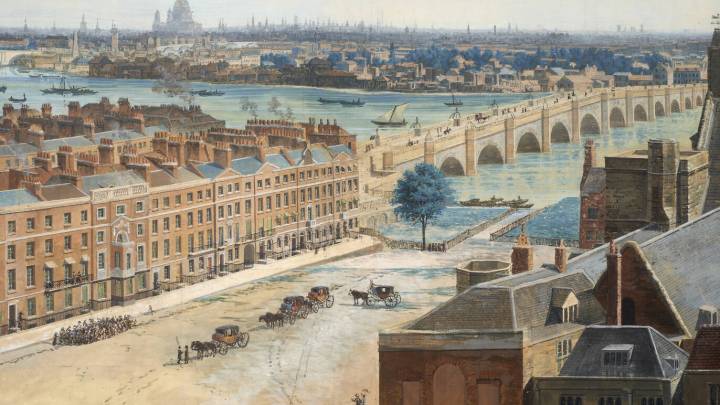
Pierre Prévost, A Panoramic View of London from the Tower of St. Margaret’s Church, Westminster, detail, ca. 1815
(Museum of London)
◊ ◊ ◊ ◊ ◊
From Time Out London:
Panorama: London’s Lost View
Museum of London, Smithfield, 15 March — 30 September 2019
In 1815, French artist Pierre Prévost climbed the tower of St Margaret’s Church in Westminster and started sketching. His specialty was panoramas—epically long landscape paintings, displayed in a rotunda to show a 360-degree view—and this time he was painting London. Prevost’s 100-foot panorama of the capital was exhibited in Paris, and then lost. But the 20-foot painting he made as a dry run survived. It was bought last year by the Museum of London for £250,000 and is on public display from March to September 2019. Prévost’s painting will be mounted flat on the floor, letting visitors walk its length to check out the skyline of Regency London. You’ll see the old Palace of Westminster (destroyed in a fire 19 years later), the original Westminster Bridge, St Paul’s, horse-drawn carriages in Parliament Square, and even cows grazing in St James’s Park.
The catalogue entry from the Sotheby’s Sale (4 July 2018) is available here»
The press release for the acquisition (11 July 2018) is available here»
The press release for the exhibition is available here»
Exhibition | Slavery, Culture, and Collecting
From the Museum of London:
Slavery, Culture, and Collecting
Museum of London Docklands, 15 September 2018 — 15 September 2019
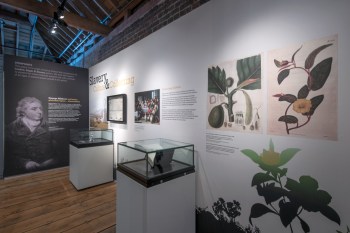 The latest display in the London, Sugar and Slavery gallery at the Museum of London Docklands highlights the connection to slavery of some of Britain’s oldest cultural organisations. Slavery, Culture, and Collecting follows slave owner and art collector George Hibbert (1757–1837), a prominent member of a large subsection of British society which derived its wealth directly from the slave economy. These figures were often active philanthropists, and are commemorated in memorials for their associations with charitable causes, while their connections to slavery are invisible even today. Hibbert was instrumental in building the West India Docks which now house the Museum of London Docklands. This connection positions the museum as an important place to think about the relationship between slavery and cultural heritage.
The wealth generated by slavery was used to create cultural institutions such as museums, universities, art galleries and charities. Advocates of slavery would then use culture in their arguments for the continuing use of enslaved labour, on the grounds that Africans needed the ‘civilising influence’ of Europe. The display contains a short film, as well as objects from the collection to encourage further debate around this challenging issue.
Slavery, Culture, and Collecting is delivered with the support of the Antislavery Usable Past project at the University of Nottingham.
More information about the display is available here»
Liebieghaus Acquires Major Collection of Ivory Sculptures

Furienmeister (active around 1600‒1625), Fury on a Charging Horse, 1610; ivory, wood, and bone; 41 cm high (Frankfurt am Main: Liebieghaus Skulpturensammlung, Reiner Winkler Collection).
◊ ◊ ◊ ◊ ◊
From the press release (7 March 2019). . .
White Wedding: The Ivory Collection of Reiner Winkler Now in the Liebieghaus. Forever
Liebieghaus Skulpturensammlung, Frankfurt am Main, from 27 March 2019
Curated by Maraike Bückling
The Liebieghaus Skulpturensammlung is to be enriched by a magnificent addition. The Ernst von Siemens Kunststiftung, the Städelscher Museums-Verein, and the Städel Museum, with the support of the Kulturstiftung der Länder and the Hessische Kulturstiftung, have acquired for the Liebieghaus Skulpturensammlung a collection of over 200 valuable ivory sculptures owned by Reiner Winkler. With this acquisition, made possible through the generous gift of a large part of the collection by Reiner Winkler, the Liebieghaus has achieved the most important expansion of its own holdings in the history of the museum. From 27 March 2019, some 190 artworks will be shown on view in the exhibition White Wedding: The Ivory Collection of Reiner Winkler Now in the Liebieghaus. Forever. The ivory works from the Middle Ages and the Baroque and Rococo periods will be presented in theme-based chapters.
Over the decades, the collector and patron Reiner Winkler (b. 1925) has assembled a legendary private collection of ivory sculptures with a focus on Baroque masterpieces. One outstanding work is, for example, Fury on a Charging Horse (1610). Further masterpieces in the collection are The Fall of the Rebel Angels (first third of the 18th century) from Southern Italy/Sicily, The Three Parcae (ca. 1670) by Joachim Henne (1629‒ca. 1707), and Francis van Bossuit’s (1635–1692) Mercury, Argus and Io (ca. 1670/75?), as well as important sculptural works by Johann Caspar Schenck (ca. 1620‒1674), Balthasar Grießmann (ca. 1620–1706), and Matthias Steinl (1643/44–1727). The unique compilation of works provides the Liebieghaus Skulpturensammlung with the opportunity to expand its own internationally important collection at the very highest level. The acquisition also establishes European ivory art as a central focus of the collection in the Baroque and Rococo department at the Liebieghaus—a focus which, in the future, will be the subject of in-depth academic research and education.
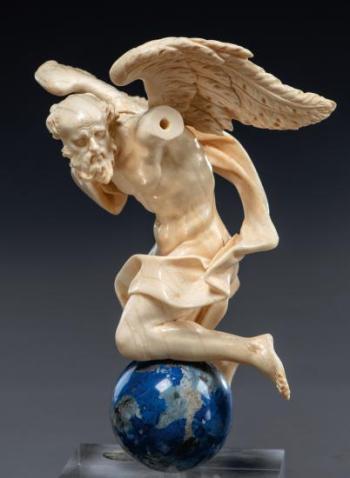
Matthias Steinl, Chronos on the Globe, ca. 1720‒1725, ivory (Frankfurt am Main: Liebieghaus Skulpturensammlung, Reiner Winkler Collection).
“Reiner Winkler’s collection is not only the world’s largest private collection of ivory sculptures; it is also unique for its particular art-historical significance. We are delighted and immensely grateful to Mr. Winkler that his collection will now find a new home in the Liebieghaus Skulpturensammlung—in the very place that Reiner Winkler had long imagined for his artworks. The patron’s assignment of the collection at an extremely generous price is tantamount to the gift of most of the pieces and has made this most important addition to the holdings in the history of the museum possible. With the collection of Reiner Winkler, the Liebieghaus has been granted not only a new area of focus within the collection, but also the opportunity to considerably expand the international significance and profile of the Liebieghaus,” explained Philipp Demandt, Director of the Liebieghaus Skulpturensammlung and the Städel Museum.
Reiner Winkler has been building up his collection continuously since 1962. After several years of collecting sculptures of various materials and periods, he soon decided to concentrate on ivory sculptures of the 17th and 18th centuries, and as well as, to a considerably lesser extent, the early 19th century. Winkler has maintained a close relationship with the Liebieghaus Skulpturensammlung for many years. On a number of occasions in the past he has generously provided the museum with loans for exhibitions.
Winkler commented on the transfer of his collection to the museum: “I am very happy that my collection will find a new and permanent home in the Liebieghaus and will therefore continue to exist as a ‘Gesamtkunstwerk.’ I have been pursuing this idea for many years now, since I am convinced that, in this way, it will be possible to achieve a wonderful symbiosis. The framework is ideal, as regards both the setting and art history. Then there is the perfect manner in which the areas of focus of the collection blend with the academic expertise of the museum, the proximity to our home town of Wiesbaden and, last but not least, the enthusiasm and the wonderful commitment of all those involved. This has strengthened my conviction that every single work will find a superb new home here and that there cannot be a better permanent place for my collection than the Liebieghaus. I am proud and delighted that uniting the existing collection of Baroque and Rococo art in the Liebieghaus with my collection will now transform the museum into a place where internationally important sculptures will be made accessible to the public as in no other location, and I hope that many visitors will experience great pleasure in viewing the exhibits.”
The acquisition was made possible by the Ernst von Siemens Kunststiftung, the Städelscher Museums-Verein, and the Städel Museum with the support of the Kulturstiftung der Länder and the Hessische Kulturstiftung.
The President of the Städelscher Museums-Verein, Sylvia von Metzler, is delighted “that the Städelscher Museums-Verein as an important patron of the acquisitions for the Städel Museum and the Liebieghaus Skulpturensammlung was able to make a significant contribution towards the acquisition of this unique collection.”
“Our support for the acquisition of the exquisite Winkler ivory collection is the largest financial sponsorship which the Ernst von Siemens Kunststiftung has undertaken in recent years, since the foundation covered almost half of the philanthropic purchase price. Our founder was a businessman and patron of the arts, and he would have appreciated the hands-on manner in which the enthusiastic and generous collector and the Liebieghaus have taken advantage of this unique opportunity to bring about a substantial expansion of the collection,” observed Dr. Martin Hoernes, Secretary General of the Ernst von Siemens Kunststiftung.
Eva Claudia Scholtz, Managing Director of the Hessische Kulturstiftung, confirmed: “The Hessische Kulturstiftung is delighted that, through its involvement, one of the most remarkable collections of Baroque sculptures in private ownership can now be made permanently accessible to an audience from Germany and abroad in the Liebieghaus in Frankfurt.”
As a first step, the Kulturstiftung der Länder supported the acquisition of the Fury on a Charging Horse. Additional support for the entire collection is subject to the approval of the next meeting of the Board of Trustees of the Kulturstiftung der Länder. Prof. Dr. Markus Hilgert, Secretary General of the Kulturstiftung der Länder: “It is most fortunate that a museum such as the Liebieghaus is able to acquire a collection as complete as this one and at the same time to come across an collector whose expertise and passion for art is linked to the conviction that such magnificent treasures should remain accessible to the public. It was a similar conviction which, in the past, led to the founding of the Kulturstiftung der Länder, which is why we are delighted to support this acquisition.”
The Collection
The Reiner Winkler Collection concentrates on works from the 17th and 18th centuries, the golden age of the art of ivory carving. It contains a large number of English, French, Italian, German, Spanish, Austrian, Dutch, and Flemish ivory sculptures, as well as two works from India and China. They include statuettes, groups of figures, reliefs, medallions, and a small number of tankards and ceremonial vessels. “With the works from the Reiner Winkler Collection, visitors to the Liebieghaus can appreciate fine and top-quality artworks of European sculpture during the Baroque and Rococo periods that cover a truly remarkable range,” observed Dr. Maraike Bückling, Head of Collections in the Renaissance to Classicism department and curator of the exhibition. The works in the extensive collection provide an impressive overview of the history of Baroque ivory art. In addition, the various features of ivory carving within Europe are shown in an impressive manner. In some areas, the collection of the Liebieghaus and the Reiner Winkler Collection complement each other, as for example in the works by the artists of the Schenck family. The Liebieghaus owns an ivory relief, The Archangel Michael Fighting the Devil (1683) by Christoph Daniel Schenck (1633–1691). The Reiner Winkler Collection boasts several outstanding works by this family of artists, including an exquisite Allegory of Summer (ca. 1666), created by an older relative of Christoph Daniel, Johann Caspar Schenck (ca. 1620–1674). While the Liebieghaus possesses a small ivory relief identified as belonging to the circle of the Netherlandish artist Gérard van Opstal (1594/97–1668), the Reiner Winkler Collection now adds two further works from his vicinity, one of which may have belonged to King Louis XIV. One of the most important artists of the 17th and 18th centuries was the Austrian Matthias Steinl (1643/44–1727). The holdings of the museum include an unusual wooden statue of Maria Immaculata (1688), while the Reiner Winkler Collection contains Steinl’s small, masterfully worked ivory statuette Chronos on the Globe (ca. 1720/1725?). Masterpieces by famous sculptors such as Adam Lenckhardt (1610–1661), Balthasar Grießmann (ca. 1620–1706), Thomas Schwanthaler (1634–1707), Francis van Bossuit (1635–1692), David Le Marchand (1674–1726), Jean Cavalier (ca. 1650/60‒1698/99), Joachim Henne (1629‒ca. 1707), Theophilus Wilhelm Freese (1696–1763), Johann Christoph Ludwig Lücke (ca. 1703‒1780), and Simon Troger (1693–1768) will be finding their way into the Liebieghaus Sculpture Collection following the acquisition of the Reiner Winkler Collection.
The Exhibition
With the exhibition White Wedding: The Ivory Collection of Reiner Winkler Now in the Liebieghaus. Forever, the Liebieghaus Skulpturensammlung presents almost all the pieces from the Reiner Winkler Collection, thereby demonstrating their artistic range. The works within the collection enter into a dialogue with objects from the museum’s own collection. Ivory works from the Liebieghaus are juxtaposed with those from the Reiner Winkler Collection, and museum exhibits by the same artists but made of other materials are also on view. Some 190 exhibits trace the history of small sculpture in the Baroque and Rococo ages. Certain masterpieces from the Reiner Winkler Collection are the subject of a special focus within the exhibition. These include, for example, Fury on a Charging Horse (1610) by the so-called Master of the Furies (active ca. 1600–1625), a central work from the Reiner Winkler Collection. Also on view are The Three Parcae (ca. 1670) by Joachim Hennes, Francis van Bossuit’s Mercury, Argus and Io (ca. 1670/75?), the relief panels carved by an unknown Augsburg sculptor Minerva introducing Sculpture and Painting to the seven Free Arts (second half of the 17th century), as well as the Depiction of eight Cardinal Virtues (second half of the 17th century), together with Matthias Steinl’s Chronos on the Globe (ca. 1720/25?), the Allegory of Damnation in Hell (1736) by Johann Christoph Ludwig Lücke, and the Fall of the Rebel Angels (first third of the 18th century), carved by an unknown ivory artist from southern Italy or Sicily. Germany and Austria played an important role in ivory art, as can be clearly seen in the Reiner Winkler Collection. Therefore, important artists such as Leonhard Kern (1588‒1662), Georg Pfründt (1603‒1663), Jacob Dobbermann (1682–1745), the Lücke family, and the Schencks are awarded their own chapters within the exhibition. A special section unites medieval works, representations of saints, and works that convey Biblical content, which are combined to form a group. Works dedicated to themes from antiquity and those which were created by court sculptors or Kammerbildhauer are also displayed as an ensemble. Three art regions are presented: the Netherlands, Southern Italy/Sicily, and Dieppe.
Exhibition | Perfect Poses?

Now on view at the Glyptotek:
Perfect Poses?
Museo Calouste Gulbenkian, Lisbon, 26 October 2018 — 4 February 2019
Ny Carlsberg Glyptotek, Copenhagen, 1 March — 16 June 2019
The exhibition Perfect Poses? is a sculptural odyssey through the period between the French Revolution of 1789 and the beginning of the First World War in 1914—a period also known as ‘the long 19th century’. French sculpture of the 19th century was a deeply felt passion both with Carl Jacobsen, founder of the Glyptotek, and Calouste Gulbenkian, founder of the museum in Lisbon. The exhibition Perfect Poses? presents works of both collectors from a new angle—working from the poses of the sculptures. Thus the exhibition is at once a unique encounter between two collections and an updated look at a period in sculptural history that has long languished in the shadow of 20th-century modern art.
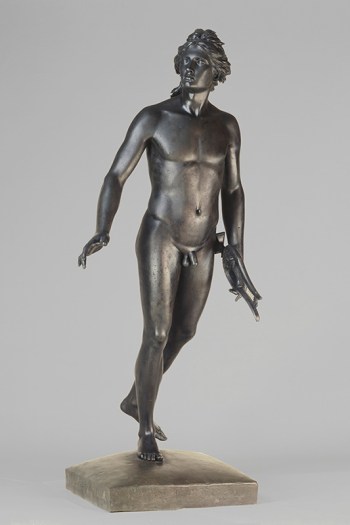
Jean-Antoine Houdon, ‘Apollo’, 1790, bronze (Lisbon: Calouste Gulbenkian Museum, inv. 552).
The human body has been the sculptor’s favourite motif from as far back as antiquity right up to the 20th century when sculpture also became abstract and experimental in relation to motif and form. It is specifically the body in sculpture which has, since antiquity, been the pivotal point for the feelings and narratives the artists have wanted to express concerning the great universal themes of human life. The art history of sculpture can, therefore, also be seen and related through the way the artists through the various ages have let body language, movement, and, not least, pose speak about such themes as love, life, and death.
The exhibition’s focus on the poses of sculpture emphasises the body language of the works whereby their universal messages, common to all, become clearer to us through the pose. This quality in figurative sculpture was something that lay behind the Glyptotek’s founder, Carl Jacobsen’s fascination with both ancient classical sculpture and the figurative French sculpture of his own era. He believed that the three-dimensional representation of the human body is the way to come closest to expressing the basic human condition in art in an intuitive, understandable manner. Figurative sculpture is something which can be experienced and understood without having an art historical background. Here we rediscover his passion—with a focus on the significance of pose in this context.
This exhibition has been realised through a unique collaboration between the Glyptotek and the Museo Calouste Gulbenkian in Lisbon. The two museums have much in common; each was founded by a passionate collector with a great love for figurative sculpture and its capacity to relate the great human stories. The exhibition is curated in collaboration between Classical Archaeologist Rune Frederiksen, Head of Collections at the Glyptotek, and the art historians of the Gulbenkian.
In Lisbon, the show was entitled Pose and Variations: Sculptures in Paris in the Age of Rodin; more information is available here.
Exhibition | Under the Skin: Illustrating the Human Body
Now on view at the RCP:
Under the Skin: Illustrating the Human Body
Royal College of Physicians, London, 1 February — 15 March 2019

Tabulae neurologicae, Antonio Scarpa, published Pavia, 1794 (London: Royal College of Physicians).
Identifying and understanding what lies under our skin has been central to medical research and training for hundreds of years. Physicians, surgeons, artists, and printers have developed tools and techniques to illustrate human anatomy and to communicate what is hidden inside the human form. From simple woodcuts to high-tech MRI scans, their greatest challenge has been to represent the layers of the three-dimensional body on the two-dimensional screen or page.
Their efforts are masterpieces of art and science. The drawings, books, and objects from the RCP library, archive, and museum collections displayed in this exhibition capture beautiful and unsettling interpretations of the shapes, structures, and textures of organs and tissues. Visit the exhibition to explore the artistry and innovation of anatomical illustration from the medieval world to the present day.
Print Quarterly, March 2019
The eighteenth century in the current issue of Print Quarterly:
Print Quarterly 36.1 (March 2019)
S H O R T E R N O T I C E
Donatella Biagi Maino, “Gaetano Gandolfi’s Album of Prints by Giambattista and Giandomenico Tiepolo,” pp. 45–54. Focusing on a little known album of prints assembled by Gaetano Gandolfi (1734–1802), the article explores the relationship between Bolognese and Venetian art in the second half of the eighteenth century, with a particular emphasis on the generative role of the works of Giambattista and Giandomenico Tiepolo.
N O T E S A N D R E V I E W S
• Angela Nikolai, Review of the exhibition catalogue, Zeichenunterricht: Von der Künstlerausbildung zur ästhetischen Erziehung seit 1500 (Graphische Sammlung ETH Zürich, 2017–18), pp. 63–64. “On its 150th anniversary, the Graphische Sammlung ETH Zurich hosted three exhibitions, the last of which presented and drawings related to artistic training since the sixteenth century” (63), focusing on Italian, Dutch, and German engravings and etchings from the sixteenth to the nineteenth centuries. “The selection ranges from reproductive prints of antiquities and painted academy scenes to anatomical prints or sheets from drawings books” (64).

Chinese Bird-and-Flower wallpaper at Felbrigg Hall, Norfolk, ca. 1752, woodblock-printed outlines with the colours added by hand (David Kirkham / National Trust).
• Ming Wilson, Review of Emile de Bruijn, Chinese Wallpaper in Britain and Ireland (London, Philip Wilson Publishers, 2017), pp. 64–66. Drawing on the archives of the National Trust and on works still in situ, this volume establishes a chronology charting what kind of wallpaper was in fashion in the British Isles from 1740 onwards. “It is no exaggeration to say that this book is a comprehensive listing of all Chinese wallpapers known to be in existence today and an indispensable reference work on the subject, with a history of British interior design thrown into the bargain” (66).
• Armin Kunz, Review of the exhibition catalogue, Copy.Right: Adam von Bartsch: Kunst Kommerz Kennersschaft (Kunstsammlung der Universität Göttingen, 2016), pp. 66–68. The 31 essays “assembled in this volume present welcome additions to these final chapters in the long-neglected history of the reproductive print” (68).

Kitagawa Utamaro, The Courtesan Onitsutaya Azamino Tattooes Her Name and the Word ‘inochi’ (Life) into the Arm of Her Lover Gontar, a Man of the World, ca. 1798–99, woodblock print (Boston: MFA).
• Ellis Tinios, Review of Sarah Thompson, Tattoos in Japanese Prints (MFA, Boston: 2017), pp. 68–69. “Thompson’s concise and informative introductory essay explores the meaning of tattoos in Japanese society. . . Large-scale body tattoos appear to have originated in the late eighteenth century among ‘bandits’ and were then taken up by petty criminals, firemen, and others on the margins of society. The practice was banned in the 1810 with little effect” (68).
• Desmond-Bryan Kraege, review of Rolf Reichardt, ed., Lexikon der Revolutions-Ikonographie in der europäische Druckgraphik, 1789–1889, 3 volumes (Münster, Rhema, 2017), pp. 70–71. “The fruit of extensive documentary research in the collections of almost 50 European institutions,” this publication “provides a good complement to an encyclopaedic work that is set to become an indispensable reference for students of print culture and political art during the long nineteenth century” (71).
• Exhibition catalogue, Hélène Iehl and Felix Reusse, eds, La France, Zwischen Aufklärung und Galanterie: Meisterwerke der Druckgraphik / La France au siècle des Lumières et de la galanterie: Chefs-d’œuvre de la gravure (Michael Imhof Verlag, 2018), p. 92. “This exhibition catalogue celebrates the gift to the museum in Freiburg, Germany, from the local collector Joseph Lienhart, of his collection of French prints of the eighteenth century formed since the 1970s” (92). [Noted under ‘publications received’.]

Anonymous artist after a drawing by Robert Bonnart, published by Nicolas Bonnart I, Portrait of Catherine Thérèse de Matignon, Marchioness of Seignelay, Wearing Fontange, a Black Veil and Mantua with a Blue Petticoat, 1690–96, hand-coloured etching and engraving, 290 × 196 mm (London: British Museum).
• Anthony Griffiths, review of Pascale Cugy, La Dynastie Bonnart: Peintres, Graveurs et Marchands de Modes à Paris sous L’ancien Régime (Presses Universitaires de Rennes, 2017), pp. 103–05. The Bonnart family “are one of the few producers that have given their name to a genre: in the nineteenth century ‘Bonnarts’ became a term used to define the full length men and women in fashionable clothing standing against a plain or a simple background” (103). This book focuses on the production of the Bonnart family over a century, shedding new light on eighteenth-century France not only from an artistic point of view, but also from a social and legal one.
• Mark McDonald, review of exhibition catalogue, Ceán Bermúdez: Historiador del arte y coleccionista ilustrado (Madrid, Biblioteca Nacional de España, 2016), pp. 106–11. Drawing upon a rich variety of sources, this catalogue focuses on one of the most eclectic and interesting figures of the Spanish Enlightenment: the art collector, patron, writer, and historian Juan Augustín Ceán Bermúdez (1749–1829). “Ceán is often described as the first historian of Spanish art and his writings include translations, catalogues, and descriptions of art collections” (106). With five chapters and 158 individual entries, this publication from the 2016 exhibition in Madrid “presents groundbreaking scholarship and is the most complete study of this fascinating figure” (106).
Exhibition | Treasures from the Palace Museum: The Flourishing of China
From the Moscow Kremlin Museums:
Treasures from the Palace Museum: The Flourishing of China in the 18th Century
Moscow Kremlin Museums, 15 March – 30 May 2019

Portrait of the Qianlong Emperor (Beijing: The Palace Museum).
The Moscow Kremlin Museums present pieces from the collection of the Beijing Palace Museum (Gugong). The display will be dedicated mainly to the Qianlong Emperor (1736–1796), to important milestones in his life, as well as to court ceremonial in the Qing period. This project is the first part of the bilateral cultural initiative between Russia and China. Then, from the 8th of August 2019, the Palace Museum (Gugong) will host an exhibition “Russian Court Ceremony” from the collection of the Moscow Kremlin Museums
Everyday life and official events at the Qing court were strictly regulated. The most important and solemn ritual was the enthronement of a new emperor, which included numerous elaborated ceremonies. Ten emperors of the Qing dynasty were enthroned at the imperial palace of the Purple Forbidden City. That explains the richness of the exhibits relating to the enthronement, kept at the Palace Museum.
The reign of the Qianlong Emperor—the most famous ruler in the history of China—is marked by military success and achievements in politics, by the spread of Tibetan Buddhism and by a particular attitude of the educated ruler towards ancient cultural heritage. He strictly maintained moral principles of his ancestors, was fond of reading and composing texts, revered rituals and music as traditional features of a civilized state — thus continuing original Chinese spiritual traditions of the Manchurian dynasty.
Being a man of many talents, the Emperor had an exquisite taste and personally controlled the creation of various works of applied art at court. The Qianlong reign can be justly called the ‘golden age’ of culture in Late Imperial China. An exceptional situation occurred at the Qing court—after sixty years of reigning, the Qianlong Emperor abdicated, and his son the Jiaqing Emperor ascended the throne, but the decisions were still made by his father.
There will be over a hundred exhibits on display at the Moscow Kremlin Museums: symbols of power, ceremonial attire of emperors and empresses, decorations for clothing, portraits, paintings, calligraphy, documents, memorial items, including gifts from the Qianlong Emperor to his mother, as well as ceremonial utensils, musical instruments and ritual objects, used during main national ceremonies and daily at court.
Exhibition | From Hand to Hand: Painting in Northern India
From the Krannert Art Museum:
From Hand to Hand: Painting and the Animation of History in Northern India
Krannert Art Museum, University of Illinois at Urbana–Champaign, 28 February — 12 May 2019
Curated by Allyson Purpura, with research assistance from Yutong Shi and Samit Sinha

Kakubha Ragini, India, Rajasthan, possibly Bundi School, 18th century; opaque watercolor on paper (Krannert Art Museum, Gift of George P. Bickford, 1970-10-4).
This exhibition features works from KAM’s collection of exquisite paintings predominantly from Rajasthan and the Punjab hills, in the northwestern region of the Indian subcontinent. Many of these works were commissioned by royals of the Rajput or Hindu, princely courts that came under the suzerainty of the Mughal Empire between the late 1500s and 1800s. Their enthusiastic arts patronage led to the flourishing of a wide range of regional painting styles and subjects. Especially prevalent are images drawn from the great Hindu epics in which stories of love, longing, and devotion are recounted through the deeds of Hindu deities and their avatars on earth.
Also popular and showing the centuries-long comingling of Rajput and Mughal artistic preferences, are depictions of court life and aristocratic portraiture. The exhibition also features a selection of richly illustrated, devotional narratives commissioned by patrons as acts of piety, and to accrue divine merit for the next life.
While local Indian painters had been producing illustrated texts on horizontal palm leaves for Jain, Buddhist, and Hindu devotees from as early as 1000 CE, the introduction of papermaking from central Asia via the expansion of the Mughal empire freed artists to work in larger, vertical page formats.
However, Rajput paintings were not bound or displayed on walls. They were held close to the body, to be viewed intimately, one at a time, then shared with companions by being passed from hand to hand. Many were also passed on to friends and allies and traveled long distances as precious gifts. Devotional paintings were also created for pilgrims at temple sites who carried them on their journeys home. Others were used as visual aids in itinerant storytelling, or for prayer and recitation. Many artists were themselves itinerant, working in different court ateliers over their careers. Another kind of “mobility” is found in the almost synesthetic blending of musical, literary, and visual metaphor that animate the images themselves.
From Hand to Hand explores the performative dimensions of these evocative paintings. The exhibition’s related programming asks more broadly how these works narrate themselves into the contemporary politics of place and identity in South Asia today. KAM’s collection of Indian paintings was built through the generous donations of distinguished collectors George P. Bickford, Alvin O. Bellak, and Rachel and Allen S. Weller, between 1965 and 2003. A selection of these works was recently conserved through a grant from the E. Rhodes and Leona B. Carpenter Foundation.
Curated by Allyson Purpura, senior curator and curator of Global African Art, with research assistance from curatorial interns Yutong Shi and Samit Sinha.
Krannert Art Museum acknowledges and thanks University of Illinois faculty Jessica Vantine Birkenholtz, Assistant Professor in the Department of Religion; Rini Bhattacharya Mehta, Assistant Professor in the Department of Comparative World Literatures; Hans Hock, Professor Emeritus in the Department of Linguistics; and Dede Fairchild Ruggles, Professor and Chair of the Department of Landscape Architecture; as well as Krista Gulbransen, Assistant Professor of Art History at Whitman College, for their generous consultation in the preparation of this exhibition.
Exhibition | Heaven and Earth in Chinese Art

Square curiosity box with multiple treasures, Qianlong 1736–95, Qing Dynasty (1644–1911); wood, jade, bronze, amber, agate, and ink on paper; 20 × 25 × 25 cm (Taipei: National Palace Museum).
◊ ◊ ◊ ◊ ◊
Press release (via Art Daily) for the exhibition:
Heaven and Earth in Chinese Art: Treasures from the National Palace Museum, Taipei
Art Gallery of New South Wales, Sydney, 2 February — 5 May 2019
Curated by Cao Yin
The Art Gallery of New South Wales presents Heaven and Earth in Chinese Art: Treasures from the National Palace Museum, Taipei. The exhibition is a rare opportunity to encounter some of the highest artistic achievements in Chinese history. Featuring 87 masterworks, the exhibition explores the extraordinary creativity of Chinese artists over the centuries, with objects dating from 5000 years ago in the Neolithic period to the nineteenth century.
 Director of the Art Gallery of NSW, Dr Michael Brand said the National Palace Museum holds one of the world’s finest collections of Chinese art with the majority of its holdings originating from the imperial collections of the Qing dynasty (1644–1911). “One of the most-visited museums in the world, the National Palace Museum in Taipei has a collection of outstanding beauty and historical importance.”
“Heaven and Earth in Chinese Art presents the ancient Chinese philosophical concept of tian ren he yi, the harmonious coexistence of nature and humans within the cosmos, which holds particular relevance today as we face the environmental challenges of contemporary life,” Dr Brand said. “The Art Gallery of NSW is the first cultural institution to host these extraordinary objects in Australia providing local audiences an exclusive opportunity to see how Chinese art speaks to the modern world,” Dr Brand added.
Dr Chen, Chi-nan, Director of the National Palace Museum, Taipei, said the museum has had a long-term commitment to international cultural exchange and has successfully curated a large number of exhibitions in Europe, America, and Asia from its collection. “Despite this impressive record, the National Palace Museum, Taipei, has not exhibited in the southern hemisphere, until now,” Dr Chen said. “Major highlights from the National Palace Museum collection travelling to Sydney include one of its most popular treasures: the Meat-shaped stone—a Qing dynasty masterpiece. This is only the third time it has been seen outside Taipei,” Dr Chen said.

Meat-shaped stone, Qing dynasty, 1644–1911 (Taipei: National Palace Museum).
The Meat-shaped stone, carved from jasper and set in a decorative gold stand, draws thousands of admirers a day. The stone most closely resembles the dish dongpo rou which is believed to have been invented by Su Dongpo (also known as Su Shi), an 11th-century Chinese poet and artist.
Art Gallery of NSW exhibition curator and curator of Chinese art, Yin Cao said Heaven and Earth in Chinese Art showcases the many ways in which Chinese artists have represented the trinity of heaven, earth, and humanity. “Since the earliest times, the Chinese have created imaginative stories and rich symbols to explain the unfathomable aspects of the world around them. Each work in Heaven and earth in Chinese art tells a unique story of the society in which it is created and bears a broader cultural and philosophical meaning,” Cao said.
“From the miniature carving of an olive pit to one of the longest paintings in Chinese history, this exhibition presents the highest level of artistic skill and advances in technology over the different eras, and shows the aspiration of Chinese artists as they try to capture the essence of nature and the world around them,” Cao added.
Heaven and Earth in Chinese Art presents paintings, calligraphy, illustrated books, bronzes, ceramics, jade, and wood carvings divided into five thematic sections: Heaven and Earth, Seasons, Places, Landscape, and Humanity.
The exhibition is accompanied by a book Heaven & Earth in Chinese Art: Treasures from the National Palace Museum, Taipei edited and written by exhibition curator Yin Cao with Dr Karyn Lai, associate professor of Philosophy in the School of Humanities and Languages at the University of NSW. It includes catalogue entries by National Palace Museum curators.
Cao Yin with Karyn Lai, Heaven & Earth in Chinese Art: Treasures from the National Palace Museum, Taipei (Sydney: Art Gallery of NSW, 2019), 236 pages, ISBN: 978-1741741438, $40.










 Enfilade
leave a comment