Exhibition | The Yoke of Bondage

Interesting as both an exhibition and a pedagogical approach, with details of the latter in this article from The Harvard Gazette:
The Yoke of Bondage: Christianity and African Slavery in the United States
Andover-Harvard Theological Library, Cambridge, 5 December 2018 –15 March 2019
The exhibit is curated by Freshman Seminar 43D: Christianity and Slavery in America, 1619–1865 taught by Professor Catherine Brekus. On display are original materials from the Special Collections of AHTL, as well as reproductions from materials held at other Harvard libraries.
Most people today assume that Christianity and slavery are incompatible. For most of Christian history, however, the opposite was true. Christians not only owned slaves, but they also argued that slavery was sanctioned by the Bible. This exhibit explores the relationship between Christianity and African slavery in the United States from the late eighteenth century, when the first antislavery societies were organized, until the onslaught of the Civil War.
In sermons, poems, pamphlets, and memoirs, American Christians fought over the meaning of their faith. In contrast to proslavery theologians, who described Christianity as a religion of hierarchy, order, and submission, opponents of slavery—including large numbers of black Christians—argued that the Bible is a story about liberation. “Stand fast therefore in the liberty wherewith Christ hath made us free,” they read in Paul’s Letter to the Galatians, “and be not entangled again with the yoke of bondage.”
Additional information is available in this story from The Harvard Gazette.
Exhibition | The Slave Bible: Let the Story Be Told
From the press release (26 November 2018) for the exhibition:
The Slave Bible: Let the Story Be Told
Museum of the Bible, Washington, D.C., 28 November 2018 — April 2019
 The Slave Bible: Let the Story Be Told spotlights an abridged version of the [Christian] Bible used by British missionaries who worked with enslaved Africans in the Caribbean. The exhibition provides insight into a dark moment in history in which the Bible and religion were used for imperial and economic gain.
Parts of the Holy Bible, selected for the use of the Negro Slaves, in the British West-India Islands, an abridged version of the Bible, which became known as the Slave Bible, was published in London in 1807 and used by some British missionaries to convert and educate enslaved Africans about Christianity—while instilling obedience and preserving their system of slavery throughout their colonies. Only three surviving copies are known to exist. British colonists created the Slave Bible by removing sections—and in some cases entire books—from the Bible out of fear that the full Bible would promote rebellion among slaves or offer hope for a better life. The story of the Exodus from Egypt and the book of Revelation were stripped from this truncated version of the Bible. The results were drastic. A typical Protestant edition of the Bible contains 66 books, a Roman Catholic version has 73 books, and an Eastern Orthodox translation contains 78 books. By comparison, the astoundingly reduced Slave Bible contains only parts of 14 books.
“The Slave Bible was used to push a specific message to enslaved people. But this important artifact raises questions about much more than just this moment in history of human enslavement and Christian missions; it raises questions about how we understand and use the Bible today,” said Seth Pollinger, Director of Museum Curatorial.
Some examples of texts omitted from the Slave Bible include
• Exodus 21:16 “And he that stealeth a man, and selleth him, or if he be found in his hand, he shall surely be put to death.”
• Galatians 3:28 “There is neither Jew nor Greek, there is neither bond nor free, there is neither male nor female: for ye are all one in Christ Jesus.”
• Jeremiah 22:13 “Woe unto him that buildeth his house by unrighteousness, and his chambers by wrong; that useth his neighbour’s service without wages and giveth him not for his work.”
For many African Americans, the book of Exodus is a cultural touchstone and continues to be exceedingly influential. The story of the suffering of Israelites as Egyptian slaves and their deliverance spur comparisons of the capture of Africans, the experiences of African Americans in the United States, and their hope for a better tomorrow through emancipation and civil rights legislation.
“I urge people of faith to see the Slave Bible exhibit, which provides an important historical view on how religion was distorted for man’s profit. While the abridged Bible was used as a book of oppression, the Bible today, indeed, is a book of freedom and hope for all communities, across the globe,” said Reverend Matthew Watley, Executive Minister of Reid Temple in Washington, D.C.
The exhibit is presented in coordination with Museum of the Bible partners Fisk University and the Center for the Study of African American Religious Life at the Museum of African American History and Culture. Museum of the Bible will hold a series of cultural events and panel discussions with clergy, historians, educators, and thought leaders to highlight the artifact and its impact on religion today.
Exhibition | Anton Maria Maragliano (1664–1739)
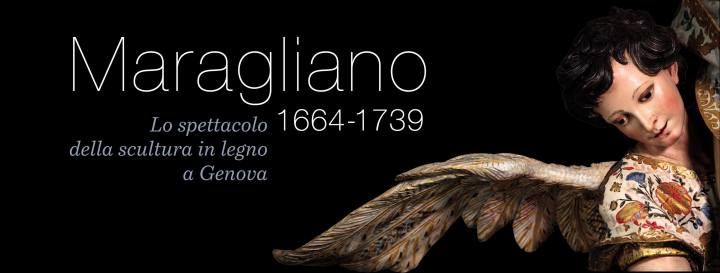
On view in Genoa at the Palazzo Reale:
Anton Maria Maragliano (1664–1739), Lo spettacolo della scultura in legno a Genova
Palazzo Reale di Genova, 10 November 2018 — 10 March 2019
Curated by Daniele Sanguineti
From November 10th 2018 to March 10th 2019 Teatro del Falcone in Palazzo Reale Museum hosts the first monographic exhibition dedicated to the Genoese sculptor Anton Maria Maragliano (1664–1739). Viewers can admire the artist’s masterpieces, testaments to the persuasive power of painted and gilded wood to personify the protagonists of Paradise: from the elegant Marian statues, to the graceful Crucifixes, to the great processional machines with the martyrs of the saints.
 Maragliano’s ability to meet the needs of clients through beautiful images and strong emotional impacts made possible the obtaining of a monopoly that forced the sculptor to develop a structured business model. Two generations of students were welcomed in the rooms of Strada Giulia, in the heart of Genoa, where Maragliano had his workshop, giving rise to the phenomenon of divulging the master’s language which represents the most fascinating, though problematic, aspect of the approach to sculptor: and the pupils of the students pursued this popularization beyond the end of the century. The exhibition presents a dual approach: on the one hand, it displays a chronological path, with Maragliano’s cultural references, the beginnings, the artist’s workshop; on the other hand, it displays thematic sections, articulated in groups of works divided according to iconography.
The exhibition opens with a section dedicated to artistic precedents for the young Maragliano, from Giuseppe Arata and Giovanni Battista Agnesi, to Giovanni Battista Bissoni and Marco Antonio Poggio. The places that Maragliano evoked through a series of documents, engravings, and watercolors usefully tell the stages of apprenticeship and the environments that hosted the master’s workspace over the years. The magnificent San Michele Arcangelo of Celle Ligure, requested of Maragliano in 1694, and the San Sebastiano for the Disciplinanti of Rapallo, commissioned in 1700, testify to the role of models in tune with the most up-to-date figurative culture rooted in Genoa thanks to the painter Domenico Piola and the French sculptor Pierre Puget. These sculptures, capable of translating into the three-dimensionality of the artefact the engaging grace of contemporary painting and Bernini’s sculpture, reveal the new, delicate dynamism of Baroque culture.
The practice of work, from the manipulation of clay models to the collaboration with painters—especially those of Casa Piola—constitute a deepening of particular interest that make comprehensible the ideational project in the entirety of its process. The progressive juxtaposition of Crucifixes—large and small, from a chapel, from a high altar, or from a procession—shows the substantial renewal conferred by Maragliano on the iconography until obtaining a repeatable formula on the part of the students. A series of spectacular Madonnas seated on the throne and an extraordinary processional chest—the Sant’Antonio Abate contemplates the death of Saint Paul the Hermit now relevant to the brotherhood of Mele—highlight the theatrical values of Maragliano’s compositions, for which the biographer Ratti, reporting the judgment of the people, wrote, “have all the air of Paradise.”
Penitential themes from Holy Week are illustrated in the enthralling section on the Passion. Alongside works of small format, including nativity statues are exhibited refined objects—sacred and profane—commissioned by noble families for their private collections. The journey ends with an allusion to the complex management of Maragliano’s heritage, thanks to the presence of some pieces made by his primary students.
The catalogue is published by Sagep and available from Artbooks.com:
Daniele Sanguineti, et al., Maragliano (1664–1739), Lo spettacolo della scultura in legno a Genova (Genova: Sagep Editori, 2018), 288 pages, ISBN: 978-8863735970, €30 / $60.
Exhibition | Drawings and Paintings from The Horvitz Collection
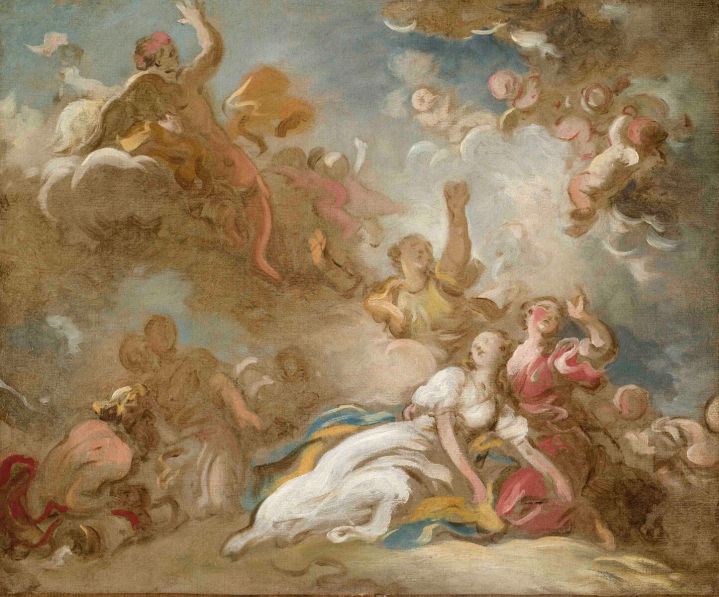
Jean-Honoré Fragonard, Death of Cleopatra
(The Horvitz Collection; photo by Michael Gould)
◊ ◊ ◊ ◊ ◊
Opening this month at FUAM, the exhibition is a variation of Storytelling: French Art from the Horvitz Collection; from the press release:
A French Affair: Drawings and Paintings from The Horvitz Collection
Fairfield University Art Museum, Fairfield, Connecticut, 25 January — 29 March 2019
Curated by Alvin Clark
The Fairfield University Art Museum is pleased to announce its upcoming exhibition, A French Affair: Drawings and Paintings from The Horvitz Collection, which will be on view from January 25 through March 29, 2019, in the museum’s Bellarmine Hall Galleries in Bellarmine Hall on the campus of Fairfield University.
Produced by some of the most prominent artists of the Renaissance, Baroque, Rococo, and Neoclassical epochs, the 80 works on view comprise two separate exhibitions—Imaging Text: Drawings for French Book Illustration and Seventeenth and Eighteenth-Century French Paintings. All come from The Horvitz Collection, one of the world’s finest and most distinguished holdings of French art.
History, mythology, poetry, portraiture, and everyday life provided a vast storehouse of subject matter for French artists from the 16th through the mid-19th centuries. A French Affair features paintings and drawings in all these genres by celebrated artists such as Charles Le Brun, Nicolas de Largillière, Jean-Honoré Fragonard, Jean-Baptiste Oudry, and Anne-Louis Girodet de Roucy Trioson. The impressive selection of 70 drawings, some exhibited with related prints, focuses on a particular category—designs for book illustration—thereby highlighting not only the creative inventiveness of the artists who formulated lavish visual imagery from the written word, but also the rich literary traditions of France and the vibrant book publishing industry they spawned.
“It is a privilege for the Fairfield University Art Museum to present this captivating array of paintings and drawings by some of the leading protagonists of French art of the ancien régime and post-Revolutionary period, lent by the renowned Horvitz Collection,” said Linda Wolk-Simon, Frank and Clara Meditz Director and Chief Curator.
Particularly rich is the drawings exhibition component of this two-part presentation, Imaging Text, which highlights for visitors the importance of book illustration and the robust publishing trade in France as a catalyst for artistic invention. The new prominence of illustrations in printed books, and the heightened demand for draftsmen to produce such images, offered many artists entree into elite artistic, literary, and social circles beginning in the late 17th century. The choice selection of paintings from the same moment, with their bravura handling of light and color and masterful depictions of human form and inanimate objects, speaks to the rigorous artistic training and traditions, promoted by the French Academy and the Salon (the official annual art exhibition), in which all artists of the period—painters, sculptors, draftsmen, printmakers—were schooled.
Renowned for its breadth and quality, The Horvitz Collection has been the focus of many national and international exhibitions and scholarly publications, and it now contains nearly 2,000 drawings, paintings, and sculptures. The exhibition is curated by Alvin L. Clark, Jr., Curator, The Horvitz Collection and the J.E. Horvitz Research Curator, Emeritus, Department of Drawings, Division of European and American Art, Harvard Art Museums/Fogg. An illustrated catalogue of the drawings is available.
Alvin Clark and Elizabeth M. Rudy, Imaging Text: French Drawings for Book Illustration from The Horvitz Collection (Boston: The Horvitz Collection, 2018), 76 pages, ISBN: 978-0991262533, $10.
S E L E C T E D P R O G R A M M I N G
Thursday, January 24, 5:00pm
Collecting French Art: A Conversation with Jeffrey Horvitz and Alvin Clark
Saturday, February 2, 12:00pm
Sarah Cantor (Kress Interpretative Fellow), Gallery Talk: Drawing for Books in 18th-Century France
Thursday, February 7, 11:00am
Michelle DiMarzo (Curator of Education and Academic Engagement), Art in Focus: Pierre-Paul Prud’hon, Sylvia and the Satyr, 1800
Tuesday, February 12, 6:00pm
Performance: ekphrasis vii — Fairfield University MFA students will read original pieces inspired by the works on view in A French Affair: Paintings and Drawings from The Horvitz Collection
Thursday, February 21, 5:00pm
Sarah Cantor (Kress Interpretative Fellow), Gallery Talk: Drawings to Prints
Wednesday, March 6, 5:00pm
Elizabeth Rudy (Carl A. Weyerhaeuser Associate Curator of Prints, Harvard Art Museums), Lecture: 18th-Century French Drawings — part of the Edwin L. Weisl, Jr. Lectureships in Art History, funded by the Robert Lehman Foundation
Display | Instruction and Delight: Children’s Games

Wallis’s Elegant and Instructive Game exhibiting the Wonders of Art in Each Quarter of the World, ca. 1820
(New Haven: Yale Center for British Art)
◊ ◊ ◊ ◊ ◊
Opening this month at YCBA:
Instruction and Delight: Children’s Games from the Ellen and Arthur Liman Collection
Yale Center for British Art, New Haven, 17 January — 23 May 2019
Curated by Elisabeth Fairman with Laura Callery
By the beginning of the eighteenth century in Britain, parents and teachers had begun to embrace wholeheartedly a suggestion from the philosopher John Locke (1632–1704) that “Learning might be made a Play and Recreation to Children.” The material culture of this period, and the subsequent generation, reveals a significant shift in thinking, as adults found fresh value in childhood and in play for its own sake. British publishers leapt at the chance to design books and games for both instruction and delight. This small display celebrates the recent gift of eighteenth- and nineteenth-century children’s games and books to the Center by Ellen and Arthur Liman, Yale JD 1957.
Instruction and Delight: Children’s Games from the Ellen and Arthur Liman Collection has been curated by Elisabeth Fairman, Chief Curator of Rare Books and Manuscripts at the Center, with the assistance of Laura Callery, Senior Curatorial Assistant.
A catalogue appeared in 2017 from Pointed Leaf Press:, with additional information (and images) from this HyperAllergic piece by Claire Voon).
Ellen Liman, Georgian and Victorian Board Games: The Liman Collection (New York: Pointed Leaf Press, 2017), 182 pages, ISBN: 978-1938461439, $65.
Exhibition | Winckelmann and the Vatican Museums
Now on view at the Vatican:
Winckelmann: Masterpieces throughout the Vatican Museums
Winckelmann: Capolavori diffusi nei Musei Vaticani
Vatican Museums, 9 November 2018 — 9 March 2019
Curated by Guido Comini and Claudia Valeri
 A ‘journey within the journey’ along the entire Vatican Museums tour itinerary, this ‘dispersed’ exhibition celebrates the great German scholar Johann Joachim Winckelmann, father of modern archaeology and precursor of today’s art historians. Preceded by and announced in May at the study day on the Montalto Collection in Villa Negroni, Winckelmann: Masterpieces throughout the Vatican Museums symbolically brings to a conclusion the many initiatives organized to honour the renowned archaeologist in the dual anniversary year of 2018—300 years since his birth and 250 since his tragic death in Trieste.
In the years of his ‘dazzling’ stay in Rome (1755–1768), the Vatican Museums as we know them did not yet exist, but Winckelmann already visited the Vatican Belvedere and returned repeatedly to admire the statues conserved there. Indeed, it was due to his favourable judgement that many antiquities that he studied during his visits to the monuments and collections of the Eternal City were then purchased by the pontiffs. The exhibition, curated by Guido Cornini and Claudia Valeri, is intended to highlight precisely this role of the Vatican collections as a cornerstone for the studies, theories, and writings of the renowned German archaeologist. All sectors of the museums have been involved in this impressive and original exhibition project that offers the visitor a thematic itinerary with pauses for in-depth analysis of 50 selected works—on the basis of the role Winckelmann attributed to them in the construction of his aesthetic thought.
Room XVII of the Pinacoteca is dedicated to the presentation of the figure and his age. The screening of a film and the display of some of his most important writings help explain the atmosphere and cultural climate of Rome around the mid-eighteenth century. Winckelmann arrived in 1755 for a brief stay and instead spent the rest of his life in Italy; enchanted by the grandiose beauty of the antiquities, he devoted all his attention and prodigious talent to them.
Guido Comini and Claudia Valeri, Winckelmann: Masterpieces throughout the Vatican Museums (Vatican City: Edizioni Musei Vaticani, 2018), 232 pages, ISBN: 978-8882714307, $58. Also available in Italian.
Exhibition | Painting the Floating World

Utagawa Toyokuni, One Hundred Looks of Various Women, 1816
(Roger Weston Collection)
◊ ◊ ◊ ◊ ◊
Press release (4 October 2018) for the exhibition:
Painting the Floating World: Ukiyo-e Masterpieces from the Weston Collection
Art Institute of Chicago, 4 November 2018 — 27 January 2019
Curated by Janice Katz
The Art Institute of Chicago presents Painting the Floating World: Ukiyo-e Masterpieces from the Weston Collection, a collection formed by Roger Weston over the last twenty-five years which captures compellingly the beginning, major developments, and final flowering of ukiyo-e (pictures of the floating world) painting. Encompassing folding screens, hanging scrolls, handscrolls, and albums, these works are technically accomplished masterpieces by the most famous artists in Edo (present-day Tokyo) and beyond. Ukiyo-e comprises both paintings and prints, so it is especially meaningful that such a complete collection of paintings can be shown at a museum known for its significant holdings of prints.

Chobunsai Eishi, Woman Writing a Poem on a Fan, 1789/1801 (Roger Weston Collection).
The floating world (ukiyo) flourished in the bustling urban centers of Kamigata (Kyoto, Osaka) and Edo from the seventeenth through nineteenth centuries. People of all ranks shared in metropolitan amusements, including the Yoshiwara pleasure quarters and the kabuki theater. The extraordinary paintings in the exhibition, which focus almost exclusively on the beautiful people (bijinga) who were the celebrities of this milieu, offer a privileged, intimate view of the floating world and its many attractions. Ukiyo-e paintings were commissioned works executed by well-known artists, among them Katsushika Hokusai (1760–1849) and Kitagawa Utamaro (1753–1806). Lavish, one-of-a-kind objects, the paintings display the makers’ extraordinary technical skill and address a wide range of subjects, including actors, courtesans, geisha, musicians, and scenes of everyday life in Edo.
“When visitors walk away from this show, we want them to have an understanding that the floating world is full of individuals looking to forge a unique identity for themselves as urban, sophisticated, fashionable and trendy, just as we do in our modern-day society,” said Janice Katz, the Roger L. Weston Associate Curator of Japanese Art.
The exhibition, staged in the museum’s Regenstein Hall, will be the largest exhibition exclusively of ukiyo-e paintings in the U.S. With approximately 160 pieces of art on display, the sheer size of the exhibition is spectacular. Visitors can find parallels between ukiyo-e and present day culture—the exploration of fashion and celebrity, the desire to seek out unique experiences—as well as a thread of influence that can be traced though to the fantasy worlds of Japanese anime and manga.
The paintings are organized in chronological order throughout eight rooms, charting the birth of ukiyo-e and key moments in its evolution. To give visitors the ability to observe the skill of the artists up close, the glass cases housing the works will have a depth of just eight inches. The experience of the exhibition is further enhanced with dynamic maps of the city, educational videos, and digital tablets.
The Art Institute of Chicago will be the exclusive venue for this exhibition. A one-day international symposium will be held on November 15, 2018. In addition, a complementary exhibition in the Weston Wing and Japanese Art Galleries featuring prints and paintings from the Art Institute’s collection will be on view from October 6, 2018 to February 10, 2019. Painting the Floating World: Ukiyo-e Masterpieces from the Weston Collection is generously sponsored by Roger L. and Pamela Weston.
Janice Katz and Mami Hatayama, eds., Painting the Floating World: Ukiyo-e Masterpieces from the Weston Collection (Chicago: Art Institute of Chicago, 2018), 350 pages, ISBN: 978-0300236910, $65.
 From the seventeenth through the nineteenth century, artists in Kyoto and Edo (now Tokyo) captured the metropolitan amusements of the floating world (ukiyo in Japanese) through depictions of subjects such as the beautiful women of the Yoshiwara pleasure quarters and performers of the kabuki theater. In contrast to ukiyo-e prints by artists such as Katsushika Hokusai, which were widely circulated, ukiyo-e paintings were specially commissioned, unique objects that displayed the maker’s technical skill and individual artistic sensibility. Featuring more than 150 works from the celebrated Weston Collection, the most comprehensive of its kind in private hands and published here for the first time in English, this lavishly illustrated and meticulously researched volume addresses the genre of ukiyo-e painting in all its complexity. Individual essays explore topics such as shunga (erotica), mitate-e (images that parody or transform a well-known story or legend), and poetic inscriptions, revealing the crucial role that ukiyo-e painting played in a sophisticated urban culture.
Janice Katz is Roger L. Weston Associate Curator of Japanese Art at the Art Institute of Chicago. Mami Hatayama is curator of the Weston Collection.
Exhibition | Women Artists in Europe, Monarchy to Modernism
Press release (28 December 2018) from the DMA:
Women Artists in Europe from the Monarchy to Modernism
Dallas Museum of Art, 22 December 2018 — 9 June 2019
Curated by Nicole Myers
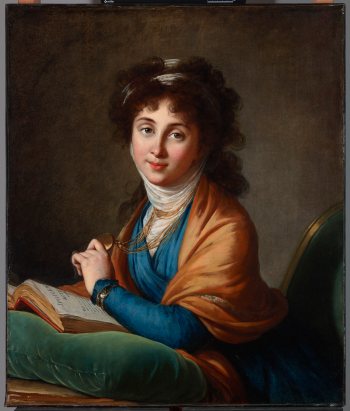
Elisabeth Louise Vigée-Lebrun, Portrait of Natalia Zakharovna Kolycheva, née Hitrovo, 1799, oil on canvas (lent by the Michael L. Rosenberg Foundation, 29.2004.13).
Spanning Europe from the late 18th through mid-20th centuries, the women artists featured in this exhibition worked at a time when prestigious art schools, exhibition venues, and commercial outlets were primarily reserved for their male counterparts. Drawn primarily from the DMA’s permanent collection, this special presentation features paintings and works on paper by artists including Elisabeth Vigée-Lebrun, Rosa Bonheur, Eva Gonzalès, Käthe Kollwitz, Gabriele Münter, and more. Although their artwork cannot be characterized by a single style, viewpoint, or technique, these artists are united by the challenges they faced in pursuing professional careers.
Underlying women’s exclusion was the widely held belief that they were biologically incapable of the intellectual and manual skills necessary to produce great art. Banned from studying the live nude model until the late 1800s, they were prevented from receiving the training necessary for depicting historical or religious subjects that glorify the human form. Instead, women were encouraged to focus on the less significant fields of portraiture, genre, and still life, and to practice drawing, pastel, and watercolor rather than oil painting. Despite this discrimination, the number of professional women artists grew rapidly from the 1850s onward. The triumph of modern art movements over traditional academic styles resulted in more opportunities for equality in the arts in the 20th century.
Women Artists in Europe from the Monarchy to Modernism, on view through June 9, 2019, is organized by the Dallas Museum of Art and curated by Nicole R. Myers, The Lillian and James H. Clark Curator of European Painting and Sculpture. The exhibition can be seen for free as part of the Museum’s general admission policy.
Exhibition | The Claggetts of Newport: Master Clockmakers

Installation view of The Claggetts of Newport: Master Clockmakers in Colonial America (Newport: Redwood Library & Athenaeum, photo by Michael Osean).
◊ ◊ ◊ ◊ ◊
Press release (via Art Daily) for the exhibition:
The Claggetts of Newport: Master Clockmakers in Colonial America
The Redwood Library and Athenæum, Newport, 13 December 2018 — 21 April 2019
Curated by Gary Sullivan and Benedict Leca
In an era when it emerged alongside New York, Boston, Philadelphia, and Charleston as one of the five main port cities of the American Enlightenment, Newport famously distinguished itself by its uniquely progressive society, but also by its cultural refinement, exemplified as much by the Redwood Library—America’s first purpose-built library and earliest public neoclassic building—as by the masterpiece clocks produced by the Claggett dynasty. The Claggetts of Newport: Master Clockmakers in Colonial America features 35 clocks, the largest assemblage of Claggett and Wady clocks ever brought together—many never exhibited publicly. It examines the range of the Claggetts’ clock production in terms of their technical sophistication, decorative finesse, and context of fabrication.
“As the pinnacle of what was often the most expensive item in an elite colonial home, these clocks reflect the cultural aspirations of early Americans, and the role that Newporters played in fashioning an American style that contrasted with European fashions,” said Redwood Executive Director and exhibition co-curator Benedict Leca.
 Drawn from a full roster of public and private collections, the exhibition includes pieces from the Metropolitan Museum of Art, Brown University, The Preservation Society of Newport County, Old Sturbridge Village Collection, and the Rhode Island Historical Society. It features twenty clocks by William Claggett, including his masterpiece: the arch-dial, eight-day quarter-striking clock in japanned case belonging to the Redwood. Thomas Claggett is represented by eleven clocks, while James Wady—to whom only eleven clocks are ascribed—by four clocks, including one using a convex block-and-shell pendulum door, a feature that typified Newport clocks. Among other highlights is a table clock with japanned surface by William Claggett; a trio of Thomas Claggett clocks in related, uniquely regional cases, one a dwarf clock and another a musical clock by him; and two uncased eight-day time and strike movements enabling visitors to peer into the mechanics of a working clock.
The exhibition includes many clocks borrowed from private collections that feature significant provenance information. Preserved by Rhode Island families, some for 300 years, the identities of the original owners of several examples are documented and early family histories are known for others, shedding light on the value, details of construction and the circumstances governing commissions.
“This is an unprecedented presentation of clocks that is unlikely ever to be duplicated. With the recent book devoted to the Claggetts by Fennimore and Hohmann, the Claggetts’ achievement as a highpoint of early American craftsmanship can now be comprehensively appreciated,” said exhibition co-curator Gary Sullivan, the leading authority on early American clocks.
Organized by the Redwood Library & Athenæum—the sole venue—The Claggetts of Newport: Master Clockmakers in Colonial America juxtaposes significant early square dial clocks with later, highly elaborate clocks featuring japanned cases and complex movements indicating the day, tides, and phases of the moon. The clocks’ increasing technical and decorative elaboration over the course of the eighteenth century coincided with the growing prosperity of Newport’s merchant class, whose patronage fueled the city’s emergence as a major colonial artistic center.
The exhibition charts a complex narrative that teases out the three distinct personalities that comprise the Claggett dynasty—William Claggett (1694–1748), his assumed relative Thomas Claggett (d. 1797), and William’s son-in-law James Wady (ca. 1706–1759). As well, the show offers insights on the network of sub-contracted specialist case makers, brass founders and glaziers that the Claggett workshop relied on to produce their clocks.
The technical expertise required to produce a clock, whereby founders cast brass parts that clockmakers filed into the finished movement and positioned inside custom casework made these more than “a great ornament to [a] Room.” The Claggett’s ascendency as clockmakers coincides with the entry of science into public discourse through newly-formed philosophical societies, such as Newport’s Literary and Philosophical Society (1730), the group integral to the founding of the Redwood Library, whose members met to discuss current political and scientific issues. William Claggett himself experimented with electricity, and evidence abounds that clocks were conceived as far more than time pieces: in a 1725 pamphlet Benjamin Franklin compares God’s regulation of the world to the movement of a clock, a metaphor used and critiqued later by the philosopher George Berkeley.
The Claggetts of Newport: Master Clockmakers in Colonial America is co-curated by Gary R. Sullivan and Benedict Leca. The Redwood gratefully acknowledges support from the Edward W. Kane and Martha J. Wallace Family Foundation, and by several donors who wish to remain anonymous. Further support for the gallery presentation comes from Cornelius C. Bond and Ann E. Blackwell, and an in-kind donation by Sandra Liotus Lighting LLC. A catalog recording the exhibition will be available in 2019.
Donald Fennimore and Frank Hohmann, with an Introduction by Dennis Carr, Claggett: Newport’s Illustrious Clockmakers (New Haven: Yale University Press, 2018), 272 pages, ISBN: 978-0300233797, $65.
Exhibition | Silent Night Turns 200

From the Salzburg Museum, in celebration of the song’s 200th anniversary (with nine exhibition sites in all) . . .
Silent Night 200: The Story, the Message, the Present
Stille Nacht 200: Geschichte, Botschaft, Gegenwart
Salzburg Museum, 29 September 2018 — 3 February 2019
Curated by Peter Husty and Birgit Gampmayer
Two hundred years ago, Joseph Mohr and Franz Xaver Gruber met in Oberndorf. Mohr was born in Salzburg in 1792 and ordained a priest here. In 1815, he was appointed as a curate in Mariapfarr. Here, in 1816, he wrote the poem “Silent Night.” 1816 was a hard year for Salzburg. Salzburg had lost its independence. The year without summer brought crises and famine. The words of the carol were created under this impression; they express a longing for redemption and peace. In 1817, Mohr was moved to Oberndorf on the river Salzach. Gruber was born in 1787 in Hochburg in the Innviertel, Upper Austria; he was a teacher in Arnsdorf close by and played the organ in the Oberndorf church. For a short time, the careers of the two men crossed in Oberndorf. Here, Gruber composed the music to the poem on 24 December 1818 for Christmas Eve in the church of St Nicholas. Mohr and Gruber performed the carol themselves. Today it is sung throughout the world at Christmas. It has been translated into countless languages.
Curators: Mag. Peter Husty und Mag. Birgit Gampmayer, BA
Idea: Hon.-Prof.Mag. Dr. Martin Hochleitner
Research concept: Univ.-Prof. Dr. Thomas Hochradner ( Universität Mozarteum Salzburg)










 Enfilade
leave a comment