Exhibition | Turner and Constable: The Inhabited Landscape

John Constable, The Wheat Field, 1816, oil on canvas, 22 × 31 inches (Clark Art Institute, Gift of the Manton Art Foundation in memory of Sir Edwin and Lady Manton, 2007.8.27).
◊ ◊ ◊ ◊ ◊
Press release for the exhibition at The Clark:
Turner and Constable: The Inhabited Landscape
The Clark Art Institute, Williamstown, Massachusetts, 15 December 2018 — 10 March 2019
Curated by Alexis Goodin
Joseph Mallord William Turner (1775–1851) and John Constable (1776–1837) rose to prominence as landscape artists in early nineteenth-century Britain. Their inspired subjects, their distinctive compositions, and their innovative brushwork combined to elevate a genre traditionally considered less important than history painting and portraiture. Turner and Constable: The Inhabited Landscape explores the significance of human figures and the built environment in the landscape, as well as the personal significance of specific places to each artist.
The exhibition features more than fifty paintings, drawings and watercolors, prints, and books, a beautiful selection of which are on loan from the Yale Center for British Art and the Chapin Library at Williams College. The works in the show are primarily drawn from the Clark’s Manton Collection of British Art, created by Sir Edwin Manton and given to the Clark by the Manton Art Foundation in 2007. This transformative gift included more than 250 oil paintings, sketches, works on paper, and prints, making the Clark a center for the study of nineteenth-century British Art.
“One of the real joys of visiting the Clark is the opportunity to consider magnificent landscapes in our galleries while surrounded by the natural beauty of our own campus,” said Olivier Meslay, the Hardymon Director of the Clark. “The Manton collection is so special to us because it is a rich resource that continues to inspire our curators to consider these works through a myriad of lenses. With this exhibition we will look at landscapes in a different context—and we’re particularly excited because this concept provides a perfect opportunity to present several works that have never been shown at the Clark, while many others are rarely on view due to their delicate nature.”
Alexis Goodin, the Clark’s Curatorial Research Associate, organized the exhibition. “It’s easy to overlook the people depicted in the landscapes of Turner and Constable,” said Goodin. “Often these artists’ figures are small, quickly painted, and sometimes not anatomically correct—qualities that might make them seem less relevant to a breathtaking landscape view. When one begins identifying the people within landscapes and their actions, however, these figures can reveal social and political concerns of the time as well as the artists’ interests and connections to the places depicted. We hope this exhibition opens up a new understanding of these works for our visitors and deepens their appreciation for two of the most revered landscape painters of the nineteenth century.”
The exhibition considers a variety of elements presented in landscapes by both Turner and Constable and creates a framework for appreciating the ways in which these figures lend added meaning to the works. They include:
The Observed Landscape
Turner and Constable created a wide range of landscapes and seascapes throughout their careers. They often depicted familiar places that shed light on the personal histories of the artists. Figures incorporated into these landscapes were important to the picture’s narrative and not merely a measure of scale.
Constable, having spent his honeymoon in the seaside village of Osmington, recorded this place of personal importance. Osmington Bay (1816) reveals nature’s grandeur on an intimate scale. The figures—including a fisherman mending a net, a shepherd, and a mother with her child—show the beach as a place of both work and leisure. In the painting Osmington Village (1816–17, Yale Center for British Art), smoke billows from the chimney of the vicarage while people make their way by cart or foot along the village lane, conveying both domestic comfort and productivity within the landscape.
Laborers in the Landscape
Laborers—ploughmen, shepherds, laundresses, fishermen, sailors—populate many of Constable’s and Turner’s landscapes and seascapes. The workers’ presence animates the natural world and underscores the potential abundance of the land or sea. Contemporary accounts reveal difficult working conditions and the extreme poverty of agricultural workers, conditions often not apparent in the artists’ portrayals. The laborers’ presence invites the observer to consider how the environment shaped them, and how they influenced their surroundings. The ways in which Turner and Constable rendered laborers within their landscapes may also shed light on how they viewed the workers.
The Wheat Field (1816) presents a view across a valley in Constable’s native Suffolk. Harvesters cut down the golden wheat with scythes, reapers bundle the stalks, and gleaners collect leftover grains while a boy and his dog guard lunch. The idealized scene belies the heat of the sun and the long hours of monotonous and sometimes painful work. Constable’s inclusion of different classes working together suggests that commercial success and charity were not mutually exclusive. This sympathetic treatment of the poor came at a time when the landless classes were increasingly denied access to places that they had traditionally used to grow food or graze animals.
Laborers fill the foreground in Turner’s Saumur from the Île d’Offart, with the Pont Cessart and the Château in the Distance (c. 1830). In this scene of the town of Saumur, located on the Loire River in west central France, washerwomen spread out laundry to dry on the steps while men load cargo onto barges. The workers bring the picturesque view to life, showing the town as a center of commercial prosperity.
The Literary Landscape
Turner often turned to literary texts for source material, situating characters in settings that enhanced their stories or populating imaginary landscapes with familiar narratives. He was commissioned to design illustrations for literary publications, supplying finished watercolors that printmakers would turn into engravings used in bound volumes.
Turner spent the summer of 1831 in Scotland, sketching landscapes described in Sir Walter Scott’s poems and novels for a proposed illustrated edition of the author’s works. The project never came to fruition, but Turner worked up his drawings for a related publication. Wolf’s Hope, Eyemouth (c. 1835) is one of six finished watercolors translated into illustrations for Rev. George Wright’s Landscape-Historical Illustrations of Scotland and the Waverly Novels (1836). Wolf’s Hope, Eyemouth illustrates one of the settings in Sir Walter Scott’s novel The Bride of Lammermoor (1819), showing the harbor town where the novel’s tragic hero, Edgar Ravenswood, resided in a dilapidated castle called Wolf’s Crag.
The Built Landscape
The buildings within Constable’s and Turner’s works not only identify the geography and place their landscapes within time, but also reveal each artist’s personal connections to place. Constable found inspiration in the English countryside, often highlighting the small villages, cottages, churches, cathedrals, and other built structures that he encountered.
Salisbury Cathedral and its environs held special meaning for Constable, as his good friends and patrons the Bishop of Salisbury John Fisher and his nephew, John Fisher, later Archdeacon of Berkshire, resided there. Inspired by the majestic Gothic cathedral, he painted this important seat of the Anglican faith from many viewpoints, often emphasizing the spire towering over the plain. For Constable, a member of the Church of England, the church was not just architecture or a relic of the past, but a symbol of enduring faith. Indeed, as a seat of Anglican worship, Salisbury represented steadfastness and tradition in a time of increasing challenges to its authority, including the rise of Evangelicalism and the revival of Anglo-Catholicism brought on by the Oxford movement in the mid-1830s. The exhibition presents four works in various media depicting the cathedral—three from the Manton Collection of British Art and a fourth collected by Sterling and Francine Clark in 1945.
Turner grew up in London, and the city provided him with his earliest subjects. His watercolor The Tower of London (c. 1794) served as the basis for an engraving published in The Pocket Magazine on January 1, 1795. Viewed from across the Thames, the White Tower, built in 1078 and famously used as a prison until 1952, rises majestically above a city awash with light. Large mast ships on either side of the small composition frame the view of this historic fortress. The still water of the Thames reflects the boats and buildings, giving the scene a timeless calm. The absence of figures and narrative allows the focus to remain on the built environment.
Turner and Constable: The Inhabited Landscape is presented in the Clark’s special exhibition galleries in the Clark Center. The Clark also presents a companion installation of sixteen landscape drawings by Thomas Gainsborough in the Manton Gallery for British Art, located in the Manton Research Center, from December 1, 2018 until March 17, 2019. Fourteen of the Gainsborough drawings on view in this installation are from the Manton collection. Though recognized as one of the most fashionable portrait painters in the eighteenth century, Gainsborough made hundreds of drawings of the English landscape. Abundant with foliage, cottages, and pastoral figures, the works evoke the gentle woodland and heath of the artist’s native Suffolk and the mountainous Lake District of Cumbria. Gainsborough’s landscape drawings in this presentation reveal the artist’s fascination with mixed-media technique: graphite, chalks, ink washes, watercolor, and oil paints intermingle on toned papers.
Exhibition | Seeing the Divine: Pahari Painting of North India

Radha and Krishna Walking at Night, ca. 1775–80, Punjab Hills, Kingdom of Kangra or Guler
(New York: The Metropolitan Museum of Art)
◊ ◊ ◊ ◊ ◊
Press release for the exhibition:
Seeing the Divine: Pahari Painting of North India
The Met Fifth Avenue, New York, 22 December 2018 — 21 July 2019
Curated by Kurt Behrendt
Starting December 22, The Metropolitan Museum of Art will present an exhibition focusing on early painting styles that emerged in the Pahari courts of North India during the 17th and 18th centuries. Featuring some 20 of the most refined paintings produced in South Asia during the period, Seeing the Divine: Pahari Painting of North India will examine the innovative ways in which Pahari artists depicted the Hindu gods. By juxtaposing devotional images with emotionally charged narrative moments, the paintings gave royal patrons a novel approach to forging a personal connection with the divine through devotion (bhakti). Highlights include a rare, early 19th-century temple banner measuring 26 feet that is being shown publicly for the first time. The majority of the works on view are recent promised gifts of Steven Kossak, and they transform The Met’s ability to showcase 17th- to 18th-century North Indian painting of the highest caliber.
Working mostly in miniatures and large-format folios, Pahari artists employed remarkably innovative vocabularies. They often depicted god as a child, a lover, a terrible protector, or even a personal vision. Famous narratives such as the Ramayana and the Gita Govinda (Song of Govinda) had tremendous appeal at the Pahari courts, and the exhibition will include folios that reference both. The Monkey Leader Angada Steals Ravana’s Crown from His Fortress (ca. 1725), a folio from the Ramayana (the story of Rama’s quest to save his beloved Sita from the demon Ravana), is attributed to the master painter Manaku (active ca. 1725–60). Radha and Krishna Walking at Night (ca. 1775–80), a folio from the Gita Govinda, depicts Krishna’s emotionally charged interactions with Radha—here, the artist contrasts her solitude and longing with erotically charged encounters to emphasize the idea of unity between god and devotee.
The impressive temple banner recounts the complex story of Krishna’s rescue and marriage to his first wife, Rukmini, as well as dramatic scenes of Krishna and his many followers fighting a heroic battle in the Himalayan foothills—a battle that represents the great conflict between gods and demons to restore cosmic order.
The exhibition is organized by Kurt Behrendt, Associate Curator of the Department of Asian Art at The Metropolitan Museum of Art. It is made possible by The Miriam and Ira D. Wallach Foundation.
Exhibition | Ruben and Isabel Toledo: Labor of Love

Press release (6 December 2018) from the DIA:
Ruben and Isabel Toledo: Labor of Love
Detroit Institute of Arts, 16 December 2018 — 7 July 2019
Organized by Laurie Ann Farrell
The Detroit Institute of Arts (DIA) presents Ruben and Isabel Toledo: Labor of Love, a major exhibition of new works created by the artistic couple in response to works in the DIA’s permanent collection. This three-part exhibition project includes a large-scale installation designed by the Toledos in response to iconic Diego Rivera cartoons from his Detroit Industry Murals; additional new works by the Toledos responding to works in the DIA’s collection, located throughout the museum; and a collaboration with local nonprofit Sew Great Detroit, through which the Toledos worked with seamstresses from the organization to generate a collection of handmade limited-edition tote bags to complement the exhibition.

Francisco de Goya, Dona Amalia Bonells de Costa, ca. 1805, oil on canvas (Detroit Institute of Arts).
For Labor of Love, Ruben and Isabel Toledo produced an innovative range of new works that highlight their creative synergy, connect the past with the present, and will inspire the DIA’s visitors to understand connections between fashion and art with the works in the DIA’s collection—in new and unexpected ways.
Ruben and Isabel Toledo: Labor of Love will open at the DIA on December 16, 2018, and run through July 7, 2019. The exhibition is organized by Laurie Ann Farrell, the DIA’s Curator and Department Head for The James Pearson Duffy Department of Modern & Contemporary Art. The exhibition is free with museum admission, which is free for residents of Wayne, Oakland and Macomb counties.
Isabel Toledo (Cuban-American, b. 1961) is a renowned fashion designer and artist whose oeuvre includes the dress that Michelle Obama wore to President Barack Obama’s 2009 Inauguration. Ruben Toledo (Cuban-America, b. 1961) is an artist whose paintings and illustrations also have strong connections to fashion and style.
This exhibition marks the first time the artists have made works inspired by a major museum’s collection. Working within the framework of the DIA’s world-class, encyclopedic collection, the Toledos engaged with works by Francisco Goya, Alison Saar, Eva Hesse, Donald Judd, Robert Motherwell, and others from Central Africa and ancient Egypt. By mining the DIA’s collection as inspiration for new sculptures, paintings, drawings, and installations, the Toledos, together with the DIA, present the Museum’s collection in a new light.
Explains Farrell, “The cumulative experience of a large exhibition and the discovery of works across a variety of galleries will introduce visitors to the power and poetry of the Toledos’ collaborative process while simultaneously offering new insights into works that span cultures and time.”
Adds Salvador Salort-Pons, the DIA’s Director, President, and CEO, “Isabel and Ruben’s inspiring work in dialogue with our world class collection will infuse our building with ‘a Cuban accent.’ I am excited to see the energy of this dialogue, which together with our impactful interpretive models will help the museum fulfill its mission to ‘help visitors find personal meaning in art, individually and with each other.’ This exhibition is a good example of the ways that the DIA can resonate with a broad and diverse audience, and find new opportunities to engage people with art and fashion.”
The museum’s expansive holdings are displayed in 130 galleries spanning three floors of the 658,000-square-foot museum. Visitors will have the opportunity to discover original Toledo creations positioned alongside the works that inspired their conception within 10 different galleries ranging from ancient Egyptian through contemporary art, throughout the entire museum. A printed gallery guide will include a map of where the Toledo works are located within the galleries along with a short introductory text in both English and Spanish.
For example, in the Egyptian Galleries, Ruben and Isabel collaborated on a linen sculpture that invites viewers to consider the way ancient Egyptians took such great care of the dead, protecting the body with bandaging to prepare it for the afterlife. The Toledos’ work, Human Remains, displays how linen records the shape of the wearer by molding to the body. The geometric patterns on their sculpture are inspired by the mummy on view in the center of the gallery.
Another example is First Lady Silhouette, created by Isabel, which holds court in an Early American period room. Viewers will delight in seeing fabric used to create Michelle Obama’s lemongrass colored coat and dress adorning this new work’s breastplate on a dress that is designed to mirror those worn in the late 18th and early 19th centuries. The skirt of the dress also features Ruben’s illustrations reimagining President Barack Obama and the Former First Lady on their historic promenade to the White House in 2009.
In addition, the Toledos have designed an immersive experience set within a 10,000-square-foot temporary exhibition space. The gallery will present five original, rarely seen cartoons from Diego Rivera’s Detroit Industry Murals in the DIA’s collection alongside new works by the Toledos that explore Detroit’s history of industry and modernization. While interpreting the epic Rivera murals, the Toledos creatively draw parallels to their worlds of fashion and art. Extrapolating on the past, present, and future in art, the artists project and distill the poetic and spiritual essence that they see as essential to all of the arts.
Ruben Toledo’s Color Code paintings line the first gallery of the Labor of Love special exhibition, with four paintings of reclining women that recall Diego Rivera’s monumental women known as the Four Races in the Detroit Industry Murals. Ruben’s larger-than-life figures are artfully camouflaged through the patterned surface of their skin. The artist notes that his women have been weaponized as a commentary on our current political climate. His contemporary adaptations of Rivera’s women offer insight into the various ways that Ruben’s work bridges gaps between art and fashion.
The DIA and the Toledos partnered with the nonprofit Sew Great Detroit (SGD), a branch of Alternatives for Girls (AFG), as another component of the exhibition. The Sew Great Detroit seamstresses’ interaction with the artists offered many insights into the realities of the fashion industry—a field in which many of the participants have strong interest. This year-long partnership has been documented and will be presented as part of the exhibition. This is an unprecedented partnership for both the Toledos and the DIA.

Isabel Toledo and Ruben Toledo, Synthetic Cloud, 2018, nylon, as installed at the DIA, 2018.
◊ ◊ ◊ ◊ ◊
About Ruben and Isabel Toledo
The Cuban-born Toledos met in high school in New Jersey and married in 1984. Andy Warhol was a guiding light for them; they met him as teenagers at a Fiorucci store. Traversing the fashion, illustration and the fine art world, Warhol taught them by example the value and cultural richness of a borderless artistic world. They have utilized this creative freedom and risk-taking approach in both of their individual works and their collaborative projects. This exhibition will further advance this fearless approach by allowing them to incorporate illustration, photographic research and social anthropology as well as film-making techniques to explore new ways of demonstrating the creative cross pollination they thrive on.
A muse to her husband’s sculpture, painting and illustration, Isabel Toledo’s sculptural designs are often influenced by her husband’s creative sketches for her designs. Ruben’s surreal view of life brings humor and unconventionality to his wife’s industrial world. The Toledos’ long history of collaboration includes creating original costumes and scenography for the Broadway musical After Midnight (2014) for which Isabel Toledo received a Tony nomination for costume design. Most recently, the couple reimagined George Balanchine’s The Nutcracker for the Miami City Ballet and Music Center in Los Angeles in 2017. Their combined work over the past 30 years both inside and outside the art world has resulted in a highly personal visual language with a diverse and cohesive rhythm.
In 1985 Isabel Toledo presented her first fashion collection. She went from being a designer’s designer with an underground cult-like following to being a global household name when Michelle Obama wore her lemongrass lace ensemble to President Barack Obama’s inauguration ceremony in 2009. Isabel Toledo was presented with the third annual Couture Council Award for Artistry of Fashion from the Museum at the Fashion Institute of Technology in 2008.
Ruben is a painter, sculptor and fashion chronicler who creates incisive illustrations for top international magazines, journals and fashion retailers, including the New Yorker, Vogue, Louis Vuitton, Nordstrom, Harper’s Bazaar, Visionair and The New York Times. His work has been shown at prestigious institutions including the Costume Institute of the Metropolitan Museum of Arts, New York, the Victoria and Albert Museum in London, and the Pitti Palace in Florence.
Along with her husband, Ruben Toledo, Isabel was the recipient of the Cooper-Hewitt Design Award for their work in fashion in 2005, she was also the recipient of an Otis Critics’ award by the Los Angeles-based Otis College of Art and Design. In 2010, the Toledos were awarded honorary doctoral degrees in fine arts by Otis College in Los Angeles, CA.
About Alternatives For Girls’ Sew Great Detroit Program
Alternatives For Girls (AFG) is a Detroit-based 501(c)3 nonprofit serving homeless and high-risk girls and young women through safe shelter, street outreach, educational support, crisis intervention, and counseling. AFG’s Sew Great Detroit is a social enterprise program that provides sewing and employment training. Women in the program learn valuable skills, like machine sewing and hand finishing techniques, understanding characteristics of fabric, fabric cutting methods, and beginning design concepts. The women earn an hourly wage for their work, which is supported through contracted sewing projects.
Searching for the 1725 Portrait of Esther Barbara von Sandrart
From H-ArtHist:

Georg Daniel Heumann, after Georges Desmarees, Portrait of Esther Barbara von Sandrart, 1727, 34 × 23 cm (Herzog Anton Ulrich-Museum).
Im Rahmen der Vorbereitung für die Ausstellung Die Welt im Bildnis: Frankfurter Porträtsammlungen vom 16.–18. Jahrhundert, die unter der Leitung von Prof. Dr. Jochen Sander im Frühjahr 2020 im Museum Giersch der Goethe-Universität stattfinden wird, wird nach dem Porträt der Esther Barbara von Sandrart gesucht.
Kernelement der geplanten Ausstellung ist eine Sammlung von Porträtgrafiken aus dem Bestand der Universitätsbibliothek Johann Christian Senckenberg, die aus dem Besitz der Frankfurter Patrizierfamilie Holzhausen stammt. 1923 gelangten die druckgrafischen Blätter gemeinsam mit dem Büchernachlass Adolf von Holzhausens in die Universitätsbibliothek. Unter diesen knapp 1200 Blättern (meist Kupferstiche und Schabkunstblätter, aber auch Holzschnitte und Radierungen) befindet sich das Porträt der Esther Barbara von Sandrart im Kupferstich von Georg Daniel Heumann.
Esther Barbara von Sandrart (1651–1731/33), geb. Bloemart, war die Ehefrau des Joachim von Sandrart und selbst Kunstsammlerin. Ihr Porträt hielt man oft fälschlicherweise für das der Maria Sibylla Merian. Der Stich Heumanns von 1727 basiert auf einem Gemälde des Malers Georges Desmarees aus dem Jahr 1725. Es zeigt die Witwe von Sandrart in einem Studierzimmer vor einer Karte Südostasiens (?), ein Detail, das im Stich fehlt. Auf dem Tisch vor ihr ausgebreitet und in dem kleinen geöffneten Kabinettschrank präsentiert sich dem Betrachter eine Naturaliensammlung bestehend aus Muscheln, präparierten Schmetterlingen und Insekten.
In der Ausstellung im Museum Giersch soll der Stich in einer Sektion zum Porträt des Wissenschaftlers und Naturforschers präsentiert werden. Wünschenswert wäre eine Gegenüberstellung mit dem Gemälde Desmarees‘. Bisher ist es aber nicht gelungen, dieses zu lokalisieren. Im Wikipedia-Artikel zur Person Joachim von Sandrarts wird es ohne Verweis auf die Bildquelle gezeigt.
Jeglicher Hinweis zur Ermittlung des Aufenthaltsorts von diesem Gemälde ist von großer Hilfe. Bitte setzten Sie sich mit uns in Verbindung:
Corinna Gannon M.A.
Kunstgeschichtliches Institut Frankfurt am Main
Senckenberganlage 31
60325 Frankfurt am Main
gannon@kunst.uni-frankfurt.de
Exhibition | MONUMENTality
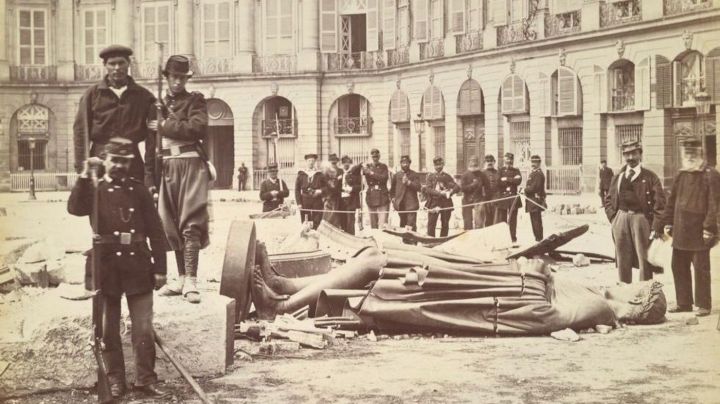
Bruno Braquehais, Statue of Napoleon I after the Toppling of the Vendôme Column, 1871
(Los Angeles: Getty Research Institute)
◊ ◊ ◊ ◊ ◊
Press release (19 November 2018) for the exhibition:
MONUMENTality
Getty Center, Los Angeles, 4 December 2018 — 21 April 2019
Curated by Frances Terpak, Maristella Casciato, and Katherine Rochester
As the role and meaning of monuments in contemporary culture takes on new urgency, the Getty Research Institute is presenting an exhibition that connects these contemporary concerns to the past. MONUMENTality invites viewers to consider how the meanings of monuments can change over time and why some monuments endure while others fall.
“In organizing both this extraordinary exhibition and the current scholar year theme, the Getty Research Institute has focused on an especially timely subject—monuments and monumentality. Here, art history has very contemporary implications as many people, especially in the U.S., are passionately debating and re-examining the roles that monuments play in our communities and cities,” said Andrew Perchuk, acting director of the Getty Research Institute. “The GRI’s special collections are a rich source of archival material that makes it possible to take a broad view of both the varied life of monuments and the concept of the monumental from the classical to the contemporary.”
The exhibition investigates various paradigms of monumentality generated through systems of belief and structures of power, presenting historical rare books, political ephemera, photographs, and contemporary art about or inspired by monuments from antiquity to present day.
Artists in the exhibition include Dennis Adams, Annalisa Alloatti, Lane Barden, Mirella Bentivoglio, Joyce Cutler-Shaw, Tacita Dean, Theaster Gates, Leandro Katz, Michael Light, Benedetta Cappa Marinetti, Edward Ranney, Ed Ruscha, Ursula Schulz-Dornburg, Lebbeus Woods, and more.
Objects in the exhibition date back to the 16th century, depicting early modern as well as classical monuments. For example, the renowned 18th-century printmaker Giovanni Battista Piranesi created grandiose reconstructions of Ancient Rome and a detailed scrolling engraving of Trajan’s column, erected in 113 CE. Rare 19th-century photographs document rebelling citizens during the 1871 Paris commune surrounding the toppled statue of Napoleon Bonaparte in the Place Vendôme, illustrating how the erection and destruction of monuments has been a recurring theme from antiquity to the present.
Among the oldest monuments explored in the exhibition are the Nazca lines, hundreds of ancient geoglyphs drawn into the southern desert of Peru by the Nazca people between 200 BCE and 500 CE. Recorded by photographers in the 20th century these enigmatic monuments are subject to plentiful theories about their meaning and purpose. In the exhibition, they are represented through photographs by Edward Ranney (American, b. 1942) who visited the sites repeatedly throughout the last half of the 20th century.
Juxtaposed with the Nazca images are photographs of earthworks created in the 1960s and 1970s by American artists who drew inspiration from these ancient monuments.
“Just as size and scale have been important in human efforts to mark cosmic and geological time, they are used by artists to invoke the monument and locate meaning. The phenomenology of the monument, the power structures behind monuments, and the meanings of monument, even when lost, are compelling subjects for contemporary artists,” said Frances Terpak exhibition co-curator and curator of photography at the Getty Research Institute. “Monuments are often made by artists but artists also take on the monument as a subject for exploring, deconstructing, and challenging.”
One of the newest objects in the exhibition is a deconstructed monument by Theaster Gates who is currently the artist in residence at the Getty Research Institute. For this exhibition Gates has toppled his own monumental piece Dancing Minstrel, 2016/18. Originally exhibited in 2016 as a larger-than-life bobble head depiction of the racist trope of the black minstrel, the installation at the Getty features the oversized parts of the figure scattered across the floor, a dramatic dismantling of a racist stereotype.
The exhibition also considers monumentality in relation to cities, both real and imagined. Design proposals and plans for the never-built Palace of the Soviets submitted during and after a major international competition in 1931–33 placed alongside a utopian plan to connect East and West Berlin at the height of the Cold War reveal how power is envisioned through the construction of the city and its monuments. The connection between monuments and the built environment is further explored through printed material, photographs, and ephemera. The impulse to document Los Angeles, for example, has spawned projects of enormous scope—such as Ed Ruscha’s extensive photo-documentations of Los Angeles Every Building on the Sunset Strip, 1966 and Hollywood Blvd, 1973 and 2002 and Lane Barden’s Linear City, a monumental tool for envisioning the city at the start of the 21st century by mapping its main arteries: water, rail, and automotive.
“Monuments, though often meant to stand for eternity, can physically change over time—from erosion, looting, war, or iconoclasm—or they can stay intact but change in their meaning, losing context or relevance, or becoming integrated with daily life in new ways. And monuments can form organically, through the ways that people interact with the built environment,” said Maristella Casciato, exhibition co-curator and curator of architecture at the Getty Research Institute. “MONUMENTality investigates the ways that monuments are necessarily dynamic, ultimately reflecting, through their endurance or failure, the world around them.”
The exhibition checklist is available here»
Exhibition | The Art of the Site: Building and Demolishing
Now on view at the Cité de l’architecture et du patrimoine:
The Art of the Site: Building and Demolishing from the 16th to the 21th Century
Cité de l’architecture et du patrimoine, Paris, 9 November 2018 — 11 March 2019
Curated by Valérie Nègre and Marie-Hélène Contal
 The exhibition juxtaposes different viewpoints, bringing together a collection of works and documents produced by artists, journalists, and amateurs, as well as those who work in situ: engineers, architects, contractors, and—what is rarer—labourers, through votive offerings or masterpieces produced by the Compagnons charpentiers des Devoirs du Tour de France. The exhibition ends with the statements of three contemporary architect-engineers: Patrick Bouchain, Marc Mimram, and Martin Rauch, for whom the building site is ever increasingly the space where architecture meets complexity, inventiveness and the aspirations of the modern-day world.
As the result of close collaboration between specialists of art and specialists of techniques, the exhibition offers a diverse interpretation of the theme: it casts a light on the technical dimension, as well as the social, political, and artistic dimensions. The path begins with what you would expect to find on a site: construction processes, machines, and men at work. It then highlights the political and social issues about the place that is being built. Even though the site is a highly technical area, it is also a theatre for those in charge, who like to show themselves there, and for the labourers, who are sometimes viewed as oppressed masses, sometimes viewed as heroes.
L’Art du chantier: Construire et démolir du 16e au 21e siècle (Paris, Snoeck, 2018), 283 pages, ISBN: 978-9461614728, 42€.
Print Quarterly, December 2018
The eighteenth century in the current issue of Print Quarterly:
Print Quarterly 35.4 (December 2018)

François Vivares after Samuel Wale, Trade Card of Henry Scott, Gardener and Fruitseller, Weybridge, Surrey, 1754, etching and engraving, 281 × 211 mm (London: The British Museum).
A R T I C L E S
• Bryony Bartlett-Rawlings, “Jonathan Richardson (1667–1745) as Etcher,” pp. 392–406.
On the basis of the 1772 auction catalogue for the sale of Jonathan Richardson Jr’s collection, the article sheds light on Richardson’s activity as a printmaker, his working method, and intended audience. By quoting contemporary correspondence by and on the artist, the article also places Richardson’s etchings within the context of his life and work.
• Martin Hopkinson, “Gardeners’ Trade Cards by William Kilburn and François Vivares,” pp. 420–26.
Deservedly famous for his outstanding textile designs and illustrations to William Curtis’s Flora Londinensis, Kilburn also etched a trade card for the gardener Thomas Greening, an image of great botanical precision. A comparison is drawn with two elaborate trade cards for gardeners by François Vivares.
N O T E S A N D R E V I E W S
• Jean-Gérald Castex, Review of the exhibition catalogue, A Kingdom of Images: French Prints in the Age of Louis XIV, 1660–1715 (Getty Research Institute, 2015; and Bibliothèque National de France, 2015–16), pp. 430–32.
• An Van Camp, Review of Ad Stijnman and Simon Turner, ed., The New Hollstein Dutch & Flemish Etchings, Engravings, and Woodcuts, 1450–1700: Johannes Teyler and Dutch Colour Prints, parts 1–4 (Sound and Vision Publishers, 2017), pp. 432–34.
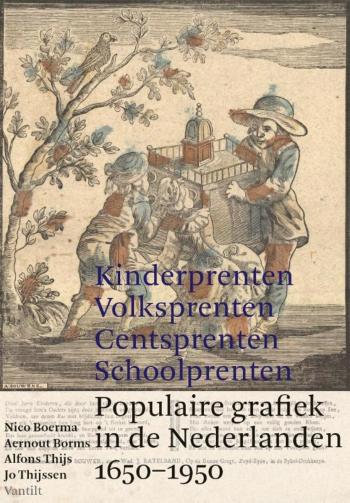 • Ger Luijten, Review of Nico Boerma, Aernout Borms, Alfons Thijs, and Jo Thijssen, eds., Kinderprenten, Volksprenten, Centsprenten, Schoolprenten: Populaire grafiek in de Nederlanden 1650–1950 (Uitgeverij Vantilt, 2014), p. 434.
“At more than a thousand pages,” this volume “is a reference work that deserves a place in any library striving to cover the history of printmaking … Written and compiled by Dutch and Flemish specialists of popular prints over a period of some ten years, it provides a mine of information that is nowhere else to be found … The book has a useful summary in English and German.”
• Anthony Dyson, Review of Richard Goddard, ‘Drawing on Copper’: The Basire Family of Copper-Plate Engravers and Their Works (Maastricht University Press, 2016), pp. 437–39.
• Notice of the exhibition catalogue, Marcela Vondráčková, Norbert Grund (1717–1767): Půvab všedního dne / The Charm of the Everyday, Czech and English (National Gallery in Prague, 2017), p. 459.
“This handsomely-illustrated exhibition catalogue gives a survey of the work of the delightful rococo painter Norbert Grund (1717–1767), who is scarcely known outside Central Europe … We look forward to learning more … in a comprehensive monograph on Grund’s oeuvre, which is due to be published by Marcela Vondráčková.”
• Patricia Emison, Review of Susanna Berger, The Art of Philosophy: Visual Thinking in Europe from the Late Renaissance to the Early Enlightenment (Princeton University Press, 2017), pp. 471–74.
“Berger’s readable and well-illustrated account tackles the topic of logic’s contribution to the history of visualization, and of scholastics’ interest in transmitting knowledge via images … Berger has dug deep in unusual places,” including a mnemonic treatise of 1725 and eighteenth-century student notebooks from Paris and Leuven. “This is fascinating material.”
• Sarah Grant, Review of April Calahan, Fashion Plates: 150 Years of Style (Yale University Press, 2015), pp. 474–78.
Exhibition | Georges Focus: The Madness of a Painter
From the communiqué de presse:
Georges Focus (1644–1708): La folie d’un peintre de Louis XIV
Palais des Beaux-Arts, Paris, 13 October 2018 — 6 January 2019
Curated by Emmanuelle Brugerolles
 La découverte de l’œuvre de Georges Focus produite lors de son enfermement aux Petites Maisons suscite aujourd’hui l’étonnement, pour ne pas dire un choc, qui nous bouleverse. Elle nous inspire le sentiment de l’inédit, du jamais vu, et remet en cause nos idées reçues. Georges Focus, membre de l’Académie royale de peinture et de sculpture sous Louis XIV, eut une double production artistique, académique d’une part, personnelle et intime, d’autre part. L’étonnant corpus réuni en France pour la première fois au Palais des Beaux-Arts, soit environ 80 dessins ainsi que des estampes et des peintures provenant de l’université d’Édimbourg, de collections particulières et d’institutions publiques dont les Beaux-Arts de Paris, rend compte de sa trajectoire unique. Une occasion d’explorer l’oeuvre exceptionnelle et singulière d’un artiste de l’époque de Louis XIV, atteint de folie.
Emmanuelle Brugerolles, ed., Georges Focus: La Folie d’un Peintre de Louis XIV (Paris: Beaux-Arts de Paris Editions, 2018), 447 pages, ISBN: 978-2840565444, $80.
The full press release is available here»
Exhibition | Bed Furnishings in Early America
Now on view at the Wadsworth Atheneum:
Bed Furnishings in Early America: An Intimate Look
Wadsworth Atheneum Museum of Art, Hartford, Connecticut, 26 September 2018 — 27 January 2019
Curated by Brandy Culp

Anna Tuels, Paper Template-pieced Quilt, Hourglass, 1785, New England, various worsteds, silk, and printed cottons, with a wool backing and wool batting (Wadsworth Atheneum, 1967.75).
From birth to death, the bed played a significant role in life’s daily cycles. Almost a room within a room, the bed was a place for sleeping as well as intimate activities, such as sex, childbirth, nursing, convalescence, and even death. From the seventeenth to early nineteenth century there was a bed in almost every room of the home. The ‘best bed’—today we call it the master bed—was usually located in either the distinguished parlor or ‘best’ bedchamber. These were public spaces, where guests were entertained and daily activities took place.
The fully-outfitted bedstead was one of the most expensive household items in Early America, regardless of one’s wealth. Bed hangings, counterpanes, coverlets, bed rugs, and quilts bear witness to the aspirations of their owners and makers. All are exceptional examples of handwork that reflect the skills of talented artisans, whether hired professional or homemaker, and mark the global intersections between people of various cultures. Bed Furnishings in Early America, An Intimate Look explores the evolution of privacy, intimacy, status, and global exchange through the bedstead, its textiles, and their placement within the home into the late nineteenth century.
Exhibition | Bouke de Vries: War and Pieces

Bouke de Vries, War and Pieces, 2012, 18th-, 19th-, and 20th-century porcelain, plastic, sprayed plaster, acrylic, steel, aluminum, gilded brass, and mixed media (installation view at the Wadsworth Atheneum Museum of Art, 2018).
◊ ◊ ◊ ◊ ◊
From the press release, via Art Daily:
Bouke de Vries: War and Pieces
Wadsworth Atheneum Museum of Art, Hartford, Connecticut, 4 October 2018 — 6 January 2019
Montgomery Museum of Fine Arts, Montgomery, Alabama, 2 February — 12 May 2019
For years, the work of celebrated artist Bouke de Vries has been shown all over Europe in museums, galleries, castles, and palaces. America won’t be left behind. Now and through the middle of 2019, several sculptures by Dutch-born de Vries will be making their stateside debut at museums in Hartford, Connecticut; Montgomery, Alabama; and Nashville, Tennessee. Foremost among them is his pièce de résistance: War and Pieces, a 26-foot-long installation inspired by the lavish decorative centerpieces of 18th-century European banqueting tables.
The first venue is the Wadsworth Atheneum, in Hartford, where de Vries is the featured artist in the 180th installment of the museum’s MATRIX contemporary art exhibition series, running from 4 October 2018 until 6 January 2019. “Because the Wadsworth Atheneum possesses such an outstanding collection of the very kind of porcelain figures and centerpieces that Bouke de Vries references in his monumental work,” observes Linda Roth, Senior Curator and Charles C. and Eleanor Lamont Cunningham Curator of European Decorative Arts, “featuring War and Pieces at our museum makes perfect sense.” Adds de Vries: “It is an honor to debut my most ambitious work at America’s first-ever museum of art, the Wadsworth Atheneum, in their longstanding and groundbreaking MATRIX series.”
From Hartford, War and Pieces travels South, to Alabama, where it will be on view at the Montgomery Museum of Fine Arts from 2 February to 12 May 2019.
Employing broken shards of various kinds of porcelain-ancient and modern—from Hummel thru blanc de Chine to IKEA—the artist has arranged them into apocalyptic vignettes of orchestrated destruction. Dead center is a towering nuclear mushroom cloud. Six mano-a-mano battle scenes flank the cloud, fought by armour-clad figures molded from 18th-century embodiments of Mars and Minerva by England’s Derby factory. The sugarcoated warring figures are mutating into cyborgs with colorful bionic limbs and weaponry from Transformer toys. The striking diversity among the sugar, porcelain and plastic underscores the tension between the handmade and the industrial. De Vries’s masterwork is an unforgettable commentary on the follies of war and is perhaps the most startling tablescape since Judy Chicago’s landmark Dinner Party, 1979.
London-based, de Vries first worked in fashion with John Galliano, Stephen Jones, and Zandra Rhodes before switching careers. Since then the 57-year-old artist has worked as a conservator of ceramics and glass, in addition to his pursuits as an artist since 2010. Ironically, the skills he deploys as a restorer went in a totally opposite direction for War and Pieces. Instead of reconstructing shattered porcelain, he deconstructed it, inaugurating a new status while creating new virtues. Says de Vries: “I have dreamed of sharing my approach to art—especially War and Pieces—at such prestigious museums around the United States.”
In addition, from 2 February until 9 June 2019, as part of Derived from the Decorative: Works by Faig Ahmed, Beth Lipman and Bouke de Vries at Nashville’s Cheekwood Estate and Gardens, other works by de Vries will be making their American bow. Peacock 1 and Glass Cloud are also both constructed of broken pieces of historic ceramic and glass. Bouke de Vries is represented in the United States by Ferrin Contemporary in North Adams, Massachusetts.










 Enfilade
leave a comment