Exhibition | De Vouet à Boucher
Now on view at Musée des Beaux-Arts d’Orléans:
De Vouet à Boucher, au cœur de la collection de Motais de Narbonne
Musée des Beaux-Arts d’Orléans, 15 September 2018 — 13 January 2019
Curated by Olivia Voisin and Viviane Mesqui
 Le musée des Beaux-Arts d’Orléans présentera du 15 septembre 2018 au 13 janvier 2019 l’intégralité de la collection d’Héléna et de Guy Motais de Narbonne dans une exposition originale plongeant au coeur de l’univers des collectionneurs : entre culture muséale et connoisseurship, les Motais de Narbonne ont rassemblé 80 tableaux des XVIIe et XVIIIe siècles, italiens et français, résolument tournés vers l’histoire.
Leur collection, qui par ses artistes et par ses sujets entre en résonnance avec la collection de peintures anciennes du musée des Beaux-Arts d’Orléans, sera montrée pour la première fois au public dans son intégralité, en dialogue avec des oeuvres de collections publiques ou privées.
Cette exposition se place sous le parrainage de Pierre Rosenberg, membre de l’Académie française et grand connaisseur de la collection Motais de Narbonne, en collaboration avec de nombreux historiens de l’art. Tout au long du parcours, le visiteur pénétrera dans l’intimité d’une collection privée vivante, rythmée par les histoires et les coups de coeur qui ont conduit à sa constitution. Les Motais de Narbonne partagent avec cette exposition non seulement l’exceptionnelle collection qu’ils ont rassemblée, mais également une part de l’histoire intime qui se tisse entre un amateur et un tableau. L’émotion, les motifs insolites et surprenants occupent ainsi une place particulière dans le coeur d’Héléna et de Guy Motais de Narbonne, stimulant leur regard et générant parfois une acquisition. De même, leur vif intérêt pour les musées, qui a joué un rôle déterminant dans la formation de leur regard et de leur goût, ponctue le parcours par des rapprochements avec des peintures qui les ont inspirés.
The press kit (dossier de presse) is available here»
Viviane Mesqui and Pierre Rosenberg, De Vouet à Boucher, au coeur de la collection Motais de Narbonne (Heule: Snoeck, 2018), 263 pages, ISBN: 978-9461614742, $50.
Exhibition | Armenia!

Altar Frontal, detail, New Julfa, 1741; gold, silver, and silk threads on silk (Mother See of Holy Etchmiadzin, Armenia; photo by Hrair Hawk Khatcherian and Lilit Khachatryan).
◊ ◊ ◊ ◊ ◊
Press release (20 September 2018) for the exhibition now on view at The Met:
Armenia!
The Met Fifth Avenue, New York, 22 September 2018 — 13 January 2019
Curated by Helen Evans, with C. Griffith Mann and Constance Alchermes
Armenia! explores the arts and culture of the Armenians from their conversion to Christianity in the early fourth century through their leading role on international trade routes in the 17th century. The exhibition emphasizes how Armenians developed a distinctive national identity in their homeland at the base of Mt. Ararat (widely accepted as the resting place of Noah’s Ark) and how they maintained and transformed their traditions as their communities expanded across the globe.
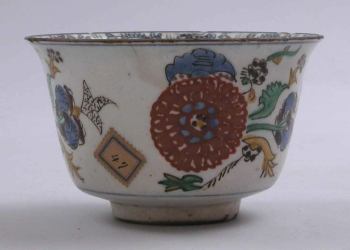
Kütahya Vessel, 18th century, stonepaste; polychrome painted under transparent glaze, 6.7 cm high (New York: The Metropolitan Museum of Art, 02.5.45).
More than 140 opulent gilded reliquaries, richly illuminated manuscripts, rare textiles, liturgical furnishings made of precious materials, khachkars (cross stones), church models, and printed books demonstrate Armenia’s distinctive imagery in their homeland and other major Armenian sites, from the Kingdom of Cilicia on the Mediterranean to New Julfa, in Safavid Persia. Select comparative works display Armenian interaction with other cultures. Major Armenian repositories of their culture provide almost all the works in the exhibition. Most are on view in the United States for the first time; many have not traveled for centuries.
Armenia! focuses on major Armenian centers of production from their homeland west and east. It includes images of Armenians, from self-portraits to depictions of male and female rulers, donors, theologians, and historians. Special attention is given to works by major artists such as T’oros Roslin, Sargis Pidzak, Toros Taronatsi, and Hakob of Julfa working in the Armenian homeland, the Kingdom of Cilicia, and New Julfa.
More than half of the works on display are on loan from The Republic of Armenia with the support of The Ministry of Culture. Imposing liturgical works are coming from the Mother See of Holy Etchmiadzin, the primary site of the Armenian Church. In Yerevan, the ‘Matenadaran’ Mesrop Masthots` Institute – Museum of Ancient Manuscripts is lending exceptional manuscripts, and the History Museum of Armenia is lending monumental church sculptures. The Holy See of Cilicia in Lebanon, the Armenian Patriarchate of Jerusalem, and the Armenian Mekhitarist Congregation in Venice are the other major Armenian religious communities lending exceptional works. Armenian collections lending select works are the Calouste Gulbenkian Museum in Portugal and in America, the Diocese of the Armenian Church (Eastern) (New York); the Armenian Museum of America (Boston); and the Alex and Marie Manoogian Museum (Southfield, Michigan). Additional works are coming from The Met and other American and European institutions.
Photographs of Armenian architecture and landscapes by noted Armenian-Canadian photographer Hrair Hawk Khatcherian and his assistant Lilit Khachatryan will provide context for the works in the exhibition, in the catalogue, and on the exhibition page of the website.
The exhibition was organized by Helen C. Evans, the Mary and Michael Jaharis Curator of Byzantine Art, with the support of C. Griffith Mann, the Michel David-Weill Curator in Charge, Department of Medieval Art and The Cloisters, and the assistance of Constance Alchermes, Research Assistant. Exhibition design is by Michael Langley, Exhibition Design Manager; graphics are by Chelsea Amato and Morton Lebigre, Graphic Designers; and lighting is by Clint Ross Coller and Richard Lichte, Lighting Design Managers.
The exhibition is made possible by The Hagop Kevorkian Fund. Additional support is provided by the Carnegie Corporation of New York, the Michel David-Weill Fund, the Armenian General Benevolent Union, The Giorgi Family Foundation, The Hirair and Anna Hovnanian Foundation, the Karagheusian Foundation, The Nazar and Artemis Nazarian Family, the Ruddock Foundation for the Arts, The Strauch Kulhanjian Family and The Paros Foundation, Aso O. Tavitian, and the National Endowment for the Arts.
The catalogue is distributed by Yale UP:
Helen Evans, ed., Armenia: Art, Religion, and Trade in the Middle Ages (New York: The Metropolitan Museum of Art, 2018), 352 pages, ISBN: 978-1588396600, $65.
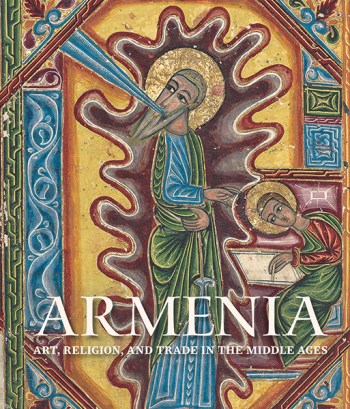 As the first people to officially convert to Christianity, Armenians commissioned and produced astonishing religious objects. This sumptuous volume depicts and contextualizes the compelling works of art that defined the rich and complicated culture of medieval Armenians, including carvings, liturgical furnishings, beautifully illustrated manuscripts, gilded reliquaries, exquisite textiles, printed books, and more. Situated at the center of trade routes that connected the East and West during the Middle Ages, Armenia became a leading international trade partner for Seljuk, Mongol, Ottoman, and Persian overlords, while also serving as a powerful ally to Byzantium and European Crusader states. Written by a team of international scholars, with contributions from Armenian religious leaders, this book will stand as the definitive text on the art and culture of medieval Armenia.
Helen C. Evans is Mary and Michael Jaharis Curator of Byzantine Art in the Department of Medieval Art and The Cloisters at The Metropolitan Museum of Art.
Exhibition | Armenia: Art, Culture, Eternity
Press release (25 October 2018) from the Armenian Museum of America:
Armenia: Art, Culture, Eternity
Armenian Museum of America, Watertown, Massachusetts, exhibition open from November 2018

Kütahya vessel, 18th century, polychrome fritware (Watertown, Massachusetts: Armenian Museum of America).
The Armenian Museum of America is pleased to share its vision for the future. Founded in 1971, the Museum serves as the largest repository of Armenian artifacts in the diaspora, as well as the largest ethnic museum in Massachusetts. As the Museum builds towards the future, it strives to create a stronger, more connected community through shared exploration of Armenian art and history, both for Armenians and those who are new to Armenian culture.
The Museum’s new gallery Armenia: Art, Culture, Eternity provides an overview of Armenian culture from antiquity to present-day Armenian experience here in the United States. Over fifty objects are on display, illustrating Armenia’s origins in the Asian continent, the invention of a unique Indo-European language and alphabet, the early adoption of Christianity, Armenian medieval illuminated manuscripts, interconnected trade routes, and the tragedy of the Genocide.
Armenia: Art, Culture, Eternity is the culmination of twelve months of intense research and design and represents a new level of scholarship and interpretation at the Museum. The project was made possible by the support of the Board of Trustees and was spearheaded by Executive Director Jennifer Liston Munson and architect Virginia Durruty, who worked side-by-side with Michele Kolligian, President of the Board of Trustees, on the inspired design. The gallery represents an incredible achievement and is the start of a holistic consideration of the entire Museum, which will examine everything from the building’s distinctive Brutalist architecture—including how the hard space is a meaningful metaphor for Armenia’s difficult history—to the Museum’s role in telling the modern Armenian-American cultural narrative.
Exhibition | Before the Deluge: Apocalyptic Floodscapes
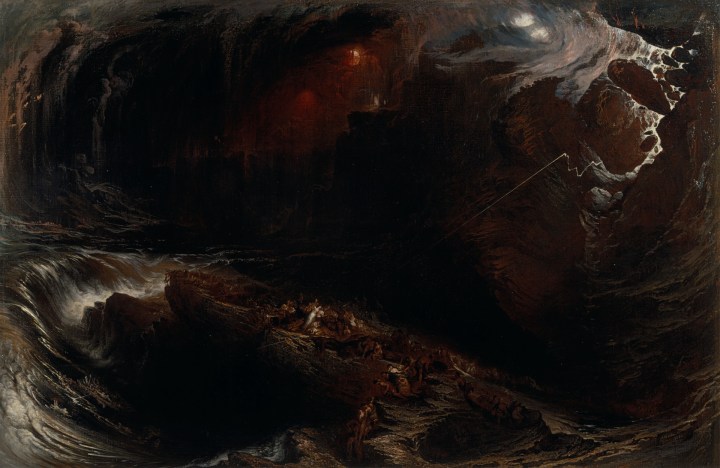
John Martin, The Deluge, 1834, oil on canvas, 66 × 102 inches
(New Haven: Yale Center for British Art, Paul Mellon Collection, B1978.43.11)
◊ ◊ ◊ ◊ ◊
Opening next month at the YCBA:
Before the Deluge: Apocalyptic Floodscapes from John Martin to John Goto, 1789 to Now
Yale Center for British Art, New Haven, 18 December 2018 — 24 March 2019
Curated by Eva Mebius, with Matthew Hargraves
This exhibition will explore how the idea of the Deluge has been represented and interpreted by British artists and writers from the end of the eighteenth century to the present day. It will consider the diverse ways they have responded to accounts of both biblical and mythological, and real and fictional, floods and the political ends to which this theme has been used in their respective historical contexts. Drawing on the Center’s collections of prints and drawings, photographs, and rare books and manuscripts, Before the Deluge will examine the connections between our own sense of antediluvianism and that of earlier times, charting the artistic representation of apocalyptic floods, and the scientific and political debates about the Deluge to which these writers and artists contributed. From John Martin’s Deluge, one of the most sensational images of the Romantic age, to the diluvian reimagining of the eighteenth-century English landscape by contemporary artist John Goto, we see the floodwaters rise and recede, only to seep back once again. However, Before the Deluge will also consider how proximity to water and its threat inspired human ingenuity through various objects, such as paper peepshows of the Thames tunnel, and blueprints for bridges and canals. The fragile relationship between human civilization and the water that sustains or destroys us has perhaps never been more apparent than at the present moment.
Exhibition | Empresses of China’s Forbidden City, 1644–1912
PEM press release:
Empresses of China’s Forbidden City, 1644–1912
Peabody Essex Museum, Salem, Massachusetts, 18 August 2018 — 10 February 2019
Freer|Sackler, Smithsonian Institution, Washington, D.C., 3 March — 23 June 2019
Curated by Daisy Yiyou Wang and Jan Stuart
 The Peabody Essex Museum (PEM) debuts Empresses of China’s Forbidden City, the first major international exhibition to explore the role of empresses in China’s last dynasty—the Qing dynasty, from 1644 to 1912. Nearly 200 spectacular works, including imperial portraits, jewelry, garments, Buddhist sculptures, and decorative art objects from the Palace Museum, Beijing (known as the Forbidden City), tell the little-known stories of how these empresses engaged with and influenced court politics, art and religion. On an exclusive U.S. tour, this exhibition is a once-in-a-lifetime opportunity to see rare treasures from the Forbidden City, including works that have never before been publicly displayed and many of which have never been on view in the United States. Coinciding with the 40th anniversary of the establishment of U.S.-China diplomatic relations, the exhibition is organized by the Peabody Essex Museum, Salem, Massachusetts; the Smithsonian’s Freer Gallery of Art and Arthur M. Sackler Gallery (Freer|Sackler), Washington, D.C.; and the Palace Museum, Beijing.
A leader in preserving and promoting Chinese art and architecture, PEM honors over 200 years of U.S.-Chinese commercial and cultural exchange through its renowned collection and exhibition program. Working closely with its partnering organizations, PEM presents this unprecedented exhibition in order to celebrate the vibrant legacy of cultural dialogue between these two countries.
With an international team of experts, exhibition co-curators Daisy Yiyou Wang, PEM’s Robert N. Shapiro Curator of Chinese and East Asian Art, and Jan Stuart, the Melvin R. Seiden Curator of Chinese Art at the Freer|Sackler, spent four years travelling to the Forbidden City to investigate the largely hidden world of the women inside. Delving into the vast imperial archives and collection, their fresh research unveils how these women influenced history as well as the spectacular art made for, by and about them. “This exhibition establishes a new model for future international research and museum collaborations,” says Dr. Shan Jixiang, director of the Palace Museum.
Revealing the Hidden World of the Empresses

Court painters in Beijing, possibly including Zhang Zhen or his son Zhang Weibang, Drinking Tea from Yinzhen’s Twelve Ladies, Kangxi period, 1709–23, hanging scroll, ink and color on silk (Beijing: Palace Museum, Gu6458-7/12).
China’s grand imperial era—the Qing dynasty—was a multiethnic and multicultural state founded in 1644 by a small northeast Asian group who came to call themselves ‘Manchus’. These conquering rulers adopted the Forbidden City in Beijing as the seat of the government. The Manchu ruling house differed from their populous Han Chinese subjects by language, history, and culture. In the Qing dynasty, Manchu customs prohibited foot-binding and encouraged women to learn to ride and hunt. In general, Manchu women enjoyed more freedom and rights than their Han Chinese counterparts.
While the Qing imperial court was strictly patriarchal and hierarchical, a few empresses stood out and helped shape the long history of the dynasty. The empress headed the imperial harem and could influence the emperor. She was regarded as the ‘mother of the state’ and a role model for all women. Presiding over the state ritual promoting silk production, empresses honored women’s vital role in the economic health of the state through textile production.
While the emperor-centric Qing imperial court recorded only skeletal outlines of the empresses’ lives, only recently have historians begun to fill in a more complete picture. Exhibition curators were able to reconstruct their rich and active lifestyles from the lavish art produced by the Qing court. Sumptuous objects showcased in this exhibition include the largest assemblage of imperial textiles and jewelry that have ever traveled to the U.S. from the Palace Museum. These works demonstrate how Qing dynasty empresses projected authority through what they wore, from stunningly embroidered socks to splendid dragon robes.
“We are very proud to reclaim the presence and influence of these empresses, about whom history has largely been silent,” says Daisy Wang, PEM’s curator for this exhibition. “The exquisite objects related to the empresses give us a better understanding of these intriguing women. Further evidence found in court archives and other historical sources help illuminate their hidden, but inspiring lives.”
Stories of Opulence and Influence
Out of two dozen Qing empresses, this exhibition focuses on three key figures: Empress Dowager Chongqing (1693–1777), Empress Xiaoxian (1712–1748) and Empress Dowager Cixi (1835–1908). Their life experiences revolve around six core themes: imperial weddings, power and status, family roles, lifestyle, religion, and political influence.

Imperial Workshop, Beijing, Stupa Containing Empress Dowager Chongqing’s Hair and Amitayus Buddha, Qianlong period, 1777, gold and silver alloy with coral, turquoise, lapis lazuli, and other semiprecious stones, and glass; pedestal: zitan wood (Beijing, Palace Museum, Gu11866).
Empress Dowager Chongqing came from humble beginnings, entering a princely household as a maidservant at age 11 and bearing her only child at age 18. Her son eventually became the Qianlong emperor, which made Chongqing the focus of his filial piety, a core Confucian virtue. He honored her as the Sage Mother of the state, a status vividly captured by two life-size portraits of her in the exhibition. After her death in 1777, she was commemorated by her son with a 237-pound gold shrine. Encrusted with gemstones, the shrine holds her hair to ensure her rebirth in the Buddhist paradise. As the largest of its kind in the Palace Museum’s collection, the shrine will be displayed at PEM and the Freer|Sackler for the first time outside of China.
Fifteen-year-old Xiaoxian married the future Qianlong emperor while he was a prince. She became the empress after her husband ascended the throne. As childhood soulmates and confidants, Xiaoxian closely attended to her husband as he endured a months-long illness. She was a caring daughter-in-law and a wise manager of imperial family affairs, qualities that garnered her widespread respect.
In 1748, at the age of 36, Xiaoxian fell ill and died while traveling with her husband. In response, the heartbroken emperor brushed a poem to mourn his beloved wife. Empresses of China’s Forbidden City is the first exhibition to ever reveal this soulful elegy to the public.
Though tradition declared that “women shall not rule,” there was room for ambitious Qing empresses. Soon after giving birth to the Xianfeng emperor’s only heir, Cixi, a low-ranking consort, received a promotion. Facing a succession crisis after the death of her husband in 1861, Cixi, alongside the other empress dowager Ci’an (1837–1881), instigated a coup to gain political power and become co-regents to Cixi’s son, the child emperor. As the most powerful empress in Chinese history, Cixi ruled China for nearly half a century, bringing radical changes to the role of women in court politics and art patronage.
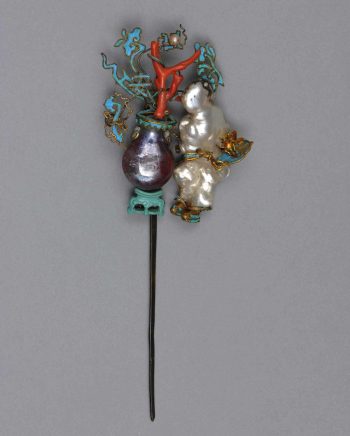
Hairpin with Figure and Vase, 18th or 19th century, pearls, sapphire, coral, turquoise, kingfisher feather, and silver with gilding (Beijing: Palace Museum, Gu10130).
The exhibition culminates with a commanding sixteen-foot oil portrait of Empress Cixi. It was her gift to President Theodore Roosevelt in 1905. Cixi directed the American artist Katharine Carl to create an image of a youthful and benevolent ruler to express her good will to people in America at a time when U.S. and China experienced challenging relations. A recent conservation project at the Smithsonian has restored the painting to its original splendor. Empresses of China’s Forbidden City marks its first public display in the U.S. since the 1960s.
“The study of women in history is exciting, timely and necessary,” says Jan Stuart, co-curator at the Freer|Sackler. “By focusing on the material and spiritual world of these women, we begin to fill in details absent from previous accounts of women in Chinese history. To the extent that the empresses’ experience of the expectations and constraints finds echo in our own world, we hope this exhibition will prompt broader reflection on the position of women in society and fosters a sense of commonality and connection across time and cultures.”
Surrounded by a dazzling array of imperial treasures, visitors will also discover engaging in-gallery interactive experiences, such as creating an empress’s robe. Other experiences include immersive videos and opera performance, as well as English and Chinese language label text and guided tours. In November 2018, halfway through the run of the six-month exhibition at PEM, an additional 30 artworks from the Palace Museum will be installed in the galleries, including magnificent paintings and imperial robes.
“This exciting exhibition fulfills our institutions’ shared commitment to expanding the appreciation of China’s rich culture, in this instance by recovering the preeminence of the Qing empresses through these stunning and rare objects,” notes Dan Monroe, the Rose-Marie and Eijk van Otterloo Director and CEO of Peabody Essex Museum, and Julian Raby, Director Emeritus, Freer Gallery of Art and Arthur M. Sackler Gallery, Smithsonian Institution.
The catalogue is distributed by Yale UP:
Daisy Yiyou Wang and Jan Stuart, eds., with essays and entries by Daisy Yiyou Wang, Jan Stuart, Lin Shu, Luk Yu-ping, Ying-chen Peng, Evelyn Rawski, and Ren Wanping, Empresses of China’s Forbidden City, 1644–1912 (New Haven: Yale University Press, 2018), 264 pages, ISBN: 978-0300237085, $60.
Empresses in the Qing dynasty (1644–1912) played an influential role in the imperial court and the cosmopolitan culture of their time. Offering compelling insights into the material culture, activities, and living spaces of Qing empresses, this lavishly illustrated book features over one hundred spectacular works of art from the Palace Museum in Beijing—including large-scale portraits, court robes, and richly decorated Buddhist sutras—that bring the splendor of the Qing court to life. A series of insightful essays examines the fascinating ways that key imperial women engaged with art, religion, and politics. This unprecedented exploration of the Qing court from the perspective of its royal women is an important new contribution to our understanding of Chinese art and history.
Daisy Yiyou Wang is the Robert N. Shapiro Curator of Chinese and East Asian Art at the Peabody Essex Museum. Jan Stuart is the Melvin R. Seiden Curator of Chinese Art at the Freer Gallery of Art and Arthur M. Sackler Gallery, Smithsonian Institution.
Exhibition | The Art of London Firearms
Opening next month at The Met:
The Art of London Firearms
The Met Fifth Avenue, New York, 29 January 2019 — 29 January 2020

Samuel Brunn, detail of one of a pair of flintlock pistols, with silver mountings attributed to Michael Barnett, ca. 1800 (New York: The Metropolitan Museum of Art, 1992.330.1,.2).
This exhibition will explore a fascinating and often overlooked chapter in the art of European gunmaking through a selection of important London-made firearms, dating from around 1760 through 1840, drawn exclusively from The Met collection. Many of the works have rarely, or never, been on public display. This will be the first focus exhibition in the United States in nearly fifty years to examine London firearms and will celebrate the in-depth recataloguing of this important section of the Museum’s collection.
Beginning around 1780, a small group of talented gunmakers set up workshops on the outskirts of the London city center. Their names—Durs and Joseph Egg, John and Joseph Manton, H. W. Mortimer, and Samuel Brunn, among others—are largely unknown to those outside the arms and armor field. But their contributions to the art of firearms are almost without parallel. In fierce competition with one another for lucrative commissions, fame, and prestige, they brought the flintlock gun to a level of refinement never before seen. They developed revolutionary new firearms technologies and, most importantly, a distinctly English style of firearm, wholly different from that of Continental Europe and immediately recognizable by its elegant proportions, restrained use of ornament, and precision workmanship. Indeed, they presided over what one writer of the period termed an ‘Augustine age’ of gunmaking.
Exhibition | Witnesses: Émigré Medallists in Britain
From the press release (18 September 2018) for the exhibition:
Witnesses: Émigré Medallists in Britain
The British Museum, London, 4 October 2018 — 7 April 2019
Curated by Philip Attwood
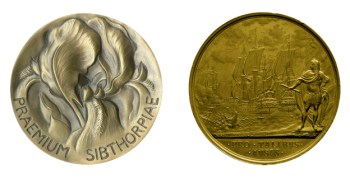
Danuta Solowiej, Oxford University Department of Plant Sciences Sibthorp Prize Medal, bronze, 2001 (London: The British Museum); John Roettiers, Charles II Naval Reward Medal, gold, 1665 (London: The British Museum).
The British Museum presents a new exhibition called Witnesses: Émigré Medallists in Britain, sponsored by Spink. This focused exhibition uncovers the invaluable role played by artists from abroad in the development of British medallic art. On display are medals that span six centuries, documenting significant historical moments and commemorating famous British figures. The exhibition uses objects to tell an international story, as it explores the motivations that brought artists to Britain and the ways in which they enlivened this country’s medallic landscape.
The earliest works in the exhibition are from Elizabethan England. It was the Dutch artist Steven van Herwijck who, in 1562, introduced the art of the medal, already well-established on the continent, to Britain’s urban elite. Van Herwijck’s first visit to England was of short duration, but three years later, in 1565, he returned with his wife and children. Medals have been made continuously in this country ever since.
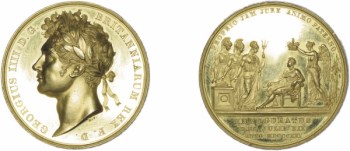
Benedetto Pistrucci, Coronation of George IV, 1821, gold (London: The British Museum).
One of the star objects on display will be a spectacular Waterloo medal conceived by 19th-century Italian gem engraver Benedetto Pistrucci (1783–1855). The medal took 30 years to complete and bears the image of the four allied sovereigns: George, Prince Regent, Francis II of Austria, Alexander I of Russia, and King Frederick William III of Prussia.
Although the story of each medallist who arrived over the centuries is unique, for many a position at the Royal Mint was coveted and considered the ultimate goal. Pistrucci was successful in this ambition as he arrived from Italy in 1815 and became Chief Medallist at the Royal Mint. He remains a well-known medalist and coin-engraver, renowned for producing a number of famous designs during his career, most notably the George and Dragon for the sovereign.
During the 1930s a number of medallists fleeing Nazi oppression sought refuge in Britain. This was a time when few British artists engaged with the medium, and so the contributions made to medallic art by Fred Kormis, Artur Loewental, and Paul Vincze (from Germany, Austria and Hungary respectively) have a special significance. Vincze summed up the question of nationality in 1975 when he stated, “I am Hungarian. My wife is French. We are British.” This exhibition will showcase Vincze’s medals commemorating victory in 1945, the coronation of 1953, and anniversaries of the battle of Trafalgar and the resettlement of Jews in Britain. Alongside these will be Loewental’s commemorative medal of Winston Churchill, inscribed “his spirit saved Britain.” Together these objects reveal the ways in which artists from abroad identified strongly with the country to which they had come.
This display will also reveal that while their skill was undeniable, the presence of artists from abroad sometimes led to rivalry with British-born medallists. Following the restoration of Charles II in 1660, London-born Thomas Simon (c.1623–1665) found himself in direct competition with John (formerly Jan) Roettiers (1631–1703), whilst the hostility between Pistrucci and William Wyon remained in place throughout the first half of the 19th century.
Bringing the exhibition up to present times, medals conceived by artists working today will also be on display. Medals by contemporary artist Danuta Solowiej will include a commission from the University of Oxford’s Department of Plant Sciences, with a beautiful rendition of the Iris germanica. Solowiej learned the art of medal making in Poland and has now been working in London for thirty years. The exhibition also celebrates works by Asian artists Dhruva Mistry RA from India and a young silversmith from Korea, Kyosun Jung, who is currently working in London.
It is generally recognised that the story of British art before the 19th century is, to a great extent, the story of artists arriving from other countries. Witnesses: Émigré Medallists in Britain brings together a selection of objects to reveal that this also true of medallic art. Drawing on the British Museum’s rich medal collection, this exhibition celebrates the contributions made by foreign artists both past and present.
Exhibition | Sidesaddle, 1690–1935

Johan Zoffany, The Drummond Family, detail, ca. 1769, oil on canvas, 41 × 63 inches
(New Haven: Yale Center for British Art, Paul Mellon Collection)
◊ ◊ ◊ ◊ ◊
On view at the National Sporting Library & Museum:
Sidesaddle, 1690–1935
National Sporting Library & Museum, Middleburg, VA, 8 September 2018 — 24 March 2019
Curated by Ulrike Weiss and Claudia Pfeiffer
In art and sport, the poised equestrian riding aside embodies the essence of elegance, power, and grace. Hidden beneath the flowing skirts of the rider is the sidesaddle, the design of which has evolved dramatically in response to the physical demands of sporting women (and sometimes men) requiring a firm seat as they began to meet the challenges of jumping and galloping across the countryside.
Sidesaddle, 1690–1935 presents a revealing perspective on the history and culture of women as equestrians, their depictions in sporting art, and the evolution of sidesaddle tack and attire represented in British, Continental, and American art from the 17th to the 20th centuries. The exhibition showcases over sixty paintings, works on paper, and sculptures on loan from museums and private collections. Co-curators Dr. Ulrike Weiss, Lecturer at the University of St. Andrews in Scotland, and Claudia Pfeiffer, the George L. Ohrstrom, Jr. Curator of Art at NSLM, are contributing essays to the accompanying catalog.
Ulrike Weiss and Claudia Pfeiffer, Sidesaddle, 1690–1935 (Middleburg: National Sporting Library & Museum, 2018), ISBN: 978-0996890540, $25.
Exhibition | Piqué at the Court of Naples

Giuseppe Sarao, Piqué Table, ca. 1730s
(Saint Petersburg: The Hermitage)
◊ ◊ ◊ ◊ ◊
From Galerie Kugel:
Piqué: Gold, Tortoiseshell, and Mother-of-Pearl at the Court of Naples
Complètement Piqué! Le fol art de l’écaille à la Cour de Naples
Galerie Kugel, Paris, 12 September — 8 December 2018
Galerie J. Kugel presents the first exhibition devoted to the art of piqué, which flourished in Naples during the first half of the 18th century. The technique combines lavish inventiveness, virtuoso skill, and astonishing opulence. These extraordinary objects bring together three precious materials: tortoiseshell, gold, and mother-of-pearl. According to Nicolas Kugel: “This fascinating combination is sublimated by light, which makes the gold shimmer, reveals the iridescence of the mother-of-pearl, and penetrates even the diaphanous darkness of the tortoiseshell.”

Piqué chest with chinoiserie details and four turtle-shaped feet, eighteenth century.
The exhibition includes over 50 objects created between 1720 and 1760 for connoisseurs and the court, particularly for Charles of Bourbon, who became king of Naples in 1734 and made his court one of the most splendid and cosmopolitan in all Europe. The artisans who created these masterpieces were known as Tartarugari. Giuseppe Sarao, the most famous among them, had a workshop adjoining the walls of the royal palace. Several of the pieces in the exhibition were made by Sarao, including a table—the ultimate piqué masterpiece—here lent, for the first time, by the Hermitage Museum in Saint Petersburg.
These talented artists were able not only to join and mold the tortoiseshell using boiling water and olive oil, but also inlaid gold and mother-of-pearl into the still-soft tortoiseshell. They created the most extravagant shapes, which they adorned with fashionable piqué decors such as singeries (scenes where monkeys engage in human activities), chinoiseries, and grotesques.
Alexis Kugel explains: “The exhibition will allow visitors to discover both the incredible inventiveness of the artists and the extraordinarily keen interest this art sparked among 19th-century collectors, including several members of the Rothschild family. Many pieces boasting that prestigious provenance will be presented.”
The extraordinary table from the Hermitage Museum is the greatest masterpiece to have been created using the pique technique. It is also the only table to have retained its original legs. The triangular shape of the legs is also present in the cabinet from the Royal British Collections. The extraordinarily inventive and elaborate tabletop is adorned with over a hundred chinoiserie figures, while countless animals, monkeys, insects, birds, and dragons also inhabit the space. The six main medallions depict Chinese couples in gold and mother-of-pearl, two of which are also found on the turtle casket. The compartments are decorated with small Chinese figures made of cut out and engraved gold. In the centre, four gold vases symbolise the seasons; the figures between refer to the same theme. The centre is adorned with a small cartouche in which two figures rock back and forth on a seesaw. The Chinese theme continues on the legs and stretcher. Underneath the medallion with the Chinese couple there is the monogram SfN (Sarao fecit Napoli). In 1886 Baron Stieglitz purchased the table from the Frankfort antique dealer Goldschmidt, one of the main suppliers to Mayer Carl de Rothschild, also a great connoisseur of tortoiseshell piqué. It was no doubt the death of Mayer Carl that same year (1886) that allowed Stieglitz to acquire the table. It stood in the Stieglitz Museum of Applied Arts and was transferred to the Hermitage after 1924.
The exhibition is accompanied by an illustrated catalogue, offering the first complete study of the subject. The French version will be published by Monelle Hayot and the English version by Rizzoli.
Nazanin Lankarani wrote about the exhibition for The New York Times (7 September 2018).
◊ ◊ ◊ ◊ ◊
From Rizzoli:
Alexis Kugel, Piqué: Gold, Tortoiseshell, and Mother-of-Pearl at the Court of Naples (New York: Rizzoli, 2018), 256 pages, ISBN: 978-8891820617, $60.
 The first volume dedicated to the most complete and outstanding collection of piqué objects ever assembled, a number of which have never been published before. The volume is dedicated to the art of piqué, created in Naples during the first half of the eighteenth century, a technique that combines remarkable inventiveness, virtuoso skill, and astonishing opulence. These extraordinary objects are made of three precious materials: tortoiseshell, gold, and mother-of-pearl. These pieces were made between 1720 and 1760 for the public and the court, especially for Charles de Bourbon, King of Naples. The authors of these creations were known as tartarugari. Among the most famous tartarugari was Giuseppe Sarao, whose studio was next to the walls of the Royal Palace and who created some of the pieces presented in this book. Also included is an extraordinary table from the Hermitage Museum, considered to be the greatest masterpiece created using the piqué technique, and still retaining its original legs. The catalogue will allow readers to discover both the incredible inventiveness of the artists and the extraordinarily keen interest this art sparked among nineteenth-century collectors, including several members of the Rothschild family. The volume presents more than fifty objects, representing the masterpieces of this technique. The objects are introduced by a study of the subject and a text explaining the historical context.
Alexis Kugel is a member of the fifth generation of a family of antiques dealers whose company was founded in Russia at the end of the eighteenth century. Based in Paris since 1924, they expanded the business of silver and jewelry to deal in fine furniture, works of art and sculpture, Kunstkammer objects, ivories, Renaissance jewelry, and scientific instruments.
Exhibition | Fuseli: Drama and Theater
Now on view at the Kunstmuseum Basel:
Fuseli: Drama and Theatre
Kunstmuseum Basel, 20 October 2018 — 2 October 2019
Curated by Eva Reifert

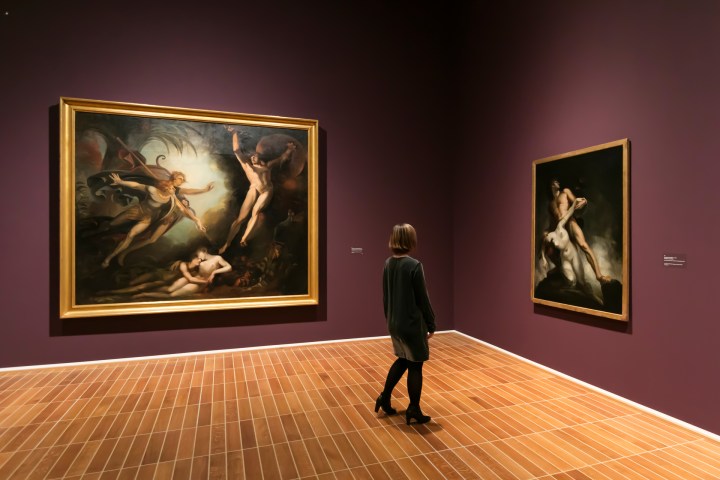
Thirteen years after the last major presentation of his work in Switzerland, at the Kunsthaus Zürich, the Kunstmuseum Basel mounts a comprehensive monographic exhibition of the work of Henry Fuseli (1741–1825), a native son of Zurich who rose to fame in Rome and London. One of the most inventive and unconventional innovators in late-eighteenth-century art, Fuseli stood on the threshold between classicism and nascent Romanticism. His oeuvre bears eloquent witness to the competing artistic paradigms in the waning decades of the Age of Enlightenment.
Fuseli styled himself as a painter of Dark Romanticism and ‘Gothic horror’, and that aspect of his oeuvre is still most familiar to audiences today. Shifting the focus, the exhibition demonstrates that drama and theater were no less vital to his artistic vision: the erudite artist’s creations almost invariably draw on literary motifs, quoting ancient mythology, John Milton’s Paradise Lost, or the recently rediscovered Nibelungen saga. After his return from Rome to London in 1779, Shakespeare’s plays become another major source of motifs in his art, as his contributions to John Boydell’s Shakespeare Gallery illustrate. Drama and Theater—the title captures the interest in the themes from literary and stage works chosen by Fuseli that animates the exhibition, but it also describes his dynamic compositions and constellations of characters and the ‘theatrical’ devices that often enliven his depictions.
Like Fuseli’s art itself, Drama and Theater is hardly subtle. The artist’s seven paintings in the Öffentliche Kunstsammlung Basel, the municipal art collection of Basel, are complemented by works generously provided on loan by the Kunsthaus Zürich and other international museums and private collections. Reflecting on the conjunction of literature, theater, and visual art from another angle, Thom Luz, resident director at Theater Basel, will enhance the exhibition by bringing his contemporary theatrical practice into the gallery. The installation is realized in collaboration with the video artist Jonas Alsleben.
Eva Reifert, ed., Fuseli: Drama and Theatre (London: Prestel, 2018), 240 pages, ISBN: 978-3791357584, £45 / $60.










 Enfilade
leave a comment