Exhibition | Before the Deluge: Apocalyptic Floodscapes
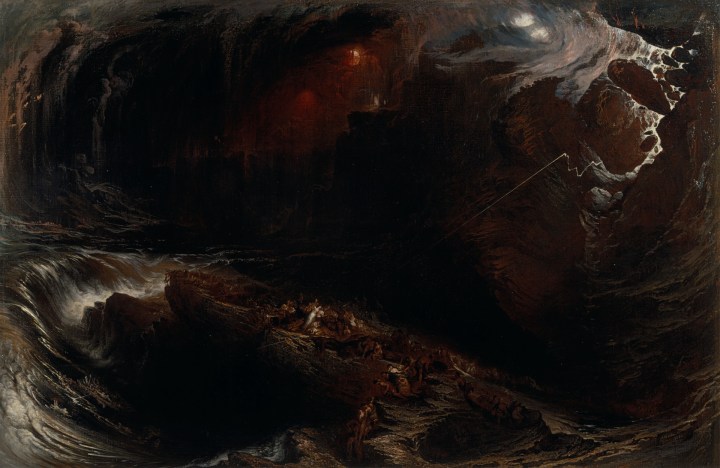
John Martin, The Deluge, 1834, oil on canvas, 66 × 102 inches
(New Haven: Yale Center for British Art, Paul Mellon Collection, B1978.43.11)
◊ ◊ ◊ ◊ ◊
Opening next month at the YCBA:
Before the Deluge: Apocalyptic Floodscapes from John Martin to John Goto, 1789 to Now
Yale Center for British Art, New Haven, 18 December 2018 — 24 March 2019
Curated by Eva Mebius, with Matthew Hargraves
This exhibition will explore how the idea of the Deluge has been represented and interpreted by British artists and writers from the end of the eighteenth century to the present day. It will consider the diverse ways they have responded to accounts of both biblical and mythological, and real and fictional, floods and the political ends to which this theme has been used in their respective historical contexts. Drawing on the Center’s collections of prints and drawings, photographs, and rare books and manuscripts, Before the Deluge will examine the connections between our own sense of antediluvianism and that of earlier times, charting the artistic representation of apocalyptic floods, and the scientific and political debates about the Deluge to which these writers and artists contributed. From John Martin’s Deluge, one of the most sensational images of the Romantic age, to the diluvian reimagining of the eighteenth-century English landscape by contemporary artist John Goto, we see the floodwaters rise and recede, only to seep back once again. However, Before the Deluge will also consider how proximity to water and its threat inspired human ingenuity through various objects, such as paper peepshows of the Thames tunnel, and blueprints for bridges and canals. The fragile relationship between human civilization and the water that sustains or destroys us has perhaps never been more apparent than at the present moment.
Exhibition | Empresses of China’s Forbidden City, 1644–1912
PEM press release:
Empresses of China’s Forbidden City, 1644–1912
Peabody Essex Museum, Salem, Massachusetts, 18 August 2018 — 10 February 2019
Freer|Sackler, Smithsonian Institution, Washington, D.C., 3 March — 23 June 2019
Curated by Daisy Yiyou Wang and Jan Stuart
 The Peabody Essex Museum (PEM) debuts Empresses of China’s Forbidden City, the first major international exhibition to explore the role of empresses in China’s last dynasty—the Qing dynasty, from 1644 to 1912. Nearly 200 spectacular works, including imperial portraits, jewelry, garments, Buddhist sculptures, and decorative art objects from the Palace Museum, Beijing (known as the Forbidden City), tell the little-known stories of how these empresses engaged with and influenced court politics, art and religion. On an exclusive U.S. tour, this exhibition is a once-in-a-lifetime opportunity to see rare treasures from the Forbidden City, including works that have never before been publicly displayed and many of which have never been on view in the United States. Coinciding with the 40th anniversary of the establishment of U.S.-China diplomatic relations, the exhibition is organized by the Peabody Essex Museum, Salem, Massachusetts; the Smithsonian’s Freer Gallery of Art and Arthur M. Sackler Gallery (Freer|Sackler), Washington, D.C.; and the Palace Museum, Beijing.
A leader in preserving and promoting Chinese art and architecture, PEM honors over 200 years of U.S.-Chinese commercial and cultural exchange through its renowned collection and exhibition program. Working closely with its partnering organizations, PEM presents this unprecedented exhibition in order to celebrate the vibrant legacy of cultural dialogue between these two countries.
With an international team of experts, exhibition co-curators Daisy Yiyou Wang, PEM’s Robert N. Shapiro Curator of Chinese and East Asian Art, and Jan Stuart, the Melvin R. Seiden Curator of Chinese Art at the Freer|Sackler, spent four years travelling to the Forbidden City to investigate the largely hidden world of the women inside. Delving into the vast imperial archives and collection, their fresh research unveils how these women influenced history as well as the spectacular art made for, by and about them. “This exhibition establishes a new model for future international research and museum collaborations,” says Dr. Shan Jixiang, director of the Palace Museum.
Revealing the Hidden World of the Empresses

Court painters in Beijing, possibly including Zhang Zhen or his son Zhang Weibang, Drinking Tea from Yinzhen’s Twelve Ladies, Kangxi period, 1709–23, hanging scroll, ink and color on silk (Beijing: Palace Museum, Gu6458-7/12).
China’s grand imperial era—the Qing dynasty—was a multiethnic and multicultural state founded in 1644 by a small northeast Asian group who came to call themselves ‘Manchus’. These conquering rulers adopted the Forbidden City in Beijing as the seat of the government. The Manchu ruling house differed from their populous Han Chinese subjects by language, history, and culture. In the Qing dynasty, Manchu customs prohibited foot-binding and encouraged women to learn to ride and hunt. In general, Manchu women enjoyed more freedom and rights than their Han Chinese counterparts.
While the Qing imperial court was strictly patriarchal and hierarchical, a few empresses stood out and helped shape the long history of the dynasty. The empress headed the imperial harem and could influence the emperor. She was regarded as the ‘mother of the state’ and a role model for all women. Presiding over the state ritual promoting silk production, empresses honored women’s vital role in the economic health of the state through textile production.
While the emperor-centric Qing imperial court recorded only skeletal outlines of the empresses’ lives, only recently have historians begun to fill in a more complete picture. Exhibition curators were able to reconstruct their rich and active lifestyles from the lavish art produced by the Qing court. Sumptuous objects showcased in this exhibition include the largest assemblage of imperial textiles and jewelry that have ever traveled to the U.S. from the Palace Museum. These works demonstrate how Qing dynasty empresses projected authority through what they wore, from stunningly embroidered socks to splendid dragon robes.
“We are very proud to reclaim the presence and influence of these empresses, about whom history has largely been silent,” says Daisy Wang, PEM’s curator for this exhibition. “The exquisite objects related to the empresses give us a better understanding of these intriguing women. Further evidence found in court archives and other historical sources help illuminate their hidden, but inspiring lives.”
Stories of Opulence and Influence
Out of two dozen Qing empresses, this exhibition focuses on three key figures: Empress Dowager Chongqing (1693–1777), Empress Xiaoxian (1712–1748) and Empress Dowager Cixi (1835–1908). Their life experiences revolve around six core themes: imperial weddings, power and status, family roles, lifestyle, religion, and political influence.

Imperial Workshop, Beijing, Stupa Containing Empress Dowager Chongqing’s Hair and Amitayus Buddha, Qianlong period, 1777, gold and silver alloy with coral, turquoise, lapis lazuli, and other semiprecious stones, and glass; pedestal: zitan wood (Beijing, Palace Museum, Gu11866).
Empress Dowager Chongqing came from humble beginnings, entering a princely household as a maidservant at age 11 and bearing her only child at age 18. Her son eventually became the Qianlong emperor, which made Chongqing the focus of his filial piety, a core Confucian virtue. He honored her as the Sage Mother of the state, a status vividly captured by two life-size portraits of her in the exhibition. After her death in 1777, she was commemorated by her son with a 237-pound gold shrine. Encrusted with gemstones, the shrine holds her hair to ensure her rebirth in the Buddhist paradise. As the largest of its kind in the Palace Museum’s collection, the shrine will be displayed at PEM and the Freer|Sackler for the first time outside of China.
Fifteen-year-old Xiaoxian married the future Qianlong emperor while he was a prince. She became the empress after her husband ascended the throne. As childhood soulmates and confidants, Xiaoxian closely attended to her husband as he endured a months-long illness. She was a caring daughter-in-law and a wise manager of imperial family affairs, qualities that garnered her widespread respect.
In 1748, at the age of 36, Xiaoxian fell ill and died while traveling with her husband. In response, the heartbroken emperor brushed a poem to mourn his beloved wife. Empresses of China’s Forbidden City is the first exhibition to ever reveal this soulful elegy to the public.
Though tradition declared that “women shall not rule,” there was room for ambitious Qing empresses. Soon after giving birth to the Xianfeng emperor’s only heir, Cixi, a low-ranking consort, received a promotion. Facing a succession crisis after the death of her husband in 1861, Cixi, alongside the other empress dowager Ci’an (1837–1881), instigated a coup to gain political power and become co-regents to Cixi’s son, the child emperor. As the most powerful empress in Chinese history, Cixi ruled China for nearly half a century, bringing radical changes to the role of women in court politics and art patronage.
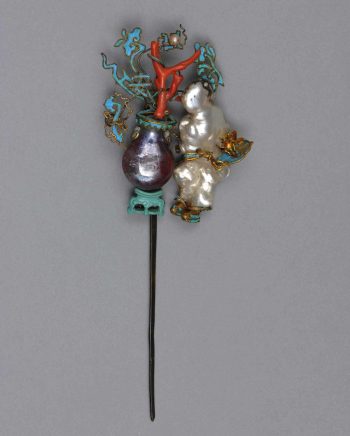
Hairpin with Figure and Vase, 18th or 19th century, pearls, sapphire, coral, turquoise, kingfisher feather, and silver with gilding (Beijing: Palace Museum, Gu10130).
The exhibition culminates with a commanding sixteen-foot oil portrait of Empress Cixi. It was her gift to President Theodore Roosevelt in 1905. Cixi directed the American artist Katharine Carl to create an image of a youthful and benevolent ruler to express her good will to people in America at a time when U.S. and China experienced challenging relations. A recent conservation project at the Smithsonian has restored the painting to its original splendor. Empresses of China’s Forbidden City marks its first public display in the U.S. since the 1960s.
“The study of women in history is exciting, timely and necessary,” says Jan Stuart, co-curator at the Freer|Sackler. “By focusing on the material and spiritual world of these women, we begin to fill in details absent from previous accounts of women in Chinese history. To the extent that the empresses’ experience of the expectations and constraints finds echo in our own world, we hope this exhibition will prompt broader reflection on the position of women in society and fosters a sense of commonality and connection across time and cultures.”
Surrounded by a dazzling array of imperial treasures, visitors will also discover engaging in-gallery interactive experiences, such as creating an empress’s robe. Other experiences include immersive videos and opera performance, as well as English and Chinese language label text and guided tours. In November 2018, halfway through the run of the six-month exhibition at PEM, an additional 30 artworks from the Palace Museum will be installed in the galleries, including magnificent paintings and imperial robes.
“This exciting exhibition fulfills our institutions’ shared commitment to expanding the appreciation of China’s rich culture, in this instance by recovering the preeminence of the Qing empresses through these stunning and rare objects,” notes Dan Monroe, the Rose-Marie and Eijk van Otterloo Director and CEO of Peabody Essex Museum, and Julian Raby, Director Emeritus, Freer Gallery of Art and Arthur M. Sackler Gallery, Smithsonian Institution.
The catalogue is distributed by Yale UP:
Daisy Yiyou Wang and Jan Stuart, eds., with essays and entries by Daisy Yiyou Wang, Jan Stuart, Lin Shu, Luk Yu-ping, Ying-chen Peng, Evelyn Rawski, and Ren Wanping, Empresses of China’s Forbidden City, 1644–1912 (New Haven: Yale University Press, 2018), 264 pages, ISBN: 978-0300237085, $60.
Empresses in the Qing dynasty (1644–1912) played an influential role in the imperial court and the cosmopolitan culture of their time. Offering compelling insights into the material culture, activities, and living spaces of Qing empresses, this lavishly illustrated book features over one hundred spectacular works of art from the Palace Museum in Beijing—including large-scale portraits, court robes, and richly decorated Buddhist sutras—that bring the splendor of the Qing court to life. A series of insightful essays examines the fascinating ways that key imperial women engaged with art, religion, and politics. This unprecedented exploration of the Qing court from the perspective of its royal women is an important new contribution to our understanding of Chinese art and history.
Daisy Yiyou Wang is the Robert N. Shapiro Curator of Chinese and East Asian Art at the Peabody Essex Museum. Jan Stuart is the Melvin R. Seiden Curator of Chinese Art at the Freer Gallery of Art and Arthur M. Sackler Gallery, Smithsonian Institution.
Exhibition | The Art of London Firearms
Opening next month at The Met:
The Art of London Firearms
The Met Fifth Avenue, New York, 29 January 2019 — 29 January 2020

Samuel Brunn, detail of one of a pair of flintlock pistols, with silver mountings attributed to Michael Barnett, ca. 1800 (New York: The Metropolitan Museum of Art, 1992.330.1,.2).
This exhibition will explore a fascinating and often overlooked chapter in the art of European gunmaking through a selection of important London-made firearms, dating from around 1760 through 1840, drawn exclusively from The Met collection. Many of the works have rarely, or never, been on public display. This will be the first focus exhibition in the United States in nearly fifty years to examine London firearms and will celebrate the in-depth recataloguing of this important section of the Museum’s collection.
Beginning around 1780, a small group of talented gunmakers set up workshops on the outskirts of the London city center. Their names—Durs and Joseph Egg, John and Joseph Manton, H. W. Mortimer, and Samuel Brunn, among others—are largely unknown to those outside the arms and armor field. But their contributions to the art of firearms are almost without parallel. In fierce competition with one another for lucrative commissions, fame, and prestige, they brought the flintlock gun to a level of refinement never before seen. They developed revolutionary new firearms technologies and, most importantly, a distinctly English style of firearm, wholly different from that of Continental Europe and immediately recognizable by its elegant proportions, restrained use of ornament, and precision workmanship. Indeed, they presided over what one writer of the period termed an ‘Augustine age’ of gunmaking.
Exhibition | Witnesses: Émigré Medallists in Britain
From the press release (18 September 2018) for the exhibition:
Witnesses: Émigré Medallists in Britain
The British Museum, London, 4 October 2018 — 7 April 2019
Curated by Philip Attwood
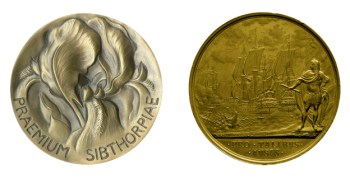
Danuta Solowiej, Oxford University Department of Plant Sciences Sibthorp Prize Medal, bronze, 2001 (London: The British Museum); John Roettiers, Charles II Naval Reward Medal, gold, 1665 (London: The British Museum).
The British Museum presents a new exhibition called Witnesses: Émigré Medallists in Britain, sponsored by Spink. This focused exhibition uncovers the invaluable role played by artists from abroad in the development of British medallic art. On display are medals that span six centuries, documenting significant historical moments and commemorating famous British figures. The exhibition uses objects to tell an international story, as it explores the motivations that brought artists to Britain and the ways in which they enlivened this country’s medallic landscape.
The earliest works in the exhibition are from Elizabethan England. It was the Dutch artist Steven van Herwijck who, in 1562, introduced the art of the medal, already well-established on the continent, to Britain’s urban elite. Van Herwijck’s first visit to England was of short duration, but three years later, in 1565, he returned with his wife and children. Medals have been made continuously in this country ever since.
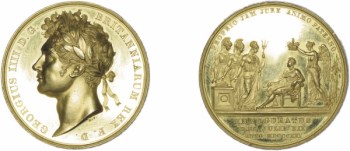
Benedetto Pistrucci, Coronation of George IV, 1821, gold (London: The British Museum).
One of the star objects on display will be a spectacular Waterloo medal conceived by 19th-century Italian gem engraver Benedetto Pistrucci (1783–1855). The medal took 30 years to complete and bears the image of the four allied sovereigns: George, Prince Regent, Francis II of Austria, Alexander I of Russia, and King Frederick William III of Prussia.
Although the story of each medallist who arrived over the centuries is unique, for many a position at the Royal Mint was coveted and considered the ultimate goal. Pistrucci was successful in this ambition as he arrived from Italy in 1815 and became Chief Medallist at the Royal Mint. He remains a well-known medalist and coin-engraver, renowned for producing a number of famous designs during his career, most notably the George and Dragon for the sovereign.
During the 1930s a number of medallists fleeing Nazi oppression sought refuge in Britain. This was a time when few British artists engaged with the medium, and so the contributions made to medallic art by Fred Kormis, Artur Loewental, and Paul Vincze (from Germany, Austria and Hungary respectively) have a special significance. Vincze summed up the question of nationality in 1975 when he stated, “I am Hungarian. My wife is French. We are British.” This exhibition will showcase Vincze’s medals commemorating victory in 1945, the coronation of 1953, and anniversaries of the battle of Trafalgar and the resettlement of Jews in Britain. Alongside these will be Loewental’s commemorative medal of Winston Churchill, inscribed “his spirit saved Britain.” Together these objects reveal the ways in which artists from abroad identified strongly with the country to which they had come.
This display will also reveal that while their skill was undeniable, the presence of artists from abroad sometimes led to rivalry with British-born medallists. Following the restoration of Charles II in 1660, London-born Thomas Simon (c.1623–1665) found himself in direct competition with John (formerly Jan) Roettiers (1631–1703), whilst the hostility between Pistrucci and William Wyon remained in place throughout the first half of the 19th century.
Bringing the exhibition up to present times, medals conceived by artists working today will also be on display. Medals by contemporary artist Danuta Solowiej will include a commission from the University of Oxford’s Department of Plant Sciences, with a beautiful rendition of the Iris germanica. Solowiej learned the art of medal making in Poland and has now been working in London for thirty years. The exhibition also celebrates works by Asian artists Dhruva Mistry RA from India and a young silversmith from Korea, Kyosun Jung, who is currently working in London.
It is generally recognised that the story of British art before the 19th century is, to a great extent, the story of artists arriving from other countries. Witnesses: Émigré Medallists in Britain brings together a selection of objects to reveal that this also true of medallic art. Drawing on the British Museum’s rich medal collection, this exhibition celebrates the contributions made by foreign artists both past and present.
Exhibition | Sidesaddle, 1690–1935

Johan Zoffany, The Drummond Family, detail, ca. 1769, oil on canvas, 41 × 63 inches
(New Haven: Yale Center for British Art, Paul Mellon Collection)
◊ ◊ ◊ ◊ ◊
On view at the National Sporting Library & Museum:
Sidesaddle, 1690–1935
National Sporting Library & Museum, Middleburg, VA, 8 September 2018 — 24 March 2019
Curated by Ulrike Weiss and Claudia Pfeiffer
In art and sport, the poised equestrian riding aside embodies the essence of elegance, power, and grace. Hidden beneath the flowing skirts of the rider is the sidesaddle, the design of which has evolved dramatically in response to the physical demands of sporting women (and sometimes men) requiring a firm seat as they began to meet the challenges of jumping and galloping across the countryside.
Sidesaddle, 1690–1935 presents a revealing perspective on the history and culture of women as equestrians, their depictions in sporting art, and the evolution of sidesaddle tack and attire represented in British, Continental, and American art from the 17th to the 20th centuries. The exhibition showcases over sixty paintings, works on paper, and sculptures on loan from museums and private collections. Co-curators Dr. Ulrike Weiss, Lecturer at the University of St. Andrews in Scotland, and Claudia Pfeiffer, the George L. Ohrstrom, Jr. Curator of Art at NSLM, are contributing essays to the accompanying catalog.
Ulrike Weiss and Claudia Pfeiffer, Sidesaddle, 1690–1935 (Middleburg: National Sporting Library & Museum, 2018), ISBN: 978-0996890540, $25.
Exhibition | Piqué at the Court of Naples

Giuseppe Sarao, Piqué Table, ca. 1730s
(Saint Petersburg: The Hermitage)
◊ ◊ ◊ ◊ ◊
From Galerie Kugel:
Piqué: Gold, Tortoiseshell, and Mother-of-Pearl at the Court of Naples
Complètement Piqué! Le fol art de l’écaille à la Cour de Naples
Galerie Kugel, Paris, 12 September — 8 December 2018
Galerie J. Kugel presents the first exhibition devoted to the art of piqué, which flourished in Naples during the first half of the 18th century. The technique combines lavish inventiveness, virtuoso skill, and astonishing opulence. These extraordinary objects bring together three precious materials: tortoiseshell, gold, and mother-of-pearl. According to Nicolas Kugel: “This fascinating combination is sublimated by light, which makes the gold shimmer, reveals the iridescence of the mother-of-pearl, and penetrates even the diaphanous darkness of the tortoiseshell.”

Piqué chest with chinoiserie details and four turtle-shaped feet, eighteenth century.
The exhibition includes over 50 objects created between 1720 and 1760 for connoisseurs and the court, particularly for Charles of Bourbon, who became king of Naples in 1734 and made his court one of the most splendid and cosmopolitan in all Europe. The artisans who created these masterpieces were known as Tartarugari. Giuseppe Sarao, the most famous among them, had a workshop adjoining the walls of the royal palace. Several of the pieces in the exhibition were made by Sarao, including a table—the ultimate piqué masterpiece—here lent, for the first time, by the Hermitage Museum in Saint Petersburg.
These talented artists were able not only to join and mold the tortoiseshell using boiling water and olive oil, but also inlaid gold and mother-of-pearl into the still-soft tortoiseshell. They created the most extravagant shapes, which they adorned with fashionable piqué decors such as singeries (scenes where monkeys engage in human activities), chinoiseries, and grotesques.
Alexis Kugel explains: “The exhibition will allow visitors to discover both the incredible inventiveness of the artists and the extraordinarily keen interest this art sparked among 19th-century collectors, including several members of the Rothschild family. Many pieces boasting that prestigious provenance will be presented.”
The extraordinary table from the Hermitage Museum is the greatest masterpiece to have been created using the pique technique. It is also the only table to have retained its original legs. The triangular shape of the legs is also present in the cabinet from the Royal British Collections. The extraordinarily inventive and elaborate tabletop is adorned with over a hundred chinoiserie figures, while countless animals, monkeys, insects, birds, and dragons also inhabit the space. The six main medallions depict Chinese couples in gold and mother-of-pearl, two of which are also found on the turtle casket. The compartments are decorated with small Chinese figures made of cut out and engraved gold. In the centre, four gold vases symbolise the seasons; the figures between refer to the same theme. The centre is adorned with a small cartouche in which two figures rock back and forth on a seesaw. The Chinese theme continues on the legs and stretcher. Underneath the medallion with the Chinese couple there is the monogram SfN (Sarao fecit Napoli). In 1886 Baron Stieglitz purchased the table from the Frankfort antique dealer Goldschmidt, one of the main suppliers to Mayer Carl de Rothschild, also a great connoisseur of tortoiseshell piqué. It was no doubt the death of Mayer Carl that same year (1886) that allowed Stieglitz to acquire the table. It stood in the Stieglitz Museum of Applied Arts and was transferred to the Hermitage after 1924.
The exhibition is accompanied by an illustrated catalogue, offering the first complete study of the subject. The French version will be published by Monelle Hayot and the English version by Rizzoli.
Nazanin Lankarani wrote about the exhibition for The New York Times (7 September 2018).
◊ ◊ ◊ ◊ ◊
From Rizzoli:
Alexis Kugel, Piqué: Gold, Tortoiseshell, and Mother-of-Pearl at the Court of Naples (New York: Rizzoli, 2018), 256 pages, ISBN: 978-8891820617, $60.
 The first volume dedicated to the most complete and outstanding collection of piqué objects ever assembled, a number of which have never been published before. The volume is dedicated to the art of piqué, created in Naples during the first half of the eighteenth century, a technique that combines remarkable inventiveness, virtuoso skill, and astonishing opulence. These extraordinary objects are made of three precious materials: tortoiseshell, gold, and mother-of-pearl. These pieces were made between 1720 and 1760 for the public and the court, especially for Charles de Bourbon, King of Naples. The authors of these creations were known as tartarugari. Among the most famous tartarugari was Giuseppe Sarao, whose studio was next to the walls of the Royal Palace and who created some of the pieces presented in this book. Also included is an extraordinary table from the Hermitage Museum, considered to be the greatest masterpiece created using the piqué technique, and still retaining its original legs. The catalogue will allow readers to discover both the incredible inventiveness of the artists and the extraordinarily keen interest this art sparked among nineteenth-century collectors, including several members of the Rothschild family. The volume presents more than fifty objects, representing the masterpieces of this technique. The objects are introduced by a study of the subject and a text explaining the historical context.
Alexis Kugel is a member of the fifth generation of a family of antiques dealers whose company was founded in Russia at the end of the eighteenth century. Based in Paris since 1924, they expanded the business of silver and jewelry to deal in fine furniture, works of art and sculpture, Kunstkammer objects, ivories, Renaissance jewelry, and scientific instruments.
Exhibition | Fuseli: Drama and Theater
Now on view at the Kunstmuseum Basel:
Fuseli: Drama and Theatre
Kunstmuseum Basel, 20 October 2018 — 2 October 2019
Curated by Eva Reifert

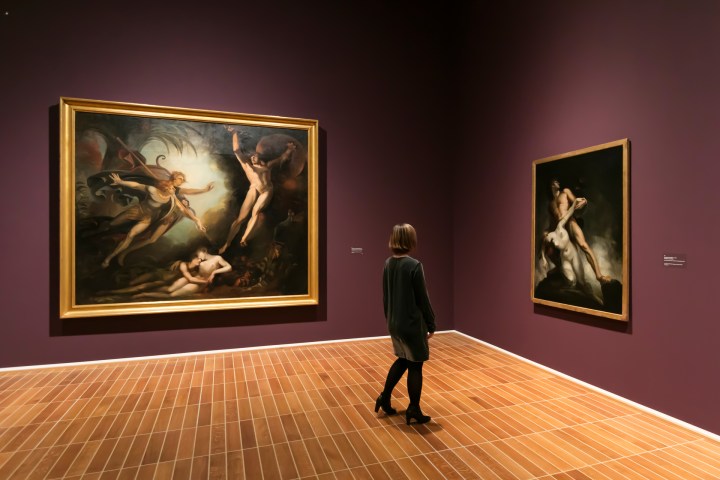
Thirteen years after the last major presentation of his work in Switzerland, at the Kunsthaus Zürich, the Kunstmuseum Basel mounts a comprehensive monographic exhibition of the work of Henry Fuseli (1741–1825), a native son of Zurich who rose to fame in Rome and London. One of the most inventive and unconventional innovators in late-eighteenth-century art, Fuseli stood on the threshold between classicism and nascent Romanticism. His oeuvre bears eloquent witness to the competing artistic paradigms in the waning decades of the Age of Enlightenment.
Fuseli styled himself as a painter of Dark Romanticism and ‘Gothic horror’, and that aspect of his oeuvre is still most familiar to audiences today. Shifting the focus, the exhibition demonstrates that drama and theater were no less vital to his artistic vision: the erudite artist’s creations almost invariably draw on literary motifs, quoting ancient mythology, John Milton’s Paradise Lost, or the recently rediscovered Nibelungen saga. After his return from Rome to London in 1779, Shakespeare’s plays become another major source of motifs in his art, as his contributions to John Boydell’s Shakespeare Gallery illustrate. Drama and Theater—the title captures the interest in the themes from literary and stage works chosen by Fuseli that animates the exhibition, but it also describes his dynamic compositions and constellations of characters and the ‘theatrical’ devices that often enliven his depictions.
Like Fuseli’s art itself, Drama and Theater is hardly subtle. The artist’s seven paintings in the Öffentliche Kunstsammlung Basel, the municipal art collection of Basel, are complemented by works generously provided on loan by the Kunsthaus Zürich and other international museums and private collections. Reflecting on the conjunction of literature, theater, and visual art from another angle, Thom Luz, resident director at Theater Basel, will enhance the exhibition by bringing his contemporary theatrical practice into the gallery. The installation is realized in collaboration with the video artist Jonas Alsleben.
Eva Reifert, ed., Fuseli: Drama and Theatre (London: Prestel, 2018), 240 pages, ISBN: 978-3791357584, £45 / $60.
Exhibition | William Hunter and the Anatomy of the Modern Museum

Press release (12 September 2018) for the exhibition:
William Hunter and the Anatomy of the Modern Museum
The Hunterian, Glasgow, 28 September 2018 — 6 January 2019
Yale Center for British Art, New Haven, 14 February — 20 May 2019
Curated by Mungo Campbell with Nathan Flis and Lola Sánchez-Jáuregui
A major new exhibition at The Hunterian, University of Glasgow, will mark an important anniversary in the history of Scotland’s oldest public museum. William Hunter and the Anatomy of the Modern Museum opens on 28 September 2018 and marks the William Hunter Tercentenary—300 years since the birth of Hunterian founder, Dr William Hunter (1718–1783). The exhibition not only offers a critical examination of Hunter—a man of exceptional vision who saw no boundaries between art and science, but explores his life, character, and career as well as his research, collection, and links to Glasgow.
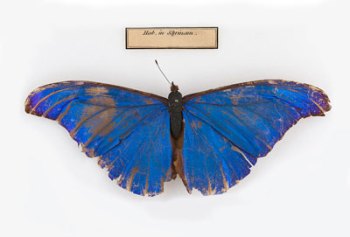
Rhetenor blue morpho butterfly (Morpho rhetenor Cramer), 1775, Suriname (Hunterian, University of Glasgow).
Hunter’s original Enlightenment collection is a rare example which has survived largely intact and these objects and artworks are the foundation of The Hunterian collections today. William Hunter and the Anatomy of the Modern Museum showcases this truly unique collection, encyclopaedic in nature and with its heart in the Scottish Enlightenment. The exhibition also offers a balanced account of the circumstances that made a collection like Hunter’s possible and examines the means by which it was amassed. Visitors will have the opportunity to see key items from Hunter’s collection, reunited for the first time in over 150 years and displayed to highlight the connections between them.
More than 400 items will be on display including: fossils; anatomical specimens and preparations; paintings, drawings and prints; rare books and manuscripts; ethnographical objects; rocks and mineral specimens; coins and medals; shells, corals, beetles, butterflies and examples of taxidermy. The majority come from The Hunterian, and Archives and Special Collections at the University of Glasgow Library, where Hunter’s collection of books and manuscripts is kept.
Key loans include a life size écorché figure from the Royal Academy of Arts in London and Johan Zoffany’s painting William Hunter Lecturing that shows William Hunter delivering an anatomy class, on loan from the Royal College of Physicians in London.
Important conservation work has been carried out on a number of items from Hunter’s collection including paintings, frames, sculptures, textiles, books, works on paper and objects of decorative art.
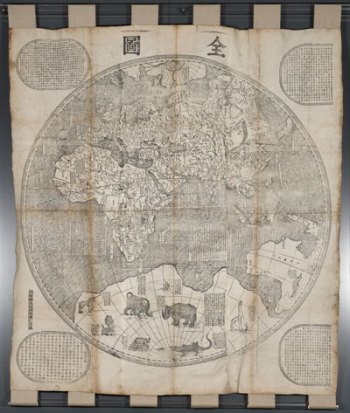
Ferdinand Verbiest, Kunyu Quantu 坤輿全圖 (A Map of the Whole World),1674, woodblock print on paper laid down on cloth, in four parts (Hunterian, University of Glasgow).
Must see items include:
• Four of Hunter’s plaster cast models, now fully restored, which were used in preparation for his great publication Anatomia Uteri Humani Gravidi Tabulis Illustrate (Anatomy of the Gravid Uterus Exhibited in Figures, 1774). A selection of related drawings, prints, and proofs are included, many of which have not been on display before. The casts show the various stages of the pregnant human womb in progressive states of dissection in graphic and stunning naturalistic detail.
• Our unique 17th-century Chinese map of the world, displayed in its entirety for the first time.
• Hunter’s complete collection of 88 gold Roman coins, issued by every Roman Emperor from 27BCE to 491CE. The Hunterian is one of only three places in the world where such a complete series can be seen.
• Hunter’s will — on loan from the National Archives of Scotland and on public display for the first time.
• The life-size écorché figure on loan from the Royal Academy of Arts in London.
• An exceptional and fully restored 18th-century Maori cloak from New Zealand made of flax and feathers.
• The Hunterian Psalter — usually housed in Archives and Special Collections at the University of Glasgow Library, this lavishly illuminated bound English manuscript is dated to 1170 and is considered the greatest treasure of William Hunter’s library.
William Hunter and the Anatomy of the Modern Museum also reveals the contribution made by Hunter to the development of modern museums as we know them today, exploring the interplay between the arts and sciences in the pursuit of knowledge over the course of the 18th century.

Jean-Siméon Chardin, A Lady Taking Tea, 1735, oil on canvas (Hunterian Art Gallery, University of Glasgow).
The exhibition and publication William Hunter and the Anatomy of the Modern Museum are the result of a five-year collaborative research project between The Hunterian and the Yale Center for British Art and showcase new research undertaken by an international team of scholars. The lead curator is Mungo Campbell, Deputy Director of The Hunterian; and the organizing curator at the Yale Center for British Art is Nathan Flis, Head of Exhibitions and Publications, and Assistant Curator of Seventeenth-Century Paintings. They are assisted by Lola Sanchez-Jauregui, William Hunter Tercentenary Curator at The Hunterian. A fully illustrated exhibition catalogue will be published by The Hunterian and the Center in association with Yale University Press.
Running in parallel with William Hunter and the Anatomy of the Modern Museum are two exhibitions offering 21st-century responses to Hunter’s collections, life, and work. Strange Foreign Bodies and Rosengarten showcase the work of leading contemporary artists and writers including Claire Barclay, Christine Borland, Anne Bevan, and Janice Galloway.
Strange Foreign Bodies is a group exhibition of films, prints, and sculptural works by artists including Claire Barclay, Christine Borland, Sarah Browne, Alex Impey, and Phillip Warnell. Taking William Hunter’s Tercentenary as its point of departure, the exhibition offers a 21st-century perspective on Hunter’s Enlightenment project, with processes of mutation, metamorphosis, and technological transformation central to many of the works. We encounter the story of a woman who has turned into an octopus, the philosophical reflections of a heart transplant patient, and the simulated breathing of an animatronic medical mannequin. These ‘strange foreign bodies’ reflect the complexity of all human embodiment today.
Rosengarten is a unique installation that brings together the sculpture of Anne Bevan and the words of Janice Galloway, two of Scotland’s foremost artists in their fields. Inspired by obstetric implements and important historic medical collections, Rosengarten looks at the tools of birthing and powerfully reflects the human and tender emotions of mother and baby that run parallel to the hard and frequently interventive experiences associated with modern childbirth.
William Hunter and the Anatomy of the Modern Museum is at the Hunterian Art Gallery from 28 September 2018 until 6 January 2019 then at the Yale Center for British Art (Yale University, New Haven, Connecticut, USA) from 14 February until 20 May 2019. The project has been generously supported by The Royal Society of Edinburgh, the Paul Mellon Centre for Studies in British Art, Museums Galleries Scotland, and the Rev. Dr Donald McKellar Leitch Urie Bequest. Strange Foreign Bodies, also at the Hunterian Art Gallery, runs from 28 September 2018 until 13 January 2019. Rosengarten is now open at the Hunterian Art Gallery and runs until 20 January 2019. Purchased with funds from the National Collecting Scheme for Scotland and a grant from the Art Fund. Admission to all three exhibitions is free.
S E L E C T E D P R O G R A M M I N G
3 October 2018 — Mungo Campbell (The Hunterian), William Hunter and the Anatomy of the Modern Museum: Curator’s Introduction
10 October 2018 — Christine Whyte (Lecturer in Global History, University of Glasgow), A Triangular Trade of Medical Knowledge: William Hunter, Enslaved Women, and Scottish Medical Expertise
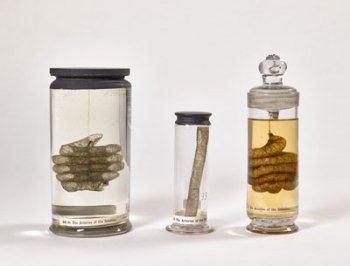
William Hunter and Assistants, Anatomical Specimens: Arteries of the Intestine, 1746–83, portion of human gut with mesentery, turpentine and glass jar; portion of human gut and glass jar; portion of human gut with mesentery, turpentine and glass jar (Hunterian, University of Glasgow).
17 October 2018 — Paul Rea (Senior Lecturer in Human Life Sciences, University of Glasgow), Anatomy in the Digital Age
24 October 2018 — Dominic Paterson (The Hunterian), Strange Foreign Bodies
31 October 2018 — Jeanne Robinson (The Hunterian), ‘Mr Termite’: An Agent of Entomology and the Empire in 18th-Century Sierra Leone
7 November 2018 — Alicia Hughes (University of Glasgow), Title to be confirmed
14 November 2018 — Anne Dulau Beveridge (The Hunterian), The Curious Collector: What William Hunter’s Portraits Tell Us about the Man
21 November 2018 — Maggie Reilly (The Hunterian), Title to be confirmed
28 November 2018 — Michelle Craig (Leverhulme Trust Doctoral Scholar, University of Glasgow), The Curious Collector: Provenance in William Hunter’s Library
5 December 2018 — Matthew Sangster (Lecturer in 18th-Century Literature and Material Culture, University of Glasgow), Conceptions of Knowledge in William Hunter’s Library
12 December 2018 — Jesper Ericsson (The Hunterian), Title to be confirmed
19 December 2018 — Frances Osis (University of Glasgow), Title to be confirmed
◊ ◊ ◊ ◊ ◊
The catalogue is published by the Yale Center for British Art:
Edited by Mungo Campbell and Nathan Flis, with the assistance of María Dolores Sánchez-Jáuregui, William Hunter and the Anatomy of the Modern Museum (New Haven: Yale Center for British Art in association with The Hunterian, 2018), 440 pages, ISBN: 978-0300236651, $65.
 Accompanying a groundbreaking exhibition, this publication is the first in 150 years to assess the contribution made by Hunter, the Scottish-born obstetrician, anatomist, and collector, to the development of the modern museum as a public institution. Essays examine how Hunter gathered his collection to be used as a source of knowledge and instruction, encompassing outstanding paintings and works on paper, coins and medals, and anatomical and zoological specimens. Hunter also possessed ethnographic artifacts from Spain, the Middle East, China, and the South Pacific, and was an avid collector of medieval manuscripts and incunabula; these were all located within one of the most important ‘working’ libraries of eighteenth-century London.
C O N T E N T S
Amy Meyers and Steph Scholten, Directors’ Foreword
Mungo Campbell and Nathan Flis, Acknowledgments
Contributors’ Biographies
Seren Nolan, William Hunter: A Chronology
Part I Physician, Anatomist, Collector
• Mungo Campbell, William Hunter and the Anatomy of the Modern Museum: An Introduction
• Nathan Flis, Skeletons in Hunter’s Closet: James Douglas and the Fashioning of William Hunter
• Craig Ashley Hanson, A Motto for a Museum: William Hunter’s Inheritance from Richard Mead
• Matthew Sangster, Conceptions of Knowledge in William Hunter’s Library
• Meredith Gamer, Scalpel to Burin: A Material History of William Hunter’s Anatomy of the Human Gravid Uterus
• Dominik Hünniger, ‘Extolled by Foreigners’: William Hunter’s Collection and the Development of Science and Medicine in Eighteenth-Century Europe
• Nicholas Thomas, ‘A Great Collection of Curiosities from the South Sea Islands’: William Hunter’s Ethnography
• María Dolores Sánchez-Jáuregui, Anatomical Jars and Butterflies: Curating Knowledge in William Hunter’s Museum
Part II Catalogue of the Exhibition
• Mungo Campbell, Portraits and Papers
• Mungo Campbell, Pedagogy and Professional Practice
• Peter Black, Anatomical Illustration and the Practice of Anatomy
• Maggie Reilly and Stuart McDonald, Anatomical Preparations
• Mungo Campbell, The Anatomy of the Human Gravid Uterus
• Peter Black and Anne Dulau Beveridge, Pictures
• Michelle Craig, The Library
• Donal Bateson, Coins and Medals
• Mungo Campbell, Pacific and Other ‘Curiosities’
• Maggie Reilly and Jeanne Robinson, Shells, Corals, Birds, Insects, and Other Preserved Animals
• John Faithfull and Neil Clark, Ores and Fossils
Appendices
1 Letter from William Hunter to William Cullen, 2–20 April 1765
2 Sale Catalogue of William Hunter’s Personal Effects, 1783
Selected Bibliography
Index
Photography Credits
Display | Eye Contact: Portraits in the Global Age
From the Thoma Foundation:
Eye Contact: Portraits in the Global Age
Thoma Foundation, Art House, Santa Fe, New Mexico, from 10 August 2018
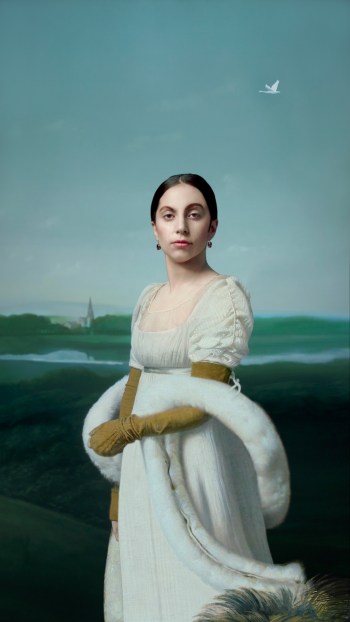
Robert Wilson, ‘Lady Gaga: Mademoiselle Caroline Rivière’, 2013, high-definition video on plasma monitor.
For the first time, Art House will exhibit works from the Thoma Foundation’s diverse collections of Spanish colonial painting and digital art in tandem. Opening August 10, Eye Contact approaches portraiture as a sociological art. While portraits are created to commemorate individual identity, they are also reflections of the economic, political, and cultural forces around them, such as world trade, colonialism, and advances in technology.
The three artworks on view span more than two centuries, from 1776 to 2015, with the recent acquisition Lady Gaga: Mademoiselle Caroline Riviere, 2013 as a centerpiece. Robert Wilson’s video portrait depicts the subject in the guise of an early 19th-century French aristocrat. It is a powerful and ironic meditation on the ability of portraits to denote immortality. Styled in accordance with the famous 1806 painting of Rivière in the Louvre by neoclassical artist Jean Auguste Dominque Ingres, Lady Gaga inhabits the persona of the original sitter, an elegant teenager who died within a year of the work’s completion. Standing in front of a computer-generated landscape, Lady Gaga holds the foreknowledge of Caroline Rivière’s tragic demise, her Gothic pose, intense eye contact, and expression conveying her awareness that even fame fades with time. Wilson is best known for his spectacular, modernist operas, among them the 1976 production Einstein on the Beach, and has been described by The New York Times as “America’s—or even the world’s—foremost avant-garde ‘theater artist.’”
Unlike Lady Gaga and the aristocrat Caroline Rivière, little is known about the woman depicted in Andrés Solano’s Portrait of Ana Josepha de Castañeda y de la Requere from 1776. The inscription on her portrait notes that she was the wife of Juan Lázaro Merino y Zaldo, most likely a sugar planter in the town of Trinidad in central Cuba. While Josepha is forthright and relatively unadorned, the extravagance of her picture frame reflects her position as a wealthy peninsular, a Spanish-born Spaniard residing in the New World or the Spanish East Indies. The gilt rococo embellishments of the frame contrast with Josepha’s frank appearance. Her bloodline is denoted in the painting’s inscription, documenting her caste at a time when cultures, identities, religions, and ideas were mixing in the Spanish colonial world.
Daniel Rozin’s Selfish Gene Mirror, 2015, meanwhile, is a digital mirror in which the viewer temporarily becomes the portrait’s subject. Via a small camera and Rozin’s customized ‘Darwinian’ algorithm, lines of pixels replicate the behavior of human genes, scrambling to assemble a lifelike visage in real time through a process of replication and propagation. Each ‘gene’ is programmed to compete for its ongoing existence. The viewer is reinterpreted within the work of art in a transitory way; once he or she walks away, the pixels die off. The memorializing impulse of portraiture, already imperfect, is abandoned.
About the Collection
Spanning the global history of computer art of the past fifty years, the Foundation’s digital art collection includes some of the first algorithmic plotter drawings on paper, software-driven, generative, and custom-coded artworks, interactive works based on real-time gaming platforms, internet-based or networked art, and works that utilize LED and LCD displays. With more than 130 works from the 17th to 19th centuries, the Spanish Colonial art collection includes religious paintings and portraits from the Viceroyalty of Peru and the Kingdom of Nueva Granada, as well as a selection of portraits fro.m the Spanish Caribbean.
Exhibition | Tablescapes: Designs for Dining
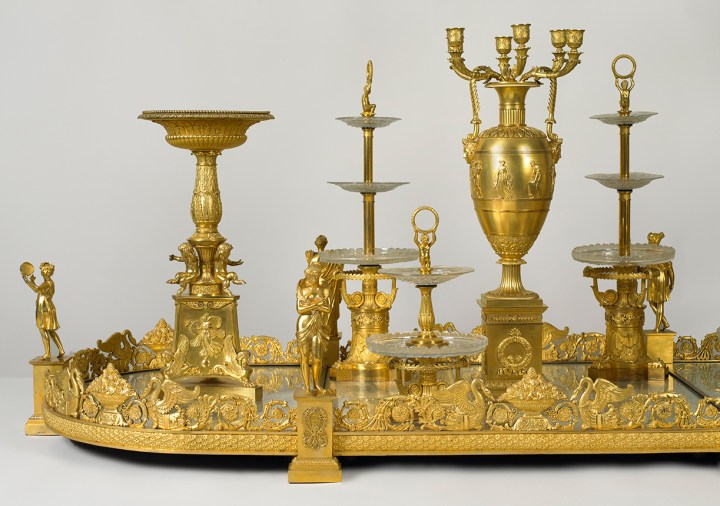
Pierre-Philippe Thomire, Surtout de Table, 1805
(New York: Cooper Hewitt, Smithsonian Design Museum)
◊ ◊ ◊ ◊ ◊
Press release (via Art Daily) for the exhibition:
Tablescapes: Designs for Dining
Cooper Hewitt, Smithsonian Design Museum, New York, 5 October 2018 — 14 April 2019
Cooper Hewitt, Smithsonian Design Museum presents Tablescapes: Designs for Dining, an exhibition that offers a creative timeline of dining experiences through three distinct installations. At the center of the exhibition is Cooper Hewitt’s surtout de table, a magnificent, newly conserved treasure from the museum’s expansive collection of over 210,000 design objects that once ornamented the tables of French nobility at the turn of the 19th century. The exhibition also spotlights the work of the underrecognized but influential textile designer Marguerita Mergentime, active in the 1920s and ’30s, whose work has not received a dedicated museum presentation in 75 years. Pivoting to address 21st-century concerns, the exhibition debuts experimental and collaborative products commissioned from National Design Award-winning designers Joe Doucet and Mary Ping.
“Tablescapes shows how taste and social values are expressed through style, materials and motifs,” said Caroline Baumann, director of the museum. “From awe-inspiring grandeur to vernacular wit to an emphasis on sustainability, the exhibition provokes a spirited conversation around design’s role in the evolution of a universal ritual.”
Surtout de Table
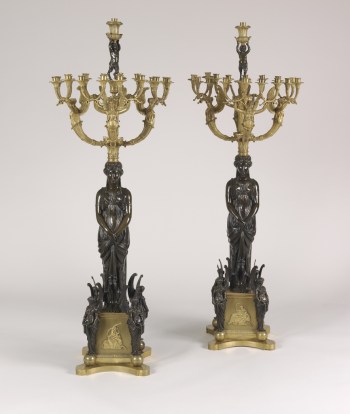
Pierre-Philippe Thomire, Candelabrum, 1815–25, gilt and patinated bronze (New York: Cooper Hewitt, Smithsonian Design Museum).
On view for the first time in 30 years, Cooper Hewitt’s surtout de table was created in Paris around 1805 by Pierre-Philippe Thomire, a French sculptor renowned for creating gilt-bronze objects for the politically and socially powerful. It is believed that Napoleon gave this example as a wedding present to his stepson, Eugène de Beauharnais, whom he often designated to host diplomatic dinners in Paris and Italy.
When placed at the center of a long table, the mirrored plateau and gilt-bronze surfaces of the surtout de table would have reflected the flames of expensive candles. As part of the exhibition’s digital experience, visitors may manipulate an image of the object to view the surtout de table under various lighting conditions. This technology, known as Reflection Transformation Imaging, facilitated the extensive conservation treatment of the surtout de table. As documented in an accompanying gallery video, Cooper Hewitt’s conservationists worked in collaboration with external specialists to restore the surface of the surtout de table, dulled by corrosion, to its original golden lustre. Additionally, the conservationists treated the deteriorating silver-leaf backing of the mirrored plateau, making the surtout de table reflective once again.
To contextualize the surtout de table, it is presented with related objects, including a late 18th-century Italian drawing for a surtout de table design inspired by the ruins of Pompeii and a fire-gilt and blackened bronze clock made by Antoine-Andre Ravrio (French, 1759–1814) with ornaments in the form of a woman playing piano, said to represent Empress Josephine, the mother of Eugène de Beauharnais, at her fashionable residence Malmaison.
Marguerita Mergentime
Marguerita Mergentime (American, 1894–1941) began her design career in New York City in the 1920s, where she made dress fabrics and bath and beach accessories. She belonged to a circle of modernist designers that included Donald Deskey, Gilbert Rohde, Frederick Kiesler, and Ilonka Karasz.
In 1934, Mergentime debuted her first designs for home linens at the Industrial Arts Exposition at Rockerfeller Center. She quickly gained recognition for her bright, modernist textile designs, which retailed at desirable department stores and were highlighted in popular magazines as essential accessories for the hostess seeking to vivify informal dining. Each of the eight napkins in the set Wish Fulfillment (1939) stimulated cocktail hour conversation with a depiction of a mystical or pseudoscientific conduit to the future—for instance, dream books or graphology—accompanied by predictions of wealth, success and happiness. Stylish and imbued with typographical interest, the tablecloth Food Quiz (1939) brought humorous, lighthearted debate to the table with conversation sparkers such as, “Do you dish the dirt before you dish the soup?”
Further illuminating Mergentime’s sensibility, the adjacent Spoon Family Gallery is dedicated to archival materials and the hanging Americana (1939), which entertained visitors at the Golden Gate International Exposition in San Francisco by uniting the names of 360 iconic American phrases, organizations, foods, points of interest, and people.
Joe Doucet and Mary Ping
For this exhibition, Cooper Hewitt commissioned Joe Doucet (American, born 1970), recipient of the 2017 National Design Award for Product Design, and Mary Ping (American, born 1978), recipient of the 2017 National Design Award for Fashion Design and founder of the studio Slow and Steady Wins the Race, to envision the future of dining. The designers address a near future in which users approach dining with greater speed and efficiency, and live in cities that are more densely populated than ever.
The Concentric and Decentric Tables and Seating, designed by Ping and the New York-based architectural firm Bureau V, can fold to seat a small group or expand to accommodate a gathering of up to nine people. Appropriately for a future of increasing material scarcity, its terrazzo-patterned surface is made not from stone, but from recycled food packaging.
Presented on the amoeba-shaped eating surfaces of Ping’s table, Doucet designed multifunctional servingware that can be used to cook, serve and store food and a set of cutlery designed for users who dine on a variety of international cuisines. Doucet fabricated the designs using 3D printing to allow for greater customization.
Tablescapes: Designs for Dining is made possible by Anonymous. Conservation of the surtout de table is made possible by the Smithsonian Women’s Committee. In-kind support is provided by Shapeways and The Abadi Group. Pure+Applied designed the exhibition.
Images and exhibition labels are available here»










 Enfilade
leave a comment