Exhibition | From Tiepolo to Canaletto and Guardi
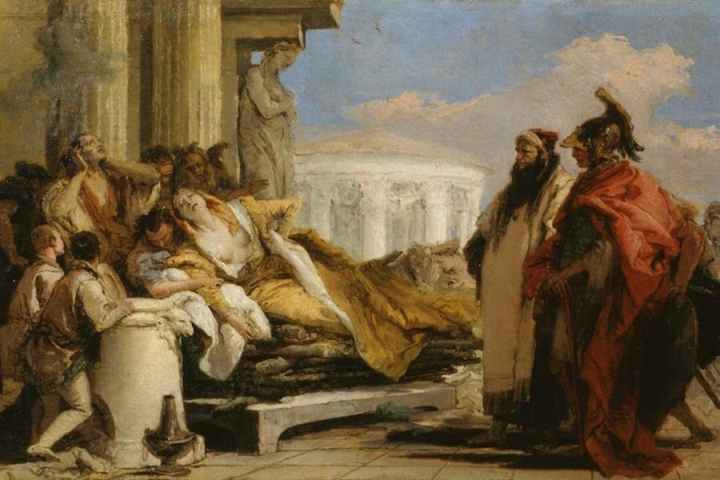
Giambattista Tiepolo, The Death of Dido, detail, 1729
(Moscow: The Pushkin State Museum of Fine Arts)
◊ ◊ ◊ ◊ ◊
Now on view at The Pushkin State Museum of Fine Arts:
From Tiepolo to Canaletto and Guardi
The Pushkin State Museum of Fine Arts, Moscow, 24 July — 14 October 2018
Palazzo Chiericati and Palazzo Leoni Montanari, Vicenza, 23 November 2018 — 10 March 2019
Curated by Victoria Markova and Giovanni Villa
With the exhibition From Tiepolo to Canaletto and Guardi, the Pushkin State Museum of Fine Arts proudly presents paintings by eighteenth-century Venetian masters from the collections of the Museo Civico di Palazzo Chiericati in Vicenza (23 pieces), the Intesa Sanpaolo Collection – Gallerie d’Italia, Palazzo Leoni Montanari in Vicenza (9 pieces), and The Pushkin State Museum of Fine Arts, Moscow (25 pieces). These works of art are shown for the first time together in one space, enabling visitors to see for themselves the full range of Venetian rococo paintings. Artworks on display are by outstanding Italian painters such as Giambattista Tiepolo, Giovanni Battista Pittoni, Luca Carlevarijs, Giovanni Battista Piazzetta, Giovanni Antonio Canal (Canaletto), Francesco Guardi, and Pietro Longhi.
Curators: Victoria E. Markova, Chief Researcher of the Pushkin State Museum of Fine Arts, Custodian of Italian paintings; Giovanni C. F. Villa, Director Emeritus of Vicenza’s civic museums.
◊ ◊ ◊ ◊ ◊
Note (added 13 January 2019)— The posting was updated to include Vicenza as a venue; more information is available here. There, the exhibition is entitled The Triumph of Color: From Tiepolo to Canaletto and Guardi.
Exhibition | Prints of Darkness: Goya and Hogarth

Left: Francisco José de Goya y Lucientes, Bobalicón (Silly Idiot), detail, 1864 (Manchester Art Gallery). Right: William Hogarth, The Enraged Musician, detail, 1741 (The Whitworth, The University of Manchester).
◊ ◊ ◊ ◊ ◊
Now on view at The Whitworth:
Prints of Darkness: Goya and Hogarth in a Time of European Turmoil
The Whitworth, The University of Manchester, 7 July 2018 — August 2019
Curated by Gillian Forrester
Francisco José de Goya y Lucientes (1746–1828) and William Hogarth (1697–1764) were the most remarkable artists of their times. Both were extremely successful portrait and history painters, but arguably their most compelling works were the uncommissioned prints they made with dazzling technical virtuosity, using line-engraving (Hogarth) and a combination of etching and aquatint (Goya). Whilst the artists were not working contemporaneously—Hogarth was fifty years old when Goya was born and died twenty years later—and never met, Goya was almost certainly familiar with Hogarth’s prints, and there are strong affinities between their works. Hogarth and Goya were both outsiders who cast their candid gazes on their dysfunctional societies. Poverty, homelessness, warfare, violence, cruelty, sexual abuse and human trafficking, social inequity, political corruption, racism, superstition, hypocrisy, rampant materialism, nationalism, mental illness, and alcoholism: all were subjected to their forensic scrutiny and no topic was off-limits. Simultaneously attractive and repellent, these challenging prints provoke a spectrum of responses, including shock, discomfort, laughter, and empathy, raising profound questions about the ethics of representation and viewing. The scenarios that they unflinchingly depicted are troublingly familiar to the contemporary viewer, eliciting an embarrassed contemplation of their own society, and themselves.
This exhibition features 100 prints by Goya and Hogarth, selected from the stellar collections at the Whitworth and Manchester Art Gallery. Although both artists are celebrated and represented in museum collections throughout the world, this is the first exhibition to consider Hogarth and Goya in tandem, providing an opportunity to compare their extraordinary graphic work. The exhibition will feature 50 prints by Hogarth, all drawn from the Whitworth’s collection. Bookended by the South Sea Bubble and his final print, the Bathos, which he published the year he died, the selection includes the serial works—The Rake’s Progress, Marriage a-la Mode, the Times of the Day, and the Four Stages of Cruelty—as well as single prints, including his emblems of British national identity, O The Roast Beef of Old England (Calais Gate) and the Enraged Musician. A fine impression of the engraving of Hogarth’s self-portrait with his pug, Trump, has been lent by Andrew Edmunds. Drinking culture was a pervasive theme in Hogarth’s work, and Gin Lane, Beer Street, and A Midnight Modern Conversation will be included, accompanied by a Hogarth-themed punchbowl made in Liverpool in 1748. The exhibition will feature 50 prints by Goya, including impressions from all the four series, as well as two etchings made early in his career in 1778, Margaret of Austria and Moenippus Menipo Filosofo.
The exhibition is timely, as it takes place during the troubled run-up to Britain’s exit from the European Union, scheduled for 29 March 2019, and the accompanying fractious debates currently taking place in Europe and elsewhere regarding national identity. Hogarth and Goya both lived through extended periods of warfare with France, and Hogarth claimed to hate the French, although he was a frequent visitor to Paris and hired French engravers for his print series Marriage a-la Mode. Angry, troubled, and ambivalent, Hogarth seems to embody the tortured mind-set of Britain on the eve of Brexit.
The exhibition is organized by Gillian Forrester, Senior Curator of Historic Fine Art at the Whitworth.
The Burlington Magazine, July 2018
The eighteenth century in The Burlington:
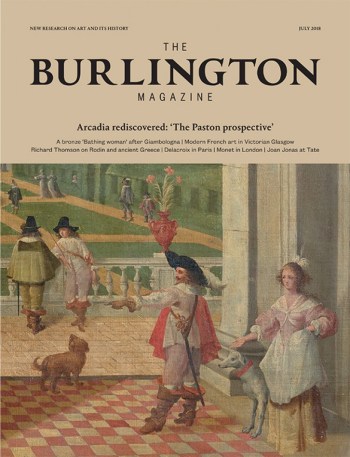
The Burlington Magazine 160 (July 2018)
 E D I T O R I A L
• Michael Hall, “At the Royal Academy of Arts,” p. 535. This is the Royal Academy’s year. The venerable London institution has celebrated its 250th anniversary by unveiling a redevelopment that has added seventy per cent more public space, staging a Summer Exhibition that has garnered five-star reviews, mounting an exhibition, The Great Spectacle, which traces the history of the annual exhibition since its inception in 1768, and publishing a monumental multi-author history of itself and its collections. . . .
A R T I C L E S
• Dorothea Diemer and Linda Hinners, “‘Gerhardt Meyer Made Me in Stockholm’: A Bronze ‘Bathing Woman’ after Giambologna,” pp. 545–53. Spurred by rivalry with French founders working for the Swedish Crown, in 1697 Gerhardt Meyer the Elder cast a bronze figure of a nude woman after a marble by Giambologna that had been in Sweden since 1632. It is inscribed ‘Me fecit Gerhardt Meyer Holmiae’.
R E V I E W S
• Laurel O. Peterson, Review of the exhibition Visitors to Versailles, 1682–1789 (Château de Versailles, 2017–18; The Metropolitan Museum of Art, 2018), pp. 582–84.
• Louis Cellauro and Gilbert Richaud, Review of the exhibition Jacques-François Blondel: An Enlightenment Architect in Metz (The Arsenal, Metz, 2018), pp. 584–86.
• Paul Taylor, Review of Susanna Berger, The Art of Philosophy: Visual Thinking in Europe from the Late Renaissance to the Early Enlightenment (Princeton University Press, 2017), pp. 606–07.
• Gauvin Alexander Bailey, Review of the exhibition catalogue, Ilona Katzew, ed., Painted in Mexico / Pintado en México, 1700–1790: Pinxit Mexici (Prestel, 2017), pp. 607–08.
• Sophie Littlewood, Review of Donald J. La Rocca, How to Read European Armor (Metropolitan Museum of Art and Yale University Press, 2017), p. 613.
O B I T U A R I E S
• Andrew Wilton, Obituary of Malcolm Cormack (1935–2018), p. 617. When the Yale Center for British Art, New Haven, opened in 1977, Malcolm Cormack was its first Curator of Paintings. At Yale, and subsequently at the Virginia Museum of Fine Arts, he staged influential exhibitions on subjects ranging from William Blake to the Camden Town Group.
Exhibition | Herculaneum and Pompeii: Visions of a Discovery
Exhibition formerly in Chiasso, now on view at the National Archaeological Museum in Naples (MANN):
Herculaneum and Pompeii: Visions of a Discovery
m.a.x. Museum, Chiasso, Switzerland, 25 February — 6 May 2018
Museo Archeologico Nazionale di Napoli, 28 June — 30 September 2018
Curated by Pietro Giovanni Guzzo, Maria Rosaria Esposito, and Nicoletta Ossanna Cavadini
 The 280th anniversary of the discovery of Herculaneum and the 270th anniversary of that of Pompeii are here celebrated with a completely original approach, by exploring the media and the methods with which the discoveries of the two sites were communicated through the visionary expressions of those who immediately intuited the implications of the discoveries and sought to promote the progress of the excavations and research into them. From the late eighteenth century to the early twentieth, from Goethe to Stendhal, William Gell, Giovanni Battista and Francesco Piranesi, and many drafters, engravers, and lovers of antiquity down to the Alinari brothers, this is an account of the passion for the excavations and precious archaeological finds and the desire to make known the discoveries through letters, hand-coloured sketchbooks, engravings, lithographs, drawings, reliefs, copperplates and gouaches, the first postcards, and daguerreotype photographs.
Pietro Giovanni Guzzo, et al., Ercolano e Pompei: Visioni di una scoperta / Herculaneum and Pompeii: Visions of a Discovery (Milan: Skira, 2018), 392 pages, ISBN: 978-8857238630 (Italian-English text), €38 / $68.
Exhibition | Montepulciano and the Eternal City
Now on view in Montepulciano:
Montepulciano and the Eternal City: Landscapes and Views from the Aesthetics of the Grand Tour to the Mid-Twentieth Century
Museo Civico – Pinacoteca Crociani di Montepulciano, 15 June — 7 October 2018
Curated by Roberto Longi
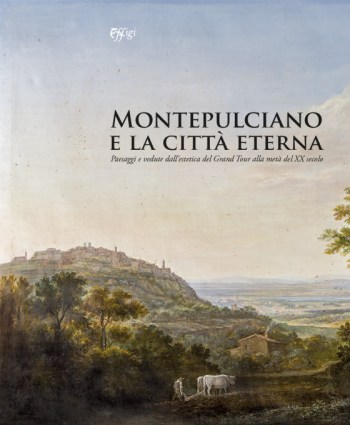 The exhibition, on view in the Crociani Civic Museum and Picture Gallery of Montepulciano from July 14th to October 7th, compares Rome and the Roman countryside with Montepulciano and its rural outskirts, through more than one hundred oil paintings, drawings, watercolours, and engravings by artists such as Labruzzi, Pacetti, Sartorio, Petrassi, Ranieri Rossi, and Ettore Roesler Franz. Of particular interest are works depicting the views of Rome and the Montepulciano countryside by foreign artists who saw the Grand Tour as a paradigm shift—the Spanish Juan Gimenez Martin, the English Samuel Prout, the Bavarian Karl Lindemann-Frommel, and the Swiss watercolourist Salomon Corrodi, who painted several views for Tsar Nicholas I and Queen Victoria.
In addition to the paintings, the exhibition includes a selection of materials which, carried by a servant, accompanied tourists on their long journeys, providing records of a time and a lifestyle: a travel writing desk, portable inkwells, medicine chests—essential in times of malaria—and tools used to prepare snacks for the journey. The noble traveller had to be perfect on all occasions; hence an iron for ties, a jewelry box, and a fragrance holder, as well as a scale for weighing coins and a travel chessboard to enliven any boring evenings at inns. A walking stick could serve as a good defense weapon or preserve a secret reserve of fine liqueur. The final section of the exhibition presents the working tools of the travelling artists: oil colours and watercolours boxes, palettes and materials for graphic techniques, travel sketchbooks, and folders. The exhibition relies on two important Roman collections and several private collections from Montepulciano.
Roberto Longi, Montepulciano e la Città Eterna: Paesaggi e vedute dall’estetica del Grand Tour alla metà del XX secolo (Rome: C&P Adver Effigi, 2018), 160 pages, ISBN: 978-8864339054, $43.
Exhibition | Precious Instruments, Distinguished Figures

Antonio Berti, Psaltery made for Maria Teresa Strozzi (1682–1748).
◊ ◊ ◊ ◊ ◊
Now on view at the Palace Venaria, near Turin:
Precious Instruments, Distinguished Figures: Music and Luthiery between the 17th and 20th Centuries in Europe
Venaria Reale, Torino, 31 May — 30 September 2018
Curated by Giovanni Accornero
The exhibition illustrates and compares four centuries of luthiery and collections, music and musicians, nobility and patronage.
Violins, violas, cellos, 5-course guitars, mandolins, lyre-guitar and psalteries made by master luthiers who were recognized and appreciated worldwide: Stradivari, Guarneri ‘del Gesù’, Amati, Guadagnini, Vinaccia, Fabricatore, Berti and Battaglia, Nadermann, Torres e Hauser—these were the fundamental Italian and European luthiers, an artistic craft that is inextricably connected the world over to the culture of ‘music making’. Precious musical instruments that on this ambitious stage move beyond craftsmanship to become genuine works of art.
It is a stimulating display that outlines a socio-cultural and artistic framework through a historical overview of around thirty musical instruments, most of which are exhibited for the first time since they are part of private collections. The instruments once belonged to famous figures: from exceptional musicians like Gaetano Pugnani, Niccolò Paganini, Charles Dancla, Yehudy Menuhin, Mauro Giuliani, Ramon Montoya, Andrés Segovia, Ida Presti, to major historical figures like the Emperor Leopold I of Habsburg, the Empress Maria Theresa of Naples and Sicily, princess Maria Teresa Strozzi, count Cozio di Salabue, countess Maria Beatrice Barbiano di Belgioioso Dal Pozzo della Cisterna, duchess Marie-Thérèse Charlotte of France, and queen Margherita of Savoy.
The exhibition is also an opportunity to familiarize the general public with the luthiery tradition of Turin that starting in the late 18th century, gained momentum (as the production in Cremona started to wane), and established itself on the European scene, a preeminence that remained unchanged for more than a century. It is a chance to rediscover the primacy of this region in yet another cultural sector.
Exhibition organized by: Consorzio Residenze Reali Sabaude in collaboration with the publishing house Edizioni Il Salabue
Exhibition | Furniture and Cabinetmakers at the Savoy Court
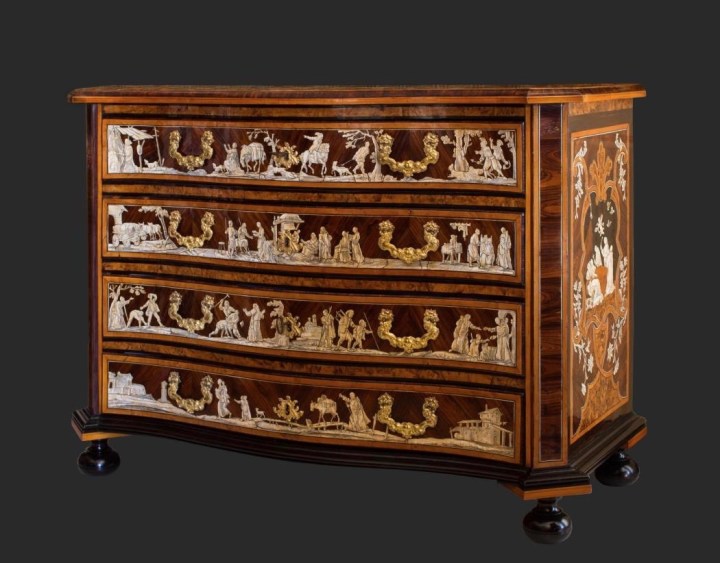
Luigi Prinotto, Chest with four drawers, depicting stories of Saint Bruno and the foundation of the Carthusian Order, 1736
(Private Collection)
◊ ◊ ◊ ◊ ◊
The exhibition at the Palace Venaria, near Turin, closed in June, but the catalogue is available from ArtBooks.com:
Genius and Skill: Furniture and Cabinetmakers at the Court of Savoy
Venaria Reale, Torino, 17 March — 15 June 2018
The exhibition aims to better define the history of furniture making in Piedmont between the 18th and 19th centuries through a display of 130 exceptional pieces crafted by the finest cabinet-makers and sculptors of the time—Luigi Prinotto, Pietro Piffetti, Giuseppe Maria Bonzanigo, and Gabriele Capello known as ‘Il Moncalvo’—some of which will be presented for the first time thanks to loans from important Piedmontese and international museums and collections.
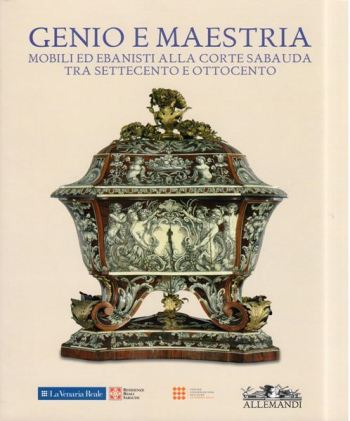 The purpose of the exhibition is to familiarize the public with precious cabinetmaking and inlay works, emphasizing their significance, use, and transformations with technical and scientific insights and multimedia installations. The exhibition tells the story of an elegant, cultivated, and complex craft that developed in Turin to cater to the needs of important royal and aristocratic patrons, in conjunction with other arts.
Special care has been adopted to design a display that is accessible to disabled visitors, including scale models, touch tablets, olfactory islands, and an Italian Sign Language video-guide. Moreover, description panels and labels are written in the EasyReading font, which is highly readable and facilitates reading for dyslexic persons.
Organizing and Scientific committee: Cesare Annibaldi, Roberto Antonetto, Clelia Arnaldi di Balme, Elisabetta Ballaira, Enrico Colle, Stefania De Blasi, Silvia Ghisotti, Luisa Papotti, Carla Enrica Spantigati
Coordinated by Carlo Callieri
Cesare Annibaldi, Roberto Antonetto, et al, Genio e Maestria: Mobili ed Ebanisti alla Corte Sabauda tra Settecento ed Ottocento (Turin: Allemandi, 2018), 304 pages, ISBN: 978-8842224594, $70.
Exhibition | What is Love? From Amor to Tinder

Nicolas de Largillière, Self Portrait of the Artist with His Family, 1704
(Kunsthalle Bremen)
◊ ◊ ◊ ◊ ◊
Press release (via Art Daily) for the exhibition now on view at the Kunsthalle Bremen; and yes, you read the poster correctly: it’s sponsored by Tinder:
What is Love? Von Amor bis Tinder
Kunsthalle Bremen, 7 July — 21 October 2018
Love is a topic that concerns everyone. The critical role that love plays in our lives is also reflected in art. The exhibition What is Love? From Amor to Tinder presents around 40 works from various eras from the collection of the Kunsthalle Bremen that focus on earthly love, lovers from mythology, narcissism, eroticism, and the idealisation of beauty. The selection is complemented by five works by contemporary artists who explore the phenomenon of online dating. These works will be exhibited for the first time in a museum.
 According to a recent study, satisfactory relationships are an important source of personal happiness for most Germans.* Several surveys have discovered that singles have a fairly detailed idea of what a rewarding partnership should look like. Why then are more people single than ever before? Shouldn’t the internet make the search for a partner easier?
First of all, the internet has nothing to do with love. Nevertheless, it has had a major impact on how we view love, courtship, and relationships. What Cupid’s arrow accomplished in earlier times is done in the digital age by our fingers. They swipe right or left, searching for the perfect match—aiming straight at our heart. The internet is a new place to look for a partner and meet new people.
Since 2017 at the latest, ‘tindering’ has become part of common German language use and the term has been added to the latest edition of the Duden (the defining dictionary of the German language), referring to the use of the Tinder app. For contemporary artists, Tinder, along with other dating apps and portals, has provided a motivation to explore the topic further. A selection of five contemporary works focusing on online dating will be presented in this exhibition and contrasted with around 40 historical and modern works from the collection of the Kunsthalle Bremen. In five sections the exhibitions explores universal questions of love, incorporating philosophical, sociological and economic aspects.
Five Chapters: Prototypical Couples, Real Couples, Narcissism, Beauty, and Eroticism
The exhibition starts with prototypical couples that continue to define our idea of partnership in the Christian pictorial tradition, such as the story of Adam and Eve—which to this day remains a pivotal motif in art. Subsequently, the exhibition will examine real couples and examine how the invention of romantic love around 1800 changed ideas of relationships. Romantic love may have replaced politically or financially motivated marriages, but users of online dating platforms frequently reveal unromantic or even economically-motivated patterns of behaviour. The individual as such and the degree to which a happy relationship can be associated with one’s own personal development and the ability to love will also be examined. In addition, the exhibition takes a look at beauty since physical appearance plays a major role in online dating. In the final section, the exhibition cuts to the chase: sex. Whereas virginity was a status symbol in earlier times, sociologists today observe the opposite: sexual experience is desirable and makes people more attractive.
Artists on Display
A total of around 60 works of art will be included in the show. Forty objects from the collection of the Kunsthalle Bremen, ranging from the sixteenth century to the present day, will be on display. The paintings, photographs, works on paper and sculptures were created by Jean Baptiste Carpeaux, Carl Friedrich Demiani, Jean Baptiste Deshayes, Anselm Feuerbach, Gaetano Gandolfi, Nan Goldin, Hendrick Goltzius, Hermann Hahn, Adriaen Isenbrant, Giovanni Battista von Lampi the Elder, Aristide Maillol, Pierre Mignard, Edvard Munch, Pablo Picasso, Markus Theodor Rehbenitz, Douglas F. Robinson, Renée Sintenis, Adolph Steinhäuser, Carl Steinhäuser, Christiaen van Couwenbergh, Charles van Loo, Pieter Christoffel Wonder, and Tom Wood. The works that address online dating, were created by the Australian artist Tully Arnot, the Turkish photographer Eylül Aslan, the Bremen artist trio Katharina Dacrés/ Lena Heins/ Jakob Weth, the Indian illustrator Indu Harikumar, and the Dutch artist Dries Verhoeven.
Exhibition | Triumph of the Baroque, Painting from 1600 to 1800
Now on view at the Hofburg:
Triumph des Barock: Malerei von 1600 bis 1800 / Il Trionfo del Barocco: Pittura dal 1600 al 1800
Diocesan Museum, Hofburg (Bishop’s Palace), Brixen / Bressanone, Italy, 28 April — 31 October 2018
 Barocke Kunst ist triumphale Ausdruckskunst. So auch in der Malerei. Die Ausstellung schöpft aus dem umfangreichen Bestand der Hofburg und zeigt Gemälde von den frühen Anfängen um 1600 bis in die Spätphase um 1800. Eine Schaulust für das Auge.
Nie waren den Menschen der Himmel und das Leben mit den Himmlischen so vertraut wie in der Barockzeit. Erzählungen aus der Bibel, Schilderungen aus dem Leben von Heiligen, Darstellungen von Maria mit dem Jesuskind—sie alle führen das Auf und Ab des Lebens vor Augen. Berühmte Maler aus Tirol sowie überregional bedeutende Künstler schufen Altarbilder für Kirchen und sakrale Gemälde zur privaten Andacht. Eine Auswahl ihrer Werke ist in der Ausstellung zu sehen, darunter Bilder von Stephan Kessler, Johann Georg Grasmair und Ulrich Glantschnigg, von Martin Theophil Polak, Karl Skreta und Johann Lingelbach. Auch Gemälde der in Wien zu Ruhm gelangten Tiroler Barockmaler, wie Paul Troger, Michael Angelo Unterberger und Josef Ignaz Mildorfer, sind ausgestellt.
Kopien nach berühmten Meistern spielten in der barocken Malerei eine große Rolle. Sie vermittelten das gedankliche Konzept des Originals nahezu ungeschmälert und trugen wesentlich zur Beliebtheit einzelner Bildmotive dar. Eine Auswahl hochwertiger Kopien wird in der Ausstellung gezeigt.
Neben Altarbildern und religiösen Werken sind auch Porträts zu sehen, einige von ihnen zum ersten Mal. Porträts stellten Macht und Reichtum, Bildung und Stand der Dargestellten zur Schau. Sie stehen für Inszenierung und Selbstdarstellung von Klerus, Adel und Bürgertum.
Johann Kronbichler, Die barocken Gemälde der Hofburg Brixen (Brixen: Hofburg, 2018), 396 pages, ISBN: 978-8888570235, $75.
 Zur Ausstellung erscheint ein Bestandskatalog. Dieser enthält—über die in der Ausstellung gezeigten Werke hinaus—alle barocken Gemälde aus der Schausammlung und den Depots sowie die Gemälde und Wandmalereien der barocken Ausstattung der Hofburg. Mit seinen knapp 700 vorgestellten Werken und dem umfangreichen Bildmaterial stellt der von Johann Kronbichler verfasste Bestandskatalog ein unverzichtbares Grundlagenwerk zur Barockkunst in Südtirol dar. Der Katalog, Band 4 der Veröffentlichungen der Hofburg Brixen, ist in der Hofburg und im Buchhandel erhältlich.
Exhibition | Blast from the Past: Artillery in the War of Independence
Along with artillery objects, the exhibition includes British paintings of arms manufacturing on loan from the National Maritime Museum in Greenwich and the Musée de l’Armée at Les Invalides in Paris.
Blast from the Past: Artillery in the War of Independence
American Revolution Museum, Yorktown, 10 June 2018 — 5 January 2019
Curated by Sarah Meschutt
 As the last great victory of the American Revolution, the 1781 Siege at Yorktown is known for the use of artillery by General George Washington’s Continental Army. Through interactive elements and artifact displays, Blast from the Past: Artillery in the War of Independence features artillery used on all fronts of the American Revolution by the American, French, and British forces. This special exhibition explores a range of topics from innovations in artillery design and technology to the individual roles of an artillery crew. Topics examine artillery deployment and transport, as well as the range of fire and science behind these powerful weapons.
Blast from the Past highlights the chronology of the weapons and reveal the technology and innovation that delivered the last great victory of the Revolution—a victory that forever made Yorktown, Virginia, the place where the subjects of a king became the citizens of a nation.
American, French and British artillery pieces include:
• British Light 3-pounder bronze field cannon, cast by Jan and Pieter Verbruggen, ca. 1776, on loan from the U.S. Army Center of Military History
• ‘La Perileuse’ French 4-pounder bronze field cannon, cast by Jean Bérenger at Strasbourg, ca 1758, on loan from the National Park Service Springfield Armory National Historic Site
• British 12-pounder bronze ‘Lafayette’ cannon, cast by William Bowen, ca. 1759, on loan from the National Park Service, Colonial National Historical Park, Yorktown Collection
• American 6-pounder iron cannon, cast by Samuel and Daniel Hughes, ca. 1775–83, on loan from the Mayor and Council of Boonsboro, Maryland
• ‘La Bellone’ French 4-pounder bronze battalion cannon, cast by D.E. Dupont at Rochefort, ca. 1773, on loan from the National Park Service, Home of Franklin D. Roosevelt National Historical Site
Visitors can take in the size and scope of American, French, and British artillery and then explore the museum for a range of hands-on experiences.
• Discover types of artillery—cannons, mortars and howitzers—and types of ammunition, from shot and shell to canister and grape.
• Figure out the right artillery tool for the job—types of shot and essential implements of rammer, sponge and linstock—in a hands-on display.
• How does one move a gun? Lift a door to determine the strength by men and horses to advance a light or heavy gun.
• Examine an artilleryman’s pocket guide; see interactive 18th-century artillery field manuals that served as reference to determine tasks such as how to draw a 6-pounder up a steep cliff or bluff.










leave a comment