ASECS Graduate Student Paper Award
ASECS Graduate Student Research Paper Award for 2010
Submissions due by 1 January 2011
Highlighting pioneering research contributions of the next generation of scholars of eighteenth-century studies, this $200 award will recognize an outstanding research essay of 15-30 pages, which has not been previously published. Four (4) copies of the submission as well as a letter of endorsement from a mentoring professor, which outlines the originality and contributions that the essay makes to the field of eighteenth-century studies should be sent to: Byron R. Wells, Executive Director, ASECS, PO Box 7867, Wake Forest University, Winston-Salem, NC 27109. The deadline for applications is January 1, 2011 and the announcement of the winner will be made at the annual meeting.
We would also like to remind faculty members to encourage applications from their most gifted students for both the Graduate Student Research Paper Award and the Graduate Student Annual Conference Paper Award.
Curatorial Fellowship at The Frick
Andrew W. Mellon Predoctoral Curatorial Fellowship 2011–2013
Applications due by 20 January 2011
The Frick Collection is pleased to announce the availability of a two-year predoctoral fellowship funded by the Andrew W. Mellon Foundation for an outstanding doctoral candidate who wishes to pursue a curatorial career in an art museum. The fellowship will offer invaluable curatorial training and will provide the scholarly and financial resources required for completing the doctoral dissertation. Internationally renowned for its exceptional collection of Western European art from the early Renaissance through the end of the nineteenth century, The Frick Collection, complemented by the equally significant resources of the Frick Art Reference Library, offers a unique opportunity for object-based research. The Mellon fellowship is best suited to a student working on a dissertation that pertains to one of the major strengths of the Collection and Library. (more…)
Graduate Seminar at YCBA: The Artist’s Studio in Britain
Making Art, Picturing Practice: The Artist’s Studio in Britain ca. 1700–1900
Yale Center for British Art Graduate Summer Seminar
Yale University, New Haven, CT, 6-11 June 2011
Applications due by 21 January 2011
In June 2011 the Yale Center for British Art (YCBA) will offer a week-long graduate seminar, generously supported by the Andrew W. Mellon Foundation, open to doctoral candidates working on topics relating to the artist’s studio and artistic practice in the eighteenth, nineteenth, and early twentieth centuries. It will focus on the studio as understood in its broadest sense, both as site and idea, and will closely examine representations of studios alongside other evidence of their function and appearance. Incorporating a wide range of materials and objects held by the Center, as well as in other collections at Yale and nearby museums, the purpose of the seminar is to interrogate representations and interpretations of the studio through primary visual documents, developing methods for the analysis and critique of the visual and material culture that can inform our understanding of art practices. The instructors for the seminar are Martina Droth, Head of Research and Curator of Sculpture at the YCBA, and Mark Hallett, Professor of Art History and Head of Department, the University of York, UK.
The flyer for the seminar provides further details and application information. Any queries may be addressed to Marinella Vinci, Senior Administrative Assistant, Department of Research: marinella.vinci@yale.edu.
Graduate Student Conference: Popular Culture in Early America
Popular Culture in Early America
The Fourth James L. and Shirley A. Draper Graduate Student Conference in Early American Studies
Storrs, Connecticut and Worcester, Massachusetts, 24-26 March 2011
Proposals due by 15 December 2010
Popular culture in early America embraced a host of activities and purposes, communities, practices, and sites. From London to Philadelphia, Charleston to Kingston, Quebec to Lima, colonial subjects and then citizens of the United States and other new republics in the Americas frequented taverns and country dances, cock fights and boxing matches, where they relaxed, competed, bonded, shared news, forged political alliances, and defined the meanings and limits of sociability. Couples strolled through pleasure gardens in eighteenth-century cities and privileged women staked claims to gentility with Wedgwood china, while men of all classes patronized brothels and then repented after listening to fiery revival sermons. Museums and theaters advertised new forms of instruction and amusement in the public arena. The respectable home, in turn, took on a new role as an entertainment center, where young ladies performed on the piano and children moved pawns on board games. Meanwhile, in realms of their own, enslaved people played homemade instruments adapting African forms and rhythms to New World surroundings, only to witness their musical culture admired, mocked, and expropriated in the commercialized form of blackface minstrelsy. Popular culture expressed the vitality of the diverse worlds that met and collided in early America and enacted their tensions and conflicts as well. (more…)
Dissertation Listings at caa.reviews
From CAA News:
Dissertation Listings
Due by 15 January 2011
Dissertation titles in art history and visual studies from US and Canadian institutions, both completed and in progress, are published annually on the caa.reviews website, making them available through web searches. Dissertations formerly appeared in the June issue of The Art Bulletin and on the CAA website.
PhD-granting institutions may send a list of doctoral students’ dissertation titles to dissertations@collegeart.org. Full instructions regarding the format of listings can be found here. CAA does not accept listings from individuals. Improperly formatted lists will be returned to sender. For more information, please write to the above email address. Deadline: January 15, 2010.
◊ ◊ ◊ ◊ ◊
The index for 2009 lists four eighteenth-century dissertations completed, including:
- Mark Magleby, “Reviewing the Mount of Diana: Henry Hoare’s Turkish Tent at Stourhead” (Ohio State, M. M. Mudrak)
- Tania Solweig Shamy, “Frederick the Great’s Porcelain Diversion: The Chinese Tea House at Sanssouci” (McGill, R. Taws, B. Wilson)
and twenty-five dissertations in progress, including:
- Hillary Brown, “Shaping the Child: Sculpted Portraits of Children in Eighteenth-Century Britain” (USC, M. Baker)
- Lauren Cannady, “Owing to Nature and Art: The Garden Landscape and Decorative Painting in Eighteenth-Century French Pavillons de Plaisance” (IFA/NYU, T. Crow)
- Nicole Cuenot “The Force of Flowers: Bringing the Outdoors in at Versailles” (Columbia, D. Freedberg)
- Christopher Currie, “Art, Illusion, and Social Mobility in Eighteenth-Century France: Rigaud, Largillierre, and the Making of the Marquis de Gueidan” (UNC Chapel Hill, M. Sheriff)
- Emily Everhart, “The Power of Friendship: Madame de Pompadour, Catherine the Great, and Representations of Friendship in Eighteenth-Century Art” (Georgia, A. Luxenberg)
- Victoria Sears Goldman, “‘The Most Beautiful Punchinelli in the World’: A Comprehensive Study of the Punchinello Drawings of Giovanni Battista Tiepolo” (Princeton, T. DaCosta Kaufmann)
- Katie Hanson, “A Neoclassical Conundrum: Painting Greek Mythology in France, 1780–1825” (CUNY, P. Mainardi)
- Heidi Kraus, “David, Architecture, and the Dichotomy of Art” (Iowa, D. Johnson)
- Andrei Pop, “Neopaganism: Henry Fuseli, Theatre, and the Cultural Politics of Antiquity, 1760–1825” (Harvard, E. Lajer-Burcharth)
For the full lists, see the caa.reviews site.
Mary Vidal Travel Award — Applications Due 15 November
HECAA members who are graduate students or who have completed the Ph.D. within the past three years are eligible to apply for modest subventions (between $100-$200, depending on the number of applicants and available funds). Named in memory of Professor Mary Vidal, the funds are intended to defray costs associated with research travel, conferences in which the recipients are presenting, or publication permission fees.
Applicants should send a CV and a brief description of the project, including an explanation of how the funds will be used, to Julie Plax by May 15th or November 15th (there are two deadlines).
National Research Council Releases Rankings for Ph.D. Programs
As David Glenn reports for The Chronicle of Higher Education (28 September 2010) . . .
Now it can be told. The American doctoral program with the longest median time-to-degree is the music program at Washington University in St. Louis: 16.3 years. That’s just one of a quarter million data points that appear in the National Research Council’s new report on doctoral education in the United States, which was finally unveiled Tuesday afternoon after years of delay. (The Chronicle has published an interactive tool that allows readers to compare doctoral programs across 21 variables.) The NRC’s new ranking system will draw the most immediate attention. It is far more complex than the method the agency used in its 1982 and 1995 doctoral-education reports. . .
The full article is available here. Useful discussion of the Art History rankings appear at The Art History Newsletter: here, here, here, and here.
ASECS Conference Funds for Graduate Students
Traveling Jam-Pot: Fund for Graduate Students
Applications due by 1 November 2010
Among the best — and customarily youngest — of our colleagues are graduate students, whose presence and voices we welcome at ASECS meetings. Their presence is vital to the continued success not just of ASECS as an organization but of our studies; these are the professors of the near future who will make “the long eighteenth century” live for countless students of the 21st century. Institutions, finding themselves strapped for funds, are economizing on grants to graduate students. Many young scholars can no longer obtain travel grants for appearances at conferences.
Award recipients are ABDs and PhDs within a year after receiving doctoral degree. An award of up to $300 will be given toward the cost of attending the ASECS annual meeting. Three (3) copies of the following information must be submitted by each applicant: Applicants must be members of ASECS at the time of submission.
- A statement of need
- Identity of other sources of funding sought
- Budget
- Endorsement from a faculty member (one copy is sufficient)
- Number of professional conferences attended in the past year
Application deadline: November 1, 2010. Applications will be read and awards given by a committee of three scholars; The Board also agreed that conference registration fees will be waived for successful candidates. Please send applications to: Byron R. Wells, Executive Director, ASECS, PO Box 7867, Wake Forest University, Winston-Salem, NC 27109.
CAA Travel Grants for the 2011 Conference in New York
Although funds are modest, CAA will offer a limited number of Annual Conference Travel Grants to graduate students in art history and studio art and to international artists and scholars. Travel grants are funded solely by donations from CAA members—please contribute today. Charitable contributions are 100 percent tax deductible.
Graduate Student Conference Travel Grant
This $150 grant is awarded to a limited number of advanced PhD and MFA graduate students as partial reimbursement of expenses for travel to the 2011 Centennial Conference in New York. To qualify for the grant, students must be current CAA members. Candidates should include a completed application form, a brief statement by the student stipulating that he or she has no external support for travel to the conference, and a letter of support from the student’s adviser or head of department. For an application and more information, please contact Lauren Stark, CAA manager of programs, at 212-691-1051, ext. 248. Send application materials to: Lauren Stark, Graduate Student Conference Travel Grant, CAA, 275 Seventh Ave., 18th Floor, New York, NY 10001. Deadline: September 24, 2010.
International Member Conference Travel Grant
CAA presents a $300 grant to a limited number of artists or scholars from outside the United States as partial reimbursement of expenses for travel to the Centennial Conference in New York. To qualify for the grant, applicants must be current CAA members. Candidates should include a completed application form, a brief statement by the applicant stipulating that he or she has no external support for travel to the conference, and two letters of support. For an application form and additional information, please contact Lauren Stark, CAA manager of programs, at 212-691-1051, ext. 248. Send materials to: Lauren Stark, International Member Conference Travel Grant, CAA, 275 Seventh Ave., 18th Floor, New York, NY 10001. Deadline: September 24, 2010.
Spring Cleaning Your CV
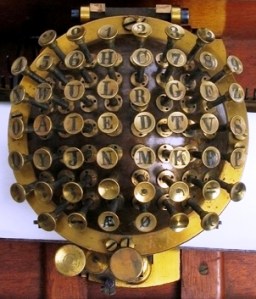
The keyboard of a writing ball, seen from above. Rasmus Malling-Hansen invented this writing machine in 1865 (Photo: Wikimedia Commons)
From the Editor
As we move into spring and past the high season for job interviews and fellowship deadlines, it may seem like a strange time to revise your CV. On the other hand, now might just be an ideal moment. Without the pressure of looming due dates, you might be able to approach the task with a clearer head and fresh energy. It might even feel constructive as opposed to being one more academic chore, another box to check in the process of submitting applications. Updating a CV can provide a useful means of assessing what you’ve accomplished in the recent past — and what sorts of holes you need to work to fill for the future. Again, there’s a tendency to push it off until some pressing deadline, but deadlines come with enough pressure without having to scramble to fix the CV (and those moments are rarely well-suited for taking stock of one’s scholarly and professional goals and progress).
 A recent posting at The Art History Newsletter notes the return of the CV Doctor at The Chronicle of Higher Education. The article (written by Julie Miller Vick and Jennifer Furlong, authors of The Academic Job Search Handbook) includes ‘before’ and ‘after’ examples, including one from art historian, ‘Lucy Scholar’. The College Art Association includes models at its Standards and Guidelines pages for Art Historians (2003) and Museum Professionals (2000). And, notwithstanding the array of bad sites, there are plenty of useful resources across the web for improving your formatting.
Remarkably — though perhaps not surprisingly — prescriptions from academic bastions such The Chronicle and CAA offer minimal help in terms of updating the visual design for a CV. Here’s CAA’s recommendation:
Avoid making the cv complicated. Dramatic layouts and attempts to pad your cv will probably work against you. A beautifully constructed cv will not get you the job if your scholarship is weak.
I agree, but none of this is especially useful in terms of actually formatting a document, and the last sentence seems to harbor a funny suspicion that ultimately appearances are deceptive and thus not to be trusted. In any case, even if “your scholarship is weak” you’re surely under no obligation to make your CV look bad, too. (In an interesting way, this returns us to the bias against fashion in academic circles).
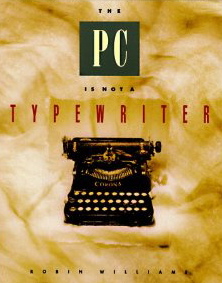 To be clear: an academic CV should conform to traditional visual standards. Yet, no one expects you to use a typewriter, and presumably doing so would be counted against you. The analogy, in fact, lies at the center of the argument made in Robin Williams’s wonderful book, The PC Is Not a Typewriter. Don’t let the publication date of 1995 put you off; it’s full of terrific advice that’s still all too timely. You’ll learn for instance, why it makes sense to use two spaces between sentences on a typewriter but is absurd to do so on a computer keyboard (the last time I surveyed my students on this point, the majority had still been instructed to keyboard with two spaces after each period). I’ve also found the advice at LifeClever Give Your Resume a Face Lift to be immensely useful, and the end result is hardly “dramatic” — just a much better formatted CV. Other resources or ideas? Feel free to comment. –C.H.










 Enfilade
leave a comment