Spring Cleaning Your CV
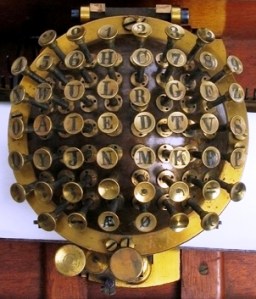
The keyboard of a writing ball, seen from above. Rasmus Malling-Hansen invented this writing machine in 1865 (Photo: Wikimedia Commons)
From the Editor
As we move into spring and past the high season for job interviews and fellowship deadlines, it may seem like a strange time to revise your CV. On the other hand, now might just be an ideal moment. Without the pressure of looming due dates, you might be able to approach the task with a clearer head and fresh energy. It might even feel constructive as opposed to being one more academic chore, another box to check in the process of submitting applications. Updating a CV can provide a useful means of assessing what you’ve accomplished in the recent past — and what sorts of holes you need to work to fill for the future. Again, there’s a tendency to push it off until some pressing deadline, but deadlines come with enough pressure without having to scramble to fix the CV (and those moments are rarely well-suited for taking stock of one’s scholarly and professional goals and progress).
 A recent posting at The Art History Newsletter notes the return of the CV Doctor at The Chronicle of Higher Education. The article (written by Julie Miller Vick and Jennifer Furlong, authors of The Academic Job Search Handbook) includes ‘before’ and ‘after’ examples, including one from art historian, ‘Lucy Scholar’. The College Art Association includes models at its Standards and Guidelines pages for Art Historians (2003) and Museum Professionals (2000). And, notwithstanding the array of bad sites, there are plenty of useful resources across the web for improving your formatting.
Remarkably — though perhaps not surprisingly — prescriptions from academic bastions such The Chronicle and CAA offer minimal help in terms of updating the visual design for a CV. Here’s CAA’s recommendation:
Avoid making the cv complicated. Dramatic layouts and attempts to pad your cv will probably work against you. A beautifully constructed cv will not get you the job if your scholarship is weak.
I agree, but none of this is especially useful in terms of actually formatting a document, and the last sentence seems to harbor a funny suspicion that ultimately appearances are deceptive and thus not to be trusted. In any case, even if “your scholarship is weak” you’re surely under no obligation to make your CV look bad, too. (In an interesting way, this returns us to the bias against fashion in academic circles).
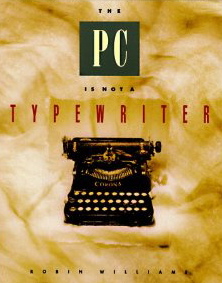 To be clear: an academic CV should conform to traditional visual standards. Yet, no one expects you to use a typewriter, and presumably doing so would be counted against you. The analogy, in fact, lies at the center of the argument made in Robin Williams’s wonderful book, The PC Is Not a Typewriter. Don’t let the publication date of 1995 put you off; it’s full of terrific advice that’s still all too timely. You’ll learn for instance, why it makes sense to use two spaces between sentences on a typewriter but is absurd to do so on a computer keyboard (the last time I surveyed my students on this point, the majority had still been instructed to keyboard with two spaces after each period). I’ve also found the advice at LifeClever Give Your Resume a Face Lift to be immensely useful, and the end result is hardly “dramatic” — just a much better formatted CV. Other resources or ideas? Feel free to comment. –C.H.
Cultural Intermediaries: Seminar Participants
The ISECS site includes a PDF file with the following list of participants for this year’s Seminar for Junior Scholars, to be held at Queen’s University in Belfast, 16-20 August. The theme is Cultural Intermediaries.
- Danna Agmon (University of Michigan), “Professional intermediaries in eighteenth-century French India”
- Vanessa Alayric (Université de Lille), “Cultural transfers of exotica: material exchanges between China and Europe through trade, mission and art”
- Angela Byrne (Royal Irish Academy), “Irish-born British diplomats in Russia, 1733-1767”
- Florence Catherine (Université de Nancy), “Albert von Haller (1708-1777), intermédiaires culturels dans les espaces français et germaniques au XVIIIe siècle”
- Mariana D’Ezio (University of Rome), “Cultural intermediaries across Europe: cultural and literary intersections between British and Italian Women writers and salonnières in the age of the Grand Tour (1700-1799)”
- Sébastien Drouin (École pratique des Hautes Études, Sorbonne Paris-IV), “Journalistes, érudits et informateurs au Refuge : les réseaux intellectuels de l’Histoire critique de la République des Lettres (1712-1718)”
- Olivera Jokic (City University of New York), “The Death of a Beautiful Moor Woman: Obstinate Clerks and the Form of Evidence in the British Colonial Archive”
- Eszter Kovács (Université de Szeged, Hongrie), “Une catégorie à part du “voyageur par état” : la réflexion de Diderot sur les missionnaires”
- Diego Lucci (American University in Bulgaria), “American Political and Social Life in Luigi Castiglioni’s Travels in the United States of North America”
- Katrina O’Loughlin (University of Western Australia), “‘A smaller compass’: body and text as cultural intermediaries in eighteenth-century women’s travel”
- Maria Petrova (State University for Humanities, Moscow), ‘The diplomats of Catherine II as cultural intermediaries: the case of the Princes Golitsyn”
- Natalie Rothman (University of Toronto), “Dragomans in the Republic of letters: cultural mediation and the making of the Levant”
- Frederik Thomasson (European Institute, Florence), “Cultural intermediaries: another way of addressing or circumventing the centre-periphery dichotomy?”
- Ellen R. Welch (University of North Carolina), “Intermediaries and the Media: Ambassadors and Emissaries in the French Periodical Press, 1672-1763”
- Laurence Williams (Magdalen College Oxford), “Mediating the Oriental City through the Arabian Nights: British Tours of Constantinople, 1719-1797”
Sartorial Choices Part II
Several weeks ago Enfilade included a reference to the fashion blog, Academichic. Readers who found it interesting, might enjoy this interview at Already Pretty, where the participants unpack their thinking on the importance of clothing within academia.

Print Culture and the American South
2010 Summer Seminar in the History of the Book:
The Global American South
& Early American Print Culture
American Antiquarian Society, Worcester, MA, 14- 18 June 2010
Applications due by 12 March 2010
 What happens when we view the imagined community of U.S. print culture from the vantage point of the South? How might such a reoriented book history challenge emerging transatlantic, transnational, and cosmopolitan histories of the U.S.? At a moment when industrial print culture was consolidating itself in the Northeast, “the South” appeared in print on several spatial scales. While asserting an “American” identity, Southerners represented themselves as a sectional alternative to the nation. Boasting a distinctive regional culture, they simultaneously celebrated local diversity. The seminar will investigate how these complementary practices of national, regional, and local self-definition circuited through print cultural conditions on the ground. How, we will ask, did distribution, copyright, authorship, and reading inflect the South’s sectional self-fashioning, its attempt to lay claim to the nation, and its engagements with the wider world?
We can hear echoes of Southern print culture’s sectional and local accents in the American Antiquarian Society’s unsurpassed periodical holdings, which also allow us to track the printed South’s circulation, reception, and representation throughout the nation. The seminar will benefit from the AAS’ wealth of ephemeral print propaganda on the South’s major political crises: Indian removal, the slavery controversy, and nullification/secession. Finally, the seminar will provide an introduction to the Tinker Collection’s rich holdings in Francophone Louisiana materials-from legal ordinance digests to an original copy of Les Cenelles. (more…)
Call for Papers: Graduate Conference on ‘New Formalisms’
Politics, Ethics, and the New Formalisms (Graduate Student Conference)
University of Illinois at Urbana-Champaign, 23-24 April 2010
Abstracts due by 10 March 2010
The British Modernities Group, in conjunction with the Unit for Criticism and Interpretive Theory and the departments of English, Philosophy, and Art History, and with support from the Illinois Program for Research in the Humanities, invites submissions from diverse disciplinary backgrounds and methodological orientations for our annual graduate student conference, this year themed “Politics, Ethics, and the New Formalisms.”
The conference will open with a keynote address by Marjorie Levinson, professor at University of Michigan, Ann Arbor, who specializes in the areas of critical theory, and in poetry and poetics. She not only theorizes the rise of the “New Formalist” movement, but enacts these tensions in her own scholarship, including a contribution to a collection of essays entitled Rethinking Historicism: Critical Readings in Romantic History in 1989, and a recent publication in Studies in Romanticism entitled “A Motion and a Spirit: Romancing Spinoza.”
New Formalism is a recent trend—a “movement,” according to Marjorie Levinson’s 2007 essay “What is New Formalism?” in the PMLA—in critical theory, cultural studies, and literary scholarship that challenges some of academia’s established methods and critical approaches. The term “New Formalism” seemingly implies a “return” to formal qualities such as genre or aesthetics in approaching literary and cultural studies. New Formalism itself is hardly a unitary concept, hence the plural reference in our title to New Formalisms; the term itself is open to debate and definition. The graduate conference will engage this critical trend by exploring the ways in which New Formalism reflects attentiveness to political and ethical issues. What does a turn or ‘return’ to formalism in the first decade of the twenty-first century mean? How does New Formalism impact disciplinary, pedagogical, or theoretical positions or methodologies? How can form be political? How can form be ethical? (more…)
Academics and the F-Word
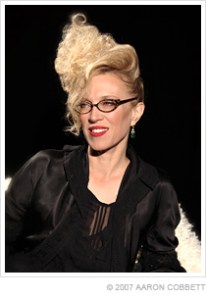
One might imagine any number of interesting permutations on that F-word, but here I’m thinking of an even more fraught notion for academics: fashion. Nearly two decades ago, Valerie Steele made the point in her 1991 Lingua Franca essay, “The ‘F’ Word”:
Valerie Steele, Director and Chief Curator of the Museum at the Fashion Institute of Technology in New York
Once, when I was a graduate student at Yale, a history professor asked me about my dissertation. “I’m writing about fashion,” I said.
“That’s interesting. Italian or German?”
It took me a couple of minutes, as thoughts of Armani flashed through my mind, but finally I realized what he meant. “Not fascism,” I said. “Fashion. As in Paris.”
“Oh.” There was a long silence, and then, without another word, he turned and walked away.
The F-word still has the power to reduce many academics to embarrassed or indignant silence. Some of those to whom I spoke while preparing this article requested anonymity or even refused to address the subject; those who did talk explained that many of their colleagues found it “shameful to think about fashion.” One professor explained the “denial” of fashion this way: “People say that they don’t care about fashion, but that may be because they aren’t self-conscious enough to envision a personal style. Style is what most academics don’t have.”
Academics may be the worst-dressed middle-class occupational group in the United States. But they do wear clothes. So I set out to discover what professors choose to wear (the clothes don’t grow in their closets), what they think about fashion (even when they claim not to think about it), and, well, why they tend to dress so badly. . .
For the full essay, click here»
◊ ◊ ◊ ◊ ◊
With the spring conference season here once more, many of us will soon find ourselves rummaging in the closet with an open suitcase on the floor, asking ourselves what an art historian should look like now (I recall one CAA several years ago in which the hotel was also hosting a cheerleading conference: lots of black clothing, scarves, and serious eyewear on the one side with plenty of exuberant hair-styling, makeup, and shiny sportswear on the other — quite the contrast).
The Sartorialist has brilliantly demonstrated how the intersection of high fashion, street fashion, and engaging photography can make for an internationally successful blog (and now book). In a more targeted manner, Academic Chic offers a fascinating glimpse at the unique challenges professors and college instructors face. In the site’s own words: “Three feminist PhD candidates at a Midwest university, on a crusade against the ill-fitting polyester suit of academic yore.” They continue:
We are three Ph.D. candidates in the humanities, who believe that academia and fashion are not at odds. When beginning graduate school we each had an existential wardrobe crisis. What does one wear in grad school anyway? We recognized that our undergraduate hoodies and jeans were no longer appropriate but were unwilling to accept the shoulder-padded khaki polyester suit that was ubiquitous among our female professors. As feminist scholars, we were also forced to reconcile the perceived-superficiality of our interest in style with our academic commitment to questioning gender and class essentialisms.
Today, in the face of all our eye-rolling colleagues, we defiantly wear dresses, fitted jackets, and pointy toe shoes. To teach in. And sometimes just to the library!
But don’t worry. We’ve done our research on this one too. Cultural critic Fred Davis calls fashion “a visual language, with its own distinctive grammar, syntax, and vocabulary.” Theorist Judith Butler, in Gender Trouble, points to the power of clothing to create and constantly recreate identity. And even philosopher Charles Baudelaire praised cosmetics and garments for creating beauty where nature fails. In short, fashion is a powerful tool for creating identity, subverting class or gender norms, performing self, and appreciating aesthetic beauty.
This won’t be our dissertation, but it might keep us sane in the mean time. With this project we hope to inspire other academics to embrace their love of clothes, to create unique and beautiful outfits, and to engage in a metadialogue about the art, literature, and garments that can move us all.
A site like Academic Chic suggests that a lot has changed since 1991 when Steele surveyed the American college campus (imagine trying to explain the blogosphere to anyone in 1991). And yet . . . many of her observations still seem remarkably familiar. . . –C.H.
Wiebenson Prize Deadline Just Around the Corner
Each year HECAA awards the Wiebenson Prize for an outstanding graduate student paper presented during the previous calendar year at a scholarly conference or as a sponsored lecture. Announced at HECAA’s annual luncheon (each spring at ASECS), the prize includes modest remuneration.
The prize is named for Dr. Wiebenson, Professor Emerita at the University of Virginia School of Architecture.
By 15 February 2010, students should submit three copies of their papers, as read, without notes, but with illustrations, to Julie Plax, who will then forward the submissions to an ad hoc committee responsible for selecting the winner. Honorable mention is also an option for papers of distinction not chosen for the prize. Recipients must be HECAA members in good standing.
‘Tis the Season for Generosity
Jay Fliegelman Excellence in Mentorship Award
Awarded by the ASECS Graduate Caucus
Nominations due by 15 December 2009
The ASECS Graduate Caucus is pleased to announce the third year of its Mentorship Award, recently renamed the Jay Fliegelman Excellence in Mentorship Award. This award, which will be given out at the annual ASECS meeting, is given to a faculty member who is an outstanding mentor and advisor who generously supports graduate students by helping them excel in their scholarship, teaching, and professional development. To nominate someone, please send the following to the Graduate Caucus’s co-chair, Jarrod Hurlbert, by December 15th:
- the name of the mentor
- the mentor’s institutional affiliation
- a brief (1-2 page) CV outlining the mentor’s major professional accomplishments
- a 1-2 page letter of recommendation from two of the mentor’s students (preferably at least one current student) that outlines the ways in which the mentor has supported his or her graduate students in scholarship, teaching, and professional development.
This year the Fliegelman Mentorship Award is going 100% electronic. Nominations must be sent via e-mail to jarrod.hurlbert@mu.edu
Fellowships at the Walpole Library
Lewis Walpole Library Fellowships and Travel Grants for 2010-2011
Lewis Walpole Library, Farmington, CT
Applications due by 18 January 2010
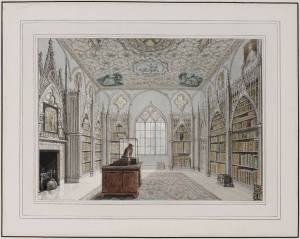
Library at Strawberry Hill
The Lewis Walpole Library offers short-term residential fellowships and travel grants to support research in the Library’s rich collections of eighteenth-century–mainly British–materials, including important holdings of prints, drawings, manuscripts, rare books, and paintings, as well as a growing collection of sources for the study of New England Native Americans.
Scholars undertaking post-doctoral or equivalent research, and doctoral candidates at work on a dissertation, are encouraged to apply. Recipients are expected to be in residence at the Library, to be free of other significant professional obligations during their stay, and to focus their research on the Lewis Walpole Library’s collections. Fellows also have access to additional resources at Yale, including those in the Sterling Memorial Library, the Beinecke Rare Book and Manuscript Library, and the Yale Center for British Art.
Lewis Walpole Library fellowships, usually for one month, include the cost of travel to and from Farmington, accommodation in an eighteenth-century house on the Library’s campus, and a living allowance stipend (now $2,000). The Library’s travel grants typically cover transportation costs for research trips of shorter duration and also include accommodation on site.
To apply for a fellowship or travel grant, candidates should send a curriculum vitae, including educational background, professional experience and publications, and a brief outline of the research proposal (not to exceed three pages) to:
Margaret K. Powell
W.S. Lewis Librarian and Executive Director
The Lewis Walpole Library
P.O. Box 1408
Farmington, CT 06034 — USA
Fax: 860-677-6369
While application materials may initially be submitted electronically, a hard copy is required for the application to be considered complete. Two confidential letters of recommendation are also required by the application deadline. Letters of recommendation should specifically address the merits of the candidate’s project and application for the Lewis Walpole Library fellowship. General letters of recommendation or dossier letters are not appropriate. The application deadline for the 2010-2011 Fellowships is January 18, 2010. Awards will be announced in March.
Call for Submissions: Graduate Students Writing Visual Studies
Call for Submissions: Visual Studies Reader, Written Entirely by Graduate Students
The first fully collaborative, student-run publication on visual studies
All submissions due by 30 January 2010
 The visual world is changing so fast that no conventional anthology can capture it. Our idea is to record the current shape of visual studies, across disciplines, as it is experienced by the upcoming generation of scholars and artists. We are gathering a group of about 100 authors. After we have completed a rough draft of the book, we will post the entire manuscript on our Wiki, and allow everyone on the internet to suggest changes, Wikipedia-fashion. All grad students are eligible; if you are studying for an MA, MFA, or PhD, or if you received your PhD in the last six months, you can contribute texts to this book.
The book is international and collaborative. It began with a group of students at the School of the Art Institute of Chicago, and now it includes about thirty students from 20 institutions around the world. Have a look at our Table of Contents to see how the book is developing. As the book grows, so does the community of editors. Everyone who joins the Reader can make suggestions about everyone else’s contributions: you will have final say over your own contribution, but you’ll also be involved in conversations with all the other participants.
After a further year of editing, in 2012, the entire book will be published by Routledge, and advertised and disseminated internationally. To apply, visit the wiki for full information:
and then send us a two-page description of what you’d like to contribute. Your proposal will be read by the grad-student authors who are currently in the project (the editor, Jim Elkins, doesn’t vote). Full instructions are on the wiki:










3 comments