Decorative Arts Trust, Research Grant Recipients, 2025
From The Decorative Arts Trust:
In 2025, the Decorative Arts Trust celebrates another record-breaking year for our Research Grants program, with 16 recipients receiving travel funding to study objects and archival records.
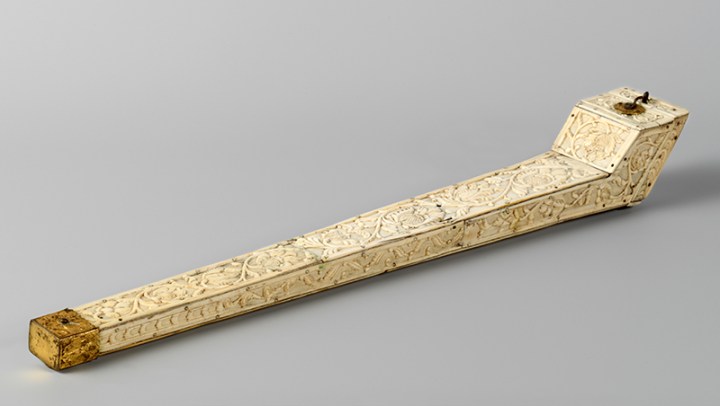
Nur’Ain Taha is studying ivory pipe cases. Pictured: Pipe case from Ceylon, 1799–1825, Sri Lanka, ivory, tropical wood, copper (Amsterdam: Rijksmuseum, NG-453).
The Trust congratulates the 2025 Research Grant recipients:
• Carson L. Beauman, MA Student, Georgia Southern University, the curriculum of Boston schools run by women, 17th–18th centuries
• Anna Flinchbaugh, PhD student, University of Southern California, embroidery’s intersection of craft and industry in the Britain and the United States, late 19th–early 20th centuries
• Kathryn Griffith, PhD student, University of Southern California, Italian goldwork in textiles and the decorative arts, 15th–16th centuries
• Julia LaPlaca, PhD student, University of Michigan, tapestries in European altar environments, 14th–16th centuries
• Jasper Martens, PhD student, University of California Santa Barbara, Netherlandish portrait miniatures with translucent mica overlays, mid-17th century (The Decorative Arts Society of Orange County Grant)
• Fiona Owens, MA student, Winterthur Program in American Material Culture, University of Delaware, the framing of Pre-Raphaelite artist Mary Macomber’s paintings, late 19th century (The Marie Zimmermann Grant)
• Emma Piercy-Wright, PhD student, University of Exeter, mother-of-pearl in French decorative arts, late 17th–early 19th centuries
• Sarah Rapoport, PhD student, Yale University, French transfer-printed ceramics, late 19th century
• Servane Rodie-Dumon, PhD student, Universite d’Artois, the career of French architect-decorator Émile Peyre, late 19th century
• Joseph Semkiu, PhD student, University of Southern California, materiality of radio chassis, mid-20th century
• Arielle Suskin, PhD student, Case Western Reserve University, Roman figural balsamaria, 3rd century BCE – 3rd century CE
• Nur’Ain Taha, PhD student, Utrecht University, ivory pipe cases that connect the early Dutch Republic and Ceylon, 17th century
• Ashley Vernon, MA student, Winterthur Program in American Material Culture, University of Delaware, ‘paper home’ collages crafted by women, late 19th century
• John White, PhD student, Princeton University, walrus and narwhal ivory in Germanic decorative arts, 15th–17th centuries
• Natalie Wright, PhD student, University of Wisconsin-Madison, The Functional Fashions Line of the Clothing Research and Development Foundation, late 20th century
• Rebecca Yuste, PhD student, Columbia University, the importation of Neoclassical style to New Spain, late 18th century
The application deadline for Research Grants is April 30 annually. For more information on grants and scholarships from the Decorative Arts Trust, read about our Emerging Scholars Program, generously supported by Trust members and donors. For deadline reminders, sign up for our e-newsletter and follow us on Facebook and Instagram. The deadline for institutions to apply for the 2025 Prize for Excellence and Innovation is approaching on June 30.
Study Course | Drawings in Theory and Practice
From ArtHist.net:
Drawings in Theory and Practice: Connoisseurship – Collecting – Curatorial Practice
Albertina, Vienna, 28 July — 1 August 2025
Applications due by 6 June 2025
We are pleased to announce the Albertina’s 7th annual study course on drawings. The course is designed for doctoral students and early post-doc-researchers who are working in the field of drawings and prints and are interested in exploring curatorial practices. The course offers the opportunity to discuss current research on the graphic arts and, at the same time, to gain insight into one of the most renowned collections of prints and drawings. The course is organized jointly by the Institute of Art History at the University of Vienna and the Albertina and is generously supported by the Wolfgang Ratjen Foundation.
Participants are expected to present aspects of their current research in a 30-minute paper. Together we will discuss relevant drawings in the Albertina and gain insight into different curatorial practices: conception and planning of exhibitions, publication of catalogues, conservation and marketing, collecting and provenance research. Accommodation in Vienna will be covered as well as documented travel costs (economy flight, 2nd class train ticket) up to 350 Euros. The general course language is English, while individual papers can be presented in German, Italian, and French. The course is directed by Univ.-Prof. Dr. Sebastian Schütze and Dr. Christof Metzger.
Applications—including a cv, short description of the drawing or print related research project, and a reference letter from a university professor—should be sent by 6 June 2025 to Dr. Silvia Tammaro, silvia.tammaro@univie.ac.at. Applicants will be notified by 15 June 2025.
Graduate Student Seminar | Caricature and the Grotesque
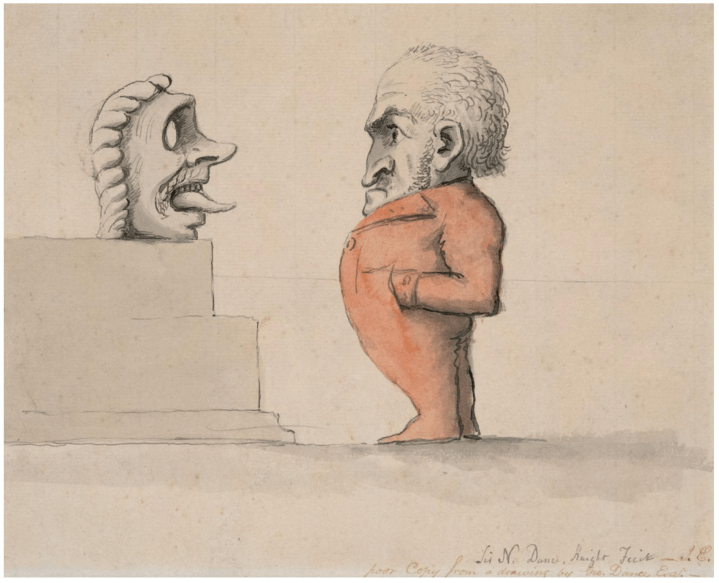
Nathaniel Dance, The Antiquarian, ca.1800, pen, ink, and watercolor.
◊ ◊ ◊ ◊ ◊
The application form is available here:
Caricature and the Grotesque: Early Modern Prints and Politics
Graduate Student Seminar led by Peter Parshall, with Cynthia Roman and Freyda Spira
The Lewis Walpole Library and Yale University Art Gallery, 21–22 May 2025
Applications accepted until 12 May 2025 (with rolling acceptance)
Distortion takes many different forms and plays a role in all artistic traditions. In one sense or another the pictorial response to the world has always shown an inclination to turn things inside out. Our task in this two-day graduate seminar will be to consider this phenomenon as it evolves in the graphic arts from the Renaissance into the early nineteenth century. In this admittedly broad setting we shall concentrate specifically on the use of distortion in political and social contexts, especially in printmaking where the wide and efficient distribution of texts and pictures first became possible. How does the use of caricature, satire, and the grotesque inflect the message of an image? What lies behind its preference for the artist and its appeal to the viewer? Does a potentially ‘popular’ medium like printing inevitably lead to the embrace of the grotesque and a conscious degradation of pictorial rhetoric?
We shall approach these questions through a discussion of original works of art, primarily works available in the Yale University Art Gallery and the Lewis Walpole Library. The main areas of study will be: Renaissance prints and the transformation of the grotesque; the invention of modern caricature with particular attention to anti-Semitism; the flourishing of British caricature in the eighteenth century; William Hogarth and social satire as political argument; and last, Francisco Goya and the relation between realism and fantasy. There will be short readings for each of four sessions held over two consecutive days. The emphasis will be on group discussion conducted as an open forum and inviting all manner of inquiry pertinent to the questions being addressed and the objects at hand.
With space limited to 10 participants, this program is open by application. Applications will be reviewed and successful applicants notified on a rolling basis until 12 May 2025, or until enrollment is filled. This seminar is sponsored by the Lewis Walpole Library, Yale University. Please contact cynthia.roman@yale.edu with questions.
• Peter Parshall, former Jane Neuberger Goodsell Professor of Art and Humanities at Reed College and Curator of Old Master Prints at the National Gallery of Art
• Cynthia Roman, Curator of Prints, Drawings, and Paintings, the Lewis Walpole Library, Yale University
• Freyda Spira, Robert L. Solley Curator of Prints and Drawings, Yale University Art Gallery
Peter Parshall has written and lectured widely on early modern art with special emphasis on the history of prints, the history and the organization of collecting, and Renaissance art theory. He co-authored with David Landau The Renaissance Print (1994), recipient of the Mitchell Prize. Among exhibitions curated are: The Unfinished Print (2001); Origins of European Printmaking (2005) with Rainer Schoch; and The Darker Side of Light: Arts of Privacy, 1850–1900 (2008). Since formal retirement he has pursued several topics of current interest and is presently writing a book on art and politics.
AHRC Studentship | Netherlandish Networks: Home-making, 1565–1799
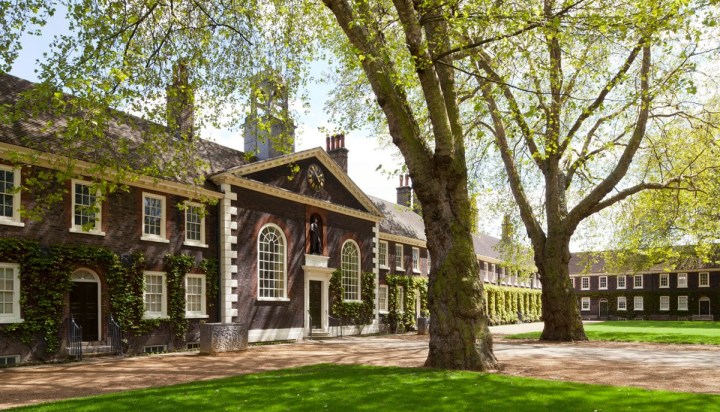
The Museum of the Home is located in almshouses, built in 1714, in Hoxton, East London.
◊ ◊ ◊ ◊ ◊
From the project description:
Netherlandish Networks:
Home-making in an Age of Emerging Global Capitalism, 1565–1799
AHRC Doctoral Studentship, Open University with the Museum of the Home and Queen Mary, University of London
Applications due by 7 April 2025
We are delighted to invite applications from students for a PhD Studentship in the Department of Art History at the Open University funded by the Arts and Humanities Research Council in partnership with the Museum of the Home (London) and the Centre for the Studies of Home at Queen Mary, University of London.
The project will explore the hidden histories behind a set of early modern objects belonging to the Museum of the Home, including a Flemish tapestry, Delftware, Chinese porcelain, japanned furniture, and items inlaid with rosewood. These diverse objects all share one quality: a relationship to the Netherlandish maritime trading networks (‘Netherlandish’ here refers to the profoundly entwined economies and cultures of what is roughly now Belgium and Holland). These Netherlandish networks spanned the globe but at their centre lay the cities of Amsterdam and Antwerp, not least because their Sephardic Jewish communities facilitated otherwise difficult trading connections between Northern Europe and the extensive Spanish and Portuguese Empires. London and the emerging British Empire relied heavily on these Netherlandish networks, especially across the sixteenth and seventeenth centuries. Crucially, these networks allowed for the circulation of religious and other refugees, merchants, skilled craftworkers, and enslaved people as well as materials like tropical hardwoods, objects like ceramics, clocks, and metalwork, and types of design that were then copied locally.
Key Research Questions
• What are the most efficient ways of mapping the many and complex journeys behind the interior fittings and furnishings that constituted home-making in early modern England as it became part of a global economy that, in turn, rested on colonialism and enslavement?
• How were early modern homes made in and through objects—so visually, spatially and materially—in relation to two overlapping immigrant communities (Sephardic Jews and Netherlanders)?
• To what extent were homes made in temporary lodgings such as boarding-houses or through public spaces such as churches or synagogues? In this process, how were objects mobilised in ritual and less formal behaviour?
• How can objects best be used to instantiate specific social histories about immigration, colonialism, and enslavement?
• What broader historical, curatorial, and art-historical methodologies may be developed from studying objects with hidden histories?
As part of the studentship, the successful candidate will be expected to spend significant periods of time with the collections at the Museum of the Home in east London. Research will also be undertaken at relevant archives across London, including the National Archives at Kew, which holds an extensive range of port books recording merchant shipping into most English ports from between 1565 and 1799.
The candidate will be co-supervised between the Open University and the Museum of the Home. Professor Clare Taylor and Dr Margit Thøfner, from the Department of Art History will supervise from the Open University, and Ailsa Hendry, Collections Manager and Lara Baclig, Community Producer, will supervise on behalf of the Museum of the Home.
Clare Taylor is a specialist in early modern interiors, material culture, and design. She has been lead supervisor for a number of Collaborative Doctoral Awards, including with the National Trust, the National Railway Museum, and the Sanderson archive. Margit Thøfner specialises in Netherlandish art, visual and material culture from the sixteenth and seventeenth centuries. Ailsa Hendry’s experience stretches across collections care and curation and she has worked on many projects exploring early modern European history. Lara Baclig specialises in community engagement and decolonial practice in collecting and displays.
More information is available here»
Call for Applications | PhD Thesis on Spain and Ibero-America
From the Call for Expression of Interest, with the French version available here:
Doctoral Thesis on the History of Art and Visual Studies
Spain and Ibero-America, particularly New Spain, ca. 1650–1870
Directed by Tomas Macsotay and Émilie Roffidal
Applications due by 11 April 2025
This call is addressed to students wishing to prepare a doctoral thesis on aspects of the history of art and visual studies in Spain and Ibero-America, particularly New Spain, ca. 1650–1870. We will support the candidate in the preparation of a thesis proposal to be submitted in France. If the proposal is accepted, the candidate will benefit from the collaboration of two art history departments in Spain and France, enabling him or her to obtain a European doctorate.
p o s s i b l e t o p i c s
1 Artistic Academies in the Ibero-American Space
• Exchanges with Italy and France, artistic models
• Interpersonal and inter-institutional networks
• The relationship between the fine arts and the applied arts, in particular with the luxury and semi-luxury market; the role of the Juntaso de Commercio and Sociedades económicas de amigos del país
• The circulation of theoretical and archaeological knowledge
• Local heritage and the movement to create a Spanish artistic identity (casticismo, cultura andaluza)
2 Religious Art in Ibero-America
• Ecclesiastical interiors, furnishings, and religious sculpture as embodiments of the transformation of religious practice
• Text-image relationships, in particular through the study of printed sermons and panegyrics
• Relationships between ‘Baroque’ art and ‘neoclassicism’, between devotion in the private and public spheres
• The question of regional models and neoclassical reform (particularly neoclassicism in Madrid and Valencia)
• The place of antiquity in the vocabulary of forms
3 The Journey to Spain, published and unpublished
• Travelogues as an expression of the reception of Spanish art
• The reception of art (perception, intertextuality, and narrativity in commentaries on monuments and works of art)
• The journey as a search for a common artistic repertoire versus local identity
4 Engraving in the Ibero-American Space
• The use of engraving to show a diversity of images: landscapes, religious and/or political ceremonies, works of art, the population, everyday life, etc.
• Links between the real and the imaginary (compositions, recompositions, etc.)
• The question of violence, revolt, and upheaval
• Engravers and the image market
Candidates must have sufficient communication skills in French and Spanish (C1 or at least B2 levels). To apply, please send a cover letter, a thesis proposal on one of the proposed themes (3,000–6,000 characters), and a transcript of Master’s result list. Successful candidates will receive support in preparing their application for a doctoral contract (funded thesis) and in writing their final thesis proposal.
Directors
• Tomas Macsotay, associate professor, Pompeu Fabra University, tomas.macsotay@upf.edu
• Émilie Roffidal, senior researcher, Centre National de la Recherche Scientifique (FRAMESPA laboratory, UMR 5136, Toulouse), emilie.roffidal@univ-tlse2.fr
Morgan Library & Museum Seminar | Drawing Nature, 1500–1900
The Morgan presents this day-long seminar for graduate students:
Drawing Nature, 1500–1900
The Morgan Library & Museum, New York, Friday, 4 April 2025
Proposals due by 21 February 2025
Led by Sarah Mallory, Assistant Curator of Drawings and Prints at the Morgan; Olivia Dill, Moore Curatorial Fellow at the Morgan; and Roberta J. M. Olson, Curator of Drawings Emerita at The New York Historical
European and North American Natural History drawings made before 1900 are historically understood as either works of fine art or as scientific records. The Morgan Library & Museum’s significant collection of natural history drawings, however, provides an opportunity to rethink longstanding divisions between the arts and sciences. This seminar will focus on collection holdings made by artists working in The Netherlands, Germany, England, France, and the Americas, from ca. 1450 to ca. 1850. Participants will have the opportunity to closely examine a large selection of works by Maria Sibylla Merian, Mark Catesby, Madeleine Françoise Basseporte, Georg Dionysius Ehret, John James Audubon, and many others. Lively discussions will address the production and subsequent uses of natural history drawings, including the ways in which techniques of observation and scientific developments informed drawing praxis. Key too will be instances in which artistic practice conditioned the production of empirical knowledge. We will also consider how gender, patronage, collecting practices, and colonial expansion inform natural history drawings.
This seminar is open to graduate students of the history of art, the history of science, and related fields, and also to graduate students interested in the conservation of works on paper. Applicants are kindly invited to submit a one paragraph statement which should include the following:
• Name and email
• Academic institution
• Class year
• Field of study
• Interest in natural history drawings and relevance of the seminar to your research
Applications should be submitted electronically with the subject header ‘Drawing Nature Seminar’ to drawinginstitute@themorgan.org by 21 February 2025. Participants will be notified by March 4.
Call for Applications | Chinese Object Study Workshops, 2025
From ArtHist.net:
Materials and Methods in Chinese Calligraphy
University of Michigan Museum of Art, Ann Arbor, 9–13 June 2025
On Jewelness: Buddhist Materiality in Sino-Himalayan Art, 1400–1800s
Asian Art Museum of San Francisco, 18–22 August 2025
Applications due by 3 March 2025
An essential element in the training of art historians and curators is object-based learning in an immersive and supportive museum environment. This hands-on experience is critically important to scholars’ developing skills in close observation, connoisseurship, and art historical and conservation analysis. The China Objects Study Workshop—currently administered by the National Museum of Asian Art and starting 2025 the University of Michigan Museum of Art—is designed to cultivate a sensitivity to the importance of objects and a holistic understanding of art that can only be achieved through in-person examination. The workshops, occurring twice yearly, provide selected graduate students in the field of pre modern Chinese art history with an immersive experience in the study of objects through a week-long intensive session at rotating North American museums. During the week the students also develop insights into museum operations and practices as well as working relationships that can advance scholarly exchange and enduring professional connections.
The program is funded by the Kingfisher Foundation and administered by the University of Michigan Museum of Art. The program is open to graduate students enrolled in, or accepted to, a PhD program in the field of Chinese art history at a North American or European university. Graduate students from other art history–related programs and/or who are working closely with Chinese art objects are welcome to apply as well. Applicants may be of any nationality and may apply for more than one workshop. Housing, most meals, and a transportation stipend will be provided for each participant.
Students are welcome to apply for both workshops in a single application, addressing their background and interest in each workshop in separate application statements. One recommendation letter for the two workshop topics is sufficient. The application deadline is March 3, and decisions will be announced by March 31. To apply, please visit the link here.
The two following workshops are offered in 2025:
Materials and Methods in Chinese Calligraphy
University of Michigan Museum of Art, Ann Arbor, 9–13 June 2025
This workshop aims to engage participants in an immersive study of the materials, tools, and techniques used in writing and researching calligraphy. Participants will closely examine a rich collection of Chinese calligraphy from the Lo Chia-Lun Collection of Chinese Calligraphy at the University of Michigan Museum of Art in Ann Arbor, MI, alongside pieces from the museum’s longstanding collection of Chinese art. The workshop will cover all aspects of calligraphy as an art object as well as the writing process and methods. This includes materials and techniques for writing and mounting, seal placement, and para-matter and content (such as frontispiece, signature, colophon, etc.). Through the practice of close looking and group discussion in front of the pieces, the workshop helps participants understand the formation of styles and modes of display and reception. In doing so, the workshop encourages participants to master the skills necessary for researching any given piece of calligraphy within a historical context and to explore new possibilities for establishing research methodologies that expand the study of Chinese art history as a holistic field.
Workshop Leaders
• Lihong Liu, University of Michigan
• Qianshen Bai, Zhejiang University
• Natsu Oyobe, University of Michigan Museum of Art
On Jewelness: Buddhist Materiality in Sino-Himalayan Art, 1400–1800s
Asian Art Museum of San Francisco, 18–22 August 2025
Jewels are a ubiquitous presence in Buddhist literary and material culture. From the Three Jewels of Buddhism to the visual and material instantiation of the wish-fulfilling jewel, the frequent appearance of jewels as metaphor and material inspires cross-disciplinary inquiries into Buddhist world-making. How might a close study of objects shed new light on jewelness in Buddhist discourse and visual culture? This workshop explores the theme of jewelness through a selection of Sino-Himalayan objects in the collection of the Asian Art Museum of San Francisco. Drawing on Buddhist objects from the 14th to the 19th centuries that highlight the connection between China and the Himalayas, the workshop will offer students the hands-on opportunity to study a range of media. They include stone carvings, glazed ceramics, glass, bronze images, precious stone inlays, illuminated manuscripts, relics and reliquaries, sculptures in dry lacquer and wood, as well as pigments and painted representations. Topics to be explored include luster, luminescence, and translucency; related ritual and technological processes; history of transcultural exchanges; broader aesthetics of opulence and splendor in Chinese and Tibetan Buddhism; and the dialectics of transparency and opacity, concealment and revelation.
Workshop Leaders
• Wen-shing Chou, Hunter College & The Graduate Center, CUNY
• Ellen Huang, ArtCenter College of Design
• Jeffrey S. Durham, Asian Art Museum of San Francisco
Burlington Magazine Scholarship | French 18th-Century Art
From The Burlington:
The Burlington Magazine Scholarship | French 18th-Century Fine and Decorative Art
Applications due by 30 March 2025
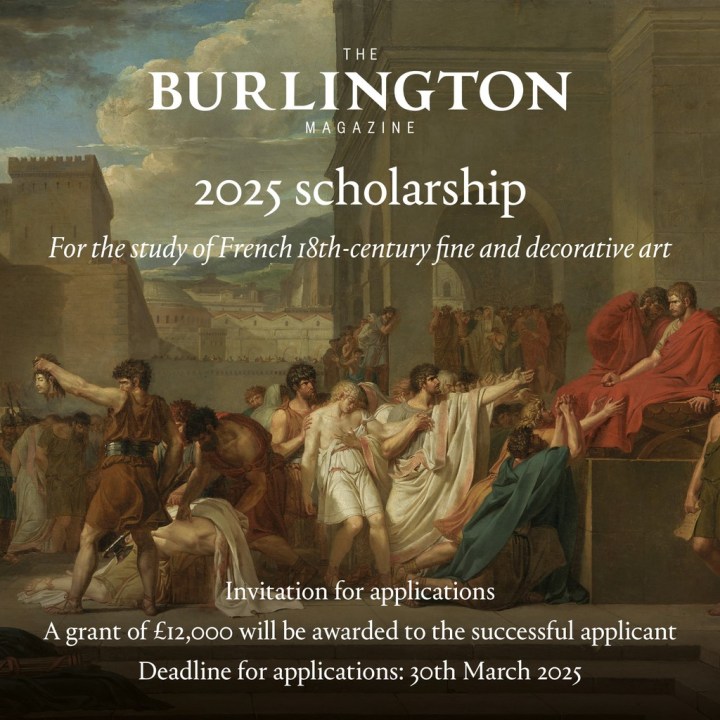 Applicants must be studying, or intending to study, for an MA, PhD, post-doctoral or independent research in the field of French 18th-century fine and decorative arts within the 12-month period the funding is given. The start date of successful applications should be at the beginning of the academic year (generally September). Earlier start dates will be considered for independent scholars or post-doctoral research. The funding is open to UK and international applicants. Research funded by this scholarship may lead to the submission of articles for publication in the Magazine: as such, the panel are looking for object related research, of the kind that the Burlington publishes.
To apply, please send your CV, description of project/research (no longer than 2 pages of A4), budget, proof of Institution you are attending/will attend to: scholarship@burlington.org.uk. Applications must be sent in PDF or Word document (.docx) format. Applications can only be submitted via email by 30 March 2025. The successful applicant will be notified by 31 May 2025.
Call for Applications | Baroque Summer Course: Death
From ArtHist.net:
Baroque — Death / Barock — Tod
24th Baroque Summer Course, Bibliothek Werner Oechslin, Einsiedeln, Switzerland, 22–26 June 2025
Organized by Anja Buschow Oechslin, Axel Christoph Gampp, and Werner Oechslin
Applications due by 23 February 2025
Death is omnipresent. No one can escape it; it is among us and goes about its business as it sees fit. If one takes seriously the “memento mori” that we encounter in droves on tombstones and that is addressed to us, the (still) living, then one can see that this commingling of life and death is of central importance to human culture and has always had a significant impact on its art forms.
This ubiquity and omnipresence of death was summed up in the long-popular Dance of Death: “we all die” according to the biblical saying “Omnes Morimur.” Patritius Wasserburger put this into verse for Count Sporck as “Zuschrift an das sämmtlich-menschliche Geschlecht” (“Letter to the whole human race”):
“You popes! Cardinals!
You bishops! You abbots!
You lappeted gentlemen!
You canons! You prelates!
All manner of priests,
Of high dignity, and also of lower rank. […]”
He records them all, even the “drunkards”:
“Oh you brothers of the wet stream!
Guzzle, dance, sing songs!
You are wild and tipsy, jolly: bluster, sleep around, shack up, rave!
Go on, twirl, feast, roister!
But: woe for eternity.”
Michael Heinrich Rentz illustrated this in his dramatic images and emphasized the direct partnership—and equality—of man and death. The series of images, first printed in 1753, was realized as a perfect baroque book, “full of meaning, instruction, and spirit.” And we are already amid the exuberant baroque pleasure in shaping and designing. Baroque rhetoric, with its astute precepts of “argutezza” or even “cavillatio,” takes particular pleasure in the boundaries, in the contact between life and death. Nothing is alien to this and the desire to transcend such boundaries fires the imagination. In 1774, the Archbishop and Elector of Mainz, who had been blessed with the “temporal right of sovereignty,” was mourned accordingly: “The tombstones may restrict his generous hands, but his heart allows no limits to be set, such as to work immortally in faithfulness to God, thus in love for his needy people.” After the “passing away,” as if only a small disturbance had occurred, it is all about the “denatus”; he has merely changed his condition—for the better, of course.
Glorification of human deeds in light of the future life after death, as the motto of the Duke of Brauschweig, Johann Friedrich, says: EX DURIS GLORIA. The separation through death is followed by reflection and the gain of a “better life.” Death is given this powerful, dialectical function of the historical continuation of “lived reality” by virtue of idealization. It challenges all the arts and the artifices of rhetoric, which “mediate” in all possible tones of a “heroic poem” in an “Imitatio Epica,” whether allegory, or panegyric or in the “Epicedium” particularly assigned to funeral ceremonies.
Those who focus so much on the afterlife, as was the case in the Baroque ecclesiastical world in the most pronounced way, have before their eyes all the glory that is emulated in this world with the greatest artistic effort in order to convey it to people and their sensory perceptions. This is what led someone like Karl Wilhelm Ferdinand Solger to recommend: “He who cannot reach God in his spirit should seek him in images, he will not be led astray.” To “draw God down into his sphere” was the motto and it fit best precisely where the scene is changed, as it were, with death. Friedrich Wilhelm Schelling saw it correctly: “This symbolic view is the church as a living work of art.” And there is more, something fundamental, hidden behind this paradigm of human destiny and the conditions of privileged human existence. Marsilio Ficino states this in the first sentences of his “Cristiana religione” (1474/5). If man could not distinguish between good and bad in the “lume dell’intellecto,” he would be the most miserable creature, as he, unlike other living creatures, also has to dress himself. And at the beginning of “Platonica Theologia” (1482), he formulates its essence: “Si animus non esset immortalis: nullum animal esset infelicius homine.”
Art draws its deeper justification from this and declares that no effort is too great for it, especially when it comes to the furnishings for funeral ceremonies, when entire church interiors are covered with allegorical scenes and high catafalques are erected. The unsurpassable dialectic of life and death calls for the greatest artistic invention, which is particularly desirable in “baroque” times and results in works of art that would give even someone like Wölfflin a headache. When Rudolf Wittkower opened the Guarini Congress in Turin in 1968, he had a whole repertoire of “unorthodox” forms at hand: “Paradossi ed apparenti contraddizioni, volute incongruenze”; it is much more than just “varietà” and—in the tradition of Nicholas of Cusa—also encompasses mathematics: “Famose (!) compenetrazioni di spazi diversi.” He observes the juxtaposition of “morbidi moduli ornamentali manieristici” and “forme cristalline di estrema austerità.” They are “prodigi strutturali.” And Wittkower’s insight was: “intelletto” and “emozione” are not separate, but belong together, just as—in art—life and death appear intertwined and death, if man takes his divinely inspired, spiritual life seriously, is ultimately only a gateway to another world. It is understandable that a cemetery is then described as “the Elysian Fields.” There are no limits to the imagination and to art.
The course is open to doctoral candidates as well as junior and senior scholars who wish to address the topic with short papers (20 minutes) and through mutual conversation. As usual, the course has an interdisciplinary orientation. We hope for lively participation from the disciplines of art and architectural history, but also from scholars of history, theology, theatre and other relevant fields. Papers may be presented in German, French, Italian or English; at least a passive knowledge of German is a requirement for participation. The Foundation assumes the hotel costs for course participants, as well as several group dinners. Travel costs cannot be reimbursed. Please send applications with brief abstracts and brief CVs by email to: anja.buschow@bibliothek-oechslin.ch. The deadline is 23 February 2025.
Concept / Organization: Dr. Anja Buschow Oechslin (Einsiedeln), Prof. Dr. Axel Christoph Gampp (Uni Basel, Fachhochschule Bern), Prof. Dr. Werner Oechslin (Einsiedeln)
Preservation Long Island Receives Curatorial Internship Grant
From the press release (18 November 2024). . .
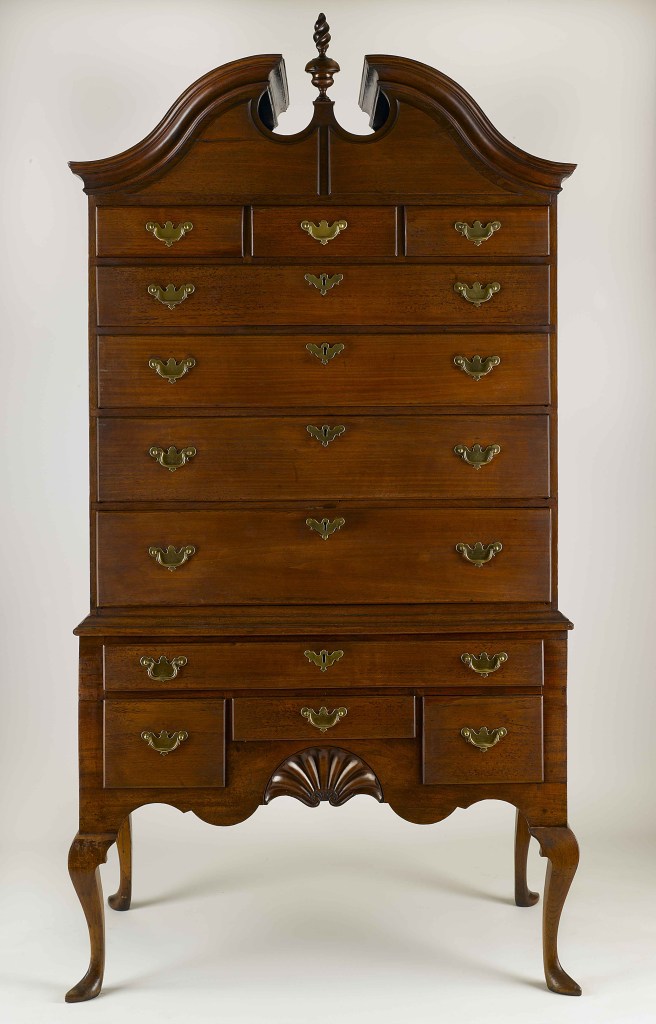
High chest of drawers, Queens County, New York, 1740–70, walnut, tulip poplar, pine (Preservation Long Island purchase, 1961.13.1).
The Decorative Arts Trust is thrilled to announce that Preservation Long Island (PLI) is the recipient of the 2025–27 Curatorial Internship Grant. Headquartered in Cold Spring Harbor, New York, PLI was founded in 1948 as the Society for the Preservation of Long Island Antiquities. PLI advances the importance of historic preservation in the region through advocacy, education, and stewardship. Their program areas include interpreting historic sites, collecting art and material culture pertaining to Long Island history, creating publications and exhibitions, and providing direct support and technical assistance to individuals and groups engaged in local preservation efforts.
In 2026, PLI will celebrate the United States Semiquincentennial as well as the 50th anniversary of their landmark furniture publication, Long Island is My Nation: The Decorative Arts and Craftsmen, 1640–1830. PLI’s Peggy N. Gerry Curatorial Fellow will collaborate with Chief Curator & Director of Collections Lauren Brincat on a series of objectives aimed at cataloging Long Island furniture in public and private collections across the region, reexamining these objects from new perspectives, and enhancing their accessibility to 21st-century researchers and the public. The Fellow will take a leading role in a new initiative building upon previous scholarship towards the creation of a collaborative Long Island furniture digital database, an exhibition, and an accompanying catalogue. Also, the Fellow will coordinate and participate in a Long Island furniture symposium in summer 2025. PLI will post the Peggy N. Gerry Curatorial Fellow position on their website at preservationlongisland.org in spring 2025. For more information about Curatorial Internship Grants, visit decorativeartstrust.org/cig.










 Enfilade
leave a comment