SAAM Fellowships for American Art History
From the Smithsonian American Art Museum:
The Smithsonian American Art Museum and its Renwick Gallery invite applications for its 2025–26 research fellowships, awarded through the Smithsonian Institution Fellowship Program (SIFP). Residencies are available at the graduate, doctoral, postdoctoral, and senior levels. The deadline to apply is October 15.
Scholars from any discipline who are researching topics relating to U.S. art, craft, and visual culture are encouraged to apply, as are those who foreground new perspectives, materials, and methodologies. Fellowships are residential and support full-time research. SAAM is devoted to advancing inclusive excellence in art history and encourages candidates who identify as members of historically underrepresented groups to apply.
The stipend for a twelve-month SIFP fellowship is $45,000 for predoctoral scholars and $57,000 for postdoctoral and senior scholars, with a supplemental research allowance of up to $5,000. Applicants who need less time to complete their research may apply for as few as three months with a prorated stipend. Residencies should take place between 1 June 2025 and 31 August 2026.
SIFP graduate student fellowships are available for ten-week summer terms and carry a stipend of $10,000.
To learn more and apply, click here. With additional questions or for research consultation, email SAAMFellowships@si.edu.
Call for Articles | Sequitur (Fall 2024): Beyond the Veil
From:
Sequitur 11.1 (Fall 2024): Beyond the Veil
Submissions and proposals due by 27 September 2024, for January 2025 publication
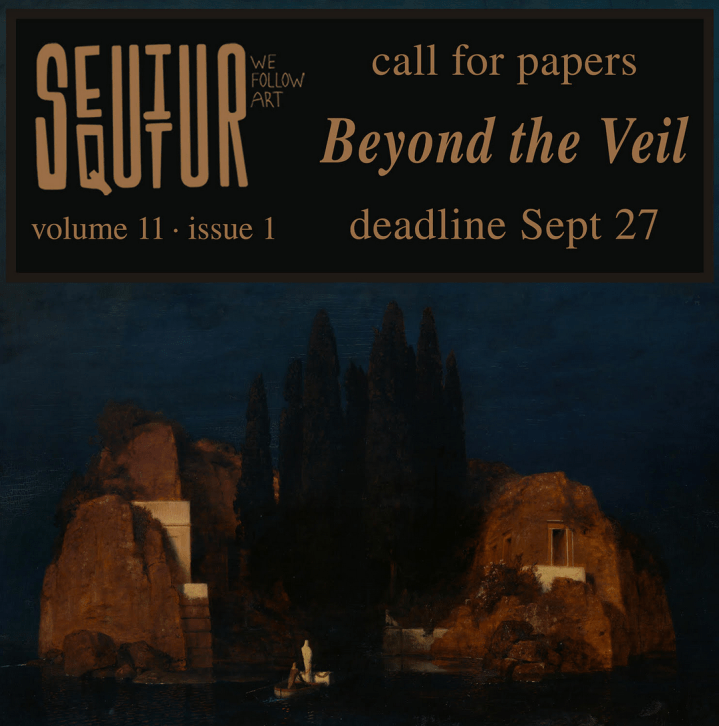
Arnold Böcklin, Island of the Dead, 1880, oil on wood, 29 × 48 inches (New York: The Metropolitan Museum of Art, 26.90).
The editors of SEQUITUR, the graduate student journal published by the Department of History of Art & Architecture at Boston University, invite current and recent MA, MFA, and PhD students to submit content on the theme of Beyond the Veil for our Fall 2024 issue. This issue invites an exploration of the unseen, the unknown, and the realms that lie out of reach of ordinary or earthly perception. What other worlds exist beyond death, within our minds, under the surface, or in the shadows?
Artists have used every medium at their disposal to imagine what these other worlds might look like, going so far as to employ symbolism, abstraction, and surrealism to grapple with the otherworldly. Ritualistic items, religious artifacts, and funerary objects serve as tangible links to the spiritual and the supernatural. On a larger scale, architectural elements like arches, portals, and windows invite us into holy spaces to seek sanctuary or guide transitions from life to death and back again. In this issue, we aim to gather scholarship that focuses on topics beyond the ordinary that consider the myriad ways in which humanity has envisioned and sought access to the mystical, the transcendent, and the liminal.
Possible subjects may include, but are not limited to:
• Otherworlds: the in-between, separation, the unearthly, seen and unseen, obfuscated, hidden, neither here nor there, out of time, secret spaces
• Transience: the beyond, travel, thresholds, liminal spaces, parallels, interstices, passages, portals, doorways, interfaces, windows, brinks
• Death & resurrection: mourning, memory, farewell, remembrance, burial, necropolis, underworld, afterlife, psychopomp, crossing, sanctuary, heaven, ascension, ceremony, rite, rite of passage, religion, holy, sacrament, celebration, life
• The supernatural: spiritualism, phantasmagoria, spectral, ethereal, occult, fantasy, superstition, internment, surreal
SEQUITUR welcomes submissions from graduate students in the disciplines of art history, architecture, archaeology, fine arts, material culture, visual culture, literary studies, queer and gender studies, disability studies, memory studies, and environmental studies, among others. We encourage submissions that take advantage of the digital format of the journal.
Founded in 2014, SEQUITUR is an online biannual scholarly journal dedicated to addressing events, issues, and ideas in art and architectural history. Edited by graduate students at Boston University, the journal engages with and expands current conversations in the field by promoting the perspectives of graduate students from around the world. It seeks to contribute to existing scholarship by focusing on valuable but often overlooked parts of art and architectural history. Previous issues can be found here.
We invite full submissions in the following categories:
Feature essays (1,500 words)
Content should present original material that falls within the stipulated word limit (1,500 words). Please adhere to the formatting guidelines available here.
Visual and creative essays (250 words, up to 10 works)
We invite MArch and MFA students to showcase a selection of original work in or reproduced in a digital format. We welcome various kinds of creative projects that take advantage of the online format of the journal, such as works that include sound or video. Submissions should consist of a 250-word artist statement and up to 10 works in JPEG, HTML, or MP4 format. All image submissions must be numbered and captioned and should be of good quality and high resolution.
We invite proposals for the following categories (abstracts should be no more than 200 words):
Exhibition reviews (500 words)
We are especially interested in exhibitions currently on display or very recently closed. We typically prioritize reviews of exhibitions in the Massachusetts and New England area.
Book or exhibition catalog reviews (500 words)
We are especially interested in reviews of recently published books and catalogs (1–3 years old).
Interviews (750 words)
Please include documentation of the interviewee’s affirmation that they will participate in an interview with you. Plan to provide either a full written transcript or a recording of the interview (video or audio).
Research spotlights (750 words)
Short summaries of ongoing research written in a more casual format than a feature essay or formal paper. For research spotlights, we typically, but not universally, prioritize doctoral candidates who plan to use this platform to share ongoing dissertation research or work of a comparable scale.
To submit, please send the following materials to sequitur@bu.edu by 27 September 2024:
• Your proposal or submission
• Recent CV
• Brief (50-word) bio
• Your contact information in the body of the email: name, institution and program, year in program, and email
• Subject line: ‘SEQUITUR Fall 2024’ and the type of submission/proposal
Please adhere to the formatting guidelines available here. Text must be in the form of a Word document, and images should be sent as .jpeg files. While we welcome as many images as possible, at least one must be very high resolution and large format. All other creative media should be sent as weblinks, HTML, or MP4 files if submitting video or other multimedia work. Please note that authors are responsible for obtaining all image copyright releases before publication. Authors will be notified of the acceptance of their submission or proposal the week of 7 October 2024 for publication in January 2025. Please contact the editors (sequitur@bu.edu) with any questions.
Fellowship | PhD Position in Architectural History, Trinity College Dublin
From the Call for Applicants, with apologies for the short notice. –CH
PhD Position in Architectural History: Stone in 18th-Century Architecture
Department of the History of Art and Architecture, Trinity College Dublin, starting September 2024
Applications due by 17 July 2024
Applicants are sought for a funded four-year PhD at Trinity College Dublin, commencing in September 2024, on a topic relating to the ERC advanced grant research project STONE-WORK, led by Professor Christine Casey in the Department of History of Art and Architecture. The successful applicant will be based in the School of Histories and Humanities and enrolled in the Structured PhD Programme. The award comprises the student’s PhD tuition fees and an annual stipend of €25,000.
STONE-WORK challenges the perception of architecture as a primarily conceptual activity by shifting focus from individual to collective achievement. Despite the emphatic materiality of architecture, its history remains dominated by a sequential model which privileges the agency of individuals and ideas. STONE-WORK’s fundamental premise is that architecture results from a cumulative sequence of actions involving an array of actors, great and small. Revealing stone’s hidden trajectory from quarry to wall, floor, column, and chimneypiece will probe the nexus of skills, techniques, and support mechanisms developed by communities in its sourcing, supplying, and fashioning, and the impact of these processes upon building activity. This cross-disciplinary research, combining the history of architecture and craft with geology aims to produce a holistic analysis of architecture and stone production.
The project pursues four main objectives:
• Transform knowledge of interdependence in architectural production.
• Develop a cross-disciplinary interface between geology, craft, and architectural history for the analysis of building stone.
• Reconstruct the trade and labour networks of Anglo-Irish stone production to determine how quarrying and stone-working affected the use of stone in eighteenth-century architecture.
• Discover the qualitative standards in materials and techniques which underpinned the handling of stone in eighteenth-century architectural production.
The PhD dissertation will explore the agency of the consumer and maker in the eighteenth-century stone industry by focusing on the chimney-piece industry in Britain and Ireland. This is an under-studied topic rich in surviving data both material and archival.
We are seeking applicants with the following qualifications:
Essential
• A first-class (or equivalent) undergraduate degree or a master’s degree with distinction in the History of Art or History of Architecture
• Excellent communicative competence in English
• Excellent research and organisational skills
• Knowledge of classical architecture in eighteenth-century Britain and Ireland
Desirable
• Demonstrable experience of using archives and working knowledge of eighteenth-century architecture
• Willingness to contribute to the activities of the STONE-WORK research project
Applications for the award must include
• A personal statement (max. 2 pages), including your motivation for applying for this PhD student position
• A curriculum vitae with educational history, including two academic references
• Transcripts of degree results
Prospective students should send these documents to Melanie Hayes at pghishum@tcd.ie by the deadline on the 17th July 2024. The successful candidate will then make a formal application to TCD via the my.tcd.ie portal and be issued with a formal offer in the same manner as other incoming PhD students. Applications will not be considered complete without academic references. Applicants will be notified of the outcome of their application by early August. If the successful candidate does not have English as a first language, s/he will also be required to submit evidence of English language competence at this stage.
Trinity College Dublin is committed to policies, procedures, and practices which do not discriminate on grounds such as gender, civil status, family status, age, disability, race, religious belief, sexual orientation, or membership of the travelling community. On that basis we encourage and welcome talented people from all backgrounds to join our staff and student body. Trinity’s Diversity Statement can be viewed in full here.
Dr Melanie Hayes, Trinity College Dublin, Department of the History of Art and Architecture, College Green, Dublin 2, Ireland, HAYESM7@tcd.ie.
U of Buckingham | MA in French and British Decorative Arts
From the University of Buckingham:
MA in French and British Decorative Arts and Historic Interiors
University of Buckingham (study based in London), starting September 2024
Bursary applications due by 19 July 2024
Applications are invited for a bursary on the University of Buckingham’s MA in Decorative Arts and Historic Interiors starting September 2024. Generously funded by the Leche Trust, the bursary, worth £8,500, will cover just under 78% of the full-time course fees for UK students and just over 50% of the fees for international students. The deadline for bursary applications is Friday, 19 July, 10am GMT. To be eligible for the bursary, students will need to have applied for and been offered a place on the course.
This unique MA in French and British Decorative Arts and Interiors, taught in collaboration with the curatorial and conservation teams at the Wallace Collection, focuses on the development of interiors and decorative arts in England and France in the ‘long’ eighteenth century (c.1660–c.1830) and their subsequent rediscovery and reinterpretation in the nineteenth and twentieth centuries. A key element of the course is the emphasis on the first-hand study of furniture, silver, and ceramics, where possible in the context of historic interiors. Based in central London, it draws upon the outstanding collections of the nearby Wallace Collection and the Victoria and Albert Museum as well as the expertise of leading specialists who participate in the teaching.
Bursary priority will be given to applicants
• with excellent academic qualifications, seeking, or currently pursuing careers in museums, the built heritage or conservation,
• in need of financial assistance,
• have a strong interest in the decorative arts and historic buildings,
• or, for those wishing to go on to pursue academic research in the decorative arts and historic interiors.
The bursary is also open to part-time students commencing their studies in 2024 and for whom the funding would be spread over two years. Find out more here. You also may contact Dr Lindsay Macnaughton lindsay.macnaughton@buckingham.ac.uk and the Admissions Office admissions@buckingham.ac.uk.
AHRC Studentship | The Status of Prints at the British Library
◊ ◊ ◊ ◊ ◊
From Birkbeck:
Re-evaluating the Status of Prints at the British Library
AHRC Collaborative Doctoral Studentship, The British Library and Birkbeck, University of London
Applications due by 29 April 2024
Birkbeck, University of London, and the British Library are pleased to announce the availability of a fully funded Collaborative Doctoral Studentship from 1 October 2024 under the AHRC Collaborative Doctoral Partnership Scheme. The focus of this project is on identifying, researching, and analysing the provenance, changing status, and visibility of about 500 books of prints in the British Library’s collection, using an 1812 unpublished finding list as a starting point. This project will be jointly supervised by Kate Retford at Birkbeck (Professor of History of Art, School of Historical Studies) and Felicity Myrone at the British Library (Lead Curator, Western Prints and Drawings). The student will spend time with both Birkbeck and the British Library and will become part of the wider cohort of AHRC CDP funded PhD students across the UK.
More information and directions for applying are available here»
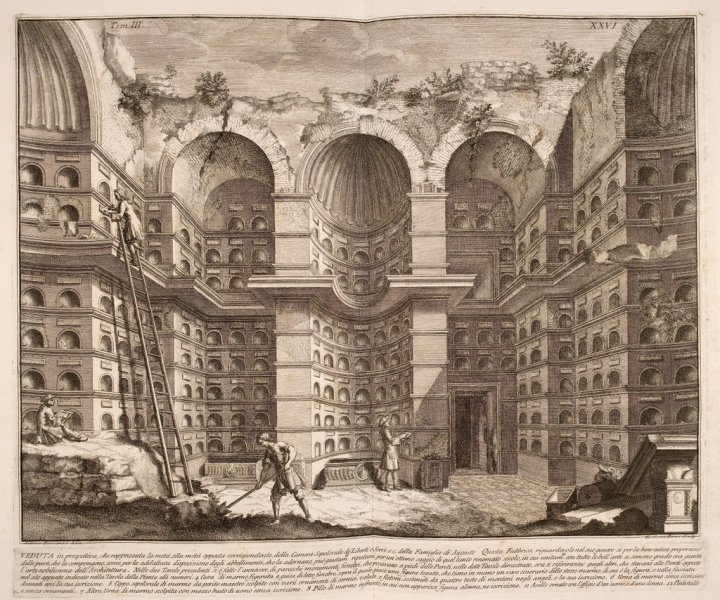
Image: Giovanni Piranesi, Illustration of an aviary, from Le Antichità romane, opera di Giambatista Piranesi, etc. (London: British Library, c13091-59; shelfmark: 744.f.2 26).
Graduate Seminar | Drawing in 18th-C. London
Stacey Sloboda and Meredith Gamer | Drawing in 18th-C. London: Academies and Entrepreneurs
The Morgan Library & Museum, New York, Friday, 19 April 2024, 10.00–4.00
Applications due by 1 March 2024
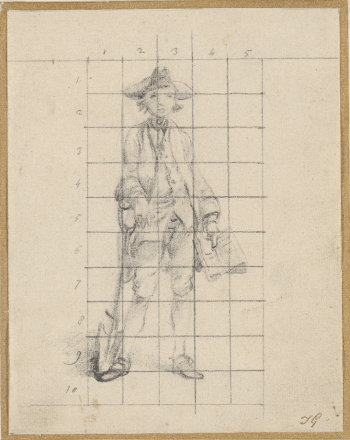
Thomas Gainsborough, A Boy with a Book and a Spade, 1748, graphite with smudging on laid paper; squared for transfer with a numbered grid, 189 × 143mm (New York: The Morgan Library & Museum, III, 59b).
Drawing was at the center of a range of artistic developments in the eighteenth-century London art world. It flourished with the development of drawing academies that culminated in the establishment of the Royal Academy in 1768. It also played a key role in the careers of entrepreneurs such as John Vanderbank, William Hogarth, Thomas Gainsborough, and Thomas Chippendale as the commercial market for printed images increased dramatically in this period. New opportunities for graphic expression encouraged artists and amateurs alike to pursue drawing as a polite and learned activity, and sketching became an increasingly innovative artistic practice. The Morgan Library & Museum has substantive holdings of drawings by British artists from this period, and this seminar offers a chance to study them as a group. Participants in this graduate seminar will engage in lively sessions addressing topics such as drawing academy practice and the use of models, the function of drawings in the studio and workshop, the role of prints, sketching as an artistic practice, and the art market and private patronage.
Stacey Sloboda is the Paul H. Tucker Professor of Art History at UMass, Boston.
Meredith Gamer is Assistant Professor of Art History and Archeology at Columbia University.
This seminar is open to graduate students of the history of art and the conservation of works on paper. Interested participants are kindly invited to submit a one paragraph statement which should include the following:
• Name and email
• Academic institution
• Class year
• Field of study
• Interest in British eighteenth-century drawings and relevance of the seminar to your research
Applications should be submitted electronically with the subject header ‘British Drawings Seminar’ to drawinginstitute@themorgan.org. Participants will be notified by 15 March 2024.
Scholarships | The Aesthetic Inventions of Ecology, ca. 1800
From ArtHist.net:
The Aesthetic Inventions of Ecology around 1800
Doctoral and Post-Doctoral Scholarships
Johannes Gutenberg-Universität Mainz, 1 October 2024 — 30 September 2027
Applications due by 15 May 2024
Johannes Gutenberg University Mainz announces the following scholarships within the framework of the new Mini Graduate College (MGRK), The Aesthetic Inventions of Ecology around 1800 (Die ästhetischen Erfindungen der Ökologie um 1800), funded by the Gutenberg Junior College (GNK):
• 4 doctoral scholarships (m/f/d) with a monthly stipend of EUR 1,550
• 1 postdoctoral scholarship (m/f/d) with a monthly stipend of EUR 1,900
The scholarships are to be filled by 1 October 2024, with a duration of three years. Selection interviews will take place in June 2024.
Requirements
• Excellent university degree (state examination, MEd, MA, or equivalent) in German Studies, English Studies, Art History, Music Theory, or related fields
• An innovative project idea within the research area of MGRK
• Knowledge in the areas of Classicism and Romanticism, as well as in ecological matters
• Interest in interdisciplinary work and team collaboration
• Proficiency in the college’s languages German and English
• Postdoctoral applicants should also present an outstanding dissertation, along with initial presentation and publication activities
Application Documents
• A one to two-page motivational letter explaining the reasons for pursuing the planned doctoral or postdoctoral project, demonstrating expectations from a Mini Graduate College and convincing statements about interdisciplinary work
• Curriculum vitae and academic certificates (high school diploma, MA, state examination, transcript of records for all courses in the master’s program, equivalent foreign degrees, and PhD for postdocs)
• If possible, a list of publications
• If necessary, language proficiency certificates
• A project outline (approximately 5–7 pages) for a project tailored to the college’s theme and methodology
• A work sample (e.g., master’s thesis, dissertation for postdocs) and an abstract (approximately 1 page) of the work sample
• Identification of two university professors who can provide information about personal suitability and academic qualifications
Further details of the research and study program of the Mini Graduate College are available by AESTHOEK1800@uni-mainz.de on request.
The university aims to increase the proportion of women in research and teaching and encourages qualified female academics to apply. Disabled individuals will be given preferential consideration if equally qualified. The college is committed to the principles of diversity and gender equality. International applicants should have sufficient knowledge of German. The MGRK accepts fellows from other funding organizations and guest scholars without offering funding, but with full integration into research.
For inquiries, please contact the participating faculty representatives:
• Prof. Dr. Barbara Thums, Department of German, Johannes Gutenberg University Mainz, thums@uni-mainz.de
• Prof. Dr. Rainer Emig, Department of English and Linguistics / English Literature and Culture, Johannes Gutenberg University Mainz, emigr@uni-mainz.de
• Prof. Dr. Immanuel Ott, Music Theory, Mainz University of Music at the Johannes Gutenberg University Mainz, immot@uni-mainz.de
• Prof. Dr. Gregor Wedekind, Department of Art History and Musicology / Art History, Johannes Gutenberg University of Mainz, Gregor.wedekind@uni-mainz.de
Please send your complete application documents in electronic form as a consolidated PDF file titled “Name-First Name-Application” by 15 May 2024, via email to the spokesperson of the MGRK:
Prof. Dr. Barbara Thums
Johannes Gutenberg University Mainz
Faculty 05 – Philosophy and Philology
aesthoek@uni-mainz.de
Call for Papers | HECAA Emerging Scholars Showcase
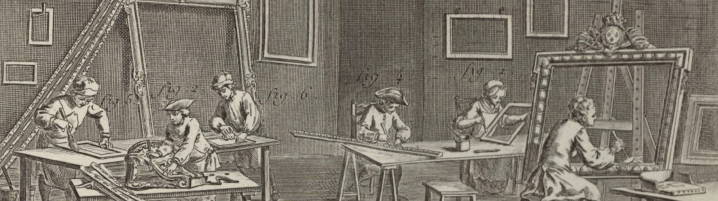
Workshop for Gilding on Wood (Doreur sur bois), detail, Encyclopédie ou Dictionnaire raisonné des sciences, des arts et des métiers, edited by Denis Diderot and Jean le Rond d’Alembert, volume 20, plate IV (Paris, 1765 / ARTFL Encyclopédie Project, University of Chicago).
◊ ◊ ◊ ◊ ◊
HECAA Emerging Scholars Showcase
Online, 5 March 2024
Proposals due by 26 January 2024
We at HECAA are thrilled to invite emerging scholars studying the art, architecture, and visual culture of the long eighteenth century around the globe to participate in our 2024 virtual showcase. A beloved HECAA tradition, the showcase is intended as a platform for emerging scholars to connect with the wider HECAA community and get feedback on their research.
Scholars will each be given 3–5 minutes to present their work, followed by an open question and answer session. This year’s Emerging Scholars Showcase will be held on Tuesday, March 5 (time TBD based on participants’ time zones). As in previous years, an additional showcase may be added if there is sufficient interest; so, we encourage you to apply even if you are unable to present on Tuesday, March 5.
To apply, please fill out this form by Friday, January 26 at midnight (EST). Emerging scholars may be current graduate students (MAs or PhDs) and early career researchers who have received their PhDs in the past five years. We ask that presenters apply no more than once every three years to allow for as many individuals as possible to participate. Also note that you do not have to be a member of HECAA to apply to participate in the Emerging Scholars Showcase, so feel free to circulate widely in your networks. Please, direct all questions, suggestions (and love) to hecaa.emergingscholarsrep@gmail.com.
Warmly,
Demetra Vogiatzaki
HECAA Board Member At-Large, Emerging Scholars Representative
Doctoral Scholarship | Representations of Black People in European Art
From ArtHist.net, where the posting includes the German description:
Doctoral Scholarship | The Representation of Black People in European Art and Material Culture Using the Example of the Tucher Family Coat of Arms
Argelander Professorship for Critical Museum and Heritage Studies, University of Bonn, and Tucher Kulturstiftung
Applications due by 31 January 2023
Since 1345, the central motif of the Tucher family coat of arms has been the head of a Person of Colour in profile. While in the early modern period the depiction was interpreted as a portrait of St Maurice and a symbol of Christian defence and virtue, depictions from the colonial period tend to suggest stereotypical, racialising ideas of Black people. As part of the doctoral scholarship The Representation of Black People in European Art and Material Culture Using the Example of the Tucher Family Coat of Arms (Die Darstellung von Schwarzen Menschen in europäischer Kunst und materieller Kultur am Beispiel des Tucher Familienwappens), some of the diverse questions raised by the family coat of arms will be explored. What can the changing depiction of Black people / BIPoC / people of the global majority in the coat of arms over the centuries tell us about the perception of people from Africa and the African diaspora in Europe? How did the presence of Black people in Europe shape the representations? What role did upheavals in the history of ideas and political economy—such as the Enlightenment in Europe, the transatlantic trade in enslaved people, and the colonisation of non-European territories—play in the different forms of representation? What purposes did the identification of a white patrician family with a Black person serve in these different eras? And to what extent did the changing materiality of European art and craftsmanship influence the forms of depiction of the family coat of arms? The doctoral candidate selected is invited to set their own research priorities according to their expertise (epochs, materialities) and to contribute comparative examples to the research. A critical examination of the tipping points of self-perception and external attribution expressed by the changing family coat of arms is desired. Reference to approaches from Postcolonial and Critical Whiteness Studies is also expressly encouraged.
Tasks
• Independent research on the topic The Representation of Black People in European Art and Material Culture Using the Example of the Tucher Family Coat of Arms
• Annual research reports
• Conclusion of a supervisory relationship at the University of Bonn at the start of the fellowship
Applicant Profile
• Completed Master’s degree in social and cultural anthropology, history, art history, cultural studies, museum studies, material culture studies, postcolonial studies, or related subjects
• Experience with historical German scripts
• Experience with historical material culture
1700€ / month doctoral scholarship; 1500€ / year travel and material costs
To apply, please send a cover letter, a description of the proposed research project (1–2 pages), a writing sample, and a CV in one PDF file to Nana Tsiklauri, ntsiklau@uni-bonn.de. The scholarship should be started as soon as possible. The deadline for applications is 31 January 2024. For details, please refer to the official call for applications at this link. If you have any questions, please contact Jun.-Prof. Dr. Julia Binter, julia.binter@uni-bonn.de.
Decorative Arts Trust Grant to Support Study of Frames at AGO
From the press release (1 December 2023). . .
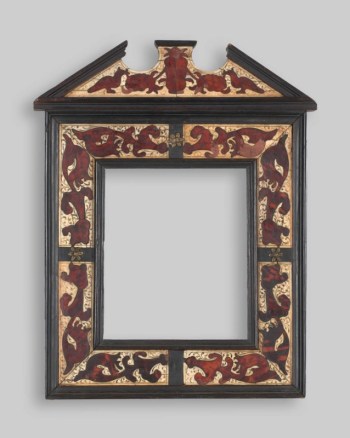
Italian Tabernacle Frame, 1600s, tortoiseshell, bone or ivory, and wood. (Toronto: AGO, gift from a private collector, 94/994).
The Decorative Arts Trust is pleased to announce that the Art Gallery of Ontario (AGO) in Toronto, Canada, will serve as our 2024–26 Curatorial Internship Grant partner. The Decorative Arts Trust underwrites curatorial internships for recent Masters or PhD graduates in collaboration with museums and historical societies. These internships allow host organizations to hire a deserving professional who will learn about the responsibilities and duties common to the curatorial field while working alongside a talented mentor.
This intern will focus on a type of material culture that links the decorative and fine arts: frames. The AGO is home to one of the largest collections of historic frames in the world, currently amounting to well over 1,200 examples. The collection is expansive in terms of both chronology and geography, ranging from the late 1400s to the early 1990s, and with fine frames from France, England, Germany, the Netherlands, Italy, Spain, the Americas, and Asia. The AGO’s goals are twofold: to study the history of frame making to preserve knowledge at a moment when most experts in the field are currently retiring; and to pair paintings and frames to show artwork within a surround that was made in the same region and time period.
Under the mentorship of Caroline Shields, Curator, European Art, and Adam Harris Levine, Associate Curator, European Art, the intern will research and catalogue the AGO’s holdings and assist in making the collection available to the public online. They will work to pair paintings with frames that are chronologically and geographically suited, and they will facilitate the loan of frames to peer museums. The intern’s term will begin in May 2024, when the AGO hosts an international conference, Many Lives: Picture Frames in Context, featuring keynote speakers Hubert Baija, Senior Frames Conservator, and Lynn Roberts, Frame Historian. As part of their tenure at the AGO, the intern will help prepare the conference papers for a digital publication.
A formal call for applications for the internship will be posted early in 2024. Current and recent graduate students who are interested in this opening are encouraged to visit AGO’s website at ago.ca for updates.










 Enfilade
leave a comment