Decorative Arts Trust Grant to Support Study of Frames at AGO
From the press release (1 December 2023). . .
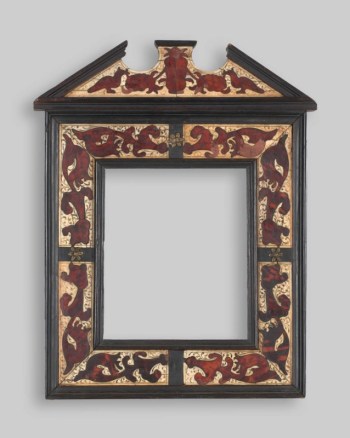
Italian Tabernacle Frame, 1600s, tortoiseshell, bone or ivory, and wood. (Toronto: AGO, gift from a private collector, 94/994).
The Decorative Arts Trust is pleased to announce that the Art Gallery of Ontario (AGO) in Toronto, Canada, will serve as our 2024–26 Curatorial Internship Grant partner. The Decorative Arts Trust underwrites curatorial internships for recent Masters or PhD graduates in collaboration with museums and historical societies. These internships allow host organizations to hire a deserving professional who will learn about the responsibilities and duties common to the curatorial field while working alongside a talented mentor.
This intern will focus on a type of material culture that links the decorative and fine arts: frames. The AGO is home to one of the largest collections of historic frames in the world, currently amounting to well over 1,200 examples. The collection is expansive in terms of both chronology and geography, ranging from the late 1400s to the early 1990s, and with fine frames from France, England, Germany, the Netherlands, Italy, Spain, the Americas, and Asia. The AGO’s goals are twofold: to study the history of frame making to preserve knowledge at a moment when most experts in the field are currently retiring; and to pair paintings and frames to show artwork within a surround that was made in the same region and time period.
Under the mentorship of Caroline Shields, Curator, European Art, and Adam Harris Levine, Associate Curator, European Art, the intern will research and catalogue the AGO’s holdings and assist in making the collection available to the public online. They will work to pair paintings with frames that are chronologically and geographically suited, and they will facilitate the loan of frames to peer museums. The intern’s term will begin in May 2024, when the AGO hosts an international conference, Many Lives: Picture Frames in Context, featuring keynote speakers Hubert Baija, Senior Frames Conservator, and Lynn Roberts, Frame Historian. As part of their tenure at the AGO, the intern will help prepare the conference papers for a digital publication.
A formal call for applications for the internship will be posted early in 2024. Current and recent graduate students who are interested in this opening are encouraged to visit AGO’s website at ago.ca for updates.
Fellowships | Morgan Drawing Institute
From The Morgan:
Morgan Drawing Institute Fellowships
The Morgan Library & Museum, New York, 2024–25
Applications due by 3 December 2023
The Morgan Library & Museum invites applications for Drawing Institute fellowships for the 2024–25 term. The application deadline is December 3, 2023. More information is available at The Morgan’s website.
Predoctoral Fellowship
The Morgan Drawing Institute will award one nine-month Predoctoral Research Fellowship to an advanced-level graduate student who has completed all course work and exams. The student should be currently engaged in carrying out research leading to the completion of a doctoral dissertation in the history of art, a significant component of which pertains to the history, theory, collecting, function, or interpretation of drawings.
Morgan-Menil Fellowship
The Morgan Drawing Institute and the Menil Drawing Institute, Houston, will award one research fellowship of three to nine months to support independent projects on some aspect of the history, theory, interpretation, or cultural meaning of drawing throughout the history of art. Preference will be given to projects that would benefit from the resources of the Morgan Library & Museum and the Menil Collection.
Postdoctoral Fellowship
The Morgan Drawing Institute will award one nine-month Postdoctoral Research Fellowship to a scholar in the first decade of their career following the completion of the PhD or equivalent advanced degree. The Postdoctoral Research Fellowship supports an independent research project, ideally working toward a clearly defined publication relating to some aspect of the history, theory, collecting, function, or interpretation of drawings.
Dissertation Listings, 2020 and 2021
CAA publishes titles of dissertations in progress and completed by students at American and Canadian institutions. Clearly, however, there are problems (the index is neither timely nor comprehensive). Penn State University maintains its own list of “Art History Dissertations and Abstracts from North American Institutions,” as compiled by Catherine D. Adams and Carolyn J. Lucarelli. If your dissertation has been overlooked, please feel free to report it directly to them. I’m conflicted because I’m not in a position to maintain a list with any credibility on my own, but I also realize this is an incredibly frustrating system. Very belated congratulations to the four scholars named below and to many of you who have also finished more recently but are not yet named on either list. –CH
The CAA index for 2020 lists nine ‘eighteenth-century art’ dissertations in progress and one ‘eighteenth-century art’ dissertation completed:
• Christine Brander, “Addressing the Body: The Artless Art of Jean-Étienne Liotard” (Yale University, N. Suthor).
• Katherine Calvin, “Antiquity and Empire: The Construction of History in Western European Representations of the Ottoman Empire, 1650–1830” (The University of North Carolina at Chapel Hill). [Calvin’s dissertation is not noted on CAA’s index, but it appears at Penn State’s list.]
The CAA index for 2021 lists seventeen ‘eighteenth-century art’ dissertations in progress, and two ‘eighteenth-century art’ dissertations completed:
• Jennifer Baez, “Painting the Miracles of Altagracia: Art, Piety, and Memory in Hispaniola, 1751–1795,” (Florida State University, P. Niell).
• Emily Thames, “Empire, Race, and Agency in the Work of José Campeche, Artist and Subject in Late Spanish Colonial Puerto Rico, 1751–1809,” (Florida State University, P. Niell). [At Penn State’s list, Thames’s dissertation is listed under 2022.]
Call for Applications | Making Her Mark: Exhibition Study Day

From the Call for Applications:
Making Her Mark: Exhibition Study Day
Baltimore Museum of Art, 23 October 2023
Applications due by 6 September 2023
The Baltimore Museum of Art and the Art Gallery of Ontario are delighted to be co-organizing the exhibition Making Her Mark: A History of Women Artists in Europe, 1400–1800, scheduled to run from 1 October 2023 to 7 January 2024 in Baltimore and from 30 March until 1 July of 2024 in Toronto. Curated by Andaleeb Badiee Banta, BMA Senior Curator of Prints, Drawings & Photographs, and Alexa Greist, AGO Associate Curator and R. Fraser Elliott Chair, Prints & Drawings, this exhibition presents a feminist revision of early modern European art. An invitational study day will be held in the exhibition galleries at the BMA, where scholars and the exhibition curators will facilitate discussions around the themes and objects on display. Advanced graduate students and early career professionals from diverse humanistic disciplines are invited to apply to participate. Up to 10 selected participants will receive a $250 travel stipend, made possible by a generous grant from the Kress Foundation, to offset travel costs.
As the first North American exhibition in over forty years to stage such an expansive woman artist-centered approach to Renaissance, Baroque, and 18th-century European art, Making Her Mark will be unique in its presentation of a wide range of materials, media, and scale, foregrounding quality works made by women, many of whom remain largely unfamiliar to general and specialist audiences. Exemplary works by well-known artistic ‘heroines’ such as Sofonisba Anguissola, Lavinia Fontana, Artemisia Gentileschi, Judith Leyster, Luisa Roldán, Rosalba Carriera, and Rachel Ruysch will join exceptional products of women-led workshops, female artisanal collectives, and talented amateurs who operated outside of the male-dominated professional arena. Expanding beyond the traditional focus on the ‘major arts’ of large-scale painting and sculpture, Making Her Mark aims to be a bold corrective to the historical assumption that women artists and makers of this period were rare and relatively untalented. This presentation will consider the entire European continent and seeks to subvert the typical monographic format, identifying it as an inherently sexist critical apparatus that encouraged the classification of women artists as anomalous.
The exhibition’s scope is purposefully broad, both temporally and geographically, in order to allow for differences in individual social circumstances, power dynamics, and cultural context, and to address the careers of women artists who had transnational reputations and relationships. Bringing together such varied objects will present them through a wider lens, one that includes creative production by female practitioners who did not or could not subscribe to male-determined criteria for what constituted important or legitimate art. Thematic groupings on the themes of power, faith, interiority, scientific documentation, empire, professional pathways, and entrepreneurship guide visitors through a wide variety of media exploring women’s contributions to the early history of botany, zoology, and epistemology; book arts; religious and history subjects; print culture; textile production; ceramics; wax modeling; metalwork; and courtly and private portraiture. A diverse presentation of works brilliantly illuminates the fact that women were involved with all manner of artistic production and contributed to nearly every aspect of early modern visual culture, even if their names were not recorded for posterity.
We invite applications from advanced graduate students as well as early career scholars who are no more than five years out from degree conferral. The ideal applicant will be engaged with the study of early modern women and materiality. We welcome applications from scholars working in disciplines outside of art history. In order to minimize the cost of attendance, we are pleased to offer accepted applicants free entrance to the exhibition and a $250 travel stipend, generously provided by the Kress Foundation.
To be considered for participation and the travel grant, please submit a one-page CV. Additionally, please provide a brief summary (not to exceed 250 words) of your interest and how this experience in the exhibition will benefit your current work. Application materials should be sent to Theresa Kutasz Christensen at TChristensen@artbma.org. We cannot consider applications received after Wednesday, September 6th. Selected applicants will be notified of their acceptance by September 22nd.
Exhibition | Dutch and Flemish Paintings from Woburn Abbey

Aelbert Cuyp, A Landscape near Calcar with the Artist Sketching, ca. 1652
(Woburn Abbey Collection)
◊ ◊ ◊ ◊ ◊
The collection of Netherlandish works at Woburn Abbey was assembled primarily in the eighteenth and early nineteenth centuries. From the press release for the exhibition:
Mastering the Market: Dutch and Flemish Paintings from Woburn Abbey
The Barber Institute of Fine Arts, University of Birmingham, 17 June — 24 September 2023
Curated by University of Birmingham MA students alongside experts from the Barber and Woburn Abbey
This summer, the Barber Institute of Fine Arts, University of Birmingham, presents a dazzling selection of Dutch and Flemish 17th-century masterpieces from Woburn Abbey, the ancestral home of the Dukes of Bedford. Featuring a dozen Old Master paintings, the exhibition Mastering the Market: Dutch and Flemish Paintings from Woburn Abbey is one of the largest and most significant group of such works from this important ducal collection to be exhibited in a public gallery since the 1950s.
Focused on the themes of patronage and collecting, Mastering the Market is curated by four Art History and Curating MA students from the University of Birmingham, with guidance and supervision from experts at both the Barber Institute and Woburn Abbey. Other aspects of the innovative and dynamic 17th-century Dutch art market will also be explored—from the unique character of artistic culture in the newly independent Dutch Republic, through art dealership and attribution, to the demand for and development of new genres. The burgeoning wealth and rise of the merchant classes in the Netherlands in the 17th century sparked huge demand for portrait commissions, also examined here through fresh interpretations of the works from Woburn Abbey.
Assembled principally by the 4th, 5th, and 6th Dukes of Bedford between the 1730s and 1830s, the Woburn Abbey collection of Dutch and Flemish paintings is one of the finest in private hands in the UK. Works include superb portraits and head studies by Rembrandt Van Rijn, Frans Hals, and Anthony Van Dyck, exquisite landscapes and seascapes by Aelbert Cuyp and Jan van de Cappelle, and lively subject pictures by Jan Steen and David Teniers. The exceptional opportunity to see these paintings together in a public gallery has arisen due to the extensive and ongoing refurbishment of the Abbey.
Key loans include Rembrandt’s Portrait of a Bearded Old Man, 1643, Hals’s Portrait of a Man, c. 1635–38, Van Dyck’s Portrait of a Married Couple, identified as Daniel Mytens and his Wife, c. 1632–34, Cuyp’s A Landscape near Calcar with the Artist Sketching, c. 1652, Steen’s Twelfth Night or ‘Le Roi Boit’, 1670–71, and Van de Cappelle’s A Dutch Harbour with Numerous Fishing Boats, c. 1652–54.
Complementing the Woburn masterpieces is a small selection of the outstanding Dutch and Flemish paintings in the Barber’s own permanent collection, notably Jan Steen’s The Wrath of Ahasuerus, c. 1668–70, Van Dyck’s Ecce Homo, c.1625–26, and Portrait of François Langlois, early 1630s (jointly owned with the National Gallery, London), plus Hals’s Portrait of a Man Holding a Skull, c. 1611–12.
Robert Wenley, Barber Institute Deputy Director, Research and Collections, says: “The exhibition will present the public with the rare opportunity to view these works up close in a gallery setting and facilitate an appreciation of the ways in which patronage and collecting reflected and contributed to a dynamic period of European history. Our talented young team of student curators will also explore the tastes and achievements of the successive Dukes of Bedford as collectors of Dutch and Flemish paintings in the decades following their first purchases on the art market of works from these schools in the early 18th century.”
Professor Jennifer Powell, Director of the Barber Institute, says: “We are delighted to present works from this important collection in Birmingham. The Barber is proud to support this unique opportunity for students of the University of Birmingham to co-curate an exhibition of such exceptional quality in its main gallery programme.”
Matthew Hirst, Curator of the Woburn Abbey Collection, says: “We are delighted to have the opportunity to present these masterpieces from Woburn Abbey alongside other works by the same masters from the Barber’s own choice collection. This opportunity to compare these works and consider the phenomenon of the Dutch and Flemish market is only possible due to the input of the students at this unique time whilst Woburn Abbey is closed to undergo a generational refurbishment project.”
Woburn Abbey houses an outstanding collection of works of art brought together by the family over nearly 500 years. During the closure, there is an active loans programme to share some of these treasures so they can be enjoyed in different contexts. Woburn has partnered with a number of prestigious venues since 2020, including Royal Museums Greenwich, the Holburne Museum, Worcester City Art Gallery, and Gainsborough’s House. Many of the important works of art from the collection have been exhibited in new ways due to these partnerships. Full restoration and renewal of the roof at Woburn Abbey has led to a prolonged closure period. This has enabled these partnerships to continue and expand offering more opportunities to share Woburn’s impressive art collection with a wider audience.
U of Buckingham | MA in French and British Decorative Arts
From the University of Buckingham:
MA in French and British Decorative Arts and Historic Interiors
University of Buckingham (study based in London), starting September 2023
Bursary applications due by 10 July 2023
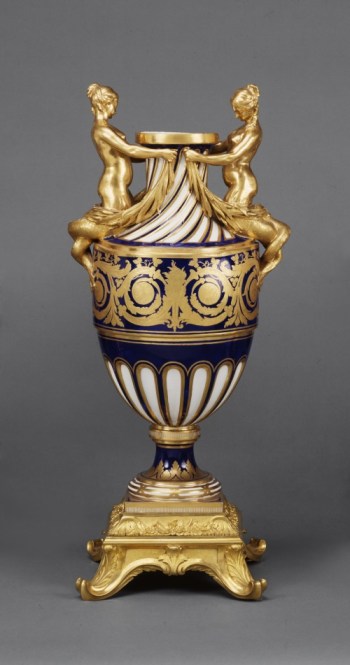
Vase ‘sirènes’, Manufacture de Sèvres, probably Josse-François-Joseph Le Riche, designer; Etienne-Henry Le Guay, the Elder, gilder, ca. 1776, soft-paste porcelain, gilded, 49 cm high (London: The Wallace Collection, C333).
Applications are invited for a bursary on the University of Buckingham’s MA in Decorative Arts and Historic Interiors starting September 2023. Generously funded by The Leche Trust, the award is worth £7,500 and will contribute towards course fees. The deadline for bursary applications is Monday, 10 July, 4pm UK time.
This unique MA in French and British Decorative Arts and Interiors, taught in collaboration with the curatorial and conservation teams at the Wallace Collection, focuses on the development of interiors and decorative arts in England and France in the ‘long’ eighteenth century (c.1660–c.1830) and their subsequent rediscovery and reinterpretation in the nineteenth and twentieth centuries. A key element of the course is the emphasis on the first-hand study of furniture, silver, and ceramics, where possible in the context of historic interiors. Based in central London, it draws upon the outstanding collections of the nearby Wallace Collection and the Victoria and Albert Museum as well as the expertise of leading specialists who participate in the teaching.
Bursary priority will be given to applicants:
• with excellent academic qualifications, seeking, or currently pursuing careers in museums, the built heritage or conservation,
• in need of financial assistance,
• have a strong interest in the decorative arts and historic buildings,
• or, for those wishing to go on to pursue academic research in the decorative arts and historic interiors.
The bursary is also open to part-time students commencing their studies in 2023 for whom the funding would be spread over two years. To be eligible for the bursary, students will need to have applied for and been offered a place on the course.
Fellowship | Reception of Antiquity, 1350–1900
From ArtHist.net:
Census Fellowship: Reception of Antiquity
Berlin, Rome, and London, 2023–24
Applications due by 31 May 2023
The Institut für Kunst- und Bildgeschichte, Humboldt-Universität zu Berlin, the Bibliotheca Hertziana – Max Planck Institute for Art History, and the Warburg Institute, School of Advanced Study, University of London, are pleased to announce a fellowship in Berlin, Rome, and London, offered at either the predoctoral or postdoctoral level. These fellowships grow out of the longstanding collaboration between the Humboldt, the Hertziana, and the Warburg in the research project Census of Antique Works of Art and Architecture Known in the Renaissance.
The fellowships extend the traditional chronological boundaries of the Census and are intended for research and intellectual exchange on topics related to the reception of antiquity in the visual arts between ca.1350 and ca. 1900. In the context of the fellowships, the topic of the reception of antiquity is also broadly conceived without geographical restriction. Proposals can optionally include a digital humanities perspective, engage with the database of the Census, or make use of the research materials of the Census project available in Berlin, Rome, and London.
The Humboldt, the Hertziana, and the Warburg co-fund a research grant of 6–9 months for students enrolled in a PhD program, or 4–6 months for candidates already in possession of a PhD Fellows can set their own schedule and choose how to divide their time between the three institutes, but they should plan to spend at least one month in residence at each of the three institutions. The stipend will be set at about 1500 EUR per month at the predoctoral level and about 2500 EUR per month at the postdoctoral level, plus a travel stipend. The fellowship does not provide housing.
Candidates can apply via the Hertziana recruitment platform by uploading the requested PDF documents in English, German, or Italian by 31 May 2023, with details of their proposed dates for the fellowship during the academic year 2023/24 (July 2023–July 2024).
Mellon Foundation Postdoc | Smarthistory
While Enfilade does not circulate regular job postings, postdoctoral fellowships are occasionally included. From Smarthistory:
Smarthistory, Andrew W. Mellon Foundation Postdoctoral Fellow
Applications due by 26 May 2023
Smarthistory is seeking applications for an Andrew W. Mellon Foundation Postdoctoral Fellow to develop public art history content. This is a one-year full-time position, beginning September 2023. Applicants will have a PhD in art history (within the last two years) as well as teaching experience. Applicants with diverse backgrounds are particularly encouraged to apply.
The successful applicant will have a commitment to public scholarship and teaching. The successful candidate will be self-motivated and comfortable working remotely for a small organization. Ideally, the candidate will have some facility with content management systems, audio and video editing, or an interest in learning these tools. The candidate will work closely with Smarthistory founders and Executive Directors Dr. Beth Harris and Dr. Steven Zucker on a range of activities including editing, producing, and publishing essays and video content for Smarthistory, working with contributors and content editors, seeking new contributors, reorganizing content as new material is added, and working to create consistency across the site. The candidate will contribute essays in their area of expertise.
The Fellow will receive professional development mentoring, periodic performance evaluations, and will be supported in developing professional relationships with academic contributors over the course of the year. This is a temporary full-time position with an annual salary of $55,000 (plus a generous health insurance option and a retirement match). The Andrew W. Mellon Foundation Postdoctoral Fellow can work remotely.
Smarthistory is a not-for-proft organization dedicated to making engaging yet rigorous art history accessible to learners around the world for free. Learn more about the organization and our mission here. We encourage applications from those who contribute to our diversity. Use this form to apply.
Summer Seminar | Material Religion in Early America
From the American Antiquarian Society:
Material Religion: Objects, Images, Books
2023 CHAViC-PHBAC Summer Seminar
American Antiquarian Society, Worcester, Massachusetts, 25–30 June 2023
Led by Christopher Allison and Sonia Hazard
Applications due by 17 April 2023
 Scholars of religion have taken a material turn, delving into the study of images, objects, monuments, buildings, books, spaces, performances, and sounds. What do these inquiries look like in the context of early America, and how did religious materialities shape early American worlds? The goal of this seminar is to explore this area’s exciting archives, theories, and methods, enabling participants to bring together religion and materiality in their own work in fresh ways.
The American Antiquarian Society provides an exceptional site for hands-on inquiries into the material worlds of early American religions. Collections at AAS furnish materials relating to religion before 1900 in North America, including Islam, Judaism, Mormonism, Catholicism, Protestantism, metaphysical religions, African-inspired religions, South Asian religions, and civil religion as well as collections that support studying religious hybridity and forms of Christianity as practiced in Hawaiian, Caribbean, and Indigenous nations and groups.
Topics will include lived religion, materialisms (old and new), sensory culture, books as objects, animisms and animacies, iconoclasm, visual piety, the ontological turn, residual transcription, and sacred objects in archival contexts. The seminar will be held from Sunday, June 25, through Friday, June 30, 2023, at the American Antiquarian Society in Worcester, Massachusetts. Co-leaders for the seminar will be Chris Allison and Sonia Hazard. Guest speakers will include Solimar Otero, Professor of Folklore and Ethnomusicology, Indiana University, Bloomington and Anthony Trujillo, doctoral candidate in American Studies, Harvard University.
Participation is intended for faculty, museum and library professionals, and graduate students. It welcomes researchers across fields such as art history, religious studies, history, anthropology, American studies, music, and literature. It is co-sponsored by the Center for Historic American Visual Culture (CHAViC) and the Program in the History of the Book in American Culture (PHBAC).
The format of the seminar will be select readings, highly interactive seminar discussion, collections explorations and archival sessions, individual research time with the collection, and site visits to notable collections and religious sites in the area, including the Worcester Art Museum, burial grounds, and sacred sites. The syllabus is available online. Information on access to the readings will be emailed to students.
Tuition for the seminar is $600, which includes lunch each day and some evening meals. Some financial aid is available for graduate students. The cost of housing is not included in the tuition fee. Housing is available at two nearby hotels.
Faculty
• Sonia Hazard is Assistant Professor of Religion at Florida State University. Her book, Building Evangelical America: How the American Tract Society Laid the Groundwork for a Religious Revolution, is forthcoming from Oxford University Press. She did her graduate work at Harvard Divinity School and Duke University.
• Christopher Allison is Director of the McGreal Center for Dominican Historical Studies, Department of History, Dominican University. He is the author of the forthcoming book, Protestant Relics: Capturing the Sacred Body in Early America, under contract with the University of Chicago Press. He did his graduate work at Yale Divinity School and Harvard University.
Guest Speakers
• Solimar Otero is Professor of Folklore and Ethnomusicology at Indiana University, Bloomington. She is the author of Archives of Conjure: Stories of the Dead in Afrolatinx Cultures (Columbia University Press, 2020).
• Anthony Trujillo is a doctoral candidate in American Studies at Harvard University. He works at the confluence of Native American and Indigenous studies, history, religious studies, anthropology, and the arts.
Predoctoral Fellow | Decay, Loss and Conservation in Art History
From the Bibliotheca Hertziana:
Predoctoral Fellow for the Research Group ‘Decay, Loss and Conservation in Art History’
Led by Francesca Borgo at the Bibliotheca Hertziana – Max Planck Institute for Art History in Rome
Applications due by 31 May 2023
The Lise Meitner Research Group “Decay, Loss and Conservation in Art History” led by Francesca Borgo at the Bibliotheca Hertziana – Max Planck Institute for Art History in Rome seeks to appoint a Predoctoral Fellow (M/F/D). The Max Planck Society is Germany’s premier research organization. The 86 Max Planck Institutes conduct research at the highest level in the service of the general public in the natural sciences, life sciences, social sciences, and the humanities. The deadline for application is 31 May 2023, 12pm CEST. Interviews will be held virtually in June 2023. Candidates should propose a funding period of desired length within the academic year 2023/2024. Motivations for the length of period proposed should be made clear in the cover letter.
The Predoctoral Fellow will conduct their own research within the framework of the Research Group, which focuses on European and Colonial art histories from the fifteenth to the eighteenth century, a period during which techniques and media were ranked based on their ability to last, and decay was first recognized as a subject worthy of aesthetic and scientific attention.
Excellence in research, commitment to pursue new insights through original scholarship, and willingness to become part of a group of young, international scholars are essential. Fellows will actively participate in the Group’s activities and are invited to contribute to its publication output while benefitting from editorial and image licensing support. They will be responsible for planning and organizing seminars, workshops, visits, and fieldtrips in collaboration with other team members and under the supervision of the Group Leader. Candidates must be conversant in English and familiar with Italian and/or German.
This position is intended for a PhD student enrolled at any university worldwide who is in the finishing stages of their dissertation. In addition to clarifying how residence in Rome benefits their PhD research, candidates should include in their cover letter a statement of how their work advances the goals of the research group. Candidates should also seek the approval of their doctoral advisor. Candidates are expected to review the Research Group’s research agenda, past initiatives and event series, as well as the broader structure of the Bibliotheca Hertziana into which the Research Group fits. We welcome applications from doctoral students in every field within the history of art, technical art history, conservation history, and museum studies, with preference given to projects spanning traditional disciplinary boundaries. The selection committee aims to assess the ability of candidates to contribute in a collegial way to the intellectual life of the Research Group.
This is a residential fellowship. By the start of the appointment, candidates are expected to have taken up residence in Rome. The fellowship may not be held concurrently with another major fellowship award; applicants must disclose any supplementary funding and may not take on other obligations during their fellowship period.
The Max Planck Society offers a fixed-term contract of employment. Stipend and benefits are determined according to the German Civil Service Collective Agreement (65% TVöD Bund E 13) or equivalent, depending on individual personal circumstances. Fellows enjoy all the privileges of the Institute, including library access seven days a week, a research budget, and their own carrel or desk.
We encourage women and individuals from communities that are underrepresented in academia to apply. The Max Planck Society is committed to fostering equal opportunities and diversity and welcomes applicants from all parts of society, regardless of gender, ethnicity, disabilities, or sexual orientation.
To apply the candidate must upload the following documents as separate PDF files to the application portal:
• Cover letter that clearly states the candidate’s contribution to the Research Group’s objectives
• Description of proposed research project (max. 1000 words), accompanied by a bibliography
• Curriculum vitae with list of publications (including those forthcoming, under revision, submitted, or in preparation)
• One reference letter
• Output proposal (max. 500 words). This could be a site visit, a collaboration with a local collection, a research seminar, a publishable piece of writing, or a contribution to a national or international conference. The proposal should detail specific names and locations and specify how the output aligns with the Research Group’s themes.










leave a comment