The Burlington Magazine, March 2023
The eighteenth century in the March issue of The Burlington . . .
The Burlington Magazine 165 (March 2023)
 E D I T O R I A L
• “Omai,” p. 219.
Given his undisputed central place in the history of British art, it is surprising that the three-hundredth anniversary of the birth of Joshua Reynolds is not being celebrated this year with more éclat. The principal tribute will be an exhibition Reframing Reynolds: A Celebration (24 June – 29 October 2023) at the Box in Plymouth, the city where Reynolds made his reputation—he was born on 16th July 1723 at Plympton, on its outskirts. The exhibition will explore the patronage he enjoyed from the Eliot family of Port Eliot, St Germans, and will be supplemented by the museum’s collection of paintings by Reynolds, the largest outside London.
Reynolds’s reputation rests largely on his portraits, so it might have been expected that the museum that contains the largest number, the National Portrait Gallery, London (NPG), would have marked the occasion with an exhibition of its own, but given that it has been closed for the past three years for a comprehensive redevelopment and redisplay, due to be unveiled on 22nd June, it has had other priorities. Yet any disappointment that the NPG is neglecting Reynolds in his anniversary year was allayed by the announcement last August that it is seeking to raise £50 million to acquire one of his greatest paintings, the full-length portrait of Omai, the first Polynesian to visit Britain. Universally praised ever since it was first seen in public, at the Royal Academy of Arts in 1776, it is a work both of great beauty and of compelling historic interest as a document of the earliest European encounter with Pacific cultures. . . Keep reading here»
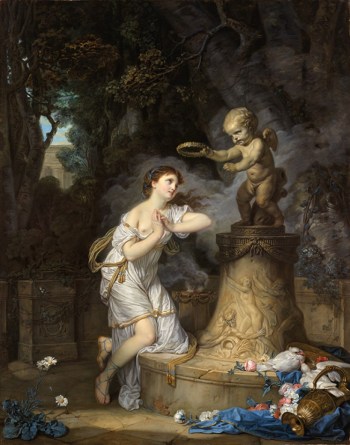
Jean-Baptiste Greuze, A Young Woman Praying at the Altar of Love (Votive Offering to Cupid), 1767, oil on canvas, 146 × 113 cm (London: The Wallace Collection).
A R T I C L E S
• Yuriko Jackall, Barbara H. Berrie, John K. Delaney, and Michael Swicklik, “Greuze’s Greens: Ephemeral Colours, Classical Ambitions,” pp. 268–79.
Jean-Baptiste Greuze was criticized in his lifetime for the unduly muted palette of some of his paintings. New technical analysis, combined with the recent discovery of a list in his handwriting of pigments he used, has revealed that his greens have faded because they incorporate fugitive yellow lakes, a practice Greuze continued even after its disadvantages were obvious.
R E V I E W S
• Roko Rumora, Review of the exhibition Chroma: Ancient Sculpture in Color (The Metropolitan Museum of Art, 2022–23), pp. 312–15.
• Desmond Shawe-Taylor, Review of the newly opened, expanded Gainsborough’s House (Sudbury), pp. 322–25.
• Friso Lammertse, Review of the newly renovated Royal Museum of Fine Arts, Antwerp (KMSKA), pp. 332–35.
• Simon Swynfen Jervis, Review of Jean-Pierre Fournet, Cuirs dorés, ‘Cuirs de Cordoue’: un art européen (Éditions d’art Monelle Hayot, 2019), pp. 342–43.
• Gauvin Alexander Bailey, Review of Aaron Hyman, Rubens in Repeat: The Logic of the Copy in Colonial Latin America (Getty Research Institute, 2021), pp. 343–44.
• Stephen Bann, Review of Joanthan Ribner, Loss in French Romantic Art, Literature, and Politics (Routledge, 2022), pp. 344–45.
• Charlotte Gere, Review of Julius Bryant, Enriching the V&A: A Collection of Collections, 1862–1914 (Lund Humphries and V&A Publishing, 2022), pp. 345–46.
• Jennifer Johnson, Review of Sam Rose, Interpreting Art (UCL Press, 2022), p. 350.
Print Quarterly, March 2023
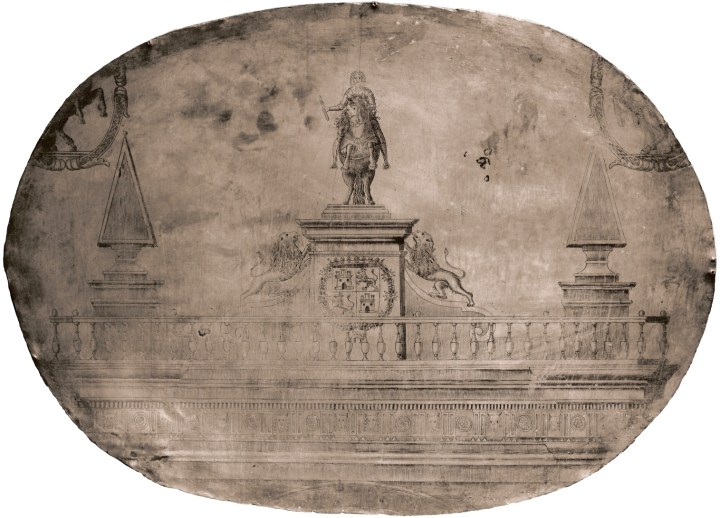
Juan Francisco Rosa, Equestrian Monument to Philip V, ca. 1738–45, engraved copper-plate, 26 × 36 cm (Chicago: Carl and Marilynn Thoma Foundation). The plate was cut into an oval, likely from what was originally a rectangle, and used as a support for an oil painting; on the other side is The Christ Child with St Joseph.
◊ ◊ ◊ ◊ ◊
The long eighteenth century in the latest issue of Print Quarterly:
Print Quarterly 40.1 (March 2023)
A R T I C L E S
• Emily C. Floyd with Suzanne Stratton-Pruitt, “Juan Francisco Rosa: Engraver to the Elite in Eighteenth-Century Lima,” pp. 33–51.
This article explores the life and works of the limeño engraver Juan Francisco Rosa (active in Lima, Peru, 1735–1756), with in-depth discussions pertaining to popular themes in his prints, patrons and contributions to the historic documentation of events and lost works in Lima. It adds two remarkable works to his oeuvre—a copperplate, now cut in two, and an illumination associated with a patent of nobility. The plate documents a famous statue of Philip V that was placed in 1738 on the bridge over the river Rímac and soon destroyed in the 1746 earthquake. The article demonstrates that Rosa produced important commissions for powerful organizations and individuals in the viceregal hierarchy, suggesting his prominence as an artist in mid-eighteenth-century Lima.
N O T E S A N D R E V I E W S
• Antony Griffiths, “Altered Plates,” pp. 63–66. Drawing attention to an anecdote in a 1726 biography of the London publisher, newspaper editor, and controversialist Abel Roper, this note charts the chronology of an altered plate by William van de Passe depicting the Duke of Buckingham on horseback in the first state, published 1625. The plate was then modified around 1630/32 in the second state to represent James, 1st Duke of Hamilton, before being transformed again in the third state of 1654–58 to portray Oliver Cromwell as Lord Protector. The plate is documented to have been subjected to a fourth “very profitable” change, altered to portray William III, though no impression has yet been found.

Romeyn de Hooghe, Les Monarches Tombants (James II falls off the back of a unicorn at left, Louis XIV on a globe at right, while William III is raised on a shield in the background), 1689, etching, sheet includes letterpress text below the image (Amsterdam: Rijksmuseum).
• Peter van der Coelen, Review of Meredith McNeill Hale, The Birth of Modern Political Satire: Romeyn de Hooghe (1645–1708) and the Glorious Revolution (Oxford University Press, 2020), pp. 66–68. Peter van der Coelen is persuaded by Hale’s argument that the satires De Hooghe produced between 1688 and 1690 were decisive for the development of political satire as a genre and that the birth of the genre should therefore be located not in eighteenth-century England but in the Dutch Republic of the late seventeenth century.
• Helmut Gier, Review of Eckhard Leuschner and Friedrich Polleross, eds., “Der Augsburger Kupferstecher und Verleger Johann Ulrich Kraus (1655–1719),” in Frühneuzeit-Info 32 (2021), pp. 68–71. A review of nine conference papers addressing Johann Ulrich Kraus, one of whose most important contributions to the history of art was the reception and dissemination in central Europe of the art favoured at the court of Louis XIV.
• Stephen Salel, Review of Timothy Clark, Hokusai: The Great Picture Book of Everything (British Museum Press, 2021), pp. 71–73.
• Janis A. Tomlinson, Review of the exhibition catalogue, Véronique Gerard, ed., Goya: Génie d’Avant-Garde. Le Maître et son École (Musée des Beaux-Arts and Éditions Snoeck, 2020), and “Goya peintre,” in Technè 53 (2022), pp. 73–75. Did Goya have a workshop? Whereas Goya’s prints seem to be a well-defined body of work, whose technique has been well-studied, as have their preparatory drawings and visual and historical sources, the paintings are another matter. Imitations, copies and forgeries began to circulate within a decade of Goya’s death and continue to complicate our understanding of his oeuvre. . . [These] two contributions . . . address some of these questions in very different ways.
• Heather Hyde Minor, Review of Ginevra Mariani, ed., Giambattista Piranesi: Matrici incise 1743–1753 (Edizioni Gabriele Mazzotta, 2010); Giambattista Piranesi: Matrici incise 1756–1757. Le Antichità Romane Lettere di giustificazione 2 (Edizioni Gabriele Mazzotta, 2014); Giambattista Piranesi: Matrici incise 1761–1765 (Editalia, 2017); and Giambattista Piranesi: Matrici incise 1762–1769 (De Luca Editori d’arte, 2020), pp. 102–06. This review explores the four-volume series of publications dedicated to cataloguing and discussing the 964 autograph printing plates by Giovanni Battista Piranesi in the collection of the Istituto Centrale per la Grafica in Rome. Further Matrici incise volumes are expected to be published in due course.
• Roger Kneebone, Review of the exhibition catalogue, Monique Kornell, ed., Flesh and Bones: The Art of Anatomy (Getty Research Institute, 2022), pp. 106–11. This review highlights the complex intersections between artists, engravers, anatomists and clinicians over four centuries. Worthy of note are the ways multiple perspectives from different kinds of parties informed the appearance of anatomical illustrations depending on their purpose and audience, resulting in images that were not always neutral in their ‘factual’ representations.
Metropolitan Museum Journal 2022
The eighteenth century in the latest issue of The Met’s journal , and a reminder that digital copies are free!
Metropolitan Museum Journal 57 (2022)
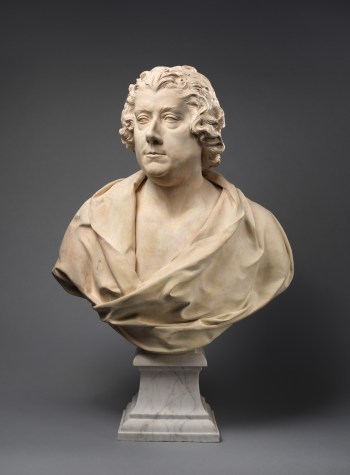
Louis François Roubiliac, Francesco Bernardi, known as ‘II Senesino’ (ca. 1686–1758), ca. 1735, terracotta with later marble base, bust: 62 × 55 × 23 cm (New York: The Metropolitan Museum of Art, Purchase, Gift of Irwin Untermyer by exchange, 2016.47).
A R T I C L E S
• Malcolm Baker, “Sculpting Reputation: A Terracotta Bust of Senesino by Roubiliac,” pp. 25–39.
• Ronda Kasl, “Witnessing Ingenuity: Lacquerware from Michoacán for the Vicereine of New Spain,” pp. 40–56.
• Wendy McGlashan, “John Kay’s Watercolor Drawing John Campbell (1782),” pp. 57–66.
• Kimberly Chrisman-Campbell, “A Tale of Two Chapeaux: Fashion, Revolution, and David’s Portrait of the Lavoisiers,” pp. 67–84.
R E S E A R C H N O T E S
• Ludmila Budrina, “Malachite Networks: The Demidov and Medici Vases-Torchères (1821–23) in The Met,” pp. 148–59.
6th Annual Ricciardi Prize from Master Drawings
From Master Drawings:
Sixth Annual Ricciardi Prize from Master Drawings
Submissions due by 15 November 2023

Édouard Manet, Woman Writing, brush and black ink on paper (Clark Art Institute, MA).
Master Drawings is now accepting submissions for the Sixth Annual Ricciardi Prize for Young Scholars. The $5,000 award is given to the best new and unpublished article on a drawing topic (of any period) by a scholar under the age of 40. The winning submission will be published in a 2024 issue of Master Drawings. Information about past winners and finalists is available here.
The average article length is between 2,500 and 3,750 words, with five to twenty illustrations. Submissions should be no longer than 10,000 words and have no more than 100 footnotes. Please note that all submissions must be in article form, following the format of the journal. We will not consider submissions of seminar papers, dissertation chapters, or other written material that has not been adapted into the format of a journal article. Written material that has been previously published, or is scheduled for future publication, will not be eligible. Articles may be submitted in any language. Be sure to include a 100 word abstract outlining the scope of your article with your submission, along with a current CV or resume, as well as your birth date. Please submit your application online by 15 November 2023. If the file is too large, please use Wetransfer.com addressed to administrator@masterdrawings.org.
The Art Bulletin, December 2022
The eighteenth century in the latest issue of The Art Bulletin 104 (December 2022), along with the methodological ‘perspective’ conversation from Fricke and Flood:
A R T I C L E S
 • Beate Fricke and Finbarr Barry Flood, “Premodern Globalism in Art History: A Conversation,” pp. 6–19.
A conversation took place in 2021 between two art historians whose research focuses on different regions of the premodern world and who have recently collaborated on a project dealing with early histories of globalism. The discussion considers the potential archival value of ‘flotsam’—that is, extant artifacts and images lacking extensive textual metadata—for (re)constructing transcultural and transregional histories of circulation and reception. It addresses divergences in the nature of the available archival materials and the ethical and methodological challenges this poses. The discussants consider the need to move beyond earlier, largely celebratory narratives of the global to engage the ways in which transregional and transcultural networks intersected with more rooted or regional traditions of art making and material culture.
• Paris A. Spies-Gans, “Why Do We Think There Have Been No Great Women Artists? Revisiting Linda Nochlin and the Archive,” pp. 70–94.
In 1971 Linda Nochlin published her quickly canonical “Why Have There Been No Great Women Artists?” (ARTnews 69, no. 9). She offered a powerful narrative, claiming that Western institutional structures and a lack of access to vital educational opportunities had historically prevented women from becoming ‘great’ artists—indeed from even having the potential to achieve greatness. I suggest new visual and textual lenses through which we can update Nochlin’s narrative and reconsider women artists on their own societies’ terms, arguing that by returning to the archive, we can identify greatness and professionalism where they have eluded us before.
R E V I E W S
• Amy Knight Powell, Review of Aaron Hyman, Rubens in Repeat: The Logic of the Copy in Colonial Latin America (Getty Publications, 2021), pp. 120–23.
• Amanda Lahikainen, Review of Joseph Monteyne, Media Critique in the Age of Gillray: Scratches, Scraps, and Spectres (University of Toronto Press, 2022), pp. 123–26.
Call for Articles | Japonisme and Fashion
From the Call for Papers:
Japonisme and Fashion — Special Issue of the Journal of Japonisme, 2024
Edited by Elizabeth Emery and Mei Mei Rado
Articles due by 1 July 2023
Japanese garments and textiles have captured the European imagination since the seventeenth century, exerting particular influence on European and American fashion after the 1860s when artists such as Whistler, Tissot, and the Rossettis competed to acquire kimono from shops such as that of Emile and Louise Desoye at 220 rue de Rivoli in Paris. They promptly emulated Japanese motifs in their own artistic creations, such as Whistler’s Princesse du pays de la porcelaine (1864–65). From paintings, poetry, and music to clothing, costume design, and cosplay, artists and designers from around the world have continued to create new japoniste works inspired by Japanese fashion.
Building on recent interest on the worldwide impact of Japanese fashion (museum exhibits and publications by scholars such as Akiko Fukai), this special issue of the Journal of Japonisme, to be published in 2024, welcomes complete essays in English (translation from French may be possible; please enquire) dedicated to figures or movements from around the world that have taken Japanese garments, textiles, or patterns as inspiration for new artistic creations. Each submission should be no longer than 20 pages (including notes) and may include up to 12 images, which will appear in color online, but black and white in print. Authors are responsible for obtaining the relevant permissions. For information about format, submission, and peer review please consult the Author Instructions. Articles should be submitted by 1 July 2023 via Editorial Manager. For more information or questions, please contact submissionsJOJ@gmail.com.
The Journal of Japonisme accepts submissions dedicated to the worldwide reception of Japanese art and culture in history, visual culture including the history of art and design, the decorative arts, painting and the graphic arts, architecture, fashion, film, literature, aesthetics, art criticism, and music. Articles related to collectors of Japanese art, either specific museums or individuals, are also encouraged.
Print Quarterly, December 2022
The long eighteenth century in the latest issue of Print Quarterly:
Print Quarterly 39.4 (December 2022)
A R T I C L E S • Antony Griffiths and Giorgio Marini, “Some Italian Importers of British Prints in the 1780s,” pp. 412–22. “There is little evidence of interest or awareness of British printmaking in Italy before the last quarter of the eighteenth century. In those years, however, things began to change with remarkable speed. The purpose of this article is to draw attention to five importers of British prints—Molini in Florence, Micali in Livorno (Leghorn), Montagnani in Rome, and Viero and Wagner, both in Venice—all of whom produced catalogues of their imported stock within the five years between 1785 and 1789. When considered as a group, these catalogues give evidence of how quickly dealers were able to import newly published stock and how varied tastes were in these years” (412). N O T E S A N D R E V I E W S
• Giorgio Marini, Note of the exhibition catalogue Delfín Rodríguez Ruiz and Helena Pérez Gallardo, eds., Giovanni Battista Piranesi en la Biblioteca Nacional de España (Biblioteca Nacional de España, Madrid, 2019), pp. 444–46.
• Laurence Lhinares, Note on the Print Collection of Horace His de La Salle (1795–1878), occasioned by the exhibition Officier et Gentleman: La Collection Horace His de La Salle (Louvre, 2019–20) and the recent purchase by the Fondation Custodia of a copy of the 1856 sale catalogue of the collector’s prints, pp. 446–50.
• Paul Coldwell, Note on Elizabeth Jacklin, The Art of Print: Three Hundred Years of Printmaking (Tate, 2021), pp. 450–51.
• Rachel Sloan, Note on Kinga Bódi and Kata Bodor, eds., The Paper Side of Art: Eight Centuries of Drawings and Prints in the Collections of the Museum of Fine Arts – Hungarian National Gallery, Budapest (2021), pp. 451–52.
• Anne Leonard, Review of the exhibition catalogue, Rena Hoisington, Aquatint: From Its Origins to Goya (National Gallery of Art / Princeton University Press, 2021), pp. 466–71. The catalogue won the 2022 IFPDA book award and discusses many notable innovators in the aquatint medium, including Giovanni David and Maria Catharina Prestel.
N O T E S A N D R E V I E W S
• Giorgio Marini, Note of the exhibition catalogue Delfín Rodríguez Ruiz and Helena Pérez Gallardo, eds., Giovanni Battista Piranesi en la Biblioteca Nacional de España (Biblioteca Nacional de España, Madrid, 2019), pp. 444–46.
• Laurence Lhinares, Note on the Print Collection of Horace His de La Salle (1795–1878), occasioned by the exhibition Officier et Gentleman: La Collection Horace His de La Salle (Louvre, 2019–20) and the recent purchase by the Fondation Custodia of a copy of the 1856 sale catalogue of the collector’s prints, pp. 446–50.
• Paul Coldwell, Note on Elizabeth Jacklin, The Art of Print: Three Hundred Years of Printmaking (Tate, 2021), pp. 450–51.
• Rachel Sloan, Note on Kinga Bódi and Kata Bodor, eds., The Paper Side of Art: Eight Centuries of Drawings and Prints in the Collections of the Museum of Fine Arts – Hungarian National Gallery, Budapest (2021), pp. 451–52.
• Anne Leonard, Review of the exhibition catalogue, Rena Hoisington, Aquatint: From Its Origins to Goya (National Gallery of Art / Princeton University Press, 2021), pp. 466–71. The catalogue won the 2022 IFPDA book award and discusses many notable innovators in the aquatint medium, including Giovanni David and Maria Catharina Prestel.
The Burlington Magazine, November 2022
The eighteenth century in the November issue of The Burlington . . .
The Burlington Magazine 164 (November 2022) — Sculpture

Massimiliano Soldani Benzi, Lamentation over the Dead Christ, 1690–92(?), gilded bronze, 57 × 40 cm (Córdoba Cathedral).
E D I T O R I A L
• The Parthenon Sculptures, p. 1063.
A R T I C L E S
• Fernando Loffredo, “Soldani’s Lamentation in Córdoba,” pp. 1118–22.
R E V I E W S
• Colin Bailey, Review of the exhibition catalogue, Renoir: Rococo Revival (Städel Museum, Frankfurt am Main, 2022), pp. 1150–53.
• Joseph Connors, Review of Livio Pestilli, Bernini and His World: Sculpture and Sculptors in Early Modern Rome (Lund Humphries, 2022), pp. 1160–62. [Pestilli “mines the correspondence of the directors of the Académie de France and sorts through student drawings in the Accademia de San Luca to find that well into the eighteenth century Bernini was copied more than any other artist” (1162).]
• Jamie Mulherron, Review of Alexandre Maral and Valérie Carpentier-Vanhaberbeke, Antoine Coysevox (1640–1720): Le sculpteur du Grand Siècle (Arthena, 2020), pp. 1165–66.
• Hugo Chapman, Review of Carel van Tuyll van Serooskerken, The Italian Drawings of the Seventeenth and Eighteenth Centuries in the Teyler Museum (Primavera Pers, 2021), pp. 1166–67.
• Christopher Martin Vogtherr, Review of Sarah Salomon, Die Kunst der Außenseiter: Ausstellungen und Künstlerkarrieren im absolutistischen Paris jenseits der Akademie (Wallstein Verlag, 2021), pp. 1167–68. [Salomon’s book focuses on four institutions: the Académie de Saint-Luc, the Colisée, the Salon de la Correspondence, and the Exposition de la Jeunesse.]
• Stephen Lloyd, Review of Magnus Olausson, Miniature Painting in the Nationalmuseum: A World-Class Collection (Nationalmuseum Stockholm, 2021), pp. 1168–70.
O B I T U A R I E S
• Michael Hall, Obituary for Mark Girouard (1931–2022), pp. 1171–72.
Journal18, Fall 2022 — Silver
In the latest issue of J18:
Journal18, Issue #14 (Fall 2022) — Silver
Issue edited by Agnieszka Anna Ficek and Tara Zanardi

I N T R O D U C T I O N
Agnieszka Anna Ficek and Tara Zanardi
In his 1656 treatise El Paraíso en el Nuevo Mundo, Antonio de León Pinelo contends that the amount of silver extracted from Potosí’s Cerro Rico was enough to build a bridge of silver from the top of the mountain to the doors of Madrid’s Royal Palace: 2,070 leagues long, 14 rods wide, and 4 fingers thick.[1] The vivid imagery of León Pinelo’s account encapsulates the magnitude of silver’s potential as the material foundation for a fantastical building project that could physically scale the earth much like the Spanish Empire did politically, militarily, and financially. Silver’s beauty, mutability, and strength coveted by Spanish colonists led to the production of spectacular objects, such as the ornamental plaque from a Jesuit Mission in the Andean highlands that serves as this issue’s cover image. At once luxurious and symbolic, the plaque’s decoration features tulips and other plants cultivated in Europe, interwoven in a repouséd floral ground with indigenous passion flowers (mburucuyà), nibbled by native birds, to create an image of a harmonious colonial society. Both the imaginary bridge and the ornamental plaque belie the violence the Spanish Crown and the Church exerted in subjugating native populations and instituting a system of forced labor to extract this precious metal.
Within and beyond the Spanish Empire, silver financed wars, upheld dynasties, and cemented political alliances. Forged into currency, silver funded slavery and the institution’s production of goods such as sugar and cacao. Silver was also valued around the globe for its pliability and sheen. From Beijing to Versailles, Mexico City to Lisbon, it furnished grand homes, glittering on dinner tables and dressing tables alike. Skilled artists manipulated silver into opulent objects, capitalizing on its luster to fabricate sinuous forms in small-scale decorative artworks as well as ambitious commissions that communicated wealth and political might.
This issue probes silver’s capacity for metamorphosis—from raw material into objects and currency. Such transformative characteristics made it a valuable medium for artists, a tool for global expansion, and a form of income for rebuilding state treasuries. . . .
A R T I C L E S
• Dani Ezor — ‘White when Polished’: Race, Gender, and the Materiality of Silver at the Toilette
• Christina K. Lindeman — Silver Thread Textiles: Industry, Dynasty, and Political Power in Eighteenth-Century Prussia
• Susan Eberhard — The Asian Silver Chocolatière: The Transpacific World in a Diplomatic Gift
E X P L O R A T I O N S
• James Middleton — An Eighteenth-Century Portrait Miniature on Silver: An Artifact from the Silver Age of Mexico
• José Andrés De Leo Martínez — La distinción del cáliz de Puebla de los Ángeles en el s. XVIII, entre dos Mundos
• Christina Clarke — Reanimating the Goldsmith: An Artisanal Reading of the Archive
Cover image: Ornamental Plaque (mariola or maya), one of a pair, 1725–50, Moxos or Chiquitos missions, Alto Peru (present-day Bolivia), silver, 42 × 31 × 3 cm (Museum of Fine Arts Boston, 1992.346).
◊ ◊ ◊ ◊ ◊
R E C E N T N O T E S & Q U E R I E S
• Jessica L. Fripp — Review of Raphaël Barontini’s show Blue Lewoz (Paris: Mariane Ibrahim Gallery, summer 2022), published in J18 October 2022. Link»
The title Blue Lewoz brings together léwoz, the music and dance created by the enslaved people on Guadaloupe, and indigo blue, a dye that was a staple of the transatlantic slave trade. Barontini writes on his Instagram that Creole Dancer was inspired by a 1950 collage by Matisse of the same name, and a tribute to the “Caribbean women and the place of the dance in the Guadeloupean léwoz tradition.” From this twentieth-century inspired work, viewers quickly moved into an alternative history of fashion and luxury of early modern Europe: collages that incorporate Jean-Marc Nattier’s eighteenth-century dresses, Bronzino’s elaborate fabrics, and Elizabethan ruffs. While Barontini’s appropriation and sources stretch wider than the long eighteenth century, many of the fashions in those portraits were the product of, as Alicia Caticha notes, “Atlantic slave trade and a host of other exploitative global networks.” And, as scholars such as Anne Lafont and Mechtild Fend have shown, portraits were often used to construct and highlight whiteness.[1] Barontini’s work reinvents those portraits and, through collage, tapestries, and textiles, celebrates resistance and Caribbean festivals. . .
• Michelle Sylliboy — “Artist’s Notes: Nm’ultes is an Active Dialogue: I Reclaiming Komqwejwi’kasikl, II An Autobiographical Creative Inquiry, and III forthcoming” published in J18 in three parts, June 2022, October 2022. Link»
Published in three installments, this intervention by L’nu interdisciplinary artist, poet, and scholar Michelle Sylliboy offers an Indigenous perspective on the colonial archive. Sylliboy responds to the dehumanizing accounts of her ancestors in Nouvelle Relation de la Gaspésie (Paris, 1691) and reclaims the komqwejwi’kasikl language from its author, French missionary Chrestien Le Clercq, who culturally appropriated its writing system. Using autobiographical creative inquiry and Nm’ultes theory, Sylliboy addresses the ongoing impact of settler colonialism on her people, the L’nuk. As a survivor of intergenerational trauma, she tells the intersecting stories of healing and reconnecting with the worldview of her ancestors, who have been caretakers of a land that stretches from the Gaspé peninsula to Newfoundland since immemorial times.
Furniture History 2022
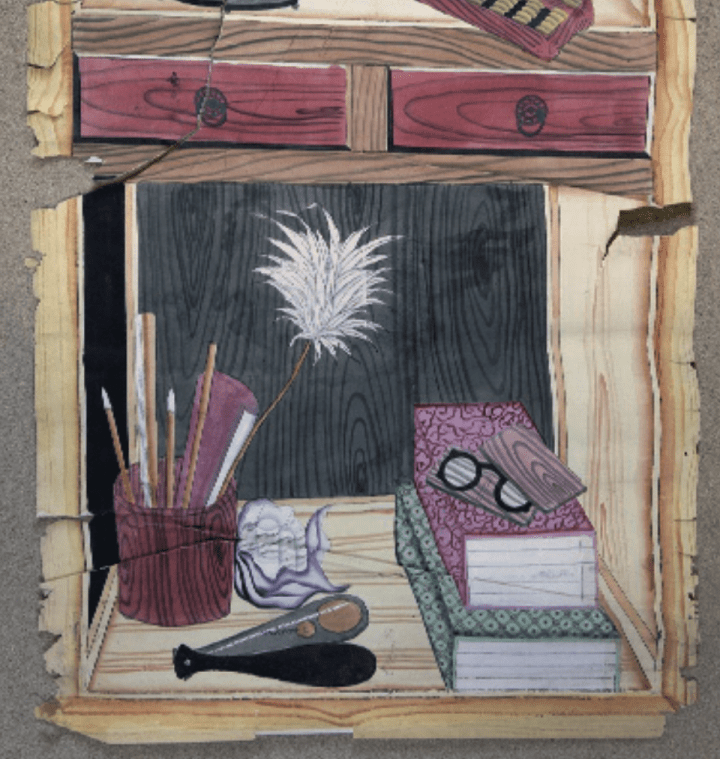
Wenfangtu, detail, ca. 1750, China, coloured woodblock print, 110 × 50 cm
(Stockholm: Nordiska Museet)
◊ ◊ ◊ ◊ ◊
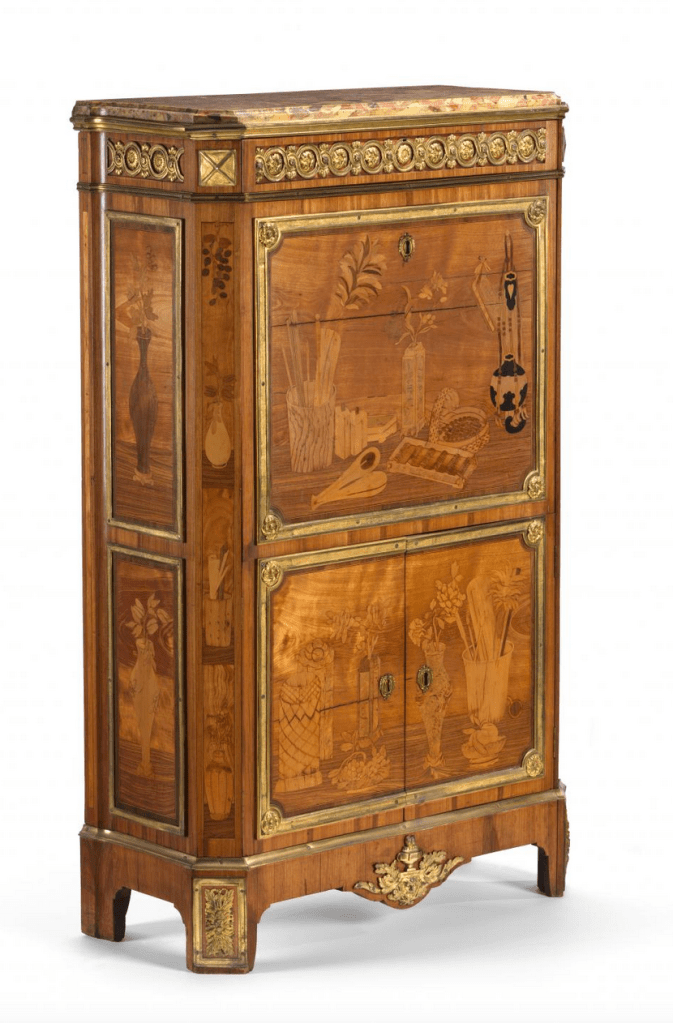
The long eighteenth century in the latest issue of Furniture History, from The Furniture History Society . . . I would particularly note the the article by Kee Il Choi, Jr, which identifies a category of Chinese woodblock prints (wenfangtu / 文房圖) as graphic source materials for marquetry panels of French furniture, especially pieces from the early 1770s—an alternative to the traditional assumption of carved Coromandel (kuancai) lacquer screens. In addition to being an ‘origins’ story, it’s fascinating material as the prints themselves raise myriad rich questions (wenfangtu are now known only from examples outside of China). –CH
 Furniture History 58 (2022)
A R T I C L E S
• Christopher Rowell, “The Carved Room at Petworth Revisited and Grinling Gibbons as an Auctioneer, Dealer, and Collector,” pp. 39–128.
• Kee Il Choi, Jr , “From Lieux to Meubles: Chinese Woodblock Prints and French Marquetry of the 1770s,” pp. 129–156.
• Irene Alessandra Meneghetti, “Transfer Printing on Wood: Research and Replication Based on Two Side Tables Attributed to Joseph Schneevogl,” pp. 157–174.
• Sarah Medlam, “Fit for a Prince: Seddon’s Cradle for Shiloh, the Prince of Peace, the Expected Child of Joanna Southcott, 1814,” pp. 175–198.
• Rufus Bird, “John Girdwood: A Modern Edinburgh Antiquary,” pp. 199–226.
A satinwood and marquetry secrétaire à abattant with gilt-bronze ormolu mounts, ca. 1775, France; stamped: René Dubois (maître, 1754–99), 137 × 84 cm (Melbourne: National Gallery of Victoria, 705.a-i-D4).










leave a comment