The Magazine of the Decorative Arts Trust, Summer 2023
The Decorative Arts Trust has shared select articles from the summer issue of their member magazine as online articles for all to enjoy. The following pieces are relevant to the eighteenth century:
The Magazine of the Decorative Arts Trust, Summer 2023

The magazine cover features Ickworth Hall, a site which Decorative Arts Trust members visited during a recent study trip to East Anglia.
• Matthew A. Thurlow, “Hervey Silver at Ickworth” Link»
• Debbie Miller, “Privies, Puzzles, and Pots: The Archaeology of Philadelphia Ceramics” Link»
• Jorge F. Rivas Pérez, “The Material World of the Spanish Colonial Estrado” Link»
• Foong Ping, “Chronicles of a Global East: Seattle Art Museum Exhibition Examines Silk Roads and Maritime Routes” Link»
• William Keyse Rudolph, “Luxury and Passion: Inventing French Porcelain at the Nelson-Atkins Museum of Art” Link»
• Bethany McGlyn, “Completing the Picture: New Research into Craft, Slavery, and Servitude in Early Lancaster” Link»
• Susan Eberhard, “Chinese Metalwork and English Restoration Silver in the ‘Chinese Taste’” Link»
The print Magazine of the Decorative Arts Trust is mailed to Trust members twice per year. Memberships start at $50, with $25 student memberships.
The Burlington Magazine, June 2023
The eighteenth century in the June issue of The Burlington (with apologies for being so slow to post, –CH) . . .
The Burlington Magazine 165 (June 2023)
 e d i t o r i a l
• “The Future of the RIBA Drawings Collection,” p. 583.
a r t i c l e s
• Tessa Murdoch, “Roubiliac and Sprimont: A Friendship Revisited,” pp. 600–11.
Recent research into the circles of Huguenot artists and craftsmen working in London in the mid-eighteenth century has provided new evidence about the friendship and working relationship between the sculptor Louis-François Roubiliac and the goldsmith Nicholas Sprimont. This lends weight to the belief that Roubiliac provided small models for casting in silver and bronze as well as for the porcelain manufactory co-founded by Sprimont in Chelsea in 1745.
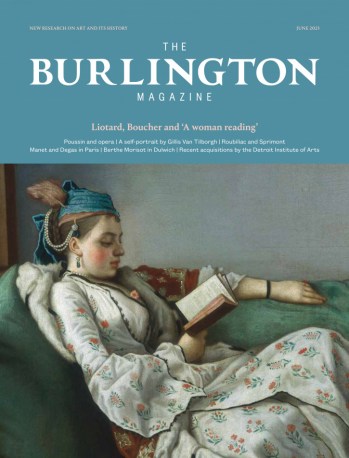
• Perrin Stein, “Liotard and Boucher: A Question of Precedence,” pp. 612–19.
There has been much debate about whether Liotard or Boucher invented the motif of a woman in Turkish costume reading a book while reclining on a sofa, which appears in both their work in the 1740s. New evidence that resolves the question highlights the very different ways these two artists constructed exoticism.
• Ann Gunn, “Titian’s Perseus and Andromeda: A Missing Link in the Chain of Provenance,” pp. 620–22.
• Simon Spier and Judith Phillips, “Joséphine Bowes’s Gift to Napoleon III: Antoine-Jean Gros’s Napoleon Distributing the Cross of the Legion of Honour to Artists during His Visit to the Salon of 1808,” pp. 626–29.
r e v i e w s
• Alexandra Gajewski, “The New Museum in the Bibliothèque Nationale, Paris,” pp. 630–37.
When in 1995–98 the books of the Bibliothèque nationale, Paris, were moved to their monumental new home in the west of the city, the library’s historic collections of antiquities, coins, medals, and other precious objects remained in the original complex of buildings in central Paris where they had been shown since the eighteenth century. Their reinstallation in the library’s newly restored museum rooms was opened last year.
• Kirstin Kennedy, Review of the exhibition Treasures from Faraway: Medieval and Renaissance Objects from The Schroder Collection (Strawberry Hill, 2023), pp. 641–43.
• Aileen Dawson, Review of the exhibition English Delftware (Bristol Museum and Art Gallery (from February 2023), pp. 652–54.
• Belinda Thomson, Review of the exhibition Berthe Morisot: Shaping Impressionism (Dulwich Picture Gallery, 2023), pp. 654–57. [In Paris, the show is entitled Berthe Morisot et l’art du XVIIIe siècle: Watteau, Boucher, Fragonard, Perronneau]
• J. V. G. Mallet, Review of Lilli Hollein, Rainald Franz, and Timothy Wilson, eds., Tin-Glaze and Image Culture: The MAK Maiolica Collection in its Wider Context (Arnoldsche Art Publishers, 2022), pp. 660–62.
• Clare Hornsby, Review of Andrew Robinson, Piranesi: Earliest Drawings / I primi disegni (Artemide Edizioni, 2022), pp. 666–67.
• G. A. Bremner, Review of Gauvin Alexander Bailey, The Architecture of Empire: France in India and Southeast Asia, 1664–1962 (McGill-Queen’s University Press, 2022), pp. 667–68
o b i t u a r y
• Peter Hecht, Obituary for Ger Luijten (1956–2022), pp. 675–76.
s u p p l e m e n t
• Recent Acquisitions (2016–22) of European Works of Art at the Detroit Institute of Arts
Call for Articles | Queerness in 18th- and 19th-C. European Art
From Arts:
Queerness in 18th- and 19th-Century European Art
Special Issue of Arts, edited by Andrew Shelton
Proposals due by 15 August 2023; final manuscripts due by 30 November 2023
A special issue of the international, peer-reviewed, open-access journal Arts dedicated to Queerness in 18th- and 19th-Century European Art and edited by Andrew Carrington Shelton (Department of History of Art, The Ohio State University) seeks essays on a wide variety of topics that subvert or disrupt heteronormative interpretations of the art and visual culture of this period. Topics to be addressed include, but are not limited to:
• Works of art produced by or under the auspices of personages who can plausibly be identified as attracted to members of the same sex
• Works or creative situations that can be construed as expressing or eliciting same-sex sexual desire or attraction
• Works or creative situations in which the heteronormative polarity of the processes of identification and desire can be perceived as having been collapsed or scrambled
• Works or creative situations that involve gender-bending or gender fluidity
• Works or creative situations that either deepen or complicate our understanding of sexuality and/or sexual identity
• Works that eroticize individuals or situations that are normally regarded as lying outside the realm of the erotic
Interested scholars should send an abstract (maximum 250 words) and CV to shelton.85@osu.edu, copying sylvia.hao@mdpi.com, by 15 August 2023. Final manuscripts must be submitted for blind peer-review no later than 30 November 2023. Due to journal restrictions, all articles must be submitted in English. Questions or concerns can be addressed to shelton.85@osu.edu or sylvia.hao@mdpi.com. More information is available here.
Print Quarterly, June 2023

Left: Edmé Jeaurat after Antoine Watteau, Talagrepo, Monk of Pégou, ca. 1731, etching and engraving, 24 × 17 cm (Cambridge, MA, Harvard Art Museums / Fogg Museum). Right: Gabriel Huquier after François Boucher, Flautist and Child Timpanist, ca. 1742, etching and engraving, sheet, trimmed 30 × 24 cm (New York, The Metropolitan Museum of Art).
◊ ◊ ◊ ◊ ◊
The long eighteenth century in the latest issue of Print Quarterly:
Print Quarterly 40.2 (June 2023)
A R T I C L E S

Roger Vandercruse Lacroix, Secretaire with Marquetry, ca. 1765, tulipwood, stained marquetry with bronze mounts and marble top, 114 × 73 × 38 cm (Private collection, Image courtesy Christie’s, London).
• Kee Il Choi Jr., “Watteau and Boucher Conjoined: Imagining China in Marquetry,” pp. 138–49.
This article examines the previously unknown pairing of Chinoiserie prints based on designs by Antoine Watteau (1684–1721) and François Boucher (1703–70) to create the pictorial marquetry veneered onto two nearly identical writing desks (secrétaires en armoire) attributed to the cabinetmaker Roger Vandercruse called La Croix or Lacroix (1727–99). Each cabinet retains traces of either the original engraving or the colour deployed to bring these ‘paintings in wood’ to life. This discovery not only exemplifies the role of prints in disseminating the chinoiseries of both Watteau and Boucher but also sheds light on the working practices of marqueteurs in eighteenth-century Paris.
• Lesley Fulton, “Johann Heinrich Wilhelm Tischbein’s Album of Prints in the British Museum,” pp. 150–69.
Fulton explores the Homeric subject matter and scenes depicted in the British Museum’s album of 81 previously unidentified etchings and engravings. Intended for Tischbein’s Vases and Homer projects, the etchings and engravings were prepared in Naples towards the end of the eighteenth century. Connections are made to motifs derived from painted vases and their relationship to Tischbein’s project for Sir William Hamilton’s Collection of Engravings from Ancient Vases (Naples and Germany, 1791–1803). Further analysis links the prints to the artist’s massive Illustrated Homer project in the first quarter of the 19th century. The paper highlights the discrepancy between the identification of an antique motif made in the late eighteenth century and how it is interpreted today. A contemporary document—probably a stocklist—from the Tischbein archive at Oldenburg in Germany, undated but drawn up between 1799 and 1808, has made it possible to identify the subject of each print and also to explain its original place in the album. The Appendix correlates the British Museum prints with their description as given in the Oldenburg document and also their correspondence with Tischbein’s various publication projects. Fulton concludes that the British Museum album probably served as a sales catalogue to which new material could be added as it arrived in the artist’s workshop.
N O T E S A N D R E V I E W S
• An Van Camp, Review of Gitta Bertram, Nils Büttner, and Claus Zittel, eds., Gateways to the Book: Frontispieces and Title Pages in Early Modern Europe (Brill, 2021), pp. 175–76. This edited volume presents fifteen essays on frontispieces and title-pages found in books printed between 1500 and 1800. Written by established academics as well as PhD candidates, the contributions explore how frontispieces intersect art and literature and how the printed images can be interpreted (contributions by Malcolm Baker, Martijn van Beek, Miranda L. Elston, Alison C. Fleming, Daniel Fulco, Lea Hagedorn, Constanze Keilhoz, Fabian Kolb, Hole Rößler, Delphine Schreuder, Alice Zamboni, and Cornel Zwierlein).
• Séverine Lepape, Review of Małgorzata Łazicka, ed., Old Master Prints from the 15th Century to the 1820s: German School, Barthel Beham and Sebald Beham. The Print Room of the University of Warsaw Library, Catalogue of the Collection (University of Warsay Library, 2019), pp. 176–78.
 • Michael Matile, Review of the exhibition catalogue, Kurt Zeitler, ed., Venedig, La Serenissima: Zeichnungen und Druckgraphik aus vier Jahrhunderten (Deutscher Kunstverlag, 2022), pp. 180–83. The Staatliche Graphische Sammlung in Munich recently presented a cross-section of its rich treasures of Venetian prints and drawings from the late fifteenth to the eighteenth century.
• Antony Griffiths, Review of Joyce Zelen, Blinded by Curiosity: The Collector-Dealer Hadriaan Beverland (1650–1716) and his Radical Approach to the Printed Image (Primavera Pers, 2021), pp. 186–89. The book focuses on Hadriaan Beverland’s activities during his last years, from 1680, which he spent as a ‘paranoid alcoholic drifting through the pubs and brothels of London’. He also assembled at least two little known manuscripts with new images composed of cut-out fragments of prints. The review highlights two portrait prints seemingly commissioned by Beverland himself which Griffiths believes ‘stand far outside the traditional canons of portraiture’, as well as the discovery by Zelen of a major sale of Beverland’s print collection held in 1690.
• Kristel Smentek, Review of Marianne Grivel, Estelle Leutrat, Véronique Meyer and Pierre Wachenheim, eds., Curieux d’Estampes. Collections et collectionneurs de gravures en Europe, 1500–1815 (Universitaires de Rennes, 2020), pp. 189–91. This review presents a swift overview of newly found documentary insights relating to individual and institutional collections of prints, largely focusing on French collectors and on the eighteenth century. Of the latter, mention is made of Albert Duke of Saxe-Teschen correspondences, Joseph-Dominique d’Inguimbert’s display practices, which included mounting between rollers, the collecting and marketing of French fashion prints, and the formation of print collections documenting the history of France, as was the case with Charles-Marie Fevret de Fontette.
• Mark McDonald, Review of Jessica Maier, The Eternal City: A History of Rome in Maps (University of Chicago Press, 2020) pp. 192–94. This review highlights interesting anachronistic features in topographical depictions of a reinvented Rome, for example, in Leonardo Bufalini’s woodcut map from 1551, the Baths of Trajan are depicted as a complete structure when it was in fact ruinous at the time. Further analysis pertains to the functions of printed maps, often as guides for pilgrims and secular tourists visiting important churches and historic sites.
• Christian Rümelin, Review of the exhibition catalogue, Celia Haller-Klinger, and Anette Michels, eds., Graphiksammler Ernst Riecker (1845–1918) und Otto Freiherr von Breitschwert (1829–1910) (Graphik-Kabinett Backnang, 2018), pp. 194–95. A review relating to two German collections formed around the turn of the nineteenth century, one of which focused on eighteenth- and nineteenth-century regional artists.
• Michael Matile, Review of the exhibition catalogue, Anne Buschoff, Marcus Dekiert and Sven Schütte, eds., Linie lernen: Die Kunst zu zeichnen (Wallraf-Richartz Museum & Fondation Corboud, 2021), pp. 195–96. This review pertains to a catalogue illustrating the history of drawing education from Cennino Cennini to their depictions in sixteenth- to eighteenth-century prints.
◊ ◊ ◊ ◊ ◊
Note (added 12 June 2023) — The original posting was updated to include reproductions of the two prints after Watteau and Boucher.
Cultural Heritage Magazine, May 2023

Cultural Heritage Magazine is published twice each year, in May and October by the National Trust:
Cultural Heritage Magazine, issue 2 (May 2023)
4 Welcome — Tarnya Cooper, the National Trust’s Curatorial and Conservation Director introduces the spring issue
6 Briefing: News, Events, and Publications, Plus Research and Conservation Round-ups
A la Ronde Interiors: The major project to conserve and repair this unique 18th-century property has now begun in earnest, with specialists working to secure the fragile and intricate decorative features. A la Ronde is a 16-sided house designed to catch the natural daylight through its unusual diamond-shaped windows as the sun moves around the building. The creation of Jane and Mary Parminter, two dynamic and well-travelled cousins who commissioned the house following their travels across Europe, it originally sat within a wider estate containing almshouses, gardens, a chapel and orchards.
14 In Conversation — John Orna-Ornstein talks to Tristram Hunt about design, creativity and the heritage sector today
24 Treasured Connections, Treasured Possessions: The Formation of Margaret Greville’s Collection — Richard Ashbourne, James Rothwell, and Alice Strickland
Treasured Possessions: Riches of Polesden Lacey — A major exhibition marking 80 years since Dame Margaret Greville left Polesden Lacey and her collection to the National Trust (1 March — 29 October 2023).
34 Dynamic and Resonant: The Sculpture of Anthony Twentyman at Dudmaston — Brendan Flynn
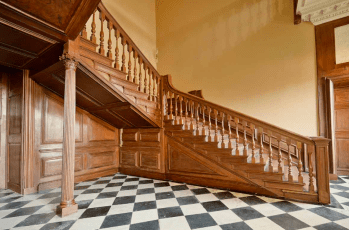
Old Staircase of Dyrham Hall, in 2019 after restoration, with old paint removed and completed graining (Photo: National Trust/David Evans).
40 Dyrham Transformed: Revealing Hidden Schemes and Re-examining Historic Narratives — Eilidh Auckland, Amy Knight-Archer and Claire Reed
Crossing the threshold back in 2015, there was a sense that something had been lost. Rooms and staircases had been painted white, decorative surfaces had deteriorated and spaces that had once glittered in candlelight seemed dimly lit and uninspiring. The National Trust’s project to transform the house, recently completed, has attempted to recapture something of its original vibrancy and dynamism and to enable visitors to step inside the world of the late 17th century. Historic schemes and historic narratives have been uncovered and unpicked, and the project concluded with the installation of new interpretation in January 2023. . . Senior National Curator Rupert Goulding’s research of the Blathwayt archives, which are scattered around the world, fuelled the core narrative.
Following this extensive research and preparation, those schemes that were anachronistic or failing were selected for re-presentation, with the aim of recreating the interiors of 1692–1710. This was the period in which the current house was built and furnished by William Blathwayt, then at the peak of his career.
As work to the main body of the house progressed, the stories it had to tell came into sharper focus. The building of the house at Dyrham Park took place in the early years of the transatlantic slave trade and William Blathwayt was one of the key colonial figures of that time. As Surveyor and Auditor General of Plantations, Blathwayt accounted for income due to the Crown from different royal colonies. He received part of his salary from colonies that were economically reliant on slavery—Barbados and Virginia each contributed £150 per year (the equivalent of around £18,000 today). Blathwayt’s house reflected his colonial connections. . .

From Melchisédech Thévenot, The Art of Swimming (1699) (National Trust Images/ Leah Band).
50 Sink or Swim: An Intriguing Manual from Kedleston’s Library — Nicola Thwaite
Melchisédech Thévenot (c.1620–92), a French diplomat fluent in several languages, was appointed Royal Librarian to Louis XIV in 1684. . . . Thévenot’s L’art de Nager—published posthumously in 1696—was largely based on De Arte Natandi by the English clergyman Everard Digby (d.1605), although there is only a brief acknowledgement of this in Thévenot’s preface. An English translation—The Art of Swimming—was published only three years later in two issues and both French and English editions were reissued over the next century, indicating a contemporary demand for instruction on the subject.
54 Shaped by Love and Loss: A Collection of Ancient Greek Vases at Nostell Priory — Abigail Allan
Nostell is full of treasures. Among the less well-known items is a group of painted Greek vases made in Athens and South Italy c.500–300BC, which were collected by John Winn (c.1794–1817) and his younger brother Charles (1795–1874). Mistakenly called ‘Etruscan’ until the mid-19th century, these 12 vases once belonged to a collection of over 130 at Nostell, sold at Christie’s in 1975 and 1998, before some were repurchased by the National Trust.
62 Loans: Selected Highlights, 2023
68 Meet the Expert: Lottie Allen, Head Gardener at Hidcote Manor, Gloucestershire
New Book | A Biographical Dictionary of RA Students, 1769–1830
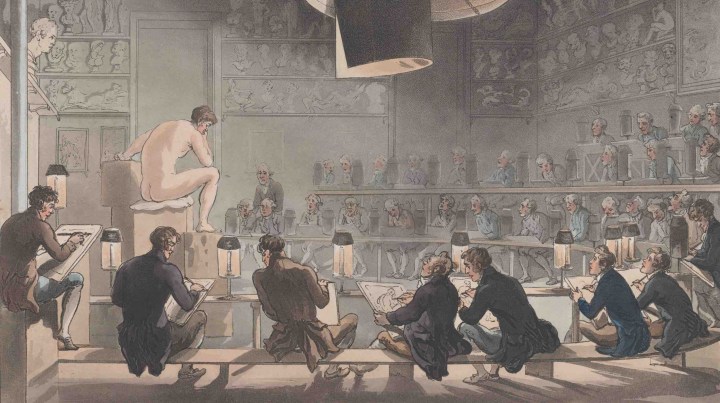
Thomas Rowlandson, Auguste Charles Pugin, and John Bluck, Drawing from Life at the Royal Academy, (detail), 1808, hand-coloured etching and aquatint, sheet: 28 × 34 cm (New York: The Metropolitan Museum of Art, New York, Elisha Whittlesey Collection, 59.533.2084).
◊ ◊ ◊ ◊ ◊
Recently published by The Walpole Society:
Martin Myrone, “A Biographical Dictionary of Royal Academy Students, 1769–1830,” The Walpole Society 84 (2022).
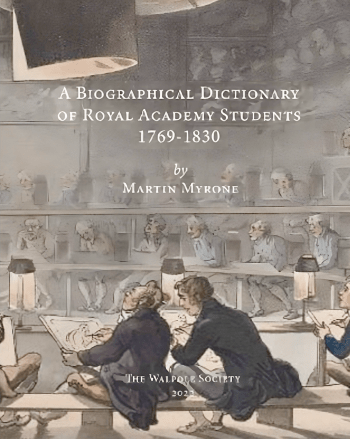 An essential new reference work for students of 18th- and 19th-century British art, Martin Myrone’s A Biographical Dictionary of Royal Academy Students 1769–1830 records every student known to have attended the RA schools in London during its first six decades. The book contains 1,800 biographical entries and draws on extensive new archival research, offering a comprehensive account of the extraordinarily diverse life stories of former RA students and an unprecedented overview of British art during the Romantic period. It provides a revealing new context for such familiar figures as John Constable, William Blake, and J.M.W. Turner, and a wealth of fresh information about three generations of obscure, forgotten, or previously unknown British painters, sculptors, engravers, and architects. As the first national art school, enjoying Royal patronage, prestige, and prominence, the Royal Academy has a pivotal role in British art history, with almost every notable figure of the era passing through its walls.
Martin Myrone is Head of Grants, Fellowships, and Networks at the Paul Mellon Centre for Studies in British Art, London.
A Biographical Dictionary of Royal Academy Students 1769–1830 is for sale to the general public exclusively through Thomas Heneage Art Books, London. It is also available free online and to download for members of the Walpole Society via their newly launched website, where a growing number of volumes can be found in a dedicated member’s area. Members of the Walpole Society support the research and publication of British art history; membership subscriptions—starting at only £20 annually for a student membership—contribute to the cost of producing new volumes, and, in return, members receive a free copy of the current year’s volume, either as a digital file or a hardback book.
The Walpole Society was formed in 1911 chiefly through the efforts of Alexander Finberg (1866—1939), who had been employed to arrange the paintings in the bequest of J.M.W. Turner. In the course of his work, Finberg saw that many artists of the 18th century lay unrecognised, and established the Society to address this lack of knowledge and to shine a light on earlier periods which were then entirely neglected. The Society was named after Horace Walpole (1717—1797), who published the first history of art in Britain, basing his work on the manuscript notebooks of George Vertue (1684—1756), which he had acquired. One of the first goals of the Walpole Society was to publish the notebooks in their original form, which included much material that Walpole omitted. This took up six volumes as well as an index volume, and was finally completed in 1950. This publication is the single most important source of information concerning art collections, artists, architects, and craftsmen working in Britain before the mid-18th century. They form part of more than 80 volumes that the Society has so far published containing articles, catalogues, and editions of original documents.
Call for Articles | Thresholds 52: Disappearance
From the Call for Papers via e-flux:
Thresholds 52: Disappearance, Spring 2024
Edited by Samuel Dubois and Susan Williams
Submissions of about 3000 words due by 15 June 2023 (extended from 1 June 2023)
Thresholds, the annual peer-reviewed journal produced by the MIT Department of Architecture and published by MIT Press, is now accepting submissions to be published Spring 2024.
 Some disappearances are pointedly more conspicuous than others. In 1983, magician David Copperfield ominously dropped a curtain revealing an empty black sky, having just made the Statue of Liberty vanish from sight. As Lady Liberty’s disappearance was watched with amazement by television viewers, Copperfield cautioned his audience: “Sometimes we don’t realize how important something is until it is gone.” Constructing illusions, playing tricks, and deceiving audiences, magicians challenge what is real, imagined, or just an illusion of the eye. But even a playful disappearance in a magic trick can reveal deeper implications.
Thresholds 52: Disappearance will explore the ways art and architecture negotiate the elusive topic of disappearance. We seek contributions that aim to discover how disappearances are spatially manifested (material/symbolic, living/non-living, human/non-human) and how the appearances of certain things have led to the disappearances of others. Submissions can address any time period or geographic setting. We are interested in scholarly articles and other artistic and intellectual contributions that engage the notion of disappearance by clarify, complicate, and challenge our collective understandings of architecture, art history, and other related disciplines and practices.
Disappearance is an ambiguous term—an occurrence, a process, or an outcome. While a disappearance can stay within the binary state of visibility to invisibility, it can also make something become less common through a slow process towards non-existence. If disappearance itself is a fascinating subject, what enables something to survive after its raison d’être disappears may be just as intriguing. Scientific determinism tells us that, materially speaking, nothing actually disappears. The law of mass conservation establishes that while matter can neither be created nor destroyed, it can be rearranged in space. But this scientific truth becomes convoluted when the lived spatial and visual experiences of humans are accounted for. How can these two opposing views exist—or not exist—within the same world?
Disappearances can be manifested in various ways, scales, and contexts:
• stolen art and historical artifacts
• start and end of various artistic movements or media
• visualization and spatial design as strategies of tracking disappearance
untraceable actions of internet culture
• phantasmagoric vanishing experiences in haunted spaces
• dematerialization of analog skills in architectural design and practice
• concealed or implied structural systems over real structures
• construction sites intrinsically being replaced with actual buildings
• disappearance of materials and techniques when better ones emerge
• sinking of coastal cities
• evaporating biodiversity
• or just anything or anyone hidden in plain sight
Please send your submission to thresh@mit.edu. Written submissions should be in English, approximately 3000 words in length, and formatted in accordance with the current Chicago Manual of Style. All submissions should include a cover letter (maximum of 200 words) as well as a biography (maximum of 50 words) and contact information for each author. Text submissions should be sent as .doc files. Where applicable, images should be submitted at 72 dpi as uncompressed .tif files. All scholarly submissions are subject to a double-blind peer review. Other creative proposals are not limited in size, medium, or format.
Call for Essays | Studi Neoclassici
From ArtHist.net:
Studi Neoclassici: Rivista internazionale 11 (2023)
Submissions due by 30 June 2023
The journal Studi Neoclassici—created to publish the results of the activity promoted by the ‘Istituto di ricerca per gli studi su Canova e il Neoclassicismo’ (‘Research Institute for Studies on Canova and Neoclassicism’) of Bassano del Grappa—has been a tool for disseminating research of the Edizione Nazionale delle Opere di Antonio Canova (‘’National edition of the works of Antonio Canova’), that converges in the critical editions of the enormous Canova’s epistolary, with the historical, biographical, stylistic insights that matter requires. The major scholars of Neoclassicism constitute the scientific and editorial council of the journal. The magazine proposes itself to the attention of scholars in various fields of research, from history to literature, from archeology to art history, from the history of culture to art criticism to the history of collecting, from the history of music to that of dance and costume. Journal articles follow the same methodological approach that characterized the “Canovian Weeks”, that is connecting different artistic and cultural experiences, from literature to art history, to history and to other arts included in the historical period between second half of the eighteenth and the first decades of the twentieth century, with the intention of proposing a complete and not only specialized picture of the theme.
Studi Neoclassici publishes monographic numbers and free topic numbers relating to the historical period of the journal, the texts of which, selected through a Call for Papers procedure, are all—except for rare and justified exceptions—subject to peer review by a ‘double blind’ procedure. In the case of the aforementioned exceptions it is the management, in its collegiality, that after careful examination assumes the responsibility of accepting the texts. Issue number 11 (2023) will host free articles and one / two reviews of volumes relating to the period covered by the magazine, edited in 2021 and 2023.
The editorial rules are available here. Texts can be presented in Italian, German, French, English, or Spanish; must not exceed 35,000 characters (spaces and notes included); and must be sent by 30 June 2023 to the journal’s scientific directors: giuliana.ericani@gmail.com and gianpavese@gmail.com.
The Burlington Magazine, April 2023
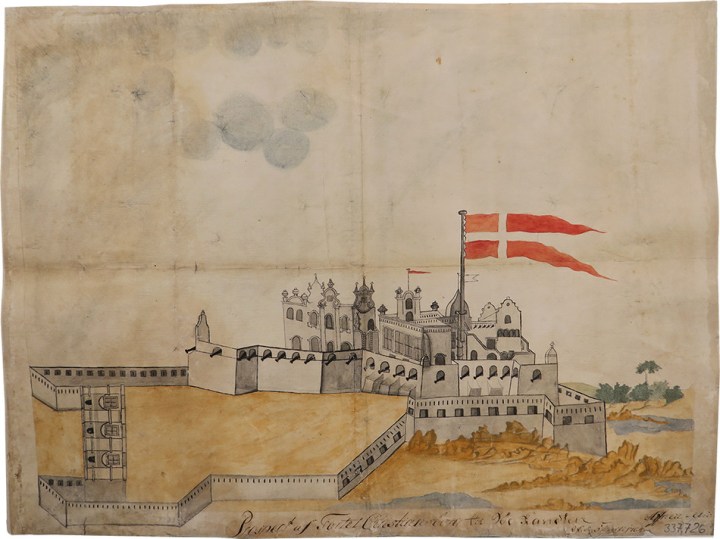
View of Fort Christiansborg [Christiansborg Castle, Osu] from the Shore, March 1764, ink and coloured wash on paper
(Danish National Archives)
◊ ◊ ◊ ◊ ◊
The eighteenth century in the April issue of The Burlington . . .
The Burlington Magazine 165 (April 2023)
A R T I C L E S
• Gauvin Alexander Bailey, “The Design of Cape Coast Castle and Dixcove Fort, Ghana,” pp. 378–93.
The first analysis of the design of two of the principal eighteenth-century British slave castles and forts of the Gold Coast reveals the Western engravings used as prototypes but also acknowledges these buildings’ engagement with African cultures and forms. Identifying the people who built them and assessing the forts’ association with the coastal African community challenges the popular misconception that they were no more than European transplants.
R E V I E W S
 • Morlin Ellis, Review of the exhibition Spain and the Hispanic World: Treasures from the Hispanic Society Museum and Library (Royal Academy of Arts, 2023), pp. 442–45.
• Simon Jervis, Review of the exhibition catalogue, Reinier Baarsen, Process: Design Drawings from the Rijksmuseum 1500–1900 (Rotterdam: 2022), pp. 456–58.
• Philip Ward-Jackson, Review of the exhibition catalogue, Yvette Deseyve, ed., Johann Gottfried Schadow: Embracing Forms (Hirmer Verlag, 2023), pp. 463–66.
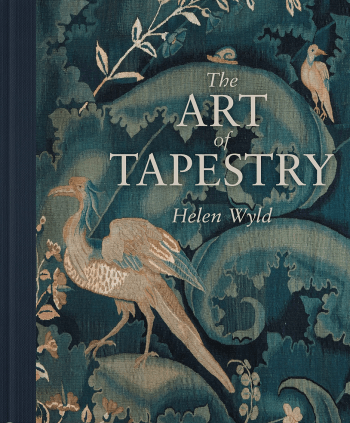
• Thomas P. Campbell, Review of Helen Wyld, The Art of Tapestry (Philip Wilson Publishers, 2022), pp. 472–75.
• Charles Saumarez Smith, Review of András Szántó, Imagining the Future Museum: 21 Dialogues with Architects (Hatje Cantz, 2022), pp. 482–83.
• John Martin Robinson, Review of Dudley Dodd, Stourhead: Henry Hoare’s Paradise Revisited (Head of Zeus, 2021), pp. 484–85.
O B I T U A R I E S
• Christopher Wood, Obituary for Hans Belting (1935–2023), pp. 486–88.
British Art Studies, March 2023
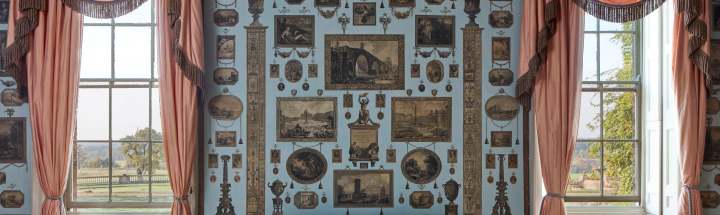
West Wall of the Print Room at Woodhall Park, Hertfordshire, created in 1782 by R. Parker.
Photographed in 2023 Matthew Hollow.
◊ ◊ ◊ ◊ ◊
The long eighteenth century in the latest issue of British Art Studies (lots of fascinating material; I’m especially taken by the videos that accompany Kate Retford’s article: they’re fabulous, particularly the one on ‘Making the Print Room’. –CH)
British Art Studies 24 (March 2023)
“Monuments Must Fall,” a ‘Conversation Piece’ convened by Edwin Coomasaru, with responses by Jodie Dowd and Nathan mudyi Sentance, Sasanka Perera, Wendy Bellion, Chrislyn Laurie Laurore, Stacy Boldrick, Joan Coutu, Emma Mahony, Nomusa Makhubu, Nickolas Lambrianou, and Raqs Media Collective.
‘Conversation Piece’ is a British Art Studies series that draws together a group of contributors to respond to an idea, provocation, or question.
Monumentality is an aesthetic form of social antagonism. . . . Many monuments are erected to do controversial work, and while they may proclaim a matter resolved or a problem consolidated, the reactions to them (sometimes long after they have been placed on pedestals) actually demonstrate the opposite is often the case. Monuments are not solely statues. Monumentality is the discursive space that surrounds certain public sculptures, including demands they be pulled down or protected, which can erupt into spontaneous or managed removal. Such a discursive space is inherently unstable, which is why most monuments ultimately must fall, physically or conceptually: either by being toppled or by having their original intentions obliterated and reimagined. . . .
Monuments are not simply physical structures, nor empty symbols, but are shaped by either social support systems that erect and conserve them, or by forms of social conflict which contest and topple them. The discursive space around a public statue, from protest to press coverage, and its translation into material conditions, is the making of its monumentality. . . .
Edwin Coomasaru’s essay and the ten responses are available here»
Kate Retford, “Cutting and Pasting: The Print Room at Woodhall Park.”
This article explores the exemplary surviving print room at Woodhall Park in Hertfordshire, created in 1782 for Sir Thomas Rumbold. A professional named “R. Parker” pasted more than 350 prints around the walls of this interior; the results were then carefully recorded in a catalogue and set of elevation diagrams. The first section, ‘Space’, analyses the print room within the broader context of the house, in order to connect exterior and interior, explore the relative qualities of ‘public’ and ‘private’ space, and consider neoclassical style as worked out in various media. The second, ‘Display’, unpacks the pasted scheme, looking at the relationship between ‘background’ images and ‘starring’ works, and that between iconography and pattern-making. The final part explores ‘Making’, analysing the processes by which prints were selected, trimmed, given paper borders, and arranged around the walls. This discussion considers both the degree to which the intermedial object of the reproductive print was translated into a trompe l’œil painting or sculpture in such schemes, and the creative work of collaging at play. The analysis in this article weaves together textual discussion with still and moving images, film, and animation. Combining these techniques, it aims to provide full documentation and analysis of the scheme, and to engage with embodied, mobile, and temporally determined viewing experience in both the house and the print room.
Article available here»
Melissa L. Gustin, “Do Sleeping Shepherds Dream of 3D-Printed Sheep: John Gibson, Oliver Laric, and Digital Neoclassicism.”
This article considers the relationship between John Gibson’s neoclassical sculpture The Sleeping Shepherd Boy [designed 1818] and Oliver Laric’s installations for the 2016 Liverpool Biennial using 3D models and prints of the Shepherd. These bodies of work allow us to think about their similarities in attitude towards imitation, the significance of the ‘neoclassical’ across different historic moments, and the cultures of copying or reproduction. It looks at the reproductive technologies of 3D scanning, printing, CNC milling, and digital remixing alongside historical reproductions such as casts and copies. These offer new potentially disruptive—but not destructive—opportunities within the legacy of neoclassical practices. The intellectual and artistic inheritance of neoclassical sculpture as an imitative practice after Greek and Roman antiquity informs Laric’s sculptural work. I draw on Alexander Nagel and Christopher Wood’s Anachronic Renaissance (2010) and George Kubler’s The Shape of Time (1968) to discuss Laric’s modular, large-scale 3D prints, which point towards issues of replacement, imitation, and wholeness. The open-source 3D models he produces as part of his practice are then used by other artists, including Zachary Eastwood-Bloom in his Divine Principles series, and the author, for making research objects.
Article available here»










2 comments