Print Quarterly, December 2023

J. J. Grandville, after Francisco de Goya, And So Was His Grandfather (‘Hasta su abuelo’), 1834, graphite, over stylus indentations, 79 × 119 mm
(Nancy: Musée des Beaux-Arts)
◊ ◊ ◊ ◊ ◊
The long eighteenth century in the latest issue of Print Quarterly:
Print Quarterly 40.4 (December 2023)
a r t i c l e s
• Thea Goldring, “Beyond Siberia: Drawings by Le Prince for the Histoire Générale des Voyages,” pp. 391–406.
This article examines two signed and dated drawings by Jean-Baptiste Le Prince (1734–1781) that were acquired by the Metropolitan Museum of Art in 2012 and identifies their origins and purpose, proving Le Prince’s hitherto unknown participation in the Histoire Générale des Voyages project. The author discusses their relationship with the commissioned illustrations to Voyage en Sibérie by Jean Chappe d’Auteroche (1728–1769), as well as Le Prince’s contribution to other illustrated books. Throughout the paper, there is a detailed analysis of his common practice to appropriate and modify visual information from earlier sources, reworking them for illustrated travel texts.

Jean-Baptiste Le Prince, Inuit Manner of Dress, 1769, pen and black ink, brush and grey wash, over black chalk, with additions in graphite, 170 × 120 mm (New York: The Metropolitan Museum of Art).
• Paula Fayos-Pérez, “La Fontaine, Goya, Grandville: A Study of Visual and Literary Sources,” pp. 406–419.
This article considers how J.J. Grandville (1803–1847) was deeply influenced by Francisco de Goya y Lucientes (1746–1828), particularly how the plates from the Caprichos inspired the former’s illustrations to Jean de la Fontaine’s Fables and other illustrated books. Incidentally, Goya had also previously derived his sources for the Caprichos and Desastres de la Guerra from earlier illustrations to La Fontaine’s 17th-century text. In doing so, the interconnection of literary and visual sources in both artists is revealed, highlighting their shared concern for public education and masked political undertones.
n o t e s a n d r e v i e w s
• Tim Clayton, Review of David Alexander, A Biographical Dictionary of British and Irish Engravers, 1714–1820 (Paul Mellon Centre for Studies in British Art and Yale University Press, 2021), pp. 442–43.
This review is just as much a praise of David Alexander’s research methods and resourcefulness as it is to the book’s groundbreaking contributions in this field. Clayton highlights the book’s revelations concerning invisible women engravers, who often worked alongside and carried on the business after their husbands had died. In keeping with Alexander’s wide area of focus, the book also includes native and foreign engravers in branches of the trade outside of fine art, leading to a far more expansive and representational dictionary than previous ones.
• Alexandra C. Axtmann, Review of Dominique Lerch, Kristina Mitalaité, Claire Rousseau and Isabelle Seruzier, eds., Les Images de Dévotion en Europe XVIe–XXIe Siècle. Une précieuse histoire (Bibliothèque Beauchesne, 2021), pp. 477–79.
This review summarises a copious book based on papers presented at a two-day conference in Paris in 2019 organized by the Dominican library of Le Saulchoir together with the Académie des Inscriptions et Belles-Lettres. The content offers a European-wide perspective on small printed devotional prints that are often considered ‘kitsch’, enabling them to be studied with a variety of approaches concerning their creation, function, and reception up to the present day.
New Book | Liotard: A Portrait of Eighteenth-Century Europe
In October, Christopher Baker was announced as the incoming editor of The Burlington Magazine (replacing Michael Hall, who has held the position since 2017). Baker’s book on Liotard has just been published in the UK by Unicorn and will be available in the US market soon.
Christopher Baker, Liotard: A Portrait of Eighteenth-Century Europe (Lewes: Unicorn Publishing Group, 2023), 176 pages, ISBN: 978-1911397595, £30 / $45.
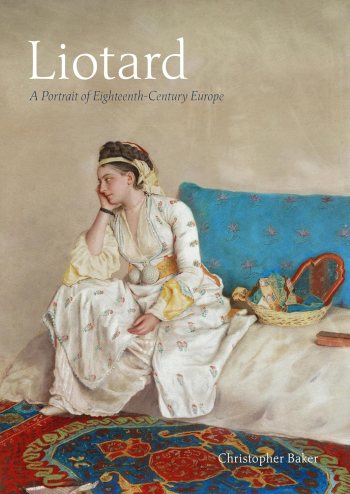 Jean Etienne Liotard (1702–1789) was one of the most accomplished, idiosyncratic, and witty artists of eighteenth-century Europe. Born in Geneva, he pursued a remarkable career, travelling across the continent and the Near East, portraying a riveting cross-section of society. Liotard worked in Paris, London, Amsterdam, Venice, Constantinople, and Vienna and excelled as a specialist in the delicate art of pastel. He became renowned for the uncanny realism of his portraits as well as the beauty of his drawings, while also experimenting with watercolour, oil painting, printmaking, and enamels. In Britain he enjoyed notoriety because of his exotic persona, and received commissions from royalty, aristocrats, grand tourists, and celebrities. Liotard: A Portrait of Eighteenth-Century Europe plots the career and practice and reputation of an extraordinary artist who deserves to be better known. This new study throws light on the wider cultural environment he navigated, illuminating connected themes, including fashion history, orientalism, and the promotion and display of portraits in the public and private spheres of Enlightenment Europe.
Christopher Baker is an art historian, curator, and author; he has been a Director at the National Galleries of Scotland and worked at Christ Church, Oxford, and the National Gallery in London. Christopher has also held Visiting Fellowships at Yale University and the British School in Rome and organised numerous highly successful exhibitions, chiefly on 18th- and 19th-century British and European art and the history of collecting.
The Burlington Magazine, November 2023
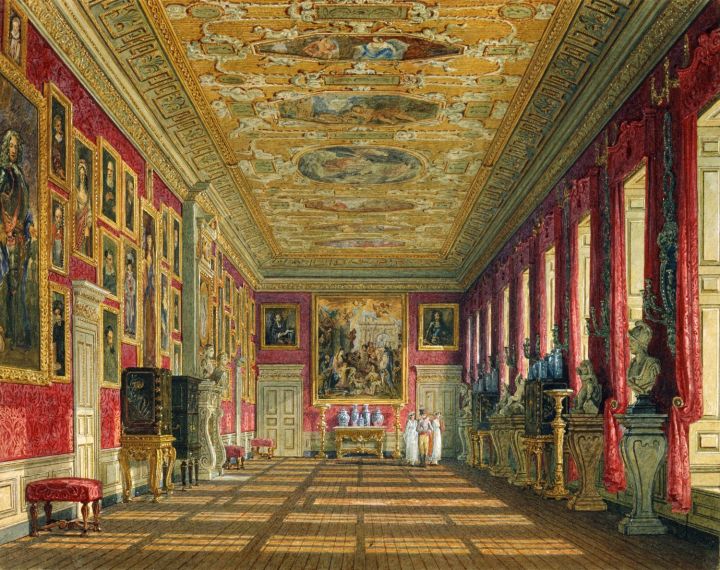
Charles Wild, Kensington Palace: The King’s Gallery, 1816, watercolour with touches of bodycolour over etched outlines, 20 × 25 cm c
(Royal Collection Trust, 922158)
◊ ◊ ◊ ◊ ◊
The eighteenth century in the November issue of The Burlington, which focuses on sculpture:
The Burlington Magazine 165 (November 2023)
e d i t o r i a l
• History of Art after Brexit, p. 1171.
It is probably fair to say that the United Kingdom’s withdrawal from the European Union in 2020 as a consequence of the referendum of 2016 was not greeted with much enthusiasm by professional art historians. The subject as it has developed over the past century is by its very nature transnational in outlook.
 a r t i c l e
• Jonathan Marsden, “George I’s Kensington Palace: The Sculptural Dimension,” pp. 1196–1205.
William Kent’s decoration of the new state rooms at Kensington Palace, London, for George I in 1722–27 has long been recognised as a pioneering exercise in neo-Palladianism. It was also an early example of the use of Classical sculpture in English interiors, a development in which Michael Rysbrack played a larger role than has formerly been recognised.
s h o r t e r n o t i c e
• Nicola Ciarlo, “Domenico Guidi in Padula: A Rediscovered Annunciation,” pp. 1206–09.
r e v i e w s
• Adriano Aymonino, “Albanimania,” pp. 1214–19.
A series of recent publications has turned the spotlight on Cardinal Alessandro Albani—described by Winckelmann as ‘the greatest patron in the world’—his villa in Rome, and collection of Classical antiquities, which have become newly accessible to scholars and the public after decades of seclusion.
• Heather Hyde Minor, Review of the exhibition catalogue, Victor Plahte Tschudi, Piranesi and the Modern Age (Nationalmuseum, Oslo / MIT Press, 2022), pp. 1239–41.
• Adam Bowett, Review of Ada De Wit, Grinling Gibbons and His Contemporaries (1650–1700): The Golden Age of Woodcarving in the Netherlands and Britain (Brepols, 2022), pp. 1247–49.
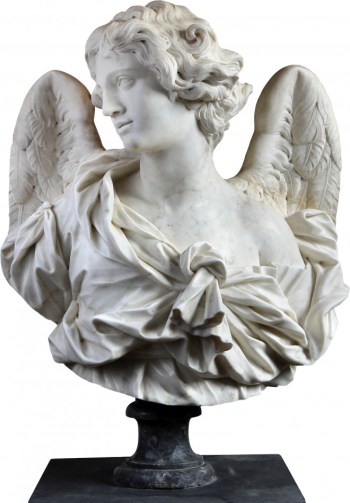
Archangel Gabriel, attributed by Nicola Ciarlo to Domenico Guidi, ca.1699–1701, marble, 94 × 81 × 39 cm, with socle (Padula: Charterhouse of S. Lorenzo).
• Marjorie Trusted, Review of Jan Zahle, Thorvaldsen: Collector of Plaster Casts from Antiquity and the Early Modern Period, 3 volumes (Thorvaldsens Museum and Aarhus University Press, 2020), pp. 1249–50.
• Natacha Coquery, Review of Iris Moon, Luxury after the Terror (Pennsylvania State University Press, 2022), pp. 1254–56.
• Joshua Mardell, Review of Jane Grenville, Pevsner’s Yorkshire, North Riding (Yale University Press, 2023), pp. 1256–57.
o b i t u a r y
• Paul Williamson, Obituary for Michael Kauffmann (1931–2023), pp. 1258–60.
Keeper of the Department of Prints & Drawings and Paintings at the Victoria and Albert Museum and subsequently Director of the Courtauld Institute of of Art, Michael Kauffmann was a scholar with a remarkable breadth of interest, as well as a widely respected and sensitive administrator and manager.
s u p p l e m e n t
• “Recent Acquisitions (2007–2023) of European Sculpture at the Victoria and Albert Museum, London,” pp. 1261–68.
Seventeen years have passed since the publication of the last supplement in this Magazine describing the recent sculpture acquisitions made by the Victoria and Albert Museum, London (V&A). The present supplement therefore highlights a selection of the most noteworthy works acquired in the intervening years.
Call for Articles | On Borders and Boundaries
From the Call for Papers:
On Borders / Boundaries in Art and Art History | O granicach w sztuce i historii sztuki
Artium Quaestiones 35
Proposals due by 10 December 2023, with full texts due by 25 February 2024
Artium Quaestiones is an academic journal published by the Department of Art History at Adam Mickiewicz University in Poznan, Poland.
The problem of borders/boundaries in art history, both ancient and modern, recurs in various guises and meanings. A border as a dividing line—structuring political, national, or regional geography—is often an object of conflict that translates into both artistic practices and discourses that attempt to systematize and qualify art created in a given area, thus influencing artistic geography. Art is often an attempt to answer or problematize borders on the grounds of cultural, economic, or racial, differences. This is the subject of the recently opened exhibition at the National Museum in Poznań, About Sharing: Art on the (Polish-German) Border, curated by Marta Smolińska and Burcu Dogramaci, or the numerous art and exhibition projects dealing with the US-Mexican or Israeli-Palestinian borders (border art). The ongoing war in Ukraine also forces us to rethink the problem of the border and identity in art.
However, a border can also be viewed more abstractly, as a boundary, a line that delineates structures and systems of practices and discourses that seek to define identity, to classify and create hierarchy. Delimitations of this type characterized modernity (modernism) in the broad sense of this term. They were, however, eventually challenged by postmodern (poststructuralist) thought and post- and decolonial studies that favored the porosity and fluidity of previously constructed divisions, and thus of identities and their associated systems of meaning. The undecidable nature of a border (a division, boundary or a frame)—and, more broadly, of the established relationship between the hierarchically established center and the margin—was long ago discussed by Jacques Derrida in terms of parergon, and theorists such as Gilles Deleuze introduced conceptual constructs that invalidated borders/boundaries as lines of division altogether. These revaluations clearly pointed out the impossibility of sustaining thinking about borders as impermeable lines—physical and conceptual—demonstrating the necessity of thinking of them in terms of a field of difference, interpenetration, hybridization, a zone that can be both conflictual and highly productive and creative.
We encourage submissions that will address the problem of the border/boundary, with a particular focus on various attempts to theorize it, reflect on the contemporary condition of these concepts and their functioning in both contemporary artistic practices, art-historical discourse and reevaluations of the state of knowledge on the art of the past. Among other things, we will be interested in
• attempts to theorize the category of the border/boundary—both physical and conceptual—in the field of art history or visual culture studies
• problematized and theoretically framed case studies of art, including architecture, dealing with the problem of territorial, interstate, regional borders (including so called border art)
• issues of artistic geography, the establishing and/or questioning of cultural and ethnic borders/divisions through artistic and/or architectural practices
• a border/boundary as an issue of architectural practice, planning and landscape design
The deadline for submissions of abstracts (maximum of 2,500 characters) and a short academic bio is 10 December 2023. Authors of qualified abstracts will be asked to submit a full text of a maximum length of 45,000 characters (including an appendix bibliography) by 25 February 2024. All texts, with prior approval of the editorial team, will undergo a double-blind peer review. Please submit proposals via pressto. Contact an editor board at aq.redakcja@amu.edu.pl.
The Burlington Magazine, October 2023
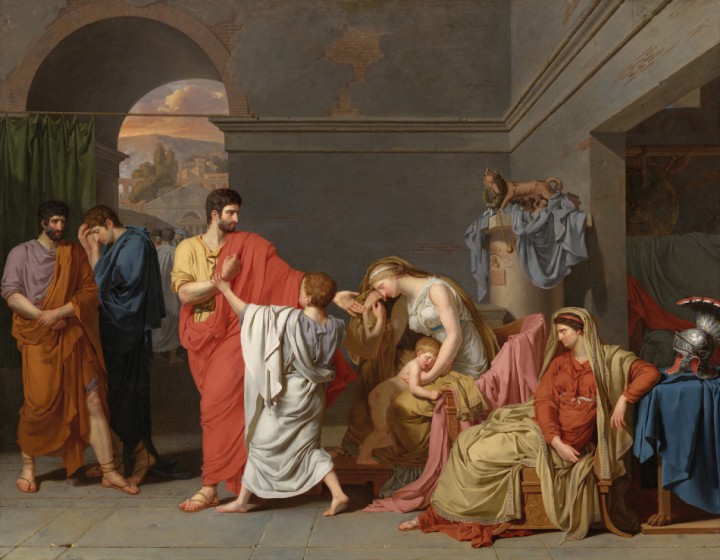
Anne-Louis Girodet de Roussy-Trioson, Coriolanus Taking Leave of His Family, 1786, oil on canvas, 114 × 146 cm
(National Gallery of Art, Washington)
◊ ◊ ◊ ◊ ◊
The eighteenth century in the October issue of The Burlington:
The Burlington Magazine 165 (October 2023)
a r t i c l e
• Aaron Wile, “Girodet’s Coriolanus Taking Leave of His Family Rediscovered,” pp. 1094–1105.
In 2019 Girodet’s lost entry for the 1786 Grand prix de peinture came to light and was acquired by the National Gallery of Art, Washington. The painting, which depicts a rarely represented incident from the story of Coriolanus—a subject that may have had contemporary political relevance—was not awarded the prize, probably because Girodet was regarded as being too close to Jacques-Louis David, a relationship to which the work may allude.
s h o r t e r n o t i c e
• Antoinette Friedenthal, “Image of a Connoisseur: An Unknown Portrait of Pierre Jean Mariette,” pp. 1106–10.
Among the unpublished miniatures in the Victoria & Albert Museum, London (V&A), is an eighteenth-century bust-length portrait of a middle-aged gentleman. A basic unillustrated inventory sheet for this work appeared in 2020 on the museum’s website. It stated that the portrait represents Pierre Jean Mariette (1694–1774) but gave no reasons for this identification and did not provide any information on the object’s provenance. It will be argued here that a combination of visual and documentary evidence confirms the identification.
r e v i e w s
 • Mark Bill, Review of the exhibition Reframing Reynolds: A Celebration (The Box, Plymouth, 2023), pp. 1124–27.
• Stephen Lloyd, Review of the refurbished Medieval, Renaissance, and Baroque galleries at the Walker Art Gallery, Liverpool, pp. 1130–33.
• Beth McKillop, Review of the exhibition China’s Hidden Century (The British Museum, London, 2023), pp. 1136–38.
• Satish Padiyar, Review of the exhibition Sade: Freedom or Evil (CCCB, Barcelona, 2023), pp. 1143–46.
• Malcolm McNeill, Review of Anne Farrer and Kevin McLoughlin, eds., Handbook of the Colour Print in China, 1600–1800 (Brill, 2022), pp. 1150–52.
• Edward Cooke, Review of Elisa Ambrosio, Francine Giese, Alina Martimyanova, and Hans Bjarne Thomsen, eds., China and the West: Reconsidering Chinese Reverse Glass Painting (De Gruyter, 2022), pp. 1152–53.
• David Ekserdjian, Review of the catalogue, Denise Allen, Linda Borsch, James David Draper, Jeffrey Fraiman, and Richard Stone, eds., Italian Renaissance and Baroque Bronzes in the Metropolitan Museum of Art (The Metropolitan Museum of Art, 2022), pp. 1156–58. The book is available as a free PDF The Met’s website.
• Rowan Watson, Review of Christopher de Hamel, The Posthumous Papers of the Manuscripts Club (Allen Lane, 2022), pp. 1160–62.
• Stefan Albl, Review of Francesco Lofano, Un pittore conteso nella Napoli del Settecento: L’epistolario e gli affari di Francesco de Mura (Istituto Italiano Studi Filosofici, 2022), pp. 1163–64.
Cultural Heritage Magazine, October 2023

Detail from one of a pair of Spanish-colonial screens depicting a landscape in the Japanese style, possibly made in Mexico City, perhaps 1660s, pigments on paper embellished with embossed and gilded clouds and arches, each screen 249 × 340 cm (Ham House, Surrey, NT 1139576, photograph by Leah Ban).
◊ ◊ ◊ ◊ ◊
Cultural Heritage Magazine is published twice each year, in May and October by the National Trust:
Cultural Heritage Magazine, issue 3 (October 2023)
4 Welcome — John Orna-Ornstein, the National Trust’s Director of Curation and Experience, introduces the autumn issue
6 Briefing: News, events, and publications, plus research and conservation round-ups
Taking the plunge | Archaeological excavations in the basement below Bath Assembly Rooms have revealed the remains of a rare 18th-century cold bath. It is thought to be the only one of its kind located in a historic assembly room, which in the 18th and 19th centuries was a popular place of entertainment, conversation, dancing, and gambling in fashionable towns. In the 18th century, medical practitioners recommended cold bathing as beneficial for various physical and mental ailments, including gout. As a result, plunge pools and cold baths surged in popularity . . . (7).
14 In Conversation — James Rothwell talks to John Benjamin about the National Trust’s under-explored jewellery collections
24 Textile Transmissions — James Clark and Emma Slocombe on repurposing church vestments in the Reformation

Nostell, West Yorkshire, neo-classical lodge, designed by Robert Adam, 1776–77, sandstone ashlar (purchased with HLF funds, 2002). Included in 60 Remarkable Buildings of the National Trust.
34 Set in Stone — George Clarke and Elizabeth Green discuss their shared love of built heritage
Preview of Green’s 60 Remarkable Buildings of the National Trust (National Trust Cultural Heritage Publishing, 2023), which includes an introduction by Clarke.
42 Modern Lives — John Chu and Sean Ketteringham on new research into 20th-century art collections
50 Election Threads — Helen Antrobus on dress, domesticity, and politics
60 Borrowing a Landscape — Emile de Bruijn on a Japanese-style folding screen at Ham House
Preview of de Bruijn’s Borrowed Landscapes: China and Japan in the Historic Houses and Gardens of Britain and Ireland (National Trust and Bloomsbury, 2023).
68 Acquisitions: Selected highlights, 2022–23
Acquisition of an important group of items historically associated with Chirk Castle, Wrexham (acquired by purchase, 2023) . . . The acquisition includes four important early 18th-century landscape paintings depicting the Chirk estate, three by the artist Pieter Tillemans (1684–1734) and one by John Wootton (c.1682–1764); family portraits by artists including Sir Godfrey Kneller and Sir Peter Lely; rare 17th-century furniture in the Servants’ Hall; estate documents including a manuscript of 1563 that shows the first known depiction of Chirk; Neo-classical furniture by Ince and Mayhew; and historic artefacts including items associated with the English Civil War and a rare 17th-century Puritan hat (69).
74 Meet the Expert, Heather Caven, Head of Collections Management and Care
Call for Articles | Irish Heritage Studies

Vicereines of Ireland: Portraits of Forgotten Women exhibition at Dublin Castle, 2021, curated by Myles Campbell
(Photo by Kenneth O’Halloran, courtesy of Office of Public Works, Dublin Castle)
◊ ◊ ◊ ◊ ◊
From Ireland’s Office of Public Works:
Irish Heritage Studies: The Annual Research Journal of the Office of Public Works, Inaugural Issue
Abstracts due by 15 December 2023; final texts due by 29 September 2024
The Office of Public Works, Ireland, is pleased to announce the launch of its annual research journal, Irish Heritage Studies, and invites submissions for the first volume to be published in spring 2025. The journal will showcase original critical research rooted in the substantial portfolio of material culture in the care of or managed by the OPW: built heritage; historic, artistic, literary, and scientific collections; the national and international histories associated with these places and objects; and its own long organisational history. Papers will contribute to a deeper understanding of this important collection of national heritage and investigate new perspectives on aspects of its history. The journal is designed for a broad public, specialist, and professional readership.
Established in 1831 (and with antecedents dating back to 1670), the Office of Public Works is a central government office currently with three principal areas of responsibility: managing much of the Irish State’s property portfolio; managing Ireland’s flood risk; and maintaining and presenting 780 heritage sites including national monuments, historic landscapes, buildings, and their collections.
We invite submissions on the following historical themes, ranging from the early medieval period to the close of the twentieth century:
• the design history of properties, demesnes, and parks in the care of or managed by OPW
• the furniture, archives, libraries, historical botanical collection, fine and decorative art collections in the care of OPW—including the State Art Collection—and items of material culture held elsewhere with connections to these properties and collections
• the social, political, biographical, and global histories connected with these properties and collections
• previously marginalised historical narratives connected to these properties and collections, such as women’s voices, Ireland minority ethnic/global majority heritage, queer lives, and disability history
• the organisational history of public works bodies in Ireland since the seventeenth century such as the Surveyor General’s activities for the crown in Ireland and the Barrack Board, prior to the formalisation of the OPW. The full spectrum of OPW’s diverse history since 1831 including civil engineering, famine relief, loan administration, architectural builds and conservation, archaeological conservation, curatorship, and interpretation of monuments and historical sites. This remit encompasses activities at properties owned or managed by the OPW, as well as OPW work undertaken at other State-owned properties (for example: Leinster House, the Four Courts)
We welcome scholarly papers from a range of perspectives, including (but not limited to) art, architectural, social, scientific and book history, cultures of collecting and display, museum and conservation studies, contested history and provenance research. We are also interested in interdisciplinary approaches and innovative methodologies. Discrete single-object case studies should seek to place the chosen subject within its broader cultural and historical context. We welcome submissions from academics, post-graduate students, allied professionals, independent researchers, and OPW personnel, and actively encourage the work of early career scholars. Submissions should draw on original and unpublished research. Manuscripts will be blind peer-reviewed before definitive acceptance for publication. The journal will be published in hardcopy, with later release for e-book sales and finally open access online.
Each volume will consist of eight to twelve papers. Final manuscripts will be 4000–8000 words (plus endnotes), typically with twelve illustrations. In addition to these more traditional essays, we welcome shorter pieces of above 1000 words (plus endnotes), typically with six illustrations. Submissions should be in English, and multi-authored contributions are welcome.
The timeline for volume one is as follows:
• deadline for submission of abstracts: 15 December 2023
• feedback to authors: 15 January 2024
• deadline for selected contributions (text and images) from authors: 17 June 2024
• peer-review process completed and final text returned by authors: 29 September 2024
• publication: spring 2025
Abstracts are welcome at any time for future volumes.
If you are interested in proposing a paper, please email an abstract of approximately 500 words (300 words for shorter case studies) with a provisional title and a brief biographical note (not CV) to Caroline Pegum, editorial manager, at IHSjournal@opw.ie by 15 December 2023. All submissions will be acknowledged. Informal enquiries are welcome at the same email address.
Print Quarterly, September 2023
The long eighteenth century in the latest issue of Print Quarterly:
Print Quarterly 40.3 (September 2023)
a r t i c l e s
 • Vitalii Tkachuk, “Averkiy Kozachkovskyi and Western Sources of Kyiv Prints, 1720s–40s,” pp. 265–86.
This article features the oeuvre of the Ukrainian engraver Averkiy Kozachkovskyi (active 1721–46), whose illustrated output by the press of the Orthodox monastery Kyiv of the Caves (Kyiv Pechersk Lavra) numbers about forty engravings. He primarily produced book illustrations, but also illustrated printed oaths taken by new members of the local student confraternity. His sources derived largely from seventeenth- and eighteenth-century Catholic imagery from German, Flemish, and French schools, several of which are discussed in detail throughout the article, especially the compositions of Peter Paul Rubens. Such borrowings testify to the willingness of Orthodox recipients to accept imagery—unaltered in iconography or style—stemming from other denominations and cultures. The paper contributes to our knowledge of Ukrainian engraving and to the study of the global transfer of images during the early modern period.
• Nicholas J.S. Knowles, “Thomas Rowlandson’s The Women of Muscovy and Other Russeries after Jean-Baptiste Le Prince,” pp. 287–301.
This article discusses a previously unidentified series of prints by Thomas Rowlandson (1757–1827), after Jean-Baptiste Le Prince (1734–1781), mentioned only as a single lot in the sale of his art collection and studio contents. No definitive set of these “Various Dresses of the Women in Muscovy” has been found, but the author has identified several substantial groups in public and private collections; the largest of these, with twenty-two prints, is in the British Museum. Most of these Rowlandson impressions reside among Le Prince originals and have previously been catalogued as by or after Le Prince. As a series overall, five hundred and forty impressions are claimed to have been produced in the lot description. The article continues with an in-depth discussion of the series and its context. An appendix lists all known impressions of Rowlandson’s Women of Muscovy prints and their location.
n o t e s a n d r e v i e w s
• Mark McDonald, Review of Susan Stewart, The Ruins Lesson: Meaning and Material in Western Culture (The University of Chicago Press, 2020), pp. 322–25. This book explores the significance of ruins in Western art and literature, paying close attention to the evidentiary role of prints and how the printmaking process parallels the ruinous lifecycle of its subject matter. In the review, Piranesi is cited as a fascinating example of creating trompe l’oeil in his prints, while later discussions focus on the discovery and metaphorical associations of Rome’s antique ruins in the eighteenth century.
• David Bindman, Review of the exhibition catalogue, Edina Adam and Julian Brooks, William Blake: Visionary (Getty Publications, 2020), pp. 330–31. This brief review pertains to a previously rescheduled, now forthcoming, exhibition on William Blake at the J. Paul Getty Museum. The author examines the collecting of Blake in America and some of the curatorial choices for this anticipated show.
 • Patricia Mainardi, Review of Pascal Dupuy and Rolf Reichardt, La caricature sous le signe des révolutions. Mutations et permanences, XVIIIe–XIXe siècles (Presses Universitaires de Rouen et du Havre, 2021), pp. 331–34. This book and review introduce the origins and rapid development of caricature during the French Revolutionary period, focusing on how topical imagery and signs manifested into an accessible visual language capable of being understood by ordinary citizens at the time. More importantly, many of these signifying tropes, such as severed heads and raids on government buildings have become universally recognisable up to the present day.
• Mark Bills, Review of Tim Clayton, James Gillray: A Revolution in Satire (Paul Mellon Centre for Studies in British Art, 2022), pp. 353–57. This extensive review of the latest monograph on James Gillray highlights the British artist’s unique achievements in the world of graphic satire. The book bravely tackles some of his previously neglected areas, such as very early and pornographic prints, or previously unpublished ones that can now be contextualised. The same is true of Gillray’s interplay of word and image (his titles, conversations and commentary of the images), which the author believes is Clayton’s most original piece of scholarship in this book.
• Jeannie Kenmotsu, Review of the exhibition catalogue, Hans Bjarne Thomsen, ed., Japanische Holzschnitte: Aus der Sammlung Ernst Grosse / Japanese Woodblock Prints: From the Ernst Grosse Collection (Michael Imhof Verlag, 2018), pp. 357–60. This review recognises the value of this catalogue in bringing Ernst Grosse and his collecting practices to a larger audience, especially since the Museum Natur und Mensch’s collection of Japanese woodblock prints was a historically important case of intersection between European japonisme and ethnological approaches to non-Western cultures. Most of Grosse’s acquisitions were made through the art dealer Hayashi Tadamasa.
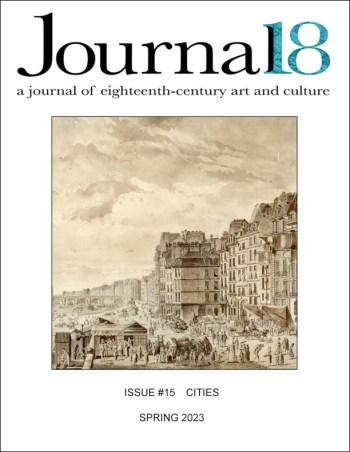
Journal18, Spring 2023 — Cities
For anyone who may have missed it, the latest issue of J18, along with lots of interesting reviews:
Journal18, Issue #15 (Spring 2023) — Cities
Issue edited by Katie Scott and Richard Wittman
Katie Scott and Richard Wittman — “Introduction”
Art history has traditionally narrated the early modern city through the monuments and buildings that constituted its environment and with reference to its spatial distribution. This special issue invites readers to consider the city instead via the social: to think about the people who once inhabited those buildings, admired those monuments, those who shared the spaces and resources of the city, and the ideas, beliefs, and practices invested in and inspired by it.
 For Aleksandr Bierig, the social is social life literally speaking, and that which the city must foster through clean air. In a close reading of Timothy Nourse’s 1700 critique of London’s coal-induced smog, and his proposal to purify the capital’s atmosphere by reverting to wood, Bierig shows that Nourse’s “restoration” acknowledged various trade-offs between social needs and industry but did not propose to turn back the clock, either socially or ecologically. Rather than retreat to pastoral, Nourse envisioned the relocation of industry to the city limits, as well as the plantation of an orbital forest to supply London. He viewed nature as a resource—in the modern sense of an object uniquely for commercial exploitation—of the good city.
Stacey Sloboda’s essay on London’s St. Martin’s Lane engages with the social on the scale and in the terms of neighborhood, a concept in which the built and the social are united. By following inhabitants of St. Martin’s Lane through rent registers and other sources, she explores the imbrication of artistic and artisanal practices that academies and art theory often obscure. Moreover, she complicates the binaries we draw to distinguish the modern and pre-modern city: between an older world of dense, low-rise housing and inward-looking community living, and the modern, outward-facing city produced by industrialization and migration. The St. Martin’s Lane school drew both some of its agents and some its artistic ideas from Europe and thought its taste modern.
Questions of place and emplacement are key also to Anne Hultzsch’s essay. However, she explores not the community and the rootedness associated with neighborhoods, but the individual’s embodied relationship to site. She reviews Sophie von La Roche’s writings on the city as “situated criticism,” situated both in the literal sense of point of view, and sociologically as a woman of a certain class. What distinguishes Hultzsch’s take on the social and sets it apart from late twentieth-century social and political histories of art criticism is her discussion of La Roche’s experience of the visual, and her use of biography to lay bare her subject’s identity in its intersectional complexity.
The two shorter pieces, each with a more historiographical focus, center on the figure of the urban observer. Richard Wrigley argues that the personage of the flâneur, normally characterized as disengaged and associated with the July Monarchy, had in fact originated in the political culture of the French Revolution, and as an effect of self-determined mobility within the city enabled by liberty. In so doing, he restores an essential political context to the phenomenon of flânerie that has long been obscured by its limiting association with the burgeoning consumer culture emblematized by the Paris passages. Sigrid de Jong, meanwhile, analyses the eighteenth-century literary trope of urban comparison. Situating such description in relation to current scholarly recourse to comparative history, she focuses on Paris and London in texts by Louis Sebastien Mercier and Helen Maria Williams, respectively. She suggests that their kind of explicitly situated subjectivity offers a privileged entry to the specifically social limitations and possibilities that structure real experiences of the city.
By variously answering such historical questions as—How did the city make room for sharing (air, ideas, experiences, space)? How did different kinds of urbanites (writers, artists, tourists, women) use, exploit and otherwise appropriate urban space? And how were the limits and possibilities of city social life made sensible in word and image (maps, views, description)?—these case studies collectively propose a richer yet less stable view of the proto-modern European city.
a r t i c l e s
• Aleksandr Bierig — “Restorations: Coal, Smoke, and Time in London, circa 1700”
• Stacey Sloboda — “St. Martin’s Lane: Neighborhood as Art World”
• Anne Hultzsch — “The City ‘en miniature’: Situating Sophie von La Roche in the Window”
s h o r t p i e c e s
• Richard Wrigley — “The Revolutionary Origins of the Flâneur”
• Sigrid de Jong — “The City and its Significant Other: Lived Urban Histories beyond the Comparative Mode”
All articles are available here»
Word & Image, July 2023
The eighteenth-century in the latest issue of Word & Image:
Word & Image: A Journal of Verbal / Visual Enquiry 39.2 (2023)
• Kristoffer Neville, “Fischer von Erlach and the Habsburg Imperial Historians,” pp. 111–33.
The Entwurff einer historischen Architectur (Outline of an Historical Architecture, 1721), by Johann Bernhard Fischer von Erlach, architect to the Austrian imperial court, is often seen as a milestone in the literature of architecture, and as the first comparative and universal history of architecture. In part because it has been studied primarily as a work of architectural history, rather than imperial history, it has become relatively unmoored from a large body of earlier and contemporary histories of the Habsburgs and the imperial house. These works cumulatively established a distinct historiographical tradition that informs the content and narrative of Fischer’s book and aligns it closely with a deeply ideological narrative in which a historical line leads directly from the Old Testament patriarchs through Greco-Roman rulers to the Holy Roman Emperors, and from Jerusalem and Rome to modern Vienna. To a substantial degree, this historiography, rather than a nascent architectural canon, determined the contents and presentation of the Entwurff.
• Emma Barker, “Woman in a Turban: Domenichino’s Sibyl, Staël’s Corinne, and the Image of Female Genius,” pp. 235–59.

Angelica Kauffmann, after Domenichino, Sibyl, ca. 1763, oil on canvas, 98 × 75 cm (Washington, DC: National Museum of Women in the Arts).
The heroine of Germaine de Staël’s Corinne, or Italy (1807) makes her first appearance in the novel “dressed like Domenichino’s Sibyl,” wearing an Indian shawl wound into a turban. The aim of this essay is to highlight the contribution that the tradition of Sibylline iconography made to the characterization of the heroine of Corinne by locating Staël in a long line of artists, writers, and patrons, particularly female ones, who adapted and appropriated this iconography for their own purposes over the previous two centuries. A crucial breakthrough was made in the early seventeenth century by Domenichino, who provided the prototype for later generations of artists by painting a freestanding picture of a generic (not, as often said, the Cumaean) Sibyl wearing a turban. Domenichino’s composition nevertheless remained exceptional in its insistence on the primacy of Sibylline inspiration, which helps to account for its role in Corinne as well as for its appeal to other early nineteenth-century writers. Staël’s direct predecessors included the artists Angelica Kauffman and Élisabeth-Louise Vigée Le Brun, both of whom portrayed female sitters in more or less Sibylline guise, but the most important was Emma Hamilton, from whose famous Attitudes Staël almost certainly derived the motif of the turban fashioned out of an Indian shawl. Staël herself adopted the turban as her characteristic headdress, as did other literary and artistic women after her; its great advantage lay in the way it enabled them to lay claim to Sibylline authority whilst also disavowing any such intent.










leave a comment