Call for Papers | The Science of Taste in the 18th Century
From Fabula.org (which also includes the accompanying bibliography) . . .
La Science du Goût au XVIIIe Siècle
Special issue of Revue Internationale d’étude du dix-huitième siècle (RIEDS), edited by Guilhem Armand and Emmanuelle Sempère
Proposals due by 1 June 2022; completed essays due by 1 November 2022
« Ce sens, ce don de discerner nos aliments, a produit dans toutes les langues connues, la métaphore qui exprime par le mot goût, le sentiment des beautés et des défauts dans tous les arts »
–Voltaire, « Goût (Gramm. Litterat. & Philos.) », Encyclopédie, vol. VII (1757).
« Une espèce de toucher plus fin, plus subtil »
–Jaucourt, « Goût (Physiolog.) », Ibid.
Ce siècle, qui est celui de l’Encyclopédie, qui, en quelque sorte, s’ouvre avec l’ennoblissement de la science par Fontenelle qui parvient dans le même temps à en faire un objet de plaisir, et se clôt avec La Physiologie du goût, n’est-il pas celui où tente de s’élaborer une véritable science du goût ?
Le 18e siècle – ou, plus largement, le grand âge classique – est en effet la grande période de théorisation du goût, mais la labilité du terme rend en même temps la notion rétive à toute tentative de définition stricte. Pourquoi désigner de l’un des cinq sens ce qui flatte l’oreille (un air), charme la vue (un tableau), plaît à l’esprit ou au cœur ? Pourquoi même désigner d’un sens corporel ce qui stimule l’esprit ou heurte les règles sociales ? Enfin, pourquoi parmi ces cinq sens choisir l’un des moins « nobles », et peut-être le moins attendu (et non pas l’odorat, l’expression « avoir le nez fin » étant attestée depuis au moins 1694) ? Car il convient de noter que les choses de la table et tout ce qui s’y rapporte relèvent du péché de gourmandise dont, rappellent médecins et théologiens de l’époque, on est puni par l’indisposition ou la maladie. Or, il n’est peut-être pas indifférent que cette association entre un sens et un jugement se cristallise à une époque où la gourmandise commence à être réhabilitée, où la gastronomie naît et acquiert progressivement ses lettres de noblesse, tandis que les belles lettres deviennent littérature. Au même moment, un domaine du savoir se dégage au croisement des disciplines artistiques et de la philosophie : l’esthétique. Le goût, ce serait donc ce terme qui permet d’évoquer à la fois une sensation, une émotion et un jugement, une intuition et une théorie.
Durant cette même période, ce que l’on appelle le goût français se répand dans toute l’Europe et même au-delà, pour devenir durablement synonyme du bon goût. La notion revient sans cesse, pour définir une convenance sociale dans les apparences, caractériser une posture, un langage, une réussite ou un échec littéraire, théâtral, artistique, mais aussi tout simplement pour désigner la saveur d’un mets. Le goût cristallise aussi des enjeux politiques et entretient des liens forts avec les notions d’esprit des nations et de génie : c’est peut-être ce qui explique l’intérêt grandissant des Lumières pour ce concept difficile, cousin du je-ne-sais-quoi, et la multiplication des tentatives de définition qu’il suscite, voire des querelles, au moment même où s’élabore la science esthétique, où le mot et l’idée d’original changent de statut, où la notion d’expérience humaine s’individualise. La question du goût se pose de façon d’autant plus intéressante que la littérature fait une place de plus en plus grande à une vie psychique clairement ancrée dans la vie physique. Cette science du goût qui s’élabore se situe ainsi au cœur du partage des savoirs qui caractérise le 18e siècle : au confluent de différents domaines, elle s’en enrichit, non sans éviter le risque d’une certaine confusion.
La question du goût au 18e siècle a fait principalement l’objet de deux types d’approche, résonnant avec l’analogie étudiée dans l’article du même nom dans l’Encyclopédie de Diderot et D’Alembert : le goût comme sens physique, renvoyant à la gourmandise, et le goût en lien avec l’esthétique au moment où cette science émerge. Les travaux de Jean-Claude Bonnet – du numéro 15 de DHS à son ouvrage La Gourmandise et la faim, 2015 – ainsi que ceux de Béatrice Fink, et d’historiens comme Philippe Meyzie (Lumières n° 11 « La Gourmandise entre péché et plaisir ») ont enrichi et affiné notre connaissance de la réhabilitation du péché de gourmandise, de la transformation des arts culinaires en ce qui s’appellera bientôt la gastronomie (1801), des débats techniques, médicaux et philosophiques. Si quelques travaux comme ceux de Frédéric Charbonneau (L’École de la gourmandise, 2008) font le lien entre esthétique – et en particulier littérature – et gourmandise, les deux domaines restent le plus souvent distincts. Cependant, les positions et postures des auteurs du 18e siècle en matière de morale et d’esthétique sont de plus en plus interrogées aujourd’hui sous l’angle d’une sensibilité concrète, voire d’une physiologie. Depuis les travaux d’Alain Corbin, les « cultures sensibles » sont devenues un objet historique et plus généralement l’anthropologie sensorielle très active outre-Atlantique depuis les travaux de Howes et de Classen trouve un assez large écho dans l’ensemble des sciences humaines. Ces approches sont d’autant plus pertinentes pour le goût qu’il engage une sensorialité dite « basse » en dépit des opérations de symbolisation dont il fait l’objet – l’homologie avec le jugement de valeur en est une. Force est en effet de constater que si le goût participe, tout comme la vue, des deux ordres de la sensibilité que constituent la morale et la sensation, il conduit bien davantage, ou plus directement, dans les ressacs de la sensation et de ses ressorts physiologiques. Serait-ce à dire que le « goût » le plus « sublime » relèverait de ce qu’il y a de plus matériel en nous[1] ? On pourrait en prendre pour preuve les coups de boutoir dont le Neveu attaque l’édifice du bon goût et qui bouleversent l’ordre moral et esthétique du Philosophe de la Satire seconde. Lequel confesse une forme de dégoût : « Je commençais à supporter avec peine la présence d’un homme qui discutait une action horrible, un exécrable forfait, comme un connaisseur en peinture ou en poésie examine les beautés d’un ouvrage de goût[2] ». Celui qui mange mal (ou peu, ou trop) et celui qui mange bien (à satiété, en bonne compagnie, avec mesure et choix) dessinent ainsi les contours de goûts concurrents, qui questionnent et mettent à mal les idéaux de sociabilité et d’universalité.
Le goût s’envisage avec profit par son envers, ou son dessous, qu’il s’agisse du “mauvais goût” ou du “dégoût”. Le premier a été envisagé par Jennifer Tsien relativement à l’esthétique du 18ème siècle (Le Mauvais goût des autres, 2017) et par Carine Barbafieri et Jean-Christophe Abramovici sous un angle résolument transversal (L’Invention du mauvais goût à l’âge classique, 2013). Le second a fait l’objet d’une journée d’étude en mai 2019 à l’Université d’Aix Marseille (« Le Dégoût : vécu, perception, représentations et histoire »).
C’est à la fois dans la lignée de ces travaux récents ou plus anciens, et dans une perspective renouvelée, que se situe cet appel. La richesse et la diversification des travaux sur le goût dans ces dernières décennies montrent à quel point les enjeux du goût débordent les questions purement esthétiques ou idéologiques. Cet appel à communication voudrait donc envisager la catégorie du goût non plus seulement dans ses fonctions normatives ou axiologiques, ou dans ses dimensions sociologiques ou esthétiques, mais aussi en tant que catégorie épistémique et scientifique. Il s’agira d’interroger la notion de “goût” au 18e dans le champ des savoirs, pour mieux comprendre les enjeux heuristiques et méthodologiques que les philosophes, écrivains, artistes, savants et amateurs ont voulu lui prêter.
Ce dossier de RIEDS s’intéressera donc au goût sous toutes les formes et dans tous les sens que lui donne le XVIIIe siècle, mais en mettant en particulier l’accent sur le lien entre les deux termes de la métaphore, les deux sens du goût, et en postulant que ce lien n’est pas seulement de l’ordre de l’histoire esthétique ou des mentalités. La labilité des notions de bon et de mauvais goût, l’empirisme qui préside au choix du terme goût pour parler de préférence esthétique et, parallèlement, l’ambiguïté qui caractérise la gastronomie encore naissante et pas encore ainsi nommée doivent avoir partie liée. C’est pourquoi nous envisageons l’angle de la science du goût, qui permet de s’intéresser au lien qu’opère cette notion entre l’intuitif et le rationnel : le goût apparaît en effet comme un point de jonction important entre une appréhension concrète – induite par le sens premier – et une signification plus abstraite, en quelque sorte à l’image de ce lien permanent entre arts et théories, fiction et savoir, qui est au cœur des écrits des Lumières. Le goût, devenu objet d’un discours savant, cristallise en effet les différends philosophiques de toute farine. Prise entre les feux du rationalisme et de la subjectivité, de la physiologie et de la morale, la science du goût ne risque-t-elle pas la contradiction ? Et ne cristalliserait-elle pas ainsi une « révolution morale » (au sens de K.A. Appiah[3]) ?
Si Kant ou Burke ont tenté de revisiter l’idée que l’esthétique pourrait se passer d’un rapport direct et sensitif, voire sensuel, aux objets, n’est-ce pas qu’il y avait bien, chez tant d’autres théoriciens, notamment les Encyclopédistes (Diderot et Jaucourt, en particulier), en partant de la physiologie, un matérialisme sourd travaillant cet ennoblissement du sens ? Mais le point de départ physiologiste n’est pas nécessairement matérialiste et peut abonder d’autres théories, comme celles du médecin et écrivain Tiphaigne de La Roche, qui tenta une solution hybride (sinon incertaine, voire confuse) de matérialisme spiritualiste.
En forçant le trait, un hiatus se dessine entre une conception subjectiviste du goût, sur lequel elle fait peser un risque d’obscurité, d’illégitimité, de solipsisme, et une conception sensitive et physiologique qui voudrait gommer la labilité du jugement de goût dans une perspective positive et scientifique. À cette aune doublement complexe, les goûts et les dégoûts des savants, des artistes et des écrivains de la période, ne nous parlent plus seulement de leur sensibilité, mais peuvent informer une histoire émotionnelle des mentalités, qui pourra s’appuyer sur les travaux de Françoise Waquet[4]. Aussi, l’examen de l’hypothèse d’une science du goût en construction au fil du siècle pourra-t-il se doubler d’une réflexion sur le savoir que nous construisons nous-mêmes sur le goût que les hommes et les femmes des Lumières ont manifesté, sans le théoriser, mais en l’expérimentant sans relâche et de multiples façons, pour une science mêlée, dont on rappellera qu’elle ne s’inféode pas à l’objectivité moderne.
Les contributions (en histoire des idées, histoire et théories de l’art, littérature, histoire culturelle) pourront aborder les axes suivants :
Les savoirs sur le goût: la critique a déjà défriché toute cette littérature autour de la gourmandise et du goût au sens physiologique, ainsi que les nombreux textes théoriques tels que les préfaces de manuels culinaires (J.-C. Bonnet, B. Fink), les ouvrages de médecine, les traités savants sur l’agronomie (on pense évidemment à Parmentier), et les correspondances d’auteurs qui révèlent goûts et dégoûts, excès et régimes. Si on prolonge l’enquête, ces textes peuvent-ils se lire comme le lieu où se pense le passage du sens matériel à sa symbolisation, où s’interroge le lien entre la perception subjective du goût et le défi théorique tendant à une forme d’universalisme ? Que nous disent, par exemple, les plaisirs d’Émilie du Châtelet ou les raffinements libertins du rapport entre l’individuel et le politique ?
Matérialité du goût et sensualisme. Comment s’articulent les théories du goût (dans tous les sens) et le sensualisme des Lumières ? Qu’impliquent les bouleversements épistémiques touchant la sensation sur la définition du jugement de goût ? Le goût peut-il relever de la pure matière ? Un savoir abstrait peut-il se passer d’un rapport direct, sensitif, voire sensuel aux objets ? Du côté de l’esthétique, il s’agira de s’intéresser à ce glissement du je-ne-sais-quoi à l’originalité, à ce moment où le goût déborde les règles de la Technè. On pourra s’intéresser aux arts d’agrément, aux querelles esthétiques, à la question de la permanence ou de l’universalité du grand goût par rapport aux théories relativistes, ainsi qu’aux questionnements sur la postérité.
Les goûteurs et les dégoûtants : sociologie et anthropologie du goût. À cette époque où se redéfinit le sublime, où l’association du beau et du bien se trouve remise en question, où les frontières du bon et du mauvais goût semblent mouvantes, c’est aussi fondamentalement le rapport du goût à la morale qui se trouve questionné, dans un siècle qui désire certes détacher la science et la philosophie d’un certain nombre de préoccupations théologiques, mais pour y fonder une éthique. Comment redéfinir le goût dans la perspective éthique des Lumières, qui s’affronte aux valeurs humanistes, aux aspirations de l’individualité et de l’harmonie sociale, à l’idée du génie des nations, aux acquis du relativisme et de l’universalisme ?
Modalités de soumission
Les propositions d’article sont à envoyer avant le 1er juin 2022, sous la forme d’un résumé ne dépassant pas 500 mots, en français ou en anglais, accompagné d’une brève notice bio-bibliographique, aux deux adresses suivantes : guilhem.armand@univ-reunion.fr et sempere@unistra.fr. Après accord du comité scientifique, les propositions retenues seront attendues pour le 1er novembre 2022. Les articles feront entre 30.000 et 45.000 caractères espaces comprises et pourront conformément aux normes de la revue être rédigés en français ou en anglais ; ils seront accompagnés d’un résumé en 500 caractères maximum, espaces comprises, et d’une biobibliographie des auteurs en 300 caractères espaces comprises.
The Burlington Magazine, April 2022
The eighteenth century in the April issue of The Burlington . . .
The Burlington Magazine 164 (April 2022)
 A R T I C L E S
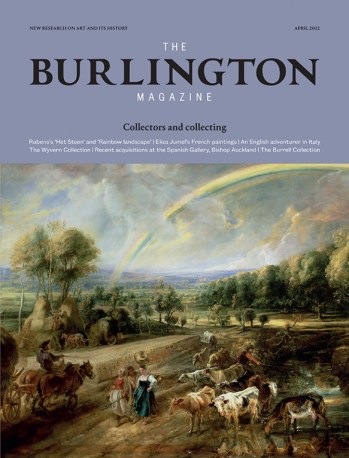
• Lucy Davis and Natalia Muñoz-Rojas, “The Provenance of Het Steen and The Rainbow Landscape by Rubens,” pp. 333–41. New documentary evidence elucidates the hitherto uncertain history of these two celebrated landscapes painted by Peter Paul Rubens ca. 1636. Having remained with this family after his death, they were purchased by the Marquess of Caracena, Governor of the Spanish Netherlands, and taken to Madrid. By 1706 they were in Genoa, in the collections of successively Bartolomeo Saluzzo (1652–1705) and Costantino Balbi (d. 1740). This article assimilates a number of archival discoveries that shed light not only on the provenance of these two paintings but also on two important Genoese collections.
• Lucia Bonazzi, “Richard Vickris Pryor in the Art Market of Napoleonic Europe,” pp. 342–49. The son of a Quaker family of brewers and wine merchants, Richard Vickris Pryor (1780–1807) spent his brief adult life in pursuit of paintings. A characteristic example of the sort of entrepreneur who sought to exploit the release of works of art onto the market in the wake of Napoleon’s campaigns, he scored his greatest success with the purchase of the Lechi collection in Brescia in 1802.
• Margaret Oppenheimer, “From Paris to New York: French Paintings from the Collection of Eliza Jumel,” pp. 350–61. Eliza Jumel (1775–1865), born in poverty, was one of New York’s richest women at her death in 1865. While in Paris in 1815–17 she formed the largest collection of European paintings yet assembled by an American, the largest part of them French. Sold in 1821, the collection has been all but forgotten, but it has proved possible to trace a number of the works she owned.
R E V I E W S
• Noémi Duperron, Review of the exhibition Le Théâtre de Troie: Antoine Coypel, d’Homère à Virgile (Musée des Beaux-Arts de Tours, 2022), pp. 394–96.
• Eric Zafran, Review of the exhibition Paintings on Stone: Science and the Sacred, 1530–1800 (Saint Louis Art Museum, 2022), pp. 396–99.
• Peter Y. K. Lam, Review of the exhibition catalogue Sarah Wong and Stacey Pierson, eds., Collectors, Curators, Connoisseurs: A Century of the Oriental Ceramic Society, 1921–2021 (Oriental Ceramic Society, 2021), pp. 402–03.
• Rowan Watson, Review of Richard Rouse and Mary Rouse, Renaissance Illuminators in Paris: Artists and Artisans, 1500–1715 (Harvey Miller, 2019), pp. 418–19.
• Richard Wrigley, Review of Iris Moon and Richard Taws, eds., Time, Media, and Visuality in Post-Revolutionary France (Bloomsbury, 2021), pp. 423–24.
• Philip Ward-Jackson Review of Bayerische Staatsgemäldesammlungen / Neue Pinakothek: Katalog der Skulpturen; Volume I: Die Sammlung Ludwigs I, Volume II: Adolf von Hildebrand (Deutscher Kunstverlag, 2021), pp. 424–25. “This is a vital link in the chain between Enlightenment celebrations of worthies and grand hommes and such later nineteenth-century sculptural pantheons as those on the Musée du Louvre, Paris, and the Albert Memorial, London . . .” (424).
O B I T U A R I E S
• Peter Cherry, Obituary for Jonathan Brown (1939–2022), pp. 427–28. As well as bringing many fresh insights to the study of the major Spanish artists from El Greco to Picasso, with a particular focus on Velázquez, Jonathan Brown made important contributions to the study of patronage and collecting and of the diffusion of the images and ideas in the wider Hispanic world. Much honoured in Spain as well as in his native America, he will also be remembered as a dedicated and assiduous teacher.
Call for Articles | Black Artists in the Atlantic World, 1500–1900
From the Call for Papers at Arts:
Special Issue of Arts: Black Artists in the Atlantic World, 1500–1900
Guest edited by Paul Niell and Emily Thames
Abstracts due by 31 May 2022, with drafts of completed articles due by 31 March 2023
We are seeking submissions for a special issue of Arts, which will focus on Black Artists in the Atlantic World, ca. 1500–1900. Invoking the modern/colonial racial category of ‘black’ draws critical and much-needed attention to the role of race in the lives and careers of artists of African descent, and others who have had to negotiate being inscribed and socialized into blackness by Atlantic societies. We approach this topic hemispherically, considering both colonial and national socio-political frameworks bordering or shaped by the broader Atlantic arena, including the Americas, Europe, and Africa. In this way, we hope to foster a comparative conversation between scholars working on the various geographic spheres of the Atlantic in order to better understand the transnational and transimperial realities faced by black artists and how they have worked through their respective settings.
This special issue acknowledges and draws inspiration from recent scholarship on artists in the Spanish colonial territories throughout the Americas, such as the essay by Barbara Munday and Aaron Hyman, “Out of the Shadow of Vasari: Towards a New Model of The ‘Artist’ in Colonial Latin America,” Colonial Latin American Review 24.3 (2015): 283-317; the monograph by Susan Verdi-Webster, Lettered Artists and the Language of Empire: Painters and the Profession in Early Colonial Quito (University of Texas Press, 2017); the 2019 Hescah symposium at the University of Florida “Beyond Biography: Artistic Practice & Personhood in Colonial Latin America,” organized by Maya Stanfield-Mazzi; and the special edition of the Colonial Latin American Review, “Visualizing Blackness in Colonial Latin America,” co-edited by Kathryn Santner and Helen Melling, 30.2 (2021). The study of black artists and image makers in the southern Atlantic has been further advanced by the work of scholars, such as Ximena A. Gómez, Agnes Lugo-Ortiz, Linda Rodríguez, and Miguel Valerio. These studies shed light on the methodological challenges as well as the importance of considering the lives, careers, and agencies of Spanish colonial artists in the writing of these regions’ social and cultural histories. Among the salient dimensions addressed by these projects is the role of race in shaping the professional lives of artists. For the northern Atlantic, which is situated later in time than those of the Ibero-Americas and the Caribbean and in contexts informed by Protestant conceptions and practices of the image, relationships between the artist, the art, the viewer, and race have been examined in such works as Kirsten Pai Buick’s Child of the Fire: Mary Edmonia Lewis and the Problem of Art History’s Black and Indian Subject (Duke University Press, 2010), Anna O. Marley’s edited collection of essays Henry Ossawa Tanner: Modern Spirit (University of California Press, 2012), and Jasmine Nichole Cobb, Picture Freedom: Remaking Black Visual Culture in the Early Nineteenth Century (New York University Press, 2015).
Engaging with the subject of black artists in the Atlantic world raises a number of critical questions. How did racial blackness shape the professional worlds negotiated by artists in the Atlantic? How does race impact the ways in which we consider black artists in the Atlantic whose racial classification is not necessarily evident in the formal and stylistic properties of their work? If an artist is of African descent, must their art be a matter of race? What was the relationship between race, blackness, and the creation of the category of ‘artist’ in the Atlantic? What other forms of making and imagery are at stake in this field of inquiry beyond artist and art, as institutionally redefined by academies of art? How has the discourse of race obscured African and African American agency, awareness, and negotiations of imperial/colonial power? How do we address the limits of the historic archive in recovering the stories of such artists? What can be learned by looking across national and imperial boundaries in the Atlantic with respect to the histories of black artists? These questions will be considered and addressed within this special issue.
Dr. Paul Niell
Department of Art History, Florida State University, Tallahassee
Interests: Spanish colonial art; architecture and visual culture; the material culture of the African diaspora with an emphasis on the Caribbean region
Dr. Emily Thames
Department of Art History, Florida State University, Tallahassee
Interests: the visual and material cultures of the colonial Atlantic world; art and empire; art in the age of revolution and nationalism; the history of colonialism; the intersection of art and race; the visual and material cultures of the African diaspora
The Burlington Magazine, March 2022
The eighteenth century in the March issue of The Burlington . . .
The Burlington Magazine 164 (March 2022)
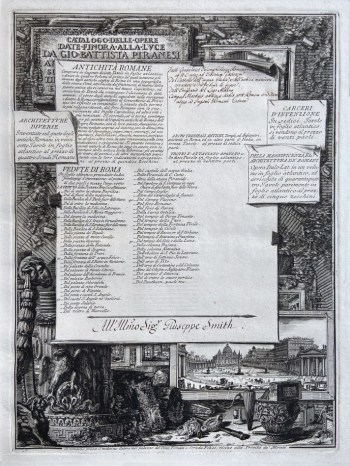
G. B. Piranesi, Catalogo delle Opere, State I, with manuscript additions, 1761, etching, 40 × 30 cm (Private collection).
A R T I C L E S
• Andrew Robison, “Piranesi’s Catalogo delle Opere,” pp. 230–45. When Piranesi moved to new quarters in Rome in 1761 he had space to store and sell his prints rather than entrust them to booksellers. This prompted him to publish an illustrated sales catalogue in the form of an etching and engraving, of which a number of copied inscribed to his friends and patrons survive. Revised twenty-nine times before Piranesi’s death in 1778, the catalogue provides important evidence about his understanding as well as the dating of his prints, series of prints and illustrated books.
• Giovan Battista Fidanza, “Carlo Maratti’s Additions to the Barberini Venus,” pp. 260–65. In 1999–2000 a restoration of the sixteenth-century mural in the Palazzo Barberini, Rome, known as the Barberini Venus, which was remodelled with additions by Carlo Maratti in 1693, removed tempera overpainting in the belief that it post-dated his changes. A newly discovered document in the Barberini archives both provides the fullest contemporary record of Maratti’s work on the mural and indicates that the tempera additions were painted by him.
R E V I E W S
• Isabelle Kent, Review of the Spanish Gallery, Bishop Auckland, pp. 276–83. In October 2021 the only museum in Britain devoted to Spanish art opened in Bishop Auckland, County Durham. Part of the Auckland Project, which uses art, faith and heritage to fuel long-term regeneration, the museum offers an impressive if idiosyncratic representation of Spain in the sixteenth and seventeenth century. [Paintings by Zurbarán were purchased by the Bishop of Durham, Richard Trevor in 1756.]
• Laura Moretti, Review of the newly opened galleries for the permanent collection at the Palazzo Maffei in Verona, pp. 290–92.
• Imogen Tedbury, Review of the exhibition Willem van de Velde and Son (Amsterdam: National Maritime Museum, 2021–22), pp. 293–95.
• Clare Hornsby, Review of the exhibition Grand Tour: Sogno d’Italia da Venezia a Pompei (Milan: Gallerie d’Italia, Piazza Scala, 2021–22), pp. 295-98.
• Carl-Johan Olsson, Review of the exhibition True to Nature: Open-Air Painting in Europe 1780–1870 (Paris: Fondation Custodia, 2021–22), pp. 298-300.
• María Cruz de Carlos Varona, Review of Beatriz Blasco Esquivias, Jonatan Jair López Muñoz, and Sergio Ramiro Ramírez, eds., Las mujeres y las artes: Mecenas, artistas, emprendedoras y coleccionistas (Abada Editores, 2021), pp. 316–17.
• Susanna Zanuso, Review of Aurora Laurenti, Intagli rococo: professionalità ed elaborazione del gusto negli interni del Palazzo Reale di Torino (Accademia University Press, Turin, 2020), pp. 318–20.
The Burlington Magazine, February 2022
The eighteenth century in February’s issue of The Burlington . . .
The Burlington Magazine 164 (February 2022) — Northern European Art
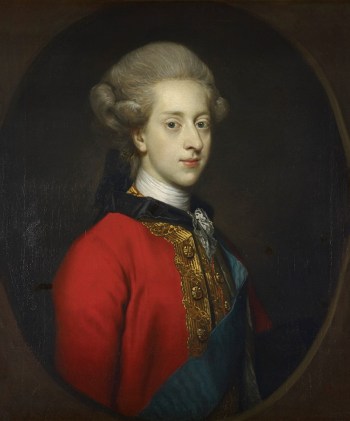
Nathaniel Dance Holland, Portrait of Christian VII, King of Denmark, 1768, oil on canvas, 77 × 63 cm (Royal Collection Trust).
A R T I C L E S
• Sara Ayres, “Christian VII of Denmark’s Lost British Portraits,” pp. 155–63. In 1768–69 the young Christian VII of Denmark visited London and Paris, where several portraits of him were painted. Three were by artists born or working in Britain—Angelica Kauffmann, Edward Cunningham, known as Calze, and Matthew Peters. All are now lost, but evidence about the comissions survives in copies and prints, contemporary descriptions and documents in the Danish State Archives.
• Lars Hendrikman, “The Finding of the Infant Bacchus,” pp. 180–83.
R E V I E W S
• Camilla Pietrabissa, Review of the exhibition Venetia 1600: Births and Rebirths (Venice: Palazza Ducale, 2021–22), pp. 190–92.
• Ivan Gaskell, Review of the new galleries of Dutch and Flemish art at the MFA Boston (open from November 2021), pp. 195–98.
• Richard Stemp, Review of the exhibition Hogarth and Europe (London: Tate Britain, 2021–22), pp. 198–200.
• Maryl Gensheimer, Review of Fabio Barry, Painting in Stone: Architecture and the Poetics of Marble from Antiquity to the Enlightenment (Yale UP, 2020), pp. 216–17.
• Clare Hornsby, Review of Ortwin Dally, Maria Gazzetti, and Arnold Nesselrath, eds., Johann Joachim Winckelmann (1717–1768): Ein Europ isches Rezeptionsph nomen / Fenomeno Europeo della Ricezione (Michael Imhof Verlag, 2021), pp. 217–18.
• Robert Skwirblies, Review of Lea Kuhn, Gemalte Kunstgeschichte: Bildgenealogien in der Malerei um 1800 (Wilhelm Fink Verlag, 2020), pp. 218–19.
• Thomas Stammers, Review of Stacey Boldrick, Iconoclasm and the Museum (Routledge, 2020), p. 222.
O B I T U A R I E S
• Marjorie Trusted, “Christian Theuerkauff (1936–2021),” pp. 223–24. For many years Deputy Director of the sculpture collection at the Bode Museum, Berlin, and honorary professor at the city’s Free University, Christian Theuerkauff was a leading scholar of Baroque ivories, whose expert connosseurship and archival research definitively shaped our understanding of many of the outstanding sculptors in the medium.
Print Quarterly, March 2022
The long eighteenth century in the latest issue of Print Quarterly:
Print Quarterly 39.1 (March 2022) . .
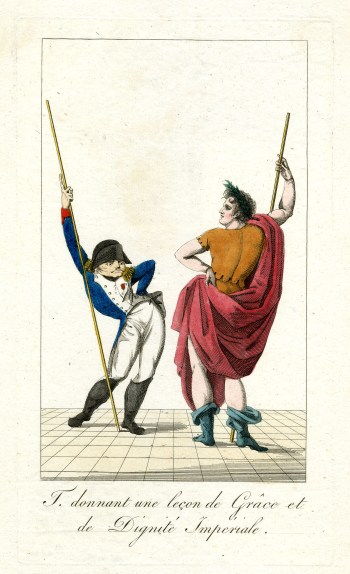
Charles Elie, T[alma] donnant une leçon de grâce et de dignité impériale (T[alma] giving a lesson in grace and imperial dignity), 1814, hand-coloured etching, 244 x 142 mm (London: British Museum).
A R T I C L E S
Antony Griffiths, “The Publication of Caricatures in Paris in 1814 and 1815, Part I: The Established Printsellers, Genty and Martinet,” pp. 31ff.
Two articles by Antony Griffiths on ‘The Publication of Caricatures in Paris in 1814 and 1815’—Part 1 in the March 2022 issue and Part 2 forthcoming—discuss the publication of caricatures in Paris during two years in which there were four regimes in power, and two occupations by foreign armies—a period which led to an unprecedented outpouring of social and political satire. Many works of great quality were produced, but most have only a title and do not reveal the names of the producers. The articles discuss how publishers and artists dealt with the political upheavals and identify some of the many participants who entered the field in these years. Part 1 deals with the caricatures published by members of the established print trade in Paris, and in particular Aaron Martinet and the newcomer Genty, who has previously been misidentified.
R E V I E W S
• Mark McDonald, Review of Juan Agustín Ceán Bermúdez, El Churriguerismo: discurso inédito (Alicante: Biblioteca Virtual Miguel de Cervantes, 2019), p. 79.
• Diana Greenwald, Review of Madeleine Viljoen, Nina Dubin and Meredith Martin, Meltdown! Picturing the World’s First Bubble Economy (Turnhout: Harvey Miller, 2020), p. 80.
• Ann V. Gunn, Review of John Bonehill, Anne Dulau Beveridge, and Nigel Leask, eds., Old Ways New Roads: Travels in Scotland 1720–1832 (Edinburgh: Birlinn, 2021), p. 81.
• Marcia Reed, Review of Troy Bickham, Eating the Empire: Food and Society in Eighteenth-Century Britain (London: Reaktion, 2020), p. 84.
• Nigel Tattersfield, Review of Graham Williams, Thomas Bewick Engraver & the Performance of Woodblocks (Kent: Florin Press, 2021), p. 86.
• Janis A. Tomlinson, Review of Mark McDonald et al., Goya’s Graphic Imagination (New York: The Metropolitan Museum of Art, 2021), p. 102.
Call for Articles | Spring 2023 Issue of J18: Cities
From Call for Proposals for J18:
Journal18, Issue #15 (Spring 2023) — Cities
Issue edited by Katie Scott and Richard Wittman
Proposals due by 15 March 2022; finished articles will be due by 1 September 2022
Art and architectural histories have traditionally approached the city in terms of the monuments and structures of its built environment and the distribution of its spaces. But the city is also, after all, its people: people who occupied and inhabited buildings, shared spaces and resources, and invested in or were inspired by ideas, labor, and beliefs. How did the city make room for that sharing? How did it inhibit it? Institutional structures—those of religion, politics, the economy, of ‘police’ in the broadest early-modern sense—played an essential part in fostering conditions in which social life occurred. How exactly did that fostering happen in the eighteenth century, and what were its intended and unintended consequences? At the same time, urban dwellers, whether elite or subaltern, continually use, transform, exploit, or otherwise make a city their own; the social forms an essential context for such appropriations. How were the limits and possibilities of social life in the eighteenth-century city defined, regulated, and sustained? In what ways did different constituencies represent those limits and possibilities, and discuss and debate them? How were they made visible, made audible, made legible? And how did different categories of labor shape and support a city’s social life?
We invite proposals that engage with the questions asked above, directly addressing relations between built forms and social bodies. These are some themes that are, we feel, raised by the topic: boundaries (walls, ditches) and the exclusion or protection of the faiths, nations, and trades they helped shape; bridges and the connections they cemented between neighborhoods, markets, spaces of leisure, etc.; infrastructure (roads, water, lighting, refuse collection) and the support it gave to the lived experience of the city; beauty and the collective aspiration to care and conservation, and also to better worlds that it proposed. We welcome contributions that consider actual spaces and communities and also ones that reflect critically on projects, both unrealized and utopian. We are open to essays that take as their objects of study built form, the representation of built form and the city generally, and urban material culture (e.g. guidebooks, street maps, shoes, carriages, walking sticks).
Issue Editors
• Katie Scott, Courtauld Institute of Art
• Richard Wittman, University of California, Santa Barbara
Proposals for issue #15 Cities are now being accepted. The deadline for proposals is 15 March 2022. To submit a proposal, send an abstract (250 words) and brief biography to the following three addresses: editor@journal18.org; katie.scott@courtauld.ac.uk; and rwittman@arthistory.ucsb.edu. Articles should not exceed 6000 words (including footnotes) and will be due by 1 September 2022. For further details on submission and Journal18 house style, see Information for Authors.
Metropolitan Museum Journal 2021

Sèvres royal porcelain manufactory, Potpourri vase and pair of elephant-head vases (from a garniture), ca. 1758, soft-paste porcelain; pot-pourri vase approximately 18 inches high, elephant-head vases approximately 16 inches high (New York: The Metropolitan Museum of Art, Gift of Samuel H. Kress Foundation, 1958, 58.75.89a, b; 58.75.90a, b; 58.75.91a, b). Iris Moon’s “article traces the afterlife of the Sèvres elephant garniture in the context of the French Revolution in order to explore how the politics of dispersal opened up new and contested meanings for luxury” (82).
◊ ◊ ◊ ◊ ◊
The 2021 issue of the Metropolitan Museum Journal is now available at The University of Chicago Press website and The Met Store. PDF’s are available for free on MetPublications.
Metropolitan Museum Journal 56 (2021)
S H I F T I N G P E R S P E C T I V E S O N M U S E U M S
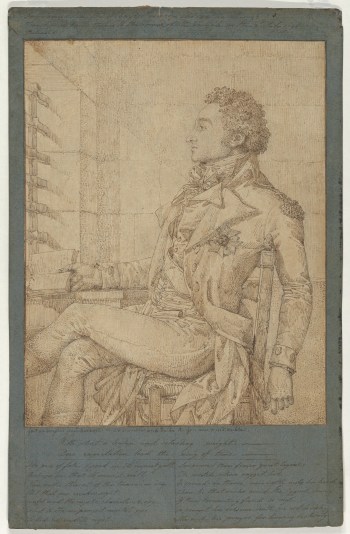
Philippe Auguste Hennequin (1762–1833), Portrait Drawing of Sir Sidney Smith in the Temple Prison, 1796, pen and brown ink over black chalk, 25 × 19 cm (New York: The Metropolitan Museum of Art, Purchase, Stephen A. Geiger Gift, in honor of George R. Goldner, 2015.290).
• Joanne Pillsbury, Aztecs in the Empire City: ‘The People without History’ in The Met
• Maia Nuku (Ngai Tai), ‘Te Maori’: New Precedents for Indigenous Art at The Met
• Tommaso Mozzati, The Vélez Blanco Patio and United States–Cuba Relationships in the 1950s
• Yelena Rakic, Collecting the Ancient Near East at The Met
• Iris Moon, The Sèvres Elephant Garniture and the Politics of Dispersal during the French Revolution
• Rebecca Capua, Facsimiles, Artworks, and Real Things
A R T I C L E S
• Maria Harvey, Icon, Contact Relic, Souvenir: The Virgin Eleousa Micromosaic Icon at The Met
• Kristen Windmuller-Luna, Talismanic Imagery in an Ethiopian Christian Manuscript Illuminated by the Night-Heron Master
• Katherine Gazzard, Philippe Auguste Hennequin’s Portrait Drawing of Sir Sidney Smith in the Temple Prison
• Peter Mallo, Artists’ Frames in Pâte Coulante: History, Design, and Method
R E S E A R C H N O T E
• Elizabeth Rice Mattison, A Source for Two Gilded Silver Figurines by Hans von Reutlingen
Laura Macaluso on Benedict Arnold’s House
We’re used to thinking about how the persistence of artifacts and architecture—especially elite forms of material culture—attest to the social and cultural status of individuals long after their deaths. With a growing scholarly appreciation for how the lack of an enduring material record also speaks to historical priorities, many readers will find this essay by Laura Macaluso interesting. And I would draw your attention more generally to Commonplace, edited by Joshua Greenberg; see the ongoing Call for Submissions below. –CH
From Commonplace:
Laura A. Macaluso, “Benedict Arnold’s House: The Making and Unmaking of an American,” Commonplace: The Journal of Early American Life (October 2021).
Arnold’s unceasing efforts to elevate himself in society through marriage and professional work can be viewed through the lens of the houses he bought or built throughout his life.

Benedict Arnold’s Shop Sign (New Haven Museum). ‘Sibi Totique’ (‘For himself and for everyone’).
Historians have examined the many aspects, both positive and negative, of Arnold’s impact on the course of events leading to the establishment of the United States. Yet the largely unanalyzed material culture of his existence—the objects he acquired and the buildings in which he and his family resided—can offer us much more about the contours of his life as he fashioned it, and how others crafted his historical memory. Arnold’s unceasing efforts to elevate himself in society through marriage and professional work can be viewed through the lens of the houses he bought or built throughout his life. This essay looks at the cultural landscape of one of his homes, the New Haven, Connecticut, house he built and resided in from 1769 until wartime. Through an analysis of the choices Arnold made in location, size, and architectural style, I identify how Arnold began to construct his identity not only as a member of the urban merchant class, but also as a gentleman. The building of the home reads as material evidence of his desire to establish his identity and place in society, but equally the abuse and destruction of Arnold’s house is a parallel to the untimely end of a life and career he worked hard to obtain.
The full essay is available here»
◊ ◊ ◊ ◊ ◊
Commonplace: Call for Submissions
Commonplace is now accepting submissions of approximately 2000 words that analyze vast early America before 1900. We seek a diverse range of articles on material and visual culture, critical reviews of books, films, and digital humanities projects, poetic research and fiction, pedagogy, and the historian’s craft. We are especially interested in deep reads of individual objects, images, or documents (including in the collection of the American Antiquarian Society). Submissions should be written in an accessible style and crafted for a wide audience. Inquiries and submissions can be made to commonplacejournal@gmail.com.
About Commonplace:
A bit less formal than a scholarly journal, a bit more scholarly than a popular magazine, Commonplace speaks—and listens—to scholars, museum curators, teachers, hobbyists, and just about anyone interested in American history before 1900. It is for all sorts of people to read about all sorts of things relating to early American life—from architecture to literature, from politics to parlor manners. It’s a place to find insightful analysis of early American history as it is discussed in scholarly literature, as it manifests on the evening news, as it is curated in museums, big and small; as it is performed in documentary and dramatic films and as it shows up in everyday life. . . .
Commonplace originally launched in 2000 as Common-Place: The Journal of Early American Life and has now been reimagined with a cleaner, more accessible interface. Our articles appear on a rolling basis and are arranged by category instead of being organized by issue and volume. . . .
Sponsored by the American Antiquarian Society, founded by editors Jane Kamensky and Jill Lepore, and designed by John McCoy, Common-Place: The Journal of Early American Life is the product of an amazing team of editors and institutions. Over nearly two decades, the journal has been published in partnerships with Florida State University, the University of Oklahoma, the Gilder Lehrman Institute of American History, and the University of Connecticut. Past editors have included Ed Gray; Catherine Kelly; Anna Mae Duane and Walt Woodward. Past contributors and guest editors have included: Joanna Brooks, Robert A. Gross, Gary B. Nash, Megan Kate Nelson, Mary Beth Norton, and Alan Taylor.
In 2019, the Omohundro Institute of Early American History and Culture joined the AAS in a new partnership to redesign and reinvigorate the site.
Journal18, Fall 2021 — The ‘Long’ 18th Century?
From J18:
Journal18, Issue #12 (Fall 2021) — The ‘Long’ 18th Century?
Edited by Sarah Betzer and Dipti Khera
 A R T I C L E S
• Architectural ‘Worlding’: Fischer von Erlach and the Eighteenth-Century Fabrication of a History of Architecture — Sussan Babaie
• Enlightenment as Thought Made Public: Joshua Reynolds’s Portrait of a Black Man — Andrei Pop
• Britain, Empire, and Execution in the Long Eighteenth Century — Meredith Gamer
• Maritime Media in the Long Eighteenth Century — Maggie M. Cao
• Poq’s Temporal Sovereignty and the Innuit Printing of Colonial History — Bart Pushaw
C O N V E R S A T I O N S
• The Mughals, the Marathas, and the Refracted Long Eighteenth Century, A Dialogue — Chanchal Dadlani and Holly Shaffer
• Teaching the ‘Long’ Eighteenth Century, A Conversation and Resources — Eleanore Neumann, with Anna Arabindan-Kesson, Nebahat Avcıoğlu, Emma Barker, Sarah Betzer, Ananda Cohen-Aponte, Dipti Khera, Prita Meier, Nancy Um, and Stephen Whiteman
Issue Editors
Sarah Betzer, University of Virginia
Dipti Khera, New York University and Institute of Fine Arts










 Enfilade
leave a comment