Art Bulletin of Nationalmuseum Stockholm 27.1
Published in November by the Nationalmuseum, with a selection of eighteenth-century topics listed below:
 The Art Bulletin of Nationalmuseum Stockholm is a journal devoted to art history. It is published in English twice a year with a content that ranges from older master paintings to contemporary design. This, the first part of Volume 27, focuses primarily on acquisitions in 2020. The journal is published through DiVA (a publishing system for research publications and student essays and a digital archive for long-term preservation of publications), with all articles available for free download here.
Editors: Ludvig Florén, Magnus Olausson, and Martin Olin.
Editorial Committee: Ludvig Florén, Carina Fryklund, Eva-Lena Karlsson, Helena Kåberg, Ingrid Lindell, Magnus Olausson, Martin Olin, Daniel Prytz, and Cilla Robach.
A R T I C L E S
Magnus Olausson and Martin Olin, “Two Large Covered Beakers with Filigree Ornamentation by Rudolf Wittkopf.”
The two filigree beakers with covers in silver gilt, made by Rudolf Wittkopf (d. 1722) in Stockholm in 1698, are not only notable examples of Swedish goldsmiths’ work from the end of the 17th century, their history also tells of a dramatic diplomatic episode in the history of relations between Sweden and Russia. The beakers were among the presents given to Tsar Peter I by the ambassadors of the Swedish king Charles XII, in the autumn of 1699.
Daniel Prytz, “A Seated Amour: A Drawing by Charles-Joseph Natoire Related to his Painting Apollo and Clytie for the Royal Palace in Stockholm.”
A drawing of a seated Amour by Charles-Joseph Natoire (1700–1777), recently acquired by the Nationalmuseum, can be said to underline the central role of the art of drawing in his oeuvre. In the present article it is posited that it was created as a finished work onto itself and should be viewed as an example of the possibilities Natoire found primarily in drawing.
Daniel Prytz, “The Vatican from the Road to Ponte Mola: A Drawing by the Amateur Artist and Patron of the Arts Sir George Howland Beaumont.”
Sir George Howland Beaumont (1753–1827) was one of the most prominent British amateur artists and important patrons of the arts of his time. The present article concerns a formerly anonymous 18th-century drawing acquired by the Nationalmuseum, here decisively attributed to Beaumont. The work is a concrete example of the artistic output of this influential judge of taste and perfectly reflects both his position in society and his artistic connoisseurship.
Micael Ernstell, “A Writing Bureau from Magistrate Asplind’s Workshop: A Gift from a Friend.”
A writing bureau dating from 1810–20 by the ornamental painter Johan Nils Asplind (1756–1820), has been generously donated to the Nationalmuseum by Margareta Leijonhufvud through the Friends of the Nationalmuseum. Asplind was active in Falun between 1779 and 1820. He produced ornamental paintings for various manor houses and on furniture he ordered from local cabinetmakers, to which he selected suitable designs from a range of originals. The writing bureau has united the influences of Chinese lacquerwork, the painting of the French rococo, and Gustavian furniture design.
Magnus Olausson, “In the Shadow of Horace Vernet: A Swedish Artist in 1820s Paris.”
This article is about the Swedish artist Alexander Clemens Wetterling’s (1796–1858) encounter with the art and artists of Paris in 1826–27. It introduces us to artistic training in the city, to important networks, and to Wetterling’s take on the struggle between Classicists and Romantics at the famous Salon of 1827. The article is based on a combined reading of Wetterling’s letters and several of the study drawings by him from his stay in Paris, recently acquired by the Nationalmuseum.
Daniel Prytz, “Shepherd Playing his Flute: A Proposed Attribution of a Painting Long in the Collections of the Nationalmuseum to Bernhard Keilhau, Called Monsù Bernardo.”
Bernhard Keilhau (1624–1687) must surely be viewed as one of the foremost artists hailing from Scandinavia, from any century. However, he is largely unknown in Sweden and there are no previous works in the collections of the Nationalmuseum attributed to this artist. The present article concerns a proposed attribution to Keilhau of a work long in the collections of the Museum and with the provenance of the Marshall of the Royal Court Martin von Wahrendorff (1789–1861).
Stephen Lloyd, “A Double-Sided Portrait Miniature Attributed to Sir Henry Raeburn (1756–1823).”
A striking and meticulously painted double-sided portrait miniature of an older man on one side and a younger man on the other side was gifted by the collector Consul Hjalmar Wicander to the Nationalmuseum in 1927 as being a work from the later 18th-century English School. By careful comparison with a small group of other miniatures and drawings this double-portrait is now presented as a significant work from the 1780s Scottish School and indeed a significant youthful achievement from the early career in Edinburgh of the great Enlightenment portraitist in oils, Sir Henry Raeburn (1756–1823).
The Burlington Magazine, October 2021
The eighteenth century in October’s issue of The Burlington . . . Rado’s article is not an eighteenth-century essay, but she is a HECAA member (!), and she briefly frames the material in terms of a longer history; the theme for the October issue is ‘art in twentieth-century China’. –CH
The Burlington Magazine 163 (November 2021)
 E D I T O R I A L
• “Art History in the Anthropocene” p. 883.
A R T I C L E S
• Mei Mei Rado, “The Empress Dowager Cixi’s Japanese Screen and Late Qing Imperial Cosmopolitanism,” pp. 886–97.
R E V I E W S
• Arthur Bijl, Review of the exhibition catalogue Kjeld von Folsach, Joachim Meyer, and Peter Wandel, Fighting, Hunting, Impressing: Arms and Armour from the Islamic World, 1500–1850 (Copenhagen: David Collection / Strandberg Publishing, 2021), pp. 946–47.
• Kee Il Jr Choi, Review of John Finlay, Henri Bertin and the Representation of China in Eighteenth-Century France (Routledge, 2020), pp. 966–67.
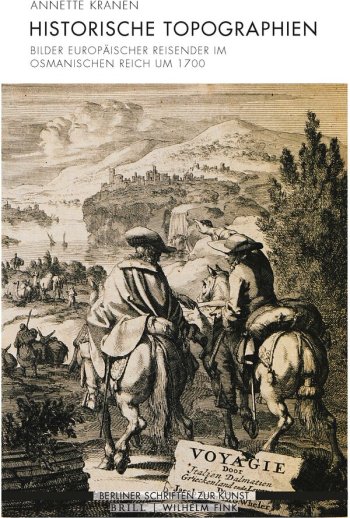
• Mirjam Hähnle, Review of Annette Kranen, Historische Topographien: Bilder europäischer Reisender im Osmanischen Reich um 1700 (Brill, 2020), pp. 971–72.
Opinion | Time to Rethink Chinoiserie

Thomas Chippendale, Chinese Chairs, 1753; black ink, gray ink, and gray wash (New York: The Metropolitan Museum of Art, 20.40.1.23). From The Met’s online description: “Preparatory drawing for Thomas Chippendale’s Gentleman and Cabinet Maker’s Director. Published in reverse as plate XXIII in the 1754 and 1755 editions. The plate is reworked and renumbered as plate XXVII in the 1762 edition. In the new version the arm chair on the right (left in the print) is left unaltered, while the chair back of the chair in the middle is changed and the chair on the left (right in the print) is changed completely.”
◊ ◊ ◊ ◊ ◊
The following op-ed was published online at Elle Decor in May with a version also appearing in the October issue of the print magazine. It’s the sort of essay that I’ve been hoping to find for a few years now, one that bridges the scholarship of the past two decades with contemporary design practice, particularly as promoted by shelter magazines. I suspect that it could be useful pedagogically as a way to connect the historical origins of the material to present-day decorating trends. –CH
Aileen Kwun, “Opinion: It’s Time to Rethink Chinoiserie,” Elle Decor (27 May 2021). From pagoda motifs to floral wallpaper, chinoiserie has always openly borrowed from Asian visual culture. But is it harmful? A design writer and reporter asks the AAPI design community to weigh in.
Foo dogs. Ginger jars. Yin-yang tables. Pagoda motifs, fiery dragons, and bamboo stalks. See it in architecture, gardens, interiors, furnishings, products, graphic motifs, and at just about every scale of design. Chinoiserie, a genre of reproduction design dating back to 17th- and 18th-century Western Europe, has had a long history. From Louis XIV’s decor at Versailles to Ettore Sottsass’s pagoda-topped postmodern shelving, Westernized versions of Asian motifs have long been a mainstay of interior design. . . .
As a style of decor, chinoiserie is ubiquitous, even beautiful. But as an Asian American, chinoiserie has never sat well with me—as a motif or as a word—and, to varying degrees, I’m not the only one. “My reading of chinoiserie is that it’s ‘Asian’ in facsimile,” the architect Michael K. Chen says. “The way that chinoiserie is deployed in interiors is something that I am a little reflexively allergic to. As a component of a ‘traditional’ interior, it seems to highlight the question: Whose tradition are we talking about?” . . .
The full essay is available here»
The Burlington Magazine, September 2021
The eighteenth century in this month’s issue of The Burlington . . .
The Burlington Magazine 163 (September 2021)
 E D I T O R I A L
• “Nicholas Goodison and The Burlington,” p. 779.
A R T I C L E S
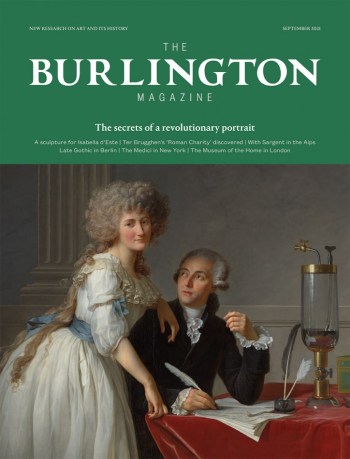
• David Pullins, Dorothy Mahon, Silvia A. Centeno, “The Lavoisiers by David: Technical Findings on Portraiture at the Brink of Revolution,” pp. 780–91.
Recent technical examination of Jacques-Louis David’s portrait of Antoine-Laurent and Marie-Anne Lavoisier in the Metropolitan Museum of Art, New York, painted between 1787 and 1788, has revealed significant and previously unknown alterations that transform our understanding of this celebrated portrait, its author, and its sitters.
R E V I E W S
• Susan Babaie, Review of the exhibition Epic Iran (V&A, 2021), pp. 837–39.
• Jonathan Conlin, Review of the exhibition Creating a National Collection: The Partnership between Southampton City Art Gallery and the National Gallery (Southampton City Art Gallery, 2021), pp. 845–48.
• Tanya Harrod, Review of the newly renovated Museum of the Home (previously the Geffrye Museum), pp. 858–61.
• John Bold, Review of John Martin Robinson, Wilton House: The Art, Architecture, and Interiors of One of Britain’s Great Stately Homes (Rizzoli Electa, 2021), pp. 872–74.
• Simon Lee, Review of Janis Tomlinson, Goya: A Portrait of the Artist (Princeton UP, 2020), pp. 874–75.
• Peter Fuhring, Review of Elena Cooper, Art and Modern Copyright: The Contested Image (Cambridge UP, 2018), pp. 875–76.
O B I T U A R Y
• Simon Jervis, “Ronald Lightbown (1932–2021),” pp. 879–80.
Spending most of his career at the Victoria and Albert Museum and National Art Library, Ronald Lightbown was a scholar of exceptional breadth, whose publications ranged from goldsmiths’ work of the late Middle Ages to Renaissance art and from the history of jewellery to Baroque wax sculpture.
American Ceramic Circle Journal 21 (2021)
In the latest issue of the ACC Journal:
 The American Ceramic Circle (ACC) is pleased to announce the release of its anniversary issue, volume XXI, of the American Ceramic Circle Journal. For this volume, the Journal committee has selected articles of great variety on quite different and diverse subjects. In the opening essay, “The Mysterious World of Redwares: Medicine and Magic in the Pottery of Pre-Enlightenment Europe,” Errol Manners connects the dots between redwares across Europe, the Americas, and China and explores their historical context. Alison McQueen’s research is an important milestone in giving the female workers of the Vincennes, and later Sevres, manufactory, their identities back. Her “study examines works by the female painters Marie-Victoire Jaquotot, Pauline Knip, Marie-Adélaide Ducluzeau, and Pauline Laurent, and the undervalued contributions of female employees responsible for retouching glaze, laying down prints, and burnishing the wares.” Ronald Fuchs’s essay “From Rehe, China, to Staffordshire, England: The Voyage of a Chinese Image” follows the ‘India Temple’ pattern made by John and William Ridgway of Staffordshire from its origin in China to its appearance on ceramics in England. For the 2019 ACC Symposium, we offered a wonderful excursion to Seagrove, NC, and Stephen Compton’s article “Jugtown Ware: A Modern Primitive Expression” will bring back for those who attended pleasant memories of that experience. Stephen will give a deeper insight into the founding and production of Jugtown Pottery. Radhika Vaidyanathan, a researcher and artist from South India, focuses on the tile-manufacturing process in the Indian subcontinent by the Swiss/German Basel Mission. Manhattan’s Hadler Rodriguez Gallery is the topic of Tom Folk’s article. The two New York gallerists were offering gay and lesbian ceramists a rare forum to freely exhibit in the 1970s and 1980s. Tizziana Baldenebro surveys Fred Marer’s collection of mid-century ceramics, which is now housed at Scripps College, Claremont, CA. The Marer Collection, which holds important examples of the American Studio Pottery Movement, is also part of the Marks Project’s online database. The Marks Project (TMP) received an ACC Grant in 2018.
C O N T E N T S
• Errol Manners — The Mysterious World of Redwares: Medicine and Magine in the Pottery of Pre-Enlightenment Europe
• Alison McQueen — Making the Marks: The Significant Roles and Challenges for Women in the First Century of Sèvres Porcelain
• Ronald W. Fuchs II — From Rehe, China to Staffordshire, England: The Voyage of a Chinese Image
• Stephen C. Compton — Jugtown Ware, a Modern Primitive Expression: American and Asian Pottery Traditions Come together in North Carolina
• Radhika Vaidyanathan — Ceramics and Missionaries in Colonial India: A Preliminary Survey of the Basel Mission Tile Factories
• Tom Folk — The Heroic Story of Manhattan’s Hadler Rodriguez Gallery
• Tizziana Baldenebro — The Marer Collection: Persistent Witness
The American Ceramic Circle (ACC) was founded in 1970 as a non-profit educational organization committed to the study and appreciation of ceramics. Its purpose is to promote scholarship and research in the history, use, and preservation of ceramics of all kinds, periods, and origins. The current active membership of approximately 500 is composed of museum and auction house professionals, collectors, institutions, and a limited number of dealers ceramics. The American Ceramic Circle Journal was first produced in 1971. Each volume has typically included five to ten articles presenting original research on a particular aspect of world ceramics. Many of the articles over the years have concentrated on American, European, and Asian ceramics from the sixteenth to the twentieth centuries, but the Journal welcomes a wide variety of ceramics-related topics. Submissions include papers presented at the ACC’s annual symposium, articles based on research sponsored by an ACC grant, and contributions from independent scholars. The Journal is distributed to all current ACC members, both individuals and institutions, as part of their membership, and individual issues are available for purchase on the ACC website. For questions, please contact ACC Journal Editor, Dr. Vanessa Sigalas, at journal@americanceramiccircle.org.
Print Quarterly, September 2021

Gottfried August Gründler, Frontispiece Der Naturforscher (1774), engraving, 90 × 110 mm
(Cambridge University Library)
◊ ◊ ◊ ◊ ◊
The eighteenth century in the latest issue of Print Quarterly:
Print Quarterly 38.3 (September 2021)
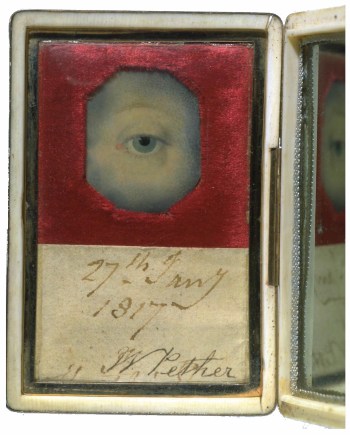
William Pether, Eye Miniature, 1817, watercolour on ivory, embedded in red velvet, 27 × 22 mm (London: Victoria & Albert Museum).
A R T I C L E S
Dominika Cora, “New Light on the Life and Work of the Mezzotint Engraver William Pether (1739–1821)”
William Pether (1739–1821) was one of the most distinguished English mezzotint engravers in the second half of the eighteenth century. Responding to scholarly confusion around his life, this article presents archival discoveries that illuminate his biography and personal life, as well as unpublished drawings and an overview of his artistic output.
N O T E S
Anna Gielas, “Gottfried A. Gründler’s Der Naturforscher (1773)”
During the second half of the eighteenth century, there was a peak in the usage of elaborate frontispiece engravings for European naturalist periodicals. Gielas introduces the frontispiece created by the renowned German engraver Gottfried August Gründler (1710–1775) for the naturalist journal Der Naturforscher and examines the useful information it displayed to the periodical’s (potential) audience. The engraving can be seen as an illustration of the cultural identity of naturalists as well as the Enlightened individual in the later decades of the eighteenth century.
Call for Articles | Colnaghi Studies Journal
From ArtHist.net:
Colnaghi Studies Journal
Articles due by 18 October 2021
Colnaghi Studies Journal is currently accepting submissions for future volumes. Articles should highlight new discoveries or current research relating to important artworks produced in—or as a direct response to—the European tradition, in the periods from Antiquity to the mid-nineteenth century. The journal welcomes articles relating to a variety of objects, including paintings, sculptures, drawings, prints, decorative arts, and textiles, as well as the history of their collection and conservation. Texts should be largely object focused and place artworks within the broader context of the culture and period in which they were produced, providing visual analysis and high-quality comparative images.
Manuscripts will be reviewed by members of the journal’s Editorial Committee, composed of specialists covering a wide range of fields, periods, and geographic areas. Texts should be between 1000 and 10,000 words (including endnotes) and include between five and fifteen illustrations, depending on the length of the article. The author of each article is responsible for obtaining all photographic material and reproduction rights. We will endeavour to help early career and independent scholars cover the cost of image licenses. Each author will receive a hard copy of the volume in which his or her article appears. Please send submissions to journal@colnaghi.com and visit the Foundation’s website for style guidelines.
The Burlington Magazine, June 2021

Charles-Louis Clérisseau, Traou en Dalmathia, 1757
(Paris: Bibliothèque nationale de France)
◊ ◊ ◊ ◊ ◊
The eighteenth century in this month’s issue of The Burlington . . .
The Burlington Magazine 163 (June 2021) — Works of Art on Paper
A R T I C L E S
• Ana Šverko, “Clérisseau’s Journey to Dalmatia: A Newly Attributed Collection of Drawings,” pp. 492–502.
A collection of 136 hitherto anonymous drawings of Italy, Istria and Dalmatia in the Bibliothèque nationale de France, Paris, is here attributed to Charles-Louis Clérisseau. The drawings, which include a group made during his journey from Venice to Diocletian’s Palace in Split with Robert Adam in 1757, further expand our understanding of Clérisseau as the forerunner of a new generation of traveller-painters.
• Tony Barnard, “Trading in Art: Antonio Cesare di Poggi (1744–1836),” pp. 492–502.
With the help of his English wife, Hester, the Italian artist A.C. Poggi forged a career in London as a portrait painter, a retailer of fans, a dealer principally in drawings and publisher of prints. Poggi’s successes and failures reflect changing fashions and fortunes in the capital’s competitive art world between his arrival in England c.1770 and departure for the Continent in 1801.
• Christopher White, “Reminiscences of the British Museum Print Room, 1954–65,” pp. 492–502.
The author’s first job, as Assistant Keeper with responsibility for the Northern schools in the Department of Prints and Drawings at the British Museum, London, introduced him to a distinguished group of curators and an occasionally eccentric band of visitors. The department’s focus was emphatically on drawings, where major acquisitions could be made by sharp-eyed scholars in the salesrooms.

Fan portraying George III and his family at the Royal Academy of Arts exhibition in 1788, made by A.C. Poggi incorporating a print by Pietro Antonio Martini after J. H. Ramberg, ca. 1790, engraved and hand-coloured paper with carved and pierced ivory sticks and guards, width when open 38.4 cm (London: Victoria and Albert Museum, T.56-1933).
◊ ◊ ◊ ◊ ◊
R E V I E W S
• Elizabeth Pergam, “The Frick Reframed,” pp. 536–39. On the plain, grey walls of the Modernist Breuer building, New York, some of the most famous works from the Frick Collection shine in a new light.
• Yuriko Jackall, Review of the exhibition catalogue Une des Provinces du Rococo: La Chine Rêvée de François Boucher, ed. by Yohan Rimaud and Alastair Laing (In Fine éditions d’art and Musée des beaux-arts et d’archéologie de Besançon, 2019), pp. 539–41.
• Jonathan Yarker, Review of the exhibition Turner’s Modern World (Tate Britain, 2020–21), pp. 541–44.
• Amanda Dotseth, Review of the exhibition publication Museo del Prado 1819–2019: Un lugar de memoria, ed. by Javier Portús et al (Prado, 2018), pp. 546–49.
• Simonetta Prosperi Valenti Rodinò, Review of Les dessins de la collection Mariette: Écoles italienne et espagnole, by Pierre Rosenberg et al, 4 vols., (Somogy, 2019), pp. 550–51.
• Oliver Tostmann, Review of Die Zeichnungen des Giovan Battista Beinaschi aus der Sammlung der Kunstakademie Düsseldorf am Kunstpalast, ed. by Sonja Brink and Francesco Grisolia (Imhof Verlag, 2020), pp. 556–57. [Beinaschi lived between 1636 and 1688, but Tostmann notes in passing points of his eighteenth-century reception.]
• Christoph Martin Vogtherr, Review of L’ Art et la manière: Dessins français du XVIIIesiècle des musées de Marseille, ed. by Luc Georget and Gérard Fabre (Silvana Editoriale, 2019), pp. 557–58.
Call for Articles | The Eighteenth Century in Comics and Graphic Novels
From ArtHist.net:
Die Aufklärung und das 18. Jh. in Comic und Graphic Novel
The Enlightenment and the 18th Century in Comics and Graphic Novels
Special Issue of Jahrbuch Der OGE 18
Jahrbuch Der Österreichischen Gesellschaft Zur Erforschung Des Achtzehnten Jahrhunderts 2022
Proposals due by 31 July 2021; completed articles will be due 31 December 2021
Anlässlich ihres 40-Jahr-Jubiläums widmet die Österreichische Gesellschaft zur Erforschung des 18. Jahrhunderts ihr Jahrbuch 2022 Repräsentationen von Aufklärung und dem 18. Jahrhundert in Comics und Graphic Novels. Zwar ist die Rezeption historischer Inhalte in der Populärkultur ein etabliertes Forschungsfeld, doch haben die Text-Bild-Narrationen dieses Mediums—verglichen etwa mit Computerspielen—bislang kaum Aufmerksamkeit gefunden. Vorliegende Arbeiten (wie C. Gundermanns Jenseits von Asterix, 2007) haben einerseits einen fachdidaktischen Schwerpunkt auf Aspekte der Vermittlung, andererseits keinen definierten Fokus auf das 18. Jahrhundert. — Dieses ist aber in mehrfacher Hinsicht interessant: Graphic Novels (etwa zu Voltaire) können Ideen der Aufklärung recht präzise auf den Punkt bringen; manche historisierenden Donald Duck-Darstellungen (etwa jene von Erika Fuchs) spiegeln dagegen durchaus tieferes Verständnis der deutschen Klassik. Dennoch hat sich bislang niemand diesem Thema wissenschaftlich angenähert. Die OGE18 will das mit ihrem Jubiläumsjahrbuch nun ändern.
Gesucht werden wissenschaftliche Aufsätze (im Umfang von rund 40.000 bis 50.000 Zeichen inkl. Leerzeichen), die die Verhandlung von Motiven, Figuren, Ereignissen und Ideen des ‚langen‘ 18. Jahrhunderts in Comics oder Graphic Novels kritisch diskutieren. Aufsätze können in deutscher, englischer oder französischer Sprache eingereicht werden. Abgabetermin ist der 31. Dezember 2021. Die Beiträge werden einem Peer-Review-Verfahren unterzogen. Bei Interesse senden Sie bitte bis spätestens 31. Juli 2021 eine knappe Skizze Ihres Beitrags an die Herausgeber_innen Thomas Assinger (thomas.assinger@sbg.ac.at), Elisabeth Lobenwein (elisabeth.lobenwein@aau.at) und Thomas Wallnig (thomas.wallnig@univie.ac.at).
Woman’s Art Journal, Spring / Summer 2021
The eighteenth century in the latest issue of WAJ:
Woman’s Art Journal 42.1 (Spring / Summer 2021)

Marguerite Gérard, Portrait of a Man and Woman in an Interior, 1818 (Tulsa: Philbrook Museum of Art; Taber Art Fund, 2019.9). The painting sold at Christie’s in Paris on 28 October 2019, Sale 17655, Lot 751.
A R T I C L E S
• Sarah Lees, “Marguerite Gérard’s Portrait of a Man and a Woman in an Interior: Portraiture, Landscape, and Social Networks,” pp. 19–26.
• Alison M. Kettering, “Watercolor and Women in the Early Modern Netherlands: Between Mirror and Comb,” pp. 27–35.
R E V I E W S
• Rosie Razzall, Review of Angela Oberer, The Life and Work of Rosalba Carriera (1673–1757): The Queen of Pastel (Amsterdam University Press, 2020), pp. 44–46.
• Wendy Wassyng Roworth, Review of the exhibition catalogue, Angelica Kauffman, edited by Bettina Baumgärtel (Hirmer, 2020), pp. 46–48.










 Enfilade
leave a comment