Journal of Art Historiography, June 2017
Selection of articles from the current issue of the Journal of Art Historiography most relevant to the eighteenth century:
Journal of Art Historiography 16 (June 2017)
The Limits of Connoisseurship: Guest Edited by Valérie Kobi
Valérie Kobi (Bielefeld University), “The Limits of Connoisseurship: Attribution Issues and Mistakes, An Introduction.”
David Pullins (The Frick Collection), “The Individual’s Triumph: The Eighteenth-Century Consolidation of Authorship and Art Historiography.”
Portuguese Art Historiography
Edward J. Sullivan (New York University), “Portuguese Art History: A View from North America.”
Foteini Vlachou (Instituto de História Contemporânea, Lisbon), “The Discourse on Utility: Art Theory in Eighteenth-Century Portugal.”
Reviews
Ingrid R. Vermeulen (Vrije Universiteit Amsterdam), Review of Kristel Smentek, Mariette and the Science of the Connoisseur in Eighteenth-Century Europe (Ashgate, 2014).
Art History, June 2017
The eighteenth century in the current issue of Art History:
Art History 40.3 (June 2017)
A R T I C L E S

Louis-Michel Van Loo, Carle Van Loo and His Family, 1757; oil on canvas, 200 × 156 cm (Musée National du Château de Versailles).
• Emma Barker, ” ‘No Picture More Charming’: The Family Portrait in Eighteenth-Century France,” pp. 526–53.
During the eighteenth century, so it is conventionally argued, the family portrait underwent a decisive transformation. Hitherto stiff and formal, such pictures took on a new informality and intimacy in response to the rise of a new set of domestic ideals. In the case of French family portraiture, this narrative has continued to be rehearsed in a largely uncritical way. What has not been adequately grasped to date is the way that such pictures functioned to legitimate the sitters and, more particularly, the male head of the family in the eyes of an external beholder. Although sometimes commissioned by a royal or noble family in response to a dynastic crisis, they most often functioned to consolidate the social ascent of wealthy commoners. The changes that the family portrait underwent during this period are bound up with the shift of political authority away from the absolute monarch towards the public sphere.
R E V I E W S
• Michael Schreffler, Review of Ananda Cohen Suarez, Heaven, Hell, and Everything in Between: Murals of the Colonial Andes (University of Texas Press, 2016), pp. 672–74.
• T. A. Heslop, Review of Christy Anderson, Anne Dunlop, and Pamela H. Smith, eds., The Matter of Art: Materials, Practices, Cultural Logics, c. 1250–1750 (Manchester University Press, 2014), pp. 681–82.
The American Historical Review (April 2017)
The “AHR Forum: Mapping the Republic of Letters” in the current issue of The American Historical Review will likely be of interest to anyone engaged with questions of art history and big data, the Grand Tour, and mapping projects. Historiographical questions are central and addressed in fascinating ways. –CH
The American Historical Review 122.2 (April 2017)
“AHR Forum: Mapping the Republic of Letters”
Dan Edelstein, Paula Findlen, Giovanna Ceserani, Caroline Winterer, and Nicole Coleman, “Historical Research in a Digital Age: Reflections from the Mapping the Republic of Letters Project,” pp. 400–24.
What can a big data approach bring to the study of the early modern Republic of Letters? This is the question we asked ourselves in our collaborative project Mapping the Republic of Letters. For the past nine years, we have been exploring the limits and possibilities of computation and visualization for studying early modern correspondences, whose massive and dispersed character have long challenged their students. Beyond cliometrics, what new ways of discovery and analysis do today’s big data offer? What can we learn by visualizing the archives and databases that are increasingly accessible and viewable online? In a variety of case studies focusing on metadata (in the letters of John Locke, Athanasius Kircher, Benjamin Franklin, and Voltaire, and in the travels of those engaging in the Grand Tour), we experimented with visualizations to produce maps of the known and unknown quantities in our datasets, and to represent intellectual, cultural, and geographical boundaries. In the process, we experienced collaborative authorship, and worked with designers and programmers to create an open access suite of visualization tools specifically for humanities scholars, Palladio. What might the next research steps be, as linked data rapidly develops further possibilities?
Giovanna Ceserani, Giorgio Caviglia, Nicole Coleman, Thea De Armond, Sarah Murray, and Molly Taylor-Poleskey, “British Travelers in Eighteenth-Century Italy: The Grand Tour and the Profession of Architecture,” pp. 425–50.
Drawing on a dynamic digital database of eighteenth-century British travelers in Italy, in this article we offer a case study focused on British architects to demonstrate the potential of digital resources for historical research. Based on the entries in John Ingammels’s Dictionary of British and Irish Travellers in Italy, 1701–1800 (1997)—which covers the itineraries and lives of more than five thousand travelers—our project adds a new richness and granularity to the understanding of the Grand Tour. We see what these tours were like and what they did for British architects in Italy and beyond. We show the patterns of places visited, of funding, of social and professional gains and interactions, and we thus catch sight of a history of architecture that goes beyond the influence of Italian architectural models on British thought and design. This approach to the Grand Tour reveals the transformation of “architecture” from a gentlemanly passion and artisanal craft into a modern profession and discipline. By indicating some of the ways in which the Grand Tour served this transformation, this case study also suggests the broader promise of our digital approach for scholars of various interests.
Jason M. Kelly, “Reading the Grand Tour at a Distance: Archives and Datasets in Digital History,” pp. 451–63.
This essay uses Giovanna Ceserani, Giorgio Caviglia, Nicole Coleman, Thea De Armond, Sarah Murray, and Molly Taylor-Poleskey’s essay “British Travelers in Eighteenth-Century Italy: The Grand Tour and the Profession of Architecture” as a point of departure from which to examine the limits and potentials of digital history, especially as it relates to the construction of archives and digital datasets. Through a critical reading of the sources used to create the Grand Tour Project—part of the Mapping the Republic of Letters project at Stanford University—it shows the ways in which datasets can both hide and embody hierarchies of power. Comparing the Grand Tour Project to other digital projects currently in production, such as Itinera and Legacies of British Slave-Ownership, this piece offers suggestions for alternative readings of the Grand Tour narrative. It ends by summarizing a series of challenges faced by historians as they contemplate best practices for creating and maintaining digital datasets in the twenty-first century.
Call for Articles | Fall 2018 Issue of J18: Albums

From J18:
Journal18, Issue #6 (Fall 2018) — Albums
The Culture of Albums in the Long 18th Century
Proposals due by 1 October 2017; finished articles will be due by 1 April 2017
Selecting, collecting, classifying, curating, displaying, narrating, disseminating, transporting, entertaining, educating, subverting: what other single object does all of that at once? Ordering knowledge through the rationale of a sequenced and empirical display of data (visual, textual, material), the album became an archetypical site of the eighteenth century’s way of thinking about and representing the world. Neither a treatise implementing a master-hypothesis nor a random gathering of material, albums can be described as both hybrid and structured objects. They have the physical structure of a book and the appearance of a narrative but are also pure displays, a rhetorical organization of iconic discourses and a virtual folding or unfolding of a larger idea having a specific program. They simultaneously contain pictorial imagery (paintings, cut-ups, and, later in the nineteenth century, photographs) and are themselves artistic creations. They provide microcosmic and portable representations of a polity, a culture, or an individual. Unexpected mixtures of media and topics also form the repertoire of many albums. They invite us to think through regimes of readability, visibility, and seriality. Often studied for their contents rather than as creations in their own right, albums raise many important questions regarding their status as archival or museum objects. Their contrived nature makes them ideal objects to be studied in terms of social practice, identity politics, and interconnectedness. They invoke relationships, compositions, and collectivity. The album offers a very fertile ground for probing the material and intellectual productivity of cultures.
What does album-making tell us about cultural and individual identities? And how do these identities utilize and make sense of this specific practice? How do albums work iconographically and textually? What is their historical significance and how can we interpret them? For Issue 6 of Journal18, we invite papers that explore these and related questions to appraise this hitherto neglected object of our discipline. In particular, we call for an investigation of parallel developments of albums around the globe across the long eighteenth century (1650–1850), as well as the theoretical debates informing notions of serialization and authenticity. Drawing upon neighboring fields of anthropology, literary criticism, philosophy, and museum studies, we invite scholars to think about these objects as ubiquitous and intimately interconnected artefacts, and to investigate them within cultures of imperialism, colonialism, identity politics, and theoretical approaches of artistic hybridity and difference.
Issue Editor
Nebahat Avcioglu, Hunter College/CUNY
Proposals for issue #6 Albums are now being accepted. Deadline for proposals: October 1, 2017. To submit a proposal, send an abstract (200 words) and a brief CV to editor@journal18.org and navciogl@hunter.cuny.edu. Articles should not exceed 6000 words (including footnotes) and will be due on April 1, 2018. For further details on the submission process see Information for Authors.
The Burlington Magazine, April 2017
The eighteenth century in The Burlington:
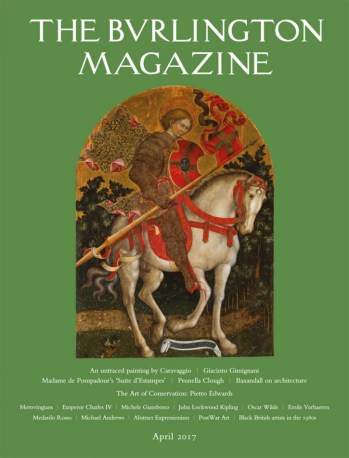 The Burlington Magazine 159 (April 2017)
AR T I C L E S
• Susan M. Wager, “The Earliest Known Version of Madame de Pompadour’s Suite d’Estampes Rediscovered,” pp. 285–89.
• Elizabeth Darrow, “The Art of Conservation: X Pietro Edwards: The Restorer as Philosophe,” pp. 308–17.
R E V I E W S
• Owen Hopkins, Review of Angelo Hornak, After the Fire: London Churches in the Age of Wren, Hooke, Hawksmoore, and Gibbs (Pimpernel Press, 2016), pp. 323–24.
• Giles Waterfield, Review of Burton Fredericksen, The Burdens of Wealth: Paul Getty and His Museum (Archway Publishing, 2015), p. 325.
• Teresa Leonor M. Vale, Review of the exhibition catalogue, Alvar Gonzalez Palacios, I Valadier: L’album dei disegni del museo napoleonico (Museo Napoleonico di Roma, 2015), p. 328.
• Richard Green, Review of Stephen Lloyd, ed., Art, Animals and Politics: Knowsley and the Earls of Derby (Unicorn Press, 2015), p. 328.
Print Quarterly, March 2017
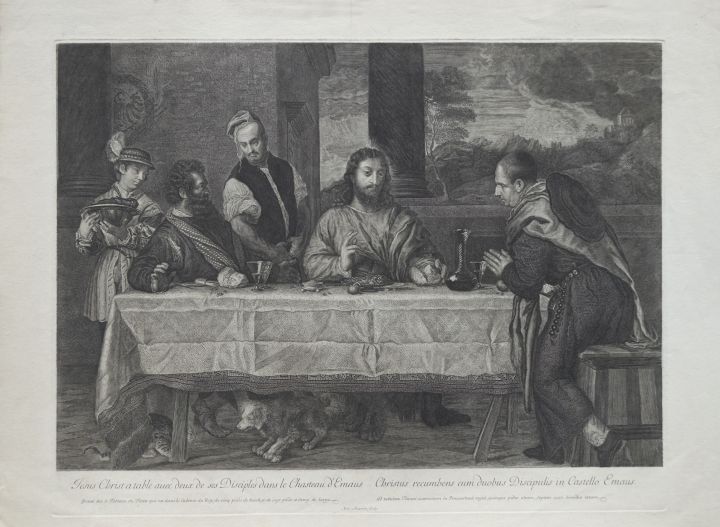
Antoine Masson, after Titian, Supper at Emmaus, second half of the seventeenth century, engraving, 452 x 586 mm
(London: The British Museum).
◊ ◊ ◊ ◊ ◊
Foremost among the several items in the current issue of Print Quarterly relevant to the eighteenth century is an article by Thomas Frangenberg addressing Franz Christoph von Scheyb (1704–77) on the art of engraving. Von Scheyb’s unusual detailed discussion of a print by Antoine Masson (1636–1700) after Titian demonstrates the sophistication with which aspects of reproductive prints could be articulated during this period, revealing prints’ merits and shortcomings, both as sources of art history and works of art in their own right. The issue also includes shorter reviews on books about Tiepolo, Piazzetta, and Novelli in the context of the eighteenth-century Venetian illustrated book; drawings and prints after the antique; and prints by Luigi Rossini (1790–1857).
Print Quarterly 34.1 (March 2017)
A R T I C L E S
• Thomas Frangenberg, “Franz Christoph von Scheyb on the Art of Engraving,” pp. 32–41
N O T E S
• Viccy Coltman, “Drawn from the Antique: Artists & the Classical Ideal,” pp. 70–72.
• Giorgio Marini, “Book Illustration in Eighteenth-Century Venice (Tiepolo, Piazzetta, Novelli: L’incanto del libro illustrato nel Settecento Veneto), pp. 73–76.
• David R. Marshall, “Luigi Rossini 1790–1857,” pp. 76–77.
A full contents list is available here»
Journal18, #3 Lifelike (Spring 2017)
The third issue of J18 is now available.
Journal18, Issue #3: Lifelike (Spring 2017)
Issue Editors: Noémie Etienne and Meredith Martin
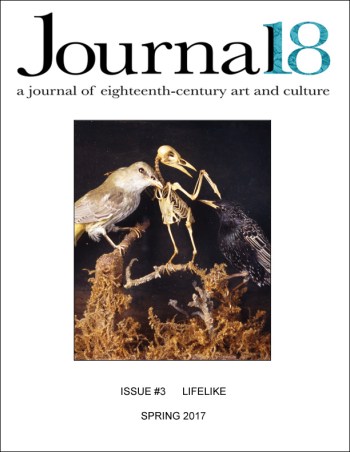 During the eighteenth century, a range of artistic productions sought to simulate motion and life in new ways. At the same time, individuals became ever more preoccupied with performing or embodying static works of art. Echoing contemporary discussions in artistic and literary discourses around vraisemblance and verisimilitude, as well as mimesis and imitation, these preoccupations also tapped in to larger social and intellectual debates about matter, mankind, and machines at a global level.
This issue of Journal18 explores these fundamental tensions between art and life, movement and permanence that obsessed the worlds of art, science, and entertainment during the eighteenth century. What was considered ‘lifelike’ in this period? How did artworks—among them taxidermy tableaux, moving statues, nautilus cups, and automaton clocks—engage with this notion and participate in redefining it? What was at stake in staging a convincing simulation of life, and what purpose—political, pedagogical, or otherwise—did it serve? What role did ephemeral performances or spectacles play in generating such illusions and in shaping their significance? And how might we interpret these acts historically today?
In addition to full-length articles, we have assembled a series of shorter essays on the theme of ‘Waxworks’. More than any other material in the eighteenth century, wax seems to have provoked debates about the permeable boundaries between illusion and imitation, art and science, absence and presence. At the same time, objects made of wax—from La Specola’s famous anatomical Venus to busts portraying victims of the French Revolution modeled from life by Marie Tussaud—have the potential to disrupt traditional categories and hierarchies of art history, which is perhaps one reason why wax has emerged in recent years as such an exciting and provocative field of study.
A R T I C L E S
• Valérie Kobi, Staging Life: Natural History Tableaux in Eighteenth-Century Europe
• Amelia Rauser, Vitalist Statues and the Belly Pad of 1793
• Eugenia Zuroski, Nautilus Cups and Unstill Life
• Lihong Liu, Pyrotechnic Profusion: Fireworks, Spectacles, and Automata in Time
W A X W O R K S
• David Mark Mitchell, Vividness without Vitality: The Specola Venus’s Intersecting Afterlives
• Robert Wellington, Antoine Benoist’s Wax Portraits of Louis XIV
• Charles Kang, Anatomy of the Bel Effet: Wax between Science and Art
• Paris Amanda Spies-Gans, ‘The Fullest Imitation of Life’: Reconsidering Marie Tussaud, Artist-Historian of the French Revolution
Cover image: Detail of stuffed Starling, Oriole and Bird’s Skeleton from Goethe’s Collection, before 1790 (Goethe-Nationalmuseum, Weimar ©Klassik Stiftung Weimar/Thomas Korn)
Print Quarterly, December 2016
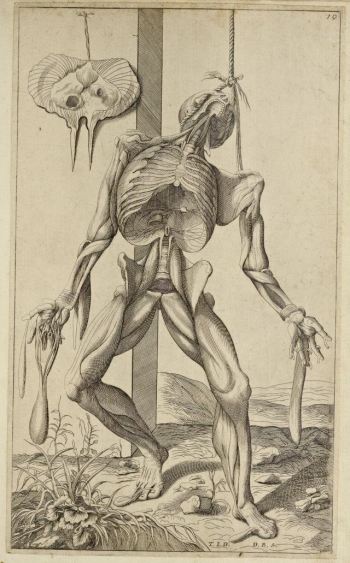
Domenico Bonaveri, Muscle Figure, pl. 10 from Notomie di Titiano (Bologna, ca, 1685–90), etching and engraving (Los Angeles: Getty Research Library).
The December 2016 issue of Print Quarterly includes several items relevant to the eighteenth century: articles concerning a redating of the Notomie di Titiano to c. 1685–90, a scrapbook in the Bibliotheca Thysiana in Leiden assembled in the late seventeenth or early eighteenth century, and a rediscovered drawing of 1669–80 by Jean Boulanger, as well as shorter pieces on the Dresden festivities of 1719 and prints and propaganda in the age of Napoleon.
Print Quarterly 33.4 (December 2016)
A R T I C L E S
• Monique Kornell, “A Dating for Domenico Bonaveri’s Notomie di Titiano,” pp. 379–91.
• Daphne E. Woutsa, “Exploring the Thysiana Scrapbook,” pp. 391–406.
• Angelamaria Aceto, “A Rediscovered Drawing by Jean Boulanger (1608–c.1680),” pp. 406–15,
N O T E S
• Madeleine Brook, “Constellatio Felix in 1719,” pp. 449–51.
• Philippe Bordes, “Prints and Propaganda in the Age of Napoleon,” pp. 453–55.
A full content list is available here»
Knole, Kent in the ‘NT Houses & Collections Annual, 2016’
Now available for free digitally, or as a hard copy through the National Trust:
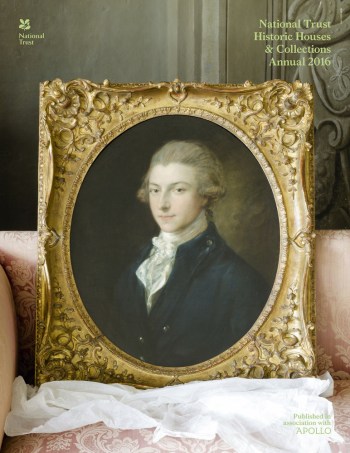 The National Trust Historic Houses & Collections Annual 2016, published in association with Apollo, is dedicated to Knole in Kent and includes these essays on eighteenth-century topics:
• Camilla Beresford, “The Bird House At Knole.” Considers a mid-18th-century gothic curiosity that once housed a remarkable collection of exotic birds.
• Christopher Rowell and Wolf Burchard, “The Third Duke of Dorset and the First Earl Whitworth as Diplomatic Patrons and Collectors.” Considers the many examples of furniture at Knole associated with the French court on the eve and aftermath of the French Revolution.
• John Chu, “Thomas Gainsborough’s Portrait of Louis-Pierre, Marquis de Champcenetz.” On how the Marquis, whose portrait by Gainsborough returns to Knole this year, found refuge and friendship in England (the portrait was at Knole by 1793 and remained there until 1930).
A full list is available here»
Call for Articles | French Porcelain, 1789–1918

Makers, Markets, and Museums: French Porcelain in the Long Nineteenth Century, 1789–1918
The French Porcelain Society Journal 7 (2018)
Proposals due by 7 April 2017
The French Porcelain Society Journal is the leading academic English-language journal on European ceramics and their histories, illustrated throughout in full colour. The society is pleased to announce the publication of Volume 6, Céramiques sans Frontières: The Transfer of Ceramic Designs and Technologies across Europe. Based on the society’s 2015 symposium, fourteen articles investigate the impact of French ceramic design on makers elsewhere in Europe and in Britain in the eighteenth and nineteenth centuries. These range from an analysis of the transfer of the Istoriato maiolica tradition from Italy to France in the late sixteenth century and an account by J.V.G. Mallet of the travels of Walther Ehrenfried von Tschirnhaus to an investigation of the links between Sèvres and Minton porcelain in the nineteenth century. For a full list of contents or to order, please consult the society’s website.
The editors now invite submissions for volume 7 of the journal, Makers, Markets, and Museums: French Porcelain in the Long Nineteenth Century, 1789–1918, to be published in 2018. From the dispersal of Sèvres porcelain from royal palaces and aristocratic collections after the French Revolution to the founding of outstanding collections of French porcelain in Britain and the United States and the establishment of new museums for the decorative arts, the nineteenth century was undoubtedly one of seismic change. It witnessed the growth of a flourishing London art market and new departures in collecting French eighteenth-century decorative art, all encouraged by the rise of the dealer. Innovation in design and manufacture was documented in a plethora of printed specialist publications, pattern books and popular journals. It is hoped that this volume will enlarge our understanding of this under-researched but important aspect of ceramic history.
The journal will include an article based on the 2016 Geoffrey de Bellaigue lecture given to the society by Dr Tom Stammers (Durham University) on “Baron Jean-Charles Davillier: A Paragon and Historian of Taste in Nineteenth-Century France.” Topics for consideration could include:
• Nineteenth-century French ceramics or those of other factories influenced by them
• Nineteenth-century collectors
• Methods of display in the nineteenth-century interior
• The role of new museums, exhibitions, and publications in advancing the study and collecting of French ceramics
• The dealer, the auction, and the art market
• New technical advances in ceramic production
• Connoisseurship
Submissions in the first instance should be a summary of no more than 750 words, with a brief description of the argument, a historiography and a note of the research tools and sources used. Please include a brief CV. The journal accepts articles in French as well as in English. The volume will comprise about 15 articles which will be peer reviewed by the editorial board and the FPS council of academic and museum specialists which includes: Dame Rosalind Savill, DBE, FBA, FSA (Curator Emeritus, The Wallace Collection, London); Oliver Fairclough, FSA, John Whitehead, FSA, Patricia Ferguson, Errol Manners, FSA, Diana Davis and Caroline McCaffrey-Howarth (University of Leeds). Articles should be no more than 6,000 words in length excluding endnotes. Up to 15 high-resolution images per article will be accepted. Please send abstracts as an e-mail attachment to: diana_davis@hotmail.co.uk by 7 April 2017. If your abstract is accepted, articles and images will be due by 29 September 2017.










 Enfilade
leave a comment