The Burlington Magazine, December 2016
The eighteenth century in The Burlington (the issue is dedicated to ‘Art in Britain’):
 The Burlington Magazine 158 (December 2016)
A R T I C L E S
• Lydia Hamlett, “Pandora at Petworth House: New Light on the Work and Patronage of Louis Laguerre,” pp. 950–55.
• Jennifer Melville, “Lady Forbes of Monymusk: A Rediscovered Portrait by Joshua Reynolds,” pp. 956–60.
• Brendan Cassidy, “A Portrait by Gavin Hamilton: Sir John Henderson of Fordell,” pp. 961–63.
• Alex Kidson, “David Solkin’s Art in Britain, 1660–1815 (Paul Mellon Centre for Studies in British Art, 2015),” pp. 964–67.
L E T T E R S
• Peter Lindfield, “A Further Allusion to Strawberry Hill at Lee Priory, Kent,” p. 979.
• Nicholas Penny, “Hugh Honour,” p. 979.
R E V I E W S
• Susanna Avery-Quash, Review of Lucilla Burn, The Fitzwilliam Museum: A History (Philip Wilson Publishers, 2016), p. 980.
• Greg Smith, Review of the exhibition catalogue, Tim Barringer and Oliver Fairclough, Pastures Green & Dark Satanic Mills: The British Passion for Landscape (Giles, 2014), pp. 981–82.
• Barry Bergdoll, Review of Stefan Koppelkamm, The Imaginary Orient: Exotic Buildings of the 18th and 19th Centuries in Europe (Axel Munges, 2015), p. 982.
• Giles Waterfield, Review of the exhibition catalogue, Victoria Avery, Melissa Calaresu, and Mary Laven, eds., Treasured Possessions from the Renaissance to the Enlightenment (Philip Wilson Publishers, 2015), p. 988.
• Malcolm Bull, Review of the exhibition In the Light of Naples: The Art of Francesco de Mura (Cornell Fine Arts Museum, Rollins College, Winter Park, 2016; Chazen Museum, University of Wisconsin-Madison, 2017; The Frances Lehman Loeb Art Center, Vassar College, Poughkeepsie, 2017), pp. 1006–07.
S U P P L E M E N T
• Tim Knox, “Recent Acquisitions (2012–16) at the Fitzwilliam Museum, Cambridge,” pp. 1017–28.
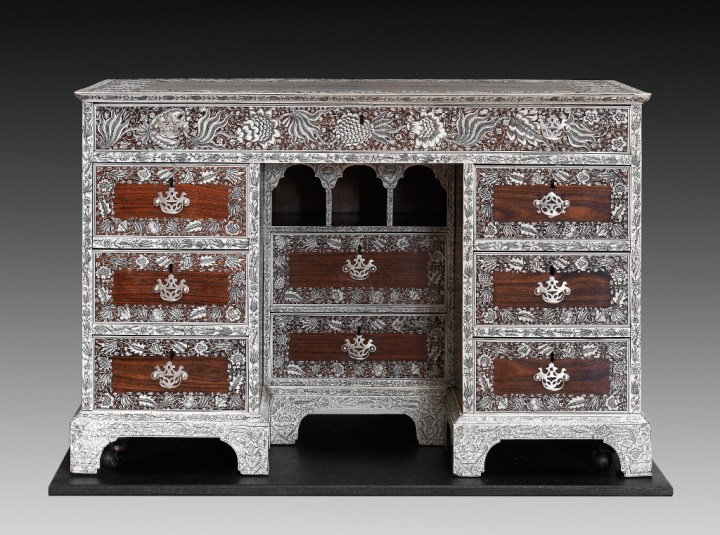
The Rumbold Desk, by an unknown craftsman from Vizagapatam, Southern India, ca. 1750–60, rosewood inlaid with ivory, silver handles, 76 × 113 × 62 cm. Accepted in Lieu of Inheritance Tax by HM Government and allocated to the Fitzwilliam Museum, 2016 (M.3–2016). This Anglo-Indian desk has been on loan to the Fitzwilliam Museum in Cambridge since 2012 and is one of the finest of a very small group of similar desks made for British patrons in India at Vizagapatam (near Madras), a centre for the manufacture of such luxurious ivory-inlaid furniture. It belonged to Sir Thomas Rumbold, 1st baronet (1736–91), a British administrator in India, who amassed a great fortune in the service of the East India Company and served as Governor of Madras from 1777 to 1780.
First Issue of ‘Art History Pedagogy and Practice’ Released
From AHTR:
 Art History Teaching Resources (AHTR) is thrilled to release the inaugural issue of Art History Pedagogy and Practice (AHPP), the first academic journal dedicated to the scholarship of teaching and learning in art history (SoTL-AH). The result of a two year initiative, generously funded by the Samuel H. Kress Foundation, AHPP responds to the need to support, collect, and disseminate pedagogical research specific to the discipline. Published biannually by AHTR in partnership with the Graduate Center for the City University of New York and the CUNY Office of Library Services, AHPP is available as an open access e-journal on Academic Works, CUNY’s Digital Commons repository.
With its first issue, “What’s the problem with the introductory art history survey?” AHPP seeks to advance a long-running conversation in art history by exploring issues related to the introductory survey course. A robust response to the initial call for papers revealed that discourse around this topic has evolved in recent years to reflect current changes across the educational landscape. Faculty today acknowledge a broader range of skills and content to be foundational to art historical study and the significant role of digital technology in instructional practice, but research is necessary to examine the impact of new pedagogies when applied in the classroom.
The Scholarship of Teaching and Learning in Art History
The scholarship of teaching and learning (SoTL) encourages scholars to investigate their teaching practice with the same curiosity and intellectual rigour used to approach key research questions in their discipline. While SoTL research encompasses many interests, it generally involves asking meaningful questions about student learning and how it can be improved; conducting research into teaching and learning that is systematic, analytical, evidence-based, and uses a variety of research methods; and sharing the results of that inquiry to benefit colleagues and contribute to a growing body of knowledge around teaching and learning.
As a peer-reviewed journal, AHPP developed as a natural outgrowth of the AHTR Weekly, a lively and wide-ranging blog series where diverse practitioners write about their teaching ideas and experiences. Together, these forums offer a digital model of publication where informal and formal SoTL exchange can complement one another and foster public-facing discourse about education in the humanities. The articles in first issue explore different models of inquiry appropriate to SoTL in art history. They include case studies and qualitative data in the form of student comments, personal reflections, and observations in the classroom, and address quantifiable measurements around learning outcomes, graded performance, and other methods used in education and the learning sciences. Most importantly they ask questions that are important to developing conceptual frameworks for pedagogical practice in art history, and serve as a point of departure for future study in this emerging area of the discipline.
AHTR
ArtHistoryTeachingResources.org (AHTR) is a online platform that connects a diverse field of practitioners teaching art history and visual culture. The site currently provides an evolving repository of adaptable lesson plans; a weekly blog of shared assignments, teaching ideas, and reflective essays; and biannual publication of Art History Pedagogy and Practice. Founded on dual goals to raise the value of the academic labor of teaching and to provide peer support across ranks of tenured, tenure-track, and contingent instructors, AHTR began in 2011 as a collaboration between Michelle Millar Fisher (CUNY, MOMA) and Karen Shelby (Baruch College, CUNY), who created the arthistoryteachingresources.org website with support from the New Media Lab at the CUNY Graduate Center. Since its public launch in 2013, AHTR has grown an average of 120% each year and has been viewed over 500,000 times by educators in K-12, post-secondary institutions, and art museums, and academic support staff including reference librarians and curriculum designers. AHTR’s administration has similarly expanded to a leadership collective of art historians and an advisory network assembled for expertise and leadership in art history, museum education, and digital humanities.
AHTR believes that effective high-quality instruction is essential to the future of art history. We are excited to contribute to this goal by providing a platform for scholarly discourse and publication on teaching and learning in art history, and look forward to the next issue of AHPP in Spring 2017. We are grateful for the support, encouragement, and hard work of so many people who have helped to realize this major initiative. In addition to the authors and peer reviewers who contributed content to AHPP’s inaugural issue, we wish to thank Jill Cirasella and Megan Wacha at CUNY, Jillian Clark at bepress, Danielle Maestretti at Flexport, CHIPS, Max Marmor, Lisa Schermerhorn, and Wyman Meers at the Kress Foundation, AHPP’s Advisory Board, and co-editors Renee McGarry and Virginia B. Spivey.
Art History Pedagogy and Practice 1.1 (December 2016)
• Virginia B. Spivey and Renee McGarry — Editor’s Introduction: Advancing SoTL-AH
• Aditi Chandra, Leda Cempellin, Kristen Chiem, Abigail Lapin Dardashti, Radha J. Dalal, Ellen Kenney, Sadia Pasha Kamran, Nina Murayama, and James P. Elkins — Looking Beyond the Canon: Localized and Globalized Perspectives in Art History Pedagogy
• Melissa R. Kerin and Andrea Lepage — De-Centering ‘The’ Survey: The Value of Multiple Introductory Surveys to Art History
• Beth Harris and Steven Zucker — Making the Absent Present: The Imperative of Teaching Art History
• Julia A. Sienkewicz — Against the ‘Coverage’ Mentality: Rethinking Learning Outcomes and the Core Curriculum
• Glenda M. Swan — Building a Foundation for Survey: Employing a Focused Introduction
Netherlands Yearbook for History of Art, November 2016
Latest issue of NKJ:
Thijs Weststeijn, Eric Jorink and Frits Scholten, eds., Netherlandish Art in its Global Context (Leiden: Brill, 2016), 296 pages, ISBN: 978-9004334977, €105 / $123. [Netherlands Yearbook for History of Art / Nederlands Kunsthistorisch Jaarboek 66 (November 2016)].
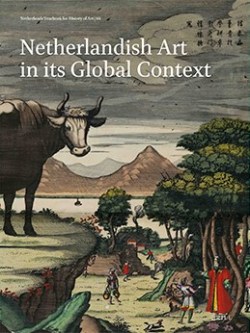 Netherlandish art testifies to the interconnectedness of the Early Modern world. New trade routes, the international Catholic mission, and a thriving publishing industry turned Antwerp and Amsterdam into capitals of global exchange. Netherlandish prints found a worldwide public. At home, everyday lives changed as foreign luxuries, and local copies, became widely available. Eventually, Dutch imitations of Chinese porcelain found their way to colonists in Surinam. This volume of the Netherlands Yearbook for History of Art breaks new ground in applying the aims and approaches of global art history to the Low Countries, with essays ranging from Greenland to South Africa and Mexico to Sri Lanka. The Netherlands, as a fringe area of the Habsburg Empire marked by internal fault lines, demonstrated remarkable artistic flexibility and productivity in the first period of intensive exchange between Europe and the rest of the world.
Thijs Weststeijn, PhD (2005), University of Amsterdam, is professor of art history before 1850 at Utrecht University. He chairs the research project The Chinese Impact: Images and Ideas of China in the Dutch Golden Age (2014–19).
Eric Jorink, PhD (2004), University of Groningen, is Teylers professor at Leiden University and researcher at the Huygens Institute (KNAW). He is the author of Reading the Book of Nature in the Dutch Golden Age, 1575–1715.
Frits Scholten, PhD (2003), University of Amsterdam, is senior curator of sculpture at the Rijksmuseum and holds the chair in the History of Western Sculpture before 1800 at the Universiteit van Amsterdam. He has published widely on Western sculpture and decorative arts. His most recent publication is Small Wonders: Late-Gothic Boxwood Micro-carvings from the Low Countries (Amsterdam 2016).
C O N T E N T S
• Thijs Weststeijn, Introduction: Global Art History and the Netherlands
• Nicole Blackwood, Meta Incognita: Some Hypotheses on Cornelis Ketel’s Lost English and Inuit Portraits
• Stephanie Porras, Going Viral? Maerten de Vos’s St Michael the Archangel
• Christine Göttler, ‘Indian Daggers with Idols’ in the Early Modern Constcamer: Collecting, Picturing and Imagining ‘Exotic’ Weaponry in the Netherlands and Beyond
• Barbara Uppenkamp, ‘Indian’ Motifs in Peter Paul Rubens’s The Martyrdom of Saint Thomas and The Miracles of Saint Francis Xavier
• Thijs Weststeijn and Lennert Gesterkamp, A New Identity for Rubens’s ‘Korean Man’: Portrait of the Chinese Merchant Yppong
• Ebeltje Hartkamp-Jonxis, Sri Lankan Ivory Caskets and Cabinets on Dutch Commission, 1640–1710
• Julie Berger Hochstrasser, A South African Mystery: Remarkable Studies of the Khoikhoi
• Ching-Ling Wang, A Dutch Model for a Chinese Woodcut: On Han Huaide’s Herding a Bull in a Forest
• Annemarie Klootwijk, Curious Japanese Black: Shaping the Identity of Dutch Imitation Lacquer
• Thomas DaCosta Kaufmann, The ‘Netherlandish model’? Netherlandish Art History as/and Global Art History
2016 Berger Prize for British Art History
 Giles Waterfield’s book The People’s Galleries: Art Museums and Exhibitions in Britain, 1800–1914 (New Haven: Yale University Press for The Paul Mellon Centre, 2015), is the winner of the 2016 William MB Berger Prize for Art History. Alex Kidson’s catalogue raisonné of George Romney’s paintings was included on the ‘short list’. The ‘long list’ of 45 books includes 20 titles relevant for eighteenth-century studies. From The British Art Journal:
• Adriano Aymonino and Anne Varick Lauder, Drawn From the Antique: Artists and the Classical Ideal (London: Sir John Soane’s Museum, 2015), 231 pages, ISBN: 978-0-957339897, £35.
• Christopher Baker, Duncan Bull, William Hauptman, Neil Jeffares, Aileen Ribeiro, MaryAnne Stevens, Jean-Etienne Liotard (1702–1789) (London: The Royal Academy of Arts and National Gallery of Scotland, 2015), 232 pages, ISBN: 978-1910350201, £27.
• Layla Bloom, Nicholas Grindle, et al., George Morland: Art, Traffic and Society in Late Eighteenth-Century England (Leeds: The Stanley & Audrey Burton Gallery, 2015), 99 pages, ISBN: 978-1874331544, £12.
• Oliver Bradbury, Sir John Soane’s Influence on Architecture from 1791: A Continuing Legacy (Farnham: Ashgate, 2015), 480 pages, ISBN: 978-1472409102, £95.
• Mary Clark, The Dublin Civic Portrait Collection: Patronage, Politics and Patriotism, 1603–2013 (Dublin: Four Courts Press, 2015), 224 pages, ISBN: 978-1846825842, £35.
• Tim Clayton and Sheila O’Connell, Bonaparte and the British: Prints and Propaganda in the Age of Napoleon (London: British Museum Press, 2015), 224 pages, ISBN: 978-0714126937, £25.
• Joan Coutu, Then and Now: Collecting and Classicism in Eighteenth-Century England (Montreal: McGill-Queen’s University Press, 2015), 336 pages, ISBN: 978-0773545434, £72.
• Lucy Davies and Mark Hallett, Joshua Reynolds: Experiments in Paint (London: Paul Holberton Publishing for The Wallace Collection, 2015), 192 pages, ISBN: 978-0900785757, £30.
• Loyd Grossman, Benjamin West and the Struggle To Be Modern (London: Merrell Publishers, 2015), 256 pages, ISBN: 978-1858946412, £35.
• E. Geoffrey Hancock, Nick Pearce, and Mungo Campbell, eds., William Hunter’s World: The Art and Science of Eighteenth-Century Collecting (Farnham: Ashgate, 2015), 424 pages, ISBN: 978-1409447740, £80.
• Simon Swynfen Jervis and Dudley Dodd, Roman Splendour / English Arcadia: The English Taste for Pietre Dure and the Sixtus Cabinet at Stourhead (London: Philip Wilson Publishing, 2015), 304 pages, ISBN: 978-1781300244, £45.
• Alex Kidson, George Romney: A Complete Catalogue of His Paintings (New Haven: Yale University Press for The Paul Mellon Centre for Studies in British Art, 2015), 960 pages, ISBN: 978-0300209693, £180.
• William Laffan and Christopher Monkhouse, with the assistance of Leslie Fitzpatrick, Ireland: Crossroads of Art and Design, 1690–1840 (New Haven: Yale University Press for the Art Institute of Chicago, 2015), ISBN: 978-0300210606, £30.
• Stephen Lloyd, ed., Art, Animals and Politics: Knowsley and the Earls of Derby (Unicorn Press, 2015), 822 pages, ISBN: 978-1910065, £60.
• Arthur MacGregor, ed., The Cobbe Cabinet of Curiosities: An Anglo-Irish Country House Museum (New Haven: Yale University Press for The Paul Mellon Centre, 2015), 495 pages, ISBN: 978-0300204353, £75.
• John Richard Moores, Representations of France in English Satirical Prints, 1740–1832 (New York: Palgrave Macmillan/Springer, 2015), 280 pages, ISBN: 978-0230545328, £60.
• Steven Parissien, ed., Celebrating Britain: Canaletto, Hogarth and Patriotism (London: Paul Holberton Publishing, 2015), 128 pages, ISBN: 978-1907372780, £25.
• Alison Smith, David Blayney Brown, Carol Jacobi, Artist and Empire: Facing Britain’s Imperial Past (London: Tate, 2015), 240 pages, ISBN: 978-1849763431, £40.
• David Solkin, Art in Britain, 1660–1815 (New Haven: Yale University Press / Pelican History of Art, 2015), 378 pages, ISBN: 978-0300215564, £55.
• Sheila White and Philip Sheail, eds and trans., Lord Fordwich’s Grand Tour, 1756–60 (Hertford: Hertfordshire Record Publications, 2015), 401 pages, ISBN: 978-0956511140, £22.
Michael Hall Appointed Editor of The Burlington Magazine
Press release (1 December 2016) from The Burlington Magazine:
 Michael Hall has been appointed Editor of The Burlington Magazine, it was announced today. He will take up his new position on 2 May 2017. He succeeds Frances Spalding C.B.E., who left in August 2016. Michael Hall was editor of Apollo from 2004 to 2010, during which time he oversaw the editorial transformation of the magazine. A former architectural editor and deputy editor of Country Life, he is an art historian who is known in particular for his work on the Gothic revival. His book George Frederick Bodley and the Later Gothic Revival in Britain and America was awarded the Alice Davis Hitchcock Medallion by the Society of Architectural Historians of Great Britain for the best book of architectural history published in 2014. Since leaving Apollo he has been a freelance author and editor, writing, among other books, Treasures of the Portland Collection, published in March this year to accompany the opening of a new gallery for the collection at Welbeck Abbey. He is currently working on a history of the Royal Collection, due be published in December 2017. A Fellow of the Society of Antiquaries of London, he is chair of trustees of the Emery Walker Trust, which opens to the public Walker’s Arts and Crafts house in Hammersmith. He is also a trustee of the Marc Fitch Fund and the William Morris Society.
Michael Hall said: “The Burlington Magazine is one of the art world’s most revered institutions, with a reputation that is second to none for publishing new research. I greatly admire its empirical, object-based outlook, which is bracingly based on facts rather than theory, and much enjoy its sharp and wide-ranging reviews. I’m looking forward to working with its distinguished trustees and highly experienced editorial and commercial team to enhance and develop its content, both in print and online, in a way that will reach out to new audiences while preserving the Burlington’s impressive traditions.”
Timothy Llewellyn, O.B.E., Chairman of the Trustees of the Burlington Magazine Foundation said: “The Board of The Burlington Magazine is pleased to appoint Michael Hall as its editor. He is a distinguished scholar, an award-winning author and a very experienced editor of both printed and digital publications. We look forward to welcoming Michael to the role in May 2017. We believe he will help The Burlington enhance its position within the international art history community, especially with a new generation of art historians.”
The Burlington Magazine is the world’s leading monthly publication in the English language devoted to the fine and decorative arts. It publishes concise, well-written articles based on original research, presenting new works, art-historical discoveries and fresh interpretations. Founded in 1903 by a group of art historians and connoisseurs that included Roger Fry, Bernard Berenson, and Herbert Horne, The Burlington Magazine has appeared monthly without interruption ever since. Its aim is to cover all aspects of the fine and decorative arts, to combine rigorous scholarship with critical insight, and to treat the art of the present with the same seriousness as the art of the past. With recent innovative developments such as its highly acclaimed online index, contemporary art writing prize and informative website, the Burlington faces an exciting future.
◊ ◊ ◊ ◊ ◊
Jack Malvern in his article, “Editor Quits Oldest Art Magazine after Brush with Staff,” The Times (7 October 2016) suggests conflicts between Hall’s predecessor, Frances Spalding, and the magazine’s staff became too difficult, in part, over questions of innovation.
The Burlington Magazine, November 2016
The eighteenth century in The Burlington:
 The Burlington Magazine 158 (November 2016)
A R T I C L E S
• Lucia Simonato, “A New Work by Domenico Guidi: The Bust of Cardinal Gianfrancesco Albani,” pp. 885–90.
• Bent Sørensen, “The Parisian Career of Jacques François Saly, 1749–53,” pp. 891–99.
L E T T E R
• Kim Legate, “More on Chippendale at Hestercombe House,” p. 904.
R E V I E W S
• Anthony Geraghty, Review of Owen Hopkins, From the Shadows: The Architecture and Afterlife of Nicholas Hawksmoor (Rekation Books, 2015), p. 907–08.
• Tessa Murdoch, Review of Malcolm Baker, The Marble Index: Roubiliac and Sculptural Portraiture in Eighteenth-Century Britain (Paul Mellon Centre for Studies in British Art, 2015), p. 908.
• Martin Postle, Review of James Ayres, Art, Artisans, and Apprentices: Apprentice Painters and Sculptors in the Early Modern British Tradition (Oxbow Books, 2014), p. 909.
• Loyd Grossman, Review of Susan Rather, The American School: Artists and Status in the Late-Colonial and Early National Era (Yale University Press, 2016), pp. 909–10.
• François Quiviger, Review of Andrea Daninos, Una Rivoluzione di Cera: Francesco Orso e e i «cabinets de figures» in Francia (Officina Libraria, 2016), pp. 911–12.
• Philip Ward-Jackson, Review of Vanessa Brett, Bertrand’s Toyshop in Bath: Luxury Retailing, 1685–1765 (Oblong Creative, 2014), p. 912.
• Jamie Mulherron, Review of the exhibition Marseille au XVIIIe siècle: Les années de l’Académie, 1753–1793 (Le Musée des Beaux-Arts, Marseille, 2016), pp. 921–23.
• Jeremy Warren, Review of the exhibition Splendida Minima (Tesoro dei Granduchi, Palazzo Pitti, Florence, 2016), pp. 923–24. [Includes the eighteenth-century reception of these small-scale sculptures.]
Journal18, #2 Louvre Local (Fall 2016)
The second issue of J18 is now available.
Journal18, Issue #2: Louvre Local (Fall 2016)
Issue Editor: Hannah Williams, Queen Mary University of London
 In issue 2, Journal18 delves into the fascinating but little known period of the Louvre’s eighteenth-century history. Now one of the world’s best-known museums, the Louvre was once a vast artistic center of a different kind. Even before Louis XIV moved the French Court from the Louvre to Versailles in 1682, the Louvre had already become a focus of creative, cultural, and intellectual energy in Paris, as artists and artisans of all trades—from watch-makers to history painters—were given lodgings and studio space in the same wings and corridors that accommodated cultural institutions like the royal academies. As the Louvre expanded over the eighteenth century, the palace and its surrounding streets came to be dominated by this growing community of artists, artisans, men of letters, and their aristocratic patrons, inhabiting this space and living out their daily lives together.
Exploring this Louvre ‘neighborhood’, issue 2 asks: who lived in the palace? Who belonged and who didn’t? What activities took place in this domestic, professional and royal setting? What collaborations and interactions transpired in its rooms and corridors? How were spaces used? What objects resided here? And how was the building itself made and re-made, discussed and debated, recorded and narrated?
At a moment when art history has become more and more global, this issue takes an intentionally local look, encouraging a more intimate approach to social histories of eighteenth-century art. Investigating the Louvre’s role in the art world of early modern Paris, the authors of Louvre Local make geographically and anthropogically inflected explorations in pursuit of a deeper understanding of life in the palace and the new art-historical narratives that such insights bring. Contributions to this issue include full-length articles as well as shorter ‘vignettes’, which metaphorically open a window through which to glimpse a snapshot of life in the Louvre. The issue also features a review of the recent landmark publication, L’Histoire du Louvre.
V I G N E T T E S
• David Maskill, The Neighbor from Hell: André Rouquet’s Eviction from the Louvre
• Noémie Etienne, A Family Business: Picture Restorers in the Louvre Quarter
• Jacqueline Riding, An Englishman in Paris: Joseph Highmore at the Académie Royale
• Mark Ledbury, Art versus Life: A Dissenting Voice in the Grande Galerie
A R T I C L E S
• Pierre-Édouard Latouche and Jean-François Bédard, A Plan of the Louvre’s Cour Carrée and the Making of the Architecture Française
• Esther Bell, A Curator at the Louvre: Charles Coypel and the Royal Collections
• Anne Higonnet, Through a Louvre Window
R E V I E W
• Dominique Poulot, Coda: L’Histoire du Louvre en perspective
Oxford Art Journal, August 2016
In the latest issue of the Oxford Art Journal:
Oxford Art Journal 39 (August 2016)
 • Introduction | Katie Scott, David Bindman, and Tom Gretton, “Helen Weston ‘in three positions’”
• Denis Diderot, “Regrets on Parting with My Old Dressing Gown,” translated by Kate Tunstall and Katie Scott
• Katie Scott, “The Philosopher’s Room: Diderot’s Regrets on Parting with My Old Dressing Gown“
Regrets on Parting with My Old Dressing Gown recounts the story of Diderot’s internal struggles with affluence and comfort and his attempt to reconcile luxury with the philosopher’s life. This article analyses some of the ways he sought to do this is by attending closely to Regrets’ spatial and material forms. Not things, but relations to things, the article argues, characterised Diderot’s ethics of consumption. It further suggests that the politics of luxury was for Diderot linked to questions not only of property but also of access and that the ancient virtue of hospitality was crucial to his defence of his new ‘revered’ dressing gown and all that it connoted.
• Valerie Mainz, “The Inequalities of Infamy”
The contribution has for focus the etching by Isaak Cruikshank, entitled The Martyr of Equality: Behold the Progress of our System. The critical analysis of the satire conjoins the figurative forms of the visual imagery with its words investigating, in the process, several of the interdependent layers of meaning that can be imputed therefrom. Produced in the days after the execution of the French king Louis XVI, which had taken place on 21 January 1793, this satirical view of the beheading of the monarch shows off the mechanism of the guillotine as a bloody, equalising, killing machine. The central figure of Philippe Égalité, the king’s distant cousin who had voted for the death of the king, is in the guise of the executioner here, but he, too, would be sent to the guillotine on 6 November of the same year.
• David Bindman, “Lost Surfaces: Canova and Colour”
The unremitting whiteness of Canova’s sculptures makes the question of colour seem an odd one to raise in connection with his art, but in fact almost all of them were originally coated or tinted to give a mellowness and a certain realism to the surface of the marble. This raised fundamental questions to do with sculpture’s relationship to painting and to ancient Greece and made the sculptor a controversial figure. He was evidently influenced by his friend and biographer the French theorist Quatremère de Quincy, who published in 1814 a pioneering book demonstrating the use of colour on ancient Greek sculptures.
• Richard Taws, “Conté’s Machines: Drawing, Atmosphere, Erasure”
This article examines the graphic practice of Nicolas-Jacques Conté, an artist, chemist, engineer, and balloonist probably best known for his invention, in 1795, of the modern pencil, synthesising English ‘lead’ rendered unavailable by the naval blockade. Conté, a former pupil of Jean-Baptiste Greuze, subsequently became a key member of the Napoleonic expedition to Egypt. He participated in the production of its most extensive visual document, the monumental Description de l’Égypte, devising an ‘engraving machine’ that facilitated the production of uniform backgrounds for the Description’s plates. With this machine, the cloudless Egyptian skies that populated the large sheets of the Description could be reproduced at speed with minimal opportunity for artistic error, reducing complex atmospheric effects to a simple mechanical process. Tracing the reemergence of Conté’s numerous inventions in subsequent accounts of media change, particularly those that focused on photography, this article examines the ways in which Conté’s work often pivoted on the question of drawing and suggests that his practice asks broader questions of the relationship between technology, vision, and imperialism in the nineteenth century.
• Richard Wrigley, “Unreliable Witness: The Flâneur as Artist and Spectator of Art in Nineteenth-Century Paris”
One of the main reasons for the flâneur’s celebrity in studies of nineteenth-century Paris has been a connection with art and artists. The flâneur has been championed as a model for artists who depict the modern, urban world; this has been allied to assumptions that the flâneur embodies a process of aestheticisation which corresponds to capturing the essence of modernity (and thereby modern art). This article reconsiders such orthodoxy and suggests that a more historicised account of the figure’s origins and meaning. The canonical texts habitually called on to illustrate accounts of the flâneur’s identity (Le Physiologie du flaneur, Baudelaire’s ‘Le Peintre de la vie moderne’ etc.) are reconsidered critically. The article concludes by arguing that a more solidly based history of the flâneur should, firstly, reach back into the early nineteenth century, and secondly, also acknowledge the political character of such independent scrutiny of contemporary Paris, it spaces and social landscape.
• Tom Gretton, “ ‘Un Moyen Puissant de Vulgarisation Artistique’. Reproducing Salon Pictures in Parisian Illustrated Weekly Magazines c. 1860–1895: From Wood Engraving to the Half Tone Screen (and Back)”
L’Illustration and Le Monde illustré, Parisian up-market general-interest weekly illustrated magazines of the Illustrated London News genre published long Salon reviews every year there was a Salon. They also reproduced numbers of Salon pictures each year, in fluctuating (often very large) numbers, in a range of reproductive technologies, and accompanied by textual and presentational clues about what sorts of value the magazine was inviting its reader/viewers to attach to the reproduction: to the painting represented also but in the first instance to the reproduction.
Engaging with recent work by Stephen Bann, this article discusses the ways in which, in these magazines, reproductive wood engravings were aligned with the great tradition of French reproductive intaglio printmaking, and it looks at the impact of the introduction of photomechanical technologies (the line block and the half-tone screen) on the values that were attached to these pictures of Salon pictures. It demonstrates the persistence into the 1890s of the value system of reproductive engraving, and its eventual displacement by the more mechanical efficiencies of the half-tone screened photograph of a work of art. The essay calibrates this displacement with the increasingly compelling demands of the news cycle in relation to the visual reporting of the Salon, and it provides evidence that the half-tone screen, for a decade after its introduction, was a less-than-adequate technology for the reproduction of photographs of works of art, as the evidence of its uptake in the more technologically progressive of these two titles, L’Illustration, demonstrates.
The essay also engages with the debate over “the end of the Salon” (Mainardi). From the evidence of the resources that these magazines devoted not only to writing about but also to reproducing pictures from, the Salon through from the 1860s to the end of the 1890s, the essay argues that, at last for the national-bourgeois audience that was constituted by the wide readership of these two magazines, reports of the Salon’s death have been greatly exaggerated.
• Satish Padiyar, “Proust and Old Time: On ‘Chardin’ and ‘Watteau’”
Before Marcel Proust began working on his masterpiece À la Recherche du temps perdu, he had an idea to be an art critic. His youthful essay “Chardin” (1895) constitutes his first important piece of art criticism. Approaching Chardin’s work ‘philosophically’, Proust’s essay draws from the old painter’s work significant ideas about the affective life of objects, the pathos of interiors and interiority, and the shattering of the frame separating museum art from modern life. My essay argues that Chardin’s painting offered young Proust a significant new ‘way’ to begin to approach the ‘involuntary memory’ of Recherche, one that he delineates through his essay’s quasi-Platonic structure. Proust’s later incomplete essay on Watteau shifts his art writing into a more subjective mode; the early ‘art’ Proust becoming before our eyes the later genre-abolishing one.
Art History, April 2016
The eighteenth century in the latest issue of Art History (the entire issue looks extraordinary). . .
Art History 39 (April 2016), special issue dedicated to Art and Technology in Early Modern Europe, edited by Richard Taws and Genevieve Warwick.
 • Genevieve Warwick and Richard Taws, “After Prometheus: Art and Technology in Early Modern Europe,” pp. 198–209.
• Etienne Jollet, “The Monument to Louis XIV at the Place Vendôme (1699) as a Technical Achievement: A Question of Interest,” pp. 318–39.
• Hanneke Grootenboer, “A Clock Picture as a Philosophical Experiment: The Tableau Mécanique in the Physics Cabinet of Bonnier de la Mosson,” pp. 340–55.
• Bryan J. Wolf, “Of Air Pumps and Teapots: Joseph Wright of Derby, John Singleton Copley and the Technology of Seeing,” pp. 356–75.
• Ann Bermingham, “Technologies of Illusion: De Loutherbourg’s Eidophusikon in Eighteenth-Century London,” pp. 376–99.
• Richard Taws, “Telegraphic Images in Post-Revolutionary France,” pp. 400–21.
• Barbara Maria Stafford, “Seizing Attention: Devices and Desires,” pp. 422–27.
Aaron Wile Awarded the 2015–16 James Clifford Prize

Jean-Antoine Watteau, Le rendez-vous de chasse, ca. 1717–18, oil on canvas, 124.5 × 189 cm
(London: The Wallace Collection)
◊ ◊ ◊ ◊ ◊
As noted at CAA News (15 March 2016) . . .
Aaron M. Wile is the winner of the 2015–16 James L. Clifford Prize. The prize is awarded annually by the American Society for Eighteenth-Century Studies to the author of the best article regarding any aspect of eighteenth-century culture. Receiving the award is Wile’s “Watteau, Reverie, and Selfhood,” published by College Art Association in The Art Bulletin.
The Clifford Fund was originally established to support an annual prize in honor of James L. Clifford. Clifford founded The Johnsonian News Letter in 1940, was Secretary to the English Institute, twice a Guggenheim Fellow, a Fellow of the Royal Society of Literature, and third President of the American Society for Eighteenth-Century Studies. During his long and energetic life, he produced numerous books, articles, bibliographies, essays, edited collections, editions and, of course, the much beloved, imitated, and quoted Johnsonian News Letter. Accordingly, the Clifford Prize is awarded to the author of the best article on an eighteenth-century subject, interesting to any eighteenth-century specialist, regardless of discipline.
The American Society for Eighteenth-Century Studies is a non-profit, educational group founded to promote the study of all aspects of the eighteenth century. It sponsors conferences, awards, fellowships and prizes, and publishes Eighteenth-Century Studies and Studies in Eighteenth-Century Culture. Requests for information about the Clifford Prize and nominations may be addressed to: asecs@wfu.edu.
Aaron M. Wile, “Watteau, Reverie, and Selfhood,” The Art Bulletin 96 (September 2014): 319–37.
Watteau’s fêtes galantes break with key aspects of academic art theory in early eighteenth-century France—particularly as put forward by Roger de Piles—to elicit an experience of reverie in the spectator. Watteau’s formal innovations inaugurated a new relationship between painting and beholder that opened up a new sphere of subjective experience, linking the artist’s enterprise with the rise of modern interiority.
The article is available free to everyone through the Taylor & Francis website, until 30 June 2016.










 Enfilade
leave a comment