The Burlington Magazine, November 2016
The eighteenth century in The Burlington:
 The Burlington Magazine 158 (November 2016)
A R T I C L E S
• Lucia Simonato, “A New Work by Domenico Guidi: The Bust of Cardinal Gianfrancesco Albani,” pp. 885–90.
• Bent Sørensen, “The Parisian Career of Jacques François Saly, 1749–53,” pp. 891–99.
L E T T E R
• Kim Legate, “More on Chippendale at Hestercombe House,” p. 904.
R E V I E W S
• Anthony Geraghty, Review of Owen Hopkins, From the Shadows: The Architecture and Afterlife of Nicholas Hawksmoor (Rekation Books, 2015), p. 907–08.
• Tessa Murdoch, Review of Malcolm Baker, The Marble Index: Roubiliac and Sculptural Portraiture in Eighteenth-Century Britain (Paul Mellon Centre for Studies in British Art, 2015), p. 908.
• Martin Postle, Review of James Ayres, Art, Artisans, and Apprentices: Apprentice Painters and Sculptors in the Early Modern British Tradition (Oxbow Books, 2014), p. 909.
• Loyd Grossman, Review of Susan Rather, The American School: Artists and Status in the Late-Colonial and Early National Era (Yale University Press, 2016), pp. 909–10.
• François Quiviger, Review of Andrea Daninos, Una Rivoluzione di Cera: Francesco Orso e e i «cabinets de figures» in Francia (Officina Libraria, 2016), pp. 911–12.
• Philip Ward-Jackson, Review of Vanessa Brett, Bertrand’s Toyshop in Bath: Luxury Retailing, 1685–1765 (Oblong Creative, 2014), p. 912.
• Jamie Mulherron, Review of the exhibition Marseille au XVIIIe siècle: Les années de l’Académie, 1753–1793 (Le Musée des Beaux-Arts, Marseille, 2016), pp. 921–23.
• Jeremy Warren, Review of the exhibition Splendida Minima (Tesoro dei Granduchi, Palazzo Pitti, Florence, 2016), pp. 923–24. [Includes the eighteenth-century reception of these small-scale sculptures.]
Journal18, #2 Louvre Local (Fall 2016)
The second issue of J18 is now available.
Journal18, Issue #2: Louvre Local (Fall 2016)
Issue Editor: Hannah Williams, Queen Mary University of London
 In issue 2, Journal18 delves into the fascinating but little known period of the Louvre’s eighteenth-century history. Now one of the world’s best-known museums, the Louvre was once a vast artistic center of a different kind. Even before Louis XIV moved the French Court from the Louvre to Versailles in 1682, the Louvre had already become a focus of creative, cultural, and intellectual energy in Paris, as artists and artisans of all trades—from watch-makers to history painters—were given lodgings and studio space in the same wings and corridors that accommodated cultural institutions like the royal academies. As the Louvre expanded over the eighteenth century, the palace and its surrounding streets came to be dominated by this growing community of artists, artisans, men of letters, and their aristocratic patrons, inhabiting this space and living out their daily lives together.
Exploring this Louvre ‘neighborhood’, issue 2 asks: who lived in the palace? Who belonged and who didn’t? What activities took place in this domestic, professional and royal setting? What collaborations and interactions transpired in its rooms and corridors? How were spaces used? What objects resided here? And how was the building itself made and re-made, discussed and debated, recorded and narrated?
At a moment when art history has become more and more global, this issue takes an intentionally local look, encouraging a more intimate approach to social histories of eighteenth-century art. Investigating the Louvre’s role in the art world of early modern Paris, the authors of Louvre Local make geographically and anthropogically inflected explorations in pursuit of a deeper understanding of life in the palace and the new art-historical narratives that such insights bring. Contributions to this issue include full-length articles as well as shorter ‘vignettes’, which metaphorically open a window through which to glimpse a snapshot of life in the Louvre. The issue also features a review of the recent landmark publication, L’Histoire du Louvre.
V I G N E T T E S
• David Maskill, The Neighbor from Hell: André Rouquet’s Eviction from the Louvre
• Noémie Etienne, A Family Business: Picture Restorers in the Louvre Quarter
• Jacqueline Riding, An Englishman in Paris: Joseph Highmore at the Académie Royale
• Mark Ledbury, Art versus Life: A Dissenting Voice in the Grande Galerie
A R T I C L E S
• Pierre-Édouard Latouche and Jean-François Bédard, A Plan of the Louvre’s Cour Carrée and the Making of the Architecture Française
• Esther Bell, A Curator at the Louvre: Charles Coypel and the Royal Collections
• Anne Higonnet, Through a Louvre Window
R E V I E W
• Dominique Poulot, Coda: L’Histoire du Louvre en perspective
Oxford Art Journal, August 2016
In the latest issue of the Oxford Art Journal:
Oxford Art Journal 39 (August 2016)
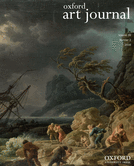 • Introduction | Katie Scott, David Bindman, and Tom Gretton, “Helen Weston ‘in three positions’”
• Denis Diderot, “Regrets on Parting with My Old Dressing Gown,” translated by Kate Tunstall and Katie Scott
• Katie Scott, “The Philosopher’s Room: Diderot’s Regrets on Parting with My Old Dressing Gown“
Regrets on Parting with My Old Dressing Gown recounts the story of Diderot’s internal struggles with affluence and comfort and his attempt to reconcile luxury with the philosopher’s life. This article analyses some of the ways he sought to do this is by attending closely to Regrets’ spatial and material forms. Not things, but relations to things, the article argues, characterised Diderot’s ethics of consumption. It further suggests that the politics of luxury was for Diderot linked to questions not only of property but also of access and that the ancient virtue of hospitality was crucial to his defence of his new ‘revered’ dressing gown and all that it connoted.
• Valerie Mainz, “The Inequalities of Infamy”
The contribution has for focus the etching by Isaak Cruikshank, entitled The Martyr of Equality: Behold the Progress of our System. The critical analysis of the satire conjoins the figurative forms of the visual imagery with its words investigating, in the process, several of the interdependent layers of meaning that can be imputed therefrom. Produced in the days after the execution of the French king Louis XVI, which had taken place on 21 January 1793, this satirical view of the beheading of the monarch shows off the mechanism of the guillotine as a bloody, equalising, killing machine. The central figure of Philippe Égalité, the king’s distant cousin who had voted for the death of the king, is in the guise of the executioner here, but he, too, would be sent to the guillotine on 6 November of the same year.
• David Bindman, “Lost Surfaces: Canova and Colour”
The unremitting whiteness of Canova’s sculptures makes the question of colour seem an odd one to raise in connection with his art, but in fact almost all of them were originally coated or tinted to give a mellowness and a certain realism to the surface of the marble. This raised fundamental questions to do with sculpture’s relationship to painting and to ancient Greece and made the sculptor a controversial figure. He was evidently influenced by his friend and biographer the French theorist Quatremère de Quincy, who published in 1814 a pioneering book demonstrating the use of colour on ancient Greek sculptures.
• Richard Taws, “Conté’s Machines: Drawing, Atmosphere, Erasure”
This article examines the graphic practice of Nicolas-Jacques Conté, an artist, chemist, engineer, and balloonist probably best known for his invention, in 1795, of the modern pencil, synthesising English ‘lead’ rendered unavailable by the naval blockade. Conté, a former pupil of Jean-Baptiste Greuze, subsequently became a key member of the Napoleonic expedition to Egypt. He participated in the production of its most extensive visual document, the monumental Description de l’Égypte, devising an ‘engraving machine’ that facilitated the production of uniform backgrounds for the Description’s plates. With this machine, the cloudless Egyptian skies that populated the large sheets of the Description could be reproduced at speed with minimal opportunity for artistic error, reducing complex atmospheric effects to a simple mechanical process. Tracing the reemergence of Conté’s numerous inventions in subsequent accounts of media change, particularly those that focused on photography, this article examines the ways in which Conté’s work often pivoted on the question of drawing and suggests that his practice asks broader questions of the relationship between technology, vision, and imperialism in the nineteenth century.
• Richard Wrigley, “Unreliable Witness: The Flâneur as Artist and Spectator of Art in Nineteenth-Century Paris”
One of the main reasons for the flâneur’s celebrity in studies of nineteenth-century Paris has been a connection with art and artists. The flâneur has been championed as a model for artists who depict the modern, urban world; this has been allied to assumptions that the flâneur embodies a process of aestheticisation which corresponds to capturing the essence of modernity (and thereby modern art). This article reconsiders such orthodoxy and suggests that a more historicised account of the figure’s origins and meaning. The canonical texts habitually called on to illustrate accounts of the flâneur’s identity (Le Physiologie du flaneur, Baudelaire’s ‘Le Peintre de la vie moderne’ etc.) are reconsidered critically. The article concludes by arguing that a more solidly based history of the flâneur should, firstly, reach back into the early nineteenth century, and secondly, also acknowledge the political character of such independent scrutiny of contemporary Paris, it spaces and social landscape.
• Tom Gretton, “ ‘Un Moyen Puissant de Vulgarisation Artistique’. Reproducing Salon Pictures in Parisian Illustrated Weekly Magazines c. 1860–1895: From Wood Engraving to the Half Tone Screen (and Back)”
L’Illustration and Le Monde illustré, Parisian up-market general-interest weekly illustrated magazines of the Illustrated London News genre published long Salon reviews every year there was a Salon. They also reproduced numbers of Salon pictures each year, in fluctuating (often very large) numbers, in a range of reproductive technologies, and accompanied by textual and presentational clues about what sorts of value the magazine was inviting its reader/viewers to attach to the reproduction: to the painting represented also but in the first instance to the reproduction.
Engaging with recent work by Stephen Bann, this article discusses the ways in which, in these magazines, reproductive wood engravings were aligned with the great tradition of French reproductive intaglio printmaking, and it looks at the impact of the introduction of photomechanical technologies (the line block and the half-tone screen) on the values that were attached to these pictures of Salon pictures. It demonstrates the persistence into the 1890s of the value system of reproductive engraving, and its eventual displacement by the more mechanical efficiencies of the half-tone screened photograph of a work of art. The essay calibrates this displacement with the increasingly compelling demands of the news cycle in relation to the visual reporting of the Salon, and it provides evidence that the half-tone screen, for a decade after its introduction, was a less-than-adequate technology for the reproduction of photographs of works of art, as the evidence of its uptake in the more technologically progressive of these two titles, L’Illustration, demonstrates.
The essay also engages with the debate over “the end of the Salon” (Mainardi). From the evidence of the resources that these magazines devoted not only to writing about but also to reproducing pictures from, the Salon through from the 1860s to the end of the 1890s, the essay argues that, at last for the national-bourgeois audience that was constituted by the wide readership of these two magazines, reports of the Salon’s death have been greatly exaggerated.
• Satish Padiyar, “Proust and Old Time: On ‘Chardin’ and ‘Watteau’”
Before Marcel Proust began working on his masterpiece À la Recherche du temps perdu, he had an idea to be an art critic. His youthful essay “Chardin” (1895) constitutes his first important piece of art criticism. Approaching Chardin’s work ‘philosophically’, Proust’s essay draws from the old painter’s work significant ideas about the affective life of objects, the pathos of interiors and interiority, and the shattering of the frame separating museum art from modern life. My essay argues that Chardin’s painting offered young Proust a significant new ‘way’ to begin to approach the ‘involuntary memory’ of Recherche, one that he delineates through his essay’s quasi-Platonic structure. Proust’s later incomplete essay on Watteau shifts his art writing into a more subjective mode; the early ‘art’ Proust becoming before our eyes the later genre-abolishing one.
Art History, April 2016
The eighteenth century in the latest issue of Art History (the entire issue looks extraordinary). . .
Art History 39 (April 2016), special issue dedicated to Art and Technology in Early Modern Europe, edited by Richard Taws and Genevieve Warwick.
 • Genevieve Warwick and Richard Taws, “After Prometheus: Art and Technology in Early Modern Europe,” pp. 198–209.
• Etienne Jollet, “The Monument to Louis XIV at the Place Vendôme (1699) as a Technical Achievement: A Question of Interest,” pp. 318–39.
• Hanneke Grootenboer, “A Clock Picture as a Philosophical Experiment: The Tableau Mécanique in the Physics Cabinet of Bonnier de la Mosson,” pp. 340–55.
• Bryan J. Wolf, “Of Air Pumps and Teapots: Joseph Wright of Derby, John Singleton Copley and the Technology of Seeing,” pp. 356–75.
• Ann Bermingham, “Technologies of Illusion: De Loutherbourg’s Eidophusikon in Eighteenth-Century London,” pp. 376–99.
• Richard Taws, “Telegraphic Images in Post-Revolutionary France,” pp. 400–21.
• Barbara Maria Stafford, “Seizing Attention: Devices and Desires,” pp. 422–27.
Aaron Wile Awarded the 2015–16 James Clifford Prize

Jean-Antoine Watteau, Le rendez-vous de chasse, ca. 1717–18, oil on canvas, 124.5 × 189 cm
(London: The Wallace Collection)
◊ ◊ ◊ ◊ ◊
As noted at CAA News (15 March 2016) . . .
Aaron M. Wile is the winner of the 2015–16 James L. Clifford Prize. The prize is awarded annually by the American Society for Eighteenth-Century Studies to the author of the best article regarding any aspect of eighteenth-century culture. Receiving the award is Wile’s “Watteau, Reverie, and Selfhood,” published by College Art Association in The Art Bulletin.
The Clifford Fund was originally established to support an annual prize in honor of James L. Clifford. Clifford founded The Johnsonian News Letter in 1940, was Secretary to the English Institute, twice a Guggenheim Fellow, a Fellow of the Royal Society of Literature, and third President of the American Society for Eighteenth-Century Studies. During his long and energetic life, he produced numerous books, articles, bibliographies, essays, edited collections, editions and, of course, the much beloved, imitated, and quoted Johnsonian News Letter. Accordingly, the Clifford Prize is awarded to the author of the best article on an eighteenth-century subject, interesting to any eighteenth-century specialist, regardless of discipline.
The American Society for Eighteenth-Century Studies is a non-profit, educational group founded to promote the study of all aspects of the eighteenth century. It sponsors conferences, awards, fellowships and prizes, and publishes Eighteenth-Century Studies and Studies in Eighteenth-Century Culture. Requests for information about the Clifford Prize and nominations may be addressed to: asecs@wfu.edu.
Aaron M. Wile, “Watteau, Reverie, and Selfhood,” The Art Bulletin 96 (September 2014): 319–37.
Watteau’s fêtes galantes break with key aspects of academic art theory in early eighteenth-century France—particularly as put forward by Roger de Piles—to elicit an experience of reverie in the spectator. Watteau’s formal innovations inaugurated a new relationship between painting and beholder that opened up a new sphere of subjective experience, linking the artist’s enterprise with the rise of modern interiority.
The article is available free to everyone through the Taylor & Francis website, until 30 June 2016.
Heather McPherson Awarded the 2016 Annibel Jenkins Prize
Heather McPherson is the 2016 recipient of the Annibel Jenkins Prize presented annually by the Southeastern American Society for Eighteenth-Century Studies for the best essay in performance and theatre studies, for her article “Tragic Pallor and Siddons,” published in Eighteenth-Century Studies 48 (Summer 2015): 479–502.
The committee’s remarks highlight the range of topics addressed, “topics as disparate as cosmetics’ association with misogyny, authenticity, Aristotle, Lady Macbeth, and the ‘tubercular look’.” The citation goes on to state that, “the essay provides us with a window into Siddons’s celebrity and the attributes that led her contemporaries to recognize her as the greatest tragic actor of her day. ‘Tragic Pallor and Siddons’ combines … close attention to textual detail, an immersion in the documented history of the period, and clear and lucid writing enhanced by judicious illustrations.”
Journal18, #1 Multilayered (Spring 2016)
The inaugural issue of J18 is now available!
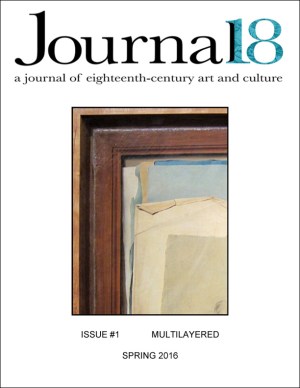 Journal18, #1 Multilayered (Spring 2016)
A R T I C L E S
• David Pullins, “Stubbs, Vernet & Boucher Share a Canvas: Workshops, Authorship & the Status of Painting”
• Charlotte Guichard, “Scratched Surfaces: Artists’ Graffiti in Eighteenth-Century Rome”
• Kristel Smentek, “China and Greco-Roman Antiquity: Overture to a Study of the Vase in Eighteenth-Century France”
• Dipti Khera, “Marginal, Mobile, Multilayered: Painted Invitation Letters as Bazaar Objects in Early Modern India”
Art history’s material turn, informed by anthropology, material culture, and consumption studies, has prompted new interest in both the physicality and the social lives of artworks. Examining the ways that eighteenth-century art objects were produced, transported, and transformed helps us to understand how they were perceived and reimagined in different cultural and temporal contexts. In the workshops and collective spaces of artistic design and manufacture, objects became the creative products of many minds and many hands, simultaneously and successively. Likewise in their afterlives as commodities and possessions, objects were continually altered through use and re-use, each transaction constituting a reframing—sometimes literal—as objects inhabited new settings or were subjected to damage, aging, or rejuvenation.
This inaugural issue of Journal18 explores the multilayered nature of eighteenth-century art. Our focus is on artworks that bear traces of multiple hands as a result of workshop production, cross-cultural exchange, re-use, restoration, vandalism, or other factors. Among the questions considered are: who were the many people involved in art’s production and reproduction (artists, collectors, scholars, dealers, handlers, and restorers)? How were eighteenth-century artworks made, re-purposed, transported, and conserved? How were they translated across media as well as across time, space, and culture? And what is the creative effect of non-creative acts like accidents or defacement? By taking a ‘multilayered’ approach, the articles in this issue not only reexamine traditional art-historical categories—such as style, originality, or authorship—but also encourage new methodological perspectives and find new meaning in the materiality of art objects.
N O T E S & Q U E R I E S
Woven Gold: Tapestries of Louis XIV – by Robert Wellington
Qing Encounters – by Craig Clunas
A Lacquered Past: The Making of Asian Art in the Americas – by Sylvia Houghteling
Castiglione and China: Marking Anniversaries – by Kristina Kleutghen
A Digitally Usable Period Room – by Anne Higonnet
Ornamenting Louis XIV – by Sarah Grant
Pastel will Travel. Liotard at the Royal Academy – by Francesca Whitlum-Cooper
Ceci n’est pas un portrait: A Curator’s Diary – by Melissa Percival
China in Wonderland – by Michelle Wang
Shock Dog! New Sculpture at the Met – by Paris Amanda Spies-Gans
Issue Editors
Noémie Etienne, Getty Research Institute, Los Angeles
Meredith Martin, NYU and Institute of Fine Arts
Hannah Williams, Queen Mary University of London
Cover image: Detail of Louis-Léopold Boilly, Trompe l’œil, ca. 1804–07. Source: Wikimedia Commons.
The British Art Journal (Winter 2015/16)
Items pertaining to the eighteenth century in the current issue:
The British Art Journal 16 (Winter 2015/16)
• Editorial: William MB Berger Prize for British Art History 2015 Winner: William Pressly, James Barry’s Murals at the Royal Society of Arts: Envisioning a New Public Art (2014).
• Romana Sammern, “Woman in Bed by Matthew William Peters (1742–1814): Titian, Reynolds, and Painted Revenge”
• M. T. W. Payne and J. E. Payne “Samuel Collings (d. 1810) and the Manifestation of ‘Annibal Scratch'”
• Neil Jeffares, “Francis Cotes (1726–1770) and His Family”
• Katherine McHale, “George Vertue and the Case of the Counterfeit Paintings: Rescuing the Reputations of Sebastiano Ricci (1659–1734) and Niccolo Cassana (1659–1713)”
• Alex Seltzer, “Catesby’s Conundrums: Mixing Representation with Metaphor”
• Peter S. Forsaith “‘A Far Greater Genius Than Sir Joshua’: Did Joshua Reynolds (1723–1789) Paint John Wesley (1703–1791)?”
• Charles S. Ellis, Review of Giulia Coco, Artisti, dilettanti e mercanti d’arte nel salotto fiorentino di sir Horace Mann (2014).
British Art Studies, Autumn 2015
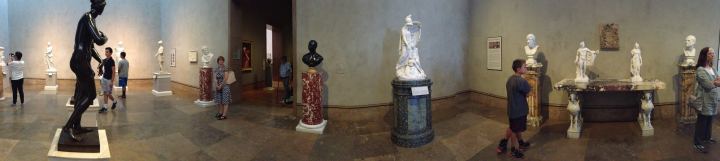
Ken Gonzales-Day, Panorama of Museum West Pavilion, 2015, chromogenic print, 20.32 x 99 cm, taken in the West Pavilion, J. Paul Getty Museum, Los Angeles, ©Ken Gonzales-Day.
◊ ◊ ◊ ◊ ◊
British Art Studies recently launched with an impressive premier issue and an exemplary commitment to free and open access, as detailed in the initial issue’s editorial statement. Congratulations! –CH
British Art Studies is free and open access: there are no subscriptions, no passwords, and no fees to pay. All content will be preserved as a free-to-use resource. The ethos of open access is one that YCBA and PMC have adopted for all their digital efforts, in the recognition that conventional proprietary models represent a major obstacle to scholarship. It is published under a Creative Commons CC BY-NC licence, meaning that you are free to share and re-use its contents for non-commercial purposes, provided that appropriate credit is given to the author/s. No permissions are needed. . . .
◊ ◊ ◊ ◊ ◊
The eighteenth century in BAS 1:
British Art Studies 1 (Autumn 2015)
Conversation Piece coordinated by Richard Johns, “There’s No Such Thing as British Art.”
‘Conversation Piece’ is a British Art Studies series that draws together a group of contributors to respond to an idea, provocation or question. The conversation will develop as more respondents enter the debate. Readers can also join in by adding a response.

Thomas Gainsborough, Charity Relieving Distress, ca. 1784, oil on canvas, 127.6 x 102.2 cm (Indianapolis Museum of Art).
Georgina Cole, “ ‘A Beautiful Assemblage of an Interesting Nature’: Gainsborough’s Charity Relieving Distress and the Reconciliation of High and Low Art.”
In the competitive environment of the eighteenth-century London art scene, Thomas Gainsborough and Sir Joshua Reynolds were often perceived as great rivals. While they shared patrons, sitters, and a stake in the future of British art, their differing artistic approaches caused considerable friction, indeed Gainsborough seceded from the Royal Academy of Art in 1784, boycotting its exhibitions and activities. This essay, however, argues that Gainsborough’s Charity Relieving Distress, painted in the year of his secession, proposes a charitable resolution of their aesthetic attitudes. The complex interrelation of allegorical and anecdotal form is interpreted as a pictorial attempt to reconcile their approaches through the concept of charity, a virtue of powerful artistic lineage in the western tradition, and of contemporary social importance.
Cyra Levenson and Chi-ming Yang, with a photo-essay by Ken Gonzales-Day, “Haptic Blackness: The Double Life of an 18th-Century Bust.”
‘One Object’ is a British Art Studies series that uses an object from a collection as a starting point for collaborative research. Cyra Levenson and Chi-ming Yang have co-authored this essay which is followed by a photo-essay by artist Ken Gonzales-Day and an interview between him and the authors.
The Burlington Magazine, November 2015
The eighteenth century in The Burlington:
The Burlington Magazine 157 (November 2015)

Interior of the Church of Santiago de Surco, Lima, Peru, attributed by Gauvin Alexander Bailey to Johann Rehr and Santiago Rosales, before 1759–1773.
A R T I C L E S
• Gauvin Alexander Bailey, “The Fantastical Rococo Altarpieces of Santiago de Surco, Peru,” pp. 769–75.
R E V I E W S
• Simon Swynfen Jervis, Review of Giuseppe Beretti and Alvar González-Palacios, Giuseppe Maggiolini: Catalogo ragionato dei disegni (In Limine, 2014) and Michael Sulzbacher, Peter Atzig, Sabine Schneider, and Karsten Hommel, Friedrich Gottlob Hoffmann (Grassi Museum, 2014), pp. 790–91.
• David Bindman, Review of William Pressly, James Barry’s Murals at the Royal Society of Arts: Envisioning a New Public Art (Cork University Press, 2014), pp. 791–92.
• Richard Green, Review of Christopher Wright, The Schorr Collection of Old Master and Nineteenth-Century Paintings (The Schorr Collection, 2014), pp. 792–93.
• David Pullins, Review of Carolyn Weekley, Painters and Paintings in the Early American South (Yale University Press, 2013), p. 795.










leave a comment